Igniting a Love of Art

Originally published in the spring 2010 issue of Santa Barbara SEASONS magazine.

Originally published in the spring 2010 issue of Santa Barbara SEASONS magazine.

“The arts support learning in academic subject areas by helping children develop higher-level thinking skills like imagination, problem solving and collaboration.”
—Kathy Koury

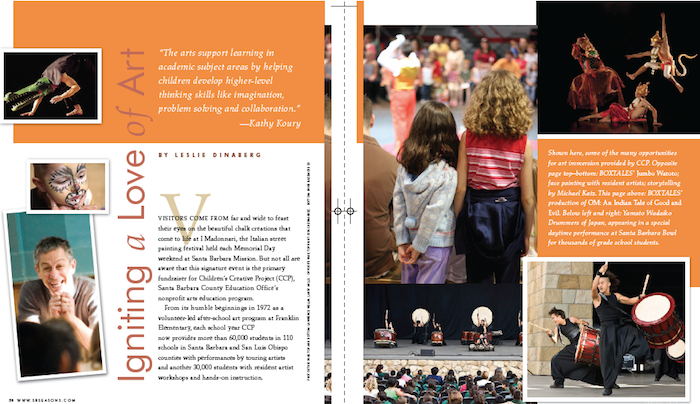
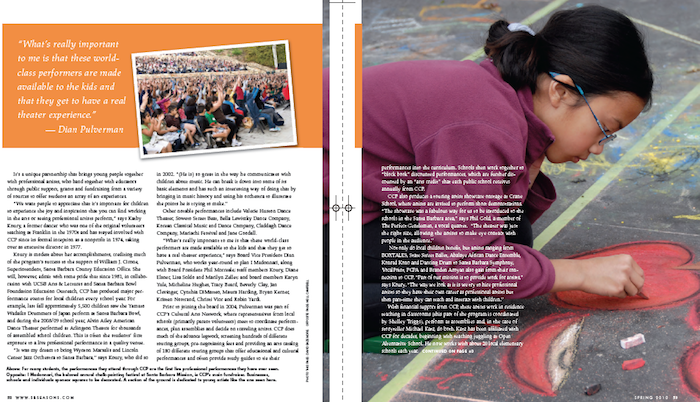
VISITORS COME FROM far and wide to feast their eyes on the beautiful chalk creations that come to life at I Madonnari, the Italian street painting festival held each Memorial Day
weekend at Santa Barbara Mission. But not all are aware that this signature event is the primary fundraiser for Children’s Creative Project (CCP), Santa Barbara County Education Office’s nonprofit arts education program.

From its humble beginnings in 1972 as a volunteer-led after-school art program at Franklin
Elementary, each school year CCP now provides more than 60,000 students in 110 schools in Santa Barbara and San Luis Obispo counties with performances by touring artists and another 30,000 students with resident artist workshops and hands-on instruction.
Originally published in the spring 2010 issue of Santa Barbara SEASONS magazine.

Originally published in the spring 2010 issue of Santa Barbara SEASONS magazine.

“What’s really important to me is that these world class performers are made available to the kids and that they get to have a real theater experience.”

— Dian Pulverman

It’s a unique partnership that brings young people together with professional artists, who band together with educators through public support, grants and fundraising from a variety of sources to offer students an array of art experiences.

“We want people to appreciate that it’s important for children to experience the joy and inspiration that you can find working in the arts or seeing professional artists perform,” says Kathy Koury, a former dancer who was one of the original volunteers teaching at Franklin in the 1970s and has stayed involved with CCP since its formal inception as a nonprofit in 1974, taking over as executive director in 1977.

Koury is modest about her accomplishments, crediting much of the program’s success to the support of William J. Cirone, Superintendent, Santa Barbara County Education Office. She will, however, admit with some pride that since 1981, in collaboration with UCSB Arts & Lectures and Santa Barbara Bowl Foundation Education Outreach, CCP has produced major performance events for local children every school year. For example, last fall approximately 5,500 children saw the Yamato Wadaiko Drummers of Japan perform at Santa Barbara Bowl, and during the 2008/09 school year, Alvin Ailey American Dance Theater performed at Arlington Theatre for thousands of assembled school children. This is often the students’ first exposure to a live professional performance in a quality venue.

“It was my dream to bring Wynton Marsalis and Lincoln Center Jazz Orchestra to Santa Barbara,” says Koury, who did so in 2002. “(He is) so great in the way he communicates with children about music. He can break it down into some of its basic elements and has such an interesting way of doing that by bringing in music history and using his orchestra to illustrate the points he is trying to make.”
Originally published in the spring 2010 issue of Santa Barbara SEASONS magazine.

Originally published in the spring 2010 issue of Santa Barbara SEASONS magazine.

Other notable performances include Valerie Huston Dance Theater, Soweto Street Beat, Bella Lewitzky Dance Company, Korean Classical Music and Dance Company, Claddagh Dance Company, Mariachi Festival and Jane Goodall.

“What’s really important to me is that these world-class performers are made available to the kids and that they get to have a real theater experience,” says Board Vice President Dian Pulverman, who works year-round to plan I Madonnari, along with Board President Phil Morreale; staff members Koury, Diane Elsner, Lisa Soldo and Marilyn Zellet; and board members Karyn Yule, Micheline Hughes, Tracy Beard, Beverly Clay, Jan Clevinger, Cynthia DiMatteo, Maura Harding, Bryan Kerner, Kristen Nostrand, Christi Vior and Robin Yardi.

Prior to joining the board in 2004, Pulverman was part of CCP’s Cultural Arts Network, where representatives from local schools (primarily parent volunteers) meet to coordinate performances, plan assemblies and decide on traveling artists. CCP does much of the advance legwork, screening hundreds of different touring groups, pre-negotiating fees and providing an arts catalog of 180 different touring groups that offer educational and cultural performances and often provide study guides to tie their performances into the curriculum. Schools then work together to “block book” discounted performances, which are further discounted by an “arts credit” that each public school receives annually from CCP.

CCP also produces a touring artist showcase onstage at Crane School, where artists are invited to perform short demonstrations.

“The showcase was a fabulous way for us to be introduced to the schools in the Santa Barbara area,” says Phil Gold, a member of The Perfect Gentlemen, a vocal quartet. “The theater was just the right size, allowing the artists to make eye contact with people in the audience.”

Not only do local children benefit, but artists ranging from BOXTALES, State Street Ballet, Abalaye African Dance Ensemble, Konrad Kono and Dancing Drum to Santa Barbara Symphony, VocalPoint, PCPA and Branden Aroyan also gain from their connection to CCP.

“Part of our mission is to provide work for artists,” says Koury. “The way we look at it is we try to hire professional artists so they have their own career as professional artists but then part-time they can teach and interact with children.”

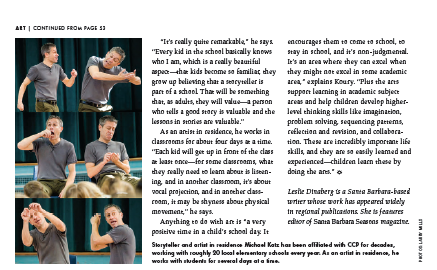
With financial support from CCP, these artists work in residence teaching in classrooms (this part of the program is coordinated by Shelley Triggs), perform at assemblies and, in the case of storyteller Michael Katz, do both. Katz has been affiliated with CCP for decades, beginning with teaching juggling at Open Alternative School. He now works with about 20 local elementary schools each year. “It’s really quite remarkable,” he says. “Every kid in the school basically knows who I am, which is a really beautiful aspect—that kids become so familiar, they grow up believing that a storyteller is part of a school. That will be something that, as adults, they will value—a person who tells a good story is valuable and the lessons in stories are valuable.”

As an artist in residence, he works in classrooms for about four days at a time. “Each kid will get up in front of the class at least once—for some classrooms, what they really need to learn about is listening, and in another classroom, it’s about vocal projection, and in another classroom, it may be shyness about physical movement,” he says.

Anything to do with art is “a very positive time in a child’s school day. It encourages them to come to school, to stay in school, and it’s non-judgmental. It’s an area where they can excel when they might not excel in some academic area,” explains Koury. “Plus the arts
support learning in academic subject areas and help children develop higher level thinking skills like imagination, problem solving, sequencing patterns, reflection and revision, and collaboration. These are incredibly important life skills, and they are so easily learned and
experienced—children learn these by doing the arts.”

Santa Barbara Seasons Spring 2010 coverOriginally published in the spring 2010 issue of Santa Barbara Seasons Magazine.

To read the story as it originally appeared in print click here: Spring 2010 childrens creative project
Noozhawk Talks: Leslie Dinaberg Sits Down With Colette Hadley

Colette Hadley’s Commitment to Education Is All About Opportunity

For Scholarship Foundation of Santa Barbara director, the future begins now for the students she aims to help

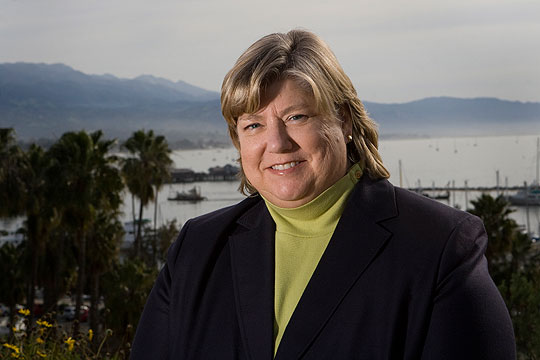
Colette Hadley, Noozhawk photo

Colette Hadley, Noozhawk photo

The Scholarship Foundation of Santa Barbara’s services are needed now more than ever as the rising costs of college mean more and more families are looking for financial aid to help afford the expense.
Noozhawk’s Leslie Dinaberg caught up with executive director Colette Hadley to talk about her life, work and what it’s like to help students and their families pursue their educational dreams.

Leslie Dinaberg: How long have you been at the Scholarship
Foundation of Santa Barbara?

Colette Hadley: Seventeen years. I started here when I was 30
and I’m 47. The foundation and I, funnily enough, were born on the same day. May
29, 1962 was the first meeting of the scholarship foundation and that’s the same day
I was born.

LD: Fate.

CH: I like to think of that a little bit as the kinship between us.
I’ve been here a long time. I started out doing, interestingly enough, some event
management and then within a year moved into program management. We were
just a tiny group, there were like four employees. We’re still small but we were
really small.

LD: Did you come to Santa Barbara to do that or were you
already here?

CH: I’m a pretty planned person in life. … I actually had worked
at the University of California at the Irvine campus and then a little bit at the UCLA campus in student affairs, and I was just kind of looking for a change. … I really liked higher
education, working with students, but I really wanted to see more of the results of
what I was doing. I wanted to be a little more hands on. I loved my work there but …
I felt like I was like kind of a cog in a big university, which I was, so I wanted to do
something smaller. I specifically said I’m going to look for an educationally related
job, most likely a nonprofit.

… I had a friend from college living in Santa Barbara and we had kept in close touch.
She said, “why don’t you come check out Santa Barbara and stay with me for a
couple of weeks.” This was in 1992 and I said “there are no jobs in Santa Barbara,
everybody knows there are no jobs in Santa Barbara, and so I’ll just come and sit on
a beach.”

LD: And you found the job through a tiny newspaper ad.

CH: I sent them my resume and they called me. … I had this
interview scheduled at the University Club and they really hadn’t told me much about it. So I go into this little room at the University Club and there are eight people in this room and I’m thinking I was just going for a one-on-one interview. I go in, I just shook the sand out of my sandals and pulled on a skirt and put on a jacket … and I walked in this room and it was full
of very warm, smiling people. … I’m looking at people who are just big circles of
warmth. … So I sit down and they’re like we’re so glad to meet you and we’re so
excited and tell us about this and tell us about that and we just sat and had a
conversation and I just instantly liked them.

… I had been home five minutes and the phone rang and it’s Billie Mans (former
executive director) and she goes, “we loved you!” Nobody does that. They say, “Oh
we’d like you to come back for a second interview.” She’s like “we loved you come
back again. We want you to meet some more board members.”

So I go back again. I’m thinking geez these people really care. They have all these
board members and the staff and they really care.

LD: What a change from a huge university. Not that they don’t
care, but there are just so many layers.

CH: Basically I went back and they offered me a job. … I had to
decide whether I wanted to take a pretty significant pay cut. But the gut was I would
enjoy working with these people. We had nothing written down or anything but
they said I’m telling you within three years you’ll be back to what you were making
and beyond that. And we promise that if you decide you want to be here and you’re
committed and you do this job that we will be here for you and I just trusted them
and they did that.

LD: That’s great.

CH: Good people. So I had good mentoring with Billie and we
kind of grew along together and good mentoring with the board and you know since
that time we’ve been that way, 17 years later, and that’s why I’m still here.

LD: When did you become the executive director?

CH: Four years ago. I worked as the program director for quite a
long time and then as the associate director. … I’m very fortunate. I still think I have
probably the best job in town. Maybe me or Ron Gallo
(executive director of the Santa Barbara Foundation), I’m not sure. Maybe me.
(Laughs)

LD: There are a lot of similarities actually.

CH: Yeah. He’s got a great board and we actually share some
people on the boards, so for me that’s the fun though. It’s great students and parents
and great board members and great staff but also really we have great donors. … It’s
something that keeps me very connected to my work.

LD: That’s great. Are most of the big supporters people who were
scholarship students at one point?

CH: Excellent question. I would say that at least half of them.
They all have a personal story … Some people have also said the opposite: they grew
up with a supportive family environment and they had the resources to send me to
college and they went to a phenomenal university and have then gone on to achieve
quite a bit in their life and then said you know what, I am really aware that there are
people out there that did not have that and it’s not an equal playing field. And so it’s
my obligation to help, that’s an attitude we run into, besides the people that say oh
yes, I couldn’t have gone if I didn’t have a scholarship.

… The stories are amazing and some of them you don’t know until years go by, and
you don’t know. So yes, that’s part of it too. I think it doesn’t matter what nonprofit
you work with or what you do. It’s about the stories. It’s about that. You probably
find that in your work too.

LD: Oh yes, it’s about the stories for sure.

CH: It’s the same thing with the parents of students, it’s their
stories, that’s really what it’s about is that connection. That’s why introducing
students or having them speak at something or tell their story, we can all find some
connection there.

LD: So is it tougher to get into college now?

CH: I will give you the stats I know. Basically the peak of the baby
boomlet, the kids of the baby boomers, was really this last year, so in sheer numbers
competing for seats, the peak was last year. It’s still high right now but it will start to
diminish. … Santa Barbara County, especially in the south county, our population of
high school seniors will start to slowly go down and so that’s happening all over the
country a little bit. So they will actually have a little less competition for seats in the
next couple of years.

However, what has offset that because we have such a bad budget situation is that
last year all of the UC’s and Cal States cut off spring transfers from community
colleges and they are all ratcheting back. Not only have they raised the fees almost
35 percent in 12 months but they also are ratcheting back the sizes of their classes
slowly. In terms of their enrollment management techniques, they are going to start
using wait lists this year at the UC’s, which is very tricky and very stressful. But yes
it’s actually for different reasons going to be just as challenging for the next couple
of years, but for different reasons.

LD: When you say ratcheting back the size of their classes do you
mean the freshman class?

CH: Yes, the number that will go through. That’s the UC’s and Cal
States. Private and independent institutions are actually right now-not the
Stanfords and the Ivies but the others-are actually a tiny bit more expansive right
now because there are students in the past year and a half particularly that have
turned away from those institutions, not because they don’t love them, but because
of the high cost … Community colleges of course are being hit by a tsunami of
students and all of them are cutting their sections. … With our student scholarship
recipients the program staff will tell you the number of students begging for
forbearance because they can’t get 12 units, they’re lucky if they get 11. They’re not
trying to get in, people think oh they don’t want to get an 8 o’clock class, they’re
trying to get anything. Any class.

… Even a few years ago they had a little more flexibility but now with calculus and
all of these things boom, you don’t get into it in the fall, you’re going to have to wait
a year. So that’s what’s affecting the students and it’s been dramatic. It has not been
a gradual change. It’s been huge this year and it’s going to get worse next year.

So getting in, still challenging. Staying in, getting what you need is probably the most
challenging that it’s ever been.

LD: That’s too bad.

CH: Yes, it is. When I hear the governor say and I believe this, he
actually came in touting education as his number one issue. I have mixed feelings
about him, as a lot of people do, but I actually believe personally it is a priority of his
but I just think that it’s just not the way our state is working right now. It’s just not
the way it is. We have a legislature that can’t agree on anything and he doesn’t really
have a lot of power with that. They are not putting education first.

LD: It’s so frustrating.

CH: It is. I think everybody is tired of that with our U.S. Congress
as well. … When I talk to colleagues who are running programs in Ohio and Virginia
and other places, everybody’s got something going on that’s affecting them.

LD: It’s nice to have those people to bounce ideas around with.

CH: … The beauty of being in an educational nonprofit is
whatever your politics are, and we have a large board, 40 people on our board, so I
spend a lot of time working with our board. But it doesn’t matter someone’s political
background. You can have people on your board that are on different ends of the
political spectrum, completely different ends, but providing educational
opportunities is a place where a lot of people come together. It’s a very cohesive
thing. Something that people rally around is helping students. Which is very much,
again, a positive feature of being here. I enjoy talking to those people of all different
opinions and backgrounds. I think that as tough as it is sometimes-and the last
year was tough, really tough-it’s pretty much relentlessly positive work.

LD: That’s really nice and probably why you’ve been able to be
here for the length of time that you have been.

CH: I totally agree. It’s must more challenging to be someplace
like our colleagues next door, we sublease part of our building to the Arthritis
Foundation. A great cause and yet it’s a longer-term goal. A scholarship, here’s a kid
you give them a scholarship they tell you what happened and they got their degree.

LD: That’s nice. So what else do you do when you’re not
working?

CH: I’m big with books, so books, films; current events are big,
big, big for me. I read a lot of newspapers; … my family and my friends are a big part
of my life.

… I love talking. I don’t love arguing about current events but I like just talking about
what’s happening with people and I like to be around people that are engaged and if
they say “I don’t read a newspaper” they might be a really great person, but they’re
probably not going to be in my close, everyday network. I love the beach and I really
love California. I just like the different parts of the state. I like the mountains, I love
the beach … When you take a walk down at Ledbetter beach, there is no place you
can turn, 360 degrees, that you don’t see something of great beauty.

LD: That’s okay. If you could be invisible anywhere, where would
you go and what would you do?

CH: Oval office probably in the White House … I just think of that
process of what goes on in that office and how decisions are made. … I can’t imagine
the weight that person feels on their shoulders. There are days I feel it here and I’m
responsible for just this agency and the employees and students we’re responsible
to and the donors we’re responsible and then I think oh my God, can you imagine
being the president of the United States or somebody who really has
responsibilities, not just somebody running a little agency.

… Or maybe the International Space Station, I would pick that one too. Of course I
wouldn’t have to be invisible just to see what’s happening.

Vital Stats: Colette Hadley

Born: May 29, 1962, in Spokane Washington

Family: “I have six brothers and sisters and then a stepbrother
and a stepsister, so 9 kids in my family. They’re my favorite people. My mom died in
1980 and my dad is 83 and he is remarried to my step mom, she’s great.”

Civic Involvement: Planned Parenthood, CASA, Big Brothers, Big
Sisters and Cal Soap.

Professional Accomplishments: “As executive director of the
Scholarship Foundation of Santa Barbara I’m just doing my best to run the agency as
best I can and to do it with integrity and efficiency. And to try and take good care of
our clients and our donors and our staff and our board and try and juggle all of those
at the same time.”

Best Book You’ve Read Recently:Island: The Complete Stories” by Alistair
MacLeod.

Favorite Local Spot: Ledbetter Beach, Arigato, Arnoldi’s or
Shalhoob’s.

Little-Known Fact: “I would secretly like to have a radio show.”


Originally published in Noozhawk on March 8, 2010. Read the article on that site here.

Giving Back: The Hutton Foundation

logo_hpOne of the biggest obstacles facing local nonprofits is the high price of real estate in Santa Barbara. Luckily Hutton Foundation is helping to fill that gap.

One of Hutton Foundation’s most significant efforts is its Under One Roof program, through which more than 30 local nonprofit organizations are housed in 12 Hutton Foundation-owned and managed properties. “One of the things local nonprofits struggled with the most was finding high-quality, affordable office space,” explains Pam Hamlin, the foundation’s executive director. Hutton Foundation rents the buildings to nonprofits at far below market rates and signs 10-year leases to help give organizations financial stability.

The organizations sharing space run the gamut, from Community Environmental Council to Santa Barbara International Film Festival, United Girls & Boys Club, Alzheimer’s Association and Camerata Pacifica, to name just a few.

The foundation’s broad areas of interest are a reflection of its president, Tom Parker, a Santa Barbara native who returned to town 12 years ago to start the Hutton Foundation, after serving as president of Hutton Companies-one of Southern California’s leading real estate developers-from 1985 to 1995.

“It’s my fault,” says Parker, with a twinkle in his eye. “What happened to me was I was doing grants and I thought, Here’s the homeless shelter, there’s someone who is hungry that needs help, here is an arts organization that is opening children’s minds to music and art and things that will make their life so much better. Who do I donate to? How do I value the two? I realized I couldn’t.”

Consequently, last year Hutton Foundation gave away $4.4 million in grants, donations and assistance to more than 100 local nonprofit organizations.

“We want to be in this community to help the process, to help nonprofits be more effective no matter what their mission-so long as it’s a mission that makes sense,” Parker says.

One thing that made sense, not just to Hutton Foundation but also to the Orfalea and Bower Foundations, was grouping services together to help children arrive in kindergarten better prepared to learn. The three groups are collaborating on an early childhood education and family resource center in Carpinteria. Opening in January at the former site of Main Elementary School, with a Community Action Commission/Head Start preschool at its core, this project represents the next evolution of Hutton Foundation. The foundation also recently made a deal to purchase the former Washington Mutual Bank building in downtown Santa Barbara, and is now evaluating which type of collaborative center will best serve the community.

Parker expected he would be semi-retired when he started Hutton Foundation, but he admits that when a great opportunity comes along he just can’t help himself. “The nonprofit sector intrigues me because there’s so much to be done,” he says. “You can really make a difference in this community.”

Originally published in Santa Barbara Magazine

Citizen Scientists: Santa Barbara Channelkeeper

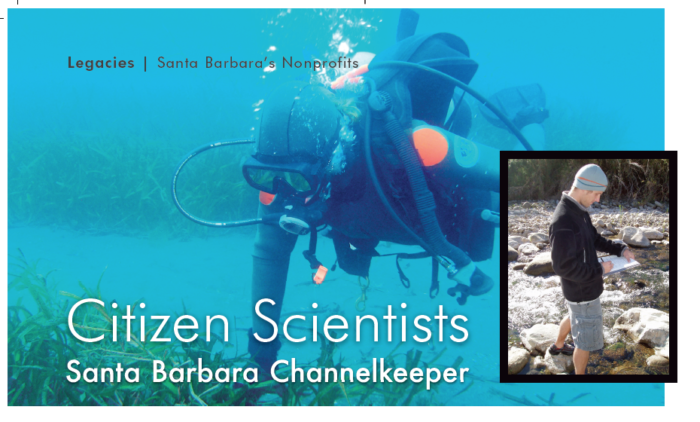
Left–right: A diver maps eelgrass habitat as part of Channelkeeper’s Marine Monitoring and Restoration Program. Watershed program director Ben Pitterle collects data on water pollution levels. Photos courtesy Santa Barbara Channelkeeper, originally published in Santa Barbara Seasons, Summer 2009.

Left–right: A diver maps eelgrass habitat as part of Channelkeeper’s Marine Monitoring and Restoration Program. Watershed program director Ben Pitterle collects data on water pollution levels. Photos courtesy Santa Barbara Channelkeeper, originally published in Santa Barbara Seasons, Summer 2009.

PEOPLE SAY WE’RE ONE OF THE best-kept secrets in town,” says Kira Redmond, executive director of Santa Barbara Channelkeeper. She may be right—but not for long.

Started as an Environmental Defense Center program in 1999, Channelkeeper is now an independent nonprofit, as well as part of one of the fastest growing grassroots environmental movements in the world: International Waterkeeper Alliance.

With just six and a half staff members, buttressed by an army of citizen scientist
volunteers, Channelkeeper works to protect and restore the Santa Barbara Channel and watersheds in a variety of ways, including water quality monitoring, education and community outreach, political advocacy and marine habitat restoration. Perhaps what is most unique about Channelkeeper is that its volunteers work out in the field.

“The field work is kind of what sets us apart,” says Redmond. “We work closely with groups like Environmental Defense Center, Surfrider and Heal the Ocean, but they are advocacy and public education focused. We work with them on a lot of issues, but as far as being out in the field and identifying pollution problems in the creeks or doing habitat monitoring in the channel, there really aren’t other environmental nonprofits that do that.”

Grassroots programs such as “Grunion Greeters” (where volunteers monitor grunion behavior on local beaches during spawning season) and “Stream Teams” (a volunteer-based water quality-monitoring program at the Goleta Slough watershed and the Ventura River) fall under the leadership of Ben Pitterle, watershed programs director.

The grunion program, which is part of a larger study being conducted at Pepperdine University, “is one of the best family-oriented volunteer opportunities I think we have,” says Pitterle. “I did Carpinteria State Beach last summer, and it’s really cool because of the campers. There are just all kinds of kids out playing. It’s fun, a family fun event. I think this is going to be our fifth or sixth year coordinating for this region . . .We get a lot of people who don’t otherwise participate in some of our water quality volunteer opportunities, so
it’s a good way to reach out to a broader group of people—especially kids.”

The “Stream Team,” operating since 2001, has a core group of volunteers. “We go out once a month to collect water samples,” Pitterle explains. “We do that with a few different purposes. One is to collect a baseline of water data to monitor over time to see if things are getting better or worse. Another reason is it’s a great way to reach out to the public, educate and to reach out to the public, educate and train them about watersheds, and help them to become environmental stewards themselves. The third is that looking at
the data helps us identify actual problems, and then we can relay that information to
different public agencies who are responsible for regulating water problems to try to get them fixed.”

Working with public agencies is a big part of what Channelkeeper does. When
budget cuts forced the county to stop its marine monitoring program this past fall,
Channelkeeper rallied its supporters and pitched in thousands of dollars to continue
this important warning service system for surfers, swimmers and beachgoers at 12 county beaches. Santa Barbara city officials also helped pick up the slack by testing at four additional locations.

In addition to partnering with county and city officials, Channelkeeper works closely with researchers at UCSB and Channel Islands Marine Sanctuary, and is collaborating with the state to implement a Marine Life Protection Act that will create a network of marine protected areas or underwater parks along the entire California coast.

“In the work that we do in the field, we work with agencies that don’t have the resources to be everywhere themselves,” says Redmond. “For instance, the city of Santa Barbara has two code enforcement staff. So they’re out there like we are, looking at businesses that might have a high potential to pollute and checking up on them. But they can’t
be everywhere at once, so with budget cuts our role is becoming increasingly important. We have really good relationships with people at these agencies, Basically, they’re grateful to us for helping them do their jobs.”

For more information about Santa Barbara Channelkeeper, call 805/563-3377 or visit www.sbck.org.
n Santa Barbara Seasons Summer 2009.

Originally published in Santa Barbara Seasons Summer 2009. Click below to read the story as it appeared in print.

SB Seasons Summer 2009

Legacies: Community Counseling & Education Center

Celebrating 25 Years of Service

By Leslie Dinaberg


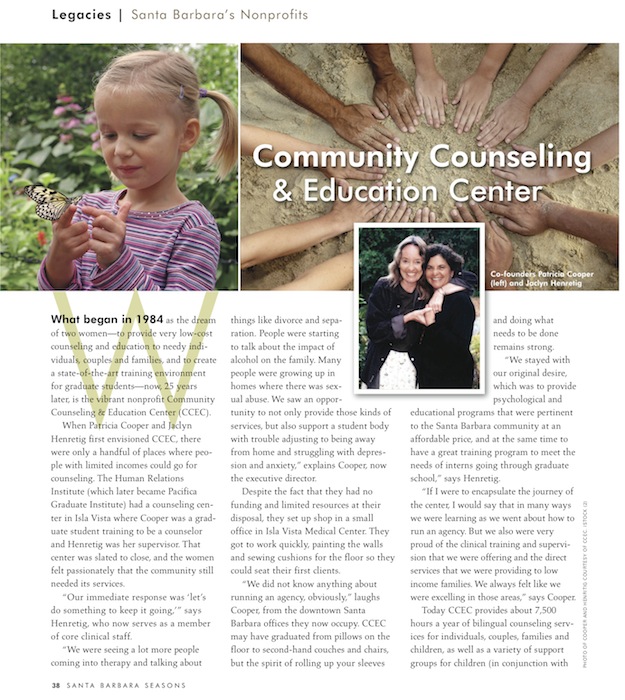
What began in 1984 as the dream of two women—to provide very low cost counseling and education to needy individuals, couples, and families, and to create a state-of-the-art training environment for graduate students—now, 25 years later, a vibrant nonprofit, the Community Counseling & Education Center (CCEC).


When Patricia Cooper and Jaclyn Henretig first envisioned CCEC, there were only a handful of places where people with limited incomes could go for counseling. The Human Relations Institute (which later became Pacifica) had a counseling center in Isla Vista where Cooper was a graduate student training to be a counselor and Henretig was her supervisor. That center was slated to close and the women felt passionately that the community still needed its services.


“Our immediate response was ‘let’s do something to keep it going,’” says Henretig, who now serves as Clinical Director.


“We were seeing a lot more people coming into therapy and talking about things like divorce and separation. People were starting to talk about the impact of alcohol on the family. Many people were growing up in homes where there was sexual abuse. We saw an opportunity to not only provide those kinds of services, but also support a student body with trouble adjusting to being away from home and struggling with depression and anxiety,” explains Cooper, now the Executive Director.


Despite the fact that they had no funding and limited resources at their disposal, they set up shop in a small office in the Isla Vista Medical Center. They got to work quickly, painting the walls and sewing cushions for the floor so they could seat their first clients.


“We did not know anything about running an agency, obviously,” laughs Cooper, from the downtown Santa Barbara offices they now occupy. CCEC may have graduated from pillows on the floor to second-hand couches and chairs, but the spirit of rolling up your sleeves and doing what needs to be done remains strong.


“We stayed with our original desire, which was to provide psychological and educational programs that were pertinent to the Santa Barbara community at an affordable price, and at the same time to have a great training program to meet the needs of the interns going through,” says Henretig.


“If I were to encapsulate the journey of the center, I would say that in many ways we were learning as we went about how to run an agency. But we also were very proud of the clinical training and supervision that we were offering and the direct services that we were providing to low income families. … We always felt like we were excelling in those areas,” says Cooper.


Today CCEC provides about 7,500 hours a year of bilingual counseling services for individuals, couples, families, and children, as well as a variety of support groups for children (in conjunction with Boys and Girls Club), single parents, and Spanish speaking families. It also offers continuing education classes to the general public. All services are either free or on a sliding fee scale, which Cooper says is becoming more critical in these stressful economic times.


While not a crisis center, CCEC does have ability to react quickly to support the community’s needs. For example, it worked closely with the Red Cross and offered free counseling services to people affected by the Jesusita Fire and prior to that, the Tea Fire.


“To have somebody to listen to you is oftentimes such a gift, and to have somebody’s undivided attention, it’s a gift and it’s something that we all crave,” says Cooper. “None of us ever feel like we get enough of that.”


“It’s truly been a pleasure for us to do the center. When I think of the things that I’m proud of in my life, certainly having the center develop as it has brings me a lot of sense of peace,” says Henretig. “Private practice is wonderful, but there’s only a few people that can afford private practice fees. This makes me feel like it goes out into the community regardless of how much money people have, and that’s a good feeling.”

=

For more information about the Community Counseling & Education Center, call 805/962-3363.

 Originally published in the Fall 2009 issue of Santa Barbara Seasons Magazine. To read the story as it appeared, click here for the first page, and here for the second page.


Noozhawk Talks: Leslie Dinaberg Sits Down With Steven Lovelace

Steven Lovelace (Michelle J. Wong / Noozhawk photo)

Steven Lovelace (Michelle J. Wong / Noozhawk photo)

As the owner/director of Santa Barbara Dance Arts (with partner Alana
Tillim), Steven Lovelace has his dance card full guiding the jazz hands and pirouettes of more than 400 young students. Here, he takes a brief intermission to talk to Noozhawk.

Leslie Dinaberg: So Arts Alive! which shared your space, is now gone, sadly. But I hear Santa
Barbara Dance Arts is expanding.

Steven Lovelace: Yes. Now my rent just doubled which is pretty scary. But Alana and I … we’re
a very good mix, she’s definitely a great artist and does wonderful choreography
and really good with the kids. She’s a great teacher … I know that it will be good
for us in the long run …

LD: I know a lot of kids that take classes from you and just love it.

SL: They do. We have 400 kids here. Are they going to do it as a profession? I’ve
got a few kids that could be able to do it. Are they talented enough, absolutely,
but you know it also takes intelligence and hard work. …

Some of it here at my studio is social. I know the girls enjoy dancing, I know they
enjoy what I do in the class, but they also enjoy coming in and being a part of this
group … they interface and they interact and it feels good.

LD: I also think you can’t discount just the physical part of dancing. I think as a
parent you realize that your kids need to run around and burn off energy and they
can’t learn if they don’t do that.

SL: And they don’t learn this in school. This doesn’t happen in school. The level
of dancing or the level of vocal coaching that goes on here of the acting classes,
that is not the same, … Before I started this I have worked in practically every
darn school in the city doing independent things.

LD: Will there be changes at your studio now that you have the entire
space?

SL: Now we’re going to really transform this into a performing arts center. …
We’ve got Kindermusik here that’s very successful. … We’ve still got a gallery
space down there. The performing arts need the visual arts anyway because
somebody’s got to build the set to put on the show. I’m about to do two musicals
in the summertime, so this is all individual artists, costumers are individual artists,
they’re not performing artists, so I work with set designers, costumers.

LD: With this transition, is the name of the whole place going to be Santa
Barbara Dance Arts?

SL: Yes. Arts Alive! doesn’t belong to me. … The Arts Mentorship Program is the
nonprofit part of it. That is our scholarship program and our dance companies,
our performing groups, and a lot of internship stuff. We do everything from teach
them to teach classes, we mentor them to choreograph. They are producing their
own things. … The kids right now they are producing their own student
choreography showcase that will be April 26th at 3 p.m. The senior dance
company produces it under our direction, they put the program together, and they
do auditions and do the ticket sales. They do everything.

LD: That’s great. That’s really good experience.

SL: Yes, it’s great. It’s for 14-18 year old kids. They put their own recordings
together, they edit the music for the kids, they do all that. They outreach to the
kids at the dance school. … They can’t walk out of here just being dancers. It
takes more than that to make it in the dance world and we know that, so I’m
teaching kids to teach. You know one girl, she went out of here, she didn’t want
to be a dance major but she taught dance on the side because she could make
20 bucks an hour teaching dance instead of slinging hash and trying to scrape
tips together so that she could help support herself in school. So that’s a really
nice little skill to walk out of here with.

I’ve got one girl in her senior year in high school she choreographed two
musicals in the school. It pays a couple of grand for her to go in and choreograph
eight dances for a musical. She’s so good at it. So she’s working on
choreography and making some money. I’m hiring her this summer to help me
choreograph my musicals because I can’t do everything. She works here in the
summertime; she’s great with teaching. She’s 19.

LD: How long have you been dancing?

SL: I started when I was 21. I actually was doing aerobics up at Nautilus, and the
gal that was running it there who is now one of my moms.

LD: Cindy Elster?

SL: Yes … she pegged me right away in class. I was very coordinated. … I would
be right up in there in the front just going for it, and I moved really well and she
said, “you know, I think you should become a teacher. You should teach. Half the
class is following you anyway.”

So she started having me come up with her on the thing and do the routines with
her and she was really basically training me to teach. (Then she said) “Why
don’t you go up to City College and take a couple of jazz classes? You’ll get all
that.”

So I went to City College and took Kay Fulton’s jazz class. It was actually an
intermediate class and … at the end of the class she lined up half a dozen of us
and she said, “You need to take ballet, you need to take ballet or modern,” she
got up to me and she says, “you can stay.” So I got to stay in the class. And that
was the beginning of dance for me.

LD: That’s kind of wild, it’s late in life, most people start dancing so
young.

SL: It is late, but it’s more common for men. Men can start late. … They get an
accelerated training. I was up in a community college. I wasn’t in a dance studio
hidden away, I was up in a community college where everybody could see me so
within six months somebody from UCSB saw me and called Alice Contadina who
was the department head at the time and she sent one of the teachers out to a
class to observe me and she said “why don’t you come out here and take some
lessons free of charge?” So I went out to UCSB and I danced out there for a year
and then they offered me a spot in their company. By that time I had quit my day
job and had gotten a job at Julie McLeod’s Dance Warehouse. So that’s my
whole history around here. Julie taught me how to teach.

LD: What’s it like to work with all those little girls?

SL: Well, there’s a lot of different ways I could answer that. … I think it’s really
important to be a place where girls can be empowered, which is one of the big
reasons we want to mentor girls and give them social skills because every time
they don’t make that audition it’s a skill to know how to take that rejection of not
getting what they want. The first time you don’t get into the college that you want,
if you don’t get that job that you think you’re perfect for that they give to someone
else.

… We really, really feel strongly that we’re providing a service, not just in giving
excellence in dance training or contemporary dances but we’re giving your kids a
community that they can feel good about. And the kids love being here.

… And I know that some of that is because it’s a great experience for them to be
here, but I have to say we provide this forum where they can be seen at
whatever talent level they are at or whatever their interest in dance is. Whether
they are just here for an after school class or they have an aspiration to go on
and go to Broadway and be in music videos or be a director or whatever. It’s here
for them and we want to be there. We take them all seriously. We don’t talk down
to the kids here. We really believe in that.

LD: If you could pick three adjectives to describe yourself, what would they
be?

SL: Holistic, resourceful, appreciative

Vital Stats: Steven Lovelace

Born: Santa Barbara, on June 6, 1957

Family: Partner Gary Clark

Civic Involvement: Santa Barbara’s Summer Solstice, Lit Moon Theatre
Company; Santa Barbara Dance Alliance: Arts Mentorship Program; Fund for
Santa Barbara

Professional Accomplishments: Co-owner/director Santa Barbara Dance Arts;
Co-owner/director Stage Left Productions; Teacher at Arts at Laguna; Former
Artistic Director and Artist in Residence with Santa Barbara’s Summer Solstice;
Dancer with Repertory-West Dance Company, Santa Barbara Dance Theatre,
Santa Barbara Civic Light Opera, Bill Evans Dance Company, and Nora
Reynolds Dance.

Best Book You’ve Read Recently: (laughs) “Twilight. It’s not like they are the
best-written books in the world but there’s something very engaging about those
characters.”

Little-Known Fact: “I like to be alone.”

Originally published in Noozhawk on April 12, 2009. Click here to read the story on that site.

Noozhawk Talks: Leslie Dinaberg sits down with Hap Freund

(Michelle J. Wong / Noozhawk photo)

(Michelle J. Wong / Noozhawk photo)

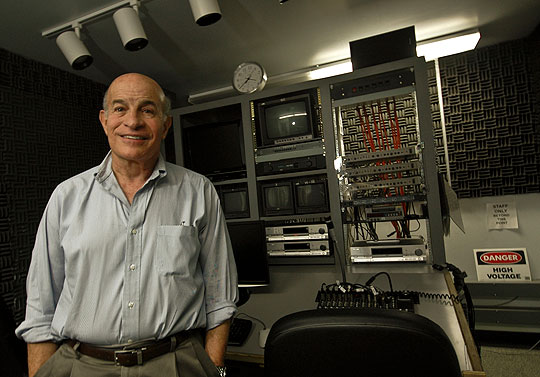
Certainly the hardest working man in (local public access) television, the
Santa Barbara Channel’s executive director Hap Freund took some time
out of his busy day to talk media matters with Noozhawk’s Leslie
Dinaberg.

Leslie Dinaberg: How did you get started in public television?

Hap Freund: I moved to Hawaii in 1980, with my wife who had a clerkship in the Hawaii
Supreme Court … I got a job with the mayor’s office. I was in the office of human
resources and I was in charge of special projects in social services but I wasn’t supposed
to spend any money and all I had to do was monitor a bunch of federal grants and it was
totally boring. … Somehow it came to me that there was this access channel that if you
produced television for it you could get your programs on TV.

…. I got together with some friends of mine and we did a documentary on homeless in
Hawaii. And after I made that documentary I then went to the Junior League and I got a
$50,000 grant to produce TV programs, to do the video training and to produce local
documentaries on social issues. … Over the course of about two years we did 18 half
hour documentaries. So I did that through my job working for the mayor’s
office.

…It was kind of a back door. I had never done television. I had been a lawyer, and a
community organizer and done a lot of work in social issues, but because the mayor
didn’t want to spent any money. …I could do anything I wanted pretty much in social
services as long as I didn’t spend money. So I did this and didn’t cost her a cent.

So that’s how I got into it. Then I moved to Ashland, Oregon when our son was about a
year and a half and I did independent work. I did a documentary for NOVA that took a
year. I wrote an article for Sports Illustrated on a wildlife forensic lab in Ashland … it
was in the swimsuit issue, so the joke was it was in the most widely read Sports
Illustrated of the year, except nobody read my article. (Laughs) But part of that, I took
that article and I wrote a grant to do a film on wildlife forensics.

LD: And you were in Seattle before you came to the Santa Channels when it switched
from belonging to Cox to being a nonprofit.

HF: Yes. We became a nonprofit in January of 2003 and I started up a couple of months
before that to set up the bylaws and the policies and personnel plan.

… One of the things I really like is what’s happened in video is it’s democratized, even
more so now because you can shoot a video with your phone. It’s been an incredible
leveler and it’s just democratized so much, and You Tube helps too. You can get the
word out. What we do is so you don’t have to have a network to get the word out. And
that’s one of the things I like about this (public television) is it’s a vehicle for people to
have their opinions. … I think that’s the cornerstone of democracy is having diverse
opinions and people hearing things that are uncomfortable.

… I always think we feel a real niche with cable. Channel 17, that’s the public access
part, with Channel 21 … I have a very broad definition of education, so I look at anything
that’s culture or arts also as educational.

LD: You are also doing things with nonprofits.

HF: Now we have a grant from Orfalea Foundation to do short spotlights on nonprofits
that are out in the field and we’ve got a grant from the Santa Barbara Foundation where
we’re trying to focus a lot on doing production work for nonprofits. I think if there’s a
direction we want to go in, we really see ourselves as being the media arm for nonprofits.

LD: That’s great. Especially because I know everybody is struggling with money to
spend on things like that.

HF: Yes and we’re inexpensive and we give them something they can multipurpose
because it isn’t just going on TV, we have a video-sharing site called SBChannels.net,
and we have all these videos. … They can link to it, they can send emails out.

LD: I hear you’re moving into the old Univision buildings in Goleta?

HF: Yes, it’s very exciting. I mean I love to be downtown but the Univision building in
the long run and even in the short run saves us money and it’s a bigger facility for less
money. And it’s a better studio. … We can have an audience of 49 people and so one of
the ideas I have is … we want to market this to nonprofits and say if you’ve got an event
if you want to have a town hall or a forum, why don’t you do it at our place because you
can put it on TV live, you can have people calling in and interacting.

… Also the other part is that I think our major mission is to facilitate and make it easier
for people to get their content out. So we look at that in terms of both the media that we
offer, …it’s both the production and the distribution. Because a lot of people just bring us
content more and more … they don’t have to produce it here to get it on the air. I am
happy to have all of that stuff.

LD: Do you have any favorite moments since you’ve been here?

HF: I could write a novel about this place. (Laughs) It’s never dull … My favorite
moment was we were producing something in the smaller studio for the film festival with
the film festival people and the police were getting ready to do a program in the other
studio and they brought some drug dogs, drug sniffing dogs in who went nuts. I saw all of
these people looking around kind of nervously and what it was was they had also brought
in some marijuana to hide behind the couch to show the dogs off, but I think a lot of
people were starting to get nervous.

… But really one of my favorite things is just knowing that people watch. When
somebody comes up to me and says, “thank you so much for showing the youth
symphony. It was so wonderful for all those kids to see their hard work on television.”
That appreciation that goes a long way.

LD: That’s great. With print media struggling, do you see an expanded or different role
for television?

HF: That’s a good question. I think the print media people who are sending the reporters
out with cameras, like the Ventura County Star or something, I think they get it. I don’t
think we compete with print media. I think the more information people have the better.
… I think there’s going to be some convergence. But I think what we need is more good
reporting and so I think the people who do print media, it’s really different than bloggers.
Bloggers can just repeat rumors. With journalists you get both sides of the story and I
think we’re losing some of that. That’s what I worry about the Internet, you can have an
opinion and people treat it as fact. … I would hate to see print journalism gone, but I
hope that what we need is good reporting. I think unbiased reporting, both sides of the
story, get the facts straight and let people make up their mind. I think that’s what’s most
important.

LD: What else do you do when you’re not working?

HF: I like to spend time with family, watch basketball, exercise, and travel though it’s
getting harder to afford. I’m a huge basketball junkie, especially Duke.

LD: If you could pick three adjectives to describe yourself, what would they be?

HP: Enthusiastic, issue-oriented, and upbeat

Vital Stats: Hap Freund

Born: July 31, 1943 in St. Louis, Missouri

Family: Wife Claudia Chotzen, sons Zach (age 22 and a senior at Stanford) and Willy
(age 18 and a senior at Laguna Blanca).

Civic Involvement: “This takes a lot of my time. This is not a 40-hour a week
commitment, so I would say that my civic involvement really is through work and trying
to get organizations in the door and caring about what they do.”

Professional Accomplishments: Executive Director of the Santa Barbara Channels,
former lawyer and community organizer, award-winning documentary
filmmaker.

Best Book You’ve Read Recently: “Shining City,” and “The Story of Edgar Sawtelle.”

Little-Known Fact: Freund was once one of the leading experts in the country on lead
paint poisoning in children. He also holds the patent on a design for a carrot-shaped
flashlight.

Originally published in Noozhawk on March 29, 2009,  click here to see the link.

Legacies: Scholarship Foundation of Santa Barbara

Scholarship Foundation of Santa Barbara, photos by Brad Eliot, story by Leslie Dinaberg. SB Seasons spring 2009.

Scholarship Foundation of Santa Barbara, photos by Brad Eliot, story by Leslie Dinaberg. SB Seasons spring 2009.

Helping Students Pursue a College Education

By Leslie Dinaberg

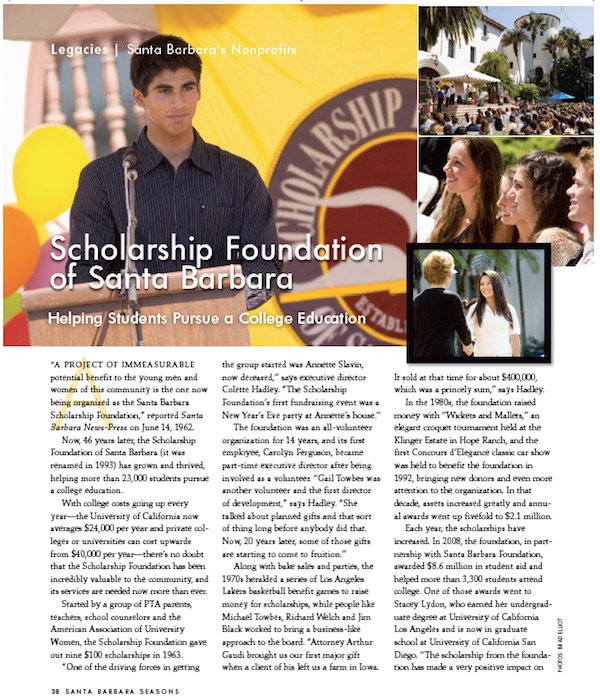
“A project of immeasurable potential benefit to the young men and women of this community is the one now being organized as the Santa Barbara Scholarship Foundation,” reported the Santa Barbara News-Press on June 14, 1962. 

Now 46 years later, the Scholarship Foundation of Santa Barbara (it was renamed in 1993) has grown and thrived, helping more than 23,000 students pursue a college education. 

With college costs going up every year—now the University of California averages $24,000 per year and private colleges or universities can cost upwards from $40,000 per year—there’s no doubt that the Scholarship Foundation has been incredibly valuable to the community and its services are needed now more than ever.

Started by a group of PTA parents, teachers and counselors, and the American Association of University Women, the Scholarship Foundation gave out nine $100 scholarships in 1963. 

Scholarship Foundation of Santa Barbara, story by Leslie Dinaberg. SB Seasons spring 2009.

Scholarship Foundation of Santa Barbara, story by Leslie Dinaberg. SB Seasons spring 2009.

“One of the driving forces in getting the group started was Annette Slavin, now deceased. Two of Annette’s children are still in town—realtor Steve Slavin and La Cumbre Junior High Principal JoAnn Caines,” says executive director Colette Hadley. “The Scholarship Foundation’s first fundraising event was a New Year’s Eve party at Annette’s house.”

The foundation was an all-volunteer organization for 14 years. Carolyn Ferguson was the first employee, part-time executive director, after being involved as a volunteer, says Hadley.  “Gail Towbes was another volunteer and the first director of development. … She talked about planned gifts and that sort of thing long before anybody did that. Now 20 years later some of those gifts are starting to come to fruition.” 

Along with bake sales and parties, the 1970s heralded a series of Los Angles Lakers Basketball benefit games to raise money for scholarships, while people like Michael Towbes, Richard Welch and Jim Black worked to bring a business-like approach to the board. “Attorney Arthur Gaudi brought us our first major gift when a client of his left us a farm in Iowa. It sold at that time for about $400,000 which was a princely sum,” says Hadley.

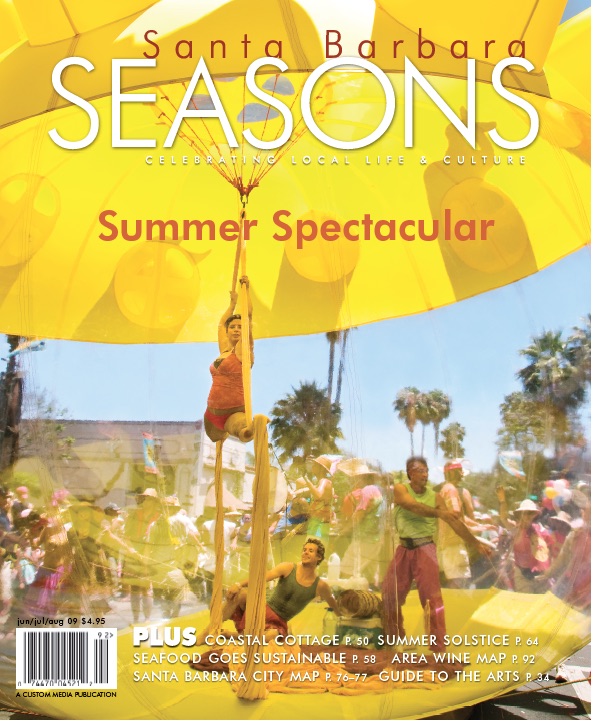
Santa Barbara Seasons Spring 2009 cover.

Santa Barbara Seasons Spring 2009 cover.

In the 1980s, the foundation raised money with “Wickets and Mallets,” an elegant croquet tournament held at the Klinger Estate in Hope Ranch, and in 1992 the first Concours d’Elegance classic car show was held to benefit the foundation, bringing new donors and even more attention to the organization. In that decade assets increased from $2.4 million to $16.5 million and annual awards went from $363,484 to $2.1 million, buoyed by gifts of $2 million each from the Cavalletto Family and Lillian and Lawrence Smith.

Each year the scholarships have increased. In 2008 the foundation awarded $8.6 million in student aid and helped more than 3,300 students attend college. One of those awards went to Stacey Lydon, who got her undergraduate degree at University of California Los Angeles, and is now in graduate school at University of California San Diego. “The scholarship from the foundation has made a very positive impact on my professional progress,” says Lydon.  

“With the scholarship I was able to take my dream internship with Network for Africa, and not have to worry about juggling a demanding school schedule, hours at an internship and time at a job, which may pay the bills but not really provide any career-enhancing experience.  I have been working with Network for Africa for almost a year now, and was able to travel with them to Rwanda this past summer.  … I couldn’t have done it without the scholarship.”

According to director of development Rebecca Anderson, 83 percent of Scholarship Foundation recipients complete their intended degree, compared to the national average of 52 percent. “Having that community foundation behind you is incredibly motivating,” she says.

Support from the Scholarship Foundation allowed Dr. Daniel Brennan to come back to his hometown as a pediatrician. “I feel so fortunate to be able to care for the children in the very community in which I was raised,” he says.  “It is an amazing privilege to care for the children of my former classmates.  It is even more special that I am able to practice pediatrics side by side with my own childhood pediatrician, Dr. Ernest Kolendrianos.”

That kind of personal touch is evident in the way the foundation does business—every eligible student is personally interviewed by either a board member or a trained volunteer—and as Hadley points out, these days it’s not just very low income families, but also middle income families that need assistance to afford college. “We do our best to make sure that everyone that wants to go to college has the opportunity to go.” 

Originally published in the Spring 2009 issue of Santa Barbara Seasons Magazine.

Click below to read the story as it appeared in print.

Seasons_SP09_FCR + Legacies

Noozhawk Talks: Leslie Dinaberg Sits Down With Dave Davis

Dave Davis

Dave Davis

After almost 25 years as the City of Santa Barbara’s Community Development Director and a City Planner, Dave Davis now brings his expertise to the Community Environmental Council (CEC), where he serves as CEO/Executive Director.

Leslie Dinaberg: Did you ever think you would end up working for the CEC after retirement?

Dave Davis: The simple answer is no … but it’s great. It was taking all the things I had
learned for 30 years and applying them from a community standpoint of being an
advocate for positive change. … It was liberating for me to really focus on what
needs to be done.

LD: It sounds like a very unique opportunity.

DD: It really was. So did I ever envision it, no. But boy it slapped me upside the
head and there was no denying that yeah, I want to do this. I want to put my
effort behind it.

LD: That’s terrific. What are some of your priority programs?

DD: Starting the energy program … to create a blueprint for Santa Barbara
County. We found a nice little jingle, “Fossil free by ’33.”

… We basically set the priorities. They are really simple. Within in this region
focus on energy efficiency, personal energy efficiency and building energy
efficiency, secondly transportation efficiency, and that includes everything from
hybrid cars to mass transit and so forth, alternative fuels, building as many
literally, renewable projects within the region as possible.

LD: What do you mean by that?

DD: Wind, solar, wave. What this blueprint does is it actually inventories the
potential for any of those categories here in Santa Barbara. When you look at the
state of California and …the amount of land that you can actually do major wind
projects boils down to a very, very small area, two or three spots, and we happen
to be one of them. In and around the Lompoc Point Conception area, and
offshore outside of the islands, there is a significant potential for wind
development over the years that could supply major amounts of energy-not just
for Santa Barbara, much more than we would ever use-that we would be
supporting the energy use of Southern California.

… The big solar projects for us are inland, Cuyama Valley those areas out there,
that’s where the potential is. But there is on top of essentially almost every
significant rooftop the opportunity to do major solar distributing to the community.

… Financing is just so expensive, so one of the things we’re working on …
there’s been recent legislation which allows cities and counties to float low
interest revenue bonds which are then paid off by people who want the solar on
their houses and their payments go onto their property taxes over 30 years.

… Lastly when it comes to renewables there, is potential within the region for
wave energy. This is really new technology, … but again when you get off of
Point Conception area, the wave frequency, wave height, again we have a
resource potential there which outstrips our usage here.

LD: So you’re got this blueprint and you’ve got these plans …

DD: … so the last thing here is to move this out into the community and public
policy. … We formed a coalition with the architects, the American Institute of
Architects, the AIA; the Santa Barbara Contractors Association, the Sustainability
Project and Built Green Santa Barbara, and we went to the city and challenged
them to work with us to develop the most energy efficient ordinance in California,
if not the country, and we did. And adopted it. And it’s been in effect and we’re
going to the county in the very term to move that policy also out into the
county.

LD: In the county, because of the fires, there’s a lot more building going on now
than we would have ever thought.

DD: Now let’s go into another example. So the fire happened and we were all
affected in one way or another, emotionally if not physically. …Again, we pulled
together our same coalition …We held a community forum up at Montecito
Covenant Church and we had 250 people.

Our coalition, led by us, went to the city and the county and said we want to
develop a plan not just to fast track these guys, but to basically put them on a
whole other process that they avoid the pitfalls of rebuilding. So we worked …
that if in fact they come in and they want to build better, they don’t go down
through that whole process of boards and committee and reviews, so they have
an independent review to look at those architectural, energy, and fire resistance
improvements and that they would move, not just to the head of the line, they
would go on consent calendar, that they would move directly on to the consent
calendar of the design review board so that they can go immediately into building
their house.

LD: It seems like incredible timing for that.

DD: Yes. …If you went in and tried to retrofit those big old houses it’s really
complicated. But now people can actually think was that the best place to put the
building. Did it need to be over here? Did the road need to be wider? Did the
materials need to be fire resistant? And while I’m doing this could the materials
basically save me money energy efficiency wise?

And I must tell you, the night we set up this forum it was one month to the day of
the fire we held the forum, which was pretty quick to get people out, organization,
everybody there. Not knowing how traumatized people would be …we really
actually hit a nerve. … People came up to me and said this is the first time since
the fire that I felt any sense of help. I teared up because it was really personal. …
This was just a great opportunity for the community to come together.

LD: What do you think would be the single thing that we, as a community, could
do to improve our energy efficiency?

DD: There isn’t one, there’s really two. They are at the heart of what I’ve been
talking about. On the South Coast, the biggest things that we can do is one,
make our buildings more energy efficient. … The second thing … if we could
develop aggressive social carpooling techniques, it would be significant. …
Young people, they’re geared to do it. Generationally, they’re going to do it, if we
can give them the tools and encourage it, then you start pushing it up to old folks
like me, we could go a long way.

LD: That’s actually a great use of technology.

DD: The other thing too, if we build the freeway, … that third lane being an HOV
(high occupancy vehicle) lane and running buses from Ventura like they’re doing.
They’re going through the roof with their subscriptions and carpooling of three
people per car. It would make a difference not just on the freeway but on the city
streets and in the parking lots.

LD: That has a good synergy with your work as a board member at MTD
too.

DD: Oh absolutely. To my glee I found with my retirement that I could pull
together all the good things that I wanted to accomplish and do them. Not bad.
(Laughs).

LD: If you could pick three adjectives to describe yourself, what would they
be?

DD: Clearly I’m passionate, and that goes from my avocations to my vocation;
knowledgeable, both from the standpoint that I’m now a community elder, and
that I have basically always loved to seek knowledge and continue to. You know
the thing that I loved about my job with the city was that it brought me into
contact with so many different fields of expertise and knowledge. …. The other
one I would say is basically I’m happy, that Joie de Vivre, let the good times
roll.

Vital Stats: Dave Davis

Born: New Orleans, Louisiana, July 15, 1948

Family: wife Jean, son Jesse (30) and daughter Nora (27)

Civic Involvement: Board member, Metropolitan Transit District, board member,
UCSB Economic Forecast Project; CEO/Executive Director, Community
Environmental Council

Professional Accomplishments: City of Santa Barbara’s Community Development
Director and City Planner for almost 25 years; taught planning and environmental
studies at UCLA and Moorpark College; Downtown Organization Citizen of the
Year; Citizens Planning Association Planner of the Year, American Planning
Association National Social Advocacy Planner of the Year; Lifetime Achievement
Award, Santa Barbara American Institute of Architects; Jacaranda Award for
Lifetime Achievement, Santa Barbara Beautiful.

Best Book You’ve Read Recently: “Three Cups of Tea” by Greg Mortenson and
David Oliver Relin

Little-Known Fact: Until a few years ago Davis was an avid surfer, and once
surfed 20-foot waves in Kaui’s Hanalei Bay.

Originally published in Noozhawk on February 17, 2009. Click here to read the article on that site.

Noozhawk Talks: Leslie Dinaberg sits down with Maria Herold

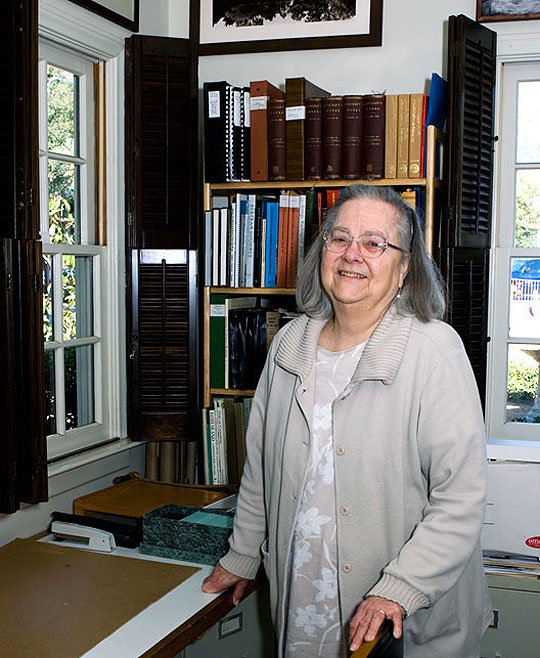
Maria Herold, longtime curator of the Montecito Association’s history committee, is an enthusiastic resource for those conducting obscure research or exploring land-use background. (Elite Henenson / Noozhawk photo)

Maria Herold, longtime curator of the Montecito Association’s history committee, is an enthusiastic resource for those conducting obscure research or exploring land-use background. (Elite Henenson / Noozhawk photo)

As longtime curator of the Montecito History Committee, Maria Herold knows-
literally-where the bodies are buried and the tales behind some of the most
storied families and legendary estates. Here she sits down with Leslie Dinaberg
to discuss some of her own history.

Leslie Dinaberg: How did you get involved with the Montecito History Committee?

Maria Herold: When I retired I decided that I would like to do something useful and I looked
around. I first looked into Recording for the Blind and Dyslexic, and I wasn’t quite
ready for their structure. I had heard that somebody was needed up here, so I
dropped in and have been here ever since. (Laughs) I just showed up!

LD: And when was that?

MH: I think about 1991.

LD: What did you retire from before that?

MH: Well, immediately before that I took care of babies … I wasn’t looking for a
job, but people asked me to take care of their babies because the hours were
perfect, my husband was a teacher and most of the people who asked me to
take care of their babies were teachers.

LD: Has history always been an interest of yours?

MH: Absolutely, because of the fact that my family has been involved with the
history of California and that has always been in the back of my mind. My
grandfather immigrated to America in 1873 and first worked in Sonoma County
and then settled in Northern Santa Barbara County and worked as a supervisor
on an old Spanish land grant.

He went back to Switzerland after he had worked here for 30 years. I was born in
Switzerland, and then I came to America when I was 16. He came when he was
15 and I came when I was 16. He came walking over the Isthmus of Panama and
I came on a freighter through the Panama Canal-so that’s history.

LD: Did you come with your family?

MH: Yes. The whole family came. … (My father) decided that instead of going to
the Santa Maria area, where he was born … he looked for the nearest place that
had a college and at that time there was a little college up on the Riviera so we
came here because of the college on the Riviera. I was the oldest child and he
wanted to be able to send me to college locally.

LD: You have an interesting history so I can see where your interest comes from.
What kinds of things do people come to the Montecito History Committee to
research?

MH: Everything from what is the story of my house or who is the architect or how
come my house is the way it is, to I heard about the Para Grande, or I heard
about the San Ysidro Ranch. Or I heard about somebody from New York who is
following a history of a person who started out in Europe, went to New York and
then ended up dying in Santa Barbara and inspiring a story of the ghost of a
countess in a local house. It gets that elaborate.

Then, of course, people who want to know the history of a street or of a property
that they want to buy. Or there is a legislation or development and, if they’re
smart, they come here and see what the history is. There are very few people
who are smart, but they manage to keep me busy, very, very busy.

I wish more people would come in because it is always ignorance that causes
problems, legal and otherwise. And in the community it creates a great deal of
problems where people are really not well informed on the history of Montecito.
And the same thing in Santa Barbara, the same thing in Goleta. If people knew
the histories there would be much less confrontation.

LD: Do you have a favorite project you’ve been involved with?

MH: I love it that the Pearl Chase Society once gave a mandate to a lady that
they were giving grants to look into part of the history of Montecito. And they
funded this lady, not me because I’m a volunteer, I don’t take money, except for
as a gift to the History Committee. But they funded this lady to work with me in
putting together a history of a particular section. We picked this section of
Montecito and looked into it in detail, starting with a map from 1871 and then
following the history of that section up to the present time. It was a fascinating
project. It took us months and literally months and months but it ended up in two
ring books of information with lots of pictures and everything else.

LD: What part of Montecito did you look at?

MH: We looked at the area between Jameson Lane (south), San Ysidro Road
(west), Hixson Road and Santa Rosa Lane (east) and Santa Rosa Lane (north).
That encompassed old farmland that had been well known farms in the 1870s
and 1880s and 1890s and also included one of the two most historic parts of
Montecito, which is Romero Hill. So we got all kinds of background with Romero
Hill and with the farming community and now having developments, so we have
everything there on how it developed since 1871.

LD: Do the other local libraries know about your resources?

MH: It depends on who they talk to at the library … I do know that UCSB is
aware of us, the Santa Barbara Historical Society sends us people all the time,
people who come into the library and say what should I do to find out about this
and that and something else, the librarians here (at the Montecito Library) send
me people all the time. So between the Santa Barbara Historical Society and the
local library we have a lot of referrals. Also there seems to be somehow people
seem to have become aware somewhere on the Internet of our existence
because I’ve had calls from all over the continent.

LD: What is the oldest structure in Montecito?

MH: What they call the Monsignor Adobe, which is a misnomer, but everybody
calls it the Monsignor Adobe. It’s a two-story Monterey and was built long before
the Monterey Adobe was built … The Monsignor Adobe is the most classic
building, I adore it. And yet it is the oldest building that’s still excellent.

LD: And what street is it on?

MH: It’s on the bottom of Sheffield Lane where Sheffield runs into North Jameson
Lane and it’s a land marked house.

LD: This sounds like very fun and very interesting work for you.

MH: Yes, but a lot of work. I would dearly adore having a helper.

LD: It seems like there should be a college student that would be
interested.

MH: Well, you know, people keep telling me that I should get involved with
Westmont students, etc. but the thing is they leave after a year, so all that is lost.
The continuity is shot down. What I need is an apprentice who will take over
because I’m not going to last forever.

LD: You’re still going strong, though.

MH: I’m 76 years old. Start counting (laughs).

LD: What else do you do like to do when you’re not volunteering at the historic
committee?

MH: For a long while I worked at Recording for the Blind and Dyslexic, which I
adored, just adored. But I can’t do it anymore. I’ve had several operations for
cancer so this is quite a trip. I used to work hours and hours over there and I just
loved it, but I can’t do it anymore. Then I’m involved with music all the time, I
always have been. I’ve been an accompanist and stuff like that. I’m still a
member of a choir, I sing with a group every Sunday but this is strictly amateur
music, but I’ve always done music.

LD: So is your group you sing with a church choir?

MH: No, it’s just a group that gets together, we all can read music, we get
together and we sing what is called early music, a capella early music and we
don’t perform, we do it for the fun of exploring early music.

LD: That’s really fun. That’s a great little local activity. If you could pick three
adjectives to describe yourself, what would they be?

MH: Old-fashioned, excitable, and enthusiastic.

Vital Stats: Maria Herold

Born: August 14, 1932, in Zurich, Switzerland.

Family: Husband George Herold; six grown children, Ann Herold, Matthew
Herold, Tina DaRos, Mark Herold, Monica Christensen, and Joseph Herold; eight
grandchildren and one great grandchild.

Civic Involvement: Volunteer curator with the Montecito History Committee, very
active with Mount Carmel Church, former volunteer for Recording the Blind and
Dyslexic.

Professional Accomplishments: Runs the Montecito History Committee archives;
formerly took care of babies in her home.

Best Book You’ve Read Recently: The Zookeeper’s Wife, by Diane
Ackerman.

Originally published in Noozhawk on January 12, 2009. Click here to read the story on that site.