Noozhawk Talks: Leslie Dinaberg Sits Down With Steven Lovelace

Steven Lovelace (Michelle J. Wong / Noozhawk photo)

Steven Lovelace (Michelle J. Wong / Noozhawk photo)

As the owner/director of Santa Barbara Dance Arts (with partner Alana
Tillim), Steven Lovelace has his dance card full guiding the jazz hands and pirouettes of more than 400 young students. Here, he takes a brief intermission to talk to Noozhawk.

Leslie Dinaberg: So Arts Alive! which shared your space, is now gone, sadly. But I hear Santa
Barbara Dance Arts is expanding.

Steven Lovelace: Yes. Now my rent just doubled which is pretty scary. But Alana and I … we’re
a very good mix, she’s definitely a great artist and does wonderful choreography
and really good with the kids. She’s a great teacher … I know that it will be good
for us in the long run …

LD: I know a lot of kids that take classes from you and just love it.

SL: They do. We have 400 kids here. Are they going to do it as a profession? I’ve
got a few kids that could be able to do it. Are they talented enough, absolutely,
but you know it also takes intelligence and hard work. …

Some of it here at my studio is social. I know the girls enjoy dancing, I know they
enjoy what I do in the class, but they also enjoy coming in and being a part of this
group … they interface and they interact and it feels good.

LD: I also think you can’t discount just the physical part of dancing. I think as a
parent you realize that your kids need to run around and burn off energy and they
can’t learn if they don’t do that.

SL: And they don’t learn this in school. This doesn’t happen in school. The level
of dancing or the level of vocal coaching that goes on here of the acting classes,
that is not the same, … Before I started this I have worked in practically every
darn school in the city doing independent things.

LD: Will there be changes at your studio now that you have the entire
space?

SL: Now we’re going to really transform this into a performing arts center. …
We’ve got Kindermusik here that’s very successful. … We’ve still got a gallery
space down there. The performing arts need the visual arts anyway because
somebody’s got to build the set to put on the show. I’m about to do two musicals
in the summertime, so this is all individual artists, costumers are individual artists,
they’re not performing artists, so I work with set designers, costumers.

LD: With this transition, is the name of the whole place going to be Santa
Barbara Dance Arts?

SL: Yes. Arts Alive! doesn’t belong to me. … The Arts Mentorship Program is the
nonprofit part of it. That is our scholarship program and our dance companies,
our performing groups, and a lot of internship stuff. We do everything from teach
them to teach classes, we mentor them to choreograph. They are producing their
own things. … The kids right now they are producing their own student
choreography showcase that will be April 26th at 3 p.m. The senior dance
company produces it under our direction, they put the program together, and they
do auditions and do the ticket sales. They do everything.

LD: That’s great. That’s really good experience.

SL: Yes, it’s great. It’s for 14-18 year old kids. They put their own recordings
together, they edit the music for the kids, they do all that. They outreach to the
kids at the dance school. … They can’t walk out of here just being dancers. It
takes more than that to make it in the dance world and we know that, so I’m
teaching kids to teach. You know one girl, she went out of here, she didn’t want
to be a dance major but she taught dance on the side because she could make
20 bucks an hour teaching dance instead of slinging hash and trying to scrape
tips together so that she could help support herself in school. So that’s a really
nice little skill to walk out of here with.

I’ve got one girl in her senior year in high school she choreographed two
musicals in the school. It pays a couple of grand for her to go in and choreograph
eight dances for a musical. She’s so good at it. So she’s working on
choreography and making some money. I’m hiring her this summer to help me
choreograph my musicals because I can’t do everything. She works here in the
summertime; she’s great with teaching. She’s 19.

LD: How long have you been dancing?

SL: I started when I was 21. I actually was doing aerobics up at Nautilus, and the
gal that was running it there who is now one of my moms.

LD: Cindy Elster?

SL: Yes … she pegged me right away in class. I was very coordinated. … I would
be right up in there in the front just going for it, and I moved really well and she
said, “you know, I think you should become a teacher. You should teach. Half the
class is following you anyway.”

So she started having me come up with her on the thing and do the routines with
her and she was really basically training me to teach. (Then she said) “Why
don’t you go up to City College and take a couple of jazz classes? You’ll get all
that.”

So I went to City College and took Kay Fulton’s jazz class. It was actually an
intermediate class and … at the end of the class she lined up half a dozen of us
and she said, “You need to take ballet, you need to take ballet or modern,” she
got up to me and she says, “you can stay.” So I got to stay in the class. And that
was the beginning of dance for me.

LD: That’s kind of wild, it’s late in life, most people start dancing so
young.

SL: It is late, but it’s more common for men. Men can start late. … They get an
accelerated training. I was up in a community college. I wasn’t in a dance studio
hidden away, I was up in a community college where everybody could see me so
within six months somebody from UCSB saw me and called Alice Contadina who
was the department head at the time and she sent one of the teachers out to a
class to observe me and she said “why don’t you come out here and take some
lessons free of charge?” So I went out to UCSB and I danced out there for a year
and then they offered me a spot in their company. By that time I had quit my day
job and had gotten a job at Julie McLeod’s Dance Warehouse. So that’s my
whole history around here. Julie taught me how to teach.

LD: What’s it like to work with all those little girls?

SL: Well, there’s a lot of different ways I could answer that. … I think it’s really
important to be a place where girls can be empowered, which is one of the big
reasons we want to mentor girls and give them social skills because every time
they don’t make that audition it’s a skill to know how to take that rejection of not
getting what they want. The first time you don’t get into the college that you want,
if you don’t get that job that you think you’re perfect for that they give to someone
else.

… We really, really feel strongly that we’re providing a service, not just in giving
excellence in dance training or contemporary dances but we’re giving your kids a
community that they can feel good about. And the kids love being here.

… And I know that some of that is because it’s a great experience for them to be
here, but I have to say we provide this forum where they can be seen at
whatever talent level they are at or whatever their interest in dance is. Whether
they are just here for an after school class or they have an aspiration to go on
and go to Broadway and be in music videos or be a director or whatever. It’s here
for them and we want to be there. We take them all seriously. We don’t talk down
to the kids here. We really believe in that.

LD: If you could pick three adjectives to describe yourself, what would they
be?

SL: Holistic, resourceful, appreciative

Vital Stats: Steven Lovelace

Born: Santa Barbara, on June 6, 1957

Family: Partner Gary Clark

Civic Involvement: Santa Barbara’s Summer Solstice, Lit Moon Theatre
Company; Santa Barbara Dance Alliance: Arts Mentorship Program; Fund for
Santa Barbara

Professional Accomplishments: Co-owner/director Santa Barbara Dance Arts;
Co-owner/director Stage Left Productions; Teacher at Arts at Laguna; Former
Artistic Director and Artist in Residence with Santa Barbara’s Summer Solstice;
Dancer with Repertory-West Dance Company, Santa Barbara Dance Theatre,
Santa Barbara Civic Light Opera, Bill Evans Dance Company, and Nora
Reynolds Dance.

Best Book You’ve Read Recently: (laughs) “Twilight. It’s not like they are the
best-written books in the world but there’s something very engaging about those
characters.”

Little-Known Fact: “I like to be alone.”

Originally published in Noozhawk on April 12, 2009. Click here to read the story on that site.

Reality Bites

Photo Ambro, FreeDigitalPhotos.net

Photo Ambro, FreeDigitalPhotos.net

Am I the last person in America who hates reality TV?

My head starts to throb every time I flip through the channels and I feel my brain’s gray matter transform into a gelatinous oozy substance, perfect for the aliens to come take it over. I’ve got 900 channels and most of them are filled with so-called “reality” shows.

Why are these shows called “reality television” when they are so far detached from reality anyway? Reality is not competing for a prize on an island and it is not trying to become the biggest pop sensation in the country. Just writing these words makes my head spin. I’m literally dizzy with annoyance, that’s how much I hate those shows.

Now don’t get me wrong, I’m not one of those alternative school parents who drives around with a “Kill Your TV” bumper sticker on my minivan, like ahem, one of my dearest friends.

I’m not against TV. I watch plenty of television, and most of it’s not on PBS. And it’s not that I have a problem with lowbrow entertainment-anyone who has met my husband can testify to that. But there’s something about the cheesy search for stardom on American Idol,  and the ridiculous search for romance on The Bachelor that I truly loathe. These show are more than just “not my cup of tea,” I despise them with all of my heart. They make my skin crawl.

Partly it’s the desperation to be in the spotlight that unifies the “stars” of all of these shows that makes my stomach churn. When I was six I wanted to be a ballerina, when I was eight I wanted to play on center court at Wimbledon, and when I was nine I wanted to sing on Broadway. But when I was 12 I accepted the reality that I didn’t have the talent to do those things, so I went on with my life.

These reality TV people need to realize it’s time for them to go on with their lives too.

But no, instead we now have this new group of overnight celebrities who are famous because they slapped someone, stole their boyfriend or spit in their face. That used to be how you became famous in junior high, not the pathway to fame in America. Now all of those overgrown teenagers are chatting up Leno, Ellen, and Regis and Kelly. Not to mention all the airwaves that are filled by wannabe/has-been actors trying to stretch their 15 minutes of fame to the breaking point by humiliating themselves on reality TV.

Here’s the thing: real stars have real talent. I don’t know what reality “stars” have. Chutzpah? Balls? A deluded sense of their own importance? Sure, some reality “stars”-albeit very few-may actually have some talent, but the only thing I’m sure they all have is the ability to really, really annoy me.

It’s not just that these shows are so popular and I can’t understand why; it’s also that as a writer I know that the cheap production values and nonexistent writing staffs of these shows are forcing the professionals out. It’s always been an uphill battle to get a well-written comedy or drama onto network television, but the success of these reality shows has made it almost impossible to get good shows on TV.

I can’t wait for the day when America’s fascination with reality TV finally runs its course. While I too enjoy watching my favorite characters claw their way to success through conniving, backstabbing, lying, cheating and stealing-I prefer to watch them do it gracefully via the piquant prose of  Mad Men, the dexterous dialogue of Damages or even the morose monotones of CNN.

When Leslie’s not ripping into reality TV, she can be reached at email . Originally published in the Santa Barbara Daily Sound on April 3, 2009.

Noozhawk Talks: Leslie Dinaberg sits down with Hap Freund

(Michelle J. Wong / Noozhawk photo)

(Michelle J. Wong / Noozhawk photo)

Certainly the hardest working man in (local public access) television, the
Santa Barbara Channel’s executive director Hap Freund took some time
out of his busy day to talk media matters with Noozhawk’s Leslie
Dinaberg.

Leslie Dinaberg: How did you get started in public television?

Hap Freund: I moved to Hawaii in 1980, with my wife who had a clerkship in the Hawaii
Supreme Court … I got a job with the mayor’s office. I was in the office of human
resources and I was in charge of special projects in social services but I wasn’t supposed
to spend any money and all I had to do was monitor a bunch of federal grants and it was
totally boring. … Somehow it came to me that there was this access channel that if you
produced television for it you could get your programs on TV.

…. I got together with some friends of mine and we did a documentary on homeless in
Hawaii. And after I made that documentary I then went to the Junior League and I got a
$50,000 grant to produce TV programs, to do the video training and to produce local
documentaries on social issues. … Over the course of about two years we did 18 half
hour documentaries. So I did that through my job working for the mayor’s
office.

…It was kind of a back door. I had never done television. I had been a lawyer, and a
community organizer and done a lot of work in social issues, but because the mayor
didn’t want to spent any money. …I could do anything I wanted pretty much in social
services as long as I didn’t spend money. So I did this and didn’t cost her a cent.

So that’s how I got into it. Then I moved to Ashland, Oregon when our son was about a
year and a half and I did independent work. I did a documentary for NOVA that took a
year. I wrote an article for Sports Illustrated on a wildlife forensic lab in Ashland … it
was in the swimsuit issue, so the joke was it was in the most widely read Sports
Illustrated of the year, except nobody read my article. (Laughs) But part of that, I took
that article and I wrote a grant to do a film on wildlife forensics.

LD: And you were in Seattle before you came to the Santa Channels when it switched
from belonging to Cox to being a nonprofit.

HF: Yes. We became a nonprofit in January of 2003 and I started up a couple of months
before that to set up the bylaws and the policies and personnel plan.

… One of the things I really like is what’s happened in video is it’s democratized, even
more so now because you can shoot a video with your phone. It’s been an incredible
leveler and it’s just democratized so much, and You Tube helps too. You can get the
word out. What we do is so you don’t have to have a network to get the word out. And
that’s one of the things I like about this (public television) is it’s a vehicle for people to
have their opinions. … I think that’s the cornerstone of democracy is having diverse
opinions and people hearing things that are uncomfortable.

… I always think we feel a real niche with cable. Channel 17, that’s the public access
part, with Channel 21 … I have a very broad definition of education, so I look at anything
that’s culture or arts also as educational.

LD: You are also doing things with nonprofits.

HF: Now we have a grant from Orfalea Foundation to do short spotlights on nonprofits
that are out in the field and we’ve got a grant from the Santa Barbara Foundation where
we’re trying to focus a lot on doing production work for nonprofits. I think if there’s a
direction we want to go in, we really see ourselves as being the media arm for nonprofits.

LD: That’s great. Especially because I know everybody is struggling with money to
spend on things like that.

HF: Yes and we’re inexpensive and we give them something they can multipurpose
because it isn’t just going on TV, we have a video-sharing site called SBChannels.net,
and we have all these videos. … They can link to it, they can send emails out.

LD: I hear you’re moving into the old Univision buildings in Goleta?

HF: Yes, it’s very exciting. I mean I love to be downtown but the Univision building in
the long run and even in the short run saves us money and it’s a bigger facility for less
money. And it’s a better studio. … We can have an audience of 49 people and so one of
the ideas I have is … we want to market this to nonprofits and say if you’ve got an event
if you want to have a town hall or a forum, why don’t you do it at our place because you
can put it on TV live, you can have people calling in and interacting.

… Also the other part is that I think our major mission is to facilitate and make it easier
for people to get their content out. So we look at that in terms of both the media that we
offer, …it’s both the production and the distribution. Because a lot of people just bring us
content more and more … they don’t have to produce it here to get it on the air. I am
happy to have all of that stuff.

LD: Do you have any favorite moments since you’ve been here?

HF: I could write a novel about this place. (Laughs) It’s never dull … My favorite
moment was we were producing something in the smaller studio for the film festival with
the film festival people and the police were getting ready to do a program in the other
studio and they brought some drug dogs, drug sniffing dogs in who went nuts. I saw all of
these people looking around kind of nervously and what it was was they had also brought
in some marijuana to hide behind the couch to show the dogs off, but I think a lot of
people were starting to get nervous.

… But really one of my favorite things is just knowing that people watch. When
somebody comes up to me and says, “thank you so much for showing the youth
symphony. It was so wonderful for all those kids to see their hard work on television.”
That appreciation that goes a long way.

LD: That’s great. With print media struggling, do you see an expanded or different role
for television?

HF: That’s a good question. I think the print media people who are sending the reporters
out with cameras, like the Ventura County Star or something, I think they get it. I don’t
think we compete with print media. I think the more information people have the better.
… I think there’s going to be some convergence. But I think what we need is more good
reporting and so I think the people who do print media, it’s really different than bloggers.
Bloggers can just repeat rumors. With journalists you get both sides of the story and I
think we’re losing some of that. That’s what I worry about the Internet, you can have an
opinion and people treat it as fact. … I would hate to see print journalism gone, but I
hope that what we need is good reporting. I think unbiased reporting, both sides of the
story, get the facts straight and let people make up their mind. I think that’s what’s most
important.

LD: What else do you do when you’re not working?

HF: I like to spend time with family, watch basketball, exercise, and travel though it’s
getting harder to afford. I’m a huge basketball junkie, especially Duke.

LD: If you could pick three adjectives to describe yourself, what would they be?

HP: Enthusiastic, issue-oriented, and upbeat

Vital Stats: Hap Freund

Born: July 31, 1943 in St. Louis, Missouri

Family: Wife Claudia Chotzen, sons Zach (age 22 and a senior at Stanford) and Willy
(age 18 and a senior at Laguna Blanca).

Civic Involvement: “This takes a lot of my time. This is not a 40-hour a week
commitment, so I would say that my civic involvement really is through work and trying
to get organizations in the door and caring about what they do.”

Professional Accomplishments: Executive Director of the Santa Barbara Channels,
former lawyer and community organizer, award-winning documentary
filmmaker.

Best Book You’ve Read Recently: “Shining City,” and “The Story of Edgar Sawtelle.”

Little-Known Fact: Freund was once one of the leading experts in the country on lead
paint poisoning in children. He also holds the patent on a design for a carrot-shaped
flashlight.

Originally published in Noozhawk on March 29, 2009,  click here to see the link.

The After-Effects of Cruising

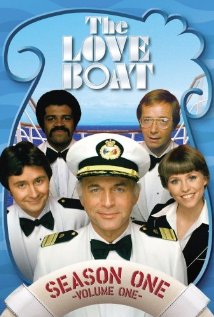
Love BoatI know cruises are supposed to be a splendid way to replenish your energy and deplete your bank account, but I didn’t realize the effects of going on the Love Boat would be so long lasting. It’s been three months since we went on a five-day cruise to Mexico for my parent’s 50th anniversary, and we’re still feeling the after-effects.

I finally got my land legs back last month, and the trip is paid for, but my son still expects turn down service and a mint on his pillow.

Worse yet, he’s decided he likes the 19 meals a day plan. It seems like every time I rinse another dish the kid is asking for more food. “Hey mom, my stomach’s got a little more room. Isn’t it post-brunch, second snack, pre-high tea appetizer time?”

Seriously, I don’t know what they put in the water on those Carnival Cruises, but we’ve created a monster.

Case in point: we went out to dinner the other night and Koss wanted to order crab legs as a starter, followed by a Cesar salad, French onion soup, steak and lobster, with both rice and French fries on the side, and a molten chocolate lava cake and crème brûlée for dessert. “Oh, and don’t forget the warm towels between courses,” he asked politely. The cashier at McDonalds was very confused.

At least the cruise taught him about washing his hands with something other than his tongue. But seriously, he’s having a bit of a hard time adjusting to his tough life as an average nine-year-old.

I get it.

It’s hard to go back to real life once you’ve experienced having a whole crew of maitre d’s and supervisors watching the waiters, dessert staff, bartenders, sommeliers and toque-toting buffet servers at your beck and call, just to make sure you don’t do something for yourself that they could do for you.

Then there’s the freedom of being able to sign for anything extra your little heart desires. I understand how it went to his nine-year-old head, but it’s got to stop. When we stopped by 7-Eleven for Slurpees the other day, he wanted to just “sign the bill” for all of his friends.

I fear all that service has scarred him for life. Thank goodness it was winter, which saved him from seeing a lot of people nearly naked that we would all prefer not to see nearly naked— although not from having to witness a case of suntan lotion being spread over the white expanse of skin belonging to a certain family of die-hard sunbathers from the Midwest.

Meanwhile, after traveling with our whole extended family (my side, which is much more opinionated than his) my husband and I have lost all capacity to make decisions for ourselves. We’re working on this, day by day.

I almost broke down and called my mom the other night when I couldn’t decide whether to make chicken or fish for dinner.

Luckily, Koss solved that dilemma for me. “I’ll have them both, Mom. What are we having for a palate cleanser?”

Originally published in the Santa Barbara Daily Sound on March 27, 2009.

When Leslie’s not reminiscing about vacations, she can be reached at Leslie@LeslieDinaberg.com. For more columns visit www.LeslieDinaberg.com.


Butchering Barbie

Candidate BarbieBarbie turned 50 this week. And if Barbie, with her perfect, plastic persona, is anything like the red-blooded, hormone-drenched women I know who’ve turned 50, I would never dare say a word against her.

Except that every time I look at Barbie she pisses me off.

It isn’t her impossibly disproportionate measurements. Though the International Journal of Eating Disorders says that if she were life-sized, Barbie’s measurements would be 38-18-34. And others say that her legs are 50 percent longer than her arms, making it physically impossible for her to even walk, let alone snowboard, samba or play in the WNBA.

It isn’t her incredibly vast wardrobe either. Although I was terribly jealous when I heard that 50 famous fashion designers gifted her with custom made couture this week, including Tommy Hilfiger’s hand-beaded white minidress, Diane von Furstenberg’s hot-pink wrap dress and Betsey Johnson’s outrageous green party dress.

It isn’t Barbie’s refusal to let herself age gracefully that gets me hot under the collar either. A little Botox here and there is understandable; she’s always in the public eye. Though she’s had so many injections her face doesn’t move, and she’d be a much better communicator if it weren’t so hard to tell what she was thinking because her expression never changes.

It isn’t even her flakiness that ticks me off. Though I must admit, at 50 years old it’s about time Barbie figured out what she wants to do with her life. By my count, she’s had more than 100 careers-including teacher, Prime Minister, Mary Kay consultant, World Cup soccer player, nurse, yoga instructor, life guard, sign-language teacher, NASCAR driver, fighter pilot, Dallas Cowboys Cheerleader and rapper -you’d think that by now she would have found something that holds her interest for more than a season.

But that’s not it either.

Every time I look at Barbie she pisses me off because I see dollar signs floating away from me. Lots and lots of dollar signs.

I suppose I should explain.

When I was a kid, my Grandpa Jules was in the toy business. He never worked for Mattel, but somehow he got a hold of one of the original prototype Barbie sets. That’s right, one of the originals, with 20 different dolls from 1959, including Barbie dressed in her original black and white zebra striped swimsuit and signature blonde topknot ponytail.

Yes, the one and only original Barbie who sold at auction for $17,450 back in 2006. And there were 20 of them in the box, including some I don’t think ever made it to market. Can you imagine what they’d be worth today?

Growing up with a father in the toy business, my mom didn’t give a second thought to letting me play with the original Barbies. $17,450 for just one little Barbie! They may as well have given me dollar bills and matches to play with.

I shaved their heads, decapitated them, painted them with nail polish and ink, removed their limbs and put them into compromising positions with Ken, G.I. Joe, and Raggedy Ann and Andy.

But unlike all of the millions of other little girls who were torturing Barbie-by the way, this is such a common occurrence that Britain’s University of Bath did a research study which found that Barbie torture was a legitimate play activity-I was actually desecrating something that should have been locked away and cashed in as a down payment on my son’s college education.

I know it’s a cherished part of American girlhood to dote on, dress up, and then eventually torture Barbie with scissors and ballpoint pens. And I loved every minute of it. But couldn’t I have weathered these important lessons in love, accessories, destruction, and deconstruction, on a less valuable Barbie’s body? After all, my sister and I had heaps of Barbie Dolls, which were left naked and either headless or with their heads twisted impossibly, arms and legs in agonizing positions, and abandoned to mingle with our extra cards, stubby pencils and lost buttons under the couch. Why oh why did mom have to let us play with the valuable ones?

When Leslie’s not blaspheming Barbie, she can be reached at email . Originally published in the Santa Barbara Daily Sound on March 13, 2009. For more columns visit LeslieDinaberg.com.

Nailed

Photo by Maggie Smith, freedigitalphotos.net

Photo by Maggie Smith, freedigitalphotos.net

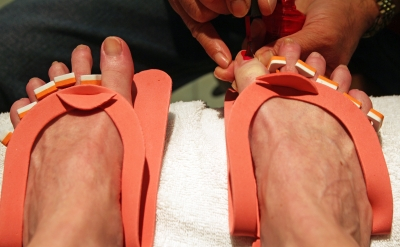
I roll up my jeans, soak my toes in that mysterious blue powdery stuff and sink into the fake leathery comfort of a foot spa chair. I set the roller massage to just the right speed and pressure, so it kneads up and down my spine without shaking my body so hard that my boobs kiss my nose, then I close my eyes and prepare for bargain basement bliss.

Ah, Nirvana. There’s nothing better than a lunchtime pedicure to relax you in the middle of a long, hard workday. It’s the perfect cure for stress.

Ah, Nirvana. There’s nothing better than a lunchtime pedicure to relax you in the middle of a long, hard workday. It’s the perfect cure for stress.

I close my eyes and pretend I’m being pampered at the Bacara, or better yet, the Ritz-Carlton in Maui. Ah, this is the life.

Then I hear it: “trông như thế nào là chất béo của cô ankles.”

Huh? They’re talking about me already. This must be a record. I haven’t even gotten to the part about the crashing waves or the umbrella drinks at my fantasy spa.

“I said you have such pretty eyes. A rhinestone bleeding heart on your thumbnail’s gonna really play them up,” says my nail technician.

“Uh, I just want a pedicure,” I say, closing my eyes and trying to get back to Maui.

“Only $4 extra if you want a knife going through the heart,” she says, shoving a card full of rhinestone designs under my chin.

“Um, no thanks. I’m not really a bling girl, or a knife through the heart girl,” I say.

“Không có bạn nhiều hơn một giá rẻ chất béo bò girl.”

“What?”

“I say you have boyfriend. You have such pretty eyes you must have lots of boyfriend. Boyfriend like the bling on toes, let me tell you,” she says.

I pull out my phone. I’m not sure what she said yet, but I know she did not say that.

“Không có bạn nhiều hơn một giá rẻ chất béo bò girl,” she says.

Hey, cut it out. I know you’re talking about me in Vietnamese and pretending you’re not.  And I’m sick of pretending not to notice.

And by the way, that iPhone I’m playing with has a translation app on it, so I know you just called me a big fat cow. I’m not sure if that’s a compliment or an insult in your culture, but cut it out.

And now I know that before the cow comment you made fun of my cankles, which isn’t very nice in any culture. Please just let me enjoy my pedicure in peace and quiet, instead of my usual paranoia that all of those giggles and guffaws from you and the other nail technicians are because you’re making fun of my outfit.

And while you’re at it, stop trying to upsell me every other minute. If I wanted to spend more money on my nails I would have gone someplace that wasn’t decorated with plastic flowers in December and Christmas tinsel in July.

I know you’re talking about me, just as surely I know there’s no way your name is really Tammy or Heather. I know you’re talking about me, just as surely as I know there’s no way you can possibly be comfortable in those hooker shoes. Relax, put on some flip-flops and stop talking about your customers while they’re sitting right there. I’ve got an app and I’m not afraid to use it.

You’re in America now, and here in America we make catty comments about people AFTER they leave, not when they’re still sitting there within earshot—and certainly not before they’ve given you a tip.

Share your nailed adventures with Leslie at Leslie@LeslieDinaberg.com. For more columns visit www.LeslieDinaberg.com.

Originally published in the Santa Barbara Daily Sound on March 6, 2009.


Legacies: Scholarship Foundation of Santa Barbara

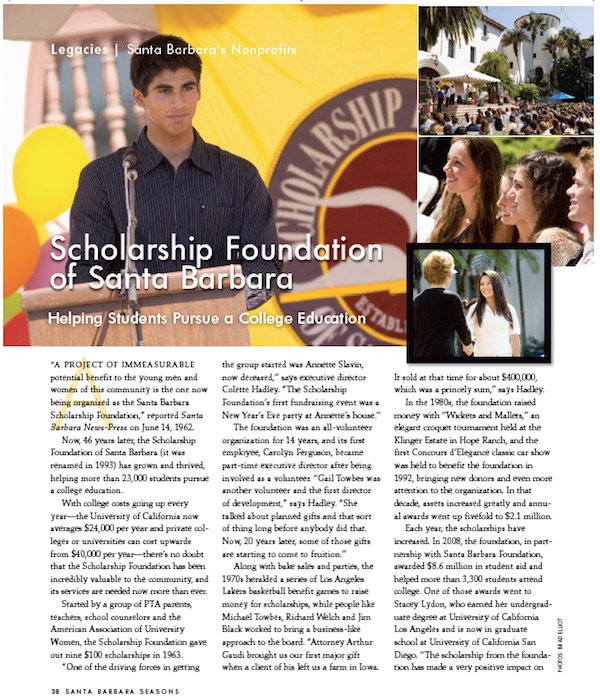
Scholarship Foundation of Santa Barbara, photos by Brad Eliot, story by Leslie Dinaberg. SB Seasons spring 2009.

Scholarship Foundation of Santa Barbara, photos by Brad Eliot, story by Leslie Dinaberg. SB Seasons spring 2009.

Helping Students Pursue a College Education

By Leslie Dinaberg

“A project of immeasurable potential benefit to the young men and women of this community is the one now being organized as the Santa Barbara Scholarship Foundation,” reported the Santa Barbara News-Press on June 14, 1962. 

Now 46 years later, the Scholarship Foundation of Santa Barbara (it was renamed in 1993) has grown and thrived, helping more than 23,000 students pursue a college education. 

With college costs going up every year—now the University of California averages $24,000 per year and private colleges or universities can cost upwards from $40,000 per year—there’s no doubt that the Scholarship Foundation has been incredibly valuable to the community and its services are needed now more than ever.

Started by a group of PTA parents, teachers and counselors, and the American Association of University Women, the Scholarship Foundation gave out nine $100 scholarships in 1963. 

Scholarship Foundation of Santa Barbara, story by Leslie Dinaberg. SB Seasons spring 2009.

Scholarship Foundation of Santa Barbara, story by Leslie Dinaberg. SB Seasons spring 2009.

“One of the driving forces in getting the group started was Annette Slavin, now deceased. Two of Annette’s children are still in town—realtor Steve Slavin and La Cumbre Junior High Principal JoAnn Caines,” says executive director Colette Hadley. “The Scholarship Foundation’s first fundraising event was a New Year’s Eve party at Annette’s house.”

The foundation was an all-volunteer organization for 14 years. Carolyn Ferguson was the first employee, part-time executive director, after being involved as a volunteer, says Hadley.  “Gail Towbes was another volunteer and the first director of development. … She talked about planned gifts and that sort of thing long before anybody did that. Now 20 years later some of those gifts are starting to come to fruition.” 

Along with bake sales and parties, the 1970s heralded a series of Los Angles Lakers Basketball benefit games to raise money for scholarships, while people like Michael Towbes, Richard Welch and Jim Black worked to bring a business-like approach to the board. “Attorney Arthur Gaudi brought us our first major gift when a client of his left us a farm in Iowa. It sold at that time for about $400,000 which was a princely sum,” says Hadley.

Santa Barbara Seasons Spring 2009 cover.

Santa Barbara Seasons Spring 2009 cover.

In the 1980s, the foundation raised money with “Wickets and Mallets,” an elegant croquet tournament held at the Klinger Estate in Hope Ranch, and in 1992 the first Concours d’Elegance classic car show was held to benefit the foundation, bringing new donors and even more attention to the organization. In that decade assets increased from $2.4 million to $16.5 million and annual awards went from $363,484 to $2.1 million, buoyed by gifts of $2 million each from the Cavalletto Family and Lillian and Lawrence Smith.

Each year the scholarships have increased. In 2008 the foundation awarded $8.6 million in student aid and helped more than 3,300 students attend college. One of those awards went to Stacey Lydon, who got her undergraduate degree at University of California Los Angeles, and is now in graduate school at University of California San Diego. “The scholarship from the foundation has made a very positive impact on my professional progress,” says Lydon.  

“With the scholarship I was able to take my dream internship with Network for Africa, and not have to worry about juggling a demanding school schedule, hours at an internship and time at a job, which may pay the bills but not really provide any career-enhancing experience.  I have been working with Network for Africa for almost a year now, and was able to travel with them to Rwanda this past summer.  … I couldn’t have done it without the scholarship.”

According to director of development Rebecca Anderson, 83 percent of Scholarship Foundation recipients complete their intended degree, compared to the national average of 52 percent. “Having that community foundation behind you is incredibly motivating,” she says.

Support from the Scholarship Foundation allowed Dr. Daniel Brennan to come back to his hometown as a pediatrician. “I feel so fortunate to be able to care for the children in the very community in which I was raised,” he says.  “It is an amazing privilege to care for the children of my former classmates.  It is even more special that I am able to practice pediatrics side by side with my own childhood pediatrician, Dr. Ernest Kolendrianos.”

That kind of personal touch is evident in the way the foundation does business—every eligible student is personally interviewed by either a board member or a trained volunteer—and as Hadley points out, these days it’s not just very low income families, but also middle income families that need assistance to afford college. “We do our best to make sure that everyone that wants to go to college has the opportunity to go.” 

Originally published in the Spring 2009 issue of Santa Barbara Seasons Magazine.

Click below to read the story as it appeared in print.

Seasons_SP09_FCR + Legacies

The “W’s” of Working Out

stockimages, freedigitalphotos.net

stockimages, freedigitalphotos.net

The symphony of treadmills and weight machines always gets a little louder this time of year-whether it’s a New Year’s resolution to lose weight, a few too many latkes or too much eggnog, or the gift of a gym membership-getting fit is one of the most popular goals at the start of each year. Here are some options to suit every workout style.

Who: The Gym Rat

What: Santa Barbara Athletic Club has awesome equipment and a vast variety of workout options, including Pilates, Spinning, indoor and outdoor weight rooms, swimming, squash and racquetball.

When: Monday – Thursday: 5:00 am – 10:30 pm; Friday: 5:00 am – 10:00 pm; Saturday: 6:00 am – 8:00 pm and Sunday: 7:00 am – 8:00 pm.

Where: 520 Castillo Street.

Wear: For a guilt-free, post workout treat, head to the new supplement/protein bar at Montecito Athletic Club (40 Los Patos Way, Montecito).

Who: The Mom

What: Enlist with “General” Stacey Cooper on a BootyCampSB mission to “raise your fitness level and your booty to new heights.”

When: Kids work out for free at the Parent-Child Booty Camp every Monday from 4:30 to 5:30 p.m.

Where: Girsh Park, 7050 Phelps Road, Goleta.

Wear: Head to Eddie Bauer (130 S. Hope Ave., La Cumbre Plaza) for the “essential daypack bottle” loaded with all the gear you’ll need to survive a day with the kids.

Who: The Beach Babe

What: Try Moms in Motion’s Stand Up Paddle Board team for “the most fun you can have on the water-while improving your balance, upper body and core strength.”

When: Sundays at 8 a.m.

Where: Leadbetter Beach, Shoreline Drive and Loma Alta.

Wear: You can rent equipment or splurge on a Kialoa -Nalu Stand Up Surf Paddle from Paddle Sports of Santa Barbara (Santa Barbara Harbor).

Who: The Couch Potato

What: Try a Jazz Dance or Hip Hop Class at Santa Barbara Dance Arts (formerly Santa Barbara Jazz Dance Academy). You’ll have so much fun you won’t even realize you’re working out till the pounds start sweating off.

When: Jazz Mondays at 6:45 p.m.; Beginning/Intermediate Hip Hop Wednesdays at 7 p.m.; Advanced Hip Hop Thursdays at 7 p.m.

Where: 1 N. Calle Cesar Chavez #100.

Wear: Pick up your dancing shoes at Harlequin’s Theatrical Supply (17 W. Gutierrez St.).

Who: The Yogini

What: Yoga Soup has a fun variety of classes, with owner Eddie Ellner’s good karma philosophy of “pay what you can,” for his eclectic “soupy mix” of classes.

When: Tuesdays at 5 p.m.; Tuesdays; Wednesdays, Thursdays and Fridays at 6:30 p.m.; Saturdays at 10:30 a.m.; and Sundays at 8:30 a.m. and 5:30 p.m.

Where: 28 Parker Way.

Wear: Head to Drishti (130 E. Canon Perdido St.) for a Manduka eKO eco-friendly yoga mat and a comfy pair of their “Beyond Yoga” pants or capris that are so stylish you’ll want to wear them all day long.

Who: The Jock

What: At Dr. Bob Wilcher’s Killer B Fitness, this Chiropractor/Personal Trainer will whip-we mean motivate-you into shape whether your goal is to run a marathon or sweat off a few sizes in his few frills, no mercy private gym.

When: By appointment, call 805-448-2222 for information.

Where: 126 Powers Ave.

Wear: Lucy (3825 State St., La Cumbre Plaza) offers a new “core power collection” of tops stay soft, comfortable and dry, no matter how much you sweat.

Who: The Hiker

What: The Santa Barbara Sierra Club offers a variety of hikes for every fitness level from the occasional hiker to the diehard backpackers.

When: Hikers meet weekly on Wednesday nights at 6:30 p.m. and Friday nights at 6:15 p.m., destination are chosen at the meeting points.

Where: Santa Barbara Mission, Laguna and Los Olivos Streets. Also visit www.santabarbarahikes.com for additional hikes scheduled every weekend from a variety of locations and terrains.

Wear: Head to Santa Barbara Oufitters (1200 State St.) to pick up one of Ex Officio’s “Insect Repellent” hats, which are great for those sunny, buggy hikes on the beach. Plus, rain or shine, you can take a trek up their indoor climbing wall.

Originally published in Santa Barbara Magazine in 2009.

I swear

stockimages, freedigitalphotos.net

stockimages, freedigitalphotos.net

The curse of language arts

My 42-year-old husband swears his parents have never heard him swear.

I wish my 9-year-old could make that claim.

His latest favorite expression is “Oh, Jesus!”

I don’t where it came from. He certainly didn’t get it from me. My expletives tend to be a lot more colorful.

He didn’t get it from his father, who saves his swearing for his own generation (although it’s mostly regarding another generation).

Even the Cartoon Network doesn’t use that particular phrase.

Koss, on the other hand, weaves it loudly into conversation at every opportunity. On a recent Sunday we went for his and hers cheap haircuts at Fantastic Sam’s. The place was crowded with families on their way home from church. We sat side by side as our locks were chopped. I smiled proudly at my well-behaved little angel. He beamed back at me and said, in his loudest voice, “Oh Jesus, Mom, look at all that hair on the floor.”

I hope the 12 sets of eyes that turned to stare at me were praying for my hair and not my soul.

And if you were one of those people in the store, and you were praying for my hair, could you ask for some natural highlights in a color other than gray?

Thanks.

How do you explain to a kid that some people get pretty offended when you take a certain someone’s name in vain?

I’m sure it was just coincidental that a few days later my package of art supplies from Thailand had been opened and inspected by the Office of Homeland Security. And I’m sure those little clicks on my telephone line were just static.

The Cuss Control Patrol is a force to be reckoned with these days. I read about a Michigan man who faced a possible jail term of up to 90 days and a $100 fine for swearing in front of children, after he was dumped from his canoe. Thank goodness they weren’t around when I slammed my finger in the car door.

Unless you’re on TV or in the movies, swearing these days requires a certain stealth.

My clever niece sneaks in potty talk by telling stories about other kids in her preschool. “Ethan said poo poo. Can you believe he said poo poo? That’s all he says. Poo poo. Poo poo. Poo poo. That Ethan.”

I try not to encourage her by laughing, but I can’t help but admire her subversive skill.

Apparently we have a subversive family.

A few years ago, my son and his father collaborated on a book about the evil adventures of Mr. Dr. Big. When Koss returned to school and proudly shared the creation with his kindergarten class, his teacher changed “they kicked his butt” to “they kicked his tushie” before reading it aloud.

I guess my Offend-o-Meter needs a tune up.

The writer in me knows that superheroes don’t kick tushie, they kick butt. But apparently the mom in me should know better.

Even if I can get past the somewhat distasteful idea of deciding on a list of unacceptable words for my child’s ever-expanding vocabulary, and stop myself from swearing in his presence, I still have another huge challenge ahead – keeping a straight face.

Sure, children swearing can be embarrassing, but it can also be downright hysterical. Some of the biggest laughs in “Meet the Fockers,” come from the baby’s first word, “*%^hole.” And I’ll never forget the litany of swear words coming out of my friend Ari Echt, when he was only 2. His vocabulary could rival a truck driver’s, and his gravelly voice made it all the more amusing.

So I think I understand the distinction. It’s funny when other kids do it, but it’s not funny when your kid does it.

Especially when Grandma’s around.

Or at a birthday party last weekend, for example.

“Hey fartface.”

“Shut up, bonehead.”

“In your face, stupidhead.”

I giggle to myself and then remember, I’m a mom and I’m obligated to turn the Offend-o-Meter up a notch.

Oh Jesus!

Share your favorite phrases with email . Originally published in the Santa Barbara Daily Sound on February 27, 2009. For more columns visit LeslieDinaberg.com.

Noozhawk Talks: Leslie Dinaberg Sits Down With Dave Davis

Dave Davis

Dave Davis

After almost 25 years as the City of Santa Barbara’s Community Development Director and a City Planner, Dave Davis now brings his expertise to the Community Environmental Council (CEC), where he serves as CEO/Executive Director.

Leslie Dinaberg: Did you ever think you would end up working for the CEC after retirement?

Dave Davis: The simple answer is no … but it’s great. It was taking all the things I had
learned for 30 years and applying them from a community standpoint of being an
advocate for positive change. … It was liberating for me to really focus on what
needs to be done.

LD: It sounds like a very unique opportunity.

DD: It really was. So did I ever envision it, no. But boy it slapped me upside the
head and there was no denying that yeah, I want to do this. I want to put my
effort behind it.

LD: That’s terrific. What are some of your priority programs?

DD: Starting the energy program … to create a blueprint for Santa Barbara
County. We found a nice little jingle, “Fossil free by ’33.”

… We basically set the priorities. They are really simple. Within in this region
focus on energy efficiency, personal energy efficiency and building energy
efficiency, secondly transportation efficiency, and that includes everything from
hybrid cars to mass transit and so forth, alternative fuels, building as many
literally, renewable projects within the region as possible.

LD: What do you mean by that?

DD: Wind, solar, wave. What this blueprint does is it actually inventories the
potential for any of those categories here in Santa Barbara. When you look at the
state of California and …the amount of land that you can actually do major wind
projects boils down to a very, very small area, two or three spots, and we happen
to be one of them. In and around the Lompoc Point Conception area, and
offshore outside of the islands, there is a significant potential for wind
development over the years that could supply major amounts of energy-not just
for Santa Barbara, much more than we would ever use-that we would be
supporting the energy use of Southern California.

… The big solar projects for us are inland, Cuyama Valley those areas out there,
that’s where the potential is. But there is on top of essentially almost every
significant rooftop the opportunity to do major solar distributing to the community.

… Financing is just so expensive, so one of the things we’re working on …
there’s been recent legislation which allows cities and counties to float low
interest revenue bonds which are then paid off by people who want the solar on
their houses and their payments go onto their property taxes over 30 years.

… Lastly when it comes to renewables there, is potential within the region for
wave energy. This is really new technology, … but again when you get off of
Point Conception area, the wave frequency, wave height, again we have a
resource potential there which outstrips our usage here.

LD: So you’re got this blueprint and you’ve got these plans …

DD: … so the last thing here is to move this out into the community and public
policy. … We formed a coalition with the architects, the American Institute of
Architects, the AIA; the Santa Barbara Contractors Association, the Sustainability
Project and Built Green Santa Barbara, and we went to the city and challenged
them to work with us to develop the most energy efficient ordinance in California,
if not the country, and we did. And adopted it. And it’s been in effect and we’re
going to the county in the very term to move that policy also out into the
county.

LD: In the county, because of the fires, there’s a lot more building going on now
than we would have ever thought.

DD: Now let’s go into another example. So the fire happened and we were all
affected in one way or another, emotionally if not physically. …Again, we pulled
together our same coalition …We held a community forum up at Montecito
Covenant Church and we had 250 people.

Our coalition, led by us, went to the city and the county and said we want to
develop a plan not just to fast track these guys, but to basically put them on a
whole other process that they avoid the pitfalls of rebuilding. So we worked …
that if in fact they come in and they want to build better, they don’t go down
through that whole process of boards and committee and reviews, so they have
an independent review to look at those architectural, energy, and fire resistance
improvements and that they would move, not just to the head of the line, they
would go on consent calendar, that they would move directly on to the consent
calendar of the design review board so that they can go immediately into building
their house.

LD: It seems like incredible timing for that.

DD: Yes. …If you went in and tried to retrofit those big old houses it’s really
complicated. But now people can actually think was that the best place to put the
building. Did it need to be over here? Did the road need to be wider? Did the
materials need to be fire resistant? And while I’m doing this could the materials
basically save me money energy efficiency wise?

And I must tell you, the night we set up this forum it was one month to the day of
the fire we held the forum, which was pretty quick to get people out, organization,
everybody there. Not knowing how traumatized people would be …we really
actually hit a nerve. … People came up to me and said this is the first time since
the fire that I felt any sense of help. I teared up because it was really personal. …
This was just a great opportunity for the community to come together.

LD: What do you think would be the single thing that we, as a community, could
do to improve our energy efficiency?

DD: There isn’t one, there’s really two. They are at the heart of what I’ve been
talking about. On the South Coast, the biggest things that we can do is one,
make our buildings more energy efficient. … The second thing … if we could
develop aggressive social carpooling techniques, it would be significant. …
Young people, they’re geared to do it. Generationally, they’re going to do it, if we
can give them the tools and encourage it, then you start pushing it up to old folks
like me, we could go a long way.

LD: That’s actually a great use of technology.

DD: The other thing too, if we build the freeway, … that third lane being an HOV
(high occupancy vehicle) lane and running buses from Ventura like they’re doing.
They’re going through the roof with their subscriptions and carpooling of three
people per car. It would make a difference not just on the freeway but on the city
streets and in the parking lots.

LD: That has a good synergy with your work as a board member at MTD
too.

DD: Oh absolutely. To my glee I found with my retirement that I could pull
together all the good things that I wanted to accomplish and do them. Not bad.
(Laughs).

LD: If you could pick three adjectives to describe yourself, what would they
be?

DD: Clearly I’m passionate, and that goes from my avocations to my vocation;
knowledgeable, both from the standpoint that I’m now a community elder, and
that I have basically always loved to seek knowledge and continue to. You know
the thing that I loved about my job with the city was that it brought me into
contact with so many different fields of expertise and knowledge. …. The other
one I would say is basically I’m happy, that Joie de Vivre, let the good times
roll.

Vital Stats: Dave Davis

Born: New Orleans, Louisiana, July 15, 1948

Family: wife Jean, son Jesse (30) and daughter Nora (27)

Civic Involvement: Board member, Metropolitan Transit District, board member,
UCSB Economic Forecast Project; CEO/Executive Director, Community
Environmental Council

Professional Accomplishments: City of Santa Barbara’s Community Development
Director and City Planner for almost 25 years; taught planning and environmental
studies at UCLA and Moorpark College; Downtown Organization Citizen of the
Year; Citizens Planning Association Planner of the Year, American Planning
Association National Social Advocacy Planner of the Year; Lifetime Achievement
Award, Santa Barbara American Institute of Architects; Jacaranda Award for
Lifetime Achievement, Santa Barbara Beautiful.

Best Book You’ve Read Recently: “Three Cups of Tea” by Greg Mortenson and
David Oliver Relin

Little-Known Fact: Until a few years ago Davis was an avid surfer, and once
surfed 20-foot waves in Kaui’s Hanalei Bay.

Originally published in Noozhawk on February 17, 2009. Click here to read the article on that site.