Lionesses of Winter

They Take Pride in Giving Back

It takes passion, money and a lot of hard work for Santa Barbara’s most treasured nonprofit organizations to thrive. This community tradition of giving back by supporting education, caring for those in need, and sharing a love for nature and the arts has an incredibly generous cast of leading ladies at its helm. Not content to simply be the torchbearers, they are also keeping an eye toward the next generation of the philanthropic community.

“I’m trying to spread the circle,” says Shirley Ann Hurley. “I’ve brought young women into my life who care passionately about these sorts of things that I do and they stimulate me and …I love the excitement that is getting to know all of these wonderful people.”

Let’s meet a few of the women who help keep the community alive and well.

The Leading Ladies

Betty Hatch

La Belle Foundation, Granada Theatre, Girl Scouts, Girls Inc., Hospice, CAMA, Cottage Hospital, Council on Drug and Alcohol Abuse, the Arts Fund, Santa Barbara Zoo, Santa Barbara Art Association, Santa Barbara Museum of Art, Foodbank of Santa Barbara County, Santa Barbara Ballet

“My life has been dedicated to the teaching of self-esteem,” says Hatch, founder of La Belle Modeling Agency (1963-1991), and now executive director of the La Belle Foundation, which offers young women free training in self-esteem, self-development and personal and social responsibility.”

“Giving to the community is just a pleasure; it’s a demonstration of our gratitude and our love for everybody here.”

Shirley Ann Hurley
Santa Barbara Scholarship Foundation, Family Service Agency, Santa Barbara Public Education Foundation, CALM, Anti-Defamation League, Santa Barbara Foundation

“The things I’ve wanted to spend my time on are the things that help children and young people become the best that they can be, which means to live up to their full potential … The organization that I have probably put the most years into and time is the Family Service Agency. The concept that we could intervene early in a child’s life and with that child’s family and help them raise a more secure child was what hooked me.”

“People keep saying what do you do for fun. I said everything. All of this is fun. And it is. It’s work, but it’s fun. There’s nothing I like better than working with a group of deeply caring people. It is so exciting. And the fact that you know that together you can make a difference in somebody’s lives and your community is just such a reward.”

Gerd Jordano
Cottage Hospital Building Campaign, Westmont College Foundation, CALM

“Board members are ambassadors for those organizations. They are sort of cheerleaders and are able to sort of talk and share what that organization is and what it’s all about. It’s really an opportunity to educate people about that organization and that gives me great joy to share my passion and my knowledge about that particular organization.”

“I’m a former cheerleader so I continue that same passion, only I’m just not jumping up and down anymore (laughs). But I do get very passionate about what I get involved with and it just brings me a lot of joy.”

Carol Palladini
Santa Barbara Women’s Fund

“The concept of the Santa Barbara Women’s Fund (which will have given away more than $1 million by the end of the year) is making your time and money most effectively used by a lot of women writing checks and putting them together and doing direct fundraising, so that you’re not spending a lot of money to make money… Our umbrella is giving in support of the greater Santa Barbara area; it has to be local, to benefit unmet needs for women, children and families.”

“A lot of the work that I’ve done in the past, on and off boards, has some Heartache mixed in with the joy of it. This has been a pleasure from the beginning.”

Joanne Rapp
Santa Barbara Foundation, Santa Barbara Scholarship Foundation, CALM, Cottage Hospital, Botanic Gardens, Laguna Cottages, Montecito Community Foundation

“I have enjoyed working with organizations that are targeted at helping youth with their educational goals, in particular the Scholarship Foundation and the Santa Barbara Foundation student loan program. Everything that you work on and within the nonprofit community enhances the quality of life and the effectiveness of our community, but helping the students transfers anywhere. … It will strengthen the fabric of whatever community that they land in.”

The Next Generation

Tiffany Foster
Storyteller, Crane Country Day School, Howard School, All Saints by the Sea Parish School, Lotusland, Lobero Theatre, Santa Barbara Museum of Art SMART Families

“When I arrived in Santa Barbara four years ago … it seemed that every fabulous, intelligent person I met was volunteering for either Storyteller or Lotusland. Before I knew it I was in the center of a vibrant group of caring women and men who dedicated their energy, financial resources, and business acumen to help make a difference in our local community.”

“Storyteller Children’s Center provides daycare and preschool to homeless toddlers in Santa Barbara as well as support services for their families. Young children deserve security, safety and a stable environment. … It is difficult to find a more worthy cause.”

Kisa Heyer
Lotusland, Santa Barbara Museum of Art SMART Families, Crane Country Day School, Storyteller, Lobero Theatre, Sarah House, Santa Barbara Museum of Natural History, CAMA

“Even after being involved with Lotusland for so long, I’m still amazed by it–not only with its collections, design, architecture, and programs–but also with the story behind the garden. Madame Ganna Walska’s wonderland is such a benefit to our community. It’s magical to see joy that children (all 4th graders visit) and adults express after visiting the garden, and no surprise, really, that we are becoming world-renowned as a one-of-a-kind experience.”

Jill Levinson
Lotusland, Visiting Nurse and Hospice Care of SB, Storyteller, New Beginnings Counseling Center, Lobero Theatre, All Saints by the Sea Parish School, Santa Barbara Museum of Art SMART Families.

“I think everyone has a need for hospice care for themselves or their loved ones at some point in their life. I just feel like it’s very important to support these organizations because they’re necessary. If they disappeared that would be a travesty for our community. Our community is so fortunate to have so much to offer everyone. I think that’s part of what’s really special about Santa Barbara, it tries to take care of people.”

Laura Shelburne
Storyteller, Crane Country Day School, the Santa Barbara Museum of Art, Stanford University, Lotusland, Santa Barbara Museum of Natural History.

“Winston Churchill once said, ‘We make a living by what we get, but we make a life by what we give.’ I spent a number of years practicing corporate law, working around the clock during the Silicon Valley boom, and I always regretted that I didn’t have enough time to do worthwhile pro bono work. While I was one of those oxymoronic happy lawyers, I have to say that now it is wonderful to be able to choose my own “clients” based on causes I believe in and use my skills and experience to help non-profits. I also feel strongly that I should set an example for my children by doing things for others and for institutions that will outlast us and continue to benefit future generations.

Lisa Wolf
Santa Barbara Ballet, CAMA, Storyteller, Lotusland, Santa Barbara Zoo, Lobero Theatre, Santa Barbara Museum of Art SMART Families, French Heritage Society, Laguna Blanca

“We started a group at the art museum because we had a feeling that the art museum was reaching out really effectively to kids in town, elementary school students and underprivileged kids and it was also a great resource for very very serious art collectors, but there was nothing in the middle. … So we created this group called SMART families (and it’s Santa Barbara Museum of Art, not that we think we’re especially bright) but a really wonderful group.”

“When you know that you’ve helped make it possible for somebody to attend a program or for somebody to be exposed to opera or some great cultural moment, or to just alleviate human suffering, it’s a great privilege to be able to do it.”

Originally published in Santa Barbara Magazine, 2007

Raise Your Hand for Right Hand Rings

© Evaletova | Dreamstime Stock Photos & Stock Free Images

© Evaletova | Dreamstime Stock Photos & Stock Free Images

Your left hand says “we,” your right hand says “me,” according to a recent ad campaign sponsored by the Diamond Trading Company, the world’s leading diamond sales and marketing company. The “women of the world raise your right hand” campaign encourages modern women to buy themselves the diamonds they deserve. According to local jewelers, many of them already are.

“Absolutely, right hand rings are certainly something a lot of women are looking at,” said Scott Harwin, sales associate for Bryant and Sons. “That left hand is kind of reserved for the engagement ring, so that right hand is open.”

“People buy right hand rings all the time for different reasons,” said Laura Givertz Gibbings, owner of Fibula Daniel Gibbings Jewelry. Gibbings said that about 80 percent of her customers are women buying for themselves, while Harwin estimated his sales to be about evenly split between gifts and purchases for self.

“Typically women will buy more of wider band to compliment what they are buying (on the left hand). People tend to put more color on the right hand as well,” said Gibbings.

Her customers do collect rings, “a lot of them,” along with necklaces, bracelets, and ensembles. “Generally they want to get a whole set and they tend to buy in color coordinates.” Emeralds and pink sapphires are very popular, as are golden colors.

Women are buying just about everything, from watches to diamond stud sets to three stone pendants, said Bryant.

In addition to the ad campaign, celebrities are also driving the right hand ring craze. Cynthia Nixon, Debra Messing, Gwen Stefani, Jennifer Garner, Joan Rivers, Maggie Gyllenhaal, Mary Louise Parker, and Sarah Jessica Parker sported right hand bling at the Golden Globes, while music divas Beyonce, Queen Latifah, Madonna, Ashanti, Sharon Osbourne, Patti LaBelle, Faith Hill and Mary J. Blige were among those “raising their right hand” with diamonds at the Grammy’s.

Jewelry trends follow the award shows, according to Gibbings. “Chandelier earrings were very popular (after last year’s Academy Awards show) and Indian jewelry.” She expects this weekend’s Oscars to set some new trends.

“Platinum is not as strong right now. Besides the fact that it’s gotten incredibly expensive, things are just swinging toward a little bit more dramatic statements in jewelry. … And I think people are tending to be more sentimental about their jewelry purchases,” Gibbings said.

Women of the world, raise your right hand.

Why a right hand ring? You’ve earned it!

Your Left Hand Feeds the Family

Your Right Hand Takes the Cake

Your Left Hand Knows the Limits

Your Right Hand Knows no Boundaries

Your Left Hand Holds the Keys

Your Right Hand Drives the Car

Your Left Hand Weeds the Garden

Your Right Hand Picks the Flowers

Treat yourself… you’ve earned it!
– From a generousgems.com advertisement for right hand rings

Originally published in South Coast Beacon

A Master at Mothering

© Sasanka7 | Dreamstime Stock Photos & Stock Free Images

© Sasanka7 | Dreamstime Stock Photos & Stock Free Images

Mr. Santa Barbara Remembers Jane Crandell

Though she’s been gone for more than 40 years, the memory of his mother still brings a twinkle to the eye of 84-year-old Larry Crandell.

“My best role was not as a father, not as a husband, but as a son. Of all the things I’ve done, I think I did that better from the time I was 15 until my mother died when I was 40-something,” he says, as he recalls his childhood with Jane Crandell, who, for the most part, single-handedly raised Larry and his younger brothers Sam and Marty.

Life in Newark, N.J. was tough for Jane, who provided for her three growing boys by working as a shoe clerk for $19 a week. She had to take two buses to get to her job, but according to Larry, she never complained.

“My father was an alcoholic who ended up in a veterans hospital,” says Larry, explaining that his father lived away from the family from the time he was six years old. “My mother was a third grade dropout.”

The family got by with help from government relief (the precursor to welfare) and Jane’s six days a week selling shoes. “The phrase, living hand to mouth doesn’t do it justice. She literally waited on, took shoes off and put shoes on people all day long,” says Larry.

But even though money was tight, ” I don’t remember my brothers or I ever feeling sorry for ourselves,” he says.

This is probably in part because Jane was so completely devoted to their happiness. “She used to be asked questions like, ‘you know you’re a reasonably attractive woman, why didn’t you date?’ And she always had the same answer: I found everything I could possibly want in life with you three boys,” Larry says.

Despite what was obviously a hard knock life, Jane saw her sons through rose-colored glasses. “She spoiled the daylights out of us. She saw us through the gauze of affection and love and in those days single mothers didn’t keep families together. I’m sure economic times were the cause of families breaking up,” says Larry.

“She had an automatic up-grader, so that whatever we did was that much better. The freedom I gained started with that she thought everything each of us did was perfect. That’s what she said and I never heard artifice from her,” he says. “Her most recurring phrase … ‘not because he’s my son,’ prefaced a million compliments that my mother made about one of us. ‘Not because he’s my son,’ that’s the way I remember her.”

Larry credits his mother for much of his self-esteem. “I really am surprised when people don’t like me–and that I got from her. I know that.”

It was also his mother who encouraged and helped develop Larry’s quick wit, which he regularly brings to Santa Barbara’s stages as master of ceremonies or auctioneer for more than 50 local charity events a year, tirelessly raising money for causes ranging from the YMCA, the Boys & Girls Clubs, Hospice, Hillside House, the Santa Barbara Athletic Round Table and just about every other nonprofit in town.

“We lived in a fourth story walkup with the tenements and I have this vivid recollection of her trudging in with two bundles of groceries and I asked the same joke six days a week. ‘Is dinner ready?’ and she would roar with laughter, every single time,” he says.

The Crandell’s were an affectionate family, thanks in large part to the example set by Jane. “When we went to the candy store to lavish three pennies on candy, it became de rigueur to kiss her goodbye. The candy store was two doors down,” says Larry.

Larry says the only resolution he’s ever kept, since age 15, was inspired by his mother. “I decided that I would never show impatience. … Somehow I had a picture of a woman who worked 10 hours a day, six days a week and carried a sick husband and three little kids on her back … Yet, she was so empathetic and so desirous of us being happy, even for the moment. And so that as I reached adulthood, I vowed not to show impatience.”

In many ways, Larry celebrates his mother’s life every day, but her birthday, October 19, has a special significance. Each year on that date, he tries to spend an or so by himself, just thinking about her and all that she gave to him. “She would have been 111 this past October, but she only lived to be 67,” he says.

“I’m not doing it intentionally, I don’t think, but when I think of her, I smile. … I think the best part of me is like her.”

Originally published in Coastal Woman

Forward Thinking Farm

Center for Urban Agriculture at Fairview Gardens

Fairview Gardens Story

Fairview Gardens Story

As one of the oldest organic farms in Southern California, Fairview Gardens is often referred to as “the little farm that could,” for its unique diversity of products and as an internationally respected model for small scale urban food production, agricultural land preservation, farm-based education, and the integration of farms and the communities that they serve. The fertile fields — on Fairview Avenue near Cathedral Oaks Road in Goleta — have been chugging along since 1895. But since the farm’s 1997 evolution into the nonprofit Center for Urban Agriculture at Fairview Gardens, lessons in organic farming and sustainable living have been added to the menu.

The produce stand is clearly visible from the street, but a closer look reveals the beginnings of avocados hatching from enormous trees in the “cathedral” orchard and long rows of asparagus poking their heads out of wet soil. Between rows of trees, a variety of squash stand at attention and you can smell the apples blossoming in preparation for the next Farmhouse Cooking Class, where participants will learn canning and preserving, and how to make apple muffins and apple and butternut squash soup.

While most of Goleta’s once fertile fields have been paved over — and indeed the farm is surrounded on all sides by tract homes, shopping malls, and suburban thoroughfares — the Center for Urban Agriculture’s founder/executive director Michael Ableman’s foresight enabled Fairview Gardens to escape that fate. To prevent the land from being turned into housing, he turned the farm into an agricultural conservation easement, and it will remain that way in perpetuity — to continue to delight neighbors with fresh organic fruits and vegetables, and sometimes annoy them with the early morning chicken cacophony and compost cologne.

Ableman chronicled the center’s founding in a book, On Good Land: The Autobiography of an Urban Farm (Chronicle Books, 1998), and Meryl Streep narrated Beyond Organic, a PBS documentary about his work.

While appreciative of the national recognition, much of the center’s efforts are focused on the local community.

About 5,000 school kids come through the farm each year, estimates Administrative Director Matthew Logan. “We just had a Goleta Valley Junior High group come through here and they were amazed that carrots grow in the ground,” he laughs. ” So that’s our main mission in so far as school tours is reconnecting kids with where their food comes from and (the benefits of) farming without chemicals or pesticides.”

The center is open to the public every day for self-guided tours, which highlight the farm’s crops and techniques, and include information on larger agricultural and environmental issues such as biodiversity, soil erosion, and pesticide use.

The use of grey water and compost, growing rows of crops between trees, rotating crops and “disking under” the old crops so that their roots add nutrients to the soil are just a few of the techniques used to maintain the farm in the most environmentally friendly fashion.

Not only is the message getting out to school kids; they’re passing it on to their parents.

“It’s amazing how many of the kids actually bring their parents out here after for at least one visit,” says Logan.

“…We’re growing food, we make enough money to support the farm and be able to pay our employees but we can also put on a number of educational events with the money that we make from the farm. … So our point is … you can farm it wisely so that you can make enough money to sustain yourself. That it can be done.”

Originally published in Santa Barbara Magazine in spring 2006.

Click here to read Giving Back: Fairview Gardens in Santa Barbara Magazine

Principal’s passion is no fluke

A strong believer in the importance of ocean literacy because “you’re only going to care about something that you love and you’re only going to love something that you know,” Vieja Valley School principal Barbara LaCorte, who will move to Hope School in the fall, spends most of her time away from school either on or near the water.

LaCorte’s dedication to the ocean and its creatures is so strong that she was recently honored as Volunteer of the Year by the Channel Islands National Marine Sanctuary, traveling to Washington with her daughter, Lindsay, to receive the award.

Contributing more than 200 volunteer hours to the Channel Islands Naturalist Corp. (“like the park rangers of the islands”) last year, LaCorte was involved in a number of projects, including creating a multimedia presentation for the speakers’ bureau, The Channel Islands A-Z; and volunteering for a research study on Xantu’s murrelet, an endangered bird species that only nests on the Channel Islands.

“They are this just amazing little bird,” LaCorte said of the murrelet. “We’re out in the middle of the night in zodiacs counting birds and crawling in the back of caves looking for eggs.”

Imagine what a kick her students at Vieja Valley School would have gotten from seeing their principal climbing in caves.

LaCorte also worked on another research project doing photo identification of blue and humpback whales, conducted numerous community outreach events, and gave regular whale-watching tours on the Santa Barbara Condor.

While it’s hard to fathom someone with such a demanding job doing so much volunteer work during her “off” time, LaCorte said, “I think that you make time for the things that you love to do. It’s been a wonderful thing for me.

“The intensity of my job, I have the balance of the end of the week I go out on the water and I watch whales. It just restores me.”

Originally published in South Coast Beacon on June 30, 2005.

Family united, a world apart

At home in Santa Barbara, proud mom soldiers on

Winning her own war against worry on the domestic front, longtime military wife Janet (Barens) Flatebo is keeping the home fires burning in Santa Barbara while her husband, son and daughter-in-law are all stationed in Iraq.

She and her husband, Gene Flatebo, both grew up in Santa Barbara. They met at a Sadie Hawkins Dance at San Marcos High, where her father, John Barens, was vice principal. They fell in love and married soon after Janet’s graduation in 1976.

At that point, Gene was already in the Marines, which he soon left to join the Army. When their twin sons, Luke and Richard, were only 5 months old, Gene was assigned to Livorno, Italy.

“I guess I had to grow up really fast,” said Janet, who gave birth to a daughter, Trina, soon after the twins. “I had three kids at age 21 and we were out of the country.”

As Gene moved up the ranks — “he was in the 82nd Airborne, he was Special Forces, he was in Delta, he was a path finder, he was a jump master, and he was in a unit, it’s called a black unit, kind of like the Delta and Special Forces” — the young family moved with him.

Italy and Berlin were some of Janet’s favorite assignments, she said, “because your friends became your family, and they are still your friends today.”

While most of the Army wives she “grew up with” have husbands who have retired and gone on to civilian jobs, Gene, who retired from the Army 11 years ago as a chief warrant officer (CW2), works for Halliburton subsidiary KBR. He volunteered for Iraq in February and will be there “at least another year.” She plans to rendezvous with him in Greece in August.

Meanwhile, she keeps company with her widowed mother, Jean Barens, and stays busy working as a registered dental assistant for Dr. Michael W. Thompson.

While still difficult, being apart has gotten easier thanks to improved communication. When Gene was in the first Persian Gulf War, Janet recalled, “I got maybe two phone calls from him, they were $50 each. … Now he calls every other day.”

Her son, Luke, an Army sergeant stationed at Camp Victory in Baghdad, and his wife, Tina, a staff sergeant stationed in Remagen in Tikrit, e-mail frequently, and even have Web cameras.

“They’ll be there a year to 18 months,” said Janet. Prior to Iraq they were stationed in Korea.

As difficult as it is to have family members so far away and in danger, Janet treasures her life as a military wife. “It was a great life. I would do it all over again,” she said.

And for others, who are just beginning on that path, she advised them to pray, keep busy and not watch too much TV.

“You have to laugh a lot and always support the person who is in harm’s way. Try not to complain … as they are just as worried about you,” she said.

“Also thank anyone who is in the military … if you know anyone who has a loved one in the military let them also know that you are grateful that they are serving our country and keeping us free.

“I don’t think the military hears that enough.”

Originally published in South Coast Beacon on May 12, 2005.

Taran honored for making a difference

“If you want to get something done, ask a busy person,” goes the conventional wisdom. “If you want to get something done, get Sissy involved with it,” say friends of Sissy Taran.

They weren’t kidding.

The Montecito resident, along with husband Bernie and daughters Francine and Nadine, recently returned from Israel, where she helped dedicate the Center for Emergency Medicine at Hadassah Medical Center in Ein Kerem.

The Tarans were part of the largest donor mission in the history of Hadassah, the Women’s Zionist Organization of America, and were among nearly 700 donors from across the United States who gave $50 million to build the state-of the-art emergency center.

Taran, who serves as vice president of membership for the 460-member Hadassah group in Santa Barbara, said the trip was amazing, particularly given the recent announcement that the Hadassah Medical Organization was nominated for the 2005 Nobel Peace Prize.

“(The hospital) is called an island of peace for both Jews and Palestinians … because it does take care of so many people,” Taran said.

“I’ve just been on such a high. I’ve been lucky that I’ve been fortunate enough that my husband and I can help make the world a better place. That’s our belief.”

Taran was also recently honored as the “Queen of Hearts” by Hadassah Southern California. She sits on the organization’s cabinet and has received commendations from Gov. Arnold Schwarzenegger; Sens. Barbara Boxer, D-Calif., and Dianne Feinstein, D-Calif.; and Los Angeles Mayor James K. Hahn; as well as lawmakers, state officials and the Los Angeles Police Department.

The honorary dinner, held in Woodland Hills, was a benefit for the pediatric hemato-oncology departments of the Ein Kerem hospital.

“I just found something that I could become passionate about,” Taran said. “I kind of found my spirituality through Hadassah.”

Taran is also a board member of Congregation B’nai B’rith, a member of CALM (Child Abuse and Listening Mediation) Auxiliary, and is involved with the Anti-Defamation League and the Coalition Against Gun Violence.

The Tarans also work with children from Cleveland and Franklin schools as part of the Fighting Back Mentor Program and tutor for the Read Right now Program.

And somehow she fits in time to baby-sit her grandson, Ethan, and “finds time for bridge and the mahjong, the important things in life, ” she laughed.

Originally published in South Coast Beacon on May 5, 2005.

Fairy godmothers help girls play dress up

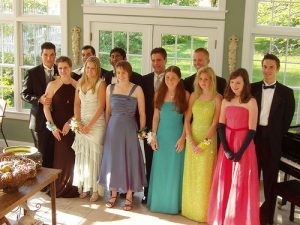
Preprom. Taken by Ken Stokes on May 20, 2005, courtesy Wikipedia Commons.

Preprom. Taken by Ken Stokes on May 20, 2005, courtesy Wikipedia Commons.

Their own daughters aren’t even going to the prom this year, but that didn’t stop Sarah Kass and Julie Lauritsen from stepping up to play fairy godmothers for some other budding Cinderellas.

The two San Marcos High moms have gathered a collection of prom dresses to help young women ease some of the financial burdens of preparing for that night of nights.

Along with appealing to girls who may not be able to afford a new prom dress (which can be hundreds and even thousands of dollars), the women are trying to “teach basic accountability as far as you don’t have to waste things and you don’t have to always buy things new,” Kass said.

Lauritsen started requesting dresses by making calls to friends whose daughters had graduated. They’ve already done their first inventory and have gotten Ablitt’s Fine Cleaners, 14 W. Gutierrez St., to donate its services. This week some volunteers will model the dresses at lunchtime to build up some awareness of their availability.

“We’re doing the best we can to make this as exciting and nonissuable,” Lauritsen said. “We’re trying to make it clear that the kids can spend their money on all the extras and borrow a dress and save their money as we go.

“For girls when they have the manicures and the hair and the makeup, let alone the flowers, it’s just ridiculous. Boys can rent their tuxes, and why can’t girls borrow dresses someplace?”

Why indeed. When Lauritsen explained the idea to Kass, she came on board right away.

“She is just so excited about it for all the years to come,” said Lauritsen.

Originally published in South Coast Beacon on May 2, 2005.

Plotting a course of poise, pageantry

Courtesy Pixabay.com.

Melinda Radsliff sets sights on Miss Teen title

The opportunity to win a share of $20,000 in scholarships and prizes was a temptation. And the fact there was no talent competition or requirement to strut in a swimsuit made it much more palatable for 19-year-old Santa Barbara City College student Melinda Radsliff to participate in the 2005 Miss Teen Santa Barbara pageant competition on March 13.

Radsliff first learned of the pageant when she got a letter in the mail that someone had referred her. She figured it was worth checking out the orientation.

“I filled out an application, kind of as a whim,” said Radsliff, who then learned she had been accepted and that the pageant would provide a training class, which is unusual.

“They kind of went through what day was going to be like,” she said.

The ages of the contestants range from 10 to 19, with Radsliff competing in the Miss Teen Division.

“The girls all seemed really excited about it,” said Radsliff, who was active in the city of Santa Barbara’s Youth Council and ADAP (Alcohol and Drug Abuse Prevention Coalition) while attending La Cuesta Continuation High School and her first year of SBCC. Since she got too old for those activities, she has joined the women’s auxiliary group at her church and is considering applying for SBCC’s student senate.

In order to qualify for the pageant, Radsliff participated in an interview session conducted by Patty Neidert, Santa Barbara pageant coordinator. While there are casual wear and formal wear modeling competitions, personality and interviewing skills are weighted heavily, which was attractive to Radsliff.

“Personality is the number one aspect that each contestant is judged on during all phases of competition,” she said.

The pageant winner will become Miss Teen Santa Barbara, and will represent Santa Barbara and the surrounding communities at the Cities Of America National Competition in Orlando, Fla. More than $60,000 in prizes and awards will be presented at the national competition while each winner enjoys an expense-paid trip of five nights and six days in Orlando.

Montecito Landscape sponsored Radsliff’s pageant expenses.

Originally published in South Coast Beacon on March 24, 2005.

Hospice offers tips for dealing with grief in the workplace

“People who grieve the death of a loved one are going to grieve it wherever they are,” said Hospice of Santa Barbara executive director Gail Rink, adding, and that includes the workplace.

Educating local businesses about how to deal with grief in the workplace and the free services Hospice provides was the subject of a Feb. 24 luncheon.

“It’s a passion for me that you people get a message,” said Rink, as she spoke eloquently about her struggles at work — even in an office that deals daily with death and dying — after her brother was murdered in Georgia. “Death is a very personal event and grief is a very personal event.”

When a coworker suffers a loss, feelings and symptoms of grief can take weeks, months and even years to manifest. “We have triggers in grief that come out of the blue — we can’t control them,” said Joanne Talbot, director of counseling services for Hospice.

There are still ripples in the workplace from the 2002 drowning death of 14-year-old Katie Janeway at Los Banos pool, said acting Santa Barbara Parks & Recreation Director Nancy Rapp. She said she saw a lot of different reactions.

“We had staff who were in denial, we had people who absolutely couldn’t function at all, and everything in between,” said Rapp, who brought in Hospice counselors as part of the response team. They were flexible and provided bilingual counseling when needed, and it was all free, she said.

When one of the counselors in the Department of Rehabilitation died suddenly, Kathy Humphries also brought in Hospice to help. The staff not only had to deal with their own grief, they also had to deal with reactions from that counselor’s clients. “Joanne came in to talk to people about their memories of those people,” said Humphries.

After the death of a coworker, employees can be distracted by emotions that range from confusion to chaotic pain, from dismay to devastation. Hospice advises that organizing an employee support group can provide an avenue for staff to discuss their feelings openly and address ways to deal with grief as a cohesive group.

When a coworker is grieving the death of a loved one, that grief will inevitably be brought into the workplace. Employers should be aware that returning to the workplace can be overwhelming and employees may be tempted to quit for fear of failure or to reduce the pressure on them. Hospice advises employers concerned about the loss of productivity to also consider the alternative cost of replacing an otherwise well-trained employee. Coworkers are told to listen but know they can’t resolve the grief, ask if they can help out, include the grieving person in work projects, ask occasionally about deceased, and alert a supervisor if they seem to be getting worse.

For more information about the free services available from Hospice of Santa Barbara, call 563.8820 or visit www.hospiceofsantabarbara.org.

Grief in the Workplace: What you should know

  • Hidden grief costs U.S. companies more than $75 billion annually, according to the Grief Recovery Institute.
  • Approximately 30 days of work is lost for each employee grieving the death of a loved one.

Grief in the Workplace: What to say

A simple word means a great deal when a person suffers a loss. Saying the “wrong” thing hurts less than saying nothing at all.

Appropriate words include:

“I am sorry to hear about your loss.”

“I heard about your loss. I don’t know what to say.”

A simple shared memory is helpful. “Remember the story you told me about … [the deceased].”

Avoid these phrases:

“You’ll get over it.”

“I know how you feel.” Each person’s loss is unique.

“It was God’s will,” or “God never gives us more than we can bear,” or “At least she isn’t suffering.”

— Source: National Hospice Organization

Originally published in South Coast Beacon on March 3, 2005.