Greeting the Grunion

I couldn’t help but giggle as I watched the silvery fish wiggle into the sand to lay their eggs. These mesmerizing creatures are only found along the coast of southern California and northern Baja California where they lay their eggs on sandy beaches just a few months out of the year.

Growing up in Santa Barbara, my parents took us “Grunion Hunting” at East Beach. I remember the thrill of being up and out on the sand hours beyond my usual bedtime. My sister and I would catch the Grunion in our hands and then throw them back to sea, not really understanding anything about the fish except that they were our tickets to dance around barefoot in the moonlight.

It had been decades since I’d thought about Grunion-until I wrote a story for Seasons Magazine about Santa Barbara Channel Keeper, a local nonprofit that works to protect and restore the Santa Barbara Channel and watersheds.

One of Channel Keeper’s programs, in coordination with Pepperdine University, is “Grunion Greeters,” where volunteers monitor Grunion behavior on local beaches during spawning season. As soon I heard about this I called my Dad, and we volunteered to be “Citizen Scientists,” the title the program generously bestows upon participants.

After one night’s training at UCSB, I was presented with my “Citizen Scientist” tiara and a spawning schedule in a surprisingly moving ceremony. Okay, maybe I really just got a free bag and a pen, but they called us all “scientists,” which is a crowning achievement I would love to report to my college physics professor, if he were still speaking to me, and if I actually took physics in college.

So science isn’t really my academic forte, but citizen science is fun. Unlike many fish, Grunion spawn completely out of the water, so you can actually watch them lay their eggs in the sand, which looks a little like the “Shake Your Booty” dance my son used to do in preschool.

Koss did a delighted version of the “Funky Chicken” along with some excited yelps the first time he saw the Grunion, and I was right back in my own childhood mode. We were lucky to spot Grunion right away during our scheduled monitoring time, 11:20 p.m. While the Grunion can be spotted shortly after high tide on specific nights, our trainers warned us that we wouldn’t always be able to see them-although sometimes the beaches are covered with thousands of Grunion dancing on the sand. The popularity of Grunion runs in some places means that some nights there are more people lining the beaches than Grunion in the run.

That definitely wasn’t the case at Leadbetter Beach, where we did our monitoring last week. We only ran into a few other people-some more interested in human spawning than animal mating behavior-along with a couple who had happened upon some Grunion the night before and were there for an encore, and some tourists who were enchanted by these strange silvery fish. “Whoa, Dude, that was awesome. What were those things,” they asked.

“Professor” Dad and I explained that they were Grunion there to spawn. Providing human or animal predators didn’t intervene, the eggs would remain buried in the sand for their incubation time of approximately two weeks. Then the larvae would hatch and the eggs would be washed out by high waves during tides before the new and full moons.

“Radical man. And to think we just happened upon them during one of the few nights of the year they’re in Santa Barbara. Totally awesome,” was their response.

It is totally awesome, and totally fun. The last expected Grunion runs of the season are at local beaches next week, on July 8 (Wednesday) at 10:40 p.m. and July 9 (Thursday) at 11:10 p.m. I can’t wait.

=

Some tips for Grunion Greeters:

Nature doesn’t always follow our schedule. The scheduled times are for high tide when the runs may begin, but keep in mind that they typically occur within a two-hour period and plan accordingly.

Bring a flashlight but use it sparingly, as less light means more of a chance that the Grunion will spawn.

It can get cold at night, so wear layers and shoes that can get wet.

If you decide to catch the Grunion (Grunion Greeters discourages this) you may only use your bare hands; no nets, hooks or gear are allowed.

For more information on this program visit www.Grunion.org.
Share your Grunion adventures with Leslie@LeslieDinaberg.com. For more columns visit www.LeslieDinaberg.com. Originally published in the Santa Barbara Daily Sound on July 4, 2009.

Giving Back: The Hutton Foundation

logo_hpOne of the biggest obstacles facing local nonprofits is the high price of real estate in Santa Barbara. Luckily Hutton Foundation is helping to fill that gap.

One of Hutton Foundation’s most significant efforts is its Under One Roof program, through which more than 30 local nonprofit organizations are housed in 12 Hutton Foundation-owned and managed properties. “One of the things local nonprofits struggled with the most was finding high-quality, affordable office space,” explains Pam Hamlin, the foundation’s executive director. Hutton Foundation rents the buildings to nonprofits at far below market rates and signs 10-year leases to help give organizations financial stability.

The organizations sharing space run the gamut, from Community Environmental Council to Santa Barbara International Film Festival, United Girls & Boys Club, Alzheimer’s Association and Camerata Pacifica, to name just a few.

The foundation’s broad areas of interest are a reflection of its president, Tom Parker, a Santa Barbara native who returned to town 12 years ago to start the Hutton Foundation, after serving as president of Hutton Companies-one of Southern California’s leading real estate developers-from 1985 to 1995.

“It’s my fault,” says Parker, with a twinkle in his eye. “What happened to me was I was doing grants and I thought, Here’s the homeless shelter, there’s someone who is hungry that needs help, here is an arts organization that is opening children’s minds to music and art and things that will make their life so much better. Who do I donate to? How do I value the two? I realized I couldn’t.”

Consequently, last year Hutton Foundation gave away $4.4 million in grants, donations and assistance to more than 100 local nonprofit organizations.

“We want to be in this community to help the process, to help nonprofits be more effective no matter what their mission-so long as it’s a mission that makes sense,” Parker says.

One thing that made sense, not just to Hutton Foundation but also to the Orfalea and Bower Foundations, was grouping services together to help children arrive in kindergarten better prepared to learn. The three groups are collaborating on an early childhood education and family resource center in Carpinteria. Opening in January at the former site of Main Elementary School, with a Community Action Commission/Head Start preschool at its core, this project represents the next evolution of Hutton Foundation. The foundation also recently made a deal to purchase the former Washington Mutual Bank building in downtown Santa Barbara, and is now evaluating which type of collaborative center will best serve the community.

Parker expected he would be semi-retired when he started Hutton Foundation, but he admits that when a great opportunity comes along he just can’t help himself. “The nonprofit sector intrigues me because there’s so much to be done,” he says. “You can really make a difference in this community.”

Originally published in Santa Barbara Magazine

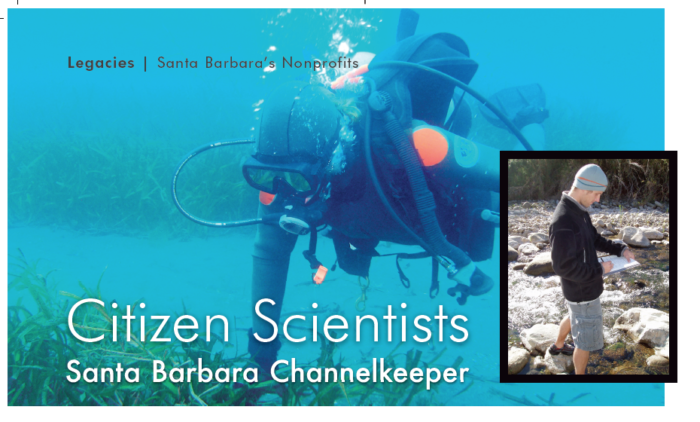
Citizen Scientists: Santa Barbara Channelkeeper

Left–right: A diver maps eelgrass habitat as part of Channelkeeper’s Marine Monitoring and Restoration Program. Watershed program director Ben Pitterle collects data on water pollution levels. Photos courtesy Santa Barbara Channelkeeper, originally published in Santa Barbara Seasons, Summer 2009.

Left–right: A diver maps eelgrass habitat as part of Channelkeeper’s Marine Monitoring and Restoration Program. Watershed program director Ben Pitterle collects data on water pollution levels. Photos courtesy Santa Barbara Channelkeeper, originally published in Santa Barbara Seasons, Summer 2009.

PEOPLE SAY WE’RE ONE OF THE best-kept secrets in town,” says Kira Redmond, executive director of Santa Barbara Channelkeeper. She may be right—but not for long.

Started as an Environmental Defense Center program in 1999, Channelkeeper is now an independent nonprofit, as well as part of one of the fastest growing grassroots environmental movements in the world: International Waterkeeper Alliance.

With just six and a half staff members, buttressed by an army of citizen scientist
volunteers, Channelkeeper works to protect and restore the Santa Barbara Channel and watersheds in a variety of ways, including water quality monitoring, education and community outreach, political advocacy and marine habitat restoration. Perhaps what is most unique about Channelkeeper is that its volunteers work out in the field.

“The field work is kind of what sets us apart,” says Redmond. “We work closely with groups like Environmental Defense Center, Surfrider and Heal the Ocean, but they are advocacy and public education focused. We work with them on a lot of issues, but as far as being out in the field and identifying pollution problems in the creeks or doing habitat monitoring in the channel, there really aren’t other environmental nonprofits that do that.”

Grassroots programs such as “Grunion Greeters” (where volunteers monitor grunion behavior on local beaches during spawning season) and “Stream Teams” (a volunteer-based water quality-monitoring program at the Goleta Slough watershed and the Ventura River) fall under the leadership of Ben Pitterle, watershed programs director.

The grunion program, which is part of a larger study being conducted at Pepperdine University, “is one of the best family-oriented volunteer opportunities I think we have,” says Pitterle. “I did Carpinteria State Beach last summer, and it’s really cool because of the campers. There are just all kinds of kids out playing. It’s fun, a family fun event. I think this is going to be our fifth or sixth year coordinating for this region . . .We get a lot of people who don’t otherwise participate in some of our water quality volunteer opportunities, so
it’s a good way to reach out to a broader group of people—especially kids.”

The “Stream Team,” operating since 2001, has a core group of volunteers. “We go out once a month to collect water samples,” Pitterle explains. “We do that with a few different purposes. One is to collect a baseline of water data to monitor over time to see if things are getting better or worse. Another reason is it’s a great way to reach out to the public, educate and to reach out to the public, educate and train them about watersheds, and help them to become environmental stewards themselves. The third is that looking at
the data helps us identify actual problems, and then we can relay that information to
different public agencies who are responsible for regulating water problems to try to get them fixed.”

Working with public agencies is a big part of what Channelkeeper does. When
budget cuts forced the county to stop its marine monitoring program this past fall,
Channelkeeper rallied its supporters and pitched in thousands of dollars to continue
this important warning service system for surfers, swimmers and beachgoers at 12 county beaches. Santa Barbara city officials also helped pick up the slack by testing at four additional locations.

In addition to partnering with county and city officials, Channelkeeper works closely with researchers at UCSB and Channel Islands Marine Sanctuary, and is collaborating with the state to implement a Marine Life Protection Act that will create a network of marine protected areas or underwater parks along the entire California coast.

“In the work that we do in the field, we work with agencies that don’t have the resources to be everywhere themselves,” says Redmond. “For instance, the city of Santa Barbara has two code enforcement staff. So they’re out there like we are, looking at businesses that might have a high potential to pollute and checking up on them. But they can’t
be everywhere at once, so with budget cuts our role is becoming increasingly important. We have really good relationships with people at these agencies, Basically, they’re grateful to us for helping them do their jobs.”

For more information about Santa Barbara Channelkeeper, call 805/563-3377 or visit www.sbck.org.
n Santa Barbara Seasons Summer 2009.

Originally published in Santa Barbara Seasons Summer 2009. Click below to read the story as it appeared in print.

SB Seasons Summer 2009

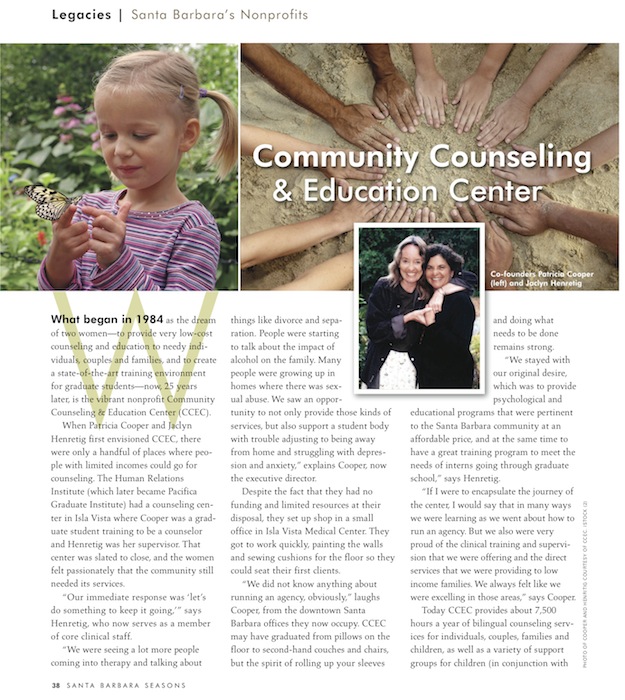
Legacies: Community Counseling & Education Center

Celebrating 25 Years of Service

By Leslie Dinaberg


What began in 1984 as the dream of two women—to provide very low cost counseling and education to needy individuals, couples, and families, and to create a state-of-the-art training environment for graduate students—now, 25 years later, a vibrant nonprofit, the Community Counseling & Education Center (CCEC).


When Patricia Cooper and Jaclyn Henretig first envisioned CCEC, there were only a handful of places where people with limited incomes could go for counseling. The Human Relations Institute (which later became Pacifica) had a counseling center in Isla Vista where Cooper was a graduate student training to be a counselor and Henretig was her supervisor. That center was slated to close and the women felt passionately that the community still needed its services.


“Our immediate response was ‘let’s do something to keep it going,’” says Henretig, who now serves as Clinical Director.


“We were seeing a lot more people coming into therapy and talking about things like divorce and separation. People were starting to talk about the impact of alcohol on the family. Many people were growing up in homes where there was sexual abuse. We saw an opportunity to not only provide those kinds of services, but also support a student body with trouble adjusting to being away from home and struggling with depression and anxiety,” explains Cooper, now the Executive Director.


Despite the fact that they had no funding and limited resources at their disposal, they set up shop in a small office in the Isla Vista Medical Center. They got to work quickly, painting the walls and sewing cushions for the floor so they could seat their first clients.


“We did not know anything about running an agency, obviously,” laughs Cooper, from the downtown Santa Barbara offices they now occupy. CCEC may have graduated from pillows on the floor to second-hand couches and chairs, but the spirit of rolling up your sleeves and doing what needs to be done remains strong.


“We stayed with our original desire, which was to provide psychological and educational programs that were pertinent to the Santa Barbara community at an affordable price, and at the same time to have a great training program to meet the needs of the interns going through,” says Henretig.


“If I were to encapsulate the journey of the center, I would say that in many ways we were learning as we went about how to run an agency. But we also were very proud of the clinical training and supervision that we were offering and the direct services that we were providing to low income families. … We always felt like we were excelling in those areas,” says Cooper.


Today CCEC provides about 7,500 hours a year of bilingual counseling services for individuals, couples, families, and children, as well as a variety of support groups for children (in conjunction with Boys and Girls Club), single parents, and Spanish speaking families. It also offers continuing education classes to the general public. All services are either free or on a sliding fee scale, which Cooper says is becoming more critical in these stressful economic times.


While not a crisis center, CCEC does have ability to react quickly to support the community’s needs. For example, it worked closely with the Red Cross and offered free counseling services to people affected by the Jesusita Fire and prior to that, the Tea Fire.


“To have somebody to listen to you is oftentimes such a gift, and to have somebody’s undivided attention, it’s a gift and it’s something that we all crave,” says Cooper. “None of us ever feel like we get enough of that.”


“It’s truly been a pleasure for us to do the center. When I think of the things that I’m proud of in my life, certainly having the center develop as it has brings me a lot of sense of peace,” says Henretig. “Private practice is wonderful, but there’s only a few people that can afford private practice fees. This makes me feel like it goes out into the community regardless of how much money people have, and that’s a good feeling.”

=

For more information about the Community Counseling & Education Center, call 805/962-3363.

 Originally published in the Fall 2009 issue of Santa Barbara Seasons Magazine. To read the story as it appeared, click here for the first page, and here for the second page.


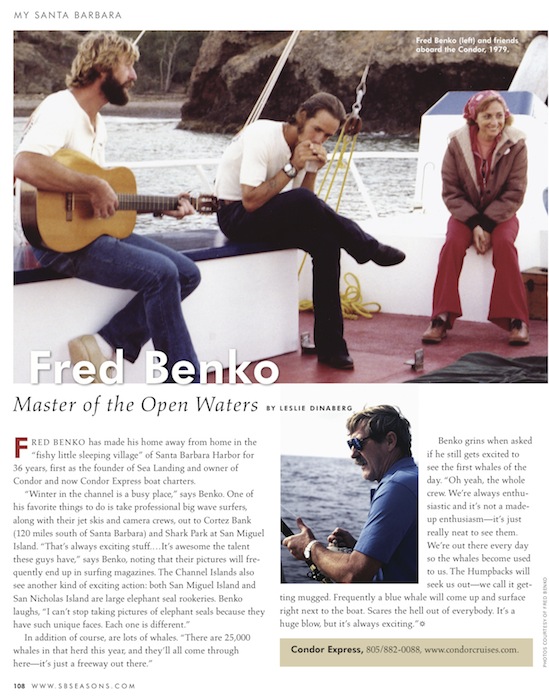
My Santa Barbara | Fred Benko

By Leslie Dinaberg

Fred Benko has been making his home away from home in the “fishy little sleeping village” of the Santa Barbara Harbor, for 36 years, first as the founder of Sea Landing and as the owner of the Condor and now the Condor Express boat charters.

“Winter in the channel is a busy place, says Benko. One of his favorite things to do is take professional big wave surfers, along with their jet skis and camera crews, out to Cortez Bank (120 miles south of Santa Barbara) and Shark Park at San Miguel Island. “That’s always exciting stuff. … It’s awesome the talent these guys have,” says Benko, noting that their pictures will frequently end up in surfing magazines. The Channel Islands also sees another kind of exciting action: both San Miguel Island and San Nicholas Island are large elephant seal rookeries. Benko laughs, “I can’t stop taking pictures of elephant seals because they have such unique faces. Each one is unique.”

In addition there are, of course, lots of whales. “There are 25,000 whales in that herd this year and they’ll all come through here. … It’s just a freeway out there. …

Benko grins when asked if he still gets excited to see the first whales of the day. “Oh yeah, the whole crew. We’re always enthusiastic and it’s not a made up enthusiasm—it’s just really neat to see them. … The neat thing is we’re out there every day so the whales become used to us. The Humpbacks will seek us out—we call it getting mugged. … Frequently a blue whale will come up and surface right next to the boat, just within 50 feet or so right next to the boat. Scares the hell out of everybody. It’s a huge blow, but it’s always exciting.”

Originally published in the Winter 2009/10 issue of Santa Barbara Seasons Magazine. Link to PDF here.


Noozhawk Talks: Leslie Dinaberg Sits Down With Steven Lovelace

Steven Lovelace (Michelle J. Wong / Noozhawk photo)

Steven Lovelace (Michelle J. Wong / Noozhawk photo)

As the owner/director of Santa Barbara Dance Arts (with partner Alana
Tillim), Steven Lovelace has his dance card full guiding the jazz hands and pirouettes of more than 400 young students. Here, he takes a brief intermission to talk to Noozhawk.

Leslie Dinaberg: So Arts Alive! which shared your space, is now gone, sadly. But I hear Santa
Barbara Dance Arts is expanding.

Steven Lovelace: Yes. Now my rent just doubled which is pretty scary. But Alana and I … we’re
a very good mix, she’s definitely a great artist and does wonderful choreography
and really good with the kids. She’s a great teacher … I know that it will be good
for us in the long run …

LD: I know a lot of kids that take classes from you and just love it.

SL: They do. We have 400 kids here. Are they going to do it as a profession? I’ve
got a few kids that could be able to do it. Are they talented enough, absolutely,
but you know it also takes intelligence and hard work. …

Some of it here at my studio is social. I know the girls enjoy dancing, I know they
enjoy what I do in the class, but they also enjoy coming in and being a part of this
group … they interface and they interact and it feels good.

LD: I also think you can’t discount just the physical part of dancing. I think as a
parent you realize that your kids need to run around and burn off energy and they
can’t learn if they don’t do that.

SL: And they don’t learn this in school. This doesn’t happen in school. The level
of dancing or the level of vocal coaching that goes on here of the acting classes,
that is not the same, … Before I started this I have worked in practically every
darn school in the city doing independent things.

LD: Will there be changes at your studio now that you have the entire
space?

SL: Now we’re going to really transform this into a performing arts center. …
We’ve got Kindermusik here that’s very successful. … We’ve still got a gallery
space down there. The performing arts need the visual arts anyway because
somebody’s got to build the set to put on the show. I’m about to do two musicals
in the summertime, so this is all individual artists, costumers are individual artists,
they’re not performing artists, so I work with set designers, costumers.

LD: With this transition, is the name of the whole place going to be Santa
Barbara Dance Arts?

SL: Yes. Arts Alive! doesn’t belong to me. … The Arts Mentorship Program is the
nonprofit part of it. That is our scholarship program and our dance companies,
our performing groups, and a lot of internship stuff. We do everything from teach
them to teach classes, we mentor them to choreograph. They are producing their
own things. … The kids right now they are producing their own student
choreography showcase that will be April 26th at 3 p.m. The senior dance
company produces it under our direction, they put the program together, and they
do auditions and do the ticket sales. They do everything.

LD: That’s great. That’s really good experience.

SL: Yes, it’s great. It’s for 14-18 year old kids. They put their own recordings
together, they edit the music for the kids, they do all that. They outreach to the
kids at the dance school. … They can’t walk out of here just being dancers. It
takes more than that to make it in the dance world and we know that, so I’m
teaching kids to teach. You know one girl, she went out of here, she didn’t want
to be a dance major but she taught dance on the side because she could make
20 bucks an hour teaching dance instead of slinging hash and trying to scrape
tips together so that she could help support herself in school. So that’s a really
nice little skill to walk out of here with.

I’ve got one girl in her senior year in high school she choreographed two
musicals in the school. It pays a couple of grand for her to go in and choreograph
eight dances for a musical. She’s so good at it. So she’s working on
choreography and making some money. I’m hiring her this summer to help me
choreograph my musicals because I can’t do everything. She works here in the
summertime; she’s great with teaching. She’s 19.

LD: How long have you been dancing?

SL: I started when I was 21. I actually was doing aerobics up at Nautilus, and the
gal that was running it there who is now one of my moms.

LD: Cindy Elster?

SL: Yes … she pegged me right away in class. I was very coordinated. … I would
be right up in there in the front just going for it, and I moved really well and she
said, “you know, I think you should become a teacher. You should teach. Half the
class is following you anyway.”

So she started having me come up with her on the thing and do the routines with
her and she was really basically training me to teach. (Then she said) “Why
don’t you go up to City College and take a couple of jazz classes? You’ll get all
that.”

So I went to City College and took Kay Fulton’s jazz class. It was actually an
intermediate class and … at the end of the class she lined up half a dozen of us
and she said, “You need to take ballet, you need to take ballet or modern,” she
got up to me and she says, “you can stay.” So I got to stay in the class. And that
was the beginning of dance for me.

LD: That’s kind of wild, it’s late in life, most people start dancing so
young.

SL: It is late, but it’s more common for men. Men can start late. … They get an
accelerated training. I was up in a community college. I wasn’t in a dance studio
hidden away, I was up in a community college where everybody could see me so
within six months somebody from UCSB saw me and called Alice Contadina who
was the department head at the time and she sent one of the teachers out to a
class to observe me and she said “why don’t you come out here and take some
lessons free of charge?” So I went out to UCSB and I danced out there for a year
and then they offered me a spot in their company. By that time I had quit my day
job and had gotten a job at Julie McLeod’s Dance Warehouse. So that’s my
whole history around here. Julie taught me how to teach.

LD: What’s it like to work with all those little girls?

SL: Well, there’s a lot of different ways I could answer that. … I think it’s really
important to be a place where girls can be empowered, which is one of the big
reasons we want to mentor girls and give them social skills because every time
they don’t make that audition it’s a skill to know how to take that rejection of not
getting what they want. The first time you don’t get into the college that you want,
if you don’t get that job that you think you’re perfect for that they give to someone
else.

… We really, really feel strongly that we’re providing a service, not just in giving
excellence in dance training or contemporary dances but we’re giving your kids a
community that they can feel good about. And the kids love being here.

… And I know that some of that is because it’s a great experience for them to be
here, but I have to say we provide this forum where they can be seen at
whatever talent level they are at or whatever their interest in dance is. Whether
they are just here for an after school class or they have an aspiration to go on
and go to Broadway and be in music videos or be a director or whatever. It’s here
for them and we want to be there. We take them all seriously. We don’t talk down
to the kids here. We really believe in that.

LD: If you could pick three adjectives to describe yourself, what would they
be?

SL: Holistic, resourceful, appreciative

Vital Stats: Steven Lovelace

Born: Santa Barbara, on June 6, 1957

Family: Partner Gary Clark

Civic Involvement: Santa Barbara’s Summer Solstice, Lit Moon Theatre
Company; Santa Barbara Dance Alliance: Arts Mentorship Program; Fund for
Santa Barbara

Professional Accomplishments: Co-owner/director Santa Barbara Dance Arts;
Co-owner/director Stage Left Productions; Teacher at Arts at Laguna; Former
Artistic Director and Artist in Residence with Santa Barbara’s Summer Solstice;
Dancer with Repertory-West Dance Company, Santa Barbara Dance Theatre,
Santa Barbara Civic Light Opera, Bill Evans Dance Company, and Nora
Reynolds Dance.

Best Book You’ve Read Recently: (laughs) “Twilight. It’s not like they are the
best-written books in the world but there’s something very engaging about those
characters.”

Little-Known Fact: “I like to be alone.”

Originally published in Noozhawk on April 12, 2009. Click here to read the story on that site.

Noozhawk Talks: Leslie Dinaberg sits down with Hap Freund

(Michelle J. Wong / Noozhawk photo)

(Michelle J. Wong / Noozhawk photo)

Certainly the hardest working man in (local public access) television, the
Santa Barbara Channel’s executive director Hap Freund took some time
out of his busy day to talk media matters with Noozhawk’s Leslie
Dinaberg.

Leslie Dinaberg: How did you get started in public television?

Hap Freund: I moved to Hawaii in 1980, with my wife who had a clerkship in the Hawaii
Supreme Court … I got a job with the mayor’s office. I was in the office of human
resources and I was in charge of special projects in social services but I wasn’t supposed
to spend any money and all I had to do was monitor a bunch of federal grants and it was
totally boring. … Somehow it came to me that there was this access channel that if you
produced television for it you could get your programs on TV.

…. I got together with some friends of mine and we did a documentary on homeless in
Hawaii. And after I made that documentary I then went to the Junior League and I got a
$50,000 grant to produce TV programs, to do the video training and to produce local
documentaries on social issues. … Over the course of about two years we did 18 half
hour documentaries. So I did that through my job working for the mayor’s
office.

…It was kind of a back door. I had never done television. I had been a lawyer, and a
community organizer and done a lot of work in social issues, but because the mayor
didn’t want to spent any money. …I could do anything I wanted pretty much in social
services as long as I didn’t spend money. So I did this and didn’t cost her a cent.

So that’s how I got into it. Then I moved to Ashland, Oregon when our son was about a
year and a half and I did independent work. I did a documentary for NOVA that took a
year. I wrote an article for Sports Illustrated on a wildlife forensic lab in Ashland … it
was in the swimsuit issue, so the joke was it was in the most widely read Sports
Illustrated of the year, except nobody read my article. (Laughs) But part of that, I took
that article and I wrote a grant to do a film on wildlife forensics.

LD: And you were in Seattle before you came to the Santa Channels when it switched
from belonging to Cox to being a nonprofit.

HF: Yes. We became a nonprofit in January of 2003 and I started up a couple of months
before that to set up the bylaws and the policies and personnel plan.

… One of the things I really like is what’s happened in video is it’s democratized, even
more so now because you can shoot a video with your phone. It’s been an incredible
leveler and it’s just democratized so much, and You Tube helps too. You can get the
word out. What we do is so you don’t have to have a network to get the word out. And
that’s one of the things I like about this (public television) is it’s a vehicle for people to
have their opinions. … I think that’s the cornerstone of democracy is having diverse
opinions and people hearing things that are uncomfortable.

… I always think we feel a real niche with cable. Channel 17, that’s the public access
part, with Channel 21 … I have a very broad definition of education, so I look at anything
that’s culture or arts also as educational.

LD: You are also doing things with nonprofits.

HF: Now we have a grant from Orfalea Foundation to do short spotlights on nonprofits
that are out in the field and we’ve got a grant from the Santa Barbara Foundation where
we’re trying to focus a lot on doing production work for nonprofits. I think if there’s a
direction we want to go in, we really see ourselves as being the media arm for nonprofits.

LD: That’s great. Especially because I know everybody is struggling with money to
spend on things like that.

HF: Yes and we’re inexpensive and we give them something they can multipurpose
because it isn’t just going on TV, we have a video-sharing site called SBChannels.net,
and we have all these videos. … They can link to it, they can send emails out.

LD: I hear you’re moving into the old Univision buildings in Goleta?

HF: Yes, it’s very exciting. I mean I love to be downtown but the Univision building in
the long run and even in the short run saves us money and it’s a bigger facility for less
money. And it’s a better studio. … We can have an audience of 49 people and so one of
the ideas I have is … we want to market this to nonprofits and say if you’ve got an event
if you want to have a town hall or a forum, why don’t you do it at our place because you
can put it on TV live, you can have people calling in and interacting.

… Also the other part is that I think our major mission is to facilitate and make it easier
for people to get their content out. So we look at that in terms of both the media that we
offer, …it’s both the production and the distribution. Because a lot of people just bring us
content more and more … they don’t have to produce it here to get it on the air. I am
happy to have all of that stuff.

LD: Do you have any favorite moments since you’ve been here?

HF: I could write a novel about this place. (Laughs) It’s never dull … My favorite
moment was we were producing something in the smaller studio for the film festival with
the film festival people and the police were getting ready to do a program in the other
studio and they brought some drug dogs, drug sniffing dogs in who went nuts. I saw all of
these people looking around kind of nervously and what it was was they had also brought
in some marijuana to hide behind the couch to show the dogs off, but I think a lot of
people were starting to get nervous.

… But really one of my favorite things is just knowing that people watch. When
somebody comes up to me and says, “thank you so much for showing the youth
symphony. It was so wonderful for all those kids to see their hard work on television.”
That appreciation that goes a long way.

LD: That’s great. With print media struggling, do you see an expanded or different role
for television?

HF: That’s a good question. I think the print media people who are sending the reporters
out with cameras, like the Ventura County Star or something, I think they get it. I don’t
think we compete with print media. I think the more information people have the better.
… I think there’s going to be some convergence. But I think what we need is more good
reporting and so I think the people who do print media, it’s really different than bloggers.
Bloggers can just repeat rumors. With journalists you get both sides of the story and I
think we’re losing some of that. That’s what I worry about the Internet, you can have an
opinion and people treat it as fact. … I would hate to see print journalism gone, but I
hope that what we need is good reporting. I think unbiased reporting, both sides of the
story, get the facts straight and let people make up their mind. I think that’s what’s most
important.

LD: What else do you do when you’re not working?

HF: I like to spend time with family, watch basketball, exercise, and travel though it’s
getting harder to afford. I’m a huge basketball junkie, especially Duke.

LD: If you could pick three adjectives to describe yourself, what would they be?

HP: Enthusiastic, issue-oriented, and upbeat

Vital Stats: Hap Freund

Born: July 31, 1943 in St. Louis, Missouri

Family: Wife Claudia Chotzen, sons Zach (age 22 and a senior at Stanford) and Willy
(age 18 and a senior at Laguna Blanca).

Civic Involvement: “This takes a lot of my time. This is not a 40-hour a week
commitment, so I would say that my civic involvement really is through work and trying
to get organizations in the door and caring about what they do.”

Professional Accomplishments: Executive Director of the Santa Barbara Channels,
former lawyer and community organizer, award-winning documentary
filmmaker.

Best Book You’ve Read Recently: “Shining City,” and “The Story of Edgar Sawtelle.”

Little-Known Fact: Freund was once one of the leading experts in the country on lead
paint poisoning in children. He also holds the patent on a design for a carrot-shaped
flashlight.

Originally published in Noozhawk on March 29, 2009,  click here to see the link.

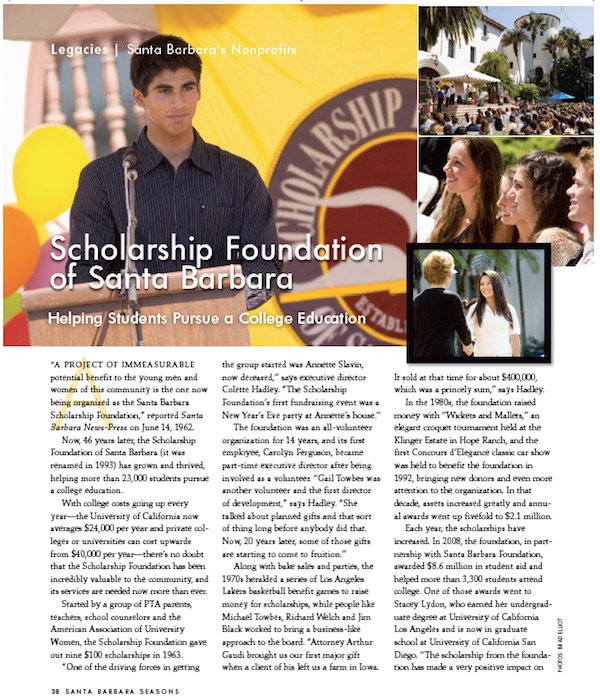
Legacies: Scholarship Foundation of Santa Barbara

Scholarship Foundation of Santa Barbara, photos by Brad Eliot, story by Leslie Dinaberg. SB Seasons spring 2009.

Scholarship Foundation of Santa Barbara, photos by Brad Eliot, story by Leslie Dinaberg. SB Seasons spring 2009.

Helping Students Pursue a College Education

By Leslie Dinaberg

“A project of immeasurable potential benefit to the young men and women of this community is the one now being organized as the Santa Barbara Scholarship Foundation,” reported the Santa Barbara News-Press on June 14, 1962. 

Now 46 years later, the Scholarship Foundation of Santa Barbara (it was renamed in 1993) has grown and thrived, helping more than 23,000 students pursue a college education. 

With college costs going up every year—now the University of California averages $24,000 per year and private colleges or universities can cost upwards from $40,000 per year—there’s no doubt that the Scholarship Foundation has been incredibly valuable to the community and its services are needed now more than ever.

Started by a group of PTA parents, teachers and counselors, and the American Association of University Women, the Scholarship Foundation gave out nine $100 scholarships in 1963. 

Scholarship Foundation of Santa Barbara, story by Leslie Dinaberg. SB Seasons spring 2009.

Scholarship Foundation of Santa Barbara, story by Leslie Dinaberg. SB Seasons spring 2009.

“One of the driving forces in getting the group started was Annette Slavin, now deceased. Two of Annette’s children are still in town—realtor Steve Slavin and La Cumbre Junior High Principal JoAnn Caines,” says executive director Colette Hadley. “The Scholarship Foundation’s first fundraising event was a New Year’s Eve party at Annette’s house.”

The foundation was an all-volunteer organization for 14 years. Carolyn Ferguson was the first employee, part-time executive director, after being involved as a volunteer, says Hadley.  “Gail Towbes was another volunteer and the first director of development. … She talked about planned gifts and that sort of thing long before anybody did that. Now 20 years later some of those gifts are starting to come to fruition.” 

Along with bake sales and parties, the 1970s heralded a series of Los Angles Lakers Basketball benefit games to raise money for scholarships, while people like Michael Towbes, Richard Welch and Jim Black worked to bring a business-like approach to the board. “Attorney Arthur Gaudi brought us our first major gift when a client of his left us a farm in Iowa. It sold at that time for about $400,000 which was a princely sum,” says Hadley.

Santa Barbara Seasons Spring 2009 cover.

Santa Barbara Seasons Spring 2009 cover.

In the 1980s, the foundation raised money with “Wickets and Mallets,” an elegant croquet tournament held at the Klinger Estate in Hope Ranch, and in 1992 the first Concours d’Elegance classic car show was held to benefit the foundation, bringing new donors and even more attention to the organization. In that decade assets increased from $2.4 million to $16.5 million and annual awards went from $363,484 to $2.1 million, buoyed by gifts of $2 million each from the Cavalletto Family and Lillian and Lawrence Smith.

Each year the scholarships have increased. In 2008 the foundation awarded $8.6 million in student aid and helped more than 3,300 students attend college. One of those awards went to Stacey Lydon, who got her undergraduate degree at University of California Los Angeles, and is now in graduate school at University of California San Diego. “The scholarship from the foundation has made a very positive impact on my professional progress,” says Lydon.  

“With the scholarship I was able to take my dream internship with Network for Africa, and not have to worry about juggling a demanding school schedule, hours at an internship and time at a job, which may pay the bills but not really provide any career-enhancing experience.  I have been working with Network for Africa for almost a year now, and was able to travel with them to Rwanda this past summer.  … I couldn’t have done it without the scholarship.”

According to director of development Rebecca Anderson, 83 percent of Scholarship Foundation recipients complete their intended degree, compared to the national average of 52 percent. “Having that community foundation behind you is incredibly motivating,” she says.

Support from the Scholarship Foundation allowed Dr. Daniel Brennan to come back to his hometown as a pediatrician. “I feel so fortunate to be able to care for the children in the very community in which I was raised,” he says.  “It is an amazing privilege to care for the children of my former classmates.  It is even more special that I am able to practice pediatrics side by side with my own childhood pediatrician, Dr. Ernest Kolendrianos.”

That kind of personal touch is evident in the way the foundation does business—every eligible student is personally interviewed by either a board member or a trained volunteer—and as Hadley points out, these days it’s not just very low income families, but also middle income families that need assistance to afford college. “We do our best to make sure that everyone that wants to go to college has the opportunity to go.” 

Originally published in the Spring 2009 issue of Santa Barbara Seasons Magazine.

Click below to read the story as it appeared in print.

Seasons_SP09_FCR + Legacies

The “W’s” of Working Out

stockimages, freedigitalphotos.net

stockimages, freedigitalphotos.net

The symphony of treadmills and weight machines always gets a little louder this time of year-whether it’s a New Year’s resolution to lose weight, a few too many latkes or too much eggnog, or the gift of a gym membership-getting fit is one of the most popular goals at the start of each year. Here are some options to suit every workout style.

Who: The Gym Rat

What: Santa Barbara Athletic Club has awesome equipment and a vast variety of workout options, including Pilates, Spinning, indoor and outdoor weight rooms, swimming, squash and racquetball.

When: Monday – Thursday: 5:00 am – 10:30 pm; Friday: 5:00 am – 10:00 pm; Saturday: 6:00 am – 8:00 pm and Sunday: 7:00 am – 8:00 pm.

Where: 520 Castillo Street.

Wear: For a guilt-free, post workout treat, head to the new supplement/protein bar at Montecito Athletic Club (40 Los Patos Way, Montecito).

Who: The Mom

What: Enlist with “General” Stacey Cooper on a BootyCampSB mission to “raise your fitness level and your booty to new heights.”

When: Kids work out for free at the Parent-Child Booty Camp every Monday from 4:30 to 5:30 p.m.

Where: Girsh Park, 7050 Phelps Road, Goleta.

Wear: Head to Eddie Bauer (130 S. Hope Ave., La Cumbre Plaza) for the “essential daypack bottle” loaded with all the gear you’ll need to survive a day with the kids.

Who: The Beach Babe

What: Try Moms in Motion’s Stand Up Paddle Board team for “the most fun you can have on the water-while improving your balance, upper body and core strength.”

When: Sundays at 8 a.m.

Where: Leadbetter Beach, Shoreline Drive and Loma Alta.

Wear: You can rent equipment or splurge on a Kialoa -Nalu Stand Up Surf Paddle from Paddle Sports of Santa Barbara (Santa Barbara Harbor).

Who: The Couch Potato

What: Try a Jazz Dance or Hip Hop Class at Santa Barbara Dance Arts (formerly Santa Barbara Jazz Dance Academy). You’ll have so much fun you won’t even realize you’re working out till the pounds start sweating off.

When: Jazz Mondays at 6:45 p.m.; Beginning/Intermediate Hip Hop Wednesdays at 7 p.m.; Advanced Hip Hop Thursdays at 7 p.m.

Where: 1 N. Calle Cesar Chavez #100.

Wear: Pick up your dancing shoes at Harlequin’s Theatrical Supply (17 W. Gutierrez St.).

Who: The Yogini

What: Yoga Soup has a fun variety of classes, with owner Eddie Ellner’s good karma philosophy of “pay what you can,” for his eclectic “soupy mix” of classes.

When: Tuesdays at 5 p.m.; Tuesdays; Wednesdays, Thursdays and Fridays at 6:30 p.m.; Saturdays at 10:30 a.m.; and Sundays at 8:30 a.m. and 5:30 p.m.

Where: 28 Parker Way.

Wear: Head to Drishti (130 E. Canon Perdido St.) for a Manduka eKO eco-friendly yoga mat and a comfy pair of their “Beyond Yoga” pants or capris that are so stylish you’ll want to wear them all day long.

Who: The Jock

What: At Dr. Bob Wilcher’s Killer B Fitness, this Chiropractor/Personal Trainer will whip-we mean motivate-you into shape whether your goal is to run a marathon or sweat off a few sizes in his few frills, no mercy private gym.

When: By appointment, call 805-448-2222 for information.

Where: 126 Powers Ave.

Wear: Lucy (3825 State St., La Cumbre Plaza) offers a new “core power collection” of tops stay soft, comfortable and dry, no matter how much you sweat.

Who: The Hiker

What: The Santa Barbara Sierra Club offers a variety of hikes for every fitness level from the occasional hiker to the diehard backpackers.

When: Hikers meet weekly on Wednesday nights at 6:30 p.m. and Friday nights at 6:15 p.m., destination are chosen at the meeting points.

Where: Santa Barbara Mission, Laguna and Los Olivos Streets. Also visit www.santabarbarahikes.com for additional hikes scheduled every weekend from a variety of locations and terrains.

Wear: Head to Santa Barbara Oufitters (1200 State St.) to pick up one of Ex Officio’s “Insect Repellent” hats, which are great for those sunny, buggy hikes on the beach. Plus, rain or shine, you can take a trek up their indoor climbing wall.

Originally published in Santa Barbara Magazine in 2009.

Noozhawk Talks: Leslie Dinaberg Sits Down With Kendre Sanborn

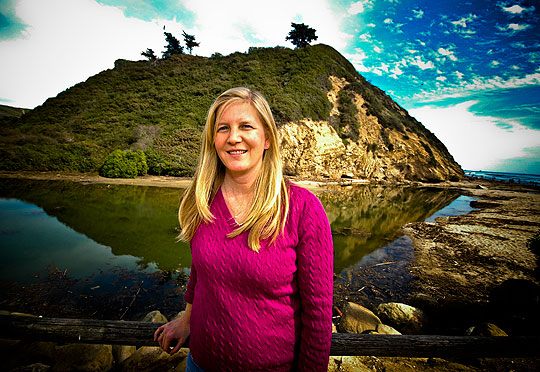
Kendre Sanborn, pausing for a quick reflection at Arroyo Burro Beach, is about as an involved school parent as one can be. (Michelle J. Wong / Noozhawk photo)

Kendre Sanborn, pausing for a quick reflection at Arroyo Burro Beach, is about as an involved school parent as one can be. (Michelle J. Wong / Noozhawk photo)

As president of both the Santa Barbara Area PTA Council and the Hope School
District Educational Foundation, not to mention the busy mother of three children,
Kendre Sanborn certainly has her hands full. Here she tells Leslie Dinaberg
about how she juggles it all.

Leslie Dinaberg: How did you get involved with the area council PTA?

Kendre Sanborn: When I was the Vieja Valley PTA president I hadn’t been on the board before. I knew nothing but wanted to get involved. I thought the best way to learn about PTA was to go through all the trainings that PTA offers and so I kept
seeing the same volunteers over and over again. And when there were issues
going on with our PTA they were really helpful and came to my aid whenever I
needed anything.

LD: And now you’re heading up the whole thing. What area does that
include?

KS: There are 27 schools currently, from Montecito all the way to Goleta. I don’t
know everything that it entails yet because I’m still kind of learning everything,
but we basically meet to make sure that everyone is up to their standards, …
they have all these criteria that they need to follow to be in good standing. It’s our
board’s job to make sure that all those groups are in good standing. Then
another thing the area council does is send out information to the presidents
about legislation that is going on. There are a lot of areas that we cover; we’re
giving information constantly to these PTA presidents.

LD: Is there anything interesting legislatively that is going on?

KS: Right now they are really pushing that the governor doesn’t cut budgets to
schools. They’re also looking at the stimulus package and they’re really keeping
an eye on that, because if each individual state gets money then PTA really
wants to make sure that the schools get money.

LD: You’re also president of the Hope School District Educational Foundation.
What does that group do? (Laughs) <Editor’s Note: Leslie Dinaberg is also on the
board of the Hope School District Educational Foundation>

KS: We do fundraising to enrich the educational programs at Hope, Monte Vista
and Vieja Valley Elementary Schools. And we also work to encourage
collaboration and communication among the three campuses. Right now we’re
working on our Fourth Annual Golf Classic, which will be held May 15th at Glenn
Annie Golf Course.

LD: And what is that fundraiser for?

KS: Well, the state and federal budget cuts have forced our school district to cut
funding for our library program in half. So the golf tournament money will be
used to help restore the library program.

LD: Great cause. Now you also volunteer at your kids’ schools, right?

KS: Yes, my two older kids go to Santa Barbara Middle School and I volunteer
once a week to help serve lunch and then I was helping as an ambassador,
where we talk to potential parents.

LD: What do you do at Vieja Valley?

KS: Wow talking about the things I do makes me realize I have a lot on my
plate. I count and deposit PTA money, volunteer in the classroom once a week,
and I’m on the committee for the honorary service awards. We will soon be in the
process of finding people to honor at our school.

LD: What about the area council event?

KS: The area council usually has a Reflections reception, which is a really neat
thing. They usually put on a reception for all the winners for our area. (The
National PTA Reflections Program is an arts recognition and achievement
program for students, which provides opportunities for students to express
themselves creatively and to receive positive recognition for original works of art.)
Then there’s also an honorary service award event held once a year. This is an
event for all the volunteers who are recognized at their schools to also be
recognized at a community level.

And also with Reflections, if you’re a winner for the area, then the district has a
reception as well, so all of those people attend, and it’s really neat to be
recognized.

LD: Let’s shift a little bit to talk about you. I know you’re really busy with volunteer
work now, but what did you do professionally before you had kids?

KS: I finished my master’s in clinical psychology and I was working on my hours,
you have to complete a certain amount of hours to be certified. During that time I
got married and had my first child. I was fortunate enough to be able to stay
home with him. I really wanted to stay home and be with my baby. So from then
on I stayed home.

LD: I know you’ve traveled a lot. What are some of your favorite trips?

KS: Africa. And more specifically I really like Kenya and Tanzania; also going to
the Artic was really neat. We’ve been to Japan, which was pretty cool. Next week
we’re on our way to Antarctica. I haven’t been before but that’s one of my
husband’s favorite places. … We took Andrew on his first international trip to
Australia and New Zealand when he was 14 months old, and he traveled so well
it made me realize, “wow, we can take him anywhere.” Then the other two just
grew up doing it. They learned how to behave on a plane.

LD: And so do you guys take a big trip every summer?

KS: Yeah. … The funniest thing. Eric was traveling a lot for business at one point
and he had a lot of miles, and he was taking Andrew to some places to help gain
a lot of miles. During the early 90s, a lot of airlines said if you fly here you get
triple the miles, so he would take Andrew to Japan for the weekend just to get
miles, and of course to see Japan. He ended up acquiring a lot of miles.

One time Andrew and I were on a trip and we were coming through Atlanta on
our way home and I was checking in at the counter and the agent said, “Okay our
flight is really full but we can upgrade Andrew, but you’ll be in coach.” And I said,
“okay fine, as long as I’m kind of close to first class.” And they said “fine, so
where is Andrew? And I said, “He’s down here.” He was seven or something and
he was so low to the ground they couldn’t see him. The agent was laughing
saying “oh my gosh; the flight attendants are going to love this. Will he be okay
by himself?” And I said, “oh absolutely”. Our kids have traveled a lot.

… For spring break we’re going to go to Bhutan and Nepal.

LD: Is there any place you’ve never been that you’ve always wanted to go
to?

KS: Yeah, I want to go to India.

LD: Do you guys totally have it down in terms of what to pack? Five people is a
lot of people.

KS: You would be shocked. When we check into hotels people are like “oh, is
this everything?” And we say yes and they are amazed. We totally have it down.
Usually we travel with about two suitcases.

LD: That would impress my husband.

KS: And two backpacks. Now it took a while to get to that (laughs) but when you
start traveling a lot you learn a lot of tricks. For instance you only pack for about a
week, and then you learn to find a place to do laundry and obviously you want to
find the least expensive places to do your laundry, especially with five people.
But sometimes you have to pay high prices but it’s a great way to not over pack. I
definitely miss my shoes when I’m gone.

Vital Stats: Kendre Sanborn

Born: December 5, Santa Monica, California

Family: Husband Eric, children Andrew (13), Emily (11) and Claira (9)

Civic Involvement: Area council PTA President, HSDEF President, Volunteer
Vieja Valley School, Santa Barbara Middle School

Professional Accomplishments: “I’ve definitely seen how organizations work
and what it is like going into an organization and being able to know what I need
to do and get it done. And also being able to get along with people and be
respectful of their issues.”

Best Book You’ve Read Recently: “I love to read. I’m reading ‘The Shack.’ It’s
really interesting because it’s kind of religious but not in a dominating way, it is
not pushing one particular religion. It’s about a way to live your life and relate to
other people.”

Little-Known Fact: “My husband and I have made more than 2,000 loans to
individuals and their families all around the world who are in less fortunate
circumstances than our own – mostly through KIVA.org, a San Francisco based
micro lender.”

Originally published in Noozhawk on February 17, 2009. Click here to read the article on that site.