Cocktail Corner: Wine Tasting Comes to Goleta

Bacara tasting room, courtesy of Bacara

Bacara tasting room, courtesy of Bacara

A spirited toast to all things alcoholic! By Leslie Dinaberg

The Goodland of Goleta got even better recently with the addition of a new wine tasting room at Bacara Resort & Spa.

Dubbed The Foley Food and Wine Society Experience (Yes, it’s a mouthful, but they’ve also got a LOT of great wines to back it up!), my husband and I were treated to the full Foley experience this week, and I have to say, it was a wonderful way to spend a summer evening.

Thanks to the gracious hospitality and good humor of assistant manager Lila Brown, we were able to taste some delectable wines, as well as learn about several of Foley Family Wines’ properties at the same time.

First up was a Chalk Hill 2010 Sauvignon Blanc, which had a refreshing citrus taste that I really liked. Not only was the wine good, but when Lila gave us a photographic tour of Chalk Hill Estate Vineyards & Winery (on the eastern edge of the Russian River Valley, south of downtown Healdsburg in Sonoma County) including the onsite chef’s culinary garden, stables and Olympic-sized equestrian pavilion, a plan to visit immediately went on my bucket list. What a gorgeous place! Continue reading

Cocktail Corner: Wine and Cheese Please!

Cest Cheese (courtesy photo)

It’s not wine … but C’est Cheese is giving away a free cup of tomato soup with each grilled cheese sandwich on National Grilled Cheese Sandwich Day (April 12)

A spirited toast to all things alcoholic! By Leslie Dinaberg

I just returned from a lovely trip to Paris, where the wine is wonderful as well as less expensive than the coffee, and the cheese is nothing short of ambrosia.
I am a firm believer, as M.F.K. Fisher said, that, “Wine and cheese are ageless companions, like aspirin and aches, or June and moon, or good people and noble ventures.” Though my husband forbid me from filling our suitcases with Camembert, Reblochon and Tomme de Savoie (so I filled my belly instead), my appetite for cheese was not completely sated.

So I was thrilled to discover that today is National Grilled Cheese Sandwich Day. What better way to fight the post-vacation blues than to celebrate this traditional American treat and pair it with some of our favorite local wines?

Here are a few options: Continue reading

Santa Barbara Spotlight: Photographer Patricia Houghton Clarke

By Leslie Dinaberg (originally appeared on the Santa Barbara SEASONS Blog)

Despite her lifelong fascination with light, shapes and colors—not to mention an impressive list of awards and exhibitions, both internationally and closer to her hometown of Santa Barbara—photographer Patricia Houghton Clarke has only been focused on photography for a short time.

"I Love You," by Patricia Houghton Clarke

“I Love You,” by Patricia Houghton Clarke

“I’ve been photographing all along, but really only started taking it seriously about ten years ago, where I was producing bodies of work and starting to show my work,” says Clarke, whose ready smile and approachable style surely does wonders to put her subjects at ease. Continue reading

CAMA’s Masterseries presents The Kalichstein-Laredo-Robinson Trio


THE KALICHSTEIN-LAREDO-ROBINSON TRIO, photo by Christian Steiner (courtesy photo)

THE KALICHSTEIN-LAREDO-ROBINSON TRIO, photo by Christian Steiner (courtesy photo)

CAMA’s 2014 Masterseries at the newly restored Lobero Theatre (33 E. Canon Perdido St.) opens with a concert by The Kalichstein-Laredo-Robinson Trio on Saturday, January 11 at 8 p.m. Three and a half decades after its debut at the White House, The Kalichstein-Laredo-Robinson Trio remains America’s Premier Piano Trio, featuring Joseph Kalichstein on piano, Jaime Laredo on violin and Sharon Robinson on cello.

Carnegie Hall commemorated their 30th Anniversary in 2007 with a concert in Stern Auditorium. One of today’s most beloved ensembles, these three artists share their passion for music with audiences worldwide. Tickets are on sale now at the Lobero Theatre Box Office; call 805/963-0761 or visit lobero.com.

Program:

Franz Schubert: Notturno (Adagio) in E-flat Major, Op.148 (D.897)
Felix Mendelssohn: Piano Trio No.2 in C minor, Op.66
Johannes Brahms: Trio in B Major, Op.8, rev.1891

—Leslie Dinaberg

Originally published in Santa Barbara SEASONS on December 30, 2013

Olympic Gold Medalist Todd Rogers: Hometown Hero Hopes To Bring Home Another Gold From London

By Leslie Dinaberg

Leslie Dinaberg: The 2012 Summer Olympics in London will be your second Olympics. How is it different preparing this time around?

Olympian Todd Rogers, photo by Mitchell Haaseth/NBC

Todd Rogers: I wouldn’t say it feels different.  … As far my training and that kind of thing go, its business as usual. There’s no real reason for us to change anything dramatically. The only thing that I try and always keep in mind is that I’m getting older, so just being intelligent about stretching and icing and just taking care of my body because I’m not as durable as I was four years ago.

LD: What percentage of your training is running and lifting versus actually playing volleyball?

TR: The majority these days is probably more running and lifting. I start lifting in November and from mid-October I’ll be doing some kind of running or some kind of exercise that has a cardio component. We (Rogers and partner Phil Dalhausser) really don’t start hitting the ball around until late January early February, there’s just not much reason to do so at a really early stage. The season gets started in April but for us the Olympics are not until August.


I hear of people hitting the ball around in November and I go, “Are you crazy?” But to each his or her own, I guess. I’m kind of a burnout athlete, I’ve discovered that about myself. I just can’t do that much, otherwise I will be sick of the sport.

LD: But you still travel and compete in other places before you go to London.

(Editor’s note: since this interview in April, Rogers/Dalhausser won their third straight gold at the 2012 Brasilia Open and retained their Shanghai Grand Slam title. They are currently competing in Beijing. For a complete tournament schedule click here.)

When you are doing all of that traveling, how much of those places are you getting to see? Are you getting to play tourist at all?

Olympian Todd Rogers, photo by Mitchell Haaseth/NBC

TR: At some of them we have. A lot of them are re-stops, so for example I’ve been to  Klagenfurt, Austria, which is probably the best tournament in the world, probably ten times. I’ve done well most of the time but not all the time, and when I haven’t done well I’ve gone out and checked out the city. It’s on a lake so I’ve gone on boats and whatnot… When we were in Berlin I made it a point to just kind of check out the surrounding area. There have been a few stops where I stay a couple of days extra just because it’s a really cool place. Like in Prague, there are some just really neat areas in Prague that are really old and I make a point of making sure that I get to those and check them out and try to find something new in those areas.

LD: I know you grew up in Santa Barbara and went to San Marcos High School and UCSB. Growing up near the beach is so unique. When you are playing volleyball internationally is it different playing on an actual beach versus some place where they bring sand in?

TR: I would say yes, absolutely. On an actual beach, if you know the beach, you have a consistent wind. The sand tends, not always, but tends to be deeper. When they bring in the man made court they are looking at trying to save money and it costs money to bring sand so they are going to put really the minimal amount of sand they can put in to save costs … it’s much more of a jumper’s sand.

There’s definitely a difference and especially if you’re in a city between buildings. The winds are really weird. It could be going one way and then ten minutes later it could be going the other way because just the way it goes through the buildings can change dramatically really quickly. Whereas on the beach, if you’re at East Beach, most of the time the wind in the afternoon blows out of the northwest. I know that.

LD: When did you start playing beach volleyball?

TR: When I was at San Marcos High School. John Lee was the coach there for the volleyball team; he’s also an English teacher.  He encouraged all of us freshman boys, actually pretty much all of his volleyball protégées to just go down to East Beach and play. He said, “You’ll become a much better indoor player if you go and play on the beach.”

It’s a lot of fun. We were all 14-year-old boys. You’ve got lots of girls in bikinis down there, you’ve got your shirt off, you’re running around in your shorts—it was a pretty easy sell for us! 

So a bunch of us just started going down there after my freshman year and I was 14-years-old and I fell in love with it right away. And I haven’t stopped playing. I didn’t stop playing when I was in college and just kept going with it.

LD: I know you have a son and a daughter (Nate, age 11 and Hannah, age 13). Are they volleyball players?

TR: My daughter loves it; she actually particularly loves beach volleyball. My son enjoys playing beach volleyball but he’s not super into it. We have a court in our backyard (Rogers and his wife Melissa live in Solvang) so we actually play a fair amount of family volleyball. It used to be kind of even, but my daughter at 13 has gotten a lot better in the last year. My son at almost 11 has not. So it’s kind of getting to an unfair level, but he’ll still play. It’s a fun family activity.

LD: You must have other people come and use your court.

TR:We always have people over and I usually have one or two foreign teams that are friends of ours that

Olympian Todd Rogers, photo by Mitchell Haaseth/NBC

play on the international tour and they come to California to train and we’ll come up here. We’ll have a little barbecue after and just kind of hang out, have a few beers, that kind of thing.

We have some friends in town that kind of hang out, their kids come over and play with our kids there or we’ll set up a few trainings with some of the kids and there’s a couple of adults that like to come over and hack it, have a good time. Usually it involves a couple of beers, though. (Laughs)

LD: I know you and Phil have already qualified for the Olympics, but assuming other Americans qualify, then you also could conceivably be competing against those people. What’s that like?

TR: It is a little different because it’s really funky the way they do it. There’s a four year window, say after the Olympics, you have your following next two years when you’re just playing on the international tour and that’s how you qualify and everyone is kind of cheering for each other. I’m always cheering for other Americans of course, unless I’m playing.

Then all of a sudden January 1, 2011 comes along and now, as happens every four years, all of a sudden you are competing against those people just to make the Olympics. So you still want them to win because they are your friends, but at the same time you want to make sure that you are doing a lot better.

Phil and have been very fortunate in that we have done well right away where we have kind of separated ourselves from our competitors …They are fighting it out amongst each other and we just are watching it. We’re pretty much already in. … now the other two teams that are fighting for the spot they’re super close and they can’t catch us so it’s like we can just sit back and just enjoy it. I’ll cheer for them, unless we’re playing against each other.

In the Olympics it’s the same kind of thing. It’s like I want to see them do well, so I’m cheering for them, but at the same time I want to ultimately win the gold medal over them if that’s what it comes down to.

LD: At this point in your career, what percentage of your skill is physical versus mental?

TR: At this point it’s almost all just a mental game for me. Keeping my body healthy, no doubt, that’s the number one thing on the physical side of things and then the rest of it is just I know what I’ve got to do, I know what I need to accomplish and most of that’s just mental. In fact Coach Lee always used to tell me and other players that the game of volleyball is 90% mental and 10% physical. That might be an extreme but it’s pretty darn close. It’s definitely more of a mental game than a physical game.

As I’ve aged and as I’ve seen my kids play and I’ve coached at UCSB and whatnot and I’ve come to realize that he’s absolutely correct. There are kids that are just jumping out of the gym and are amazing athletes and yet they’re just not very good because in the mental part they just break down they make a lot of foolish errors that are really mental errors and not physical errors. They are jumping eight inches higher than the other kids but the other kids are consistent, play smart, using their eyes and their brain and thinking okay I need to do this rather than this, whereas a lot of those exceptional athletes will just use their athleticism and at some point in their careers they are going to meet someone who’s relatively close or maybe even better than them that can’t get past that because they haven’t really developed their mental game.

So I’m fortunate in that I was able to develop that mental game and have decent physical skills, not as great as a lot of other people’s but definitely the mental side of things is so important. I am fortunate that I have that.

LD: Has volleyball always been your favorite sport?

TR: No, not really. It was actually soccer. I played soccer since I was four or five years old. I always thought that was my sport and I loved it. Even into high school when I started playing volleyball and beach volleyball, soccer was always my sport, my first love.

Coach Lee was always like, “man you’ve got to play club volleyball.” And I was always like, “No man, soccer is my sport, I’m not going to stop playing soccer.”

Then my senior year I was trying to get scholarships to play soccer and it wasn’t really happening, I could have walked on a couple of places. But some volleyball teams were recruiting me and so I ended up playing at UCSB on the volleyball team. I still went out for the soccer team and made the soccer team my freshman year but after that season I had to recognize that I’m better at volleyball than I am at soccer. And at a collegiate level, soccer is just, these guys are so fast and so quick it’s like they could run forever. I’m reasonably fast and reasonably quick but they just seem like a different type of athlete than me. In high school and below and in volleyball I was right there, one of the better players pretty much all of the time. I just realized that my upside in volleyball was much greater than it was in soccer.

LD: That’s really interesting. To me volleyball and soccer seem like such different sports.

TR: They are, but there is actually a fair amount of crossover. Like for me, trying to stay with a smaller quicker, faster guy, I had to use perfect footwork and everything had to be on balance and all that kind of stuff. I found that actually correlated really well over to particularly playing defense on the beach. Having good balance, recognizing what’s going on, what’s going to happen and being able to anticipate, which was what I had to do in soccer just to essentially stay alive. It became a trick for me on the beach court.

LD: I’ve heard the announcers call you “the professor” before, and I’m getting a little of that from our conversation. What’s that about?

TR: A lot of people said I kind of have a mental black book on everyone, as far what their tendencies are, so one of the announcers, Chris “Geeter” McGee, about ten years ago, he started calling me the professor. I like it. It actually kind of suits. I always looked at the way I play as more of a cerebral game and whenever I’m out there I want to make it into more of a cat and mouse kind of game, because that’s where my strengths lie. I’m not the biggest jumper; I’m not the biggest guy; I’m not the quickest guy. I’m reasonable on all of those areas but I knew that I would be stronger on the cerebral side of things, so it kind of fits me as a person aside from just a nickname.

LD: If you weren’t a professional athlete, what would you be doing?

TR: There’s a good shot that I would be coaching. I really enjoy coaching. I started coaching basically right out of high school, coaching junior high teams, club teams, even some high school ball. I’ve actually continued to kind of coach through my children a little bit on the volleyball but a lot on the AYSO soccer stuff and I’ve enjoyed it.

I do think that kids and people in general have changed a lot and I’ve noticed that as I’ve coached more and more it’s changed in a way that’s a lot harder to coach now. So I’m not as gung ho on it, but I could have seen myself 20 years ago being pretty focused on coaching. Other than that it’s hard to say.

… I’ve gotten into some business stuff and have kind of started to enjoy that as well, and that’s something that I’m going to be seriously looking at and trying to get my hand into some different cookie jars, if you will, so that when I retire, which is right around the corner in the next couple of years or so, I’ve got some active things going that will provide me with income and hopefully that I will enjoy.

LD: So you’re thinking about retirement a little bit?

TR: Yeah, I’m 38 and I turn 39 on September 30, so it’s just the reality of the situation. I’ve really never wanted to play much into my 40s. All of these guys … that have played into their 40s, it seems like their bodies kind of started to break down. They were all still having a lot of fun with it, which obviously in my opinion would be the number one thing, but again, I don’t want to have my body be completely breaking down. It’s hard enough to do a workout and being sore.

Essentially from January to June I feel like I’m sore all of the time because I’m working out hard and I’m playing in tournaments and my body just hurts and I’ve got to get deep tissue and ice and all that stuff. It didn’t seem like it used to be that way.

LD: Do you worry more about injuries more than you used to?

TR: Honestly, I’ve never worried about injuries per se, it’s more taking care of the little things like stretching, icing, getting those deep tissue massages, even soaking in the cold ocean after a long workout, getting up to my weight and soaking my legs. Those kinds of things I’m more cognizant of now, and I do a lot more of. … People will say, “How can you go snowboarding? that could ruin your career.”  But you know what, you could step off a sidewalk and get something wrong and your leg locks out and you blow your ACL. I’ve seen it happen before. I just think I’m going to live my life not worried about those kinds of things. I’m not going to do anything extraordinarily stupid, but I’m still going to surf, I’m still going to do the things I enjoy and if I get hurt doing those things then I’m just not going to concern myself with it.

LD: Will your family go with you to London?

TR: That’s the plan … I did not take the kids to Beijing because it was just not very conducive for children. … My wife did come over for the last week so she was there when we won the gold medal and that was very cool. But I figure In London they speak English, there’s a ton of things that are really relevant to our history as Americans having basically a lot of people that started our country coming from Great Britain and London in particular. And there are just so many cool sights to see there.

LD: We’ll all be rooting for you from Santa Barbara. Good luck.

TR: Thanks.

Both men’s and women’s Olympic Beach Volleyball competition starts play in London on July 28. Click here for the complete schedule and more information as items as added.  

Look for Leslie Dinaberg’s interview with another Santa Barbara Olympian, water polo player Kami Craig, in the summer issue of Santa Barbara Seasons Magazine, out June 1.

Originally published in Santa Barbara SEASONS on May 18, 2012.

Top Shelf — Works From Local Authors

Top Shelf — Works by Local Authors, originally published in Santa Barbara Seasons, Fall 2010.

Top Shelf — Works by Local Authors, originally published in Santa Barbara Seasons, Fall 2010.

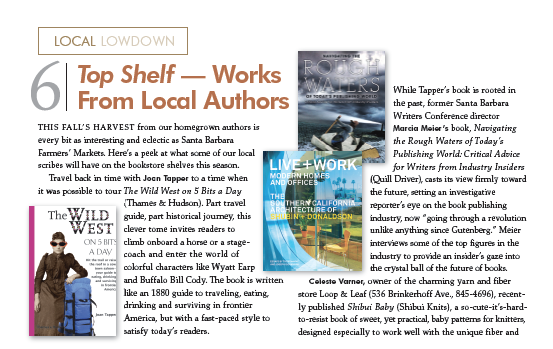
THIS FALL’S HARVEST from our homegrown authors is every bit as interesting and eclectic as Santa Barbara Farmers’ Markets. Here’s a peek at what some of our local scribes will have on the bookstore shelves this season.

Travel back in time with Joan Tapper to a time when it was possible to tour The Wild West on 5 Bits a Day (Thames & Hudson). Part travel guide, part historical journey, this clever tome invites readers to climb onboard a horse or a stagecoach and enter the world of colorful characters like Wyatt Earp and Buffalo Bill Cody. The book is written like an 1880 guide to traveling, eating,
drinking and surviving in frontier America, but with a fast-paced style to
satisfy today’s readers.

 While Tapper’s book is rooted in the past, former Santa Barbara Writers Conference director Marcia Meier’s  book, Navigating the Rough Waters of Today’s Publishing World: Critical Advice for Writers from Industry Insiders (Quill Driver), casts its view firmly toward the future, setting an investigative reporter’s eye on the book publishing industry, now “going through a revolution unlike anything since Gutenberg.” Meier interviews some of the top figures in the industry to provide an insider’s gaze into the crystal ball of the future of books.

Celeste Varner, owner of the charming yarn and fiber store Loop & Leaf recently published Shibui Baby (Shibui Knits), a so-cute-it’s-hardto-resist book of sweet, yet practical, baby patterns for knitters, designed especially to work well with the unique fiber and texture combinations in the Shibui Knits (Japanese translation: “elegant with a touch of bitterness”) lines of yarn.

Top Shelf — Works by Local Authors, originally published in Santa Barbara Seasons, Fall 2010.

Top Shelf — Works by Local Authors, originally published in Santa Barbara Seasons, Fall 2010.

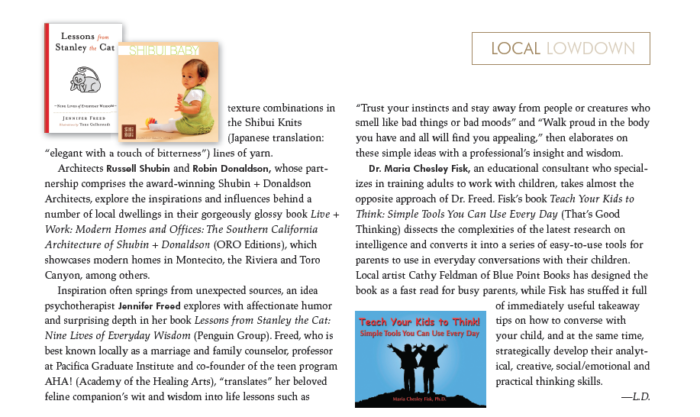
Architects Russell Shubin and Robin Donaldson, whose partnership comprises the award-winning Shubin + Donaldson Architects, explore the inspirations and influences behind a number of local dwellings in their gorgeously glossy book Live + Work: Modern Homes and Offices: The Southern California Architecture of Shubin + Donaldson  (ORO Editions), which showcases modern homes in Montecito, the Riviera and Toro Canyon, among others.

Inspiration often springs from unexpected sources, an idea psychotherapist Jennifer Freed explores with affectionate humor and surprising depth in her book Lessons from Stanley the Cat: Nine Lives of Everyday Wisdom  (Penguin Group). Freed, who is best known locally as a marriage and family counselor, professor at Pacifica Graduate Institute and co-founder of the teen program AHA! (Academy of the Healing Arts), “translates” her beloved feline companion’s wit and wisdom into life lessons such as “Trust your instincts and stay away from people or creatures who smell like bad things or bad moods” and “Walk proud in the body you have and all will find you appealing,” then elaborates on these simple ideas with a professional’s insight and wisdom.

Dr. Maria Chesley Fisk, an educational consultant who specializes in training adults to work with children, takes almost the opposite approach of Dr. Freed. Fisk’s book Teach Your Kids to Think: Simple Tools You Can Use Every Day (That’s Good Thinking) dissects the complexities of the latest research on intelligence and converts it into a series of easy-to-use tools for parents to use in everyday conversations with their children.

Local artist Cathy Feldman of Blue Point Books has designed the book as a fast read for busy parents, while Fisk has stuffed it full of immediately useful takeaway tips on how to converse with your child, and at the same time, strategically develop their analytical, creative, social/emotional and practical thinking skills.

Originally published in Santa Barbara Seasons Magazine, Fall 2010. Cover photo by Jim Bartsch.

Cover photo by Jim Bartsch.

Originally published in Santa Barbara Seasons Magazine, Fall 2010. Cover photo by Jim Bartsch.

Get Up Close and Personal with Architecture

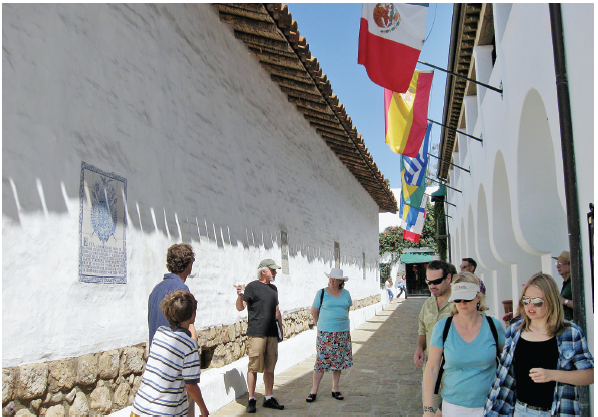
Brian Hofer points out details on the Architectural Foundation tour. Photo by Leslie Dinaberg.

Brian Hofer points out details on the
Architectural Foundation tour. Photo by Leslie Dinaberg.

To experience Santa Barbara architecture in all its glory, there’s nothing like strolling through town with an expert by your side to point out the rich history and international artistic influences that aren’t readily visible to the untrained eye.

Every weekend, trained docents from Architectural Foundation of Santa Barbara (www.afsb.org/tours_m.html, 805/965-6307) take both locals and tourists on walking journeys through the hidden courtyards, secret fountains and original adobes of downtown, focusing on architectural styles, significant and historic buildings, aesthetics and landscape history, as well as details like handmade tiles, wrought iron, stonework, balconies, doorways, archways and plantings.

The Sabado (Saturday) Tour starts in front of city hall and takes guests on a tour of De la Guerra Plaza, historic De la Guerra Adobe, El Paseo, Hill-Carrillo AdobeMeridian Studios, Lobero Theatre and more. The Domingo (Sunday) Tour, which starts at the Central Library, focuses on historic art and architecture of downtown Santa Barbara as it was reborn after the 1925 earthquake, including the library and its famous murals, La Arcada Court, the historic Arlington, The Granada and other architectural delights. You’ll also learn about Santa Barbara’s architectural history and how the Women’s League and Pearl Chase forced us to maintain architectural integrity, beautiful public park spaces and rich landscapes. Both tours start at 10 a.m. and last about 1-1 /2  hours. The foundation asks for a $10 donation per person, and proceeds go toward scholarships and other community programs.

Walking Wednesdays with Santa Barbara Walks is a clever new way to get some after-work exercise and experience the beauty of our local environment. The group, which is a project of COAST (Coalition for Sustainable Transportation, 805/875-3562), meets at 5:30 p.m. on the fourth Wednesday of every month and features a different theme and location each time. One walk included a tour through the upper eastside with architect Anthony Grumbine of Harrison Design Associates, beginning with a walkthrough of the historic Winsor Soule Hodges Residence (currently The Fielding Institute), a 1920s Spanish colonial revival estate, which was once the most expensive home built in Santa Barbara. The expedition also journeyed through a wonderful variety of architecture styles, including a Francis Underhill stripped classicism design, a Richard Neutra mid-century modern, French Norman and Dutch colonial, as well as the many architectural hybrids. Previous walks included an art walk with Ellen Durham, an architectural tour of El Andaluz with Jeff Shelton, trees of Santa Barbara with Bob Muller and a historical tour with Brian Hofer. Walking Wednesdays are free; visit www.coastsantabarbara.org/category/santa-barbarawalks/ for information on monthly locations and themes.

Originally published in Santa Barbara Seasons Magazine, Fall 2010. Cover photo by Jim Bartsch.

Cover photo by Jim Bartsch.

Originally published in Santa Barbara Seasons Magazine, Fall 2010. Cover photo by Jim Bartsch.

Limited Edition/Limitless Talent

Limited Edition, Limitless Talent. Originally published in Santa Barbara Seasons Magazine Fall 2010.

Limited Edition, Limitless Talent. Originally published in Santa Barbara Seasons Magazine Fall 2010.

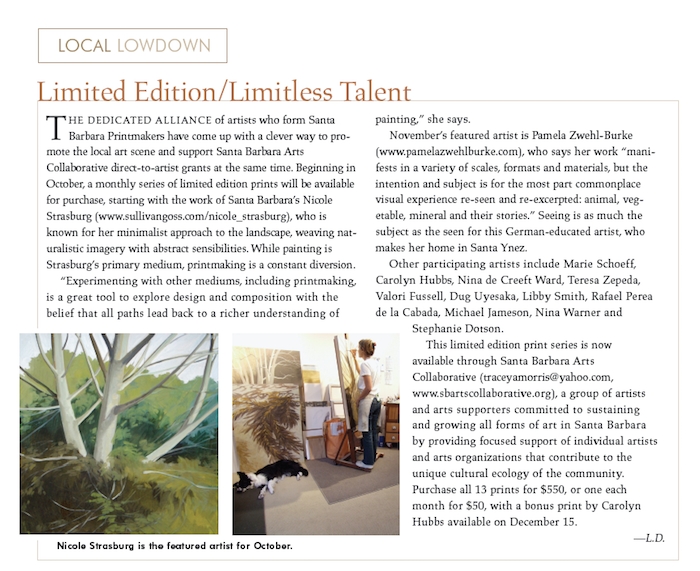
THE DEDICATED ALLIANCE of artists who form Santa Barbara Printmakers have come up with a clever way to promote the local art scene and support Santa Barbara Arts Collaborative direct-to-artist grants at the same time. Beginning in October, a monthly series of limited edition prints will be available
for purchase, starting with the work of Santa Barbara’s Nicole Strasburg (www.sullivangoss.com/nicole_strasburg), who is known for her minimalist approach to the landscape, weaving naturalistic imagery with abstract sensibilities.

While painting is Strasburg’s primary medium, printmaking is a constant diversion. “Experimenting with other mediums, including printmaking,
is a great tool to explore design and composition with the belief that all paths lead back to a richer understanding of painting,” she says.

November’s featured artist is Pamela Zwehl-Burke (www.pamelazwehlburke.com), who says her work “manifests in a variety of scales, formats and materials, but the intention and subject is for the most part commonplace visual experience re-seen and re-excerpted: animal, vegetable,
mineral and their stories.” Seeing is as much the subject as the seen for this German-educated artist, who makes her home in Santa Ynez.

Other participating artists include Marie Schoeff, Carolyn Hubbs, Nina de Creeft Ward, Teresa Zepeda, Valori Fussell, Dug Uyesaka, Libby Smith, Rafael Perea
de la Cabada, Michael Jameson, Nina Warner and Stephanie Dotson.

This limited edition print series is now available through Santa Barbara Arts
Collaborative (traceyamorris@yahoo.com, www.sbartscollaborative.org), a group of artists and arts supporters committed to sustaining and growing all forms of art in Santa Barbara by providing focused support of individual artists
and arts organizations that contribute to the unique cultural ecology of the community.

Purchase all 13 prints for $550, or one each month for $50, with a bonus print by Carolyn Hubbs available on December 15.

Originally published in Santa Barbara Seasons Magazine, Fall 2010. Cover photo by Jim Bartsch.

Cover photo by Jim Bartsch.

Originally published in Santa Barbara Seasons Magazine, Fall 2010. Cover photo by Jim Bartsch.

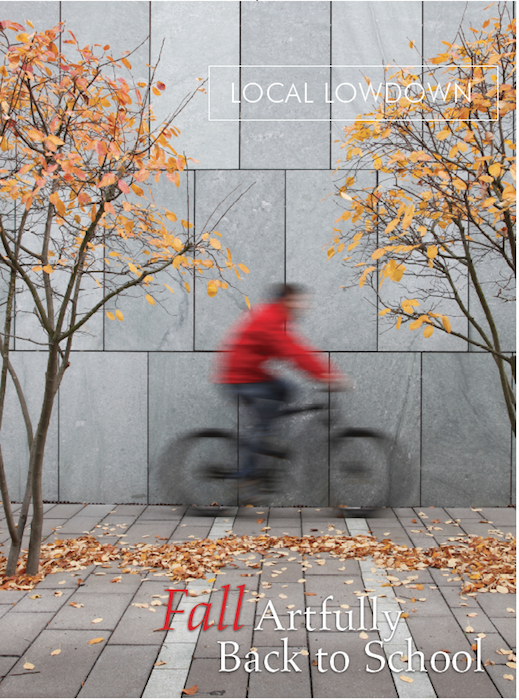
Fall Artfully Back to School

Santa Barbara Seasons, Local Lowdown, Fall 2010

Santa Barbara Seasons, Local Lowdown, Fall 2010

Back to School Get Creative!

There’s nothing quite like the creative inspiration found in the inviting smell of a fresh package of crayons or the satisfying sound you get from cracking the spine of a brand new notebook.

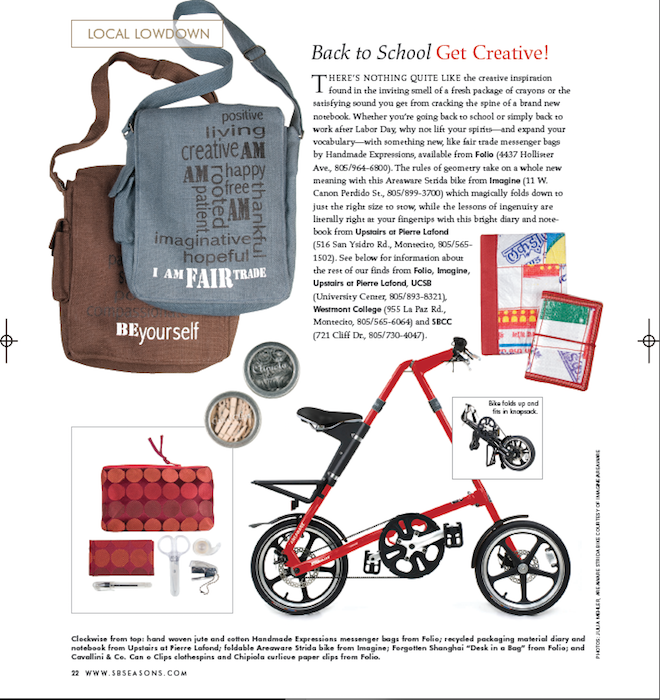
Whether you’re going back to school or simply back to work after Labor Day, why not lift your spirits—and expand your vocabulary—with something new, like fair trade messenger bags by Handmade Expressions, available from Folio (4437 Hollister Ave., 805/964-6800). The rules of geometry take on a whole new meaning with this Areaware Strida bike from Imagine (11 W. Canon Perdido St., 805/899-3700) which magically folds down to just the right size to stow, while the lessons of ingenuity are literally right at your fingertips with this bright diary and notebook from Upstairs at Pierre Lafond (516 San Ysidro Rd., Montecito, 805/565-1502).

Santa Barbara Seasons, Local Lowdown, Fall 2010

Santa Barbara Seasons, Local Lowdown, Fall 2010

See below for information about the rest of our finds from Folio, Imagine, Upstairs at Pierre Lafond, UCSB (University Center, 805/893-8321), Westmont College (955 La Paz Rd., Montecito, 805/565-6064) and SBCC (721 Cliff Dr., 805/730-4047).

Clockwise from top: hand woven jute and cotton Handmade Expressions messenger bags from Folio; recycled packaging material diary and notebook from Upstairs at Pierre Lafond; foldable Areaware Strida bike from Imagine; Forgotten Shanghai “Desk in a Bag” from Folio; and Cavallini & Co. Can o Clips clothespins and Chipiola curlicue paper clips from Folio.

Bike folds up and fits in knapsack.

PHOTOS: JULIA MEHLER, AREAWARE STRIDA BIKE COURTESY OF IMAGINE/AREAWARE

Santa Barbara Seasons, Local Lowdown, Fall 2010

Santa Barbara Seasons, Local Lowdown, Fall 2010

A is for All-Ages Education

BACK-TO-SCHOOL TIME isn’t just for kids. Santa Barbara offers a plethora of educational opportunities for learners of all ages. Do you have a passion for plants? UCCE and Botanic Garden offers a master gardener training program this fall (mgsantab@ucdavis.edu). Participants learn about sustainable landscapes, identifying and managing pests, soil and plant nutrition, plant management practices and diagnosing plant problems, then apply their knowledge to assist schools, parks, retirement communities and Botanic Garden with various garden projects.

Why not indulge your artistic impulses and support the environment with a Saturday morning workshop at Art From Scrap (302 E. Cota St., 805/884-0459, www.artfromscrap.org). Almost every Saturday from 10 a.m. to noon, local artists like Dug Uyesaka, Holly Mackay and Bill McVicar lead workshops for children and adults to explore their creativity, all at the bargain price of $6, supplies included.

Want to learn more about art? Santa Barbara Museum of Art (1130 State St., 805/963-4364, www.sbmuseart.org) offers docent-led tours of special exhibitions Tuesday through Sunday at noon and an overview of the collection at 1 p.m. (free to members or with paid admission).

Want to learn to dance the tango, shape up with fitness classes, explore your musical side or teach your dog to stay off the couch? Santa Barbara Parks and Recreation (www.sbparksandrecreation.com/) offers low-cost classes in all of these things and more.

Don’t see anything that tickles your fancy here? Check out Santa Barbara City College Adult Education (http://omni.sbcc.edu/adulted/) and UCSB Extension (www.extension.ucsb.edu/), both of which offer hundreds of classes for lifelong learners.

—Leslie Dinaberg

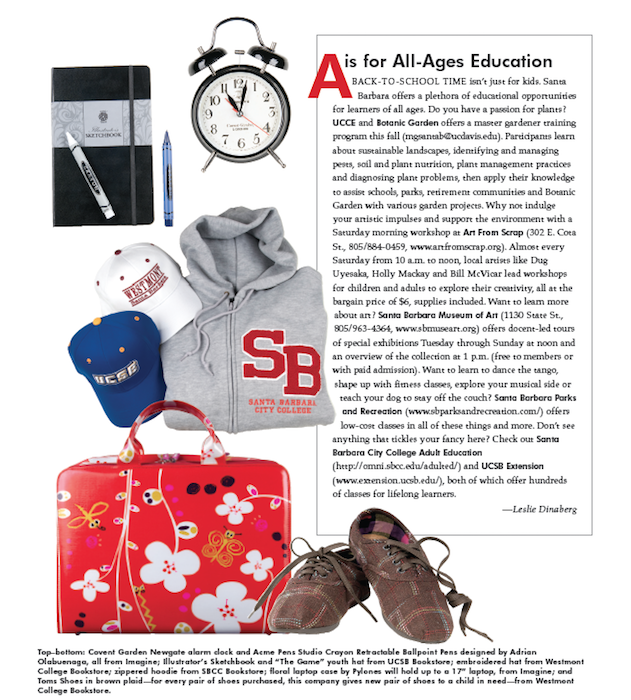
Top–bottom: Covent Garden Newgate alarm clock and Acme Pens Studio Crayon Retractable Ballpoint Pens designed by Adrian Olabuenaga, all from Imagine; Illustrator’s Sketchbook and “The Game” youth hat from UCSB Bookstore; embroidered hat from Westmont College Bookstore; zippered hoodie from SBCC Bookstore; floral laptop case by Pylones will hold up to a 17” laptop, from Imagine; and Toms Shoes in brown plaid—for every pair of shoes purchased, this company gives new pair of shoes to a child in need—from Westmont College Bookstore.

Originally published in Santa Barbara Seasons Magazine, Fall 2010. Cover photo by Jim Bartsch.

Cover photo by Jim Bartsch.

Originally published in Santa Barbara Seasons Magazine, Fall 2010. Cover photo by Jim Bartsch.

Editor’s Letter Fall 2010 (Santa Barbara Seasons Magazine)

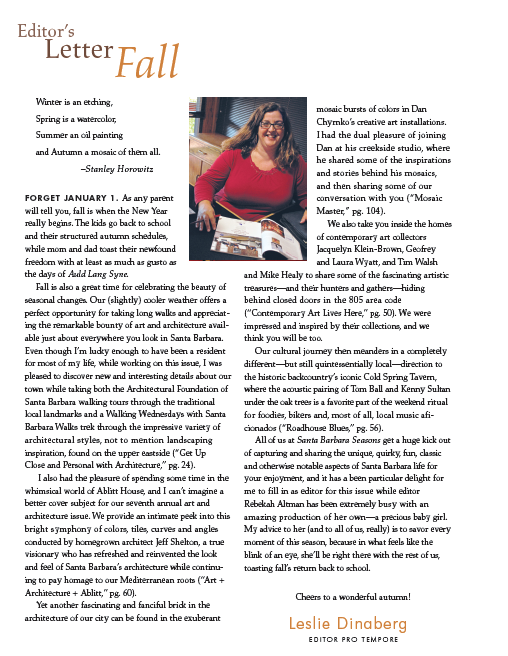
Santa Barbara Seasons Editor's Letter Fall 2010. Photo by Tracy Smith Reed.

Santa Barbara Seasons Editor’s Letter Fall 2010. Photo by Tracy Smith Reed.

 Winter is an etching, Spring is a watercolor, Summer an oil painting and Autumn a mosaic of them all. –Stanley Horowitz

FORGET JANUARY 1. As any parent will tell you, fall is when the New Year really begins. The kids go back to school and their structured autumn schedules, while mom and dad toast their newfound freedom with at least as much as gusto as the days of Auld Lang Syne.

Fall is also a great time for celebrating the beauty of seasonal changes. Our (slightly) cooler weather offers a perfect opportunity for taking long walks and appreciating the remarkable bounty of art and architecture available just about everywhere you look in Santa Barbara.

Even though I’m lucky enough to have been a resident for most of my life, while working on this issue, I was pleased to discover new and interesting details about our town while taking both the Architectural Foundation of Santa Barbara walking tours through the traditional local landmarks and a Walking Wednesdays with Santa Barbara Walks trek through the impressive variety of architectural styles, not to mention landscaping inspiration, found on the upper eastside (“Get Up Close and Personal with Architecture,” pg. 24).

I also had the pleasure of spending some time in the whimsical world of Ablitt House, and I can’t imagine a better cover subject for our seventh annual art and architecture issue. We provide an intimate peek into this bright symphony of colors, tiles, curves and angles conducted by homegrown architect Jeff Shelton, a true visionary who has refreshed and reinvented the look and feel of Santa Barbara’s architecture while continuing to pay homage to our Mediterranean roots (“Art + Architecture + Ablitt,” pg. 60).

Yet another fascinating and fanciful brick in the architecture of our city can be found in the exuberant mosaic bursts of colors in Dan Chyrnko’s creative art installations. I had the dual pleasure of joining Dan at his creekside studio, where he shared some of the inspirations and stories behind his mosaics, and then sharing some of our conversation with you (“Mosaic Master,” pg. 104).

We also take you inside the homes of contemporary art collectors Jacquelyn Klein-Brown, Geoffrey and Laura Wyatt, and Tim Walsh and Mike Healy to share some of the fascinating artistic treasures—and their hunters and gathers—hiding behind closed doors in the 805 area code (“Contemporary Art Lives Here,” pg. 50). We were impressed and inspired by their collections, and we think you will be too.

Our cultural journey then meanders in a completely different—but still quintessentially local—direction to the historic backcountry’s iconic Cold Spring Tavern, where the acoustic pairing of Tom Ball and Kenny Sultan under the oak trees is a favorite part of the weekend ritual for foodies, bikers and, most of all, local music aficionados (“Roadhouse Blues,” pg. 56).

All of us at Santa Barbara Seasons get a huge kick out of capturing and sharing the unique, quirky, fun, classic and otherwise notable aspects of Santa Barbara life for your enjoyment, and it has a been particular delight for me to fill in as editor for this issue while editor Rebekah Altman has been extremely busy with an amazing production of her own—a precious baby girl. My advice to her (and to all of us, really) is to savor every moment of this season, because in what feels like the blink of an eye, she’ll be right there with the rest of us, toasting fall’s return back to school.

Cheers to a wonderful autumn!

Leslie Dinaberg

EDITOR PRO TEMPORE

Originally published in Santa Barbara Seasons Magazine, Fall 2010. Cover photo by Jim Bartsch.

Cover photo by Jim Bartsch.

Originally published in Santa Barbara Seasons Magazine, Fall 2010. Cover photo by Jim Bartsch.