Communication is Key for WELL Health

WELL Health’s CEO Guillaume de Zwirek first discovered healthcare tech as a patient. During an Ironman triathlon, he landed in the back of an ambulance, suffering from acute heatstroke. In the months after his hospital discharge, he navigated a complex medical system full of antiquated communication practices. Seeing an opportunity, de Zwirek created WELL to solve those challenges.

“WELL enables health systems, private practices, and vendors to conduct seamless conversations with patients across multiple channels, including texting, email, telephone, and live chat,” said Pamela Ellgen, WELL’s health editor.

Through WELL, patients receive all of their healthcare communication from one trusted source—their provider—and service providers can converse with patients in real time.

The first WELL office opened in 2015 in Redwood City, the heart of Silicon Valley. “I quickly realized that wasn’t the right thing for the company, or for our team,” said de Zwirek.

“The Bay Area was overcrowded with way too many people willing to make crazy commutes. Even though our office was right on the train route, some of our team still had to travel more than an hour and a half just to get to work.

And the cost of living was out of control. In addition, turnover is a way of life in Silicon Valley. It wasn’t what I wanted for WELL. I want to build a community of people who are happy to be here and excited to help build this company.”

WELL relocated its headquarters to Santa Barbara in 2017 and now operates on Chapala Street in Invoca’s former headquarters. Listed as number 170 on the Inc. 500 list of the fastest growing privately held companies in the U.S., WELL employs 102 people, with 62 of them in Santa Barbara.

In March 2020, WELL unveiled its Rapid Release Program, which allows health systems to manage urgent COVID-19 patient communications at scale. A technology that seems tailor-made for our time, it can be deployed by users in just 48 hours, which is far quicker than a typical implementation. Seeking to address the pandemic as effectively as possible, WELL offered the program below cost and was able to serve an additional 2.5 million patients within weeks of launch.  wellapp.com

Tech Talk Special Issue for Santa Barbara Independent, published October 1, 2020.

Tech Talk Special Issue for Santa Barbara Independent, published October 1, 2020.


Tech Talk Special Issue for the Santa Barbara Independent, originally published on October 1, 2020.

To read the issue as it appeared in print, please click here, Tech Talk 768_10_01_20


Virtual Health Care: Right Here at Home

After the July 2020 acquisition of Goleta-based InTouch Health—for approximately $150 million in cash and 4.6 million shares of stock—Teladoc Health is well positioned in the global telehealth market and also a large employer here, with about 230 positions in Santa Barbara County. Joe DeVivo, Teladoc’s president of hospitals and health systems, discussed the technology, ever more important during COVID.

WHAT DOES TELADOC DO? The mission of Teladoc Health is to transform how people access and experience health-care around the world. With virtual care, we are enabling patients to access care on their terms—from general medical issues like cold and flu to chronic conditions, including mental health, and complicated medical issues.

HOW HAS THE COMPANY GROWN? Teladoc Health was established for what has come to be known as virtual urgent care: providing access to board-certified physicians via phone, app, or website for acute health needs like cold, flu, upper respiratory issues, pinkeye, and more.

Through multiple acquisitions, the company not only expanded globally, now operating in 175 countries, but also added clinical capabilities, covering more health conditions across the spectrum of care, including dermatology, mental health, expert medical services, and more.

HOW IS THE PANDEMIC AMPLIFYING THINGS? COVID-19 has exponentially increased the number of hospitals and health systems utilizing virtual-care platforms as well as expanded the use cases for those who had already deployed a virtual-care platform. While we knew in January that the InTouch transaction would play a key role in our growth, we couldn’t have predicted the level of need it’s enabling us to meet for hospital systems now motivated to create comprehensive virtual-care strategies.

Our pipeline with hospitals and health systems remains strong for the rest of 2020 and 2021, set to grow over 35 percent in 2020. Teladoc Health is now partnering with more than 60 of the top 100 hospitals.

WHAT IS INTOUCH FOUNDER YULUN WANG’S CURRENT ROLE? In his capacity as fellow with Teladoc Health, Yulun Wang will now focus on the importance of growing virtual health-care opportunities for underserved populations around the globe with the World Telehealth Initiative. We will continue to foster the Teladoc Health relationship with UCSB, and we also see expanding opportunities for students to participate in Yulun’s work with the World Telehealth Initiative.  intouchhealth.com

Tech Talk Special Issue for Santa Barbara Independent, published October 1, 2020.

Tech Talk Special Issue for Santa Barbara Independent, published October 1, 2020.


Tech Talk Special Issue for the Santa Barbara Independent, originally published on October 1, 2020.

To read the issue as it appeared in print, please click here, Tech Talk 768_10_01_20


The Cutting Edge of Robotic Surgery

Robots are no longer a futuristic notion. In fact, they’re becoming more and more common in nearby operating rooms. Robotic surgery is an advanced form of minimally invasive surgery that makes use of computer-controlled robots to do what humans can’t—and also to do what surgeons can, only better.

Think about how bulky human hands are when compared to a robot’s. “The robotic instruments are articulated at the end of the instrument where the working end is, so the working end can move like a hand would, as if it had a wrist,” explained Dr. Anne Rodriguez, a gynecologic oncologist and breast surgeon who heads up the Cottage Health Robotic Surgery team.

“That gives you the ability to maneuver much more than you would with a straight instrument. And that ability can get you into small spaces, can get you into difficult spaces, and can allow you to do a lot finer technique, so to speak.”

In 2019, the Cottage Robotic Surgery Center performed 574 robotic surgery procedures with the da Vinci XI manufactured by Intuitive. The most common surgery was hysterectomy, with 117 of them performed last year, said Maria Zate, the hospital’s public relations manager, followed by prostatectomy and hernia.

Dr. William Gallivan of the Orthopedic Institute of Santa Barbara is a big proponent of the technology. “In 2005, I started using computer navigation,” said Gallivan. “It was new technology back then, and I haven’t gone back.” He’s performed robotic surgeries on knees since 2014, tallying 350 surgeries as of August 2020, using the NAVIO Surgical System and recently the MAKO Robotic-Arm System.

The precision advantages of robotics for knee surgeries are critical. “When we use robotics, we can actually do a better preservation of bone,” he said. “For young people who want to be active, they will be able to have a very high level of activity. We’ve got this technology that allows better preservation and maintenance of bone and other soft tissues and is very effective.”

Rodriguez also pointed out the advantages of the robots for surgeons themselves. “You’re basically sitting at a console to control the instrument rather than controlling the instrument at the bedside,” she said. “So ergonomically, it’s easier on the surgeon and that gives advantages both short-term and long-term in terms of your ability to continue to do surgery.”

Other advantages include shorter hospital stays and faster recoveries, in part because there is less need for narcotic pain medicine.

“About 95 percent of my patients are wide awake with a spinal anesthetic,” said Gallivan. “It’s the safest way to do it, and the patients have more fun being awake.” Patients can listen to music (“unless it’s something bad,” he laughed) and watch 3D models and cartoon versions of the operation.

Virtually scar-less, single-site surgeries can also be handled by robots, such as single-incision hysterectomies. Rather than making several incisions, the robotic process makes just one incision through the belly button, which decreases blood loss and shortens recovery time.

“Robots have obviously been used for a long time by the aviation, automotive, and military [sectors], and then health care,” said Gallivan. “But the robotic technology has never diminished or exited from an industry that’s adopted it. It’s not going anywhere. I’m a firm believer that this technology we’re using is here to stay.”

THE BIRTHPLACE OF MODERN SURGICAL ROBOTICS

UCSB graduate Dr. Yulun Wang is considered one of the fathers of modern surgical robotics. The founder of both InTouch Health and Computer Motion, Wang developed AESOP, the first FDA-approved surgical robot (1990), and the ZEUS Robotic Surgical System. ZEUS was used in the world’s first tele-surgery procedure, known as the Lindbergh Operation, in 2001. The da Vinci surgical system now used by Cottage Health was developed by Intuitive Surgical following its merger with Computer Motion in 2003.

Tech Talk Special Issue for Santa Barbara Independent, published October 1, 2020.

Tech Talk Special Issue for Santa Barbara Independent, published October 1, 2020.


Tech Talk Special Issue for the Santa Barbara Independent, originally published on October 1, 2020.

To read the issue as it appeared in print, please click here, Tech Talk 768_10_01_20


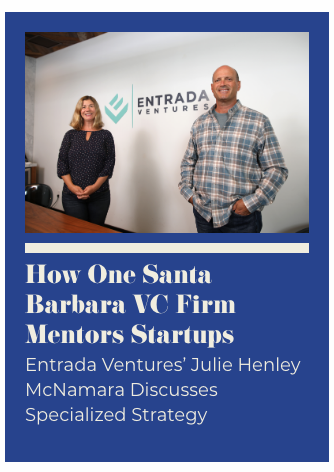
Mentoring, Not Just Money, For Startups

Julie Henley McNamara and Jason Spievak of Entrada Ventures, photo by Daniel Dreifuss for Santa Barbara Independent.

Julie Henley McNamara and Jason Spievak of Entrada Ventures, photo by Daniel Dreifuss for Santa Barbara Independent.

Founded in 2018 by a who’s who of veteran Santa Barbara tech operators, entrepreneurs, and investors, Entrada Ventures focuses on early investments that help start-ups develop into strong businesses ready for their first round of institutional financing. The firm and its team’s list of affiliations include ACT (Medtronic), Apeel Sciences, Aurrion (Juniper), CallWave, Invoca, Local Market Launch, SmartReceipt (Mobivity), Software.comValueClick (Conversant), and Web Ignite, among others.

Entrada was started under the principle that there was not much investor support in Santa Barbara. “There’s money but not a lot of support about how to navigate fundraising, building a company, operations, financials, marketing, and all of that,” explained Julie Henley McNamara, Entrada’s operating partner and a Cal Poly grad.

“We want to give money but also be helpful to the community with our portfolio of companies. It’s all about the 805.”

When business is not restricted by COVID, the VC fund team holds regular office hours at UCSB, Cal Poly, and the downtown Kiva Cowork space. “Julie is really the inspiration behind some of this,” said managing partner Jason Spievak. “We want to make that capital conversation more accessible to small businesses here in the region.”

They aren’t necessarily looking for proper pitches, just an introduction. “The office hours are also a way to put less pressure on young people if they just want to talk.”

Once Entrada invests, the collaboration is geared to the need. That ranges from becoming part of the board and meeting weekly to a much less active role. “It really kind of depends on the company,” said McNamara. “The way we like to work with them is to be as helpful as we can but not be interfering and not be intrusive.” And if she’s the interface but the need is something she cannot provide, McNamara can call on one of her partners or search through her extensive network to find the right solution.

entradaventures.com

Tech Talk Special Issue for Santa Barbara Independent, published October 1, 2020.

Tech Talk Special Issue for Santa Barbara Independent, published October 1, 2020.


Tech Talk Special Issue for the Santa Barbara Independent, originally published on October 1, 2020.

To read the issue as it appeared in print, please click here, Tech Talk 768_10_01_20


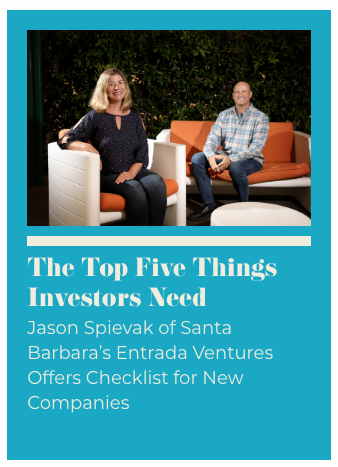
Top Five Things Investors Want (and Need)

Julie Henley McNamara and Jason Spievak of Entrada Ventures, photo by Daniel Dreifuss for Santa Barbara Independent.

Julie Henley McNamara and Jason Spievak of Entrada Ventures, photo by Daniel Dreifuss for Santa Barbara Independent.

With a career as an investor and founder spanning three decades and a broad range of technologies from agricultural sciences to virtual reality, Entrada Ventures cofounder Jason Spievak believes these five things are critical for attracting investors.

1 INTEGRITY “There’s some core criteria that we look for, and job one is integrity, far and away. Because if you can’t trust someone, you can’t rely on them and you can’t work with them, so that is absolutely binary. There is no wiggle room on what I call situational ethics.”

2 THE RIGHT FIT “Does this person have the skill and the experience to do the thing that they need to do to succeed in their role? Are they actually the right person for the job, so to speak, in terms of skills, experience, and aptitude?”

3 A WINNING MINDSET “We all, unfortunately, know people who were raised from childhood to believe that success happens to other people and it’s their job to get the ball to the one-yard line and toil away in anonymity while somebody else makes it happen. We really want to invest in folks that believe that they deserve success.”

4 SOMETHING TO PROVE “It’s a little bit esoteric, but do they have something to prove? You want to bet on someone — I don’t care if you’re proving it to your mom, your dad, your teacher who gave you a B, your coach who didn’t start you, your boyfriend who broke up with you. Who feels like they have something to prove? They work really, really hard. And they work hard when no one’s watching.”

5 CHEMISTRY “Would you want to sit next to this person on an airplane for six hours? The only guarantee is you’re going to spend a heck of a lot of time together when you invest in someone’s company, and as a result, you want to enjoy that time. You want to be learning; you want to look forward to that time together and not roll your eyes when you see their name on the phone, so it’s pretty important. People talk about investing in someone’s company as being like a marriage. It’s more than marriage in a way because you can’t get divorced.”

BONUS POINTS: PROVEN TRACK RECORD “There’s absolutely an overwhelming amount of evidence out there that shows that founders who build and successfully exit a company are more likely to do it again. So a proven track record is ideal. However, when you’re doing early-stage investing, as we like to do here in the region, it’s often the case that this is the first company for these founders; otherwise, they would not necessarily be seeking early-stage capital—they would have it already.”

entradaventures.com

Tech Talk Special Issue for Santa Barbara Independent, published October 1, 2020.

Tech Talk Special Issue for Santa Barbara Independent, published October 1, 2020.


Tech Talk Special Issue for the Santa Barbara Independent, originally published on October 1, 2020.

To read the issue as it appeared in print, please click here, Tech Talk 768_10_01_20


Tech Employers Talk Back

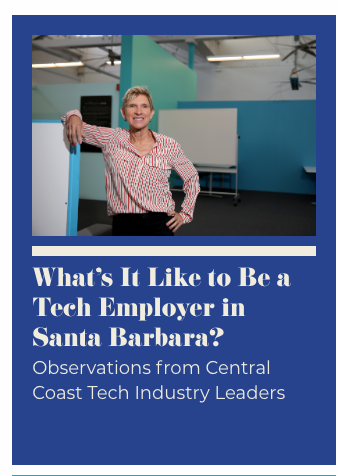
HG Insights' Elizabeth Cholawsky, photo by Daniel Dreifuss for Santa Barbara Independent.

HG Insights’ Elizabeth Cholawsky, photo by Daniel Dreifuss for Santa Barbara Independent.

As Santa Barbara’s tech sector continues to grow and evolve, so do the challenges and opportunities presented here. I asked a bunch of industry leaders for their observations, and what follows is a snapshot of what’s going on today.

ATTRACTING TALENT IS EASIER: A common complaint is that it’s hard to attract employees here compared to larger markets like Silicon Valley. “There’s a little bit of truth to that—you generally have a bigger pool—but you also don’t have the extreme competition and somewhat lack of loyalty of employees in that market,” said Elizabeth Cholawsky, president and CEO of HG Insights. “There’s a lot more turnover of employees in the Bay Area.”

As the former CEO of the Sunnyvale-based Support.com, Cholawsky said the challenges of attracting top talent are offset by advantages. “It is a small community, so people that aren’t at the top of their game often don’t survive in Santa Barbara because everybody knows everybody and experiences get shared pretty openly,” she said. “The cream of the crop rises in Santa Barbara because a lot of people want to stay here because it’s such a beautiful place to live. So you do your best to do your best, and if you’re not, it gets weeded out by the fact that we’ve got a tight-knit community.”

Others appreciate that advantage as well. “Santa Barbara is very underrated in terms of its ability to offer a challenging and a healthy tech environment, maybe without some of the rat-race elements that Silicon Valley has become,” said Mike Muench, CEO and president of Seek Thermal, who worked in Silicon Valley while a VP for Apple. “I’ve talked to a number of transplants from Silicon Valley at the executive or professional level, and, almost without exception, they’ve felt the same way: Why didn’t I do this 10 years ago? This still gives me all the technical and professional challenges that I need, but from a lifestyle tradeoff, it’s a lot more balanced and healthy.”

LONGER TENURES: “People who join the company tend to stay in the company longer, which is nice,” said ParentSquare cofounder Anupama Vaid. “In the Bay Area, the churn is so high.”

Having been a VP of the Leaf Group in Santa Monica, Entrada Ventures’ operating partner Julie Henley McNamara agrees. “There’s a real sense of loyalty here,” she said. “You’re not stressed when you get to the office because there wasn’t a lot of rigmarole to get there. From Carpinteria to Goleta, there is traffic, but nothing like the Bay Area or L.A.”

WORK-LIFE BALANCE: “Santa Barbara, especially in the day and age of COVID, offers a great quality of life and a growing, thriving, tight-knit community,” said Amy Meyer, Chief People Officer at AppFolio. “There are a lot of interconnections, just a couple degrees of separation, and the Santa Barbara community has a lot to offer. We also do a lot of work in the community—giving back through our employee driven give-back program.”

ParentSquare’s employees have access to Gold’s Gym just downstairs, explained Vaid, “and our Christmas parties and our annual get-togethers are always something outdoorsy.”

Nathan Ziv of Invoca said that their employees did a lot of team hikes prior to COVID, and that he often will take an employee out for a one-on-one meeting by walking to Stearns Wharf, just a few blocks from their office at the bottom of State Street. “When surf is good, go take a longer lunch and get in the water and then come back,” he said. “After that, you can do meetings and whatnot. I don’t think you can do that as easily in a big city.”

COMMUNITY COLLABORATION: The tech community’s interconnectedness is in part due to its relatively small size, but there’s also a concerted effort on the part of leaders to work together.

As the COVID pandemic began, Meyer from AppFolio helped create a forum for HR leaders in the tri-county area. “There’s about 15 to 20 of us from various tech companies that meet every couple of weeks, specifically to share best practices and what’s working and what’s not in navigating COVID and how to support employees through that,” she said.

Henry Ventura, who manages diversity, inclusion, and equal employment for the County of Santa Barbara, is spearheading a Diversity Roundtable coalition with a diverse group of companies. That includes leaders from Amazon’s Alexa branch on State Street, MarBorg, Deckers Brands, Just Communities, Invoca, Sonos, and Procore, among others, to promote equitable practices in the workplace.

COST OF HOUSING: The cost of living is “definitely a challenge,” said Meyer. “In light of living in a pandemic, people are now more than ever choosing where they want to live and having more flexibility. It’s going to get easier in some respects to recruit and to attract people to Santa Barbara because of that quality of life.”

CONTINUED EVOLUTION: Success will only create more opportunity, as Meyer explained, “Often, companies are headquartered wherever the founder lives.” But she believes the biggest continued growth will be thanks to UCSB’s established tech ecosystem and a growing talent pool from Westmont College.

She explained, “Both will continue to create the space for entrepreneurial, innovative thinkers and draw them.”
Tech Talk Special Issue for Santa Barbara Independent, published October 1, 2020.

Tech Talk Special Issue for Santa Barbara Independent, published October 1, 2020.


Tech Talk Special Issue for the Santa Barbara Independent, originally published on October 1, 2020.

To read the issue as it appeared in print, please click here, Tech Talk 768_10_01_20

 

Epistolary Art

805 Living September 2020, Epistolary Art, story by Leslie Dinaberg.

805 Living September 2020, Epistolary Art, story by Leslie Dinaberg.

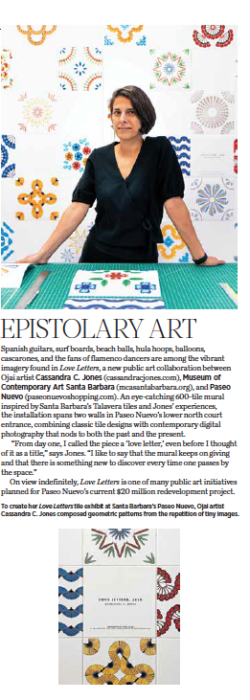
Spanish guitars, surf boards, beach balls, hula hoops, balloons, cascarones, and the fans of flamenco dancers are among the vibrant imagery found in Love Letters, a new public art collaboration between Ojai artist Cassandra C. Jones (cassandracjones.com), Museum of Contemporary Art Santa Barbara (mcasantabarbara.org), and Paseo Nuevo (paseonuevoshopping.com).

An eye-catching 600-tile mural inspired by Santa Barbara’s Talavera tiles and Jones’ experiences, the installation spans two walls in Paseo Nuevo’s lower north court entrance, combining classic tile designs with contemporary digital photography that nods to both the past and the present.

“From day one, I called the piece a ‘love letter,’ even before I thought of it as a title,” says Jones. “I like to say that the mural keeps on giving and that there is something new to discover every time one passes by the space.”

On view indefinitely, Love Letters is one of many public art initiatives planned for Paseo Nuevo’s current $20 million redevelopment project.

805 Living, September 2020.

805 Living, September 2020.

This story was originally published in the September 2020 issue of 805 Living. Click here to read it as it appeared in print.


New Foodie Finds

805 Living September 2020, New Foodie Finds, story by Leslie Dinaberg.

805 Living September 2020, New Foodie Finds, story by Leslie Dinaberg.

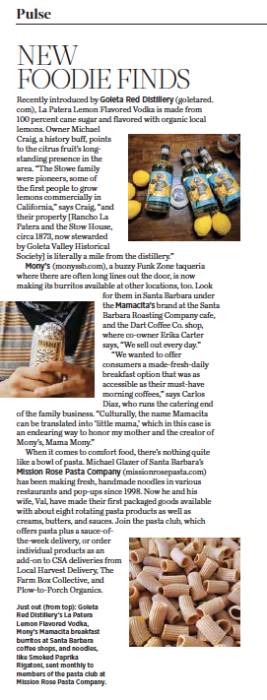
Recently introduced by Goleta Red Distillery (goletared.com), La Patera Lemon Flavored Vodka is made from 100 percent cane sugar and flavored with organic local lemons. Owner Michael Craig, a history buff, points to the citrus fruit’s longstanding presence in the area.

“The Stowe family were pioneers, some of the first people to grow lemons commercially in California,” says Craig, “and their property [Rancho La Patera and the Stow House, circa 1873, now stewarded by Goleta Valley Historical Society] is literally a mile from the distillery.”

Mony’s (monyssb.com), a buzzy Funk Zone taqueria where there are often long lines out the door, is now making its burritos available at other locations, too. Look for them in Santa Barbara under the Mamacita’s brand at the Santa Barbara Roasting Company cafe, and the Dart Coffee Co. shop, where co- owner Erika Carter says, “We sell out every day.”

“We wanted to offer consumers a made-fresh-daily breakfast option that was as accessible as their must-have morning coffees,” says Carlos Diaz, who runs the catering end of the family business. “Culturally, the name Mamacita can be translated into ‘little mama,’ which in this case is an endearing way to honor my mother and the creator of Mony’s, Mama Mony.”

When it comes to comfort food, there’s nothing quite like a bowl of pasta. Michael Glazer of Santa Barbara’s Mission Rose Pasta Company (missionrosepasta.com) has been making fresh, handmade noodles in various restaurants and pop-ups since 1998. Now he and his wife, Val, have made their first packaged goods available with about eight rotating pasta products as well as creams, butters, and sauces.

Join the pasta club, which offers pasta plus a sauce-of-the-week delivery, or order individual products as an add-on to CSA deliveries from Local Harvest Delivery, The Farm Box Collective, and Plow-to-Porch Organics.

805 Living, September 2020.

805 Living, September 2020.

This story was originally published in the September 2020 issue of 805 Living. Click here to read it as it appeared in print.


Local Ingredients at Your Door

805 Living September 2020, Local Ingredients at Your Door, story by Leslie Dinaberg.

805 Living September 2020, Local Ingredients at Your Door, story by Leslie Dinaberg.

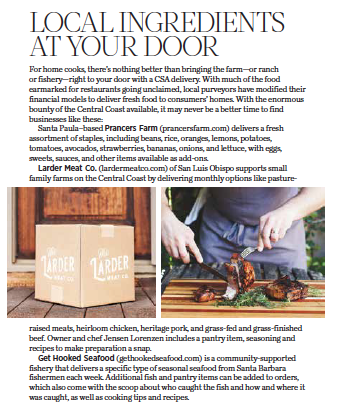
For home cooks, there’s nothing better than bringing the farm—or ranch or fishery—right to your door with a CSA delivery. With much of the food earmarked for restaurants going unclaimed, local purveyors have modified their financial models to deliver fresh food to consumers’ homes. With the enormous bounty of the Central Coast available, it may never be a better time to find businesses like these:

Santa Paula–based Prancers Farm (prancersfarm.com) delivers a fresh assortment of staples, including beans, rice, oranges, lemons, potatoes, tomatoes, avocados, strawberries, bananas, onions, and lettuce, with eggs, sweets, sauces, and other items available as add-ons.

Larder Meat Co. (lardermeatco.com) of San Luis Obispo supports small family farms on the Central Coast by delivering monthly options like pasture raised meats, heirloom chicken, heritage pork, and grass-fed and grass-finished beef. Owner and chef Jensen Lorenzen includes a pantry item, seasoning and recipes to make preparation a snap.

Get Hooked Seafood (gethookedseafood.com) is a community-supported fishery that delivers a specific type of seasonal seafood from Santa Barbara fishermen each week. Additional fish and pantry items can be added to orders, which also come with the scoop about who caught the fish and how and where it was caught, as well as cooking tips and recipes.

805 Living, September 2020.

805 Living, September 2020.

This story was originally published in the September 2020 issue of 805 Living. Click here to read it as it appeared in print.


Wine Shopping 2.0

805 Living September 2020, Wine Shopping 2.0, story by Leslie Dinaberg.

805 Living September 2020, Wine Shopping 2.0, story by Leslie Dinaberg.

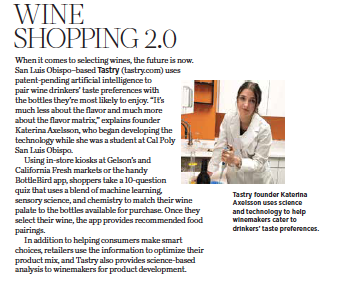
When it comes to selecting wines, the future is now. San Luis Obispo–based Tastry (tastry.com) uses patent-pending artificial intelligence to pair wine drinkers’ taste preferences with the bottles they’re most likely to enjoy. “It’s much less about the flavor and much more about the flavor matrix,” explains founder Katerina Axelsson, who began developing the technology while she was a student at Cal Poly San Luis Obispo.

Using in-store kiosks at Gelson’s and California Fresh markets or the handy BottleBird app, shoppers take a 10-question quiz that uses a blend of machine learning, sensory science, and chemistry to match their wine palate to the bottles available for purchase. Once they select their wine, the app provides recommended food pairings.

In addition to helping consumers make smart choices, retailers use the information to optimize their product mix, and Tastry also provides science-based analysis to winemakers for product development.

805 Living, September 2020.

805 Living, September 2020.

This story was originally published in the September 2020 issue of 805 Living. Click here to read it as it appeared in print.