This Land is Our Land

Discover local spots to explore, like Lost Palms Oasis in Joshua Tree National Park, at 50greatpubliclanddestinations.org. Photo by Deborah Williams.

Discover local spots to explore, like Lost Palms Oasis in Joshua Tree National Park,
at 50greatpubliclanddestinations.org. Photo by Deborah Williams.

Hoping to encourage her environmental studies students to get out and explore public lands within a 300-mile radius, UC Santa Barbara lecturer Deborah Williams has created a new website for all to enjoy. Great Public Land Destinations (50greatpubliclanddestinations.org) spotlights 50 parks, monuments, preserves, and open spaces, where visitors can appreciate natural beauty and historical significance.

“One of my goals in creating the site was to remind us of the rich diversity of our public lands,” Williams says.

In addition to well-known national parks, like Yosemite and Joshua Tree, her impressive compilation tallies lesser-known spots, such as Manzanar National Historic Site—a World War II Japanese internment camp in the Eastern Sierras, and the Antelope Valley California Poppy Reserve, preserved through fundraising efforts led by conservationist Jane Pinheiro, including a 1970s “Pennies for Poppies” drive to which schoolchildren contributed. All of the sites are within a day’s drive of the 805.

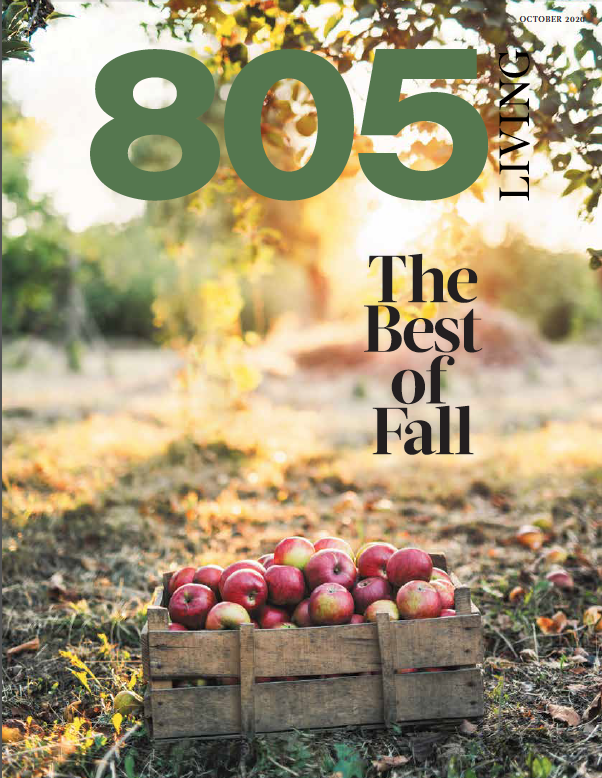
805 Living Cover, October 2020. This story originally appeared in 805 Living Magazine, October 2020. Click here to see the section as it originally appeared in print.

Wishful Weaving

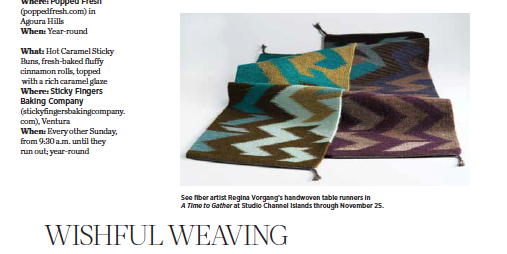
See fiber artist Regina Vorgang’s handwoven table runners in A Time to Gather at Studio Channel Islands through November 25. Photo by W. Scott Miles, the Scientific Photographer, THESCIENTIFICPHOTOGRAPHER.COM.

See fiber artist Regina Vorgang’s handwoven table runners in A Time to Gather at Studio Channel Islands through November 25. Photo by W. Scott Miles, the Scientific Photographer, THESCIENTIFICPHOTOGRAPHER.COM.

Folks are spending more time than ever in their homes these days, and with that in mind, fiber artist Regina Vorgang has turned her talents to creating functional pieces of art for the table—handwoven table runners. “I’ve been thinking a lot about family gatherings,” says Vorgang, whose Regina Design (reginadesign.com) studio is based in Camarillo. “I’m trying to focus on what can be for the end of this year, in the hope that we can gather without too much worry.”

Vorgang started her career as a graphic designer before her desire to do something more tactile led her to begin creating handwoven tapestries and rugs. “I’m inspired by nature or designs that come into my head,” she says. Her table runners are on display through November 25 in A Time to Gather, an exhibit at Studio Channel Islands (studiochannelislands.org), a former elementary school housing 40 artists’ studios and a gallery. To schedule a private viewing visit studiochannelislands.org/visit.

805 Living Cover, October 2020. This story originally appeared in 805 Living Magazine, October 2020. Click here to see the section as it originally appeared in print.

Saving the World, One Byte at a Time

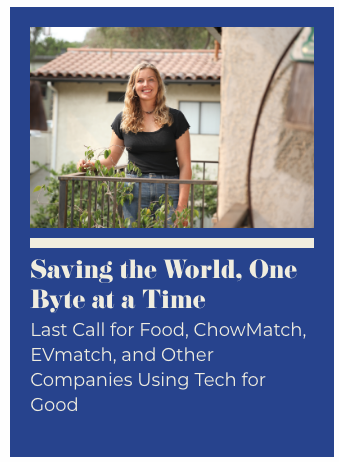
Erin McGeoy of Last Call for Food, photo by Daniel Dreifuss for Santa Barbara Independent.

Erin McGeoy of Last Call for Food, photo by Daniel Dreifuss for Santa Barbara Independent.

An increasing number of tech companies are working to create products and applications to improve our lives and make a difference in ways both small and large. While Apeel Sciences works to end hunger on a global scale, Last Call for Food matches hungry college students with discounted end-of-night restaurant meals. Founder and CEO Erin McGeoy, a Santa Barbara High water-polo standout, developed the platform while at George Washington University.

Despite scholarships and working throughout college, she still struggled financially and developed clever ways to access more affordable food. After working on the food waste team at the World Wildlife Fund, she focused her energy on the intersection of college food insecurity and wasted restaurant food to launch Last Call in 2017.

“The technology we use allows restaurants and other food vendors to share deals they have on surplus food to the Last Call website, and it enables Last Call to communicate these deals to our subscribers,” said McGeoy, who launched on the East Coast but is now actively working in her hometown to bring the service to UCSB and SBCC students. See lastcallforfood. com.

ChowMatch is also counteracting food waste locally. The initiative was launched by the Community Environmental Council (CEC) in partnership with the Santa Barbara County Food Rescue Program and is supported by COVID-19 relief funding. Explained the CEC’s Julia Blanton, “We help build relationships between donors with surplus food and charitable organizations to prevent produce and restaurant-quality prepared food from going to the landfill and instead direct it to those facing hunger throughout the county.” See chowmatch.com.

Wildnote’s mission is to protect natural resources by empowering professionals to accurately collect, efficiently manage, and effectively report on environmental compliance. Making the world a better place is emphasized at every meeting, said founder and CEO Kristen Hazard, who is based in San Luis Obispo. “It’s often the reason employees want to come work for Wildnote, because they feel a calling for their work to have meaning around the environment,” she explained. See wildnoteapp.com.

Heather Hochrein used a grad-school group thesis idea to win third place at UCSB’s New Venture Competition, and then she founded EVmatch, a peer-to-peer network for finding electric-vehicle charging stations. The app directs drivers to privately owned charging stations, allowing apartment dwellers and travelers a flexible way to charge their vehicles. See evmatch.com.

Technology is also an excellent resource for crowdfunding and marketing innovative, eco-minded products. Frustrated with trying to eliminate waste in their everyday lives, Remaker Labs cofounders David Silverander and Sky Gilbar developed Hitch, a full-size reusable water bottle with a removable, barista-approved cup hidden inside. Through funny videos featuring familiar landmarks, Hitch raised $1.2 million on Kickstarter and is still reselling through Indiegogo. They plan to deliver in November, just in time for the holidays. See carryhitch.com.

The Final company sports a similar ethos of eliminating single-use products and also used humorous videos of mermaids to market FinalStraw, a reusable straw that folds down to keychain-size. “The idea around the mermaid is this human connection to the ocean, which has a fun fantasy aspect,” said founder Emma Rose Cohen, who was part of the Save the Mermaids activist group as a student at UCSB, dressing in mermaid costumes to encourage the City of Santa Barbara to ban plastic bags. Her Kickstarter campaign raised $1.8 million, and FinalStraw is now available at REI, as well as online, with additional products—FinalFork, FinalSpork, and FinalWipe— available for preorder. See final.co. 
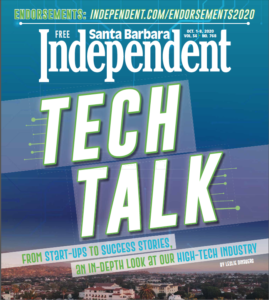
Tech Talk Special Issue for Santa Barbara Independent, published October 1, 2020.

Tech Talk Special Issue for Santa Barbara Independent, published October 1, 2020.


Tech Talk Special Issue for the Santa Barbara Independent, originally published on October 1, 2020.

To read the issue as it appeared in print, please click here, Tech Talk 768_10_01_20

 

Communication is Key for WELL Health

WELL Health’s CEO Guillaume de Zwirek first discovered healthcare tech as a patient. During an Ironman triathlon, he landed in the back of an ambulance, suffering from acute heatstroke. In the months after his hospital discharge, he navigated a complex medical system full of antiquated communication practices. Seeing an opportunity, de Zwirek created WELL to solve those challenges.

“WELL enables health systems, private practices, and vendors to conduct seamless conversations with patients across multiple channels, including texting, email, telephone, and live chat,” said Pamela Ellgen, WELL’s health editor.

Through WELL, patients receive all of their healthcare communication from one trusted source—their provider—and service providers can converse with patients in real time.

The first WELL office opened in 2015 in Redwood City, the heart of Silicon Valley. “I quickly realized that wasn’t the right thing for the company, or for our team,” said de Zwirek.

“The Bay Area was overcrowded with way too many people willing to make crazy commutes. Even though our office was right on the train route, some of our team still had to travel more than an hour and a half just to get to work.

And the cost of living was out of control. In addition, turnover is a way of life in Silicon Valley. It wasn’t what I wanted for WELL. I want to build a community of people who are happy to be here and excited to help build this company.”

WELL relocated its headquarters to Santa Barbara in 2017 and now operates on Chapala Street in Invoca’s former headquarters. Listed as number 170 on the Inc. 500 list of the fastest growing privately held companies in the U.S., WELL employs 102 people, with 62 of them in Santa Barbara.

In March 2020, WELL unveiled its Rapid Release Program, which allows health systems to manage urgent COVID-19 patient communications at scale. A technology that seems tailor-made for our time, it can be deployed by users in just 48 hours, which is far quicker than a typical implementation. Seeking to address the pandemic as effectively as possible, WELL offered the program below cost and was able to serve an additional 2.5 million patients within weeks of launch.  wellapp.com

Tech Talk Special Issue for Santa Barbara Independent, published October 1, 2020.

Tech Talk Special Issue for Santa Barbara Independent, published October 1, 2020.


Tech Talk Special Issue for the Santa Barbara Independent, originally published on October 1, 2020.

To read the issue as it appeared in print, please click here, Tech Talk 768_10_01_20

 

Epistolary Art

805 Living September 2020, Epistolary Art, story by Leslie Dinaberg.

805 Living September 2020, Epistolary Art, story by Leslie Dinaberg.

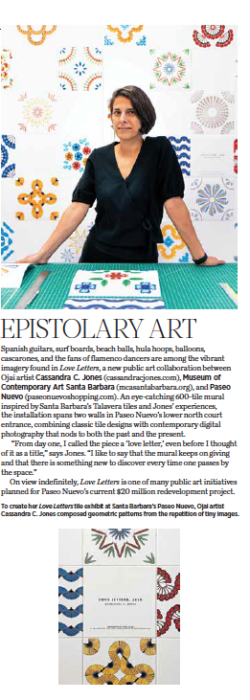
Spanish guitars, surf boards, beach balls, hula hoops, balloons, cascarones, and the fans of flamenco dancers are among the vibrant imagery found in Love Letters, a new public art collaboration between Ojai artist Cassandra C. Jones (cassandracjones.com), Museum of Contemporary Art Santa Barbara (mcasantabarbara.org), and Paseo Nuevo (paseonuevoshopping.com).

An eye-catching 600-tile mural inspired by Santa Barbara’s Talavera tiles and Jones’ experiences, the installation spans two walls in Paseo Nuevo’s lower north court entrance, combining classic tile designs with contemporary digital photography that nods to both the past and the present.

“From day one, I called the piece a ‘love letter,’ even before I thought of it as a title,” says Jones. “I like to say that the mural keeps on giving and that there is something new to discover every time one passes by the space.”

On view indefinitely, Love Letters is one of many public art initiatives planned for Paseo Nuevo’s current $20 million redevelopment project.

805 Living, September 2020.

805 Living, September 2020.

This story was originally published in the September 2020 issue of 805 Living. Click here to read it as it appeared in print.


New Foodie Finds

805 Living September 2020, New Foodie Finds, story by Leslie Dinaberg.

805 Living September 2020, New Foodie Finds, story by Leslie Dinaberg.

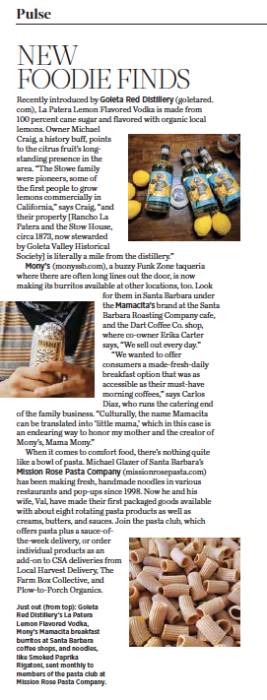
Recently introduced by Goleta Red Distillery (goletared.com), La Patera Lemon Flavored Vodka is made from 100 percent cane sugar and flavored with organic local lemons. Owner Michael Craig, a history buff, points to the citrus fruit’s longstanding presence in the area.

“The Stowe family were pioneers, some of the first people to grow lemons commercially in California,” says Craig, “and their property [Rancho La Patera and the Stow House, circa 1873, now stewarded by Goleta Valley Historical Society] is literally a mile from the distillery.”

Mony’s (monyssb.com), a buzzy Funk Zone taqueria where there are often long lines out the door, is now making its burritos available at other locations, too. Look for them in Santa Barbara under the Mamacita’s brand at the Santa Barbara Roasting Company cafe, and the Dart Coffee Co. shop, where co- owner Erika Carter says, “We sell out every day.”

“We wanted to offer consumers a made-fresh-daily breakfast option that was as accessible as their must-have morning coffees,” says Carlos Diaz, who runs the catering end of the family business. “Culturally, the name Mamacita can be translated into ‘little mama,’ which in this case is an endearing way to honor my mother and the creator of Mony’s, Mama Mony.”

When it comes to comfort food, there’s nothing quite like a bowl of pasta. Michael Glazer of Santa Barbara’s Mission Rose Pasta Company (missionrosepasta.com) has been making fresh, handmade noodles in various restaurants and pop-ups since 1998. Now he and his wife, Val, have made their first packaged goods available with about eight rotating pasta products as well as creams, butters, and sauces.

Join the pasta club, which offers pasta plus a sauce-of-the-week delivery, or order individual products as an add-on to CSA deliveries from Local Harvest Delivery, The Farm Box Collective, and Plow-to-Porch Organics.

805 Living, September 2020.

805 Living, September 2020.

This story was originally published in the September 2020 issue of 805 Living. Click here to read it as it appeared in print.


Local Ingredients at Your Door

805 Living September 2020, Local Ingredients at Your Door, story by Leslie Dinaberg.

805 Living September 2020, Local Ingredients at Your Door, story by Leslie Dinaberg.

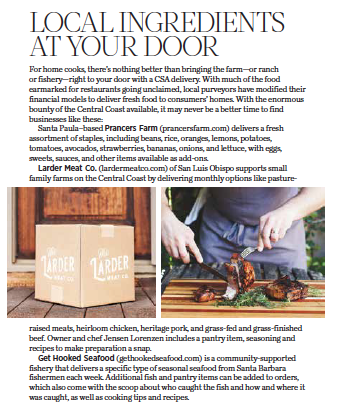
For home cooks, there’s nothing better than bringing the farm—or ranch or fishery—right to your door with a CSA delivery. With much of the food earmarked for restaurants going unclaimed, local purveyors have modified their financial models to deliver fresh food to consumers’ homes. With the enormous bounty of the Central Coast available, it may never be a better time to find businesses like these:

Santa Paula–based Prancers Farm (prancersfarm.com) delivers a fresh assortment of staples, including beans, rice, oranges, lemons, potatoes, tomatoes, avocados, strawberries, bananas, onions, and lettuce, with eggs, sweets, sauces, and other items available as add-ons.

Larder Meat Co. (lardermeatco.com) of San Luis Obispo supports small family farms on the Central Coast by delivering monthly options like pasture raised meats, heirloom chicken, heritage pork, and grass-fed and grass-finished beef. Owner and chef Jensen Lorenzen includes a pantry item, seasoning and recipes to make preparation a snap.

Get Hooked Seafood (gethookedseafood.com) is a community-supported fishery that delivers a specific type of seasonal seafood from Santa Barbara fishermen each week. Additional fish and pantry items can be added to orders, which also come with the scoop about who caught the fish and how and where it was caught, as well as cooking tips and recipes.

805 Living, September 2020.

805 Living, September 2020.

This story was originally published in the September 2020 issue of 805 Living. Click here to read it as it appeared in print.


Wine Shopping 2.0

805 Living September 2020, Wine Shopping 2.0, story by Leslie Dinaberg.

805 Living September 2020, Wine Shopping 2.0, story by Leslie Dinaberg.

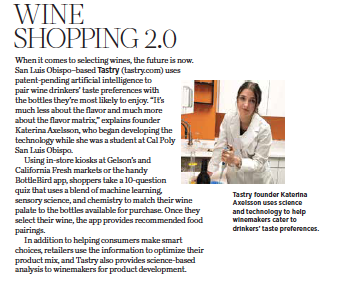
When it comes to selecting wines, the future is now. San Luis Obispo–based Tastry (tastry.com) uses patent-pending artificial intelligence to pair wine drinkers’ taste preferences with the bottles they’re most likely to enjoy. “It’s much less about the flavor and much more about the flavor matrix,” explains founder Katerina Axelsson, who began developing the technology while she was a student at Cal Poly San Luis Obispo.

Using in-store kiosks at Gelson’s and California Fresh markets or the handy BottleBird app, shoppers take a 10-question quiz that uses a blend of machine learning, sensory science, and chemistry to match their wine palate to the bottles available for purchase. Once they select their wine, the app provides recommended food pairings.

In addition to helping consumers make smart choices, retailers use the information to optimize their product mix, and Tastry also provides science-based analysis to winemakers for product development.

805 Living, September 2020.

805 Living, September 2020.

This story was originally published in the September 2020 issue of 805 Living. Click here to read it as it appeared in print.


A Taste of Paso

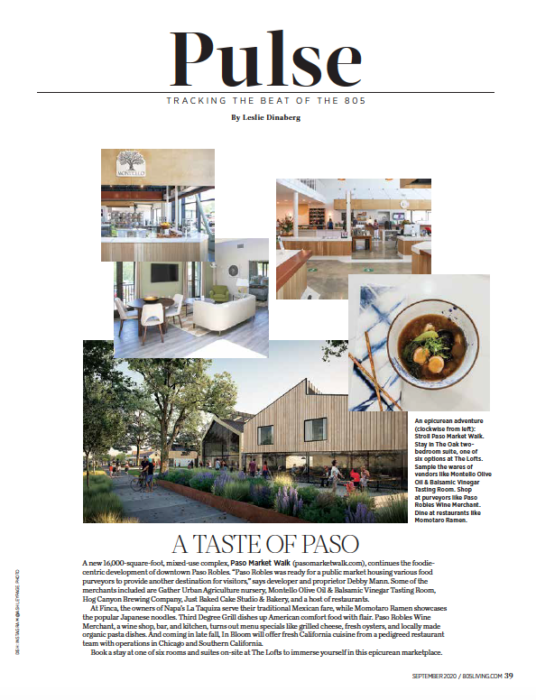
805 Living September 2020, A Taste of Paso, story by Leslie Dinaberg.

805 Living September 2020, A Taste of Paso, story by Leslie Dinaberg.

A new 16,000-square-foot, mixed-use complex, Paso Market Walk (pasomarketwalk.com), continues the foodiecentric development of downtown Paso Robles. “Paso Robles was ready for a public market housing various food purveyors to provide another destination for visitors,” says developer and proprietor Debby Mann.

Some of the merchants included are Gather Urban Agriculture nursery, Montello Olive Oil & Balsamic Vinegar Tasting Room, Hog Canyon Brewing Company, Just Baked Cake Studio & Bakery, and a host of restaurants. At Finca, the owners of Napa’s La Taquiza serve their traditional Mexican fare, while Momotaro Ramen showcases the popular Japanese noodles. Third Degree Grill dishes up American comfort food with flair. Paso Robles Wine Merchant, a wine shop, bar, and kitchen, turns out menu specials like grilled cheese, fresh oysters, and locally made organic pasta dishes. And coming in late fall, In Bloom will offer fresh California cuisine from a pedigreed restaurant team with operations in Chicago and Southern California.

Book a stay at one of six rooms and suites on-site at The Lofts to immerse yourself in this epicurean marketplace.

805 Living, September 2020.

805 Living, September 2020.

This story was originally published in the September 2020 issue of 805 Living. Click here to read it as it appeared in print.


Grazing to Go

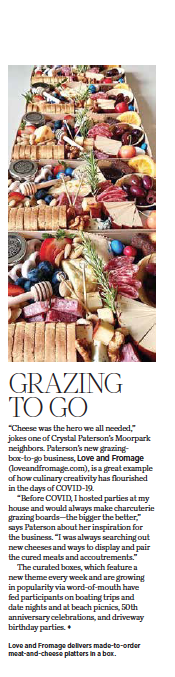
805 Living September 2020, Grazing to Go, story by Leslie Dinaberg.

805 Living September 2020, Grazing to Go, story by Leslie Dinaberg.

“Cheese was the hero we all needed,” jokes one of Crystal Paterson’s Moorpark neighbors. Paterson’s new grazing box-to-go business, Love and Fromage (loveandfromage.com), is a great example of how culinary creativity has flourished in the days of COVID-19.

“Before COVID, I hosted parties at my house and would always make charcuterie grazing boards—the bigger the better,” says Paterson about her inspiration for the business. “I was always searching out new cheeses and ways to display and pair the cured meats and accoutrements.”

The curated boxes, which feature a new theme every week and are growing in popularity via word-of-mouth have fed participants on boating trips and date nights and at beach picnics, 50th anniversary celebrations, and driveway birthday parties.

805 Living, September 2020.

805 Living, September 2020.

This story was originally published in the September 2020 issue of 805 Living. Click here to read it as it appeared in print.