Bungalow Haven

mapWhat started out as a simple opportunity to socialize with neighbors and get to know a little more about American bungalow style architecture and restoration has quickly morphed the Bungalow Haven Neighborhood Association into a vibrant, politically active neighborhood watchdog group.

Bungalow Haven was formed about two years ago by neighbors Dee Duncan and her husband Steve Dowty, and Judy and Sayre Macneil.

“The original intent was social,” said Cheri Rae, another member of the association. Rae said the group has a couple of hundred members representing about 125 households and meets once a month at Duncan and Dowty’s home. They also have an active email list and several subcommittees, including a political action committee that is currently reviewing its position on the proposed development of the former St. Francis Medical Center property.

The Bungalow Haven neighborhood — roughly bounded by Alta Vista, Laguna, Anapamu and Micheltorena streets — began to mobilize when they learned of a plan to construct 18 new units on the 1400 block of Laguna Street and relocate five bungalows. The project — developed by Capital Pacific Holding LLC and designed by architect Detlev Peikert — was well underway before the neighbors really became aware of it. However, at least in part from their efforts (including numerous appearances before the planning commission and the architectural board of review) the project has been scaled back to retain three of the existing bungalows on the property, along with plans to build the 15 new units in craftsman style rather than the originally planned red tile roofs.

“We’ve shown up 50 at a time and I think that was part of why we’ve been so successful. People were so amazed to see such a large bunch of people who were very articulate,” said Rae, who has been sharing strategies with other neighborhood associations.

Mike Jogoleff, who has lived in Bungalow Haven since childhood, fears continued encroachment by developers would ruin the neighborhood’s character. “If somebody’s working against us like these big development companies, they just come in and screw everybody,” he said.

One of the steps the neighborhood association is taking to prevent more “condo mania” is working to establish Bungalow Haven as a Historic Landmark District. Regarding the Laguna Street project, Rae said, “… we’ve all had a steep learning curve on what the rules are, and we want to prevent it from ever happening again.”

To obtain historic status, the group must first finish a neighborhood survey cataloguing the historic elements throughout the approximately 300 homes in the neighborhood. “We’re modeling our approach on the El Pueblo Viejo and the Brinkerhoff Districts. They are (the) only two historic districts in the town so far, so we’re doing the same thing that they did,” she said.

Rae admitted, “It’s a little ironic when we say with disdain, ‘they’re putting in million dollar condos’ when our houses are creeping up toward million dollar houses. It’s just (that) what you get for your money is not stucco and brand-new efficient appliances, but you get some charm.”

Jogoleff is also keenly aware that the working-class neighborhood he grew up in has changed. ” As my neighbor says, the people that buy our houses are not going to be painters and teachers. It’s going to be lawyers, doctors, accountants.”

While development projects have been catalysts, they aren’t the primary reason for the group. “The group is to preserve this style of life, simple and kind of a calmer way of life. None of us chose to go live in a tract house in Goleta. That’s just not what we wanted. … We’re not out there recruiting members. … The whole idea is for peaceful coexistence and neighborhood protection,” Rae said.

“We’re not anti-development … it’s just within reason and it’s within scale and size and having respect for the neighborhoods that are already here. It makes no sense whatsoever to develop for new people who come in when you ignore the neighbors that are already here and have built Santa Barbara to be what it is. … We feel like we’re part of the fabric of this town and we want to be able to stay here and not be run out because we can’t have the kind of life that we want to have here,” Rae said.

Originally published in South Coast Beacon

First Time Home Buyers: Adventures in Home Buying

Image by phanlop88 freedigitalimages.net

Image by phanlop88 freedigitalimages.net

Sometimes the first house you have your heart set on isn’t the one that you’re meant to have. That was the lesson Gloria Herrera and Martin Ibarra learned during their recent home-buying adventure.

After losing bids on several homes, the couple, who share a home with their daughter and Ibarra’s mother, was ready to compromise on their dream house. While they really wanted to stay in Santa Barbara, they also looked at properties in San Ynez and Buellton. Plus, they needed at least three bedrooms and they didn’t want a condominium.

This market is very competitive and difficult, said their Realtor Nicole Dinkelacker, who’s with Remax in Goleta. “It’s a lot more complicated than just finding a property.”

In the case of Herrera and Ibarra, Dinkelacker was ready with the check for a “compromise house,” when she found out that another property they had bid on earlier was available for an additional $5,000.

“Usually $5,000 you’re like oh my God, $5,000,” said Herrera. “At this point, $5,000 was like $5 to me … for a bigger property and an extra room.” Herrera said she thought the fact that she and Ibarra are both native Santa Barbarans (who met at Santa Barbara High School) was what sealed the deal for the home they eventually purchased for $700,000.

The four-bedroom, two-bathroom home on a 900 square foot lot on Noma Street in Carpinteria was a good buy, compared to what was available in Santa Barbara. “We lucked out,” said Herrera, noting that in addition to more square footage, most of the house had new carpet and had been newly painted.

Regarding making home improvements, “It’s not like you have much money left after buying the house. You pay your bills and you pay your mortgage and then … Home Depot,” said Herrera.

“Yeah, we tend to be at Home Depot a lot more, that’s for sure,” laughed Ibarra.

“When we first got the house, it wasn’t as pretty. I put in palm trees and flowers. … I think a year from now it will definitely be a lot more how we envisioned it. …You only have the weekend to really do much.”

Although fixing up the house is an ongoing project, Herrera said she’s ready to relax and enjoy the house for a while. “Even though it’s a very tight budget, … you kind of spend your weekends here at home. Sometimes it’s by choice and other times because you really have no other form of entertainment you can afford. But at least it’s yours and you know that little by little, it will get easier. … We have something that a lot of people have a hard time trying to obtain.”

“I know she had her heart set on the first house … and I know when that didn’t come through she got down. But like I told her, it’s either meant to be or not,” said Ibarra. “(I told her) we’re going to find something down the road that’s going to be much better. And soon we were able to find this.”

Originally published in South Coast Beacon

First Time Home Buyers: There’s Nothing Like the First Time

Image by phanlop88 freedigitalimages.net

Image by phanlop88 freedigitalimages.net

Here on the South Coast — where multiple bidders compete to buy $1 million generic tract houses that “need work” — first time homebuyers are definitely in the minority. But a surprising number of working professionals are getting into the market via some very creative configurations, both in terms of financing and sometimes even living situations.

“It’s a lot more complicated than just finding a property,” said Nicole Dinkelacker, a realtor with RE/MAX’s Goleta office who’s been in the business for 20 years. “Anybody with less than ten percent down, it’s very competitive and difficult.”

Difficult, but not impossible.

“You can get 100 percent financing. You have to have beautiful credit, of course, but it isn’t like you have to come up with a huge amount of money, or at least you should talk to a realtor before you decide that,” said Rebekah Mulder, a realtor with Prudential California Realty in Santa Barbara.

A former teacher and principal at Cold Springs School, who got out of education to become a financial planner and real estate agent, Mulder said she still finds a lot of her job involves educating her clients about the tax advantages of investing in real estate, as well as the many creative ways to make buying a house possible in the Santa Barbara market.

One of the unique financing methods she often teaches first-time buyers about is equity sharing, where a parent, an employer or a third party will invest in buying a house in partnership with the person who will live there.

Recently, Steen Hudson (the Director of the Rescue Mission) and his wife Trina entered into an equity share agreement with his employers, said Mulder. “The mission is realizing money on its investment and if the Hudson’s so choose they can steadily buy the mission out. It’s a great way for employers to help out their employees and make an investment as well.”

“Equity sharing is a great investment. You pair up older people who really don’t want to go out and buy an apartment house or something. Most people are unaware that if you own a residential income property, you can depreciate that property. Even if its actually appreciating, the tax code allows you depreciate it, which then shelters that much of your earned income from any taxes at all,” said Mulder. The IRS allows you to treat one physical property as both a residential property and a residential income property (divided proportionately), she explained.

Rather than asking parents or others to “help” with a down payment, Mulder advises approaching it like a business opportunity and will often make the presentation to parents as a neutral party. “We have (37-page) contracts where you negotiate every horrible thing that could happen.”

“Another thing that piggybacks on that is that buying a property with a rental on it is really good option, especially for someone that’s maybe got high income but maybe no money down, said Sharol Mulder, Rebekah’s daughter and business partner.

“A lot of times if we have people with a lot of money down, it’s a better bottom line if they buy a more expensive property with a rental on it. So let’s say they could go buy a $600,000 condo, they could probably buy a $900,000 house with a rental on it and actually come out paying less per month,” said Sharol, who recently made this type of deal with buyers Dave and Eliza Reed and Kate Russell (Eliza’s sister). “They bought a neat old turn of the century Craftsman plus an additional duplex on West Sola. … They rent out the main house for maximum income.”

In addition to financing options, first-time homebuyers often need to be educated on the basics about realtors. “There are a lot of people out there who don’t know how realtors get paid. We’re seeing people walk into open houses and work with the realtor who’s there without a recommendation. … As a buyer you’re not going to pay the realtor’s commission but you really need a good realtor, so you need a good recommendation. … It’s a great benefit to you as a buyer that the seller is going to pay your realtor’s commission but it doesn’t take away the responsibility that you have to find someone who’s really good to represent you,” said Sharol.

Having professional, experienced representation is even more important with the current climate of multiple offers being made for any given listing. “Houses are going really quickly,” said Gloria Herrera, one of Dinkelacker’s clients who recently purchased a home in Carpinteria after making an offer on another. “The whole thing has really been a learning experience.”

There’s nothing like the first time … starting next week, our South Coast Homes section will feature case studies of local first time buyers. We’ll go inside their homes to see what they were able to buy and how they were able to do it.

Originally published in South Coast Beacon

Olympic Gold Medalist Todd Rogers: Hometown Hero Hopes To Bring Home Another Gold From London

By Leslie Dinaberg

Leslie Dinaberg: The 2012 Summer Olympics in London will be your second Olympics. How is it different preparing this time around?

Olympian Todd Rogers, photo by Mitchell Haaseth/NBC

Todd Rogers: I wouldn’t say it feels different.  … As far my training and that kind of thing go, its business as usual. There’s no real reason for us to change anything dramatically. The only thing that I try and always keep in mind is that I’m getting older, so just being intelligent about stretching and icing and just taking care of my body because I’m not as durable as I was four years ago.

LD: What percentage of your training is running and lifting versus actually playing volleyball?

TR: The majority these days is probably more running and lifting. I start lifting in November and from mid-October I’ll be doing some kind of running or some kind of exercise that has a cardio component. We (Rogers and partner Phil Dalhausser) really don’t start hitting the ball around until late January early February, there’s just not much reason to do so at a really early stage. The season gets started in April but for us the Olympics are not until August.


I hear of people hitting the ball around in November and I go, “Are you crazy?” But to each his or her own, I guess. I’m kind of a burnout athlete, I’ve discovered that about myself. I just can’t do that much, otherwise I will be sick of the sport.

LD: But you still travel and compete in other places before you go to London.

(Editor’s note: since this interview in April, Rogers/Dalhausser won their third straight gold at the 2012 Brasilia Open and retained their Shanghai Grand Slam title. They are currently competing in Beijing. For a complete tournament schedule click here.)

When you are doing all of that traveling, how much of those places are you getting to see? Are you getting to play tourist at all?

Olympian Todd Rogers, photo by Mitchell Haaseth/NBC

TR: At some of them we have. A lot of them are re-stops, so for example I’ve been to  Klagenfurt, Austria, which is probably the best tournament in the world, probably ten times. I’ve done well most of the time but not all the time, and when I haven’t done well I’ve gone out and checked out the city. It’s on a lake so I’ve gone on boats and whatnot… When we were in Berlin I made it a point to just kind of check out the surrounding area. There have been a few stops where I stay a couple of days extra just because it’s a really cool place. Like in Prague, there are some just really neat areas in Prague that are really old and I make a point of making sure that I get to those and check them out and try to find something new in those areas.

LD: I know you grew up in Santa Barbara and went to San Marcos High School and UCSB. Growing up near the beach is so unique. When you are playing volleyball internationally is it different playing on an actual beach versus some place where they bring sand in?

TR: I would say yes, absolutely. On an actual beach, if you know the beach, you have a consistent wind. The sand tends, not always, but tends to be deeper. When they bring in the man made court they are looking at trying to save money and it costs money to bring sand so they are going to put really the minimal amount of sand they can put in to save costs … it’s much more of a jumper’s sand.

There’s definitely a difference and especially if you’re in a city between buildings. The winds are really weird. It could be going one way and then ten minutes later it could be going the other way because just the way it goes through the buildings can change dramatically really quickly. Whereas on the beach, if you’re at East Beach, most of the time the wind in the afternoon blows out of the northwest. I know that.

LD: When did you start playing beach volleyball?

TR: When I was at San Marcos High School. John Lee was the coach there for the volleyball team; he’s also an English teacher.  He encouraged all of us freshman boys, actually pretty much all of his volleyball protégées to just go down to East Beach and play. He said, “You’ll become a much better indoor player if you go and play on the beach.”

It’s a lot of fun. We were all 14-year-old boys. You’ve got lots of girls in bikinis down there, you’ve got your shirt off, you’re running around in your shorts—it was a pretty easy sell for us! 

So a bunch of us just started going down there after my freshman year and I was 14-years-old and I fell in love with it right away. And I haven’t stopped playing. I didn’t stop playing when I was in college and just kept going with it.

LD: I know you have a son and a daughter (Nate, age 11 and Hannah, age 13). Are they volleyball players?

TR: My daughter loves it; she actually particularly loves beach volleyball. My son enjoys playing beach volleyball but he’s not super into it. We have a court in our backyard (Rogers and his wife Melissa live in Solvang) so we actually play a fair amount of family volleyball. It used to be kind of even, but my daughter at 13 has gotten a lot better in the last year. My son at almost 11 has not. So it’s kind of getting to an unfair level, but he’ll still play. It’s a fun family activity.

LD: You must have other people come and use your court.

TR:We always have people over and I usually have one or two foreign teams that are friends of ours that

Olympian Todd Rogers, photo by Mitchell Haaseth/NBC

play on the international tour and they come to California to train and we’ll come up here. We’ll have a little barbecue after and just kind of hang out, have a few beers, that kind of thing.

We have some friends in town that kind of hang out, their kids come over and play with our kids there or we’ll set up a few trainings with some of the kids and there’s a couple of adults that like to come over and hack it, have a good time. Usually it involves a couple of beers, though. (Laughs)

LD: I know you and Phil have already qualified for the Olympics, but assuming other Americans qualify, then you also could conceivably be competing against those people. What’s that like?

TR: It is a little different because it’s really funky the way they do it. There’s a four year window, say after the Olympics, you have your following next two years when you’re just playing on the international tour and that’s how you qualify and everyone is kind of cheering for each other. I’m always cheering for other Americans of course, unless I’m playing.

Then all of a sudden January 1, 2011 comes along and now, as happens every four years, all of a sudden you are competing against those people just to make the Olympics. So you still want them to win because they are your friends, but at the same time you want to make sure that you are doing a lot better.

Phil and have been very fortunate in that we have done well right away where we have kind of separated ourselves from our competitors …They are fighting it out amongst each other and we just are watching it. We’re pretty much already in. … now the other two teams that are fighting for the spot they’re super close and they can’t catch us so it’s like we can just sit back and just enjoy it. I’ll cheer for them, unless we’re playing against each other.

In the Olympics it’s the same kind of thing. It’s like I want to see them do well, so I’m cheering for them, but at the same time I want to ultimately win the gold medal over them if that’s what it comes down to.

LD: At this point in your career, what percentage of your skill is physical versus mental?

TR: At this point it’s almost all just a mental game for me. Keeping my body healthy, no doubt, that’s the number one thing on the physical side of things and then the rest of it is just I know what I’ve got to do, I know what I need to accomplish and most of that’s just mental. In fact Coach Lee always used to tell me and other players that the game of volleyball is 90% mental and 10% physical. That might be an extreme but it’s pretty darn close. It’s definitely more of a mental game than a physical game.

As I’ve aged and as I’ve seen my kids play and I’ve coached at UCSB and whatnot and I’ve come to realize that he’s absolutely correct. There are kids that are just jumping out of the gym and are amazing athletes and yet they’re just not very good because in the mental part they just break down they make a lot of foolish errors that are really mental errors and not physical errors. They are jumping eight inches higher than the other kids but the other kids are consistent, play smart, using their eyes and their brain and thinking okay I need to do this rather than this, whereas a lot of those exceptional athletes will just use their athleticism and at some point in their careers they are going to meet someone who’s relatively close or maybe even better than them that can’t get past that because they haven’t really developed their mental game.

So I’m fortunate in that I was able to develop that mental game and have decent physical skills, not as great as a lot of other people’s but definitely the mental side of things is so important. I am fortunate that I have that.

LD: Has volleyball always been your favorite sport?

TR: No, not really. It was actually soccer. I played soccer since I was four or five years old. I always thought that was my sport and I loved it. Even into high school when I started playing volleyball and beach volleyball, soccer was always my sport, my first love.

Coach Lee was always like, “man you’ve got to play club volleyball.” And I was always like, “No man, soccer is my sport, I’m not going to stop playing soccer.”

Then my senior year I was trying to get scholarships to play soccer and it wasn’t really happening, I could have walked on a couple of places. But some volleyball teams were recruiting me and so I ended up playing at UCSB on the volleyball team. I still went out for the soccer team and made the soccer team my freshman year but after that season I had to recognize that I’m better at volleyball than I am at soccer. And at a collegiate level, soccer is just, these guys are so fast and so quick it’s like they could run forever. I’m reasonably fast and reasonably quick but they just seem like a different type of athlete than me. In high school and below and in volleyball I was right there, one of the better players pretty much all of the time. I just realized that my upside in volleyball was much greater than it was in soccer.

LD: That’s really interesting. To me volleyball and soccer seem like such different sports.

TR: They are, but there is actually a fair amount of crossover. Like for me, trying to stay with a smaller quicker, faster guy, I had to use perfect footwork and everything had to be on balance and all that kind of stuff. I found that actually correlated really well over to particularly playing defense on the beach. Having good balance, recognizing what’s going on, what’s going to happen and being able to anticipate, which was what I had to do in soccer just to essentially stay alive. It became a trick for me on the beach court.

LD: I’ve heard the announcers call you “the professor” before, and I’m getting a little of that from our conversation. What’s that about?

TR: A lot of people said I kind of have a mental black book on everyone, as far what their tendencies are, so one of the announcers, Chris “Geeter” McGee, about ten years ago, he started calling me the professor. I like it. It actually kind of suits. I always looked at the way I play as more of a cerebral game and whenever I’m out there I want to make it into more of a cat and mouse kind of game, because that’s where my strengths lie. I’m not the biggest jumper; I’m not the biggest guy; I’m not the quickest guy. I’m reasonable on all of those areas but I knew that I would be stronger on the cerebral side of things, so it kind of fits me as a person aside from just a nickname.

LD: If you weren’t a professional athlete, what would you be doing?

TR: There’s a good shot that I would be coaching. I really enjoy coaching. I started coaching basically right out of high school, coaching junior high teams, club teams, even some high school ball. I’ve actually continued to kind of coach through my children a little bit on the volleyball but a lot on the AYSO soccer stuff and I’ve enjoyed it.

I do think that kids and people in general have changed a lot and I’ve noticed that as I’ve coached more and more it’s changed in a way that’s a lot harder to coach now. So I’m not as gung ho on it, but I could have seen myself 20 years ago being pretty focused on coaching. Other than that it’s hard to say.

… I’ve gotten into some business stuff and have kind of started to enjoy that as well, and that’s something that I’m going to be seriously looking at and trying to get my hand into some different cookie jars, if you will, so that when I retire, which is right around the corner in the next couple of years or so, I’ve got some active things going that will provide me with income and hopefully that I will enjoy.

LD: So you’re thinking about retirement a little bit?

TR: Yeah, I’m 38 and I turn 39 on September 30, so it’s just the reality of the situation. I’ve really never wanted to play much into my 40s. All of these guys … that have played into their 40s, it seems like their bodies kind of started to break down. They were all still having a lot of fun with it, which obviously in my opinion would be the number one thing, but again, I don’t want to have my body be completely breaking down. It’s hard enough to do a workout and being sore.

Essentially from January to June I feel like I’m sore all of the time because I’m working out hard and I’m playing in tournaments and my body just hurts and I’ve got to get deep tissue and ice and all that stuff. It didn’t seem like it used to be that way.

LD: Do you worry more about injuries more than you used to?

TR: Honestly, I’ve never worried about injuries per se, it’s more taking care of the little things like stretching, icing, getting those deep tissue massages, even soaking in the cold ocean after a long workout, getting up to my weight and soaking my legs. Those kinds of things I’m more cognizant of now, and I do a lot more of. … People will say, “How can you go snowboarding? that could ruin your career.”  But you know what, you could step off a sidewalk and get something wrong and your leg locks out and you blow your ACL. I’ve seen it happen before. I just think I’m going to live my life not worried about those kinds of things. I’m not going to do anything extraordinarily stupid, but I’m still going to surf, I’m still going to do the things I enjoy and if I get hurt doing those things then I’m just not going to concern myself with it.

LD: Will your family go with you to London?

TR: That’s the plan … I did not take the kids to Beijing because it was just not very conducive for children. … My wife did come over for the last week so she was there when we won the gold medal and that was very cool. But I figure In London they speak English, there’s a ton of things that are really relevant to our history as Americans having basically a lot of people that started our country coming from Great Britain and London in particular. And there are just so many cool sights to see there.

LD: We’ll all be rooting for you from Santa Barbara. Good luck.

TR: Thanks.

Both men’s and women’s Olympic Beach Volleyball competition starts play in London on July 28. Click here for the complete schedule and more information as items as added.  

Look for Leslie Dinaberg’s interview with another Santa Barbara Olympian, water polo player Kami Craig, in the summer issue of Santa Barbara Seasons Magazine, out June 1.

Originally published in Santa Barbara SEASONS on May 18, 2012.

Get Up Close and Personal with Architecture

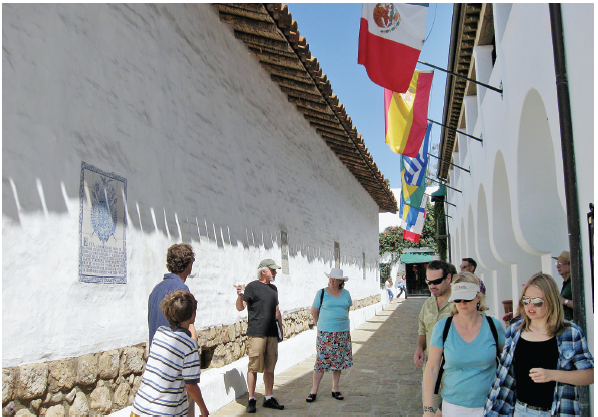
Brian Hofer points out details on the Architectural Foundation tour. Photo by Leslie Dinaberg.

Brian Hofer points out details on the
Architectural Foundation tour. Photo by Leslie Dinaberg.

To experience Santa Barbara architecture in all its glory, there’s nothing like strolling through town with an expert by your side to point out the rich history and international artistic influences that aren’t readily visible to the untrained eye.

Every weekend, trained docents from Architectural Foundation of Santa Barbara (www.afsb.org/tours_m.html, 805/965-6307) take both locals and tourists on walking journeys through the hidden courtyards, secret fountains and original adobes of downtown, focusing on architectural styles, significant and historic buildings, aesthetics and landscape history, as well as details like handmade tiles, wrought iron, stonework, balconies, doorways, archways and plantings.

The Sabado (Saturday) Tour starts in front of city hall and takes guests on a tour of De la Guerra Plaza, historic De la Guerra Adobe, El Paseo, Hill-Carrillo AdobeMeridian Studios, Lobero Theatre and more. The Domingo (Sunday) Tour, which starts at the Central Library, focuses on historic art and architecture of downtown Santa Barbara as it was reborn after the 1925 earthquake, including the library and its famous murals, La Arcada Court, the historic Arlington, The Granada and other architectural delights. You’ll also learn about Santa Barbara’s architectural history and how the Women’s League and Pearl Chase forced us to maintain architectural integrity, beautiful public park spaces and rich landscapes. Both tours start at 10 a.m. and last about 1-1 /2  hours. The foundation asks for a $10 donation per person, and proceeds go toward scholarships and other community programs.

Walking Wednesdays with Santa Barbara Walks is a clever new way to get some after-work exercise and experience the beauty of our local environment. The group, which is a project of COAST (Coalition for Sustainable Transportation, 805/875-3562), meets at 5:30 p.m. on the fourth Wednesday of every month and features a different theme and location each time. One walk included a tour through the upper eastside with architect Anthony Grumbine of Harrison Design Associates, beginning with a walkthrough of the historic Winsor Soule Hodges Residence (currently The Fielding Institute), a 1920s Spanish colonial revival estate, which was once the most expensive home built in Santa Barbara. The expedition also journeyed through a wonderful variety of architecture styles, including a Francis Underhill stripped classicism design, a Richard Neutra mid-century modern, French Norman and Dutch colonial, as well as the many architectural hybrids. Previous walks included an art walk with Ellen Durham, an architectural tour of El Andaluz with Jeff Shelton, trees of Santa Barbara with Bob Muller and a historical tour with Brian Hofer. Walking Wednesdays are free; visit www.coastsantabarbara.org/category/santa-barbarawalks/ for information on monthly locations and themes.

Originally published in Santa Barbara Seasons Magazine, Fall 2010. Cover photo by Jim Bartsch.

Cover photo by Jim Bartsch.

Originally published in Santa Barbara Seasons Magazine, Fall 2010. Cover photo by Jim Bartsch.

Editor’s Letter Fall 2010 (Santa Barbara Seasons Magazine)

Santa Barbara Seasons Editor's Letter Fall 2010. Photo by Tracy Smith Reed.

Santa Barbara Seasons Editor’s Letter Fall 2010. Photo by Tracy Smith Reed.

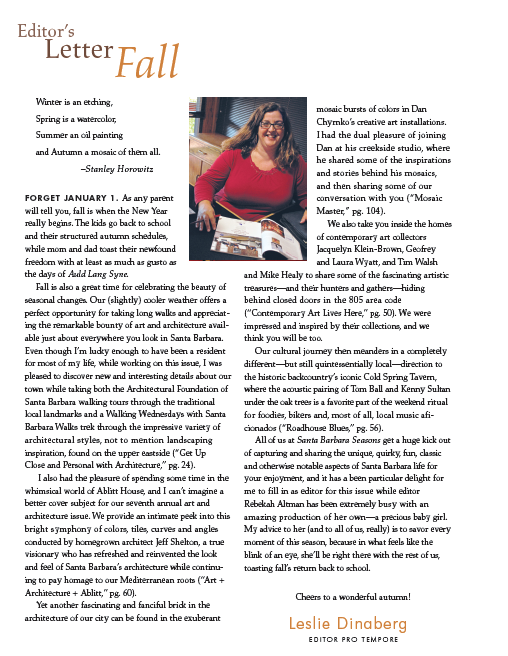
 Winter is an etching, Spring is a watercolor, Summer an oil painting and Autumn a mosaic of them all. –Stanley Horowitz

FORGET JANUARY 1. As any parent will tell you, fall is when the New Year really begins. The kids go back to school and their structured autumn schedules, while mom and dad toast their newfound freedom with at least as much as gusto as the days of Auld Lang Syne.

Fall is also a great time for celebrating the beauty of seasonal changes. Our (slightly) cooler weather offers a perfect opportunity for taking long walks and appreciating the remarkable bounty of art and architecture available just about everywhere you look in Santa Barbara.

Even though I’m lucky enough to have been a resident for most of my life, while working on this issue, I was pleased to discover new and interesting details about our town while taking both the Architectural Foundation of Santa Barbara walking tours through the traditional local landmarks and a Walking Wednesdays with Santa Barbara Walks trek through the impressive variety of architectural styles, not to mention landscaping inspiration, found on the upper eastside (“Get Up Close and Personal with Architecture,” pg. 24).

I also had the pleasure of spending some time in the whimsical world of Ablitt House, and I can’t imagine a better cover subject for our seventh annual art and architecture issue. We provide an intimate peek into this bright symphony of colors, tiles, curves and angles conducted by homegrown architect Jeff Shelton, a true visionary who has refreshed and reinvented the look and feel of Santa Barbara’s architecture while continuing to pay homage to our Mediterranean roots (“Art + Architecture + Ablitt,” pg. 60).

Yet another fascinating and fanciful brick in the architecture of our city can be found in the exuberant mosaic bursts of colors in Dan Chyrnko’s creative art installations. I had the dual pleasure of joining Dan at his creekside studio, where he shared some of the inspirations and stories behind his mosaics, and then sharing some of our conversation with you (“Mosaic Master,” pg. 104).

We also take you inside the homes of contemporary art collectors Jacquelyn Klein-Brown, Geoffrey and Laura Wyatt, and Tim Walsh and Mike Healy to share some of the fascinating artistic treasures—and their hunters and gathers—hiding behind closed doors in the 805 area code (“Contemporary Art Lives Here,” pg. 50). We were impressed and inspired by their collections, and we think you will be too.

Our cultural journey then meanders in a completely different—but still quintessentially local—direction to the historic backcountry’s iconic Cold Spring Tavern, where the acoustic pairing of Tom Ball and Kenny Sultan under the oak trees is a favorite part of the weekend ritual for foodies, bikers and, most of all, local music aficionados (“Roadhouse Blues,” pg. 56).

All of us at Santa Barbara Seasons get a huge kick out of capturing and sharing the unique, quirky, fun, classic and otherwise notable aspects of Santa Barbara life for your enjoyment, and it has a been particular delight for me to fill in as editor for this issue while editor Rebekah Altman has been extremely busy with an amazing production of her own—a precious baby girl. My advice to her (and to all of us, really) is to savor every moment of this season, because in what feels like the blink of an eye, she’ll be right there with the rest of us, toasting fall’s return back to school.

Cheers to a wonderful autumn!

Leslie Dinaberg

EDITOR PRO TEMPORE

Originally published in Santa Barbara Seasons Magazine, Fall 2010. Cover photo by Jim Bartsch.

Cover photo by Jim Bartsch.

Originally published in Santa Barbara Seasons Magazine, Fall 2010. Cover photo by Jim Bartsch.

Noozhawk Talks: Leslie Dinaberg Sits Down With Spencer Barnitz

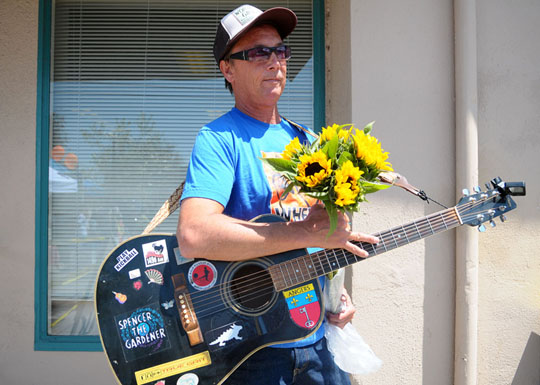
Spencer Barnitz, aka Spencer the Gardener, says his music is “shaped by the ocean, the rhythms of the world and pop music from my life.” (Lara Cooper / Noozhawk photo)

Spencer Barnitz, aka Spencer the Gardener, says his music is “shaped by the ocean, the rhythms of the world and pop music from my life.” (Lara Cooper / Noozhawk photo)

Spencer Barnitz‘s unique pipes and idiosyncratic perspective have entertained music fans for most of his life. His new wave band The Tan began when he was barely out of Santa Barbara High, eventually followed by a still-active cover band, The Wedding Band, and for the past 21 years, Spencer the Gardener, a sound the band describes as “California sun-kissed, Latin-tinged, genre-bending, big-band surf mariachi indie pop.”

Leslie Dinaberg: There’s something really unique about your music, whether you’re singing a pop song or in Spanish and even now with your kids’ album, “Organic Gangster.”  What do you think it is that makes something a Spencer song?

Spencer Barnitz: My songs are really shaped by the ocean, the rhythms of the world and pop music from my life. As a kid I listened to the Supremes but I loved Brit pop too and Mexican stuff, Salsa music, so it’s kind of a fusion in a way of a lot of those different things, which has been great and has been bad. It’s kind of a blessing and a curse in a lot of different ways.

LD: Is it different playing kid’s music?

SB: It’s funny having a CD like that. It’s cute and it has a good message. … For me it’s such a different thing because I’ve been doing pop music for so long. It’s still pop music but it’s just a different manifestation.

LD: How did you decide that you wanted to do this?

SB: Well it was kind of interesting because my girlfriend sells worms; she’s the worm girl. Last year they did a short it was in the green shorts festival. … I said you want a song? I’ll write a song for it.

I loved it! I had done the “Gobble Song” a couple of years ago, which became sort of an Internet sensation, every Thanksgiving it gets tons of hits. So there were a couple kid’s songs and I thought you know what, I should just try to keep going because everything I wrote was really fast and fun.

I did it very fast. Like one day I was reading the horoscope and it was talking about a mountain chicken frog. I was like there’s no way there is a mountain chicken frog. I went and looked it up and there it was. It’s in danger of becoming extinct. I just quickly wrote a song about it and loved the song and I love the fact that that’s how I found it. … So it’s been kind of fun and it’s been educational for me in a way.

LD: Talking to kids you get to-or have to be-so much more on the nose than you are when you are talking to adults. You do have to really say things in a different way and it’s not always easy.

SB: Because you have to sort of know what you’re talking about. (Laughs)

LD: I’ve been listening to your music since I was 16 or something and now my son got to hear you sing at his school. I love that.

SB: You know there was somebody there at the spaghetti dinner at the school and the dad had been aware of the Tan since he was 14. So it was kind of like oh wow, I don’t know if I should say thanks or sorry. Now his daughter is listening to it, so that is just an insanely long generational thing, which I like that for myself, it makes me happy. I don’t know if it makes other people happy (Laughs).

LD: Oh absolutely it does.

SB: I think I’m past the point of … sometimes you get to a point where they’re like wow they’re still here. And then you go beyond that point and it’s like wow, they’re still here.

LD: Plus you do such a wide variety of stuff Do you write all the music for Spencer the Gardener?

SB: I do except for we did put out two years ago we put out a record called “Fiesta” and I didn’t write any of that, those are all cover songs. I’ve wanted to do that record since I was a kid. Probably the reason I speak Spanish is because I grew up singing Spanish, which has a lot to do with Santa Barbara. Fiesta was just always a part of things. So I did that record because I wanted to and I’ll probably do another one at some point.

I remember I had a class at Santa Barbara High School, Mr. Hall was my Spanish teacher, and every Friday he would have everybody sing, which was just terrifying in high school.

LD: Why?

SB: I didn’t do that yet. My sister was always a good singer. She’s actually on this record.

LD: I saw that.

SB: And she’s the principal at Ellwood School. So my sister had sung a lot but I wasn’t a singer, but I would surf and I was going to Mexico so in high school on Friday afternoons you could just see everyone go oh no, but it was fun, but it was terrifying. But for these young kids it’s really fun. They’re young, they’re singing, they’re laughing. They don’t have the self-conscious thing that you do when you’re in high school.

LD: I remember your sister from junior high. That’s cool that she sang on your record.

SB: She’s got a great voice. When she got out of high school she left Santa Barbara and didn’t come back for a long time. She went to Berklee School of Music, she sang on the East Coast and so she is a very good singer.

LD: How did you guys get so musical?

SB: I don’t know. My dad died young so I don’t really even know that whole side of the family. But my sister and I, when she came back into town and she was singing she was doing some weird hand movements and I was looking at her like those are mine. They’re not my mom’s or my dad’s, they’re mine, but they are hers too. And she speaks fluent Spanish, she actually speaks a couple of languages and its like wow this is so weird, there are two kids who do these things. She just started to surf. We both do these things that are completely separate from both of our parents. … it’s just kind of some mix, maybe some weird hybrid.

LD: So tell me about how you got started in music?

SB: Well Brad (Nack) went to Europe in 1978 and … he came back and said you know we should start a new wave band. I was 18, and he was 20 … it was like we thought maybe girls would like us and it was something to do besides surfing (Laughs) and all of those same reasons that everyone does that. … I said that sounds fun, let’s go to Mexico I’ll teach you how to play guitar and we’ll write some songs and start a band.

LD: Why Mexico?

SB: Mexico has been an interesting part of my life. For some reason no matter where I go it’s like something ends up having part of Mexico in it. Mexico is because we surf for one, so that’s always a thing. If you live in California and you surf, usually you take some trips to Mexico because it’s close. For me it is a lot more than because like I said, I grew up singing in Spanish and I’ve just always spent a lot of time in Mexico. Perhaps that was one of the reasons too is just because we started the band there. We were gone for three months and then came back and started the Tan.

We were even thinking of doing a new Tan record and going to Mexico to do it.

LD: After seeing all of those people who showed up at your reunion show last summer, I think you’d have a market.

SB: There are a lot of justifications and rationalizations for doing things like going to Mexico. Yeah let’s go for six months. We need to do this. This is what we need to do (Laughs). This is really going to be a good thing for us. And it is always a good thing for me. I mean it’s been it’s been rejuvenation, escape, it’s been all kinds of things I suppose.

… We went to Mexico on a surf trip with the idea of learning to play guitars and writing songs and that’s exactly what we did and came back and started the Tan. And for a while it was fun but it was like we were definitely counter culture at that time and then somehow or other we got into the mainstream and I somehow ended up being in music for the rest of my life (Laughs).

LD: Did you ever think when you and Brad were wandering off to Mexico to learn to play guitar that this would become your life’s work?

SB: Not in the same way that I do now. There’s the beauty of youth which is you just think everything you do is going to be great. So yeah, sure, we thought we would be retired by 26 and have all the money in the world (Laughs). It was kind of a brutally rude awakening that that wasn’t going to happen. But it’s been a pretty fun ride. A good one. Music has given me a lot. It’s taken me all over the world. I mean it’s probably not for everybody because it is not real stable; there are highs and lows. It’s left me in far corners of the world too.

LD: To sing your way home?

SB: Yeah. But it’s gotten me there.

LD: Have you always stayed pretty much rooted in Santa Barbara?

SB: Yeah. I lived in LA for a little while. We moved to London with the Tan for a couple years but more and more it doesn’t matter where you are now because everything is so easy to get somewhere else. Santa Barbara is, I mean this is a great place. It is it has so much out of the world of what you want, at least what I want. It’s beautiful, it’s warm, and it’s convenient. It’s expensive but a lot of places are expensive.

LD: I read that you had a pretty serious car accident years ago?

SB: 1991. I broke all of the bones in my face. I still have plates in my face. The worst thing about that was that was right after we put out two CDs, we were on fire, and everyone was just like waiting for what the next thing with us was going to be. We had a management company and it just seemed like there was no stopping us, except for maybe a head-on, death-defying car accident, which put us out of commission for a year.

And the musical landscape changed. Our management company and us severed ties and then we just blindly kept going because I was stubborn. So yeah, that changed, that reshaped probably a lot of my future.

LD: It’s interesting though to look back on things like that because you’re making very different music now than you did back then.

SB: The stuff I do is always slightly quirky so I mean in that way if you listen to the first Spencer the Gardener CD and the one that I’m about to do, it’s still similar. Or if you listen to the first one and the kids’ one, it’s still crazy, wacky funny.

LD: Do you ever feel a kind of push and pull between art and commerce?

SB: (Laughs) Yes I do. I wish that my stuff sold like crazy!

You know I think it’s funny now because everything is so much easier. Everybody can do things but there are so many more people doing it and everything is pretty good you know, and I bind myself into that. It’s not like it’s world changingly earth shatteringly fantastic. There are a lot of fairly good bands out there, so it’s hard to kind of like sneak through and end up where you are basically have broken though where your art and commerce intersect in a beautiful way.

LD: What else do you do when you’re not working?

SB: I like to surf, play basketball, salsa, those are probably tops, jump high, run fast.

LD: If you could pick three adjectives to describe yourself, what would they be?

SB: Wow this is a really interesting question because now you’ll dealing with what do you want them to be or what are they. This is one I’m going to actually think about for a while … (Spencer sends an email to Leslie several days later) I have been perplexed by adjectives all week, so I guess self-absorbed would have to be one of them … calm and sarcastic, then, depending on the day, they change directions lazy, driven, witty, dull, thrill seeking, couch laden, etc. I doubt if you meant for me to give it this much thought…

I was thinking adventurous but no that’s not really true anymore. That was true at one time. I’ve changed over the years in different ways. That would have been something that I would have loved and would have said and would have believed and probably not so much anymore.

LD: Well there are all kinds of adventure. You could certainly argue that pursuing a life as a musician is an adventurous path.

SB: Yeah, either that or just kind of ridiculous. If you mix whimsical, adventurous and difficult together you might get ridiculous. … It’s funny because we used to have a song in the Tan called “young, strong and free.”

LD: I like that.

SB: Which would have been really the way we described ourselves. I would still say fun. Because that’s a word I overuse. Stubborn, determined and what does Einstein say when you keep doing the same thing and expecting different results.

LD: That’s the definition of insanity (Laughs).

SB: Yeah, unfortunately that seems to fit with me a little bit too.

Vital Stats: Spencer Barnitz

Born: September 14 in Santa Barbara, CA

Family: Father deceased, mother Mercedes, sister Liz

Civic Involvement: “I’ve done just a whole mess of benefits over the years for a lot of different organizations. I’m not actively involved with anybody right now.”

Best Book You’ve Read Recently: God’s Middle Finger: Into the Lawless Heart of the Sierra Madre by Richard Grant; Shadow of the Wind. 

Originally published in Noozhawk on May 11, 2010.

Igniting a Love of Art

Originally published in the spring 2010 issue of Santa Barbara SEASONS magazine.

Originally published in the spring 2010 issue of Santa Barbara SEASONS magazine.

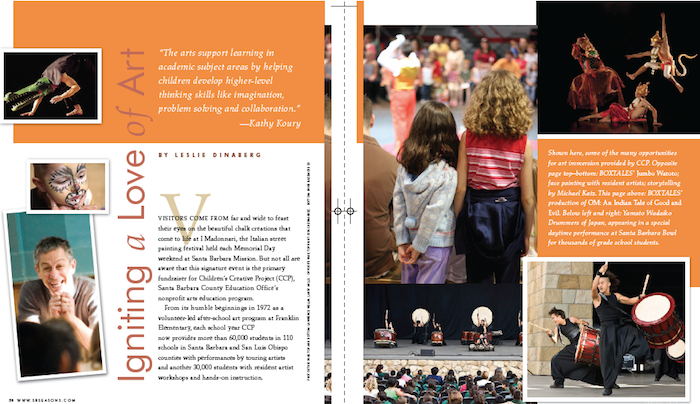
“The arts support learning in academic subject areas by helping children develop higher-level thinking skills like imagination, problem solving and collaboration.”
—Kathy Koury

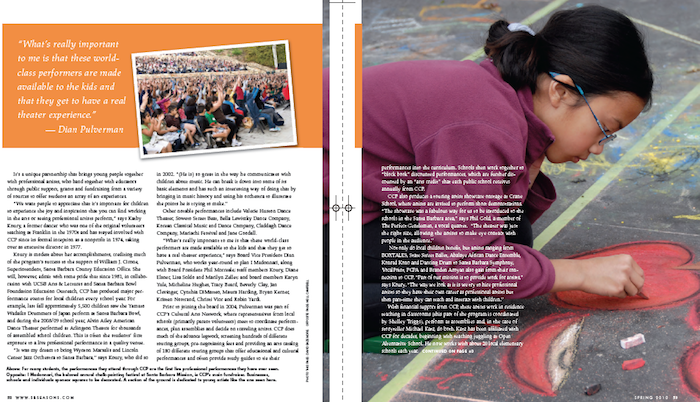
VISITORS COME FROM far and wide to feast their eyes on the beautiful chalk creations that come to life at I Madonnari, the Italian street painting festival held each Memorial Day
weekend at Santa Barbara Mission. But not all are aware that this signature event is the primary fundraiser for Children’s Creative Project (CCP), Santa Barbara County Education Office’s nonprofit arts education program.

From its humble beginnings in 1972 as a volunteer-led after-school art program at Franklin
Elementary, each school year CCP now provides more than 60,000 students in 110 schools in Santa Barbara and San Luis Obispo counties with performances by touring artists and another 30,000 students with resident artist workshops and hands-on instruction.

Originally published in the spring 2010 issue of Santa Barbara SEASONS magazine.

Originally published in the spring 2010 issue of Santa Barbara SEASONS magazine.

“What’s really important to me is that these world class performers are made available to the kids and that they get to have a real theater experience.”

— Dian Pulverman

It’s a unique partnership that brings young people together with professional artists, who band together with educators through public support, grants and fundraising from a variety of sources to offer students an array of art experiences.

“We want people to appreciate that it’s important for children to experience the joy and inspiration that you can find working in the arts or seeing professional artists perform,” says Kathy Koury, a former dancer who was one of the original volunteers teaching at Franklin in the 1970s and has stayed involved with CCP since its formal inception as a nonprofit in 1974, taking over as executive director in 1977.

Koury is modest about her accomplishments, crediting much of the program’s success to the support of William J. Cirone, Superintendent, Santa Barbara County Education Office. She will, however, admit with some pride that since 1981, in collaboration with UCSB Arts & Lectures and Santa Barbara Bowl Foundation Education Outreach, CCP has produced major performance events for local children every school year. For example, last fall approximately 5,500 children saw the Yamato Wadaiko Drummers of Japan perform at Santa Barbara Bowl, and during the 2008/09 school year, Alvin Ailey American Dance Theater performed at Arlington Theatre for thousands of assembled school children. This is often the students’ first exposure to a live professional performance in a quality venue.

“It was my dream to bring Wynton Marsalis and Lincoln Center Jazz Orchestra to Santa Barbara,” says Koury, who did so in 2002. “(He is) so great in the way he communicates with children about music. He can break it down into some of its basic elements and has such an interesting way of doing that by bringing in music history and using his orchestra to illustrate the points he is trying to make.”

Originally published in the spring 2010 issue of Santa Barbara SEASONS magazine.

Originally published in the spring 2010 issue of Santa Barbara SEASONS magazine.

Other notable performances include Valerie Huston Dance Theater, Soweto Street Beat, Bella Lewitzky Dance Company, Korean Classical Music and Dance Company, Claddagh Dance Company, Mariachi Festival and Jane Goodall.

“What’s really important to me is that these world-class performers are made available to the kids and that they get to have a real theater experience,” says Board Vice President Dian Pulverman, who works year-round to plan I Madonnari, along with Board President Phil Morreale; staff members Koury, Diane Elsner, Lisa Soldo and Marilyn Zellet; and board members Karyn Yule, Micheline Hughes, Tracy Beard, Beverly Clay, Jan Clevinger, Cynthia DiMatteo, Maura Harding, Bryan Kerner, Kristen Nostrand, Christi Vior and Robin Yardi.

Prior to joining the board in 2004, Pulverman was part of CCP’s Cultural Arts Network, where representatives from local schools (primarily parent volunteers) meet to coordinate performances, plan assemblies and decide on traveling artists. CCP does much of the advance legwork, screening hundreds of different touring groups, pre-negotiating fees and providing an arts catalog of 180 different touring groups that offer educational and cultural performances and often provide study guides to tie their performances into the curriculum. Schools then work together to “block book” discounted performances, which are further discounted by an “arts credit” that each public school receives annually from CCP.

CCP also produces a touring artist showcase onstage at Crane School, where artists are invited to perform short demonstrations.

“The showcase was a fabulous way for us to be introduced to the schools in the Santa Barbara area,” says Phil Gold, a member of The Perfect Gentlemen, a vocal quartet. “The theater was just the right size, allowing the artists to make eye contact with people in the audience.”

Not only do local children benefit, but artists ranging from BOXTALES, State Street Ballet, Abalaye African Dance Ensemble, Konrad Kono and Dancing Drum to Santa Barbara Symphony, VocalPoint, PCPA and Branden Aroyan also gain from their connection to CCP.

“Part of our mission is to provide work for artists,” says Koury. “The way we look at it is we try to hire professional artists so they have their own career as professional artists but then part-time they can teach and interact with children.”

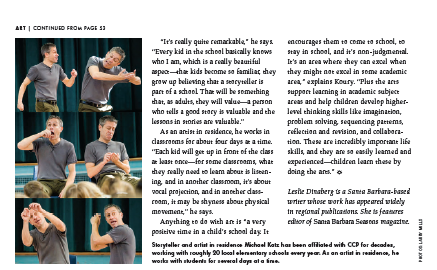
With financial support from CCP, these artists work in residence teaching in classrooms (this part of the program is coordinated by Shelley Triggs), perform at assemblies and, in the case of storyteller Michael Katz, do both. Katz has been affiliated with CCP for decades, beginning with teaching juggling at Open Alternative School. He now works with about 20 local elementary schools each year. “It’s really quite remarkable,” he says. “Every kid in the school basically knows who I am, which is a really beautiful aspect—that kids become so familiar, they grow up believing that a storyteller is part of a school. That will be something that, as adults, they will value—a person who tells a good story is valuable and the lessons in stories are valuable.”

As an artist in residence, he works in classrooms for about four days at a time. “Each kid will get up in front of the class at least once—for some classrooms, what they really need to learn about is listening, and in another classroom, it’s about vocal projection, and in another classroom, it may be shyness about physical movement,” he says.

Anything to do with art is “a very positive time in a child’s school day. It encourages them to come to school, to stay in school, and it’s non-judgmental. It’s an area where they can excel when they might not excel in some academic area,” explains Koury. “Plus the arts
support learning in academic subject areas and help children develop higher level thinking skills like imagination, problem solving, sequencing patterns, reflection and revision, and collaboration. These are incredibly important life skills, and they are so easily learned and
experienced—children learn these by doing the arts.”

Santa Barbara Seasons Spring 2010 coverOriginally published in the spring 2010 issue of Santa Barbara Seasons Magazine.

To read the story as it originally appeared in print click here: Spring 2010 childrens creative project

Noozhawk Talks: Leslie Dinaberg Sits Down With Michael Wyrsta

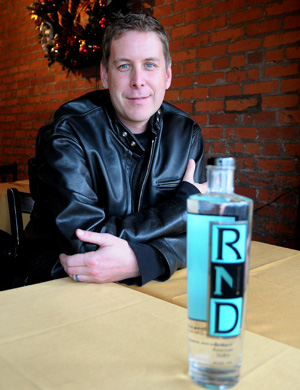
Michael Wyrsta at Opal Restaurant. Photo by Lara Cooper, Noozhawk.

Michael Wyrsta at Opal Restaurant. Photo by Lara Cooper, Noozhawk.

Attacking complicated problems is nothing new to chemist Michael Wyrsta. The
“Gaucho purebred”—who received both his BS and PhD at UCSB—lends his
considerable talents to developing vaccines, solar energy cells, green carbon
technology and eco-friendly building materials and making natural gas into
gasoline and green carbon technology. Now he’s turning his talents to creating
RND Vodka (www.RNDVodka.com), which hit the shelves of Santa Barbara restaurants and
retailers this summer.

Leslie Dinaberg: How on earth did you decide to start this vodka
company?

Michael Wyrsta: (Laughs) That is a really good question. … I was in a liquor store
looking at all the stuff on the shelf and I thought it was pretty unfortunate that all
of the brands on the shelf were pretty much imports.

I mean the good stuff.

… I was like, “why don’t we have something up there that people like or …
people respect or just think that there is some kind of cachet to it?” … So then I
went to lunch with my friend Mark Collins and I said, “You know this is lame. We
should have our own great American vodka.”

He said, “Yeah we should, let’s do it.”

Seriously it was a snap decision.

LD: To try to do it on your own.

MW: Yeah. I wrote a check right there and we just started working on it.

LD: Wow.

MW: We didn’t know anything about making vodka at that time and then we
quickly learned about it. For me as a chemist it’s easy to understand the
chemistry part of it. … But in terms of how do you put a package together, how
do you do all of this stuff we had a lot of stumbling blocks in the
beginning.

Then we got our art director, Kim Kavish involved and she’s great. … She really
helped right the ship and corrected a lot of the mistakes we’ve made in terms of
the design. Then there was a long process of licensing.

LD: So about a year ago you came up with the idea. Did you start developing the
product itself at the same time you started developing the
identity?

MW: Exactly. We have a distillery in Colorado that we worked on our formulation
with.

… What we actually do is ferment our sugar source which comes from corn, and
then go the whole process, fermentation, distillation, purification. We use really
good Colorado Spring water. It’s really clean, it’s really pure and we do our own
filtration, so we do the whole process from grain to bottle.

Then it became a logistic thing. We had to develop the identity, develop the
formulation and then develop the logistics to support all that because we wanted
it to be a unique bottle.

LD: It’s definitely a unique shape. I can also see where this would stand out in a
bar. A lot of vodkas have really pretty designs but they’re just
white.

MW: Exactly. They fade. We call that snoozing on the shelf.

LD: It seems like you’re getting a lot of recognition, including a piece in Sunset
Magazine, especially for how early in the process it is.

MW: Yes, we just launched end of July/early August.

LD: What part of your time is this endeavor?

MW: It does take a lot of my time right now … I have two other companies. A
CO2 company and I also am the CEO and president of a vaccine company up in
San Diego, so I have quite a bit of responsibility with that and I’m really busy.
That’s okay; I like doing all that stuff. For us it’s just something we have to do
until we get up to speed. My wife Inez and my best friend Lindy Lindstrom really
help a lot too.

LD: With high-end vodka is the push more on being in bars and restaurants
versus liquor stores and grocery stores?

MW: We have to be in all of them. We have to be everywhere basically because
they both support each other. … We are an ultra premium vodka, we’re
handmade, so we have more costs, we don’t do mega-scale, which a lot of
people do. So in that respect we’re focused on higher end stores, higher end
restaurants just because of the clientele.

It’s not different than a bottle of wine, if you get a good bottle of wine from Santa
Barbara it’s really expensive but you’re getting something that’s really high
quality.

I’m a scientist, so what I’d like to do is when this thing gets up to speed and we
get some real money coming in and profits, part of our goal is to donate some of
our profits to science education here in Santa Barbara.

LD: That’s great.

MW: Which would be probably through UC Santa Barbara or at that
level.

LD: I was thinking about that because I do a lot of fundraising for the elementary
schools and I can see people objecting to donations from a liquor
company.

MW: And that’s okay, I wouldn’t be against doing anonymous donation because I
understand there’s a perception issue and we wouldn’t want to be encouraging
kids to drink vodka at all. This is isn’t a 9 a.m. vodka; this is a high end sipping
vodka. We’re not promoting that lifestyle so if we were to go that route we would
definitely do something in a more low key, anonymous route.

But for me at least, science is really important and it is to the company too. In a
philosophical sense to us science is one of the few things that has been giving us
answers. We look to it when there is trouble. For example, whether or not it’s
global warming we’re looking towards a whole bunch of solutions but obviously
science plays a part in that. For example, look at the swine flu; we’re looking for a
vaccine to help us out or a drug. People to look to science for answers for really
discrete problems … it’s just sort of a way of thinking about problems and how to
solve them. It’s not about displacing any other belief system or a way of living just
taking stock on how we look at the world and addressing problems head on. I
think that’s important for us and if this is a vehicle to help do that, that’s
great.

LD: Absolutely.

MW: If we can give something back that would be great. That’s how we’re trying
to position it and work it. I live here, Mark lives here, Kim lives here. … We’re
always supporting local events; we did the museum nights for example. We like
to support the arts too, we’ve done Santa Barbara Trustees and the Alumni
Association at UCSB, so we try to be involved in all that stuff.

LD: My best gauge of how good a vodka is, is usually how I feel the next day.
How does one tell a good vodka from a not so good one in terms of taste?

MW: For me-I’m not a heavy drinker and I’m kind of a wimp when it comes to
hard alcohol-so for me I wanted the smoothest, easiest drink of vodka because
ultimately if it’s going to go in a mix, or if you’re going to drink it straight, you want
it to be able to mix well with everything and you want to be able to drink it on the
rocks or with just a little bit of something.

… It has to be really smooth and it has to have a really low burn and really light
feeling … It’s an interesting spirit because it’s very neutral in a lot of ways but
what most people don’t notice there’s a harsh feeling, a burn with a lot of lower
end vodkas and that’s a function of what’s in it. There are other molecules that
are in vodka typically that produce that feeling.

We’ve come up with a formulation that allows up to have a smoother, lighter
feeling. Sunset Magazine recently described it as ethereal and that’s a good way
of describing it.

LD: You’re launching in Santa Barbara at a really good time. There’s this trend of
Farmer’s Market cocktails where people are using all of these fresh ingredients
and sort of the sweet with the sour with the savory, all of this kind of wild stuff
that is pretty new.

MW: I think it’s great. It follows that whole foodie trend so they want high quality
drinks with really fresh ingredients.

LD: I have the list of where it’s sold locally-Roy’s, Opal. Elements, Lazy Acres,
Gelson’s, Liquor and Wine Grotto and on and on. You must have a marketing
person that’s on that.

MW: It’s just me really.

LD: That’s a big job.

MW: Yeah, I know.

LD: How did you come up with the RND Vodka name?

MW: … RND fit a lot with my background in science and markets and also
funding science. It’s a play on research and development, clearly, but it’s also I
always thought it was cool because on your gearbox in a car it’s always RND,
reverse, neutral and drive. So I always thought that was a cool little thing with
both the science and the way you see it every day in your car.

… We wanted to make it a little bit more ambiguous versus just research and
development where you would use an ampersand typically. People might be able
to come up with their own names for it: Rebels Never Die, or Restores Natural
Desires. There are so many things that people have come up with, we have a
bunch of them on our Facebook site. (http://www.facebook.com/pages/RND-
Vodka/102416823144?ref=search&sid=1443134086.1675449040..1)

LD: When you came here for college from Rochester, New York, did you think
you were going to stay?

MW: No. When I first got here for college I was like, “Oh my God where am I?” I
had no idea. It was a different universe. It took me a year to used to it. But then
you adapt. It is really different, I mean it’s almost like a different country, … but
once you figure it out it’s a great place-I love it.

LD: What else do you do when you’re not working?

MW: I love mountain biking; I surf if there’s surf. … I love the ocean and the
mountains so I take advantage of both of those.

LD: If you could pick three adjectives to describe yourself, what would they
be?

MW: Oh no. Three adjectives. Oh God. Busy, really busy. I also think I’m creative
and hopeful.

Vital Stats: Michael Wyrsta

Born: In Rochester, New York, July 6, 1974

Family: Wife Inez

Civic Involvement: Donates to a number of organizations including UCSB Alumni
Association, CALPIRG, Santa Barbara Museum of Art, Acts of Love-Autism
Speaks and the Trustee Association of Santa Barbara.

Professional Accomplishments: Graduated from UCSB in 1996 with a BS in
Microbiology and received a PhD in Materials from UCSB in 2002. Chemist for
start-up ventures, including GRT, Inc, SBA Materials, and BioSolar, Inc;
President and Founder, RND Spirits, Inc.

Best Book You’ve Read Recently: Fooled by Randomness by Nassim Nicholas
Taleb.

Little-Known Fact: “I’ll give you two. I went to a Jesuit High School and I had
long, blond dreadlocks right before I got my PhD.”

Originally published in Noozhawk on December 13, 2009. To read the article on that site click here.

Citizen Scientists: Santa Barbara Channelkeeper

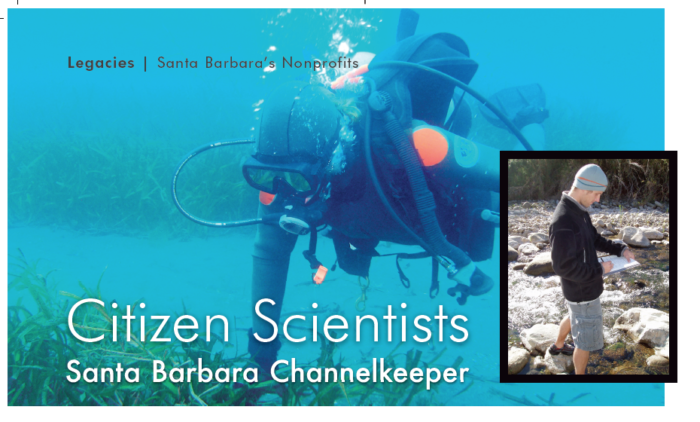
Left–right: A diver maps eelgrass habitat as part of Channelkeeper’s Marine Monitoring and Restoration Program. Watershed program director Ben Pitterle collects data on water pollution levels. Photos courtesy Santa Barbara Channelkeeper, originally published in Santa Barbara Seasons, Summer 2009.

Left–right: A diver maps eelgrass habitat as part of Channelkeeper’s Marine Monitoring and Restoration Program. Watershed program director Ben Pitterle collects data on water pollution levels. Photos courtesy Santa Barbara Channelkeeper, originally published in Santa Barbara Seasons, Summer 2009.

PEOPLE SAY WE’RE ONE OF THE best-kept secrets in town,” says Kira Redmond, executive director of Santa Barbara Channelkeeper. She may be right—but not for long.

Started as an Environmental Defense Center program in 1999, Channelkeeper is now an independent nonprofit, as well as part of one of the fastest growing grassroots environmental movements in the world: International Waterkeeper Alliance.

With just six and a half staff members, buttressed by an army of citizen scientist
volunteers, Channelkeeper works to protect and restore the Santa Barbara Channel and watersheds in a variety of ways, including water quality monitoring, education and community outreach, political advocacy and marine habitat restoration. Perhaps what is most unique about Channelkeeper is that its volunteers work out in the field.

“The field work is kind of what sets us apart,” says Redmond. “We work closely with groups like Environmental Defense Center, Surfrider and Heal the Ocean, but they are advocacy and public education focused. We work with them on a lot of issues, but as far as being out in the field and identifying pollution problems in the creeks or doing habitat monitoring in the channel, there really aren’t other environmental nonprofits that do that.”

Grassroots programs such as “Grunion Greeters” (where volunteers monitor grunion behavior on local beaches during spawning season) and “Stream Teams” (a volunteer-based water quality-monitoring program at the Goleta Slough watershed and the Ventura River) fall under the leadership of Ben Pitterle, watershed programs director.

The grunion program, which is part of a larger study being conducted at Pepperdine University, “is one of the best family-oriented volunteer opportunities I think we have,” says Pitterle. “I did Carpinteria State Beach last summer, and it’s really cool because of the campers. There are just all kinds of kids out playing. It’s fun, a family fun event. I think this is going to be our fifth or sixth year coordinating for this region . . .We get a lot of people who don’t otherwise participate in some of our water quality volunteer opportunities, so
it’s a good way to reach out to a broader group of people—especially kids.”

The “Stream Team,” operating since 2001, has a core group of volunteers. “We go out once a month to collect water samples,” Pitterle explains. “We do that with a few different purposes. One is to collect a baseline of water data to monitor over time to see if things are getting better or worse. Another reason is it’s a great way to reach out to the public, educate and to reach out to the public, educate and train them about watersheds, and help them to become environmental stewards themselves. The third is that looking at
the data helps us identify actual problems, and then we can relay that information to
different public agencies who are responsible for regulating water problems to try to get them fixed.”

Working with public agencies is a big part of what Channelkeeper does. When
budget cuts forced the county to stop its marine monitoring program this past fall,
Channelkeeper rallied its supporters and pitched in thousands of dollars to continue
this important warning service system for surfers, swimmers and beachgoers at 12 county beaches. Santa Barbara city officials also helped pick up the slack by testing at four additional locations.

In addition to partnering with county and city officials, Channelkeeper works closely with researchers at UCSB and Channel Islands Marine Sanctuary, and is collaborating with the state to implement a Marine Life Protection Act that will create a network of marine protected areas or underwater parks along the entire California coast.

“In the work that we do in the field, we work with agencies that don’t have the resources to be everywhere themselves,” says Redmond. “For instance, the city of Santa Barbara has two code enforcement staff. So they’re out there like we are, looking at businesses that might have a high potential to pollute and checking up on them. But they can’t
be everywhere at once, so with budget cuts our role is becoming increasingly important. We have really good relationships with people at these agencies, Basically, they’re grateful to us for helping them do their jobs.”

For more information about Santa Barbara Channelkeeper, call 805/563-3377 or visit www.sbck.org.
n Santa Barbara Seasons Summer 2009.

Originally published in Santa Barbara Seasons Summer 2009. Click below to read the story as it appeared in print.

SB Seasons Summer 2009