First Time Home Buyers: Vintage Charm

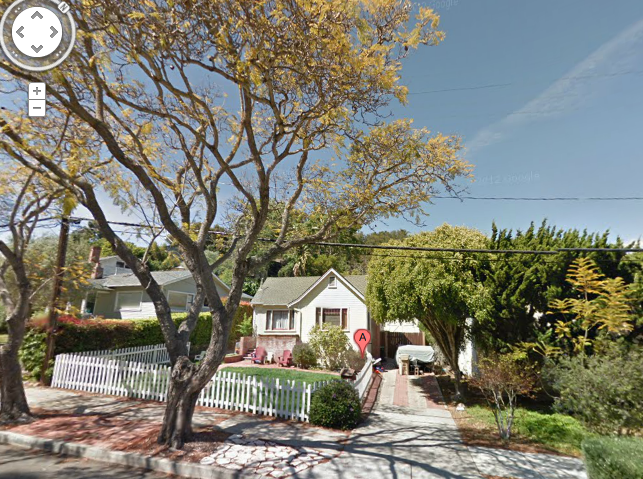
Google maps image

Google maps image

Entering the threshold of their new life together, couple opts for classic over contemporary

There are two kinds of first-time homebuyers: those that go for the modern amenities and those that go for the charm. Susan Bosse and Erik Vasquez definitely went for the charm, or at least the potential charm of their new home on 1242 W. Valerio St.

The house was built in 1925 and suffered from what Vasquez generously called “deferred maintenance.” Still, the character of the house, which still had many of its original built-ins and fixtures, attracted them.

The bones were good, the potential was there, but the old girl definitely needed a face-lift and some new internal organs.

“The thing that I think scared most people were the termites. But it was funny, the termite guys were the ones all bidding on the house so they weren’t too worried,” said Vasquez.

The inspection package was thick, said Bosse. Besides the termite damage and some water damage, the house needed to be brought up to code with a new roof and modern wiring, including new electrical and heating systems. There were also a few walls the couple decided to remove to improve the floor plan.

“We gave Susan a sledgehammer last week. I can show you the little video,” laughed Vasquez.

“It was pretty fun. I mean when else am I going to get a chance to hit a wall and knock it down,” said Bosse. It was also a good stress reliever for Bosse, who was planning her May 30 wedding to Vasquez at the time.

While some of original hardwood floors were in good shape, some needed to be redone, along with the bathroom and kitchen. “There was still food in the refrigerator,” said Bosse.

Despite the extensive improvements, Vasquez was pleased by the speedy progress his crew was making and prepared for the expense. They got estimates for the repairs up front, before deciding they could afford the house.

“The thing is we found is the cost is the people, the labor, it’s not the materials,” said Vasquez. “The materials are nothing, so if they’re in here (working), might as well make it exactly how you want because it’s not any more expensive to make it boring as it is to make it more interesting.”

Originally published in South Coast Beacon

First Time Home Buyers: The American Dream … the South Coast Reality

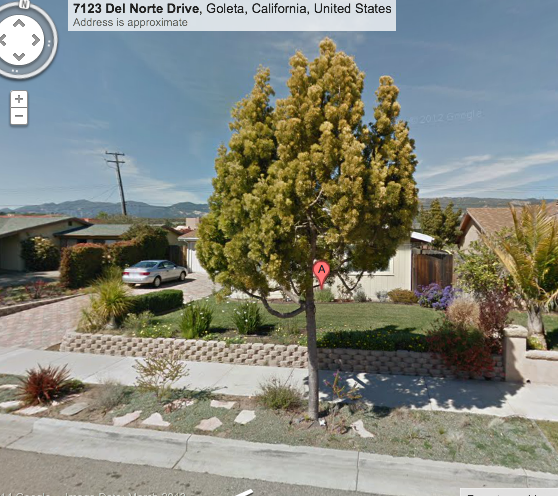
Google maps photo

Google maps photo

Breaking into the local real estate market is tough but not impossible. Leslie Dinaberg explores who’s buying for the first time and how.

Practicality, frugality and focus were the key values that got Jonathan and Kara Rocque into their first home, at 7126 Del Norte Dr. in Goleta. Both UCSB graduates, the Rocques lived in a one-bedroom apartment and didn’t really upgrade their lifestyle much after college in order to save money for a house.

They started making offers right after they married, about 2-1/2 years ago, but Jonathan said he wasn’t really ready to buy until recently. “People always say ‘get in as soon as you can,’ but … at the same time, I really have no regrets not getting in any sooner because I wasn’t ready.” An engineer, he said he worked for a start-up company and was worried about job stability.

“I think I got to the point where I gained more confidence in myself and that things were going to be okay,” said Jonathan, who now works for Indigo Systems, which recently merged with FLIR Systems.

When he felt really ready to buy, Jonathan had the willing assistance of his father, John Rocque, a realtor and mortgage broker in San Dimas.

Another factor that kept the Rocques from buying quickly was their expectation of what they would be able to afford. “We started thinking that we wanted our dream home out of the shoot, and I think that’s what delayed our purchase, probably,” said Jonathan.

The three-bedroom two and a half-bathroom home the Rocques eventually bought this year for $659,500 has a studio apartment (garage conversion) on the property, a big selling point. “We were looking at these two-bedroom one-bath cottages and went, I just can’t do it. There’s got to be something out there that’s better because it doesn’t leave us the flexibility to grow,” said Jonathan. “When we saw this place with the studio I just thought ‘Oh God, couldn’t be better.’ I could give up the garage and take the extra income that will definitely help.”

Kara noted the backyard had a shed for storage, making it easier for her to give up the garage space. Being able to have a vegetable garden was also important to her, as was the school district. “Basically any school in Goleta, I’m totally comfortable with,” said Kara, who teaches first grade at La Patera.

The Rocques also knew what they didn’t want: no condos and no commuting. “The whole reason we live in Santa Barbara is the lifestyle,” said Jonathan. “I ride my bike. I love the mountains. I love riding by the ocean. I love the weather. I value my time … I’m not going to drive an hour each way to work. I’d go somewhere else where I could live close,” he said.

“I don’t think either one of us ever wants to move into one of the new developments because they’re so crunched together,” added Kara. “Yeah they look pretty, they’re nice and new, but to me this has more character than those houses. You can paint it whatever color you want to paint it; you can do whatever you want with your yard.”

While the Rocques would eventually like to move to a larger house, they are fixing up their yard and treating the house like a home.

“It’s not short term, but it’s not forever,” said Kara.

“This house easily gets us ten years,” said Jonathan. “If we wanted to, at some point we’ll refinance and we could reclaim that space (the studio).”

And as for the realities of being able to afford to stay on the South Coast, they credit much of their success to Patrick Flood, the financial consultant Jonathan began working with when he graduated from college. The Rocques said they feel both blessed and proud to be able to get into the housing market

“I like taking on challenges too. I took a major in college … that was challenging. And staying in Santa Barbara was a big challenge, but I was going to do it. I was really, really happy that we could,” said Jonathan.

Added Kara: “If we can do it here then we can do it anywhere.”

Originally published in South Coast Beacon

Bungalow Haven

mapWhat started out as a simple opportunity to socialize with neighbors and get to know a little more about American bungalow style architecture and restoration has quickly morphed the Bungalow Haven Neighborhood Association into a vibrant, politically active neighborhood watchdog group.

Bungalow Haven was formed about two years ago by neighbors Dee Duncan and her husband Steve Dowty, and Judy and Sayre Macneil.

“The original intent was social,” said Cheri Rae, another member of the association. Rae said the group has a couple of hundred members representing about 125 households and meets once a month at Duncan and Dowty’s home. They also have an active email list and several subcommittees, including a political action committee that is currently reviewing its position on the proposed development of the former St. Francis Medical Center property.

The Bungalow Haven neighborhood — roughly bounded by Alta Vista, Laguna, Anapamu and Micheltorena streets — began to mobilize when they learned of a plan to construct 18 new units on the 1400 block of Laguna Street and relocate five bungalows. The project — developed by Capital Pacific Holding LLC and designed by architect Detlev Peikert — was well underway before the neighbors really became aware of it. However, at least in part from their efforts (including numerous appearances before the planning commission and the architectural board of review) the project has been scaled back to retain three of the existing bungalows on the property, along with plans to build the 15 new units in craftsman style rather than the originally planned red tile roofs.

“We’ve shown up 50 at a time and I think that was part of why we’ve been so successful. People were so amazed to see such a large bunch of people who were very articulate,” said Rae, who has been sharing strategies with other neighborhood associations.

Mike Jogoleff, who has lived in Bungalow Haven since childhood, fears continued encroachment by developers would ruin the neighborhood’s character. “If somebody’s working against us like these big development companies, they just come in and screw everybody,” he said.

One of the steps the neighborhood association is taking to prevent more “condo mania” is working to establish Bungalow Haven as a Historic Landmark District. Regarding the Laguna Street project, Rae said, “… we’ve all had a steep learning curve on what the rules are, and we want to prevent it from ever happening again.”

To obtain historic status, the group must first finish a neighborhood survey cataloguing the historic elements throughout the approximately 300 homes in the neighborhood. “We’re modeling our approach on the El Pueblo Viejo and the Brinkerhoff Districts. They are (the) only two historic districts in the town so far, so we’re doing the same thing that they did,” she said.

Rae admitted, “It’s a little ironic when we say with disdain, ‘they’re putting in million dollar condos’ when our houses are creeping up toward million dollar houses. It’s just (that) what you get for your money is not stucco and brand-new efficient appliances, but you get some charm.”

Jogoleff is also keenly aware that the working-class neighborhood he grew up in has changed. ” As my neighbor says, the people that buy our houses are not going to be painters and teachers. It’s going to be lawyers, doctors, accountants.”

While development projects have been catalysts, they aren’t the primary reason for the group. “The group is to preserve this style of life, simple and kind of a calmer way of life. None of us chose to go live in a tract house in Goleta. That’s just not what we wanted. … We’re not out there recruiting members. … The whole idea is for peaceful coexistence and neighborhood protection,” Rae said.

“We’re not anti-development … it’s just within reason and it’s within scale and size and having respect for the neighborhoods that are already here. It makes no sense whatsoever to develop for new people who come in when you ignore the neighbors that are already here and have built Santa Barbara to be what it is. … We feel like we’re part of the fabric of this town and we want to be able to stay here and not be run out because we can’t have the kind of life that we want to have here,” Rae said.

Originally published in South Coast Beacon

It’s all about hue!

Image by gubgib freedigitalphotos.net

Image by gubgib freedigitalphotos.net

Gone are the days of a one-color-fits-all approach to decorating. Now homeowners are choosing colors to illicit a mood and perk up a room’s decor.

Wall color is one of the easiest and least expensive ways to add some color to your home, said Pat Musarra, owner of Affordable One-Day Design.

Ralph Lauren even offers Color Testers, a new product line that allows you to sample the complete palette. Each Color Tester packet provides paint coverage in a satin finish for 2-foot by 2-foot sections of wall, retails for $3.99, and may be purchased online at www.rlhome.polo.com.

Even if you’re leery of paint, with so many varieties of home accessories available, it’s easy to start small and experiment boldly with color on items like throw pillows, vases, candles, slipcovers, candy dishes, sheets and towels and table linens.

“New lighting is very important. Just changing lampshades can have an enormous impact,” said Musarra, who also recommended taking a look down at your floors. “Area rugs or maybe pulling up wall-to-wall carpeting and laying down a hardwood floor or some kind of new laminate floor … Especially if the wall-to-wall carpeting is old or the color’s outdated.”

In addition to freshening your home’s look, colors can be used to create a mood.

“Red will wake up a room,” said interior designer Rosemary Sadez Friedmann. “It should be used as an accent in accessories, part of a pattern in upholstery or one impressive chair or bench. Red is a good color to have in a nursery because it stimulates and aids the development of neural connections in an infant’s brain.”

Musarra said she’s seen red — and other bright colors — used a lot as a kitchen accent color, with coffee makers, mixers and other small appliances now available in a wide variety of colors.

Orange is another color that is “uplifting, stimulating and enlivening,” according to Barbara Richardson, director of color marketing for ICI Paints. “It has the ability to raise our spirits and to make us feel optimistic — a quality that is in high demand right now.”

“Yellow would be a good color for a workout room, particularly if aerobics were involved. It’s also a good color for a game room, study or office because it helps to keep you attentive. A yellow bathroom will take the chill out of the air,” said Friedmann.

Whatever color you choose to update your home’s look, experts advise you start small, with maybe a few throw pillows or some new kitchen linens.

“It’s amazing how many inexpensive ways there are to update your home,” said Musarra, who specializes in quick and cost effective design strategies.

Musarra charges a flat fee of $200 for her services, which include a two-hour home consultation, followed up with a written design plan.

“I also restyle the room for you while I’m there,” she said. “Move furniture in, move some out, re-hang artwork, re-group accessories, and give a room a whole new makeover, using basically what the client has and at the same time, offering suggestions as to what she or he should buy to complete the look they’re trying to achieve.”

What colors are hot

“It” is either Violet Tulip, Coraly Orange, Full Bloom (a Salmony Pink) or Turquoise Blue, depending on which expert you ask about the “it color” in home decorating this year.

“I’m seeing a lot of pinks and salmon and turquoise and brown, not my favorites, but I am seeing a lot of those colors,” said Pat Musarra, owner of Affordable One-Day Design.

Pantone – the company that crowned violet tulip as this year’s queen – has even created a new color system called Colorstrology, which “infuses elements of astrology and numerology with the spirituality of color.”

According to Michele Bernhardt, creator of Colorstrology, 2005 will resonate with spirituality and healing.

“The year will begin with a heavy influence in regard to foreign affairs, education, religion and sports. Peace, balance and cooperation in all types of relationships will be a major theme and can also be a major challenge. Violet tulip can help us see past our differences while dissolving our feelings of separateness,” said Bernhardt.

At www.colorstrology.com, you’ll find your personal birth color, along with a personality profile and advice on your color vibe. September, for example, is Baja Blue, “a divine and alluring color that resonates with beauty, purity and wisdom.” This color “can help ease tension and promote tranquility,” making it an ideal choice for a bedroom or a yoga studio.

Taking the color horoscope a step further, a Virgo born on Sept. 8 would have Etruscan Red as their personal color for the year, a color that “corresponds with depth, vitality and passion.”

According to the site, “wearing, meditating or surrounding yourself with Etruscan Red inspires you to move through life with energy and wisdom.”

Sounds like a good color to decorate the office.

What color is your mood?

Here are some color guidelines based on the type of mood you want to create.

RED__Use red for excitement. It is associated with power, passion, dominance, activity and heat. It represents youthfulness, impulse and intensity. Red is also a grounding color and can make you feel secure.

ORANGE__Orange represents excitement and can be stimulating. It can make you feel like hurrying and that is why it’s usually a color used in fast-food places and quick mart-type stores. They want you in and out quickly. Happiness, liveliness, exuberance and boldness are also associated with orange.

BLACK__Use black to evoke drama, elegance, power, sophistication and mystery. Black is also associated with death, fright, aloofness, fatigue, cold, darkness and bereavement.

YELLOW __Yellow is eye-catching, inspirational and raises ones spirits. It is also said to aid digestion, communication and sharpen memory. Design experts advise you treat yellow like sunlight. You want it around for the happiness it produces but you don’t want it to be overpowering.

GRAY__Gray is said to be steady, resigned, stable, deliberate, guarded, dignified, indecisive, disciplined, protected, cool and neutral.

PURPLE__Purple can be used to increase spirituality and enlightenment. It evokes feelings of elegance, restfulness, supremacy, creativity, royalty and reverence. Purple is also said to promote peace, quiet overactive glands and lower blood pressure.

BLUE__Blue is a breath of fresh air, evoking feelings of openness, tranquility, serenity, restoration and well being. It is also said to lower respiratory rates, promote relaxation and increase healing.

BROWN__Brown reminds us of nature and the earth. It is also said to be restful, rich, casual, tranquil, safe, homespun, reliable, stable, sturdy and simultaneously cool and warm.

GREEN__Green reminds us of harmony, balance, compassion, wealth, security and growth. It is said to promote relaxation and refresh the spirit. Green is also a good color to promote health, although it may not reflect well on all skin tones.

WHITE__White evokes feelings of cleanliness, simplicity, safety, purity, enlightenment, individualism, idealism, optimism, joy, innocence, hope and reflection.

Want to find the real hue?

Take this completely unscientific quiz to find out which color (or colors) suit your inner self.

Check off all of the descriptions that apply to you, then count how many A, B, C, D, E and F personality traits you had. That’s your true hue.

B. I frequently rearrange my furniture and repaint my walls.

B. I love jury duty.

E. I always tell the truth, even if it hurts.

D. I often engage complete strangers in conversation.

E. I feel overwhelmingly compelled to pipe up during city council meetings.

B. I burn the midnight oil at work and volunteer for extra tasks.

F. I am a back-seat driver.

D. I would rather shop at a farmers’ market than a mall.

C. The hardest part of throwing a party is deciding the menu.

F. I am the boss, or I should be.

F. I feel good about me, especially when I compare myself with others.

B. I love details.

D. I define myself by my parenting skills.

A. I was never good at sharing.

B. Someday I’m going to chuck it all and go live in the wilderness.

C. Home is the center of my world.

D. When friends call, I can be counted on to help.

E. Winning isn’t everything; it’s the only thing.

A. My friends and family say I’m stubborn. What do they know?

F. Some might find me arrogant.

A. Hallmark commercials make me cry.

A. I’m the first to volunteer for charity functions and luncheons.

C. Pushover doesn’t even begin to describe how easy it is to talk me into things.

Your True Hue

A. Seeing green.

You are confident and caring, and would feel good in a room of sage, basil or celadon. The new greens for 2005 will lean toward the seashore tones. Botanical-inspired greens remain popular.

B. Yellow fellows.

You will feel energized in a room with buttery walls and mahogany furniture. Let in the light with minimal window coverings. The new yellows for 2005 will lean toward ochre and gold.

C. Purple people.

Forget practicality; celebrate your spirit with shades of violet, lavender and silver. Use eggplant or plum as an accent.

D. Orange you glad.

You love food, home and entertaining. Surround yourself with pumpkin, copper or muted auburn. Orange will bring cheerfulness and order to your home.

E. Blue you.

Your dependable, serene nature will feel at ease in rooms washed in shades of gray-blue and soft turquoise — both popular colors for 2005. Definitely use blue in bedrooms for a peaceful night’s sleep.

F. Red hot.

You like to be in charge. Choose red for accents: think floral arrangements rather than carpets. Or start small in the kitchen with a new fire engine red coffee maker.

Originally published in South Coast Beacon (2003)

First Time Home Buyers: Adventures in Home Buying

Image by phanlop88 freedigitalimages.net

Image by phanlop88 freedigitalimages.net

Sometimes the first house you have your heart set on isn’t the one that you’re meant to have. That was the lesson Gloria Herrera and Martin Ibarra learned during their recent home-buying adventure.

After losing bids on several homes, the couple, who share a home with their daughter and Ibarra’s mother, was ready to compromise on their dream house. While they really wanted to stay in Santa Barbara, they also looked at properties in San Ynez and Buellton. Plus, they needed at least three bedrooms and they didn’t want a condominium.

This market is very competitive and difficult, said their Realtor Nicole Dinkelacker, who’s with Remax in Goleta. “It’s a lot more complicated than just finding a property.”

In the case of Herrera and Ibarra, Dinkelacker was ready with the check for a “compromise house,” when she found out that another property they had bid on earlier was available for an additional $5,000.

“Usually $5,000 you’re like oh my God, $5,000,” said Herrera. “At this point, $5,000 was like $5 to me … for a bigger property and an extra room.” Herrera said she thought the fact that she and Ibarra are both native Santa Barbarans (who met at Santa Barbara High School) was what sealed the deal for the home they eventually purchased for $700,000.

The four-bedroom, two-bathroom home on a 900 square foot lot on Noma Street in Carpinteria was a good buy, compared to what was available in Santa Barbara. “We lucked out,” said Herrera, noting that in addition to more square footage, most of the house had new carpet and had been newly painted.

Regarding making home improvements, “It’s not like you have much money left after buying the house. You pay your bills and you pay your mortgage and then … Home Depot,” said Herrera.

“Yeah, we tend to be at Home Depot a lot more, that’s for sure,” laughed Ibarra.

“When we first got the house, it wasn’t as pretty. I put in palm trees and flowers. … I think a year from now it will definitely be a lot more how we envisioned it. …You only have the weekend to really do much.”

Although fixing up the house is an ongoing project, Herrera said she’s ready to relax and enjoy the house for a while. “Even though it’s a very tight budget, … you kind of spend your weekends here at home. Sometimes it’s by choice and other times because you really have no other form of entertainment you can afford. But at least it’s yours and you know that little by little, it will get easier. … We have something that a lot of people have a hard time trying to obtain.”

“I know she had her heart set on the first house … and I know when that didn’t come through she got down. But like I told her, it’s either meant to be or not,” said Ibarra. “(I told her) we’re going to find something down the road that’s going to be much better. And soon we were able to find this.”

Originally published in South Coast Beacon

First Time Home Buyers: Going Condo

Image by phanlop88 freedigitalimages.net

Image by phanlop88 freedigitalimages.net

The quest to buy a condominium on the South Coast can be grueling on the nerves. “It was crazy. You’d go out and at every open house … you’d see all the same people all the time,” said Cari Thomas, who recently purchased a San Roque condo with her husband Sam. “They started looking like your competition. Like you didn’t want to smile at anybody.”

“I think our biggest surprise was the amount of demand and the fact that there were multiple offers over the asking price,” said Sam. The Thomases looked at dozens of condos and were outbid on six different places before purchasing their new home at 3663 San Remo Drive for $560,000.

We feel like we lucked out, said Cari.

“Once you get a firm understanding of the market, your standards change a little bit. There were places the first weekend we looked that were significantly less money that were not as nice, but a month and a half later we were wishing we would have made offers on those ones that we saw early on,” said Sam.

As is the case with many first-time homebuyers, the two-bedroom, two-bath place the Thomases purchased was more expensive than what they originally budgeted for. When their realtor, Judith McDermott from Village Properties, urged them to “Just drive by and see what you can get for that amount,” they immediately liked it enough to call their loan broker and make the arrangements to make an offer.

“We put five percent down and are using an interest only loan. Some of the money was from savings, some was from a previous 401K plan, and some was an investment from friends,” said Sam.

Part of what sold them on the condo was its immediate livability. “The paint, it’s amazing what paint and color can do. And it was decorated really nicely and the mountain view was pretty,” said Cari. She also liked the fact that the condo overlooks a pool and the rooms were pretty spacious compared to other condominiums.

“It definitely felt modern and we liked how they redid all the architecture on the outside,” said Sam, noting that the kitchen appliances were upgraded three years ago when the complex was converted from apartments to condominiums.

The fact that the association fees were comparatively low was also a plus for the Thomases. Another advantage was the location, close to downtown and their workplace, Cima Management.

At the time of their purchase, they simply saw the Hope School District location as a plus for the condominium’s resale value. However, the Thomases have since learned they’re expecting their first child in November.

“It (the school district) wasn’t something we were searching for initially, but now it worked out great,” Cari said.

Originally published in South Coast Beacon

Get Up Close and Personal with Architecture

Brian Hofer points out details on the Architectural Foundation tour. Photo by Leslie Dinaberg.

Brian Hofer points out details on the
Architectural Foundation tour. Photo by Leslie Dinaberg.

To experience Santa Barbara architecture in all its glory, there’s nothing like strolling through town with an expert by your side to point out the rich history and international artistic influences that aren’t readily visible to the untrained eye.

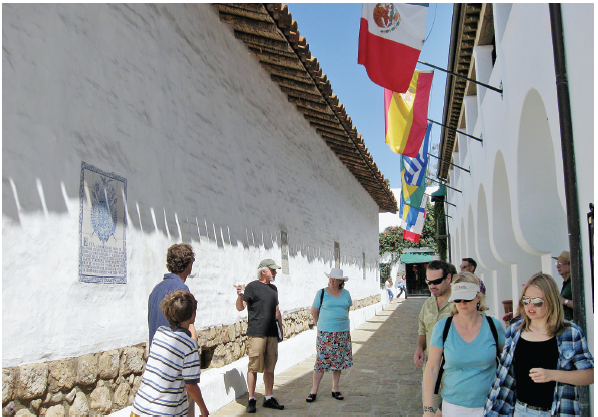
Every weekend, trained docents from Architectural Foundation of Santa Barbara (www.afsb.org/tours_m.html, 805/965-6307) take both locals and tourists on walking journeys through the hidden courtyards, secret fountains and original adobes of downtown, focusing on architectural styles, significant and historic buildings, aesthetics and landscape history, as well as details like handmade tiles, wrought iron, stonework, balconies, doorways, archways and plantings.

The Sabado (Saturday) Tour starts in front of city hall and takes guests on a tour of De la Guerra Plaza, historic De la Guerra Adobe, El Paseo, Hill-Carrillo AdobeMeridian Studios, Lobero Theatre and more. The Domingo (Sunday) Tour, which starts at the Central Library, focuses on historic art and architecture of downtown Santa Barbara as it was reborn after the 1925 earthquake, including the library and its famous murals, La Arcada Court, the historic Arlington, The Granada and other architectural delights. You’ll also learn about Santa Barbara’s architectural history and how the Women’s League and Pearl Chase forced us to maintain architectural integrity, beautiful public park spaces and rich landscapes. Both tours start at 10 a.m. and last about 1-1 /2  hours. The foundation asks for a $10 donation per person, and proceeds go toward scholarships and other community programs.

Walking Wednesdays with Santa Barbara Walks is a clever new way to get some after-work exercise and experience the beauty of our local environment. The group, which is a project of COAST (Coalition for Sustainable Transportation, 805/875-3562), meets at 5:30 p.m. on the fourth Wednesday of every month and features a different theme and location each time. One walk included a tour through the upper eastside with architect Anthony Grumbine of Harrison Design Associates, beginning with a walkthrough of the historic Winsor Soule Hodges Residence (currently The Fielding Institute), a 1920s Spanish colonial revival estate, which was once the most expensive home built in Santa Barbara. The expedition also journeyed through a wonderful variety of architecture styles, including a Francis Underhill stripped classicism design, a Richard Neutra mid-century modern, French Norman and Dutch colonial, as well as the many architectural hybrids. Previous walks included an art walk with Ellen Durham, an architectural tour of El Andaluz with Jeff Shelton, trees of Santa Barbara with Bob Muller and a historical tour with Brian Hofer. Walking Wednesdays are free; visit www.coastsantabarbara.org/category/santa-barbarawalks/ for information on monthly locations and themes.

Originally published in Santa Barbara Seasons Magazine, Fall 2010. Cover photo by Jim Bartsch.

Cover photo by Jim Bartsch.

Originally published in Santa Barbara Seasons Magazine, Fall 2010. Cover photo by Jim Bartsch.

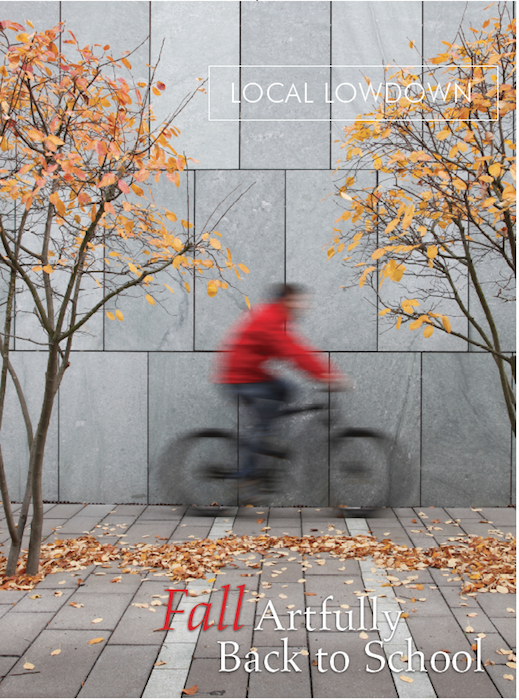
Fall Artfully Back to School

Santa Barbara Seasons, Local Lowdown, Fall 2010

Santa Barbara Seasons, Local Lowdown, Fall 2010

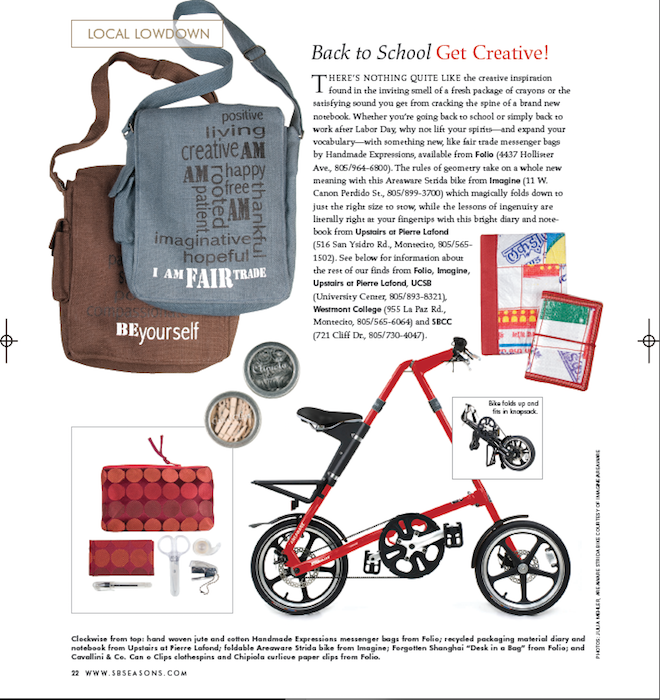
Back to School Get Creative!

There’s nothing quite like the creative inspiration found in the inviting smell of a fresh package of crayons or the satisfying sound you get from cracking the spine of a brand new notebook.

Whether you’re going back to school or simply back to work after Labor Day, why not lift your spirits—and expand your vocabulary—with something new, like fair trade messenger bags by Handmade Expressions, available from Folio (4437 Hollister Ave., 805/964-6800). The rules of geometry take on a whole new meaning with this Areaware Strida bike from Imagine (11 W. Canon Perdido St., 805/899-3700) which magically folds down to just the right size to stow, while the lessons of ingenuity are literally right at your fingertips with this bright diary and notebook from Upstairs at Pierre Lafond (516 San Ysidro Rd., Montecito, 805/565-1502).

Santa Barbara Seasons, Local Lowdown, Fall 2010

Santa Barbara Seasons, Local Lowdown, Fall 2010

See below for information about the rest of our finds from Folio, Imagine, Upstairs at Pierre Lafond, UCSB (University Center, 805/893-8321), Westmont College (955 La Paz Rd., Montecito, 805/565-6064) and SBCC (721 Cliff Dr., 805/730-4047).

Clockwise from top: hand woven jute and cotton Handmade Expressions messenger bags from Folio; recycled packaging material diary and notebook from Upstairs at Pierre Lafond; foldable Areaware Strida bike from Imagine; Forgotten Shanghai “Desk in a Bag” from Folio; and Cavallini & Co. Can o Clips clothespins and Chipiola curlicue paper clips from Folio.

Bike folds up and fits in knapsack.

PHOTOS: JULIA MEHLER, AREAWARE STRIDA BIKE COURTESY OF IMAGINE/AREAWARE

Santa Barbara Seasons, Local Lowdown, Fall 2010

Santa Barbara Seasons, Local Lowdown, Fall 2010

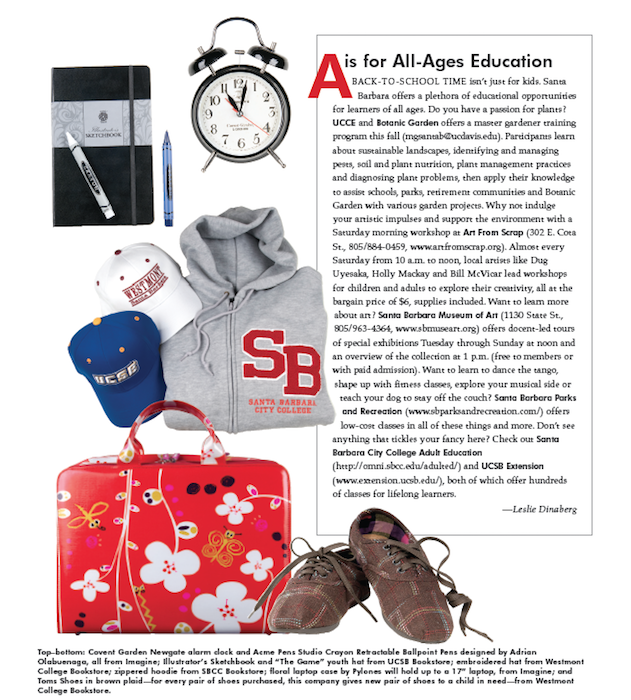
A is for All-Ages Education

BACK-TO-SCHOOL TIME isn’t just for kids. Santa Barbara offers a plethora of educational opportunities for learners of all ages. Do you have a passion for plants? UCCE and Botanic Garden offers a master gardener training program this fall (mgsantab@ucdavis.edu). Participants learn about sustainable landscapes, identifying and managing pests, soil and plant nutrition, plant management practices and diagnosing plant problems, then apply their knowledge to assist schools, parks, retirement communities and Botanic Garden with various garden projects.

Why not indulge your artistic impulses and support the environment with a Saturday morning workshop at Art From Scrap (302 E. Cota St., 805/884-0459, www.artfromscrap.org). Almost every Saturday from 10 a.m. to noon, local artists like Dug Uyesaka, Holly Mackay and Bill McVicar lead workshops for children and adults to explore their creativity, all at the bargain price of $6, supplies included.

Want to learn more about art? Santa Barbara Museum of Art (1130 State St., 805/963-4364, www.sbmuseart.org) offers docent-led tours of special exhibitions Tuesday through Sunday at noon and an overview of the collection at 1 p.m. (free to members or with paid admission).

Want to learn to dance the tango, shape up with fitness classes, explore your musical side or teach your dog to stay off the couch? Santa Barbara Parks and Recreation (www.sbparksandrecreation.com/) offers low-cost classes in all of these things and more.

Don’t see anything that tickles your fancy here? Check out Santa Barbara City College Adult Education (http://omni.sbcc.edu/adulted/) and UCSB Extension (www.extension.ucsb.edu/), both of which offer hundreds of classes for lifelong learners.

—Leslie Dinaberg

Top–bottom: Covent Garden Newgate alarm clock and Acme Pens Studio Crayon Retractable Ballpoint Pens designed by Adrian Olabuenaga, all from Imagine; Illustrator’s Sketchbook and “The Game” youth hat from UCSB Bookstore; embroidered hat from Westmont College Bookstore; zippered hoodie from SBCC Bookstore; floral laptop case by Pylones will hold up to a 17” laptop, from Imagine; and Toms Shoes in brown plaid—for every pair of shoes purchased, this company gives new pair of shoes to a child in need—from Westmont College Bookstore.

Originally published in Santa Barbara Seasons Magazine, Fall 2010. Cover photo by Jim Bartsch.

Cover photo by Jim Bartsch.

Originally published in Santa Barbara Seasons Magazine, Fall 2010. Cover photo by Jim Bartsch.

Leslie Dinaberg Sits Down with Leslie Westbrook

Leslie Westbrook

Leslie Westbrook

Building on her lifelong interests in travel, fine art, and antiques, longtime local writer and editor Leslie Westbrook recently went public with her treasures, opening up a storefront, Leslie A. Westbrook, Art & Antiques, in Montecito’s upper village.

Leslie Dinaberg: Tell me about your new business venture?

Leslie Westbrook: I used to have an antique shop 20 years ago on Coast Village Road (Basement Antiques). So when I travel, I’ve been a travel writer for a long time, I’ve bought things and brought them back and sold them, sort of to supplement my income, but not in a big way.

LD: So you took your air miles and went to Brazil.

LW: I thought I’ll go down and I’ll buy some stuff and I’ll bring it back and I can sell it to collectors and/or consign it or sell it to shops. My area of interest and emphasis has always been art, but from South American “Santos,” because I’ve always liked them and been interested in them. So I went down there, I spent four days going to flea markets and a couple of antique dealers down there that I know and I bought a bunch of stuff. And I have a friend, sort of like my Brazilian son, he speaks Portuguese and helps me. Then I went off to Argentina and I said “here’s the money, ship this off DHL.”

LD: Now I know you and Miguel Fairbanks (who runs a wedding, event and portrait photography business in the back studio) are old friends.

LW: Yes and I just happened to say to him, “what are you doing with this space?” And he said, “You know, I need to rent it. Do you want to rent it?” … I wrote a check.

Three days later customs went on strike and held all of my goods and they’re still down there. … All of the sudden I had an empty shop, so I thought, I’d better get creative. I had a few pieces from the previous shipment…. and then I have more art than I have wall space in my house, so I brought in a Toulouse Lautrec and a Manet and I sort of started tearing things off the walls. Then I looked for a couple of contemporary artists who were local but who weren’t really showing here, like sculptor Jim Martin (www.jimmartinsculpture.com) and mixed media artist Barbara Bouman Jay (www.barbaraboumanjay.com and Ed Lister, who is an English artist who lives in Montecito but still doesn’t show here. … And then I took some things on consignment so and I bought a few other things. But I’m still waiting for my stuff to come from Brazil.

LD: How is business?

LW: Little by little the word is getting out. It’s picking up. What is really good for me is the decorators and designers are discovering me.

LD: That’s great. It seems like this is kind of antiques area in the upper village. How does this business fit in with your writing?

LW: Well, interestingly enough, I’ve been writing for California Home for about ten years and I also contribute to Traditional Homes and I wrote years ago for Art and Antique newspaper, I was the west coast editor, so I’ve always had an interest in art and antiques and design and I spent years scouting houses and writing about people’s gorgeous houses, so that ties in nicely. I am very open if someone is either decorator or they have a beautiful home and they want to bring me a disk of photos to look at for submission because I actually sit here and write all day. I’m here with my laptop and pity the poor customer if I’m lost in reverie, I have to tear myself away and become a salesperson. But it’s really kind of like a writing studio with a lot of stuff around me for sale is what it’s kind of turned into. And it’s nice to be writing here as opposed to being home alone–here I have more human contact. People come by which is really nice. So I have a shingle.

LD: I can definitely see where that would work. Do you think you’re still going to be traveling for your writing?

LW: I kind of tied myself down here. It’s a little bit of a dilemma. All of a sudden life I went oops, but I will have to go on buying trips if and when things get here and I have to replace them so in that event I’ll either get someone to sit here or I’ll close the door for a week and say gone buying. So right now I don’t have any travel plans but probably in October I’ll go back down to South America.

I wish I could clone myself so I could travel and be here. It’s a shift. Or if I do well enough at some point I could hire someone. I’m not in that position yet.

LD: When did you come to Santa Barbara?

LW: About 35 years ago. I came here to live on a hippie farm; Lambert Farm There’s a story I wrote about it in the new Carpinteria Magazine (http://carpinteriamagazine.com/). It was about 1973.

…. I grew up in Santa Monica but I used to come here in the summers. My best friend, her grandparents had Stewart Orchids, so we used to come up and stay at her grandparents’ house in Hope Ranch and that was when I was about 11 or 12,and then I met this boy at the Renaissance Faire and he lived on a farm called Lambert Farm with Kenny and Kathy Bortolazzo, they were married, and all these other people, so I moved up to live with him on this farm. It was this really cool place and it was all artisans and everybody had their own little Hobbity houses, outdoor bathrooms.

The romance was a summer romance but I fell in love with Santa Barbara and the love affair lasted with Santa Barbara.

LD: Were you always a writer?

LW: I always wrote. When I was first here after the hippie thing I worked as a cook on this estate and I made a documentary film and tried a lot of different things and I worked in advertising, and did headline writing and copywriting and then I turned into a travel writer. … I was an art major in college. I never finished school but I always loved to write and just 25 years later here I am, journalist, girl reporter. It’s fun to be interviewed though because I know when I’m interviewing people sometimes I want to share stories too.

LD: If you could pick three adjectives to describe yourself, what would they be?

LW: Gregarious or outgoing, compassionate, and honest.

LD: If you could be invisible anywhere in Santa Barbara, where would you go and what would you do?

LW: I would probably want to be in Oprah’s house (laughs), see what she needs and see where I could fill in a few holes.

Vital Stats: Leslie Westbrook

Born: Pasadena, June 14.

Family: “Mom, sister, dad, I don’t have a husband, I’m single, I don’t have any children, however I’m a fairy godmother.”

Civic Involvement: “I like to volunteer for different organizations every year, most recently I worked with Recording for the Blind and Dyslexic and the Art Museum Council. Lately I’ve been looking into bipolar people and working with FACT (families advocating for compassionate treatment).”

Professional Accomplishments: Journalist for 25 years; owns and operates Leslie A. Westbrook, Art & Antiques at 1482 East Valley Road, Suite 36, Montecito (805-969-4442).

Best Book You’ve Read Recently: Truth and Beauty by Ann Patchett

Little-Known Fact: “The men in my life all died, dumped me or went to jail!”

Originally published in Noozhawk on August 3, 2008. Click here to read the story on that site.

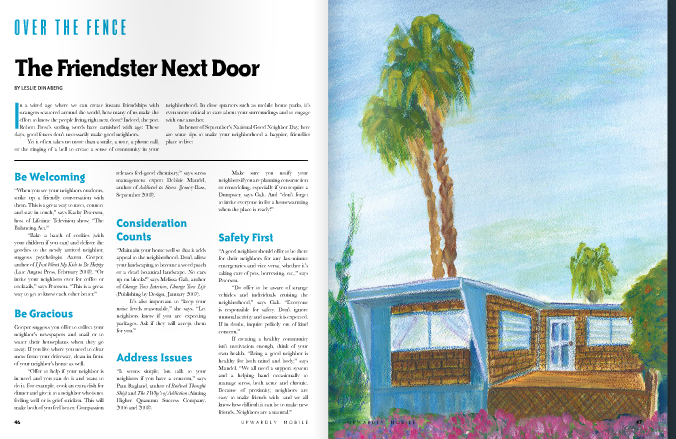
Won’t You Be a Good Neighbor (The Friendster Next Door)

This story as it originally appeared in Upwardly Mobile Magazine

This story as it originally appeared in Upwardly Mobile Magazine

It’s sad but true that in an age where we’re wired 24/7 and can–and do–create community anywhere, we often don’t know the people who live right next door. With all due respect to Robert Frost, good fences don’t really make good neighbors.

With as little effort as a smile, a note, a phone call or the ringing of a bell you can help create a sense of community in your neighborhood. Neighborliness is always nice, but when you live in close quarters such as mobile home parks, it’s even more critical to care about your surroundings and engage with one another.

In honor of National Good Neighbor Day on September 28, here are some tips to make your neighborhood a happier, friendlier place to live:

Be Welcoming
“When you see your neighbors outdoors, strike up a friendly conversation with them. This is a great way meet, connect and stay in touch,” says Kathy Peterson, host of Lifetime Television show, “The Balancing Act.”

“Bake a batch of cookies (with your children if you can) and have them deliver the goodies to the newly-arrived neighbor, suggests psychologist Aaron Cooper, author of “I Just Want My Kids To Be Happy.” “Or invite your neighbors over for coffee or cocktails,” says Peterson. “This is a great way to get to know each other better.”

Be Gracious
Cooper suggests you offer to collect your neighbors’ newspapers and mail or water their houseplants, when they go away. Or when clearing snow in your driveway, or sweeping, clean a path in front of your neighbor’s home as well.

“Offer to help if your neighbor is in need and you can do it and want to do it. For example, cooking an extra dish for dinner and giving it to a neighbor who is not feeling well or is grief-stricken, will make both of you feel better. Compassion releases feel-good chemistry,” says stress management expert Debbie Mandel, author of “Addicted to Stress.”

Consideration Counts
“Maintain your home well so that it adds appeal to the neighborhood. Don’t allow your landscaping to become a weed patch or dead botanical landscape, and no cars up on blocks,” says Melissa Galt, author of “Change Your Interiors, Change Your Life.”

“Keep your noise levels reasonable,” she says. “Let neighbors if you are expecting packages and ask them if they can accept them for you.”

Address Issues
“It seems simple, but talk to your neighbors if you have a concern,” says Pam Ragland, author of “The 7 Why’s of Addiction” and “Radical Thought Shift.”

Make sure you notify your neighbors if you are planning construction or remodeling, especially if you require a dumpster, says Galt, adding, “don’t forget to invite everyone in for a room or housewarming when the place is ready!”

Safety First
“A good neighbor should offer to be there for their neighbors for any last minute emergencies and vice versa whether it’s taking care of pets, borrowing, etc.,” says Peterson.

“Do offer to be aware of strange vehicles and individuals cruising the neighborhood; everyone is part of safety. Don’t ignore unusual activity and assume it is expected; if in doubt, inquire politely out of kind concern,” says Galt.

If creating a healthy community isn’t motivation enough, think of your own health. “Being a good neighbor is healthy for both mind and body,” says Mandel. “We all need a support system and a helping hand occasionally to manage stress both acute and chronic. Because of proximity, neighbors are easy to make friends with–and we all know how difficult it can be to make new friends. Neighbors are a natural!”

Originally published in Upwardly Mobile Magazine