A walk with Art Walk’s Founder Kerrie-Kilpatrick Weinberg

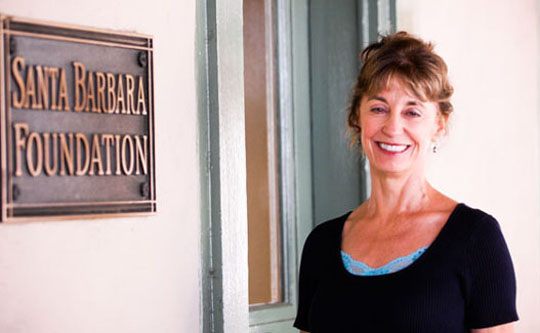
Kerrie Kilpatrick-Weinberg, founder of Artwalk for Kids/Adults (courtesy photo)

Kerrie Kilpatrick-Weinberg, found of Artwalk for Kids/Adults (courtesy photo)

“Through positive self-expression the doors of opportunity will open,” is the mission statement for the nonprofit Art Walk for Kids/Adults. It could also be the motto for the life of Art Walk’s founder, Kerrie Kilpatrick-Weinberg.

“Art Walk has opened so many doors for me in Santa Barbara, friendships, the areas I work. It’s amazing how things flow into one another when you’re on that right path,” says Kilpatrick-Weinberg, who trained as a set designer in England before developing Art Walk in Santa Barbara in 2000. The program–which is suitable for all but designed for at risk and special needs students–uses the creation of art projects to teach students other academic skills like math, problem solving, reading and understanding directions.

Working around the schedules of her two sons, Ben (now 15) and Sam (now 10), Kilpatrick-Weinberg–who was then a single mother and met her husband Henry Weinberg through Art Walk–began the program as an informal art camp in her backyard. From there she segued into working with the home schooling community, then Devereux’s developmentally disabled students.

She credits her brother Nigel, who was autistic, for inspiring her work. “The hyperactive, the kids with ADHD, the kids who some people call special needs, I just call creative,” she says. “I’ve always done art with any kid that has a learning difference. That seems to be my area, my gift. I don’t find it challenging, I find it really my normal comfort zone because of Nigel.”

With a full art program soon in place at Devereux, Kilpatrick-Weinberg set her sights on expanding to the Los Prietos Boys Camp, a residential correctional/treatment facility for teens.

With the support of the County Arts Commission and the County Education Office, and some funding from the Fund for Santa Barbara, Kilpatrick-Weinberg began her journey into what she calls “the golden triangle,” of Los Prietos Boys Camp, Juvenile Hall and El Puente School, which serves students who have been expelled or imprisoned and are transitioning back to school.

“I would develop this relationship with a kid in Juvenile Hall, then I would see them at Los Prietos for six months, then if things went well they went back to school and they went back to El Puente, so I would have another relationship with them,” says Kilpatrick-Weinberg.

“Some of those kids I knew two years, from beginning to end. It was great to see how well they were doing because a lot of them had given up on themselves, and I’m not saying it was just Art Walk, but the whole process … was immensely life changing for them.”

That continuity of relationships is important. “A lot of the people we work with don’t like too much change,” she says. When Devereux announced closure of its residential program, Kilpatrick-Weinberg began Chagall House so that her autistic adult students could continue to create art. They meet every Wednesday night, have showings of their work around town, and get together for dinner regularly at the Weinberg house, where they catch up socially and discuss and critique their art. Henry, Ben and Sam all take part.

“These are my friends, they’re not just people I create with. They’ve become part of our family,” says Kilpatrick-Weinberg.

Another important part of the Art Walk family is Brandon Sonntag, an artist and teacher who has been collaborating with Kilpatrick-Weinberg since 2001. “It’s just the two of us. There’s something very nice about having two people who get along, who know how to bring out the best in our clients,” she says.

In addition groups already mentioned Art Walk collaborates with a host of other organizations, including local elementary schools, Hillside House, Patricia Henley Foundation, United Nations, Summit for Danny, United Way, Red Cross, Cancer Hope Foundation, Camp Reach for the Stars, Sarah House, Santa Barbara Symphony, Lobero Theatre, and I Madonnari, among others.

One would think her volunteer plate was overflowing from Art Walk, but Kilpatrick-Weinberg still finds time to help at her sons’ schools, and serve on the board of Sarah House, where she and Henry have hosted an annual Oscar Party benefit for the past three years. For the second year, she is also chairing Sarah House’s annual holiday fundraiser–“Light Up the Night: The Artizan’s Ball”–on December 8 at the Santa Barbara Women’s Club.

But Art Walk has opened the door to so many other things for Kilpatrick-Weinberg–including Sarah House, where she first became involved by creating an Art Walk art tree that was auctioned for “Light Up the Night”– that it’s Art Walk that’s closest to her heart.

“Art Walk is a healing program in many ways, it isn’t just about at risk or special needs; it’s about anybody who wants to create. It’s art walk for kids and adults. What it probably should be is art walk for everyone because that’s what it is,” she says.

==

For more information about Art Walk for Kids/Adults visit http://www.artwalkforkids.org.

Originally published in Coastal Woman, 2007

Take Your Daughters to Work Day

“I know that girls can be anything that they want to be,” said featured speaker Barbara Ibarra Keyani as she shared her moving story of going “beyond her barrio” to UCSB, MIT, becoming a mother of two daughters now in college and her current position with the Santa Barbara School Districts with the 80 girls and 50 women who participated in Girls Incorporated’s annual Take Our Daughters to Work Day on May 24. Continue reading

Mating in the Millennium

Stuart Miles (Freedigitalphotos.net)

Stuart Miles (Freedigitalphotos.net)

The singles scene is changing fast.

Leslie Dinaberg tags along to dig up the dish on blind dating — 21st-century style.

MAN SEEKING WOMAN: Funny guy with killer body and money to burn seeks woman who doesn’t believe everything she reads.

Eye catching ad, isn’t it? It should be. That’s the online dating promo for professional online personal ad writer Evan Marc Katz, founder of e-cyrano.com, just one of the many Web sites for people who are looking for love in all kinds of interesting places. Continue reading

First Time Home Buyers: Vintage Charm

Google maps image

Google maps image

Entering the threshold of their new life together, couple opts for classic over contemporary

There are two kinds of first-time homebuyers: those that go for the modern amenities and those that go for the charm. Susan Bosse and Erik Vasquez definitely went for the charm, or at least the potential charm of their new home on 1242 W. Valerio St.

The house was built in 1925 and suffered from what Vasquez generously called “deferred maintenance.” Still, the character of the house, which still had many of its original built-ins and fixtures, attracted them.

The bones were good, the potential was there, but the old girl definitely needed a face-lift and some new internal organs.

“The thing that I think scared most people were the termites. But it was funny, the termite guys were the ones all bidding on the house so they weren’t too worried,” said Vasquez.

The inspection package was thick, said Bosse. Besides the termite damage and some water damage, the house needed to be brought up to code with a new roof and modern wiring, including new electrical and heating systems. There were also a few walls the couple decided to remove to improve the floor plan.

“We gave Susan a sledgehammer last week. I can show you the little video,” laughed Vasquez.

“It was pretty fun. I mean when else am I going to get a chance to hit a wall and knock it down,” said Bosse. It was also a good stress reliever for Bosse, who was planning her May 30 wedding to Vasquez at the time.

While some of original hardwood floors were in good shape, some needed to be redone, along with the bathroom and kitchen. “There was still food in the refrigerator,” said Bosse.

Despite the extensive improvements, Vasquez was pleased by the speedy progress his crew was making and prepared for the expense. They got estimates for the repairs up front, before deciding they could afford the house.

“The thing is we found is the cost is the people, the labor, it’s not the materials,” said Vasquez. “The materials are nothing, so if they’re in here (working), might as well make it exactly how you want because it’s not any more expensive to make it boring as it is to make it more interesting.”

Originally published in South Coast Beacon

First Time Home Buyers: The American Dream … the South Coast Reality

Google maps photo

Google maps photo

Breaking into the local real estate market is tough but not impossible. Leslie Dinaberg explores who’s buying for the first time and how.

Practicality, frugality and focus were the key values that got Jonathan and Kara Rocque into their first home, at 7126 Del Norte Dr. in Goleta. Both UCSB graduates, the Rocques lived in a one-bedroom apartment and didn’t really upgrade their lifestyle much after college in order to save money for a house.

They started making offers right after they married, about 2-1/2 years ago, but Jonathan said he wasn’t really ready to buy until recently. “People always say ‘get in as soon as you can,’ but … at the same time, I really have no regrets not getting in any sooner because I wasn’t ready.” An engineer, he said he worked for a start-up company and was worried about job stability.

“I think I got to the point where I gained more confidence in myself and that things were going to be okay,” said Jonathan, who now works for Indigo Systems, which recently merged with FLIR Systems.

When he felt really ready to buy, Jonathan had the willing assistance of his father, John Rocque, a realtor and mortgage broker in San Dimas.

Another factor that kept the Rocques from buying quickly was their expectation of what they would be able to afford. “We started thinking that we wanted our dream home out of the shoot, and I think that’s what delayed our purchase, probably,” said Jonathan.

The three-bedroom two and a half-bathroom home the Rocques eventually bought this year for $659,500 has a studio apartment (garage conversion) on the property, a big selling point. “We were looking at these two-bedroom one-bath cottages and went, I just can’t do it. There’s got to be something out there that’s better because it doesn’t leave us the flexibility to grow,” said Jonathan. “When we saw this place with the studio I just thought ‘Oh God, couldn’t be better.’ I could give up the garage and take the extra income that will definitely help.”

Kara noted the backyard had a shed for storage, making it easier for her to give up the garage space. Being able to have a vegetable garden was also important to her, as was the school district. “Basically any school in Goleta, I’m totally comfortable with,” said Kara, who teaches first grade at La Patera.

The Rocques also knew what they didn’t want: no condos and no commuting. “The whole reason we live in Santa Barbara is the lifestyle,” said Jonathan. “I ride my bike. I love the mountains. I love riding by the ocean. I love the weather. I value my time … I’m not going to drive an hour each way to work. I’d go somewhere else where I could live close,” he said.

“I don’t think either one of us ever wants to move into one of the new developments because they’re so crunched together,” added Kara. “Yeah they look pretty, they’re nice and new, but to me this has more character than those houses. You can paint it whatever color you want to paint it; you can do whatever you want with your yard.”

While the Rocques would eventually like to move to a larger house, they are fixing up their yard and treating the house like a home.

“It’s not short term, but it’s not forever,” said Kara.

“This house easily gets us ten years,” said Jonathan. “If we wanted to, at some point we’ll refinance and we could reclaim that space (the studio).”

And as for the realities of being able to afford to stay on the South Coast, they credit much of their success to Patrick Flood, the financial consultant Jonathan began working with when he graduated from college. The Rocques said they feel both blessed and proud to be able to get into the housing market

“I like taking on challenges too. I took a major in college … that was challenging. And staying in Santa Barbara was a big challenge, but I was going to do it. I was really, really happy that we could,” said Jonathan.

Added Kara: “If we can do it here then we can do it anywhere.”

Originally published in South Coast Beacon

Mixed Messages

Television by Salvatore Vuono (freedigitalphotos.net)

Television by Salvatore Vuono (freedigitalphotos.net)

Be careful — what your kids watch may be hazardous to their health and your wallet.

If TV is “chewing gum for the eyes,” as Architect Frank Lloyd Wright once said, it may be causing more than tooth decay in children — TV may also be making them fat, according to two new studies.

“The more than 1,000 hours that the average school child will spend in front of the television this year will harm him or her far more than the one second of Janet Jackson’s breast,” said TV-Turnoff Network Executive Director Frank Vespe.

The typical child sees about 40,000 ads a year on TV and the majority of ads targeted to kids are for candy, cereal, soda and fast food, a report by the Kaiser Family Foundation found. In addition, many of the ad campaigns enlist children’s favorite TV and movie characters — Spongebob Cheez-Its, Scooby-Doo Cereal, Teletubbies Happy Meals, to name a few — to pitch products.

Apparently the $12 billion per year spent on advertising to youth works. “Commercials make people want to buy things, like Cox high speed internet,” said 4-year-old Sophia Bordofsky.

Indeed, a series of studies examining product choices found that children recalled content from ads they’d seen, and their preference for a product occurred with as little as a single commercial exposure and grew stronger with repeated exposures, found a recent report by the American Psychological Association. The Kaiser study also found that exposure to food advertising affects children’s food choices and requests for products in the supermarket.

While there’s no doubt that advertisers are selling to children, not everyone is buying. Many parents restrict their children’s viewing. “They do have to do their homework first and they have to take turns picking a show,” said Misty Bordofsky, Santa Barbara mother of four children aged 4 to 13. “Usually they’ll leave the room and go do something else if it’s the show another kid picked,” she said.

Numerous parents may limit their children to watching videos and commercial-free television and a rare few don’t let their kids watch TV at all.

“I am appalled by marketing that targets children with ads for junk food and toys. Young children are not able to understand the inherent bias of an advertisement. They are easy targets,” said Charla Bregante, a Goleta mother of two who is in that 2 percent demographic that does not own a television.

“Most of the advertising during children’s programming is for junk food such as candy, chips, and sugared cereals. Kids are given the message that these foods are desirable and nag their parents to buy them. In addition, children tend to snack more while they are watching TV. Turning off the TV is one of the best ways to fight obesity in children. Almost any other activity will use more energy than sitting in front of a television,” said Bregante.

“While older children and adults understand the inherent bias of advertising, younger children do not, and therefore tend to interpret commercial claims and appeals as accurate and truthful information,” said psychologist Dale Kunkel, a professor of communication at UCSB and senior author of the APA report, which recommends restricting ads targeting children under the age of 8.

“I can tell you that my children rarely nag me for a specific toy or food item. I believe this is because they are not exposed to television advertising and the consumer culture promoted in television programming,” said Bregante, who encouraged families to participate in TV-Turnoff Week, April 19-25 (www.tvturnoff.org).

Is there anything positive for kids on television? Yes, according to Professor Kunkel: “There are lots of positive influences that may result from children’s viewing of certain pro-social or educational programs. The problem is that parents have to mine the media landscape pretty hard to find those occasional nuggets.”

Television is an (almost) inescapable part of modern culture. “With the recent explosion in satellite and digital specialty channels, we now have access to a plethora of both good quality and inappropriate TV content. In this crowded television environment, the key for parents is to search out high quality TV programs for their kids, and whenever possible, enjoy them together as a family,” recommends the Media Awareness Network, a nonprofit organization that focuses on media literacy.

For parents who don’t want to opt out completely, David Kleeman, Director of the American Center for Children and Media, recommends that parents ask the following questions to select viewing that is good for children:

Does the program actively engage my child, physically or intellectually? Television watching doesn’t have to be passive. It can prompt questions, kindle curiosity, or teach activities to pursue when the set is off.

Does my child see others like himself or herself on television? Young children believe that television reflects the real world. To not see people like themselves — in race, ethnicity, or physical ability, for example — may diminish their self-worth. A lack of role models should spark discussion about how TV portrays different types of people.

Do I respect this program? Parents don’t have to like every show their children choose — in fact, young people need their own district culture. But parents should trust that a program’s creators understand and respect how children grow and learn.

Originally published in South Coast Beacon

Making their presence felt

Women's Fund of Santa BarbaraWomen’s Fund getting more bang for bucks

Looking for a low-key, high-impact way to tap into the power of collective philanthropy, Carol Palladini was inspired when she read a Los Angeles Times article about the Everychild Foundation. The idea is simple. Take the time, energy, and money spent on mounting and attending elaborate fund raisers and write a single check once a year.

The appeal was also simple: “Many women in the Santa Barbara area feel not only a need, but an obligation to be a powerful force for good in our community,” Palladini wrote in the invitation letter to the inaugural members of the Women’s Fund of Santa Barbara.

A few short months after that initial request, the Women’s Fund awarded its first donations on Jan. 31, giving $105,000 to the Santa Barbara Neighborhood Clinic’s Eastside Family Dental Clinic and $35,000 to two St. Vincent’s programs, PATHS (Program of Affordable Transitional Housing and Services) and Casa Alegria, an infant and toddler care facility.

“A group of women had been meeting at the Santa Barbara Foundation to talk about women and philanthropy,” explained Palladini. That group eventually evolved into a founding committee that included Palladini, Peri Harcourt, Shirley Ann Hurley, Jean Kaplan, Dale Kern, Joanne Rapp, Elna Scheinfeld, Meredith Scott, Anne Smith, Kay Stern, Marsha Wayne and Fritzie Yamin, as well as Raynette Cornejo, the Santa Barbara Foundation liaison.

Their intention was to take a year to develop the plan for the Women’s Fund, “but people started calling and saying ‘when can we write checks?’ which is amazing because usually you have to cajole and pull money out of people,” said Palladini.

“All it took was a letter of invitation to 500 women and the money started coming in,” said Palladini.

Each member contributes a minimum of $2,500 per year, which is then deposited in Donor Advised Fund administered by the Santa Barbara Foundation. At the end of the year, 90 percent of the funds collected are donated to one or more local nonprofit organizations.

“Our umbrella for giving is meeting unmet needs for women, children and families in the greater Santa Barbara area,” said Palladini. “The main goal is not to divvy it up in little tidbits, so that the impact of collective women’s giving is really felt.”

Granting is decided by a simple majority vote of members. Women who wish to ease the cost of dues may form a donor group, which then shares one vote in how the money is spent.

To join, send a check payable to Women’s Fund of Santa Barbara, c/o Santa Barbara Foundation, 15 E. Carrillo St., Santa Barbara 93101. For more information, contact Palladini at 565.0342 or e-mail her at carolpall@earthlink.net.

Originally published in South Coast Beacon in 2007.

Where Silence is Golden

The Immaculate Heart Center for Spiritual Renewal

A feeling of tranquility and peace welcomes visitors as they enter the grounds of Montecito’s historic estate, La Casa de Maria, and head up the oak tree-lined driveway to the grand stone house in the center of the 26-acre nonprofit interfaith retreat and conference center. Once considered holy ground by the Chumash nation, today La Casa de Maria offers a quiet destination for people of all faiths to escape the stress of everyday life and deepen their spirituality through individual and couples retreats in the intimate surroundings of the Immaculate Heart Center for Spiritual Renewal, or in group gatherings throughout La Casa’s campus.

La Casa’s property was originally part of the San Ysidro Ranch; then became El Prado Rancho, the first lemon orchard in the area; then later became Rancho El Bosque, which brought the addition of the estate house, designed by architect Mary Craig. The home, which now houses the Immaculate Heart Center, remains mostly intact today, featuring stone quarried from nearby San Ysidro Creek, hand-carved teak ceilings, distinctive Italian fireplace mantels, and courtyard tiles from Spain.

“It is a very prayerful surrounding,” says Carol Carrig, the center’s director since 1997. Offering a spiritual bed and breakfast getaway, with delicious organic meals made from produce grown on the property and prepared by the Immaculate Heart Community of former nuns, guests often start out visiting for a few days, then come back again for longer retreats. “They realize that they’re getting in getting in touch with the deeper things that are going on within themselves,” says Carrig.

But beneath the peace and solitude of the center lies a long and storied history, not just of faith, but also of integrity, determination, and vision.

In 1943 Novice Mistress Mother Regina McPartlin, along with 12 novice Sisters of the Immaculate Heart of Mary, turned the estate into a Novitiate, where young women train to become nuns. While they pursued religious life on La Casa’s grounds, the peaceful surroundings were also gaining a reputation in Hollywood. Stars such as Irene Dunne, Loretta Young, and Ricardo Montalban came for retreats, holding prayer services in the Novitiate by day, while staying overnight at the Biltmore. In 1955, La Casa de Maria Retreat House formed and became the first retreat center for Catholic married couples. “Every weekend for probably 15 years, 40 married couples came to La Casa. The priests said mass for them, gave them conferences, they renewed their marriage vows, and had wonderful weekends,” says Stephanie Glatt, director of La Casa de Maria.

During the 1960s, there were conflicts between James Francis McIntyre-the Cardinal Archbishop of Los Angeles who oversaw the Immaculate Heart community-and the sisters’ understanding of the Vatican’s directive to update the church for contemporary times. “McIntyre said, ‘either follow what I say or give up your vows,'” recalls Carrig. “So that’s what we decided to do. To remain a community and to follow what we believed should be the right direction-but everybody had to give up their vows.”

The sisters took the revolutionary step of evolving into the Immaculate Heart Community, an ecumenical group of men and women, both single and married. Rather than fall apart, as many predicted, the Immaculate Heart Community has stayed together and thrived, with almost 200 members still active around the world. The community has operated the Immaculate Heart Center for Spiritual Renewal since 1974, opening its doors for private retreats for people of all faiths.

“It feels like a holy land. Not like Christian, I mean it just feels that the meditation, the peace, the quiet there is special,” says author/psychotherapist Alyce Faye Cleese, one of La Casa’s patrons. She calls the sisters “renegade nuns,” adding, “their story, for their day as women, was an extraordinary piece of women’s lib really-their courage and their bravery and their saying, ‘We’re women, we can do this and we will survive.'”

Today La Casa offers a wide array of programs, such as 12 Step Retreats; the Sacred Art of Living and Dying (for caregivers); Kaballah (Jewish Mysticism) (Jewish Mysticism); Waking up on Earth: Spiritual Life in a Time of Crisis; Centering Prayer Practice Retreats; Recovering Religion as a Work of the Imagination; and Capacitar, which combines Tai Chi, meditation and other practices that integrate spirituality and body wisdom.

In 2005, the Immaculate Heart Community bought back the entire property and is now in the process of a $7.7 million capital campaign. In addition to paying off the mortgage, they also plan to renew the conference buildings, preserve the ecology of the site-including the creating a sustainable agricultural site that protects native plants; developing an organic orchard/garden to provide the produce for the dining rooms; and improving the overall health of the citrus orchard and native Coast Live Oak grove-and develop additional La Casa-sponsored programs. “Part of that is our plan to integrate La Casa de Maria with the greater community and have more people understanding what we’re doing and supporting our program,” says capital campaign chair Christine Garvey, a retired banker. “We’ve mobilized a lot of the neighbors.”

One “neighborly” recruit is capital campaign cabinet member Joan Kreiss, a physician who did AIDS research in Africa before moving to town seven years ago. “What I love about La Casa de Maria is its rich sense of history,” she says. “For our family-and this is particularly important for my children-living next door to La Casa de Maria… gives a sense of context, a sense of being part of a historical continuum.”

“It’s kind of like Peter Pan, you have to believe,” says Cleese. “Not in God, just believing in the goodness of people and the goodness of nature and that something (like La Casa de Maria) is worth existing.”

For more information on La Casa de Maria, call Stephanie Glatt at 969.5031 ext. 204 or visit www.lacasademaria.org.

Originally published in Santa Barbara Magazine

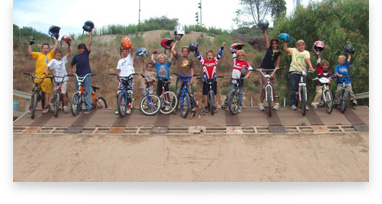
Generation BMX

Young racers test their mettle with their pedals

Faster, higher and often younger than you might imagine, BMX racers are tearing up the dirt at Elings Park every Friday night.

Elings Park BMX (courtesy photo)

Elings Park BMX (courtesy photo)

The sport, which first became popular in the 1970s, is one of the fastest-growing competitions in the country, partially due to the popularity of the X Games and BMX-inspired DVDs, video and computer games. BMX (bicycle motocross) is scheduled to become an Olympic sport in 2008 and, according to Dale Bowers, track director of Santa Barbara BMX, there are three or four local bikers who “could be peaking” at that time.

Several local BMX racers will be competing in the National Bicycle League NBL Grands in Louisville, Ky., this weekend, including Logan Beebe, Chris Burke, Austin Davis, Michael Davis, Austin Hamilton, Jarrett Kolich Kolich, Amber Melgoza, Brianna Wiley and Jason Wiley.

While the level of expertise in Santa Barbara is high, Bowers emphasized that there’s a BMX skill level race for everyone, including beginners — and grownups. If you can ride a bike, you can BMX, which means there are some pretty impressive 5- and 6-year-olds out there.

Racers work their way up, depending on their age and how good they are, said Scott Berry, a 13-year-old La Colina Junior High student.

“I saw commercials on TV and really wanted to try it … we came up on a Friday night and just watched,” he said. “I just liked what I saw and wanted to try it.”

Bowers recommended that interested families follow Scott’s lead: just come to the track and check it out. “It doesn’t cost anything to come in and watch. Not much you can do for free on a Friday night, and its exciting entertainment.”

For participants, too, BMX is very affordable, said Scott’s mother, Debbie Carder.

It costs $45 per year to join the NBL, with a 30-day trial membership available for $30 (which is credited toward the full membership). Races, which take place most Fridays beginning at 6 p.m., are $8, and practices, at 6 p.m. Wednesdays, are $5.

“They’re so helpful, too,” emphasized Carder. “Even the older kids … they take the time to help the little ones. They go out of their way. They’re not snotty. They just take them under their wing … without being asked. It’s kind of like a family in a way.”

Originally published in South Coast Beacon

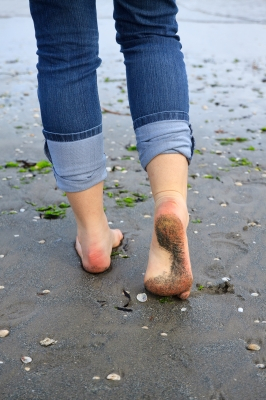
Talk about a walk

Photo by graur razvan ionut (freedigitalphotos.net)

Photo by graur razvan ionut (freedigitalphotos.net)

After 27 years, these ladies think they’ve hit their stride

It’s been said that walking a mile in someone’s shoes fuels greater understanding — so just imagine what walking three miles together, five days a week, for 27 years, will fuel.

In the case of walking partners Judy Bernstein, Beverley Brier, Natalie Gaynes, Barbara Mizes, Blanca Presser and Phyllis Cox (who joined the group in 1998), they’ve shared laughter, friendship, triumph and sorrow. They’ve also seen how the South Coast has changed in the Patterson Avenue/Kellogg School neighborhood they’ve walked for so many years.

“We have been through the many travails all these years, starting with young children, teenagers, college entrance exams, weddings and now grandchildren…” Brier said. “One gentleman who has seen us walking for years said we look like Pacman, the mouths are all going a mile-a-minute.”

The mouths may be moving quickly, but so are the legs. Even our 20-something photographer was huffing and puffing as we took an early morning walk with these dynamos.

Presser and Gaynes started walking together and the others quickly joined in. Bernstein said she started out trying to get in shape for her first trip to Europe, adding that having a group of friends to exercise with is very motivating.

“It’s so long and so boring and so tiring and when you talk, you don’t notice it,” Bernstein said.

“We solve the world’s problems on our walks,” Brier said.

“But most of them are personal,” Bernstein added.

Cox recalled that she joined the group the year before her daughter got married, and had her friends help guide her through the planning. Last week, Mizes was planning her father’s funeral and Brier was helping with a memorial for a close friend.

While the ladies have serious discussions during their walks, sometimes inspired by their lives and sometimes by the changes they see, they also have fun.

Not only have the women formed friendships among themselves, they’ve gotten to know the neighbors. The men at a residential care home wave each morning and let them know if they’re running late, while the neighborhood dogs expect a pat on the head.

“I cannot tell you how many people that I meet at a dinner party who say, ‘Do I see you walking?'” Mizes said.

The sweat is pouring but the banter stays lively throughout our walk.

Some of their husbands wonder how they have so much to say to each other, but Brier said they’re never at a loss.

“If you want to say something you have to jump in,” said Mizes, who once recruited a member (Ginny Alexander, who has since moved) on a flight to London. She even tried to get the Beacon staffers to join.

“We’ll get you through all of the trials and tribulations,” she said. “Every time you think you’ve got a problem, by the time you go through us giving you input you’ll feel better.”

Thanks. We already do.

Originally published in South Coast Beacon