Sullivan Goss Presents 100 GRAND, 2013

100grand2013smallIn what has quickly become a favorite Santa Barbara holiday tradition, Sullivan Goss presents the fifth annual 100 GRAND exhibition, curated by Susan Bush and featuring 100 WORKS OF ART FOR $1,000 OR LESS. 

Opening on 1st Thursday (December 5) and running through February 2, this exhibition has become “an incubator of emerging talent, an entryway for beginning collectors, a holiday celebration in the art community and an ever timely reminder that everyone’s life is improved by the addition of original works of art.”

100 GRAND features paintings, drawings, photographs, assemblage and sculpture by emerging and established artists that are priced to sell and sized (for the most part) to fit into smaller spaces. Contemporary curator Susan Bush was able to secure work from many of last year’s best­selling artists, but there are also 17 artists who have never shown with Sullivan Goss before.

Featured artists include: Will AdlerSean AndersonMeredith Brooks AbbottErik BergKen BortolazzoLiz Brady, Lisabette Brinkman, Phoebe BrunnerChris ChapmanCarlyle ChaudrucConnie ConnallyJoann DufauMehosh DziadzioPamela EnticknapPeggy FerrisPriscilla FossekNancy GiffordDane GoodmanRobin GowenJames Taylor Gray, Ruthy Green, Jason HadleyJames HapkeHolli HarmonTracey Sylvester HarrisDerek HarrisonKristen HawkesCynthia JamesScott KahnMasha KeatingPhilip KoplinMary­Austin KleinDan Levin, Mark Lozano, Clare LittleLaurie MacmillanVirginia McCrackenSusan McDonnellDavid Molesky, Jennifer MosesAmalia MouradZoe NathanHank PitcherLisa PedersenRafael PereaAngela PerkoKimberley Pratt­-ShiberIan PutnamPaula ReErik ReelMaria RendonBrad ReyesJoan Rosenberg­-Dent, Jourdan Ross, Lindsey RossCaren SatterfieldSusan Savage, Susan Shapiro, Elena SiffLeslie Lewis SiglerBarry SpacksNicole StrasburgMarlene Struss, Makeda Tekle­-Smith, James David ThomasSusan TibblesCasey UnderwoodTaj VaccarellaSarah VedderDeborah VeldkampRoe Ann WhiteMonica Wiesblott and Abigail Zimmerman.

Sullivan Goss—An American Gallery is located at 7 E. Anapamu St. For more information click here.

—Leslie Dinaberg

Originally published in Santa Barbara SEASONS on November 29, 2103.

One Radio Host, Two Dancers Features NPR’s Ira Glass

Ira Glass and dancers, Photo by Ebru Yildiz

Ira Glass and dancers, Photo by Ebru Yildiz

Ira Glass with dancers?

That’s right, the always entertaining host of NPR’s This American Life has taken to the road with choreographer Monica Bill Barnes & Company for a quirky show combining two art forms that, as Glass puts it, “have no business being together – dance and radio.”

Coming to The Granada on Saturday, October 19 from UCSB Arts & Lectures, the resulting show is said to be “a hilarious, lively and very talky evening of dance and captivating stories that brought down the house in its test run at Carnegie Hall,” according to the organizers.

How did this surprising collaboration begin?

In May 2012, they collaborated on three short dances that were part of a This American Life variety show that was beamed into movie theaters nationwide. It was such a success that they decided to do a full show that combines stories and dance. Some are performed together on stage by Glass, Barnes and dancer Anna Bass. For a few, the dancers or the radio host take over for a while. The result? A funny and strangely wonderful evening exploring the life of the artist.

“This is the perfect show for anyone who has ever thought to themselves, ‘God, Ira Glass’ show is the most awesome radio show ever, except it’s missing modern dance,’ ” Glass says.

The show starts at 8 p.m. for more information or tickets call 805/893-3535, visit ArtsAndLectures.UCSB.edu or The Granada Theatre at 805/899-2222, granadasb.org.

 Originally published in Santa Barbara SEASONS on October 18, 2013.


¡Viva el Arte de Santa Bárbara! welcomes Los Vega Son Jarocho

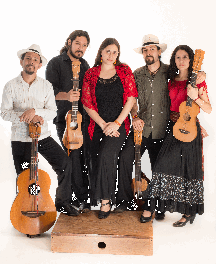
Los-Vega.sm_This week ¡Viva el Arte de Santa Bárbarawelcomes Los Vega Son Jarocho, fifth generation jarocho musicians from Veracruz, Mexico. Carrying on a longstanding family tradition, Los Vega brings a fresh pespective to this distinctive style, playing jaranas (small guitars), percussion, vocals and zapateado (footwork). 

According to the organizers, “for more than five generations the Vega family has contributed to traditional son jarocho, taking on the responsibility of keeping a musical expression alive through the generations. Son jarocho is a style of music with origins in music brought from Spain in the colonial period, melded with indiginous folk music, dynamic Afro-Caribbean beats and wise-cracking wordplay unique to the tropical Veracruz region on the Gulf of Mexico. It is music traditionally played on stringed instruments such as the jarana, a strummed guitar with eight to ten strings, three of which are double, and the requinto, a small four-stringed guitar, and is accompanied by intricate dance or zapateado, often performed on wooden platforms or tarimas.”

They will perform a free family concert at Isla Vista School at 7 p.m. on Friday, October 18 (6875 El Colegio Rd., Goleta, 805/893-5037). On Saturday, October 19, they travel to Guadalupe City Hall for a free family concert at 7:30 p.m. (918 Obispo St., Guadalupe, 805/343-2939), returning to Santa Barbara to perform a free family concert at the Marjorie Luke Theatre at Santa Barbara Jr. High on Sunday, October 20 at 7 p.m. (721 E. Cota St., 805/884-4087 x7).

In addition to these performances, on October 17, La Cumbre Jr. High and the Santa Barbara Westside Association co-host a unique opportunity to learn and practice with the musicians of Los Vega Son Jarocho in a free participatory workshop from 5:30–7 p.m. at La Cumbre Jr. High, 2255 Modoc Rd. Musicians and dancers of all levels are welcome to come play together. Please bring your own instrument —or be ready to sing and dance!

Based on a vision of accessible cultural offerings for Santa Barbara County’s Latino communities, ¡Viva el Arte de Santa Bárbara! brings together diverse audiences at free famly events in neighborhood venues on five weekends each year. The program is a consortium of the Marjorie Luke Theatre, the Guadalupe Cultural Arts & Education Center, Isla Vista School, and UCSB Arts & Lectures, represented by co-ordinators Alíz Ruvalcaba, Graciela Parra and Catherine Boyer. Volunteers from PTAs, the California Youth Corps, UCSB sororities and fraternities, and many others, join together to host and staff the events.  

¡Viva el Arte de Santa Bárbara! is funded by The James Irvine Foundation and the National Endowment for the Arts with additional support from the SAGE, the Santa Barbara Foundation, Incredible Children’s Art Network, the UCSB Office of Education Partnerships, the Santa Barbara County Arts Commission, The Marjorie Luke Theatre’s Dreier Family Rent Subsidy Fund, the Santa Barbara IndependentSanta Barbara Latino, the Santa Maria SUNUnivisión, the Sandman Inn, Best Western South Coast Inn and Ramada Limited. This project is funded in part by the Community Arts Grant Program using funds provided by the City of Santa Barbara, in partnership with the Santa Barbara County Arts CommissionCo-presented by the Marjorie Luke Theatre, the Guadalupe Arts & Education Center and UCSB Arts & Lectures, in collaboration with the Isla Vista School After School Grant.

Originally published in Santa Barbara SEASONS on October 17, 2013.

You Go Girls! Opening Tonight: The Project-Fine Art Zone

Talk about girl power! Creative Director Tracy Smith Reed and I got a sneak peak at The Project-Fine Art Zone yesterday and came out wishing we could be a part of this powerhouse of talent.  You’ll definitely want to check out the opening during tonight’s First Thursday celebration in downtown Santa Barbara.

Nine very talented female artists have teamed together to create a collaborative non-profit art gallery. The artists–ERIKA CARTER, SUSAN TIBBLES, LIZ BRADYLISA PEDERSEN, VIRGINIA McCRACKEN, DONNA ASYCOUGH, ASHLEY DART, THERESA CARTER and LLOYD DALLETT–will own and operate the gallery themselves and donate 20 percent of all art sales to Girls Inc.

The work runs the gamut, from Erika’s colorful layered paintings invoking the spirit of San Miguel de Allende and Guanajuanto, to Susan’s fascinating mixed media assemblage pieces, Liz’s organic and botanical form explorations, Lisa’s dreamy landscapes, Virginia’s miniature paper mache mouse house shadow boxes, Donna’s vibrant florals, Ashley’s whimsical ironic juxtapositions, Theresa’s stunning color combinations and Lloyd’s Asian-accented creations.

My on-the-fly photography doesn’t do the work justice–you’ll have to go see it.

In addition to a variety of work on sale from each artist, each of the women has created a unique 8 x 8″ collectible square piece on sale for the unbelievable price of $200 each. What a terrific way to start a local art collection, support local artists and Girls Inc. at the same time.

Speaking of support, the space–a gorgeous site at 740 State Street, Suite 1, overlooking De La Guerra Plaza–is being provided by Montesanto Group. Erika wanted to make sure to give a special thanks to Gene Montesanto and John Bennett for their generosity in providing the space and helping to get this fabulous project going.

After tonight’s grand opening, the gallery will be open Thursday through Saturdays, 11 a.m. to 6 p.m., Sundays noon to 6 p.m. and by appointment. For more information contact Erika@ErikaCarter.com or call 805/452-6127.

–Leslie Dinaberg

Originally published in Santa Barbara SEASONS on June 2, 2011.

Lloyd Dallett

Lloyd Dallett

Theresa Carter

Theresa Carter

Ashley Dart

Ashley Dart

Works by all nine of The Project artists

Works by all nine of The Project artists

Artist Jane Gottlieb Honored at UCLA’s Anderson School

New Paris Welcome by Jane Gottlieb (courtesy photo)

New Paris Welcome by Jane Gottlieb (courtesy photo)

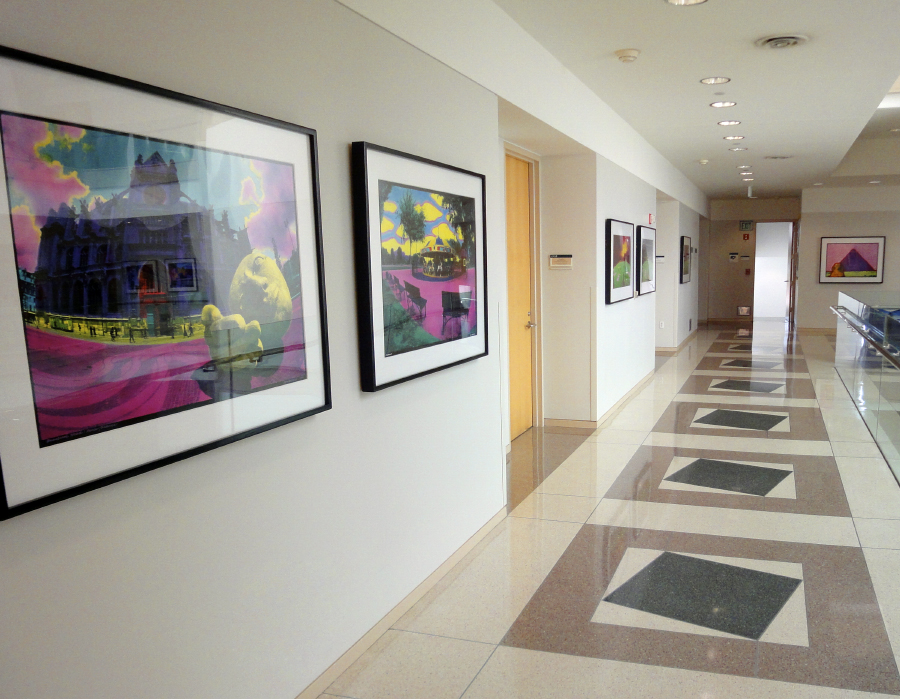
The UCLA Anderson School of Management recently honored alumna Jane Gottlieb, a local artist whose “Dreamscapes” collection will be displayed within the school’s Entrepreneurs Hall for the next ten years. The exhibition includes 25 pieces featuring Gottlieb’s signature technique of hand-painting dyes onto large-scale Cibachrome photographs. The result is a colorful kaleidoscope of dream cars, scenic vistas, and everyday life, transformed by the artist’s hand into vibrant conversation pieces.

Jane Gottlieb's installation at UCLA Anderson School (courtesy photo)

Jane Gottlieb’s installation at UCLA Anderson School (courtesy photo)

“UCLA is the place that really inspired all of my dreams of becoming an artist,” says Gottlieb.  After graduating from UCLA in 1968 with a degree in painting and art history, she worked as an art director for Warner Brothers where she oversaw classic films like Klute and THX-1138. However, it was her playful hand-painted photographs that eventually earned her international acclaim.

As much painter as photographer, Gottlieb says, “I hope to create images that surprise and intrigue, drawing the viewer into my idyllic vision, ultimately uplifting them with vibrant color and evocative beauty.”

Published on Santa Barbara SEASONS blog on August 13, 2013.

Little red wagon takes the cake

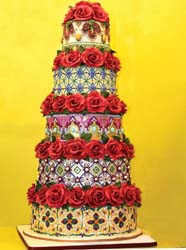
Cake by Sarah Farmer of Sugar

Cake by Sarah Farmer of Sugar

Sarah Farmer delivers the baked goods in Big Apple exhibit

Launching imaginative voyages for boys and girls since 1917, and glorified in a 1992 movie, the ubiquitous little red Radio Flyer wagon chalked up another adventure recently. Local cake artist Sarah Farmer, of Sugar, relied on one in her journey to New York City’s Grand Central Station, where she was among the 50 leading sugar artists showing off their creations at the largest wedding cake event ever held.

Farmer said she was thrilled to be invited to the event, called Cakewalk at Grand Central, and hosted by Brides Magazine and Martini & Rossi, but getting her three-foot tall confection to New York was a challenge, to say the least. The stunning, complicated, Moroccan-themed wedding cake, inspired in part by Chef Karim’s Restaurant in Victoria Court, had its own airplane seat, but still had to be completely deconstructed for the trip.

Plus, the original vision of the two boxes in which the cake would travel had to be modified into three boxes at the eleventh hour.

“Then I had to figure out how to get these three boxes through the airport,” said Farmer, who credits local United Airlines staff members Tim Crews, Aaron Muller and Sean Russer with helping her — and her cake — make it safely to Grand Central Station.

And then there’s the little red wagon belonging to her daughter, Lily.

“It was a Radio Flyer that my sister had found on the side of the road … this beat-up thing covered with leaves and rust and sticks hanging off it, and I thought, that will work,” she said. “By the end of the trip I had named her Lucy, because I thought this is more than just a wagon, this is my personal assistant.”

Stretching the limits of her creativity is nothing new for Farmer. Along with partner Kirsten Soria, who is the baker half of the duo, they’ve created completely edible cakes that look like a Monopoly Game, Manolo Blahnik shoes, Academy Award statues, Santa Barbara’s downtown district, Michael Jackson and an exact replica of the Four Seasons Biltmore Resort.

“Every artist’s dream is to make a living doing what they love,” said Farmer, who studied illustration and design at the Fashion Institute before fate intervened and she began working with baked goods at Debbie’s Delights.

“For me, cakes are clay. Cakes are a canvas. Each one is a personal challenge to me to create something new and fantastic,” Farmer said. “Everything I have ever studied, painting, sculpture, graphic design, illustration, jewelry design, all comes into play when creating our cakes.”

In addition to the dozens of weddings, birthdays and events on the docket for Sugar, coming up soon is a Halloween photo shoot commissioned by Child Magazine. It’s a safe bet that whatever witchy creation Sugar comes up with will not only be incredibly clever, but extremely delicious as well.

=

For more information visit, www.sugarcakes.com. Sugar is open by appointment only Thursday-Saturday. Call 683.5600 or 452.4659 to schedule a complimentary tasting.

Originally published in South Coast Beacon. Click here to read the story on that site.

Labor of love

SBMA docents often young students’ first exposure to art

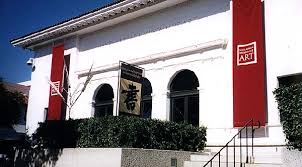
Santa Barbara Museum of Art

Santa Barbara Museum of Art

“The most important thing about learning to look at art is that what you feel about it matters. Your opinion is valid. There is no right answer,” is what Santa Barbara Museum of Art (SBMA) Docent Pat Andersons tells elementary school students before she brings them in for tours.

The very first visitors on SBMA’s opening day in 1941 were schoolchildren. Today the Museum serves about 30,000 children per year through its education program, said Spokeswoman Martha Donelan.

Much of the educational programming is carried out by docents, who collectively volunteer approximately 12,000 hours per year, said Andersons, president of the 79-member group, which includes artists, teachers, a married couple who met through the program (Candice Taylor and Paul McClung) and even a retired rocket scientist (Cliff Hauenstein). Docents undergo nine months of rigorous training, as well as ongoing education. Unlike many museums, which use scripted tours, “One of the things that’s so different about our program is that we do all our own research … we select the pieces … it’s a really personal thing.”

Most docents lead tours for both children and adults, but it’s clearly the kids who’ve captured Andersons’ heart. One of the things that fascinated me when I started touring kids is that “a lot of children have never been to a museum … so the concept of original art … makes them almost giddy,” she said.

Prior to the elementary school field trips — funded entirely by SBMA, including the buses — docents visit the school to give a preparatory talk. “(The school visit) is actually one of the most important aspects of the program because not only does it give the children something to look forward to and get them excited about the program, but they feel more comfortable coming here if they know what to expect,” said Andersons.

“… We have wonderful exhibitions and an outstanding permanent collection, but the education program, and the docent programs in particular, are the ways that we reach out to people and let them know what we have and why it’s interesting and what’s cool about it,” said Donelan.

After children tour the museum, they are given souvenir postcards and free tickets to bring their families back to the Museum. Teachers are also given posters and hands-on activities do back in the classroom. The program — which serves schools from as far away as Lompoc and Hueneme at no cost — is curriculum-based, designed to compliment what teachers are doing in the classroom from K-12.

With art programs in the schools being cut, sometimes we’re it, said Andersons. Admittedly, being a docent is demanding, but infinitely rewarding, said Andersons. “We all think we get back much more than we give,” she said.

For additional information about the docent-training program, call Sue Skenderian at 684.6384.

Originally published in South Coast Beacon

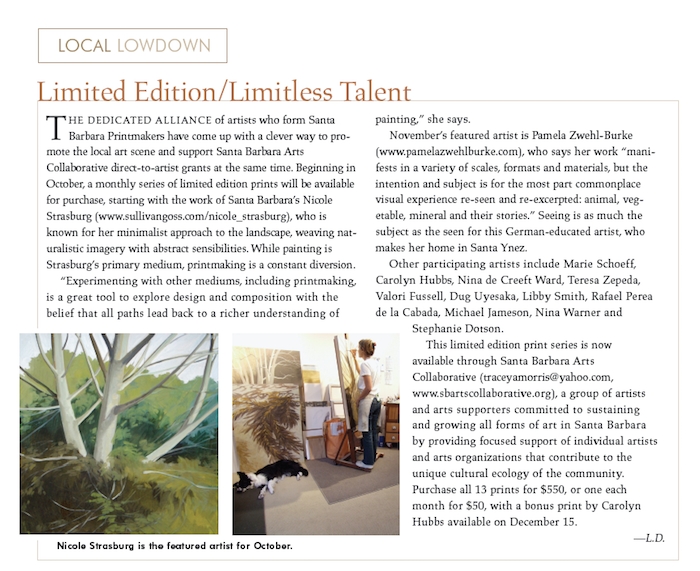
Limited Edition/Limitless Talent

Limited Edition, Limitless Talent. Originally published in Santa Barbara Seasons Magazine Fall 2010.

Limited Edition, Limitless Talent. Originally published in Santa Barbara Seasons Magazine Fall 2010.

THE DEDICATED ALLIANCE of artists who form Santa Barbara Printmakers have come up with a clever way to promote the local art scene and support Santa Barbara Arts Collaborative direct-to-artist grants at the same time. Beginning in October, a monthly series of limited edition prints will be available
for purchase, starting with the work of Santa Barbara’s Nicole Strasburg (www.sullivangoss.com/nicole_strasburg), who is known for her minimalist approach to the landscape, weaving naturalistic imagery with abstract sensibilities.

While painting is Strasburg’s primary medium, printmaking is a constant diversion. “Experimenting with other mediums, including printmaking,
is a great tool to explore design and composition with the belief that all paths lead back to a richer understanding of painting,” she says.

November’s featured artist is Pamela Zwehl-Burke (www.pamelazwehlburke.com), who says her work “manifests in a variety of scales, formats and materials, but the intention and subject is for the most part commonplace visual experience re-seen and re-excerpted: animal, vegetable,
mineral and their stories.” Seeing is as much the subject as the seen for this German-educated artist, who makes her home in Santa Ynez.

Other participating artists include Marie Schoeff, Carolyn Hubbs, Nina de Creeft Ward, Teresa Zepeda, Valori Fussell, Dug Uyesaka, Libby Smith, Rafael Perea
de la Cabada, Michael Jameson, Nina Warner and Stephanie Dotson.

This limited edition print series is now available through Santa Barbara Arts
Collaborative (traceyamorris@yahoo.com, www.sbartscollaborative.org), a group of artists and arts supporters committed to sustaining and growing all forms of art in Santa Barbara by providing focused support of individual artists
and arts organizations that contribute to the unique cultural ecology of the community.

Purchase all 13 prints for $550, or one each month for $50, with a bonus print by Carolyn Hubbs available on December 15.

Originally published in Santa Barbara Seasons Magazine, Fall 2010. Cover photo by Jim Bartsch.

Cover photo by Jim Bartsch.

Originally published in Santa Barbara Seasons Magazine, Fall 2010. Cover photo by Jim Bartsch.

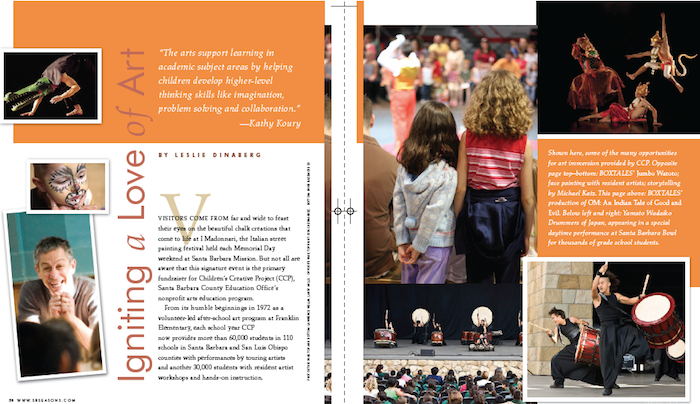
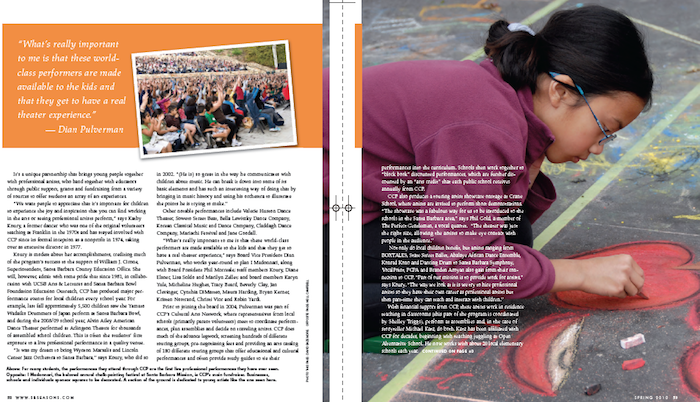
Igniting a Love of Art

Originally published in the spring 2010 issue of Santa Barbara SEASONS magazine.

Originally published in the spring 2010 issue of Santa Barbara SEASONS magazine.

“The arts support learning in academic subject areas by helping children develop higher-level thinking skills like imagination, problem solving and collaboration.”
—Kathy Koury

VISITORS COME FROM far and wide to feast their eyes on the beautiful chalk creations that come to life at I Madonnari, the Italian street painting festival held each Memorial Day
weekend at Santa Barbara Mission. But not all are aware that this signature event is the primary fundraiser for Children’s Creative Project (CCP), Santa Barbara County Education Office’s nonprofit arts education program.

From its humble beginnings in 1972 as a volunteer-led after-school art program at Franklin
Elementary, each school year CCP now provides more than 60,000 students in 110 schools in Santa Barbara and San Luis Obispo counties with performances by touring artists and another 30,000 students with resident artist workshops and hands-on instruction.

Originally published in the spring 2010 issue of Santa Barbara SEASONS magazine.

Originally published in the spring 2010 issue of Santa Barbara SEASONS magazine.

“What’s really important to me is that these world class performers are made available to the kids and that they get to have a real theater experience.”

— Dian Pulverman

It’s a unique partnership that brings young people together with professional artists, who band together with educators through public support, grants and fundraising from a variety of sources to offer students an array of art experiences.

“We want people to appreciate that it’s important for children to experience the joy and inspiration that you can find working in the arts or seeing professional artists perform,” says Kathy Koury, a former dancer who was one of the original volunteers teaching at Franklin in the 1970s and has stayed involved with CCP since its formal inception as a nonprofit in 1974, taking over as executive director in 1977.

Koury is modest about her accomplishments, crediting much of the program’s success to the support of William J. Cirone, Superintendent, Santa Barbara County Education Office. She will, however, admit with some pride that since 1981, in collaboration with UCSB Arts & Lectures and Santa Barbara Bowl Foundation Education Outreach, CCP has produced major performance events for local children every school year. For example, last fall approximately 5,500 children saw the Yamato Wadaiko Drummers of Japan perform at Santa Barbara Bowl, and during the 2008/09 school year, Alvin Ailey American Dance Theater performed at Arlington Theatre for thousands of assembled school children. This is often the students’ first exposure to a live professional performance in a quality venue.

“It was my dream to bring Wynton Marsalis and Lincoln Center Jazz Orchestra to Santa Barbara,” says Koury, who did so in 2002. “(He is) so great in the way he communicates with children about music. He can break it down into some of its basic elements and has such an interesting way of doing that by bringing in music history and using his orchestra to illustrate the points he is trying to make.”

Originally published in the spring 2010 issue of Santa Barbara SEASONS magazine.

Originally published in the spring 2010 issue of Santa Barbara SEASONS magazine.

Other notable performances include Valerie Huston Dance Theater, Soweto Street Beat, Bella Lewitzky Dance Company, Korean Classical Music and Dance Company, Claddagh Dance Company, Mariachi Festival and Jane Goodall.

“What’s really important to me is that these world-class performers are made available to the kids and that they get to have a real theater experience,” says Board Vice President Dian Pulverman, who works year-round to plan I Madonnari, along with Board President Phil Morreale; staff members Koury, Diane Elsner, Lisa Soldo and Marilyn Zellet; and board members Karyn Yule, Micheline Hughes, Tracy Beard, Beverly Clay, Jan Clevinger, Cynthia DiMatteo, Maura Harding, Bryan Kerner, Kristen Nostrand, Christi Vior and Robin Yardi.

Prior to joining the board in 2004, Pulverman was part of CCP’s Cultural Arts Network, where representatives from local schools (primarily parent volunteers) meet to coordinate performances, plan assemblies and decide on traveling artists. CCP does much of the advance legwork, screening hundreds of different touring groups, pre-negotiating fees and providing an arts catalog of 180 different touring groups that offer educational and cultural performances and often provide study guides to tie their performances into the curriculum. Schools then work together to “block book” discounted performances, which are further discounted by an “arts credit” that each public school receives annually from CCP.

CCP also produces a touring artist showcase onstage at Crane School, where artists are invited to perform short demonstrations.

“The showcase was a fabulous way for us to be introduced to the schools in the Santa Barbara area,” says Phil Gold, a member of The Perfect Gentlemen, a vocal quartet. “The theater was just the right size, allowing the artists to make eye contact with people in the audience.”

Not only do local children benefit, but artists ranging from BOXTALES, State Street Ballet, Abalaye African Dance Ensemble, Konrad Kono and Dancing Drum to Santa Barbara Symphony, VocalPoint, PCPA and Branden Aroyan also gain from their connection to CCP.

“Part of our mission is to provide work for artists,” says Koury. “The way we look at it is we try to hire professional artists so they have their own career as professional artists but then part-time they can teach and interact with children.”

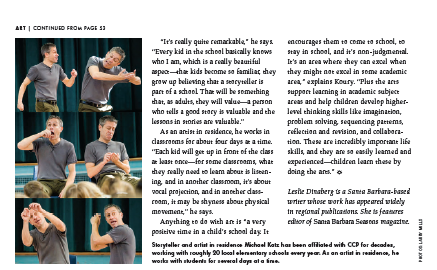
With financial support from CCP, these artists work in residence teaching in classrooms (this part of the program is coordinated by Shelley Triggs), perform at assemblies and, in the case of storyteller Michael Katz, do both. Katz has been affiliated with CCP for decades, beginning with teaching juggling at Open Alternative School. He now works with about 20 local elementary schools each year. “It’s really quite remarkable,” he says. “Every kid in the school basically knows who I am, which is a really beautiful aspect—that kids become so familiar, they grow up believing that a storyteller is part of a school. That will be something that, as adults, they will value—a person who tells a good story is valuable and the lessons in stories are valuable.”

As an artist in residence, he works in classrooms for about four days at a time. “Each kid will get up in front of the class at least once—for some classrooms, what they really need to learn about is listening, and in another classroom, it’s about vocal projection, and in another classroom, it may be shyness about physical movement,” he says.

Anything to do with art is “a very positive time in a child’s school day. It encourages them to come to school, to stay in school, and it’s non-judgmental. It’s an area where they can excel when they might not excel in some academic area,” explains Koury. “Plus the arts
support learning in academic subject areas and help children develop higher level thinking skills like imagination, problem solving, sequencing patterns, reflection and revision, and collaboration. These are incredibly important life skills, and they are so easily learned and
experienced—children learn these by doing the arts.”

Santa Barbara Seasons Spring 2010 coverOriginally published in the spring 2010 issue of Santa Barbara Seasons Magazine.

To read the story as it originally appeared in print click here: Spring 2010 childrens creative project

Leslie Dinaberg Sits Down With Erika Carter

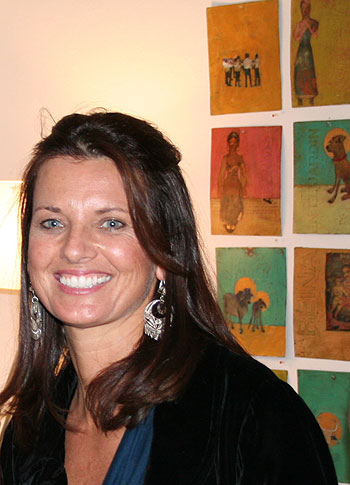
Artist Erika Carter (courtesy photo)

Artist Erika Carter (courtesy photo)

Downtown Santa Barbara’s 1st Thursday events have grown into a popular hive of art, music and wine, and few spots are buzzier than Erika Carter’s Studio 3 East gallery, (http://www.erikacarter.com/) located at 3 East De La Guerra Street above Starbuck’s. Here Carter, a Santa Barbara native, talks with Leslie Dinaberg about living an artful life.

Leslie Dinaberg: What are you working on now?

Erika Carter: It’s a holiday show. It will be the third annual show for Donna Asycough and myself … this one is “Arbol de Vida” which is the “Tree of Life.” … The paintings I do are all retablos; those are the little tin devotional paintings, folk art. …This year I’ll be doing 100 of them.

LD: Wow.

EC: Yeah, I know. It’s a lot of work. Donna and I are both just very passionate about Mexico. We can’t get enough of it.

LD: How do you psych up to do 100 paintings?

EC: It’s insane. I get all the tins out; I prep them all at the same time. Most of them are collage transfers, so I take photographs, transfer them, and do some things. … This is all collage, this is all photo transfer, and then I paint on it too as well, so it’s a mixture. I’ll go and I’ll photograph like crazy and then I’ll come back and start looking at my images, start laying them out and then I get to a point where they all get started. They’ll all be to a point where there will be 100 of them sitting there and I’ll start cranking and it will be 10 hour days.

LD: And do you primarily paint here in the studio?

EC: This is it, so it will be a mess in November. It’s very sad for the artist (Melissa Gill) showing here in November.

LD: There’s something kind of cool about that because most gallery space isn’t studio space.

EC: No. This was originally a studio space, that’s all it was, and for me to survive and have a studio space which of course wasn’t as big as it is now, was to start doing shows to help pay the rent, which has been really great. I would do a show, have a few friends, and hang some artwork for the weekend. Then people started hearing about the gallery space and it grew and now I’m booked through 2009.

LD: Wow. That’s awesome.

EC: Well it’s awesome and it’s not awesome because it’s a lot of responsibility for the next year. It’s a little scary because of economic times. … We break even; no one is getting rich up here, it just pays for itself. When I have my shows I make money. I’m lucky because my stuff sells, but that’s when I make money because I keep my 50 percent. So I try to do two to three shows a year and that kind of pays me, then the rest of the year the shows that we have up pay for the space, and sometimes it does pay more.

LD: Do you also do events? It’s such a cool space.

EC: Yes, we’ve done lots of private birthday parties here and stuff like that, so that’s great. On 1st Thursdays we have a liquor license too, so we sell lots of wine–that helps.

LD: So have 1st Thursdays helped your business?

EC: Yes. I think it’s great exposure. It’s definitely daunting at times because you know how fast three weeks goes by. I’ve got to take down a show, put up a show, it’s really hectic. It gets really crazy. And I just signed up for another year of it.

LD: So you’re obligated to be open.

EC: Yes. We’re open Tuesday through Saturday 12 to 5 and obligated just to the artists that have shows here. They’re all painting right now for their upcoming shows. It’s kind of a scary time. It’s like wow, I hope we sell something.

LD: Maybe people should stop investing in the stock market and buy art.

EC: Well it’s funny; I was just talking to somebody about that. … It is where people should invest. I mean it’s a good investment compared to the stock market.

LD: The pieces are one of a kind.

EC: Yeah, exactly. It exists, it is what it is, and it usually almost always holds its value. And you’re enhancing your living space, or your attic. Whatever.

… (Running the gallery) it’s been great, what I’ve learned is invaluable. Every aspect, working with groups of artists, getting to know all of the artists in Santa Barbara, being part of that. That’s a hard thing to break into.

LD: But you’ve been an artist in Santa Barbara for a really long time.

EC: I have. But it’s really easy for me to just close my doors and sit in front of my canvas and not talk to anybody for weeks. Even though I’ve been painting here forever and ever, it’s very easy to get locked into your own little world and talk to maybe two artists. You know of all the other artists but you’re not really communicating. It’s much different when you actually have created a space and now you can actually show their work. They just come to you and it’s been great. I mean the art I’ve seen and the people, it’s all been really great.

LD: Prior to this did you have a studio somewhere else?

EC: No. I’ve been here almost 20 years. … When I moved in here this was lower State Street. Paseo Nuevo did not exist. When I moved in here everything was shut down around us, everything was boarded up, my rent was $250 and it was that little teeny room over there. … Nicole Strasburg (http://www.nicolestrasburg.com/ ) was in the unit over there and Liz Brady (http://www.lizbradyart.com/ ) was here too, she had my little space and some tattoo artist had been there. When I moved in the room was tattooed, the ceilings and beer cans, it was so hideous.

LD: It’s totally cool now and has a very different feel from most galleries.

EC: That was kind of the point too. I don’t like walking into galleries. I never have. I’ve always felt that they’re too reserved; it’s just a little too snooty or elitist. I don’t have that problem now, but when I was much younger I just felt really intimidated. For a long time I just used to show in coffee shops, which is still great. I still encourage people to do that. Just hang your art wherever you can in this town.

LD: Have you always wanted to be an artist?

EC: No. Isn’t that funny. I never thought I was talented enough to be an artist. I don’t even really call myself that now. It’s kind of a stretch. It’s not a stretch because that’s what people need to title you something, but it’s definitely something you’re always trying to achieve. You’re hopefully always getting better and getting more secure with your work. Some paintings you make and you’re like wow, I did that. I can’t believe I did that it’s amazing and then other stuff you can spend two weeks on something and go holy sh*t I can’t paint. What was I thinking?

Vital Stats: Erika Carter

Born: Santa Barbara (St. Francis Hospital) on October 25, 1962.

Family: Husband Dr. David Dart; son Carter, age 20; five adult stepchildren and their six children.

Civic Involvement: ” I look at it as my civic duty is that I am showing local artists and allowing them to either start their careers or continue them.”

Professional Accomplishments: Artist, owner of Studio 3 East gallery.

Little-Known Fact: “I’m not high energy at all (laughs). A lot of people think that I am. They think that I’ve just got tons of energy and I’m not. I fight for my energy, definitely. I love a good nap in the middle of the day.”

Originally published in Noozhawk in October 2008. Click here to read the story on that site.