

My Gym Diary

© Tadija | Dreamstime Stock Photos & Stock Free Images

© Tadija | Dreamstime Stock Photos & Stock Free Images

The Weight Watchers theory is that writing down what you eat can make you lose weight, so I decided to keep a going-to-the-gym-diary to help me get in better shape. Here is what happened my first seven (non-consecutive) days at the gym.

Day 1- Feel That Credit Card Burn

Like most new endeavors, getting in shape takes motivation, determination, commitment, and cold, hard cash. I want to change my life, so buying the “lifetime gym membership”–where I pay $45 a month for the rest of my life, regardless of whether I ever break a sweat–seems like a really good idea.

I’ll also need new shoes, socks, a gym bag, sweats, a heart rate monitor, water bottle, an iPod and a lifetime subscription to “Ahnold Magazine” to get started on my journey.

No wonder all these people are wiping off their equipment with $20 bills. I guess that’s the price you pay to get in shape.

Day 2 – Just Do It

There’s nothing like new shoes to put a spring in my step. I drive the 12 blocks from my house to the gym, then circle around the lot 17 times before parking 3 blocks away. I’m exhausted before I set foot in the door.

I see some moms I know from school and end up chatting for an hour, while I occasionally look appreciatively at the equipment. If you’re at the gym, does that time count as a workout? I decide that it does and feel a little superior as I leave and notice the same three cars from an hour and a half ago still waiting for parking.

Day 3 – Checking Things Out

I go up to the weight room to look around. The grunting, the cyborg noises and the mirrors all bring back horror movie flashbacks and the armpit-vomit smell reminds me of my college dorm. Maybe I’ll try the cardio machines.

I’m still learning to use the equipment, so I peek over at Skinny Sally’s control panel to see what level and program she’s using on the elliptical machine. Of course I’m not very subtle and almost lose my balance trying to crane my neck for a better view. Must be the traction on my new shoes!

She gives me a dirty, sweaty, scary stare and quickly throws her towel over the lit up panel. Meow! It’s not like I was snooping in her purse, and why is it filled with ex-lax and breath mints?

Day 4 – Not Checking Things Out

I can’t stand it any longer. My bladder’s about to burst like a wicked rhinoceros. I force myself to go into the locker room to pee. As I wash my hands, I try to avoid making eye contact with Skinny Sally, who is completely nude except for her hair dryer, and now friendly as can be.

I sit down on a bench to compose myself.

When I look up, there’s a 95-year-old naked woman, Wrinkled Rhonda, two inches away from my face.

Day 5 – Real Time Versus Gym Time

I keep switching treadmills, but they are all defective. There’s no way I’ve only been working out for 17 minutes. It’s been at least an hour. I try to focus on what I’ll write my column about next week. If I’m thinking about work, can I bill for my time? I would call my accountant, but the gym has gotten very strict about enforcing their no cell phone policy on the gym floor and in the locker rooms–and I don’t have an accountant. Earlier today, Wrinkled Rhonda was naked in the hallway, taking a call from her great great great great grandson.

Day 6 – Power Reading

I have an epiphany. If you read while you’re on the treadmill, the time goes by faster. I should be reading War and Peace for my book club, but Bolkonski and Tolstoy are a lot less compelling than finding out what’s going on with Carmen Electra and Joan Jett.

Is reading the “National Enquirer” at the gym the same as reading it in the grocery store? I’m pretty sure that as long as you read it standing up, then it doesn’t have any calories.

Day 7 — Look Out

I’ve discovered something else about reading at the gym. I can’t read with my glasses and I can’t see other people without them. This is good and bad. My sister still hasn’t forgiven me for not recognizing her the other day. Give me a break. She was pretty sweaty, and very blurry.

On the other hand, if I don’t make eye contact with my high school homecoming date over there on the elliptical machine, maybe he won’t recognize me. Of course I’m twice the woman I was back then–hence the gym membership–so there’s no way he’d recognize me.

I remember from theatre arts that if you’re backstage and you can’t see the audience, they can’t see you either. I wonder if this is how it works at the gym? Maybe I should just take off my glasses when I look at the scale and forget about the gym completely.

Originally appeared in the Santa Barbara Daily Sound March 30, 2007

The Amazing Adventures of Danger Boy and Wimpy Mom

© Kapu | Dreamstime Stock Photos & Stock Free Images

© Kapu | Dreamstime Stock Photos & Stock Free Images

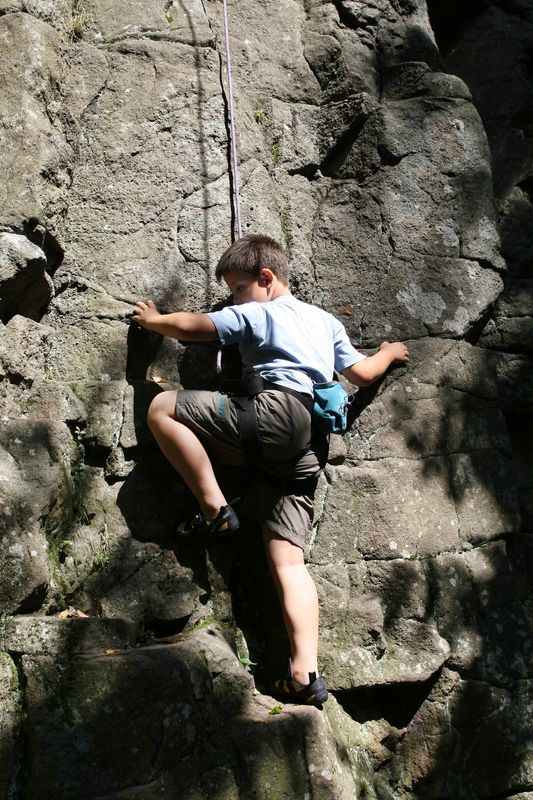
I stared up at Koss in amazement, as he confidently donned his bike helmet and harness to climb Gibraltar Rock. He looked so little, just a wisp of a boy, yet so excited and sure of himself. I couldn’t help but be impressed. Then I looked down at Rattlesnake Canyon 150 feet below, and almost lost my footing–and my lunch.

What kind of nut job mom lets their seven-year-old kid climb a mountain? Yet, there I was, terrified and shaking, watching from the side of the road. My Little Danger Boy was about to try rock climbing for the first time, with only a rope, a helmet and a harness to protect him from harm.

It was all his teacher’s fault. Teacher Danger Boy is an avid rock climber, and he promised the kids he would take them climbing as a belated Christmas gift. Talk about the gift that keeps on giving–grey hairs. Now it was time for him to “pay up on his promise,” and I was a wreck.

Under normal circumstances I wouldn’t have been anywhere near the mountain. It’s been well documented that I’m not exactly the queen of all things daring and dangerous. My fears are completely rational. When I was 16 years old I took a 25-foot spill down a cliff onto the beach, and therefore all cliffs–even biggish sand dunes–are extremely dangerous and should be avoided at all costs.

OK, I was wearing flip-flops and was too busy flirting with the boy I was with to pay attention to my footing, but that doesn’t change the fact that all cliffs–and even biggish sand dunes–are extremely dangerous and should be avoided at all costs.

But see, Big Danger Boy (a.k.a. my husband Zak) was off on a dangerous “mancation” of his own that day, kayaking down boulder-filled rivers, drinking way too much and supervising a bunch of Neanderthals wobbling their way through a testosterone- and alcohol-fueled makeshift firewalk.

Since Zak was unavailable, I had to be there to “supervise” Koss’s rock climbing adventure. I warned his teacher that I would be watching from the side of the road. Unfortunately, Teacher Danger Boy didn’t pick up on the massive waves of “please don’t make me come and watch this” vibes I was sending his way, and said it would be just fine for me to watch from afar. I could have strangled him with my bare hands, but Koss really wanted to go, and his Wimpy Mom just didn’t have the heart to say no.

Clearly I was the one that needed a helmet to protect me from the blow to the head I must have suffered that got me to edge of this cliff (if 20 feet away is still “edge”).

I flashed back to Big Danger Boy’s skydiving adventure a few years back. I spent what should have been a lovely Saturday with my nerves shot, chained to the telephone. I could have killed him when he came back with a house full of pumped-up revelers, complaining of groin pain.

This time there was stomach pain (mine) as I grabbed my camera with one hand and a tree to steady myself with the other. I don’t even like writing about this, it just wigs me out again. If I could have sent him up there with full body armor and a hovering helicopter I would have, but all I could do at that point was cross my white knuckles, fingers, toes, and eyes and watch from afar as Koss climbed up that mountain like it was the most natural thing in the world.

Through the zoom lens of my camera I could see the huge smile on his face when he got to the top. He was so pumped up and proud of himself. For a split second I thought that maybe I wasn’t such a Wimpy Mom after all.

Originally appeared in the Santa Barbara Daily Sound on June 8, 2007

My Destination Vacation

© Dushenina | Dreamstime Stock Photos & Stock Free Images

© Dushenina | Dreamstime Stock Photos & Stock Free Images

While most of Santa Barbara was schussing down the slopes at Mammoth or slathering on the sunscreen in Hawaii, I spent my spring break on a guilt trip, once again. I’m a creature of habit and guilt trips are definitely my vacation destination of choice.

Well, not exactly “choice.”

I’d rather be drinking upside down margaritas in Mexico, or yachting in Europe without a care in the world, but given my current bank account, that wasn’t going to be happening this year–again. Like most other creative types who feel incredibly lucky just to be able to eke out a living without selling their souls, when there’s work to be had, I have to work.

Last week just happened to be one of those weeks. It also just happened to be the first week of Koss’s spring break. Yes, that wasn’t a typo. The FIRST week of his spring break. Apparently the families in our school district worked so hard for the three months after our three-week winter break that they need a two-week spring break to oh, say, ski in Mammoth or sun in Hawaii.

Not that I’m bitter or anything. If I could afford to take FIVE weeks off in the middle of the school year and go somewhere glamorous, I’d do it in a heartbeat. I’m sure if I left out enough bowls of cereal, the kid would be fine.

Instead, I sent my son to camp, where he golfed, bowled, fished, hiked, learned a few swear words, and had a marvelous time. I, of course, felt incredibly guilty.

Despite the fact that I take my son to school every day, spend a ridiculous amount of time volunteering at his school when I should be working, then pick my son up from that same school every single day, have a semi-nutritious snack waiting for him in the car, and am always there after school to help him with his homework, schedule play dates, play handball, and take him to soccer/basketball/baseball/whatever else is in season practice–if I spend even a small part of his school breaks working, I feel guilty. If I spend a large part of those breaks working, I feel really guilty.

And if, as was the case last week, I spend a part of those school breaks actually taking a break for myself, say by putting him in camp all day while I do some writing and then go to the movies, I feel really, really guilty. Especially when my husband surprises me and says he wants to go to the movies one night during the week. Do I admit that I’ve actually already seen everything worth seeing? Then I’ll feel really guilty since he’s the one who’s been working full time while I’m doing full time chauffer/ part time career thing from home, which is actually harder, I know, because I’ve worked full time before when he stayed at home, but I feel guilty saying that because I know he’d switch positions with me in a heartbeat if I’d let him.

It’s a vicious cycle. But I’m comforted to know that I’m not the only woman who was raised on a diet of guilt (though mine was well seasoned with plenty of humor, I should add, so that I won’t feel too guilty when my mother reads this). A recent article in the Washington Post told the story of a woman in Virginia who felt so guilty about leaving her family in the evening that she almost missed out on an interesting lecture–titled “Mommy Guilt.”

Honey, I feel your pain, but I’ve decided to play through it anyway.

Rather than guilt tripping about my need to have a little bit of time to myself–and taking it anyway–I’m going to make friends with my guilt and take it on a few more outings this week. You won’t see us on the slopes, unfortunately, but maybe you’ll see us at the movies.

Originally appeared in the Santa Barbara Daily Sound April 6, 2007

Education 101

Are Santa Barbara Schools Making the Grade?

Education 101, story from Santa Barbara Magazine

Education 101, from Santa Barbara Magazine

Education 101, from Santa Barbara Magazine

For better or worse, the days when parents would simply whisk their children off to the nearest school are long gone. Discussions of “where are you sending your child?” dominate local parks, pediatrician’s offices and preschool playgrounds. While there’s no such thing as a one-size-fits-all approach to education, luckily we have lots of options in Santa Barbara. In general, our schools are getting better too–a concerted effort is underway to narrow the achievement gap between middle- to upper-class and low-income students. “Our schools are improving,” according to experts including longtime local educator Gerrie Fausett, the current superintendent of the Hope School District and former principal of Santa Barbara Junior High and Washington Elementary School on the Mesa. She says that schools are “doing a better job educating our students, and have particularly improved in their work with students that are not meeting academic expectations. The improvements and the dedication to making sure that kids are learning what they need to learn are moving forward.” Continue reading

A passion for philanthropy

New consulting ventures offer nonprofit groups much more than the sum of their parts

BY LESLIE DINABERG

The fabric of Santa Barbara’s intricately embroidered nonprofit community has some new embellishments in its design, as two consulting groups have recently announced their formations: The Crandell Company and Resource Innovators. Continue reading

Take Your Daughters to Work Day

“I know that girls can be anything that they want to be,” said featured speaker Barbara Ibarra Keyani as she shared her moving story of going “beyond her barrio” to UCSB, MIT, becoming a mother of two daughters now in college and her current position with the Santa Barbara School Districts with the 80 girls and 50 women who participated in Girls Incorporated’s annual Take Our Daughters to Work Day on May 24. Continue reading

Mating in the Millennium

Stuart Miles (Freedigitalphotos.net)

Stuart Miles (Freedigitalphotos.net)

The singles scene is changing fast.

Leslie Dinaberg tags along to dig up the dish on blind dating — 21st-century style.

MAN SEEKING WOMAN: Funny guy with killer body and money to burn seeks woman who doesn’t believe everything she reads.

Eye catching ad, isn’t it? It should be. That’s the online dating promo for professional online personal ad writer Evan Marc Katz, founder of e-cyrano.com, just one of the many Web sites for people who are looking for love in all kinds of interesting places. Continue reading

Mixed Messages

Television by Salvatore Vuono (freedigitalphotos.net)

Television by Salvatore Vuono (freedigitalphotos.net)

Be careful — what your kids watch may be hazardous to their health and your wallet.

If TV is “chewing gum for the eyes,” as Architect Frank Lloyd Wright once said, it may be causing more than tooth decay in children — TV may also be making them fat, according to two new studies.

“The more than 1,000 hours that the average school child will spend in front of the television this year will harm him or her far more than the one second of Janet Jackson’s breast,” said TV-Turnoff Network Executive Director Frank Vespe.

The typical child sees about 40,000 ads a year on TV and the majority of ads targeted to kids are for candy, cereal, soda and fast food, a report by the Kaiser Family Foundation found. In addition, many of the ad campaigns enlist children’s favorite TV and movie characters — Spongebob Cheez-Its, Scooby-Doo Cereal, Teletubbies Happy Meals, to name a few — to pitch products.

Apparently the $12 billion per year spent on advertising to youth works. “Commercials make people want to buy things, like Cox high speed internet,” said 4-year-old Sophia Bordofsky.

Indeed, a series of studies examining product choices found that children recalled content from ads they’d seen, and their preference for a product occurred with as little as a single commercial exposure and grew stronger with repeated exposures, found a recent report by the American Psychological Association. The Kaiser study also found that exposure to food advertising affects children’s food choices and requests for products in the supermarket.

While there’s no doubt that advertisers are selling to children, not everyone is buying. Many parents restrict their children’s viewing. “They do have to do their homework first and they have to take turns picking a show,” said Misty Bordofsky, Santa Barbara mother of four children aged 4 to 13. “Usually they’ll leave the room and go do something else if it’s the show another kid picked,” she said.

Numerous parents may limit their children to watching videos and commercial-free television and a rare few don’t let their kids watch TV at all.

“I am appalled by marketing that targets children with ads for junk food and toys. Young children are not able to understand the inherent bias of an advertisement. They are easy targets,” said Charla Bregante, a Goleta mother of two who is in that 2 percent demographic that does not own a television.

“Most of the advertising during children’s programming is for junk food such as candy, chips, and sugared cereals. Kids are given the message that these foods are desirable and nag their parents to buy them. In addition, children tend to snack more while they are watching TV. Turning off the TV is one of the best ways to fight obesity in children. Almost any other activity will use more energy than sitting in front of a television,” said Bregante.

“While older children and adults understand the inherent bias of advertising, younger children do not, and therefore tend to interpret commercial claims and appeals as accurate and truthful information,” said psychologist Dale Kunkel, a professor of communication at UCSB and senior author of the APA report, which recommends restricting ads targeting children under the age of 8.

“I can tell you that my children rarely nag me for a specific toy or food item. I believe this is because they are not exposed to television advertising and the consumer culture promoted in television programming,” said Bregante, who encouraged families to participate in TV-Turnoff Week, April 19-25 (www.tvturnoff.org).

Is there anything positive for kids on television? Yes, according to Professor Kunkel: “There are lots of positive influences that may result from children’s viewing of certain pro-social or educational programs. The problem is that parents have to mine the media landscape pretty hard to find those occasional nuggets.”

Television is an (almost) inescapable part of modern culture. “With the recent explosion in satellite and digital specialty channels, we now have access to a plethora of both good quality and inappropriate TV content. In this crowded television environment, the key for parents is to search out high quality TV programs for their kids, and whenever possible, enjoy them together as a family,” recommends the Media Awareness Network, a nonprofit organization that focuses on media literacy.

For parents who don’t want to opt out completely, David Kleeman, Director of the American Center for Children and Media, recommends that parents ask the following questions to select viewing that is good for children:

Does the program actively engage my child, physically or intellectually? Television watching doesn’t have to be passive. It can prompt questions, kindle curiosity, or teach activities to pursue when the set is off.

Does my child see others like himself or herself on television? Young children believe that television reflects the real world. To not see people like themselves — in race, ethnicity, or physical ability, for example — may diminish their self-worth. A lack of role models should spark discussion about how TV portrays different types of people.

Do I respect this program? Parents don’t have to like every show their children choose — in fact, young people need their own district culture. But parents should trust that a program’s creators understand and respect how children grow and learn.

Originally published in South Coast Beacon

First Time Home Buyers: There’s Nothing Like the First Time

Image by phanlop88 freedigitalimages.net

Image by phanlop88 freedigitalimages.net

Here on the South Coast — where multiple bidders compete to buy $1 million generic tract houses that “need work” — first time homebuyers are definitely in the minority. But a surprising number of working professionals are getting into the market via some very creative configurations, both in terms of financing and sometimes even living situations.

“It’s a lot more complicated than just finding a property,” said Nicole Dinkelacker, a realtor with RE/MAX’s Goleta office who’s been in the business for 20 years. “Anybody with less than ten percent down, it’s very competitive and difficult.”

Difficult, but not impossible.

“You can get 100 percent financing. You have to have beautiful credit, of course, but it isn’t like you have to come up with a huge amount of money, or at least you should talk to a realtor before you decide that,” said Rebekah Mulder, a realtor with Prudential California Realty in Santa Barbara.

A former teacher and principal at Cold Springs School, who got out of education to become a financial planner and real estate agent, Mulder said she still finds a lot of her job involves educating her clients about the tax advantages of investing in real estate, as well as the many creative ways to make buying a house possible in the Santa Barbara market.

One of the unique financing methods she often teaches first-time buyers about is equity sharing, where a parent, an employer or a third party will invest in buying a house in partnership with the person who will live there.

Recently, Steen Hudson (the Director of the Rescue Mission) and his wife Trina entered into an equity share agreement with his employers, said Mulder. “The mission is realizing money on its investment and if the Hudson’s so choose they can steadily buy the mission out. It’s a great way for employers to help out their employees and make an investment as well.”

“Equity sharing is a great investment. You pair up older people who really don’t want to go out and buy an apartment house or something. Most people are unaware that if you own a residential income property, you can depreciate that property. Even if its actually appreciating, the tax code allows you depreciate it, which then shelters that much of your earned income from any taxes at all,” said Mulder. The IRS allows you to treat one physical property as both a residential property and a residential income property (divided proportionately), she explained.

Rather than asking parents or others to “help” with a down payment, Mulder advises approaching it like a business opportunity and will often make the presentation to parents as a neutral party. “We have (37-page) contracts where you negotiate every horrible thing that could happen.”

“Another thing that piggybacks on that is that buying a property with a rental on it is really good option, especially for someone that’s maybe got high income but maybe no money down, said Sharol Mulder, Rebekah’s daughter and business partner.

“A lot of times if we have people with a lot of money down, it’s a better bottom line if they buy a more expensive property with a rental on it. So let’s say they could go buy a $600,000 condo, they could probably buy a $900,000 house with a rental on it and actually come out paying less per month,” said Sharol, who recently made this type of deal with buyers Dave and Eliza Reed and Kate Russell (Eliza’s sister). “They bought a neat old turn of the century Craftsman plus an additional duplex on West Sola. … They rent out the main house for maximum income.”

In addition to financing options, first-time homebuyers often need to be educated on the basics about realtors. “There are a lot of people out there who don’t know how realtors get paid. We’re seeing people walk into open houses and work with the realtor who’s there without a recommendation. … As a buyer you’re not going to pay the realtor’s commission but you really need a good realtor, so you need a good recommendation. … It’s a great benefit to you as a buyer that the seller is going to pay your realtor’s commission but it doesn’t take away the responsibility that you have to find someone who’s really good to represent you,” said Sharol.

Having professional, experienced representation is even more important with the current climate of multiple offers being made for any given listing. “Houses are going really quickly,” said Gloria Herrera, one of Dinkelacker’s clients who recently purchased a home in Carpinteria after making an offer on another. “The whole thing has really been a learning experience.”

There’s nothing like the first time … starting next week, our South Coast Homes section will feature case studies of local first time buyers. We’ll go inside their homes to see what they were able to buy and how they were able to do it.

Originally published in South Coast Beacon

First Time Home Buyers: The American Dream … the South Coast Reality

Google maps photo

Google maps photo

Breaking into the local real estate market is tough but not impossible. Leslie Dinaberg explores who’s buying for the first time and how.

Practicality, frugality and focus were the key values that got Jonathan and Kara Rocque into their first home, at 7126 Del Norte Dr. in Goleta. Both UCSB graduates, the Rocques lived in a one-bedroom apartment and didn’t really upgrade their lifestyle much after college in order to save money for a house.

They started making offers right after they married, about 2-1/2 years ago, but Jonathan said he wasn’t really ready to buy until recently. “People always say ‘get in as soon as you can,’ but … at the same time, I really have no regrets not getting in any sooner because I wasn’t ready.” An engineer, he said he worked for a start-up company and was worried about job stability.

“I think I got to the point where I gained more confidence in myself and that things were going to be okay,” said Jonathan, who now works for Indigo Systems, which recently merged with FLIR Systems.

When he felt really ready to buy, Jonathan had the willing assistance of his father, John Rocque, a realtor and mortgage broker in San Dimas.

Another factor that kept the Rocques from buying quickly was their expectation of what they would be able to afford. “We started thinking that we wanted our dream home out of the shoot, and I think that’s what delayed our purchase, probably,” said Jonathan.

The three-bedroom two and a half-bathroom home the Rocques eventually bought this year for $659,500 has a studio apartment (garage conversion) on the property, a big selling point. “We were looking at these two-bedroom one-bath cottages and went, I just can’t do it. There’s got to be something out there that’s better because it doesn’t leave us the flexibility to grow,” said Jonathan. “When we saw this place with the studio I just thought ‘Oh God, couldn’t be better.’ I could give up the garage and take the extra income that will definitely help.”

Kara noted the backyard had a shed for storage, making it easier for her to give up the garage space. Being able to have a vegetable garden was also important to her, as was the school district. “Basically any school in Goleta, I’m totally comfortable with,” said Kara, who teaches first grade at La Patera.

The Rocques also knew what they didn’t want: no condos and no commuting. “The whole reason we live in Santa Barbara is the lifestyle,” said Jonathan. “I ride my bike. I love the mountains. I love riding by the ocean. I love the weather. I value my time … I’m not going to drive an hour each way to work. I’d go somewhere else where I could live close,” he said.

“I don’t think either one of us ever wants to move into one of the new developments because they’re so crunched together,” added Kara. “Yeah they look pretty, they’re nice and new, but to me this has more character than those houses. You can paint it whatever color you want to paint it; you can do whatever you want with your yard.”

While the Rocques would eventually like to move to a larger house, they are fixing up their yard and treating the house like a home.

“It’s not short term, but it’s not forever,” said Kara.

“This house easily gets us ten years,” said Jonathan. “If we wanted to, at some point we’ll refinance and we could reclaim that space (the studio).”

And as for the realities of being able to afford to stay on the South Coast, they credit much of their success to Patrick Flood, the financial consultant Jonathan began working with when he graduated from college. The Rocques said they feel both blessed and proud to be able to get into the housing market

“I like taking on challenges too. I took a major in college … that was challenging. And staying in Santa Barbara was a big challenge, but I was going to do it. I was really, really happy that we could,” said Jonathan.

Added Kara: “If we can do it here then we can do it anywhere.”

Originally published in South Coast Beacon