
Decisions, Decisions …

Wheat ThinsIt’s the Wheat Thins that get me every time. The anxiety starts as soon I walk down the cracker aisle. Should I go for the low sodium or the reduced fat? The ranch flavor looks good too, but the Harvest Five-Grain Wheat Thins are on sale. What’s the difference between those and the multi-grain kind again?

Before I know it, my head is spinning with visions of calorie and cost calculations and cheese combinations and I’ve spent 17 minutes that I don’t have to spare talking to myself and staring at a shelf full of crackers. What are Chicken in a Biscuits? How do they get them in there?

Am I the only one who has problems making such mundane decisions?

Apparently not.

Decision-making is a source of stress for enough people that you can actually get a degree in Decision Science these days. Evidently Carnegie Mellon University is one of the leading centers in the world for studying decision-making, so I checked out their website to see if they could help me.

No luck. Apparently in order to learn how to make decisions scientifically there are lots of math classes involved, which seems like it would take way too much math. If I could calculate things in my head faster, then I wouldn’t have any problem making simple decisions.

There are some decisions–whether or not to quit a job, have a baby, color your hair, lie about whether you ate that last piece of See’s Candy–that should require a little bit of agonizing over. I’m not talking about those kinds of decisions. But agonizing over what kind of crackers to buy can’t possibly be normal. Right?

I turned to the experts.

Psychiatrist Lynne Tan says it is. “People agonize about the consequences of their decisions. There’s always the fear of getting it wrong.”

“Beware of excessive choice: choice overload can make you question the decisions you make before you even make them, it can set you up for unrealistically high expectations, and it can make you blame yourself for any and all failures. In the long run, this can lead to decision-making paralysis, anxiety, and perpetual stress. And, in a culture that tells us that there is no excuse for falling short of perfection when your options are limitless, too much choice can lead to clinical depression,” according to Barry Schwartz, Ph.D., author of The Paradox of Choice: Why More is Less.

The only time I really feel depressed about having too many choices is when I realize how much time I’ve wasted trying to make a choice that ultimately, won’t really make that much difference. So the Honey Wheat Thins might clash a little bit with the spicy pepper jack cheese. Is that really worth spending another minute of my life thinking about? I think not.

According to Dr. Schwartz’s book, most “good” decisions involve these steps: Figuring out your goal or goals; evaluating the importance of each goal; arraying the options; evaluating how likely each of the options is to meet your goals; and picking the winning option. The easy to remember acronym for this is FEAEP. You then use the FEAEP results modify your goals, the importance you assign them, and the way you evaluate future possibilities.

What the FEAEP? I’m sorry, but the consequence of making decisions using that technique would be that I’d spent my entire life talking to myself while wandering the aisles at the grocery store.

From now I’ve got a new decision-making technique–the Coin Of Destiny (COD, patent pending).

I can’t believe it took me so long to decide on this method. It’s so simple. I should have thought of this years ago. Pick a coin. Don’t spend more than three minutes picking out the right coin. If you’re tempted, close your eyes and pick the first coin you touch. Now it’s time to make your next decision. Flip the coin. If you don’t like the outcome of the flip, take the opposite choice. It’s a nearly foolproof approach.

Oh, and if you don’t have a coin handy, check out www.flipacoin.net, a virtual coin flipping site which offers a choice of 91 different coins from 28 different countries.

Come to think of it, the Eeny Meany Miney Mo Of Destiny (EMMMOD, patent pending) might just be the way to go. I’ll decide later.


Originally appeared in the Santa Barbara Daily Sound

An Interview with Arcelia “Chello” Gladden

Home ownership means the fulfillment of a dream for many, but for Arcelia “Chello” Gladden, buying her first home also gave her an injection of self-confidence.

“I’m so pleased with myself, because I did it on my own. I didn’t have a husband. So I really did this on my own and with all the help of Coastal Housing Partnership (CHP) and my work,” she says. At the time she bought her first home in Lompoc, in 2003, Gladden had been working at Raytheon in Goleta for 29 years and renting the same home in Santa Barbara for 15 years.

Her rental unit was sold and the new landlord raised the rent considerably, which made Gladden think that it might be time for her to become a homeowner.

She went to an employer-sponsored CHP seminar and came away convinced that it was time for her to take the plunge. “I listened to them and they just put a bug in my ear. I just thought to myself, I’ve got to do something. I’m going to end up probably homeless. Because we weren’t getting any raises and my rent was going up, up, up. It was not a good thing,” she says.

Gladden looked around, but she was reluctant to move to Lompoc, even though it was more affordable than Santa Barbara. “I hated the idea, but I needed to invest my money.”

CHP sent her to speak with a loan officer at Santa Barbara Bank and Trust, who helped lead the way. Gladden used her pension money to purchase the four-bedroom home for “a little under $300,000.” Shortly after her first seminar with CHP, Gladden, her recently divorced daughter and grandchildren moved in.

Two years later, in 2005, the house’s value had increased by more than $100,000. Now an enthusiastic believer in real estate investments, Gladden refinanced the house using CHP benefits and used that money to buy a second house in Lompoc that she rents to her daughter.

Gladden has nothing but praise for CHP and frequently urges her colleagues to take advantage of their services. “I found them very, very helpful to me. I wouldn’t have done it without them.”

Originally published in the Coastal Housing Partnership Newsletter

Holiday Letters Bring Ho Ho Ho’s

Image by digitalart, courtesy of freeimages.net

Image by digitalart, courtesy of freeimages.net

I love getting mail during the holiday season. It’s great. Instead of people asking me for money, I get chocolate catalogs, cards that wish me Season’s Greetings, and the reassurance that my college friends are still alive.

While I appreciate the heartfelt sentiments, and the updated pictures of the kids/pets/intestines/etc., there’s nothing more satisfying than opening up a mass-produced holiday letter that is so bad it is actually worth saving. You know the ones that gush with sincere emotions, and use the word “blessings” multiple times. They never let you forget that the writers have a bigger house than you, children with bigger brains and better jump shots than yours, better jobs than yours, and are much, much closer to sainthood than you can ever even dream of aspiring to–never mind the whole “I’m Jewish” thing.

I like to gather with friends to read these brag rags aloud and make fun of the writers. Add a little brandy to the eggnog, and I can feel the holiday spirit wash over me.

Here are some tips to get your holiday missive added to the playbill:

The more pompous the letter the better. “Jenna, our preschooler, is so brilliant she speaks 12 languages and just got an early admission acceptance to Harvard,” “Our his and hers XK Jaguar convertibles look like Barbie cars next to our ridiculously huge house,” and “My sixth wife, Tawny, is an aerobics instructor, brain surgeon, and mechanic who cooks gourmet meals for the homeless in her spare time.”

Even though Fox News totally invented the “war on Christmas,” this may be enough for me to take up arms.

Think of all the stamps you’ll save if your holiday letter can do double duty as Junior’s college application. “It’s no surprise that Ludwig (the football team’s top benchwarmer, mediocre concert pianist, class president, C+ student and all around great guy) was accepted at Stanford, given daddy bought a science lab (can you say, ‘future President of the United States’?).” Can you say future invader of North Korea?

If you can have someone other than yourself write the letter–like your dog or your cat–that’s even better. All those woofs, barks and meows get me extra catty after the third eggnog. If you think those are clever, think of what epistolary holiday gems might come from the “mind” of your pet TV remote control or garbage disposal.

Holiday letters in the form of poems are another party favorite. Especially the ones that are ostensibly written by your three-month old genius, and contain such gems as, “I heard you’ve been naughty, so here’s the scoop… Santa’s running short on coal this year, so you get Baby Poop.” That’s an envelope they’ll be rushing to open.

Even if you don’t have a baby genius/budding Wordsworth at home, having your kids write the annual holiday letter can be lots of fun. Their grammar may not be perfect, but their candor can be quite charming. Just ask our friends who had their house remodeled last year and then let their daughter tell the world what mom really thought of the contractor. I’m sure the backed up plumbing was just a coincidence …

Originally appeared in the Santa Barbara Daily Sound

The thrill is (not quite) gone

hiram-walker-peppermint-schnapps-usa-10094612tI thought my daredevil days were over last week when I looked up at the beautiful snow-covered mountain and didn’t think about skiing or snowboarding down it, but rather looked longingly at the bar and thought, “What a gorgeous spot for me to hang out and have a hot toddy.”
Not that I’ve ever been the queen of all things daring and dangerous, but this year skiing just looked more painful than fun. It was finally time for risky business and I to part ways. We’d had a good run, but now it was time to slow down and enjoy the cocktails. Sure I’d miss that feeling when my heart starts racing faster at the top of a hill, and my hands get a little sweaty and my cheeks a little flushed, but I could live without it. And I’d feel really stupid if I broke my leg skiing.

Goofing around by a warm fireplace looked a lot more fun than goofy-footing it down the side of a mountain. If that means I’m getting old, I can deal with that. Truth be told, I’ve never been a fan of heights or cold, both of which seem important for skiing. I’m kind of glad I don’t have to pretend to enjoy myself through the terror just to earn my spiked hot chocolate anymore. I can skip the chair lift and go straight to the bar, and I’m OK with that.

Not everyone I know is willing to age so gracefully. At his 40th birthday party, a friend announced he had taken up surfing, even though he can barely swim. Another 40ish pal spent the week at a dude ranch, finally getting back on the horse after a few disastrous childhood attempts.

Getting in touch with your inner daredevil isn’t just an aging male phenomenon, either. One of my girlfriends recently went hang gliding for the first time–with her 8 and 10-year-old sons. Talk about taking your life in your hands. What do you do when they start fighting over the songs the birds are singing, or insist that you draw a line down the middle of the sky to keep them equidistantly apart?

Despite the warning signs, and the threat of public mockery in my column, on Thanksgiving my husband decided to take up snowboarding.

Keep in mind that this is the man who has to pop Aleve and Zantac to survive a round of golf. And now he thinks taking up a sport where the only way to stop free-styling down a hill is to free-fall in the snow is a good idea? My brother-in-law, who’s got to be almost 50 by now, also joined Zak on the slopes that day. You’d think he’d be old enough to know better.

Suffice to say that when we counted our Thanksgiving blessings, all night drug stores, extra strength painkillers, and Jacuzzi’s were high on the list. Zak and Brian checked off the “snowboarding” box on their life experiences list, and cursed the idiots who wrote the list.

I still get the need for new challenges, but I don’t really understand the desire to seek out new aches and pains. They seem to find me all by themselves without any invitation at all. But I hated to think that my aching back had completely won out over my daredevil ways. Surely there must be something I could do to prove to myself that I still had it.

A few days later we were off to watch UCSB take on Northwestern in the NCAA soccer playoffs. My father will probably ground me for writing this, but I’ll risk it. Rather than face the Wildcats unarmed in the cold November air, my sister and I snuck a bottle of Peppermint Schnapps in my purse to help fight them off. Sorry Dad, but it was really cold!

My heart started racing faster when the campus security guard asked if he could check my purse on the way in. My hands got a little sweaty and my cheeks a little flushed. So I did what any self-respecting, outlaw mom would do. I pretended I couldn’t hear him and kept on walking.

Maybe the thrill isn’t gone after all.

Originally published in the Santa Barbara Daily Sound.

An Interview with Jonathan and Kathy Abad

The third time may be the charm for most people, but Jonathan and Kathy Abad had to go through eight unclosed escrows on different houses in order to finally buy their home in Goleta last year with the help of Coastal Housing Partnership (CHP).

Unlike many first-time homebuyers, the Abads had some real estate experience when they came to CHP for assistance, having purchased, upgraded and sold several mobile homes in the area while building up equity to buy a house of their own.

Since 1987, we would move just about every two years to maximize our profits, explained Kathy, who works for Hispanic Business Inc. Once they felt they had built up enough capital, they looked at homes for about a year and a half before finally purchasing their home.

“We basically wanted the biggest amount of property for our buck,” said Kathy. Plus, as parents of two young children, they wanted at least three bedrooms, plus a den to use as a home office.

“We saved a good 12 grand (working with CHP),” said Jonathan. The Abads worked with realtor Kristiann Wightman, (who owns Presidio Properties, a Homebuyers Assistance Program Participating Organization, which offers buyers back 40% of the broker commission) and though they didn’t get a mortgage loan through CHP, they got a discounted loan from a friend who matched the price of CHP’s discount.

In addition to the cost savings from CHP, the Abads were impressed with the educational services offered.

“If we would have known about them five years earlier, it would have really helped us out to learn faster than we would have on our own,” said Jonathan, who works for the Housing Authority of the City of Santa Barbara. “They are there to really answer your questions and you’re not learning from a specific realtor that has a vested interest …you are getting a lot of point of views from people at these kind of workshops.”

He added, “I wish I knew about this six, seven years ago when we started doing this. It would have saved us so much work.”

Originally published in the Coastal Housing Partnership Newsletter

An Interview with Scott and Sheri Martin

When Scott and Sheri Martin looked to buy their first home, using Coastal Housing Partnership (CHP) made the difference between being able to buy “something” and buying a house they really wanted, without compromising.

Both Scott and Sheri grew up in Santa Barbara — attending San Marcos High School, Santa Barbara City College, and UCSB — all the while watching real estate prices skyrocket over the years.

“Even for two professionals that were making good salaries in Santa Barbara, it’s still a daunting task to get into a home,” said Scott, a Strategic Business Consultant.

They pondered their options for a couple of years before Sheri, a first grade teacher at Adams School, went on the CHP website (www.coastalhousing.org) to research mortgage lenders.

One of their first calls was to Christine Errea, at Chase Home Finance, a CHP discount provider that offers back 100% of the processing fee, credit report fee and 1/8% of the interest rate on first mortgages.

“The people on the network are fantastic,” said Scott, giving high praise to both Errea and real estate agent Kristiann Wightman, who owns Presidio Properties, another Homebuyers Assistance Program Participating Organization, which offers buyers back 40% of the broker commission.

With the combined discounts from Chase and Presidio, the Martins were able to purchase a three-bedroom, two-bathroom home in Solvang, which includes an unobstructed view of the entire valley from their backyard.

“We were able to find the place we really wanted to get into, and it was made possible. That’s the thing that CHP really did for us,” said Scott. “We didn’t have to make compromises and that’s what we were honestly, very concerned about for a long time.”

In addition to singing the praises of CHP to their colleagues, the Martins also want to let employers know what a great benefit CHP membership is.

Citing the common complaint of high employee turnover in Santa Barbara County, Scott said, “… If it helps them maintain their employee base and deepen their bench, it’s not just good for the homebuyer, it’s good for the employer too.”

Originally published in the Coastal Housing Partnership Newsletter

Embracing the joys of laziness

The Joy of LazinessPreparing to embark on a week of holiday leisure, I inventoried my reading material and came across the book I’ve been waiting for my whole life. It’s called The Joy of Laziness. The early bird may get the worm, but late sleepers live longer, according to this wonderful book by German Scientists Peter Axt and Michaela Axt-Gadermann.

You hear that, mom–and every single boss who has dared to give me the stink eye when I stumbled in a few minutes late because I needed that triple latte more than I needed to be on time–late sleepers live longer!

According to The Joy of Laziness, everybody has a limited amount of life energy at his or her disposal. The speed with which this energy is consumed determines your life span. Every day we encounter countless demands on our energy, such as stress, hurry, frustration, cold, sleep deprivation, poor nutrition and an inappropriate fitness regimen. A lifestyle that uses a lot of energy accelerates the aging process, makes you more susceptible to illness, and can even shorten your life.

In other words, laziness rocks! And I’m not the only one who thinks so. I’ve got German scientists behind me on this.

My theory is that the only reason we don’t embrace our laziness more openly–and less guiltily–is those darn pilgrims. All that nonsense about every hour needing to be spent productively and idle hands being the devil’s workshop is just that: nonsense.

Most men I know already embrace the laziness rocks theory. They don’t even notice the dust bunnies hopping off the sofa as they plop themselves on to it. And it would never occur to them to wash the dishes immediately after a meal, or fold clothes as soon as they come out of the laundry. They may be on to something there.

The women I know, on the other hand, have an almost impossible time relaxing just for the heck of it. They join book clubs, so they’ll have some justification to read for pleasure, and get dogs, so they’ll have an excuse to walk on the beach.

My friend Suzanne, who is a stay at home mom, says that she feels guilty for playing with her kids unless her house is perfectly spotless.

“You’re a stay at home MOM, not a stay at home MAID,” I reminded her. Her perfectly clean house always leaves me with a sense of wonder. That is, I wonder how much happier she would be if she stopped cleaning and took the time to read People Magazine, watch Grey’s Anatomy and play computer games like I do.

Nonessential household duties have no hold on me. I hate to do things like wash dishes and make beds when I know that the next day there’ll just be more dirty dishes and more unmade beds. Doing the same housework over and over again makes me feel like a hamster on a wheel to nowhere. Look, it’s a sink full of dishes. Look, it’s a sink full of dishes again! Ooh, look, the dishes are here again!

Sure it’s wonderful to have a clean house and a home cooked meal, but I would much rather write a few more stories and pay someone else to provide those things for me. Especially since the domestic arts are not exactly where my talents lie.

I’ll confess, the worst grade I ever got in high school, I kid you not, was in home economics.

Admitting I’m not a domestic goddess takes a lot of the pressure off, especially this time of the year. One of the great advantages of not cooking–or not cooking well–is you get to be the one who brings wine and cheese and crackers to Thanksgiving dinner.

In addition to not having to ruin my makeup while slaving over a hot stove, there are actually intellectual advantages to idleness. According to the book How to Be Idle by Tom Hodgkinson, Einstein launched his theory of relativity by wondering what it would be like to ride on a sunbeam; Newton discovered gravity while sitting in an orchard; and the Harry Potter character popped into J.K. Rowling’s mind as she was gazing out a train window.

I’ll be counting my blessings that a few more people have figured out that laziness rocks, and also makes you healthier, smarter and more creative. And by the way, have you read the latest positive news about dark chocolate and red wine? We’ve got a lot to be grateful for this Thanksgiving–except for those stupid Pilgrims.

Originally published in the Santa Barbara Daily Sound.

Oops She’s Single Again

Britney Spears, courtesy Wikipedia.

Britney Spears, courtesy Wikipedia.

Britney Spears and the people of Connecticut both voted Independent this week.

But Britney captured my interest in a way that Senator Joe Lieberman never could, even if he is a nice Jewish boy.

Sure they’ll both have plenty of party invitations, but I’m more concerned for her. A recent study found that if you’re a woman, divorce is bad for your health.

Granted, dumping an unemployed, 28-year-old father of two babies who spends more time changing hairstyles than changing diapers is probably not the biggest “Oops!” in the world for Britney–that would have been hooking up with the loser in the first place. K-Fed? A cross between K-M art and Federated? Classy written all over that guy.

At first glance, both divorce stories made me laugh out loud. “Britney Spears has filed for divorce from her husband Kevin Federline, citing irreconcilable differences, like Britney is the only one with a career.” And “Stand by your man or get sick, study says.”

What a load of hooey, I thought, thinking of how many women I knew who were far better off once they’d lost a couple hundred pounds of husband. Maybe Britney can get back together with Justin Timberlake. They were so cute on the Mickey Mouse Club.

As I pictured them spawning a whole chorus line of belly-baring, head-popping, break-dancing babies, I couldn’t help wondering about that other story. The one about real women getting divorced, without a record deal and a few hundred servants to keep them warm at night.

Conducted over a ten-year period at Iowa State University, the study found that women who were divorced were not just husband-less, they also had less income, less help around the house, and less–and sometimes no–health insurance.

“What we found was that the act of getting a divorce produced no immediate effects on [physical] health, but it did have effects on mental health,” said co-author Fred Lorenz. “Ten years later, those effects on mental health led to effects in physical health.”

Now granted, these women all lived in Iowa, which has got to be the most depressing, schizophrenic place on earth. How would you like to be wined and dined and complimented and courted like crazy by presidential hopefuls once every four years, and then completely ignored until someone had a craving for potatoes? I wouldn’t be surprised if the whole state eventually developed some mental health issues. Maybe the divorced women are just a bit more precocious.

And it’s not like any of those Hawkeyes–who probably kept the house but lost their season tickets in the divorce settlement–had Britney’s $38 million bucks to help mend their broken hearts. When they were interviewed a decade later, the divorced women reported 37 percent more sickness than the married ones. Do they not have match.com in Iowa? Or are they putting something funny in the Happy Hour Cosmopolitans in Des Moines?

Personally, I think Britney and those women from Iowa ought to get together for a few cocktails. I’ve always found that the best cure for any kind of man trouble is a night out with the girls.

Even us happily married people (gotta throw hubby a bone here) need a girls’ night out every once in a while. And while Lieberman can probably count on plenty of new friends when he returns to the Senate, we’ll still save him a seat at our table.

Originally published in the Santa Barbara Daily Sound.

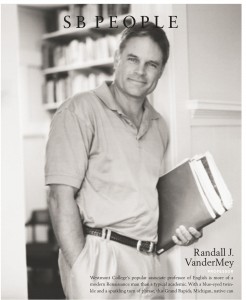
SB People: Randall J. VanderMey

Randall Vandermey in Santa Barbara Magazine

Randall Vandermey in Santa Barbara Magazine

Westmont College‘s popular English professor is more of a modern Renaissance man than a typical academic. With a blue-eyed twinkle and a sparkling turn of phrase, this Grand Rapids, Michigan, native who’s been at Westmont since 1990 can engage you in intellectual conversations about art, poetry and religion as fluidly and captivatingly as he can turn the dialogue toward the joys of getting down on the floor to play blocks with his 2-year-old granddaughter, Jasmine Marie.

Despite his many literary accomplishments–he’s written eight books, published short fiction, nonfiction and poetry, and produced three plays–VanderMey is really a teacher at heart, who describes the Christian liberal arts college as having “an atmosphere that’s really quite filled with trust and joy.”

It wasn’t always that way. “When I came to Westmont 16 years ago, I would say that, at best, the spiritual climate was sketchy,” says VanderMey, who credits the leadership of former President Stan Gaede (who left in 2005) for much of the turnaround.

These days, “People’s politics differ and religiously differ, maybe academic politics differ. But still my colleagues are people I could have lunch with, talk with, respect.”

A highlight of VanderMey’s professional and personal life was escorting 43 students through a semester in Europe in 2003, where they spent four months traveling through 23 cities in 12 countries. One of the best parts of the trip was spending a week each in four different religious communities: the abbey on the Isle of Iona in Scotland, where Celtic monks are believed to have produced the Book of Kells, a marvelous example of medieval illumination; Woodbrooke Quaker Study Centre in the United Kingdom; a Catholic monastery in Teze, France; and the Schloss Mittersill Study Centre in Austria, which VanderMey describes as a castle housing a Protestant evangelical community.

As a professor, VanderMey prizes and encourages independent thought. “I guess I have a model in my mind of what kind of student I want to produce–a student who’s a little bit contrary. They should be willing to stand up for themselves against what they read, not to be hostile to it, but to think for themselves,” says VanderMey. This idea, he acknowledges, “might surprise people who think of a Christian college as a place where students are taught to think in lock step. But that’s not how Westmont is and that’s not how I am at Westmont. I want to make them better critical thinkers and open-minded. I mean, if the Christian faith can’t stand up to critical thinking, why embrace it?”

That critical examination of faith is a recurring theme in VanderMey’s work. “I’m writing out of my core convictions, which is why things germinate for 10 years before I write them,” he says, over lattes at downtown’s Finestra cafe. While certainly heartfelt, his work is also a bit irreverent. For example, his 1993 book, God Talk, is a critical look at “the triteness and truth in Christian cliches,” taking on routine phrases such as, “God wants you to succeed,” “Act of God,” and “There must be a reason,” and examining what people really mean when they use them. Writes VanderMey: “The habit of using stock phrases can sometimes be not only a symptom, but also a cause of spiritual paralysis.”

Language, both spiritual and otherwise, is a topic close to VanderMey’s heart. He’s the author of The College Writer: A Guide to Thinking, Writing and Researching, which is now in its second edition. And locals may know VanderMey’s work from the 2004 production Kenosis, a theatrical staging of his spiritual poetry set to contemporary music, which played at the Center Stage Theater. He has also taught poetry writing classes (partnering with Peri Longo) at Hospice of Santa Barbara and is currently at work on another textbook, with the working title of The Contrary Reader.

He writes and teaches with the same zest for life he embraces with his family. VanderMey–who loves golfing and bowling–is an enthusiastic grandpa and 54-year-old father and stepfather to four grown children (Gabrielle VanderMey, Julia and Jason Clark, and Mike Sakkers), as well as the self-proclaimed “biggest fan” of his wife Dana VanderMey, who is the supervisor of volunteers for Hospice of Santa Barbara.

There’s never a dull moment at home, says VanderMey, whose daughter Gabrielle and stepdaughter Julia were both married in Santa Barbara this summer, coincidentally to two young men named Matt.

VanderMey, who once considered writing a book about marriage communication, chuckles at what kind of advice he might offer the newlyweds. An editor discouraged him from writing the book, asking why– with so many experts–they would want a marriage book from him.

There’s that twinkle in VanderMey’s eyes again. “I’m thinking about making it a humor book,” he says. “My wife (who can sometimes be found doing stand up comedy at Soho) is a very funny lady.”

Originally published in Santa Barbara Magazine

SB Magazine story on Randall Vandermey

Aliens among us

Captain_Underpants_Talking_ToiletsOnce upon a time I imagined raising my child in an exquisitely gender-neutral environment. None of this pink for girls, blue for boys stuff. I was sure I would raise a boy exactly the same way I would have raised a girl.

Then I actually had a child.

As the epidural wore off, reality kicked in. I had joined the MOB. I was the Mother Of a Boy. Nature, nurture, schmurture. I quickly discovered how little it mattered what I did.

Koss took about five minutes to decide he liked his stuffed football better than his teddy bear and another three to decide that peeing in my face was hysterically funny.

The fart jokes started about ten minutes after that, and seven years later, I’m still holding my breath.

He had his own little alien personality from the very beginning.

I had pictured us cuddled under a bright yellow comforter, sharing my favorite books from childhood. Nancy Drew, Little House on the Prairie, Are You There God, It’s Me Margaret?…yeah, right. Our bedtime reading was filled with Dinosaur stats and Pokemon facts. His boy-brain was so hungry for straight information, I felt lucky if our story time involved any story narratives at all.

If there’s one thing I’ve learned since I joined the MOB, it’s that boys are actually alien beings. Their brains work differently than ours do. Apparently anything that moves fast is cool; anything that moves fast and is somehow gross is super cool; and anything that moves fast, is gross, and remotely resembles a snort, a burp, or a fart is super duper cool.

Oh, and there is nothing funnier than laughing until milk spurts out of your nose–and if it’s chocolate milk, it’s even funnier. And if you can somehow turn spurting chocolate milk out of your nose into a competitive sport with Olympic or Guinness Book potential, then half the world’s population would forever be in your debt.

This is not just a MOB observation, it’s scientific fact.

It is actually embedded in our DNA that when we go on vacation, I’m the only one who remembers to pack our suitcases with extra sweatshirts, toilet paper, snacks, books, light bulbs, sunscreen, magazines and the directions to our hotel, while my husband, Zak, is the only one who can figure out how to fit all that stuff in the trunk of our car.

And if for some reason Zak can’t get everything to fit, Koss is right there telling him how to do it.

Just like his father, Koss loves information. And just like his father, if he doesn’t know the right information, he’ll make something up.

We call it “Male Answer Syndrome” in our house.

My mom used to call it “Diarrhea of the Mouth,” which Koss finds hysterically funny.

Now that I’ve had seven years experience in the MOB, I guess I shouldn’t really be surprised to find that Koss would rather read the Encyclopedia of Spiders than Charlotte’s Web. If somebody wrote Captain Underpants and Attack of the Farting, Spitting and Barfing Spiders, Koss would really be in heaven.

So I guess I shouldn’t be surprised that the potty humor genre has become so popular. Books with titles like The Day My Butt Went Psycho, Captain Underpants and the Wrath of the Wicked Wedgie Woman, and Zombie Butts From Uranus! are somehow more attractive to boys than The Trumpet of the Swan, The Wind and the Willows, and From the Mixed up Files of Mrs. Basil E. Frankweiler.

“Well duh, mom, those don’t sound very funny,” MANswers my seven-year-old son.

“Captain Underpants is totally funny,” MANswers my 41-year-old husband. “Want to smell something gross?” asks Zak, targeting a gigantic fart in our direction and immediately sending our son into peals of laughter.

Like I said, they’re alien beings.

Originally published in the Santa Barbara Daily Sound.