The Katherine Harvey Fellows Program

There is no doubt that Santa Barbara has a robust philanthropic community. Last year the National Center for Charitable Statistics reported 1,891 registered nonprofits in the county and more than $2 billion in revenue. But there is also no doubt that these organizations are getting a bit, ahem, gray around the temples.

So how do you ignite young do-gooders in a community where the high cost of housing and the low availability of well-paying jobs make it struggle for many to take care of their own needs, let alone the needs of others? Where will the next generation of charitable leaders come from?

The Santa Barbara Foundation is planting the seeds for future boards with the Katherine Harvey Fellows program, designed to cultivate philanthropic leaders for the community. With graduates like Santa Barbara City Councilwoman Helene Schneider, the Santa Barbara Bowl Foundation’s Scott Brittingham, and the Community Environmental Council’s Sigrid Wright already making their marks around town, the program, established in 1999, is already having an impact.

Funded by the late Katherine Harvey, a former Santa Barbara Foundation trustee, the invitation only fellowship program provides a forum for a select group of young professionals to explore ways to make a significant, lasting impact in the community.

The class of 2006/07–Katya Armistead, Magda Arroyo, Greg Bartholomew, Christine Brooks, Jeff Forster, Geoff Green, Colette Hadley, Nina Johnson, Vincent Martinez, Rachael Steidl, Michael Takahara, and Travis Wilson–began their 18-month journey last year by participating in all aspects of the work of the Santa Barbara Foundation, including agency research, community relations and fundraising.

Class members take turns chairing and organizing the monthly meetings, gaining valuable experience in keeping the lively group on task. Members of the board of trustees also serve as mentors to the “Fellows,” offering leadership, insight, and access on a personal level.

Steidl, founder of SBParent.com and a board member for the Teddy Bear Cancer Foundation, praised her mentor, County Superintendent of Schools Bill Cirone. “They matched me with someone who was a great fit for my business and a great link for my personal interests as well.”

In addition to partnering with board members and sitting in on the foundation’s grant making committees, the “Fellows” also work closely together.

In addition to meeting monthly, they do personal interviews within the group to help develop one-on-one skills, as well as public speaking skills, when they present their interviewees to the group.

“The most valuable aspect of this experience has been meeting people from sectors other than education and sharing with them the passion of philanthropy and making a difference,” says Armistead, a Red Cross board member who runs UCSB’s Visitor Center and is Assistant Director for the Office of Admissions.

After the first year, the education portion of the program winds down a bit and the “Fellows” get to create, implement, and evaluate some grants of their own.

The foundation allocates $30,000 for this purpose, but like the “Fellows” before them, this class has decided to raise additional funds to give away. At press time they had already secured $5,000 in challenge grant funds from the Hutton Foundation and were working on appeal letters to raise even more.

Following a spirited debate about where to give the money, foundation board member and former “Fellow” Ken Saxon offered, “This discussion … is the meat of this program. …(The foundation) could have set up a process about how you make these decisions. We’ve chosen not to, and have decided to let each class struggle with this. It’s hard, it’s frustrating, it’s cool, it’s creative, but it’s not easy.”

“It’s amazing to have put all of these strangers in a room almost a year ago and to see how comfortable everyone has gotten with each other and the dialogue that now takes place with the group,” says Steidl, adding that her fellowship experience has already helped her professionalize her charity work.

“I know that I am now a better board member because of the experience,” says Armistead, who along with her colleagues–who range in age from 27 to 42–are becoming just the kind of young philanthropists that Katherine Harvey had envisioned.

==

To donate or request more information about the Katherine Harvey Fellows program, contact the Santa Barbara Foundation, 1111 Chapala St.., Santa Barbara, CA 93101, 805/963-1873.
Originally published in Coastal Woman

An Interview with Arcelia “Chello” Gladden

Home ownership means the fulfillment of a dream for many, but for Arcelia “Chello” Gladden, buying her first home also gave her an injection of self-confidence.

“I’m so pleased with myself, because I did it on my own. I didn’t have a husband. So I really did this on my own and with all the help of Coastal Housing Partnership (CHP) and my work,” she says. At the time she bought her first home in Lompoc, in 2003, Gladden had been working at Raytheon in Goleta for 29 years and renting the same home in Santa Barbara for 15 years.

Her rental unit was sold and the new landlord raised the rent considerably, which made Gladden think that it might be time for her to become a homeowner.

She went to an employer-sponsored CHP seminar and came away convinced that it was time for her to take the plunge. “I listened to them and they just put a bug in my ear. I just thought to myself, I’ve got to do something. I’m going to end up probably homeless. Because we weren’t getting any raises and my rent was going up, up, up. It was not a good thing,” she says.

Gladden looked around, but she was reluctant to move to Lompoc, even though it was more affordable than Santa Barbara. “I hated the idea, but I needed to invest my money.”

CHP sent her to speak with a loan officer at Santa Barbara Bank and Trust, who helped lead the way. Gladden used her pension money to purchase the four-bedroom home for “a little under $300,000.” Shortly after her first seminar with CHP, Gladden, her recently divorced daughter and grandchildren moved in.

Two years later, in 2005, the house’s value had increased by more than $100,000. Now an enthusiastic believer in real estate investments, Gladden refinanced the house using CHP benefits and used that money to buy a second house in Lompoc that she rents to her daughter.

Gladden has nothing but praise for CHP and frequently urges her colleagues to take advantage of their services. “I found them very, very helpful to me. I wouldn’t have done it without them.”

Originally published in the Coastal Housing Partnership Newsletter

An Interview with Jonathan and Kathy Abad

The third time may be the charm for most people, but Jonathan and Kathy Abad had to go through eight unclosed escrows on different houses in order to finally buy their home in Goleta last year with the help of Coastal Housing Partnership (CHP).

Unlike many first-time homebuyers, the Abads had some real estate experience when they came to CHP for assistance, having purchased, upgraded and sold several mobile homes in the area while building up equity to buy a house of their own.

Since 1987, we would move just about every two years to maximize our profits, explained Kathy, who works for Hispanic Business Inc. Once they felt they had built up enough capital, they looked at homes for about a year and a half before finally purchasing their home.

“We basically wanted the biggest amount of property for our buck,” said Kathy. Plus, as parents of two young children, they wanted at least three bedrooms, plus a den to use as a home office.

“We saved a good 12 grand (working with CHP),” said Jonathan. The Abads worked with realtor Kristiann Wightman, (who owns Presidio Properties, a Homebuyers Assistance Program Participating Organization, which offers buyers back 40% of the broker commission) and though they didn’t get a mortgage loan through CHP, they got a discounted loan from a friend who matched the price of CHP’s discount.

In addition to the cost savings from CHP, the Abads were impressed with the educational services offered.

“If we would have known about them five years earlier, it would have really helped us out to learn faster than we would have on our own,” said Jonathan, who works for the Housing Authority of the City of Santa Barbara. “They are there to really answer your questions and you’re not learning from a specific realtor that has a vested interest …you are getting a lot of point of views from people at these kind of workshops.”

He added, “I wish I knew about this six, seven years ago when we started doing this. It would have saved us so much work.”

Originally published in the Coastal Housing Partnership Newsletter

SB People: Randall J. VanderMey

Randall Vandermey in Santa Barbara Magazine

Randall Vandermey in Santa Barbara Magazine

Westmont College‘s popular English professor is more of a modern Renaissance man than a typical academic. With a blue-eyed twinkle and a sparkling turn of phrase, this Grand Rapids, Michigan, native who’s been at Westmont since 1990 can engage you in intellectual conversations about art, poetry and religion as fluidly and captivatingly as he can turn the dialogue toward the joys of getting down on the floor to play blocks with his 2-year-old granddaughter, Jasmine Marie.

Despite his many literary accomplishments–he’s written eight books, published short fiction, nonfiction and poetry, and produced three plays–VanderMey is really a teacher at heart, who describes the Christian liberal arts college as having “an atmosphere that’s really quite filled with trust and joy.”

It wasn’t always that way. “When I came to Westmont 16 years ago, I would say that, at best, the spiritual climate was sketchy,” says VanderMey, who credits the leadership of former President Stan Gaede (who left in 2005) for much of the turnaround.

These days, “People’s politics differ and religiously differ, maybe academic politics differ. But still my colleagues are people I could have lunch with, talk with, respect.”

A highlight of VanderMey’s professional and personal life was escorting 43 students through a semester in Europe in 2003, where they spent four months traveling through 23 cities in 12 countries. One of the best parts of the trip was spending a week each in four different religious communities: the abbey on the Isle of Iona in Scotland, where Celtic monks are believed to have produced the Book of Kells, a marvelous example of medieval illumination; Woodbrooke Quaker Study Centre in the United Kingdom; a Catholic monastery in Teze, France; and the Schloss Mittersill Study Centre in Austria, which VanderMey describes as a castle housing a Protestant evangelical community.

As a professor, VanderMey prizes and encourages independent thought. “I guess I have a model in my mind of what kind of student I want to produce–a student who’s a little bit contrary. They should be willing to stand up for themselves against what they read, not to be hostile to it, but to think for themselves,” says VanderMey. This idea, he acknowledges, “might surprise people who think of a Christian college as a place where students are taught to think in lock step. But that’s not how Westmont is and that’s not how I am at Westmont. I want to make them better critical thinkers and open-minded. I mean, if the Christian faith can’t stand up to critical thinking, why embrace it?”

That critical examination of faith is a recurring theme in VanderMey’s work. “I’m writing out of my core convictions, which is why things germinate for 10 years before I write them,” he says, over lattes at downtown’s Finestra cafe. While certainly heartfelt, his work is also a bit irreverent. For example, his 1993 book, God Talk, is a critical look at “the triteness and truth in Christian cliches,” taking on routine phrases such as, “God wants you to succeed,” “Act of God,” and “There must be a reason,” and examining what people really mean when they use them. Writes VanderMey: “The habit of using stock phrases can sometimes be not only a symptom, but also a cause of spiritual paralysis.”

Language, both spiritual and otherwise, is a topic close to VanderMey’s heart. He’s the author of The College Writer: A Guide to Thinking, Writing and Researching, which is now in its second edition. And locals may know VanderMey’s work from the 2004 production Kenosis, a theatrical staging of his spiritual poetry set to contemporary music, which played at the Center Stage Theater. He has also taught poetry writing classes (partnering with Peri Longo) at Hospice of Santa Barbara and is currently at work on another textbook, with the working title of The Contrary Reader.

He writes and teaches with the same zest for life he embraces with his family. VanderMey–who loves golfing and bowling–is an enthusiastic grandpa and 54-year-old father and stepfather to four grown children (Gabrielle VanderMey, Julia and Jason Clark, and Mike Sakkers), as well as the self-proclaimed “biggest fan” of his wife Dana VanderMey, who is the supervisor of volunteers for Hospice of Santa Barbara.

There’s never a dull moment at home, says VanderMey, whose daughter Gabrielle and stepdaughter Julia were both married in Santa Barbara this summer, coincidentally to two young men named Matt.

VanderMey, who once considered writing a book about marriage communication, chuckles at what kind of advice he might offer the newlyweds. An editor discouraged him from writing the book, asking why– with so many experts–they would want a marriage book from him.

There’s that twinkle in VanderMey’s eyes again. “I’m thinking about making it a humor book,” he says. “My wife (who can sometimes be found doing stand up comedy at Soho) is a very funny lady.”

Originally published in Santa Barbara Magazine

SB Magazine story on Randall Vandermey

Can the Homeless and the Business Community Coexist?

An update on some of the latest efforts

California conjures images of endless summers filled with surf, sun and sand, but increasingly, those beach bum images of the past are being replaced by those of an entirely differently type of bum: aggressive panhandlers. After all, if you had to spend the winter on the streets, wouldn’t you rather be in San Diego than Detroit? While the attractiveness of the state’s mild weather is understandable, it comes at a high cost. Panhandling can have significant negative economic impacts on the surrounding businesses. Here’s a brief look at what some communities are doing to combat the problem.

Many cities are using legislation to crack down on homeless persons living in public spaces. According to the latest U.S. Conference of Mayors Hunger and Homelessness report, despite an overall increase in unmet needs for emergency shelter, there has been an increase in criminalization of the homeless between an initial survey in 2002 and a 2005 survey of 224 American cities. For example, the survey found a 12 percent increase in laws prohibiting begging in certain public places and an 18 percent increase in laws that prohibit aggressive panhandling–bringing the total number of cities prohibiting aggressive panhandling to 45 percent, while 21 percent have prohibitions on begging of any kind.

There was also a 14 percent increase in laws prohibiting sitting or lying in certain public spaces and a 3 percent increase in laws prohibiting loitering, loafing, or vagrancy–bringing the total number of cities prohibiting camping in particular public places to 28 percent, with 39 percent prohibiting loitering in particular public areas.

In addition to legal efforts, business organizations are working to educate the public about how to handle panhandling. For example, the downtown Chico Business Association is actively encouraging business owners, employees, residents and visitors “to redirect their generosity to the institutions best suited to helping the homeless and struggling citizens.” The organization provides a list of such institutions and encourages people to donate to them, rather than directly rewarding those people who beg on the street. Similar efforts are also underway in Santa Barbara, San Luis Obispo and Santa Maria.

Most effective are a combination of two very different strategies, according to strategic planning firm Civic Strategies, Inc. One is a carrot-and-stick approach, which works best for the “temporarily homeless” that are down on their luck. In this instance, cities crack down on aggressive panhandling and other quality of life violations while offering easily accessible alternatives, such as 24-hour gateway centers that direct homeless people to shelters, job training and drug treatment.

The other strategy is aimed at the “chronically homeless,” people with serious mental illnesses, physical ailments, drug addictions or all three. The strategy that works for these people, who are the most disruptive groups of homeless people and most expensive (because they are frequently arrested and often end up in emergency rooms) is to give them access to decent housing, intensive health care and drug treatment facilities and accept that they’ll be long-term wards of the city.

Other constructive alternatives to criminalization include coordinated outreach efforts, where police and social workers or volunteers work together to place people in shelters and provide mental and physical health assistance, as well as job advice and training. The Pasadena Police Department and the Los Angeles Department of Health have partnered to form the Homeless Outreach Psychiatric Evaluation (HOPE) Team to work in this way.

There’s also another strategy that’s just taking shape: an end to “dumping.” In Los Angeles, officials discovered that police from other jurisdictions were driving homeless people from their jails to downtown L.A. and letting them out there because downtown had the services, and the suburbs didn’t. This has led to a demand that suburban areas take care of their own homeless problems, backed by a recent survey in the L.A. area that found there were as many people living on the streets and in the parks of the San Fernando and San Gabriel valleys as in the central city.

In Northern California, officials are also realizing that the homeless are not just an urban phenomenon. The Association of Bay Area Governments is working to attack the problem regionally, by tracking the homeless across the region to see how they move through institutions (soup kitchens, work programs, jails, hospitals, shelters, etc.) and among localities, with an aim to better understand the problem and design programs that work.

“If you want people to shop in your community, to come to your community, you have to address this problem so the homeless are not a barrier,” Berkeley’s Mayor Tom Bates said. “We can’t do this alone. We have to do it together.”

Originally published in California Centers Magazine on July 1, 2006.

Courting Families

Dubai Mall by Nishat Khan, courtesy Flickr https://www.flickr.com/photos/nishatkhan/12033808253

Dubai Mall by Nishat Khan, courtesy Flickr https://www.flickr.com/photos/nishatkhan/12033808253

Special Events Attract the Family Market

Parents hunting for great places to go hang out with friends, grab a bite, shop a bit, or entertain their kids for a few hours, need look no further than their local shopping center. While malls are usually thought to be family friendly, some centers are pulling out all the stops to foster that image.

“In general, the entire industry recognizes the value of being family friendly,” says Alice Love, Senior Manager, Marketing for Pacific View Mall in Ventura and La Cumbre Plaza in Santa Barbara. But her centers, both owned by the Macerich Company, go the extra mile to court the family market.

For example, La Cumbre Plaza’s weekly Certified Farmers Market — which already drew hundreds of visitors in search of fresh organic produce, flowers and other gourmet goods– recently ran a promotion inviting children to experience the farmers market by offering them a special tour each week.

“They would stop at the different vendors and learn how that particular fruit or vegetable is grown,” says Love.

Upon completing the tour, they were taken into a store that happened to specialize in children’s furniture, where they got to do an art project. They created their own placemat, which was then laminated so they could take it home to use. Each child was also given a token to purchase something from the farmers market.

San Luis Obispo, has taken the farmers market concept a step further, regularly drawing crowds of 10,000 downtown during the summertime, and about half that during the winter. People of all ages flock to the downtown shopping area where the streets are blocked off every Thursday night for barbecued ribs, fresh strawberries, local wines, and of course, kid-friendly entertainment like puppet shows, balloon animals and live music.

Some very lively music, the clanging of budding young percussionists and drummers, can be heard at Ventura’s Pacific View Mall’s “Kids View” gathering. Children and their parents gather at the food court each week for what Love calls, “educational entertainment.”

The playbill varies. “One week it might be entertainment with marionettes, then we may have someone that comes in with musical instruments and all the kids get to play with them, which is quite a racket,” she says.

While programs like “Kids View” cater to the preschool crowd, who need parental supervision, other centers are finding that drop-off educational programs like SCORE!, Sylvan Learning Center, Kumon Math & Reading Center, and California Learning Center offer the perfect opportunity for kids to work their brains while mom gets her shopping done, unencumbered.

Working with nonprofit community groups is also a great way to bring families to a center, and engender goodwill for your business. La Cumbre Plaza recently drew large crowds when it hosted the local Girl Scouts’ Amazing Cookie Kick-Off event. In addition to cookie relays and games, there was a cookie rally where some of Santa Barbara’s top restaurants and chefs showcased creative desserts made with Girl Scout cookies that were then judged by a panel of local celebrities. The winning recipes were showcased at the restaurant, on television, and in the local newspaper, thus supplying loads of free publicity for both the Girl Scouts and the mall.

Signature family events can help create new community traditions, like Pacific View Mall’s annual Lemon Fest, held the weekend after Labor Day. Tying into the center’s heritage as a lemon grove in the 1920s, the festival features live entertainment, a kids play area, arts and crafts booths, and food booths.

“There’s something for everybody in the family to do,” says Love, whose team has been successfully running the Lemon Fest for the past five years.

Also drawing on their agricultural heritage for festival inspiration — and additional retail traffic — are downtown Watsonville, with its Main Street Watsonville Annual Strawberry Festival, and Carpinteria’s annual Avocado Festival.

Finally, there’s nothing like annual holiday events to bring out the kids and their parents. La Cumbre Plaza, Pacific View Mall, Main Street in Huntington Beach, and the Pismo Beach Pier are among the many shopping areas that feature in-store trick or treating. And it would be a challenge to find a mall that doesn’t have a photo-friendly Santa available the day after Thanksgiving.

While family friendly holiday activities abound in December, Pacific View Mall offers something unique, at least in California. The first Saturday in December brings “Holiday Traditions, Ventura Style” to the region, trucking in 30 tons of snow for the annual celebration, which concludes with fireworks, and Santa lighting the community Christmas tree.

It’s wet, it’s messy, and it’s incredibly fun, says one regular attendee.

Sounds a lot like parenting, doesn’t it.

Originally published in California Centers Magazine on June 1, 2006.

Sweet Dreams

Profile of Brent Torson, En Gedi Beds

Growing up in Portland, Oregon, Brent Torson spent his boyhood days dreaming of living in California where “the sky was blue and the sun always shined,” and designing “the fanciest cars he could imagine.” Now happily ensconced in sunny Santa Barbara, Torson’s fertile imagination has been transported by another kind of vehicle entirely – a new line of custom-made children’s furniture, En Gedi Beds by Torson Design.

Inspired in part by his three children – five-year-old Jaden, three-year-old Elliana and baby Lissette – Torson’s beds charm both the young and the young-at-heart.

“I’m going for that romantic era, I think that kind of journey, as opposed to doing a shiny spaceship. I’ve in fact talked to many of my wife’s friends, that have said ‘Yeah, I would sleep in that now if it was big enough,'” laughs Torson, the twinkle in his eye leaving no doubt about his own delight in new venture.

“I like wondering what’s something that hasn’t been done yet? So that’s what drives me, or what drove me even as a child was … trying to think of what’s next or what’s right around the bend,” says Torson, whose wife Leanne is also an accomplished artist whose paintings grace the walls of their Riviera cottage.

“Having kids I was just opened up to this new world of wow, there’s all these things that kids need and want and would love to have. And then I was like what would I have liked to have (as a kid) and then it just came about.”

Though his children, who are home schooled by Leanne, offer plenty of input and advice at the drawing board of his home design studio, Torson says, “Really the target market is also the parents. I want the parents to fall in love with these things. They are the ones that are going to buy them. And then they have kind of a timeless, romantic quality about them.”

The Coach Bed, the first in the En Gedi collection, conjures up Cinderella fairytale fantasies with its timeless design that Torson based on old European horse-drawn carriages.

Elliana is definitely a fan, Torson says. But then, what little girl wouldn’t want to fall asleep in such a magical setting to dream of her prince.

For adventures inspired by the high seas (and a lot of input from Jaden), there’s the Privateer Bed, a pirate ship style indoor playhouse, complete with two decks, sails, a crow’s nest, and even working Nerf ball cannons.

Torson’s skills as an architectural model builder (his “bread and butter” business) came into to play as he worked out different motifs for the beds.

“I think (both designs) have old world charm and that’s why I chose these two to begin with,” says Torson. They also reflect his romantic sensibilities, as does his life with Leanne, whom he met in an acting class at Santa Barbara City College in 1998 and married six months later.

While the designs are being marketed as beds that will draw upon the talents of local artists and craftspeople, Torson explains that they are really meant to provide complete living spaces for their young owners. Built-in dressers, bookshelves, toy storage, writing desks, lighting and even guest beds can be incorporated into the designs. Also on the drawing board are several new designs, including an indoor tree house, a Polynesian jungle hut and a super hero hideout. And in addition to the one-of-a-kind furniture pieces, Torson is an accomplished muralist who can literally set the scene for each fantasy adventure.

“The heart behind this business, my heart, is that it would employ local creative people,” says Torson.

Originally published in Santa Barbara Magazine in March, 2006.

Forward Thinking Farm

Center for Urban Agriculture at Fairview Gardens

Fairview Gardens Story

Fairview Gardens Story

As one of the oldest organic farms in Southern California, Fairview Gardens is often referred to as “the little farm that could,” for its unique diversity of products and as an internationally respected model for small scale urban food production, agricultural land preservation, farm-based education, and the integration of farms and the communities that they serve. The fertile fields — on Fairview Avenue near Cathedral Oaks Road in Goleta — have been chugging along since 1895. But since the farm’s 1997 evolution into the nonprofit Center for Urban Agriculture at Fairview Gardens, lessons in organic farming and sustainable living have been added to the menu.

The produce stand is clearly visible from the street, but a closer look reveals the beginnings of avocados hatching from enormous trees in the “cathedral” orchard and long rows of asparagus poking their heads out of wet soil. Between rows of trees, a variety of squash stand at attention and you can smell the apples blossoming in preparation for the next Farmhouse Cooking Class, where participants will learn canning and preserving, and how to make apple muffins and apple and butternut squash soup.

While most of Goleta’s once fertile fields have been paved over — and indeed the farm is surrounded on all sides by tract homes, shopping malls, and suburban thoroughfares — the Center for Urban Agriculture’s founder/executive director Michael Ableman’s foresight enabled Fairview Gardens to escape that fate. To prevent the land from being turned into housing, he turned the farm into an agricultural conservation easement, and it will remain that way in perpetuity — to continue to delight neighbors with fresh organic fruits and vegetables, and sometimes annoy them with the early morning chicken cacophony and compost cologne.

Ableman chronicled the center’s founding in a book, On Good Land: The Autobiography of an Urban Farm (Chronicle Books, 1998), and Meryl Streep narrated Beyond Organic, a PBS documentary about his work.

While appreciative of the national recognition, much of the center’s efforts are focused on the local community.

About 5,000 school kids come through the farm each year, estimates Administrative Director Matthew Logan. “We just had a Goleta Valley Junior High group come through here and they were amazed that carrots grow in the ground,” he laughs. ” So that’s our main mission in so far as school tours is reconnecting kids with where their food comes from and (the benefits of) farming without chemicals or pesticides.”

The center is open to the public every day for self-guided tours, which highlight the farm’s crops and techniques, and include information on larger agricultural and environmental issues such as biodiversity, soil erosion, and pesticide use.

The use of grey water and compost, growing rows of crops between trees, rotating crops and “disking under” the old crops so that their roots add nutrients to the soil are just a few of the techniques used to maintain the farm in the most environmentally friendly fashion.

Not only is the message getting out to school kids; they’re passing it on to their parents.

“It’s amazing how many of the kids actually bring their parents out here after for at least one visit,” says Logan.

“…We’re growing food, we make enough money to support the farm and be able to pay our employees but we can also put on a number of educational events with the money that we make from the farm. … So our point is … you can farm it wisely so that you can make enough money to sustain yourself. That it can be done.”

Originally published in Santa Barbara Magazine in spring 2006.

Click here to read Giving Back: Fairview Gardens in Santa Barbara Magazine

Direct Relief’s Home Team

A group of Santa Barbara High School grads is having a positive impact on worldwide healthcare while headquartered in their hometown. No less than four SBHS alumni are part of the 24-person staff at Direct Relief International, the locally based global nonprofit agency that provides essential materials to areas hit by disaster.

Annie Maxwell, a 1997 SBHS graduate, was the first in a wave of Dons. She caught wind of the organization in 2002, when CEO Thomas Tighe was on the cover of Santa Barbara Magazine.

Click here to read this story in Santa Barbara Magazine

“My mom, in probably one of her valiant efforts to try to get all of her children close to home, sent it to me at Michigan when I was at school and said, ‘you should work here,'” said Annie, who started as an unpaid intern and is now Chief of Staff.

She’s currently on special assignment in New York, working at the United Nations under former President Bill Clinton, the Special Envoy for Tsunami Recovery.

In a matter of days, “I went from a warehouse in a beach town to a UN high rise with security and dogs sniffing bombs,” said Annie. “I keep waiting for the director to call cut.”

Her longtime friends — Lucy Anderson, Damon Taugher and Brett Williams, all class of 1998 — are also stoked at their good fortune in being able to have a positive impact on relief efforts such as Hurricane Katrina.

The organization’s gotten this great lift from having them here, said Thomas, who praises his young colleagues as hard working, incredibly smart and disarmingly polite.

Plus their affection and respect for each other and for the mission of Direct Relief is contagious.

“It’s great work because the more you do, the more people are directly affected,” said Brett, the warehouse manager, calling from Ecuador, where he detoured from sightseeing to visit potential partners for Direct Relief.

Lucy also took time off from serving as development manager to visit Direct Relief hospitals while vacationing in Nepal. “It was far and away the highlight of my trip, just seeing the difference that one Direct Relief shipment can make was incredible.”

Based on his own vision, Damon is now directing a new program that has provided $12 million in free medicines to clinics throughout California, a new direction for Direct Relief.

“I don’t think anyone when they’re 14 says ‘wow do you think we could be influential in running the largest international aid organization in California in ten years,'” said Annie. “It’s just not something that you usually say over lunch in the quad. … I was more worried about not failing my English quiz and hoping that we’d beat San Marcos.”

How Direct Relief Helps

Hurricanes Katrina and Rita

August 29 and September 24, 2005

At least 37 tons of medical and personal care supplies–soap, toothbrushes, toothpaste, etc.–have been shipped (FedEx did it free of charge) to at least 41 health facilities in the Gulf region. DRI also donated $1.1 million in cash grants to clinics and hospitals there.

India Flood Disaster

July 26, 2005

More than $800,000 of anti-infective and antiparasitic agents, analgesics, rehydration salts and water purification tablets were sent to the Mumbai Public Health Department.

Earthquake/Tsunami in Southeast Asia

December 26, 2004

More than $32 million in cash and supplies–enough to administer full courses of pharmaceutical treatment to at least three million people–were donated to healthcare facilities and nonprofit organizations in the affected countries.

Southern California Wildfires

October 21-November 4, 2003

With a donation from Alcon Laboratories, 6,000 units of eye lubricant were sent to firefighters and public safety officials in San Diego.

To donate, contact Direct Relief International, 27 S. La Patera Lane, Santa Barbara, CA 93117, 805-964-4767, www.directrelief.org.

Originally published in Santa Barbara Magazine in Winter 2006.

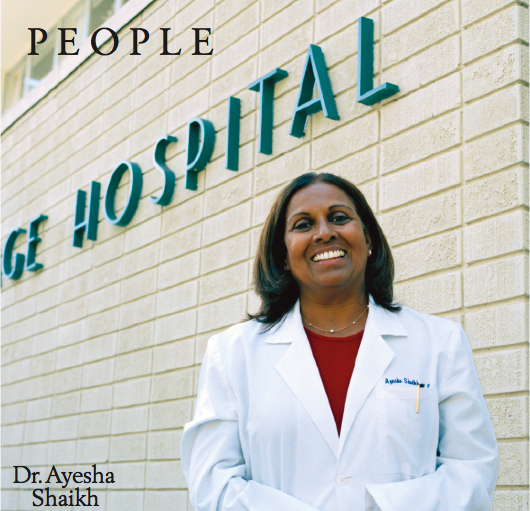
Dr. Ayesha Shaikh


Click Here to Read Dr. Ayesha Shaikh From Santa Barbara Magazine

Dr. Ayesha Shaikh

Dr. Ayesha Shaikh

Having practiced obstetrics and gynecology in Santa Barbara for the past 20 years, Dr. Ayesha Shaikh (rhymes with “bake”) has a hard time walking through town without someone recognizing her.

Her daughter Sarah, 20, a student at Middlebury College, says she can’t go anywhere without someone recognizing her mom.

Her husband of 25 years, Mohammed, an engineer who owns Image-X, frequently quips that he’s “the only Indian Muslim who walks six feet behind his wife.”

He might have to widen that perimeter in January, when his wife’s network will expand even further as she takes over as Cottage Hospital’s Chief of Staff.

Her new assignment, to serve as a liaison between the hospital’s administration and its medical team, comes at one of the most exciting and tumultuous times in the facility’s history, as construction gets underway on a $500 million new hospital, which is not expected to be completed until 2013.

As anyone who’s been through a home remodel can testify, living through years of construction can make you feel like taking a hammer to the closest available target, and Dr. Shaikh will be right there to absorb the blows.

“You know how physicians are,” she said. “If they want to be heard they can be heard. … I think I’ll be hearing a lot of, ‘where’s my parking!'”

Soothing frazzled nerves comes naturally for Dr. Shaikh, having delivered thousands of babies over the years (she stopped counting after her first 250). She hasn’t lost a father yet, although there have been a few close calls.

“You know when they start turning funny shades of color, you say, ‘okay, there’s a chair, why don’t you take a seat and sit down. I’ll take care of the baby and the mom,'” laughs Dr. Shaikh, her lilting Indian/British accent having the desired calming effect.

“It’s amazing how these guys can talk and do all this Rambo-style stuff and when it comes to delivery they become like little ducks … They see that little baby and they burst into tears.”

The joy in sharing these moments is one of the reasons why Dr. Shaikh plans to continue delivering babies, despite her new administrative responsibilities at the hospital.

“It’s fulfilling — I don’t want to say you feel great, but you feel nice, especially when things go well and it’s someone who you’ve seen through a lot of difficult times. You just feel so good.”

Originally published in Santa Barbara Magazine in winter 2006.