Huguette M. Clark Family Treasures to be Auctioned at Christie’s

Notable artwork from the estate of the late Huguette M. Clark—whose Bellosguardo Estate in Montecito was donated to the people of Santa Barbara as a center for “the fostering and promotion of the arts” and is in the process of being developed—will be presented at Christie’s New York beginning early next month.

According to a release from Christie’s, “Four masterworks by Claude Monet and Pierre-Auguste Renoir will be presented in the evening sale of Impressionist & Modern Art at Christie’s New York on May 6, followed by a dedicated sale titled An American Dynasty: The Clark Family Treasures on June 18. Highlights of the collection will be shared with the public through a series of preview exhibitions around the globe in the coming weeks, beginning with an unveiling of the Impressionist and Modern works at Christie’s London that runs through February 4, 2014. The total collection is expected to realize in excess of $50 million.”

Among the pieces up for auction May 6 are:

Nymphéas by Claude Monet, courtesy Christie's

Nymphéas by Claude Monet, courtesy Christie’s

Nymphéas by Claude Monet | Estimate: $25,000,000-35,000,000

Huguette Clark purchased Claude Monet’s Nymphéas in 1930 in New York from the Durand-Ruel Galleries, whose Paris branch had jointly acquired the work with the Galerie Bernheim-Jeune directly from the artist ten years earlier. A splendid example of the artist’s pre-eminent theme – his beloved lily pond at Giverny – Clark’s Nymphéas was painted in 1907, during an intense creative period in Monet’s career. The artist had enjoyed a celebrated career in Paris as the leading artist of the Impressionist movement when he moved with his family to the small farming community of Giverny in 1883 and began working on the elaborate gardens that would inspire him for the last two decades of his life. Between 1905 and 1908, Monet worked feverishly to complete more than 60 increasingly abstract views of the pond, equivalent to about one every three weeks. The painting is distinguished by its strong color contrasts, aggressive brushwork, and novel vertical format. One contemporary critic enthused about the Nymphéas series, “There is no other living artist who could have given us these marvelous effects of light and shadow, this glorious feast of color.” Since entering the collection of Huguette Clark, the present Nymphéas has remained out of the public eye. The international tour in anticipation of the May auction will be the first time the painting is publicly exhibited since 1926.


Jeunes filles jouant au volant by Pierre-Auguste Renoir, courtesy Christie's

Jeunes filles jouant au volant by Pierre-Auguste Renoir, courtesy Christie’s

Jeunes filles jouant au volant by Pierre-Auguste Renoir| Estimate: $10,000,000-15,000,000

Renoir painted Jeunes filles jouant au volant circa 1887, after a three-year period of intense questioning of Impressionist methods and experimentation with his own techniques. Renoir reintroduced traditional notions of draftsmanship into his art. Seeking to give the human form a more monumental presence, he focused increasingly on contour, which he used to silhouette his figures sharply against the background. Jeunes filles jouant au volant is among the most complex compositions from this period of Renoir’s work, depicting five contemporary female figures playing a racquet sport in a rural landscape. The result is an intentional hybrid of timelessness and modernity, the idyllic and the everyday, which gives the painting its particular power.


Chrysanthèmes by Pierre-Auguste Renoir, courtesy Christie's

Chrysanthèmes by Pierre-Auguste Renoir, courtesy Christie’s

Chrysanthèmes by Pierre-Auguste Renoir| Estimate: $3,500,000-5,500,000

Pierre-Auguste Renoir’s Chrysanthèmes was purchased in November 1929 by Huguette Clark and her mother, Anna Eugenia La Chapelle, just two weeks after the Wall Street Crash that would begin the Great Depression. The painting, executed circa 1876-1880, is one of five large-scale paintings of chrysanthemums that Renoir produced by 1884. In the early 1880s, Renoir painted a sequence of elaborate floral compositions that number among the boldest and most fully resolved still-lifes of the artist’s career. Renoir relished the opportunity to depict still-lifes, as they allowed him to paint more freely and develop his techniques. While part of the appeal of chrysanthemums for Renoir was surely practical (the flowers are hardy and do not wilt easily), they also carried a potent iconographic significance. Chrysanthemums had strong associations with East Asia in the artist’s day, and Renoir, being well aware of the vogue for japonisme, may have chosen this particular flower to heighten the appeal of his paintings to collectors.


Femme à l’ombrelle by Pierre-Auguste Renoir, courtesy Christie's

Femme à l’ombrelle by Pierre-Auguste Renoir, courtesy Christie’s

Femme à l’ombrelle by Pierre-Auguste Renoir| Estimate: $3,000,000-5,000,000

Renoir’s Femme à l’ombrelle was painted in 1873, a critical point in both the artist’s career and in the history of the Impressionist movement; this was the same year Renoir helped found the Société Anonyme Coopérative des Artistes, Peintres, Sculpteurs, Graveurs, etc., a group which later came to be known as the Impressionists. Throughout the 1870s, one of Renoir’s favorite subjects was the contemporary young woman in a secluded garden oasis, often holding a parasol, a crucial accoutrement for the bourgeois woman. Few of his sitters, however, have the arresting presence of the young woman in Femme à l’ombrelle, who may in fact be Monet’s wife, Camille. In addition to having an art historical significance, the work also has noteworthy provenance, having first been owned by Erwin Davis, one of the pioneering collectors of Impressionism in the United States.

For more information about the auction click here.

—Leslie Dinaberg

Originally published in Santa Barbara SEASONS on April 15, 2014.

Howard School Gets OK to Expand Capacity

Howard School courtesy photo

Howard School courtesy photo

The Carpinteria Planning Commission recently voted unanimously to allow The Howard School  to expand its enrollment capacity from 80 to 100 students.

Offering  pre-Kindergarten through 8th grade instruction, the Howard School, located at 5315 Foothill Rd. in Carpinteria, is the only school in Santa Barbara County that offers an education based on the Carden Method—a curriculum that cultivates development of the whole child, and focuses on teaching students how to think rather than simply what to know.

Courtesy The Howard School

Courtesy The Howard School

“It is important for us to create a nurturing, sound environment that equips children with the skill sets they need in order to go out and thrive in the post-education world,” says headmaster, Joel Reed. “The tenets of the Carden Method provide the ideal foundation for critical thinking, confidence-building, and a balance of self-reliance and cooperation with one’s community.”

The Howard School is accepting applications through mid-March, and the admissions materials are available online at www.TheHowardSchool.org, as well as the school’s office.

—Leslie Dinaberg

Originally published in Santa Barbara SEASONS on March 2, 2014.

AB Design Studio Selected as New Architect for Children’s Museum of Santa Barbara

Aerial view of Santa Barbara Children's Museum, courtesy AB Design Studio

Aerial view of Santa Barbara Children’s Museum, courtesy AB Design Studio

The long-wished-for Children’s Museum of Santa Barbara takes another step forward with the selection of architects from AB Design Studio Inc. to complete the building, which was initially designed by the late Barry Berkus.

Affectionately dubbed “the sand castle,” the whimsical design features approximately 15,000 square feet of interactive exhibits including a rooftop sky garden with exhibits and viewing areas. The museum will also house a state-of-the-art theater for video art and a small classroom, as well as a museum store.

Expected to be Santa Barbara’s first LEED-certified museum, the innovative building will highlight its own features such as the use of repurposed blue jeans for insulation and several “kid-powered” exhibits.


Rooftop view of Santa Barbara Children's Museum, courtesy AB Design Studio

Rooftop view of Santa Barbara Children’s Museum, courtesy AB Design Studio

The building will be located at 125 State St. between Hotel Indigo and the Train Depot. According to a recent statement, the project is currently in the permitting stage and will start construction in the summer of 2014 with a plan to be open in 2016.

—Leslie Dinaberg

Originally published in Santa Barbara SEASONS on February 3, 2014.

“The Bachelor” Wedding Comes to The Biltmore Santa Barbara

"The Bachelor" Sean Lowe proposes to Catherine Giudici (courtesy ABC.com) "The Bachelor" Sean Lowe proposes to Catherine Giudici (courtesy ABC.com)

“The Bachelor” Sean Lowe proposes to Catherine Giudici (courtesy ABC.com)

Four Seasons Resort The Biltmore Santa Barbara will be live in primetime on January 26, when “THE BACHELOR: SEAN AND CATHERINE’S WEDDING,” airs, featuring former Bachelor Sean Lowe and fiancée Catherine Giudici in a live telecast of their nuptials.

The program airs live on Sunday, January 26 at 8 p.m. on ABC. This will mark the first time ever that a “Bachelor” wedding has been telecast live.

The Four Seasons Resort The Biltmore Santa Barbara has been a dream setting for weddings since 1927. This legendary property practically bursts with romance and classic elegance, not to mention 20 acres of lush botanical gardens, and an incomparable ocean view.

“It’s a truly special place that has served as inspiration and fairytale wedding destination for thousands of brides and grooms over the decades,” says Karen Earp, general manager. “We are so happy to be the location for Sean and Catherine’s wedding celebration and honored to forever be a part of their love story.”

Lowe and  Giudici became engaged in beautiful, exotic Thailand at the finish of filming Lowe ’s edition (Season 17) of “The Bachelor” in November 2012. Hosted by Chris Harrison, the show will let viewers in on all the exciting festivities, from planning the big day to the next stage of their romantic journey with a beautiful wedding ceremony in the perfect location.

—Leslie Dinaberg

Originally published in Santa Barbara SEASONS on January 16, 2014.

Take Your Daughters to Work Day

“I know that girls can be anything that they want to be,” said featured speaker Barbara Ibarra Keyani as she shared her moving story of going “beyond her barrio” to UCSB, MIT, becoming a mother of two daughters now in college and her current position with the Santa Barbara School Districts with the 80 girls and 50 women who participated in Girls Incorporated’s annual Take Our Daughters to Work Day on May 24. Continue reading

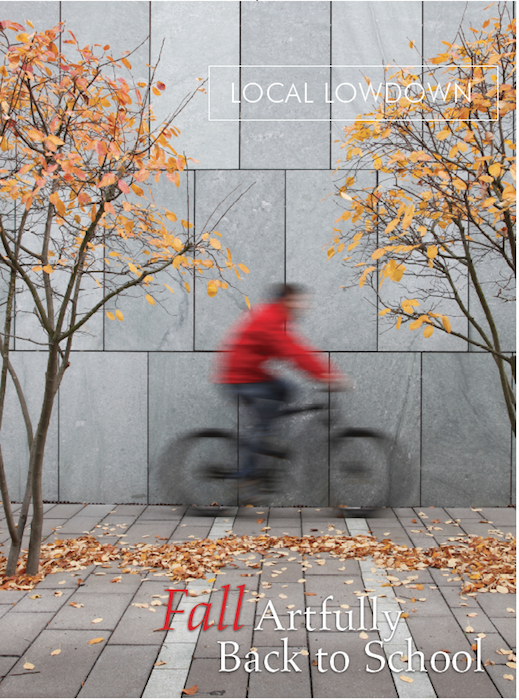
Fall Artfully Back to School

Santa Barbara Seasons, Local Lowdown, Fall 2010

Santa Barbara Seasons, Local Lowdown, Fall 2010

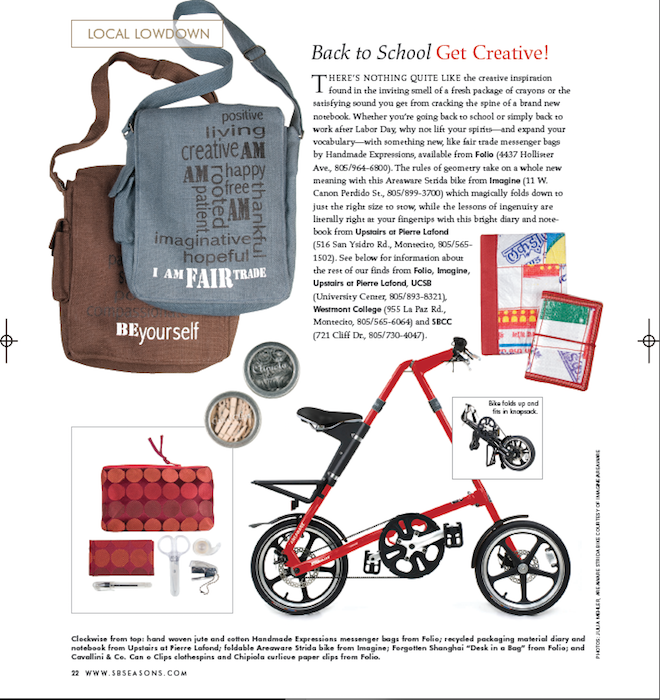
Back to School Get Creative!

There’s nothing quite like the creative inspiration found in the inviting smell of a fresh package of crayons or the satisfying sound you get from cracking the spine of a brand new notebook.

Whether you’re going back to school or simply back to work after Labor Day, why not lift your spirits—and expand your vocabulary—with something new, like fair trade messenger bags by Handmade Expressions, available from Folio (4437 Hollister Ave., 805/964-6800). The rules of geometry take on a whole new meaning with this Areaware Strida bike from Imagine (11 W. Canon Perdido St., 805/899-3700) which magically folds down to just the right size to stow, while the lessons of ingenuity are literally right at your fingertips with this bright diary and notebook from Upstairs at Pierre Lafond (516 San Ysidro Rd., Montecito, 805/565-1502).

Santa Barbara Seasons, Local Lowdown, Fall 2010

Santa Barbara Seasons, Local Lowdown, Fall 2010

See below for information about the rest of our finds from Folio, Imagine, Upstairs at Pierre Lafond, UCSB (University Center, 805/893-8321), Westmont College (955 La Paz Rd., Montecito, 805/565-6064) and SBCC (721 Cliff Dr., 805/730-4047).

Clockwise from top: hand woven jute and cotton Handmade Expressions messenger bags from Folio; recycled packaging material diary and notebook from Upstairs at Pierre Lafond; foldable Areaware Strida bike from Imagine; Forgotten Shanghai “Desk in a Bag” from Folio; and Cavallini & Co. Can o Clips clothespins and Chipiola curlicue paper clips from Folio.

Bike folds up and fits in knapsack.

PHOTOS: JULIA MEHLER, AREAWARE STRIDA BIKE COURTESY OF IMAGINE/AREAWARE

Santa Barbara Seasons, Local Lowdown, Fall 2010

Santa Barbara Seasons, Local Lowdown, Fall 2010

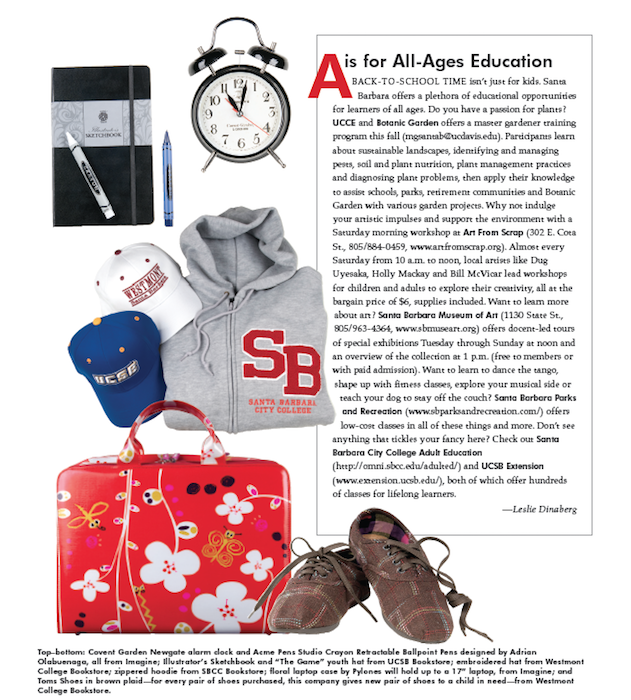
A is for All-Ages Education

BACK-TO-SCHOOL TIME isn’t just for kids. Santa Barbara offers a plethora of educational opportunities for learners of all ages. Do you have a passion for plants? UCCE and Botanic Garden offers a master gardener training program this fall (mgsantab@ucdavis.edu). Participants learn about sustainable landscapes, identifying and managing pests, soil and plant nutrition, plant management practices and diagnosing plant problems, then apply their knowledge to assist schools, parks, retirement communities and Botanic Garden with various garden projects.

Why not indulge your artistic impulses and support the environment with a Saturday morning workshop at Art From Scrap (302 E. Cota St., 805/884-0459, www.artfromscrap.org). Almost every Saturday from 10 a.m. to noon, local artists like Dug Uyesaka, Holly Mackay and Bill McVicar lead workshops for children and adults to explore their creativity, all at the bargain price of $6, supplies included.

Want to learn more about art? Santa Barbara Museum of Art (1130 State St., 805/963-4364, www.sbmuseart.org) offers docent-led tours of special exhibitions Tuesday through Sunday at noon and an overview of the collection at 1 p.m. (free to members or with paid admission).

Want to learn to dance the tango, shape up with fitness classes, explore your musical side or teach your dog to stay off the couch? Santa Barbara Parks and Recreation (www.sbparksandrecreation.com/) offers low-cost classes in all of these things and more.

Don’t see anything that tickles your fancy here? Check out Santa Barbara City College Adult Education (http://omni.sbcc.edu/adulted/) and UCSB Extension (www.extension.ucsb.edu/), both of which offer hundreds of classes for lifelong learners.

—Leslie Dinaberg

Top–bottom: Covent Garden Newgate alarm clock and Acme Pens Studio Crayon Retractable Ballpoint Pens designed by Adrian Olabuenaga, all from Imagine; Illustrator’s Sketchbook and “The Game” youth hat from UCSB Bookstore; embroidered hat from Westmont College Bookstore; zippered hoodie from SBCC Bookstore; floral laptop case by Pylones will hold up to a 17” laptop, from Imagine; and Toms Shoes in brown plaid—for every pair of shoes purchased, this company gives new pair of shoes to a child in need—from Westmont College Bookstore.

Originally published in Santa Barbara Seasons Magazine, Fall 2010. Cover photo by Jim Bartsch.

Cover photo by Jim Bartsch.

Originally published in Santa Barbara Seasons Magazine, Fall 2010. Cover photo by Jim Bartsch.

Women’s Festival Debuts

wf-logoThe inaugural Women’s Festivals launched in Santa Barbara March 7-9th and Arizona March 14-16th. Founded by local businesswoman Patty DeDominic and her partner Mary Schnack, these conferences were created to “celebrate the accomplishments of women and inspire others to realize their dreams,” with forums focusing five key areas: personal, professional, philanthropic, political, and planet.

The Saturday morning “personal” panel on “Transition: The Best is Yet to Come,” was thought-provoking for the approximately 50 people (predominately women) that attended.

Introducing the panel, Alberto G. Alvarado, the Los Angeles district director for the U.S. Small Business Administration, started out the morning with a laugh when he asked the audience, “When does a woman most enjoy a man’s company?” The answer: “When she owns it.”

Then it was on to a dynamic discussion of transitions–both in life and in business–with four very different women.

“Your experiences turn to lessons and hopefully those lessons turn to wisdom,” said Tessa Warschaw, Ph.D., founder of Big Thinking Women and the author of “Winning by Negotiation,” and “Resiliency: How to Bounce Back Faster, Stronger, Smarter.” As you age, “if you don’t have your marbles and you don’t have cash, you’re in trouble,” said Warschaw.

“If you live in the future or in the past, you’re wasting your time,” said Linda LoRey, President and CEO of Frederick’s of Hollywood, who related her story of taking the company public and in the same year becoming a mother for the first time at age 52. “You can do it all, but you can’t do it all at once,” she said, though it sounds like she, at least, can do an awful lot at once.

Maureen Ford, an entrepreneurial education expert and author of “The Turning Point,” said that a dream about her dead mother inspired her to write the book for which all profits go toward Women for Women International, a nonprofit humanitarian organization dedicated to financial, educational, and interpersonal support of women survivors of war, poverty and injustice.

Joan Frentz, author of “Life Begins at 60,” who works as a personal trainer in Carpinteria, talked about the importance of staying in good physical health. “The good and bad news is that we’re going to live to be 100,” said the impressively spry 72-year-old. “We have to take care of ourselves to make those years worthwhile.”

A fundamental objective of the festivals was “to bring together a unique gathering of extraordinary women to share their experiences and wealth of knowledge with the goal of transforming the lives of participants,” according to the organizers. Other featured speakers included: Dr. Susan Love, U.S. Representative Lois Capps (D-CA), Sara Miller McCune and LeVar Burton.

Originally published in Noozhawk on March 25, 2008.

Backstory: Behind the Scenes of “Citizen McCaw”

Citizen McCawThe implosion of the Santa Barbara News-Press newsroom 18 months ago sparked a labor battle, which led to the departure of dozens of staffers, the creation of a union, and a swarm of legal actions. Now the story is reaching the big screen, with the March 7th world premiere of Citizen McCaw, a full-length documentary examination of the past year and a half at the local daily and its effect on the community.

For the film’s co-producers–Rod Lathim, Charles Minsky, Peter Seaman and Sam Tyler, all locals–the project has been a time-consuming, pro bono, labor of love.

Asked what made them decide the events at the News-Press would make a good topic for a documentary, Tyler said, “It’s a great story. … You have a newspaper, you have a community, you have the courts, you have national voices, national interests, and they are all involved in this really bizarre and very, very unusual meltdown of a hometown daily paper. … You have a wealthy woman. You have her boyfriend, you have people quitting into an uncertain job market, you have community protesters, and you have judges and lawyers. I mean it’s just a wild, crazy scene, and all of the elements of a really interesting story.”

It was Tyler, the producer of documentaries such as In Search of Excellence and Good to Great, who got the ball rolling.

“He called me up one day and we had coffee and he mentioned it was a shame what was going on with the News-Press and wouldn’t it be great if we made a documentary about it? I could tell he was passionate about it, and it turned out, so was I,” said Minsky, director of photography for films such as Pretty Woman and The Producers. “What has happened to the News-Press hit me hard. I like getting up and reading the paper every morning and we had a very good paper here, before all this happened. So I guess I was a little mad as well, and wanted to find out what everyone else thought about our situation.”

“You can’t write this stuff. … If you made up all this stuff, people would go ‘Oh, c’mon, you’re trying too hard to come up with something,'” said Lathim, a fourth generation Santa Barbara native who founded Access Theatre and spearheaded development of the Marjorie Luke Theatre. “They are writing the story. It’s not our story, although we are a part of it because we live here. … Another reason why we’re doing it is that whether we want to be part of the story or not, we are because we’re Santa Barbara residents. We care about our community. We want to know what the news is and we want to make sure that people are treated fairly and that we can trust our news and get our news in places where it’s trustworthy.”

“Personally, I got angry every time I went to the end of my driveway here in Carpinteria and picked up my News-Press. I’d been doing that every morning for the last 15 years and, like a lot of people in Santa Barbara, got very attached to the paper and its writers. Suddenly everything changed. Where’d Barney Brantingham go? John Zant? Melinda Burns? What the hell happened to the paper I used to know?” said Seaman, writer of films such as Shrek the Third and Who Framed Roger Rabbit. “So that’s where the interest started for me. Plus I knew Sam Tyler and Rod Lathim and Chuck Minsky, and their own interest in doing the film fed mine.”

The story is told in a timeline, started with Thomas Storke and the history of the News-Press, and then on through Wendy McCaw’s reign. “What’s happened here in Santa Barbara is a cautionary tale for comparable issues potentially around the country,” said Tyler. “It hasn’t exploded this way anywhere else, When Rupert Murdoch bought the Wall Street Journal, ” there wasn’t one-hundredth of the smoke around there that there is here in this inferno around Santa Barbara. They’re comparable issues.”

While the documentarians are clearly passionate about their subject, “we don’t insert ourselves in this film. We never intended to and we didn’t,” said Lathim. “The story is told onscreen by the people involved in the story. Our role in this really is to piece all the pieces of the puzzle together.”

Those pieces include interviews with national leaders in journalism, such as Washington Post Executive editor Ben Bradlee, former NBC News reporter Sander Vanocur, and Harvard’s Alex Jones. The ex-News-Press staffers are represented, as is McCaw, although not willingly.

“She refused half a dozen requests for interviews, had her lawyer send us four nasty letters and subpoenaed our footage,” said Tyler. With that caveat, the filmmakers insist her point-of-view is still represented. “I think she’s probably in it six times herself, her own words in black and white, put fairly up in context representing her point of view,” he said. “She actually appears speaking a couple of times, and her lawyers are in two or three times. So she has at least a dozen presentations of her point of view in this film, directly countering the other. Like Jerry Roberts said, ‘I quit because of ethics,’ Wendy McCaw said, ‘No he didn’t. That’s a lot of bull.’ What goes on here is the same thing that goes on in newsrooms everywhere. I mean viewers make up their own minds.”

Originally published in Noozhawk on March 1, 2008.

Grief Book Benefits Hospice and the Temple

The sun shined on Hospice of Santa Barbara and Congregation B’nai B’r61DjnDCK+3L-1._BO2,204,203,200_PIsitb-sticker-arrow-click,TopRight,35,-76_AA300_SH20_OU01_ith Sunday afternoon at a special event honoring the publication of Sissy Taran’s new book, The Sun Will Shine Again: Life Lessons from a Year of Grieving, (www.thesunwillshineagain.com) with all proceeds going to support the two organizations.

“This is the first time in history of Hospice of Santa Barbara that we’ve ever sponsored a book,” said Executive Director Gail Rink, who interviewed Taran and Rabbi Steve Cohen about their experiences working together. Taran and Rabbi Cohen wrote the book–which documents Taran’s first year of grieving the death of her husband Bernie–through a series of conversations. They met once a week for seven months, primarily at the Breakwater Restaurant, to share the journey Sissy went through.

Rabbi Cohen said he viewed the project as a unique opportunity to learn more about the grief process. He was with the Taran family when they learned of Bernie’s cancer diagnosis, and with them shortly afterward when he passed away. “It was a wonderful but very short-lived period of intimacy,” which he welcomed the opportunity to extend through collaboration on the book project.

He initially decided to become a rabbi because it was important to him to be close to people in key moments of their lives, and saw this project as a rare opportunity for that type of closeness.

One of the most important lessons he learned was that there is not a linear progression from devastation to happiness, Rabbi Cohen said.

“We walk it all differently, but it’s our individual walk. So this, somehow, and I don’t know why, this book was burning within me. Somehow. Because I’ve never written and if I had to sit down at a computer I still wouldn’t have written a book,” said Taran, who taped all of her sessions with Rabbi Cohen and pieced together the book from the transcripts, with the help of editor Laurie Deans Medjuck. “We ended up throwing out about 75 percent of it,” said Taran.

Even though she was, and still is grieving, Taran said she doesn’t feel sorry for herself. “How can you have pity for yourself when you have someone who’s there for you with so much love,” she said of her collaboration with Rabbi Cohen.

“I don’t know how I or Sissy or any of us would have faced this journey alone,” said

Congresswoman Lois Capps, who was widowed in 1997. “You’ve created a beautiful thing out of most deep and personal pain. What a lesson and what a gift!”

Through writing this book I found something within me that wanted to help myself and other people, said Taran. “Today’s benefit is my way of giving back to two organizations close to my heart.”

Originally published in Noozhawk on February 12, 2008.

Behind the Scenes at the Election Office

If the seventh and eighth grade students from Anacapa School are any kind of a barometer, then, as the national media predicts, young people are engaged in this presidential election with an extraordinary level of interest.

County Clerk, Recorder and Assessor Joe Holland took the students on a behind-the-scenes tour of the election office on Thursday to demonstrate what happens to the 35,000 absentee ballots that had already been received by that day (he expects that 50,000 of the 183,000 Santa Barbara County registered voters will have voted by mail by election day).

With the increasing numbers of people that vote by mail, “election day is actually 29 days long now,” Holland explained to founding headmaster Gordon Sichi’s American History and Society class.

The first step in the envelope’s journey to being counted is the signature on the outside, explained Holland. “There’s a bar code on there that tells us who you are. So when we receive that envelope back, we send it through a machine that’s called an ASR, automatic signature recognition machine. It goes through and compares your signature with the signature that we have on file for you with your voter registration card, and if it matches then it accepts it. If it doesn’t match, like for me, I’m Joseph E. Holland, if I leave out the ‘E’ it won’t match. So then what we do with the ones that don’t match, we’ll actually have a person pull that up, oh look at it’s the same J and the S and the PH, and accept it. But this machine actually accepts about 80 percent of all the envelopes that are returned,” he said.

If someone sends in an envelope without a signature, the elections office tries to contact him or her in order to have him or her sign the ballot so that it can be counted. Once the signatures are verified, the next step is to open the envelopes. The eighth grade students who had taken the elections office tour the year before were impressed to see that a new automated ballot-opening machine had replaced the tables of people with letter openers.

“How much did the new machine cost?” asked a student.

“We’re leasing it right now, but it’ll cost us about $80,000 to buy,” answered Holland.

“Is it worth it?” asked another student.

Holland thinks it is. The machine, which can open about 5,000 envelopes per hour, cuts them open on three sides to make sure that no ballots are stuck inside. Part of the reason for this security measure, he explained, is that in the 1992 primary there was a really close race for county supervisor (between Willy Chamberlin and Bill Wallace, who eventually won the seat). The recount results found that about ten absentee ballots were still in their envelopes and had not been counted. In addition, there are also privacy issues with having the envelopes opened by hand which are avoided by using the machine.

Once the ballots are opened they unfold them and run them through the tallying machines, which are the same machines found in the county’s 215 precincts on Election Day. The results will not be available until 8:05 p.m. on election night. Until then they are then stored on a computer, which is kept under high security. Only two people have access to the machine, and there are cameras all over the office to make sure no one tries to get in the locked room where it is kept, said Holland.

“What about a hacker getting into the results?” asked a student.

That’s a good question, acknowledged Holland, explaining that there is no Internet access allowed in the room, for that very reason. Another new security measure in place for this year is the secretary of state has given a directive to all counties not to modem results over phone lines, as was done in the past. Instead the results will be driven in to the elections office, which in the case of far away precincts like New Cuayama, may delay the tallying of the final results by as much as two and a half hours.

“If the election is really close, we may not know who won in California until all of the absentee ballots are counted,” said Holland. He has up to 29 days to certify the final results of the election.

The students got to vote in a mock election, where Thomas Jefferson, Abraham Lincoln, John F. Kennedy, Dwight D. Eisenhower and Franklin D. Roosevelt vied for president. Roosevelt and Kennedy tied with only four votes each, but there were 11 write-in votes, which weren’t officially counted.

“I wrote in Barak Obama,” said eighth grader Emily Welkowitz, who wore an “Obama ’08” bumper sticker on her back.

“I think it’s totally interesting,” said eighth grader Jessica DiMizio. “I like all the new machines and stuff. Last year we saw them opening the absentee envelopes and it was just a bunch of people sitting around a big table.”

Part of the philosophy of Anacapa School is to bring the students into the community, said Sichi. “I can go anywhere in this town with a little notice and people will open up their businesses to us. People in Santa Barbara are so generous.” He planned to follow up the field trip with a lesson on voting machines and a discussion of the controversies surrounding them.

When asked if they talked a lot about the presidential primary in class, eighth grader Haley Yuhas said: “Oh yeah, that’s all we talk about. It’s great. It’s really, really interesting.”

Originally published in Noozhawk on February 5, 2008.