Laundry Lessons

tongdang freedigitalphotos.net

tongdang freedigitalphotos.net

My friend Erin turns 40 today. She doesn’t want any presents; she just wants me to tell her the meaning of life.

That’s all. The meaning of life. Just a simple, little gift. I don’t think she’ll accept “no,” “42,” or even “swordfish” as an answer.

Doesn’t she know that I don’t really know what the meaning of life is? I’m not THAT much older than she is. Though I do know from personal experience that you can’t find the meaning of life in any store. Not even the shoe department at Nordstrom.

It’s not in a glass of wine or a tree or a yoga pose. And contrary to what some people say, I never learned about the meaning of life in kindergarten.

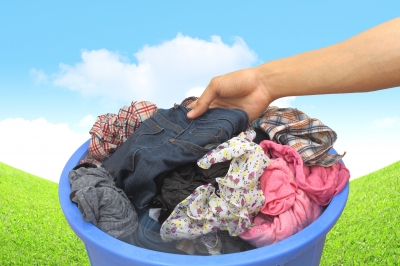
But I do know one thing I can share with her: You can learn a lot about life by doing laundry.

On the surface it may seem like a never-ending, redundant chore-whites, brights, darks, lights, towels, sheets, rinse and repeat. Again, five, six, seven, eight, whites, brights, darks, lights, towels, sheets, rinse and repeat. You can never catch up with the laundry. The moment that you match that last clean pair of socks, another soiled and sweaty duo shows up in the basket to take their place.

You’re never done. There’s always another day and another pair of dirty socks.

Of course anyone who does a lot of laundry knows that there’s really no such thing as being able to make all the socks match up in perfect pairs. Sure they start out that way when they’re new and fresh from the factory. Those socks are unscarred and optimistic because they’re too young and naïve to know any better. They walk down the aisles of Target in perfect harmony, believing that plastic staples and a shared manufacturer will bind them blissfully together forever.

Little do they know that once they hit that laundry basket life is full of surprises. The lucky pairs will stay in the same cycles, dancing around separately by day—while one rendezvous with a favorite t-shirt, the other attaches itself to a sweet smelling sheet—only to reunite in a cozy drawer for the night.

It doesn’t matter how many clothes you have or how often you wash them, every load of laundry is familiar, but if you look carefully enough you’ll always find surprises. Some weeks are full of grays and some are full of color. Some clothes, like some people, thrive in hot water, while others prefer it to be chilly. And try though you may to keep your dainty delicates away from the dryer, sometimes they attach themselves to a muddy pair of khakis or a stinky sweatshirt with an old college logo and they’re never quite the same after that.

An errant burr might worm its way into your sole leaving a scar on your heel that only you can see but you feel it every time you take a step. Buttons fall off and disappear into the ether. An errant purple crayon makes its way out of a classroom to permanently mark its territory on your favorite pink tank top. Things don’t always come out the way you think they will in the wash. That’s why they invented tie-dye.

The rinse cycle is good for cleaning off the grime, but sometimes you have to repeat—rinse and repeat, rinse and repeat. And there are some things that never come completely clean no matter how many soaks you give them and some that are always a little rumpled some matter how carefully you iron them.

Another thing you’ll come to realize after doing lots and lots of laundry is that not everything grooves to the same timetable. Those thick, thirsty Egyptian cotton towels turn out to be high maintenance, but worth the extra minutes in the dryer, while that Irish linen blouse demands more TLC than you have the patience for. So what if it was $59.99 (on sale!). Do enough laundry and you’ll learn that some things are just not worth the aggravation.

Sometimes the laundry can enrich you in more than just wisdom. I once made $2.87 in change and immediately went and bought myself a Slurpee. It was the coldest, sweetest, brain-freezing Slurpee in that summer full of Slurpees in a life full of Slurpees. I closed my eyes and wanted to savor every slurp of that special Slurpee. I opened my eyes and saw that I spilled some on my shirt.

And once again it’s back to the laundry. You toss and you tumble and try to sort through things and you clean them and they get messed up and you clean them again and again.

Whites, brights, darks, lights, towels, sheets, rinse and repeat. You’re never done. There’s always another day and another pair of dirty socks.

And another chance to clean them.

Share your laundry lessons with Leslie at Leslie@LeslieDinaberg.com. For more columns visit www.LeslieDinaberg.com. Originally published in the Santa Barbara Daily Sound on April 16, 2010.


Ho Ho Holiday

‘Tis the Season in Santa Barbara

By Leslie Dinaberg

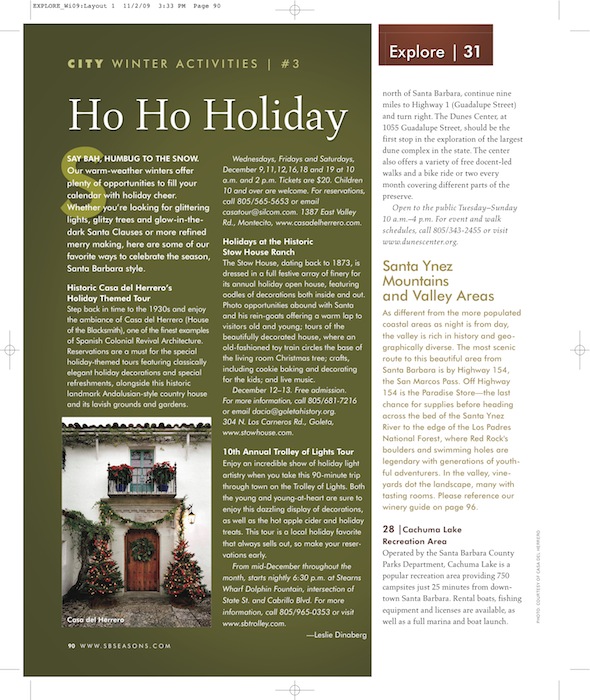
Say bah, humbug to the snow. Our warm-weather winters offer plenty of opportunities to fill your calendar with holiday cheer. Whether you’re looking for glittering lights, glitzy trees and glow-in-the-dark Santa Clauses, or more refined merry making, here are some of our favorite ways to celebrate the season, Santa Barbara style.

Historic Casa del Herrero’s Holiday-Themed Tour

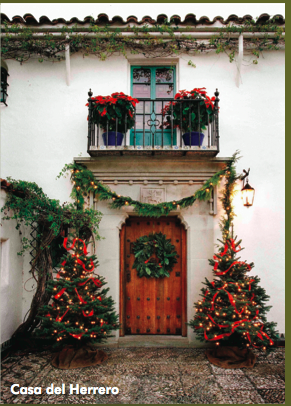
Step back in time to the 1930s and enjoy the ambiance of Casa del Herrero (House of the Blacksmith), one of the finest examples of Spanish Colonial Revival Architecture. Reservations are a must for the special holiday-themed tours featuring classically elegant holiday decorations and special refreshments, alongside this historic landmark Andalusian-style country house and its lavish grounds and gardens.

Wednesdays, Fridays and Saturdays, December 9,11,12,16,18 and 19th at 10 a.m. and 2 p.m. Tickets are $20. Children 10 and over are welcome. For reservations call (805) 565-5653 or email casatour@silcom.com. 1387 East Valley Road, Montecito. www.casadelherrero.com.

Holidays at the Historic Stow House Ranch

The Stow House, dating back to 1873, will be dressed in a full festive array of finery for its annual holiday open house, featuring oodles of decorations both inside and out. Photo opportunities abound with Santa and his rein-goats offering a warm lap to visitors old and young; tours of the beautifully decorated house, where an old-fashioned toy train circles the base of the living room Christmas tree; crafts, including cookie-baking and decorating for the kids and live music.

December 12 and 13. Free admission. Call (805) 681-7216 or email dacia@goletahistory.org for more information. 304 N. Los Carneros Road, Goleta. www.stowhouse.com.

10th Annual Trolley of Lights Tour

Enjoy an incredible show of holiday light artistry when you take this 90-minute trip through town on the Trolley of Lights. Both the young and young-at-heart are sure to enjoy this dazzling display of decorations, as well as the hot apple cider and holiday treats. This tour is a local holiday favorite that always sells out, so make your reservations early.

From mid-December and throughout the month meets at 6:30 p.m. nightly at Stearns Wharf Dolphin Foundation, intersection of State Street and Cabrillo Boulevard. For more information call (805) 965-0353 or visit sbtrolley.com.

Originally published in the winter 2009/10 issue of Santa Barbara Seasons Magazine. See the pdf version here.


City Spring Activities: Mother’s Day Treats

Mother's Day Treats, originally published in the spring 2010 issue of Santa Barbara Seasons Magazine.

Mother’s Day Treats, originally published in the spring 2010 issue of Santa Barbara Seasons Magazine.

It can be challenging to come up with a sensational way to celebrate the woman who birthed you, clothed you, fed you, nagged you and dragged you to get you on the path to where you are today—all in the name of motherly love, of course.

This Mother’s Day is your turn to put her on a pedestal for a change. Here are some of our favorite mom-worthy ways to honor yours.

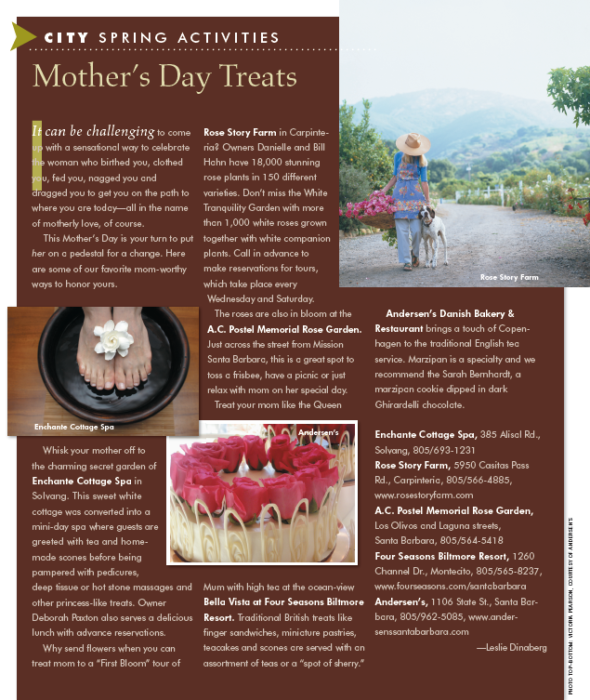
Whisk your mother off to the charming secret garden of Enchante Cottage Spa in Solvang. This sweet white cottage was converted into a mini-day spa where guests are greeted with tea and homemade scones before being pampered with pedicures, deep tissue or hot stone massages and other princess-like treats. Owner Deborah Paxton also serves a delicious lunch with advance reservations.

Why send flowers when you can treat mom to a “First Bloom” tour of Rose Story Farm in Carpinteria? Owners Danielle and Bill Hahn have 18,000 stunning rose plants in 150 different varieties. Don’t miss the White Tranquility Garden with more than 1,000 white roses grown together with white companion plants. Call in advance to make reservations for tours, which take place every Wednesday and Saturday.

The roses are also in bloom at the A.C. Postel Memorial Rose Garden. Just across the street from Mission Santa Barbara, this is a great spot to toss a frisbee, have a picnic or just relax with mom on her special day.

Treat your mom like the Queen Mum with high tea at the ocean-view Bella Vista at Four Seasons Biltmore Resort. Traditional British treats like finger sandwiches, miniature pastries, teacakes and scones are served with an assortment of teas or a “spot of sherry.”

Andersen’s Danish Bakery & Restaurant brings a touch of Copenhagen to the traditional English tea service. Marzipan is a specialty and we recommend the Sarah Bernhardt, a marzipan cookie dipped in dark Ghirardelli chocolate.

Enchante Cottage Spa, 385 Alisal Rd., Solvang, 805/693-1231, http://www.enchantecottagespa.com

Rose Story Farm, 5950 Casitas Pass Rd., Carpinteria, 805/566-4885,
www.rosestoryfarm.com

A.C. Postel Memorial Rose Garden, Los Olivos and Laguna streets, Santa Barbara, 805/564-5418

Four Seasons Biltmore Resort, 1260 Channel Dr., Montecito, 805/565-8237,
www.fourseasons.com/santabarbara

Andersen’s, 1106 State St., Santa Barbara,
805/962-5085, www.andersenssantabarbara.com

Santa Barbara Seasons Spring 2010 cover Originally published in the spring 2010 issue of Santa Barbara Seasons. To read the story as it appeared in print, click here: Sea_SP10_074

Igniting a Love of Art

Originally published in the spring 2010 issue of Santa Barbara SEASONS magazine.

Originally published in the spring 2010 issue of Santa Barbara SEASONS magazine.

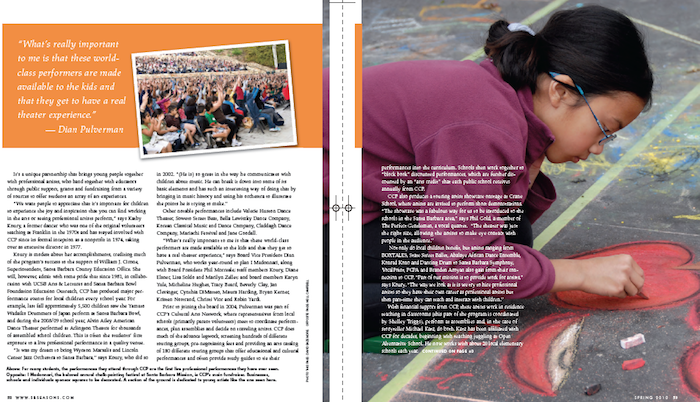
“The arts support learning in academic subject areas by helping children develop higher-level thinking skills like imagination, problem solving and collaboration.”
—Kathy Koury

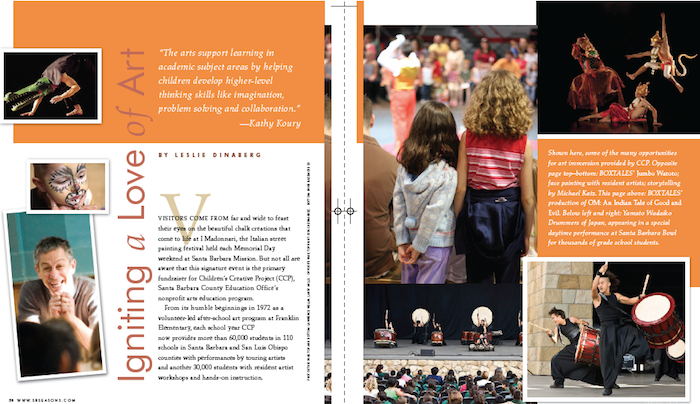
VISITORS COME FROM far and wide to feast their eyes on the beautiful chalk creations that come to life at I Madonnari, the Italian street painting festival held each Memorial Day
weekend at Santa Barbara Mission. But not all are aware that this signature event is the primary fundraiser for Children’s Creative Project (CCP), Santa Barbara County Education Office’s nonprofit arts education program.

From its humble beginnings in 1972 as a volunteer-led after-school art program at Franklin
Elementary, each school year CCP now provides more than 60,000 students in 110 schools in Santa Barbara and San Luis Obispo counties with performances by touring artists and another 30,000 students with resident artist workshops and hands-on instruction.

Originally published in the spring 2010 issue of Santa Barbara SEASONS magazine.

Originally published in the spring 2010 issue of Santa Barbara SEASONS magazine.

“What’s really important to me is that these world class performers are made available to the kids and that they get to have a real theater experience.”

— Dian Pulverman

It’s a unique partnership that brings young people together with professional artists, who band together with educators through public support, grants and fundraising from a variety of sources to offer students an array of art experiences.

“We want people to appreciate that it’s important for children to experience the joy and inspiration that you can find working in the arts or seeing professional artists perform,” says Kathy Koury, a former dancer who was one of the original volunteers teaching at Franklin in the 1970s and has stayed involved with CCP since its formal inception as a nonprofit in 1974, taking over as executive director in 1977.

Koury is modest about her accomplishments, crediting much of the program’s success to the support of William J. Cirone, Superintendent, Santa Barbara County Education Office. She will, however, admit with some pride that since 1981, in collaboration with UCSB Arts & Lectures and Santa Barbara Bowl Foundation Education Outreach, CCP has produced major performance events for local children every school year. For example, last fall approximately 5,500 children saw the Yamato Wadaiko Drummers of Japan perform at Santa Barbara Bowl, and during the 2008/09 school year, Alvin Ailey American Dance Theater performed at Arlington Theatre for thousands of assembled school children. This is often the students’ first exposure to a live professional performance in a quality venue.

“It was my dream to bring Wynton Marsalis and Lincoln Center Jazz Orchestra to Santa Barbara,” says Koury, who did so in 2002. “(He is) so great in the way he communicates with children about music. He can break it down into some of its basic elements and has such an interesting way of doing that by bringing in music history and using his orchestra to illustrate the points he is trying to make.”

Originally published in the spring 2010 issue of Santa Barbara SEASONS magazine.

Originally published in the spring 2010 issue of Santa Barbara SEASONS magazine.

Other notable performances include Valerie Huston Dance Theater, Soweto Street Beat, Bella Lewitzky Dance Company, Korean Classical Music and Dance Company, Claddagh Dance Company, Mariachi Festival and Jane Goodall.

“What’s really important to me is that these world-class performers are made available to the kids and that they get to have a real theater experience,” says Board Vice President Dian Pulverman, who works year-round to plan I Madonnari, along with Board President Phil Morreale; staff members Koury, Diane Elsner, Lisa Soldo and Marilyn Zellet; and board members Karyn Yule, Micheline Hughes, Tracy Beard, Beverly Clay, Jan Clevinger, Cynthia DiMatteo, Maura Harding, Bryan Kerner, Kristen Nostrand, Christi Vior and Robin Yardi.

Prior to joining the board in 2004, Pulverman was part of CCP’s Cultural Arts Network, where representatives from local schools (primarily parent volunteers) meet to coordinate performances, plan assemblies and decide on traveling artists. CCP does much of the advance legwork, screening hundreds of different touring groups, pre-negotiating fees and providing an arts catalog of 180 different touring groups that offer educational and cultural performances and often provide study guides to tie their performances into the curriculum. Schools then work together to “block book” discounted performances, which are further discounted by an “arts credit” that each public school receives annually from CCP.

CCP also produces a touring artist showcase onstage at Crane School, where artists are invited to perform short demonstrations.

“The showcase was a fabulous way for us to be introduced to the schools in the Santa Barbara area,” says Phil Gold, a member of The Perfect Gentlemen, a vocal quartet. “The theater was just the right size, allowing the artists to make eye contact with people in the audience.”

Not only do local children benefit, but artists ranging from BOXTALES, State Street Ballet, Abalaye African Dance Ensemble, Konrad Kono and Dancing Drum to Santa Barbara Symphony, VocalPoint, PCPA and Branden Aroyan also gain from their connection to CCP.

“Part of our mission is to provide work for artists,” says Koury. “The way we look at it is we try to hire professional artists so they have their own career as professional artists but then part-time they can teach and interact with children.”

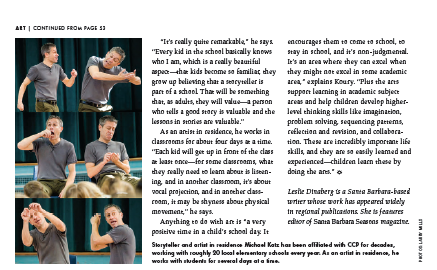
With financial support from CCP, these artists work in residence teaching in classrooms (this part of the program is coordinated by Shelley Triggs), perform at assemblies and, in the case of storyteller Michael Katz, do both. Katz has been affiliated with CCP for decades, beginning with teaching juggling at Open Alternative School. He now works with about 20 local elementary schools each year. “It’s really quite remarkable,” he says. “Every kid in the school basically knows who I am, which is a really beautiful aspect—that kids become so familiar, they grow up believing that a storyteller is part of a school. That will be something that, as adults, they will value—a person who tells a good story is valuable and the lessons in stories are valuable.”

As an artist in residence, he works in classrooms for about four days at a time. “Each kid will get up in front of the class at least once—for some classrooms, what they really need to learn about is listening, and in another classroom, it’s about vocal projection, and in another classroom, it may be shyness about physical movement,” he says.

Anything to do with art is “a very positive time in a child’s school day. It encourages them to come to school, to stay in school, and it’s non-judgmental. It’s an area where they can excel when they might not excel in some academic area,” explains Koury. “Plus the arts
support learning in academic subject areas and help children develop higher level thinking skills like imagination, problem solving, sequencing patterns, reflection and revision, and collaboration. These are incredibly important life skills, and they are so easily learned and
experienced—children learn these by doing the arts.”

Santa Barbara Seasons Spring 2010 coverOriginally published in the spring 2010 issue of Santa Barbara Seasons Magazine.

To read the story as it originally appeared in print click here: Spring 2010 childrens creative project

Noozhawk Talks: Leslie Dinaberg Sits Down With Colette Hadley

Colette Hadley’s Commitment to Education Is All About Opportunity

For Scholarship Foundation of Santa Barbara director, the future begins now for the students she aims to help
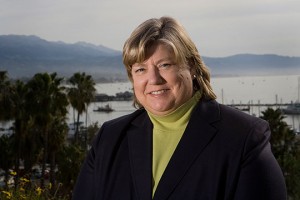
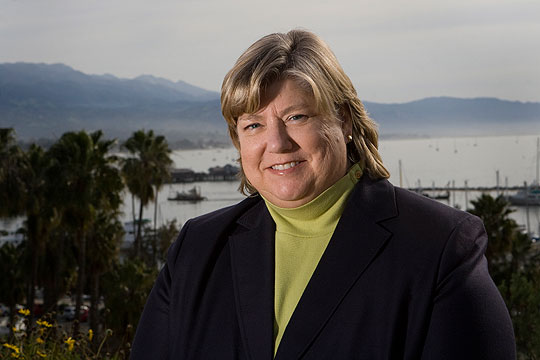
Colette Hadley, Noozhawk photo

Colette Hadley, Noozhawk photo

The Scholarship Foundation of Santa Barbara’s services are needed now more than ever as the rising costs of college mean more and more families are looking for financial aid to help afford the expense.
Noozhawk’s Leslie Dinaberg caught up with executive director Colette Hadley to talk about her life, work and what it’s like to help students and their families pursue their educational dreams.

Leslie Dinaberg: How long have you been at the Scholarship
Foundation of Santa Barbara?

Colette Hadley: Seventeen years. I started here when I was 30
and I’m 47. The foundation and I, funnily enough, were born on the same day. May
29, 1962 was the first meeting of the scholarship foundation and that’s the same day
I was born.

LD: Fate.

CH: I like to think of that a little bit as the kinship between us.
I’ve been here a long time. I started out doing, interestingly enough, some event
management and then within a year moved into program management. We were
just a tiny group, there were like four employees. We’re still small but we were
really small.

LD: Did you come to Santa Barbara to do that or were you
already here?

CH: I’m a pretty planned person in life. … I actually had worked
at the University of California at the Irvine campus and then a little bit at the UCLA campus in student affairs, and I was just kind of looking for a change. … I really liked higher
education, working with students, but I really wanted to see more of the results of
what I was doing. I wanted to be a little more hands on. I loved my work there but …
I felt like I was like kind of a cog in a big university, which I was, so I wanted to do
something smaller. I specifically said I’m going to look for an educationally related
job, most likely a nonprofit.

… I had a friend from college living in Santa Barbara and we had kept in close touch.
She said, “why don’t you come check out Santa Barbara and stay with me for a
couple of weeks.” This was in 1992 and I said “there are no jobs in Santa Barbara,
everybody knows there are no jobs in Santa Barbara, and so I’ll just come and sit on
a beach.”

LD: And you found the job through a tiny newspaper ad.

CH: I sent them my resume and they called me. … I had this
interview scheduled at the University Club and they really hadn’t told me much about it. So I go into this little room at the University Club and there are eight people in this room and I’m thinking I was just going for a one-on-one interview. I go in, I just shook the sand out of my sandals and pulled on a skirt and put on a jacket … and I walked in this room and it was full
of very warm, smiling people. … I’m looking at people who are just big circles of
warmth. … So I sit down and they’re like we’re so glad to meet you and we’re so
excited and tell us about this and tell us about that and we just sat and had a
conversation and I just instantly liked them.

… I had been home five minutes and the phone rang and it’s Billie Mans (former
executive director) and she goes, “we loved you!” Nobody does that. They say, “Oh
we’d like you to come back for a second interview.” She’s like “we loved you come
back again. We want you to meet some more board members.”

So I go back again. I’m thinking geez these people really care. They have all these
board members and the staff and they really care.

LD: What a change from a huge university. Not that they don’t
care, but there are just so many layers.

CH: Basically I went back and they offered me a job. … I had to
decide whether I wanted to take a pretty significant pay cut. But the gut was I would
enjoy working with these people. We had nothing written down or anything but
they said I’m telling you within three years you’ll be back to what you were making
and beyond that. And we promise that if you decide you want to be here and you’re
committed and you do this job that we will be here for you and I just trusted them
and they did that.

LD: That’s great.

CH: Good people. So I had good mentoring with Billie and we
kind of grew along together and good mentoring with the board and you know since
that time we’ve been that way, 17 years later, and that’s why I’m still here.

LD: When did you become the executive director?

CH: Four years ago. I worked as the program director for quite a
long time and then as the associate director. … I’m very fortunate. I still think I have
probably the best job in town. Maybe me or Ron Gallo
(executive director of the Santa Barbara Foundation), I’m not sure. Maybe me.
(Laughs)

LD: There are a lot of similarities actually.

CH: Yeah. He’s got a great board and we actually share some
people on the boards, so for me that’s the fun though. It’s great students and parents
and great board members and great staff but also really we have great donors. … It’s
something that keeps me very connected to my work.

LD: That’s great. Are most of the big supporters people who were
scholarship students at one point?

CH: Excellent question. I would say that at least half of them.
They all have a personal story … Some people have also said the opposite: they grew
up with a supportive family environment and they had the resources to send me to
college and they went to a phenomenal university and have then gone on to achieve
quite a bit in their life and then said you know what, I am really aware that there are
people out there that did not have that and it’s not an equal playing field. And so it’s
my obligation to help, that’s an attitude we run into, besides the people that say oh
yes, I couldn’t have gone if I didn’t have a scholarship.

… The stories are amazing and some of them you don’t know until years go by, and
you don’t know. So yes, that’s part of it too. I think it doesn’t matter what nonprofit
you work with or what you do. It’s about the stories. It’s about that. You probably
find that in your work too.

LD: Oh yes, it’s about the stories for sure.

CH: It’s the same thing with the parents of students, it’s their
stories, that’s really what it’s about is that connection. That’s why introducing
students or having them speak at something or tell their story, we can all find some
connection there.

LD: So is it tougher to get into college now?

CH: I will give you the stats I know. Basically the peak of the baby
boomlet, the kids of the baby boomers, was really this last year, so in sheer numbers
competing for seats, the peak was last year. It’s still high right now but it will start to
diminish. … Santa Barbara County, especially in the south county, our population of
high school seniors will start to slowly go down and so that’s happening all over the
country a little bit. So they will actually have a little less competition for seats in the
next couple of years.

However, what has offset that because we have such a bad budget situation is that
last year all of the UC’s and Cal States cut off spring transfers from community
colleges and they are all ratcheting back. Not only have they raised the fees almost
35 percent in 12 months but they also are ratcheting back the sizes of their classes
slowly. In terms of their enrollment management techniques, they are going to start
using wait lists this year at the UC’s, which is very tricky and very stressful. But yes
it’s actually for different reasons going to be just as challenging for the next couple
of years, but for different reasons.

LD: When you say ratcheting back the size of their classes do you
mean the freshman class?

CH: Yes, the number that will go through. That’s the UC’s and Cal
States. Private and independent institutions are actually right now-not the
Stanfords and the Ivies but the others-are actually a tiny bit more expansive right
now because there are students in the past year and a half particularly that have
turned away from those institutions, not because they don’t love them, but because
of the high cost … Community colleges of course are being hit by a tsunami of
students and all of them are cutting their sections. … With our student scholarship
recipients the program staff will tell you the number of students begging for
forbearance because they can’t get 12 units, they’re lucky if they get 11. They’re not
trying to get in, people think oh they don’t want to get an 8 o’clock class, they’re
trying to get anything. Any class.

… Even a few years ago they had a little more flexibility but now with calculus and
all of these things boom, you don’t get into it in the fall, you’re going to have to wait
a year. So that’s what’s affecting the students and it’s been dramatic. It has not been
a gradual change. It’s been huge this year and it’s going to get worse next year.

So getting in, still challenging. Staying in, getting what you need is probably the most
challenging that it’s ever been.

LD: That’s too bad.

CH: Yes, it is. When I hear the governor say and I believe this, he
actually came in touting education as his number one issue. I have mixed feelings
about him, as a lot of people do, but I actually believe personally it is a priority of his
but I just think that it’s just not the way our state is working right now. It’s just not
the way it is. We have a legislature that can’t agree on anything and he doesn’t really
have a lot of power with that. They are not putting education first.

LD: It’s so frustrating.

CH: It is. I think everybody is tired of that with our U.S. Congress
as well. … When I talk to colleagues who are running programs in Ohio and Virginia
and other places, everybody’s got something going on that’s affecting them.

LD: It’s nice to have those people to bounce ideas around with.

CH: … The beauty of being in an educational nonprofit is
whatever your politics are, and we have a large board, 40 people on our board, so I
spend a lot of time working with our board. But it doesn’t matter someone’s political
background. You can have people on your board that are on different ends of the
political spectrum, completely different ends, but providing educational
opportunities is a place where a lot of people come together. It’s a very cohesive
thing. Something that people rally around is helping students. Which is very much,
again, a positive feature of being here. I enjoy talking to those people of all different
opinions and backgrounds. I think that as tough as it is sometimes-and the last
year was tough, really tough-it’s pretty much relentlessly positive work.

LD: That’s really nice and probably why you’ve been able to be
here for the length of time that you have been.

CH: I totally agree. It’s must more challenging to be someplace
like our colleagues next door, we sublease part of our building to the Arthritis
Foundation. A great cause and yet it’s a longer-term goal. A scholarship, here’s a kid
you give them a scholarship they tell you what happened and they got their degree.

LD: That’s nice. So what else do you do when you’re not
working?

CH: I’m big with books, so books, films; current events are big,
big, big for me. I read a lot of newspapers; … my family and my friends are a big part
of my life.

… I love talking. I don’t love arguing about current events but I like just talking about
what’s happening with people and I like to be around people that are engaged and if
they say “I don’t read a newspaper” they might be a really great person, but they’re
probably not going to be in my close, everyday network. I love the beach and I really
love California. I just like the different parts of the state. I like the mountains, I love
the beach … When you take a walk down at Ledbetter beach, there is no place you
can turn, 360 degrees, that you don’t see something of great beauty.

LD: That’s okay. If you could be invisible anywhere, where would
you go and what would you do?

CH: Oval office probably in the White House … I just think of that
process of what goes on in that office and how decisions are made. … I can’t imagine
the weight that person feels on their shoulders. There are days I feel it here and I’m
responsible for just this agency and the employees and students we’re responsible
to and the donors we’re responsible and then I think oh my God, can you imagine
being the president of the United States or somebody who really has
responsibilities, not just somebody running a little agency.

… Or maybe the International Space Station, I would pick that one too. Of course I
wouldn’t have to be invisible just to see what’s happening.

Vital Stats: Colette Hadley

Born: May 29, 1962, in Spokane Washington

Family: “I have six brothers and sisters and then a stepbrother
and a stepsister, so 9 kids in my family. They’re my favorite people. My mom died in
1980 and my dad is 83 and he is remarried to my step mom, she’s great.”

Civic Involvement: Planned Parenthood, CASA, Big Brothers, Big
Sisters and Cal Soap.

Professional Accomplishments: “As executive director of the
Scholarship Foundation of Santa Barbara I’m just doing my best to run the agency as
best I can and to do it with integrity and efficiency. And to try and take good care of
our clients and our donors and our staff and our board and try and juggle all of those
at the same time.”

Best Book You’ve Read Recently:Island: The Complete Stories” by Alistair
MacLeod.

Favorite Local Spot: Ledbetter Beach, Arigato, Arnoldi’s or
Shalhoob’s.

Little-Known Fact: “I would secretly like to have a radio show.”


Originally published in Noozhawk on March 8, 2010. Read the article on that site here.

Fly on the Wall

Photo: Jeroen van Oostrom, freedigitalphotos.net

Photo: Jeroen van Oostrom, freedigitalphotos.net

If eavesdropping were an Olympic sport, I would have a gold medal and a sponsorship deal with Verizon. Can you hear me now? I sure hope so! From the time I was very young I’ve been ridiculously fascinated by other people’s conversations.

One of my earliest memories is sitting in the hallway (after being sent to bed) and snooping on the adult conversation at my parent’s dinner parties. I didn’t understand half of what they were talking about-Harvey Wallbangers, Mia Farrow, Dick and Liz-but that didn’t stop me from wanting to listen.

When I read the Harriet the Spy and Nancy Drew books I started keeping an eavesdropping notebook, dotting my i’s with little hearts and writing down interesting snippets of conversation I overheard. Despite my lack of skill in martial arts and Mandarin, I think I would have been a great CIA Agent. Going on stakeouts, drinking stale coffee, cracking wise with colleagues and writing things down sounds like great fun to me. I absolutely love to observe and report.

I was once sure I had uncovered a huge murder-suicide-extortion plot at the Good Earth Restaurant, where I overheard a couple of guys in an adjacent booth talking about babes, blood and bribes-until I saw the movie on Lifetime Television. So much for my spy skills; that’s probably why I became a journalist.

I always ask people what they would want to do if they could be invisible. It floors me when people say they’ve never thought about this. Seriously? Never. I think about invisibility several times a day. It’s always been my preferred superpower and I often imagine how much fun it would be to be a fly on the wall in other people’s lives. An invisible fly with big ears.

I just like to listen to other people. Their voices, their slang, what they say and what they don’t say but so clearly communicate with their body language. I can’t get enough of it. At heart I’m a peeper, a lurker, a voyeur.

Reuters writer Christinne Muschi complains about “the social media arms race,” and bemoans that “Somehow, somewhere, we all want to know, minute by minute, what each other is doing … Do we? I can understand some of the occasional useful aspects of networking and canvassing large amounts of people instantly, but to me most twittering is voyeurism cloaked as social networking, navel gazing re-cast as information gathering.”

Where’s the downside? I find much of it fascinating.

It’s not always the content of the communication that interesting to me-I can only handle so many stories about pets and mean bosses, and most Reality TV talk bores me to tears-sometimes it’s the context. Like when members of Congress were tweeting during the middle of the President’s last State of the Union address-apparently they need to have that movie theater reminder posted: “Please refrain from the use of cell phones during the following presidential presentation.”

The new-ish phenomenon of paying for tweeting puts this kind of communication in another light entirely. The Daily Beast reported that Kim Kardashian (who is famous for being uh, famous I guess) commands $10,000 per post on Twitter. At 71 bucks a character I would think she’d be able to come up with something more interesting than, “Have u guys ever tried Popchips? They are kind of amazing!” and “Look who joined me for my Carls Jr Facebook lunch!!!”

That’s almost enough to make me swear off Twitter the same way I did live television, since now I can time shift via DVR and skip through commercials with my TV remote.

I guess I’m saying they need to invent a social media where people don’t know that they’re posting bits of their lives. And I’m exempt from participating, but still get to watch and listen. And I’m an invisible fly who dots her i’s with hearts. And there’s a gold medal for me. That’s all I’m saying.

Do you think Twitter’s only for twits? Share your thoughts with Leslie@LeslieDinaberg.com. For more columns visit www.LeslieDinaberg.com. Originally published in the Santa Barbara Daily Sound on January 15, 2010.

Winter Activities: Ho Ho Holidays

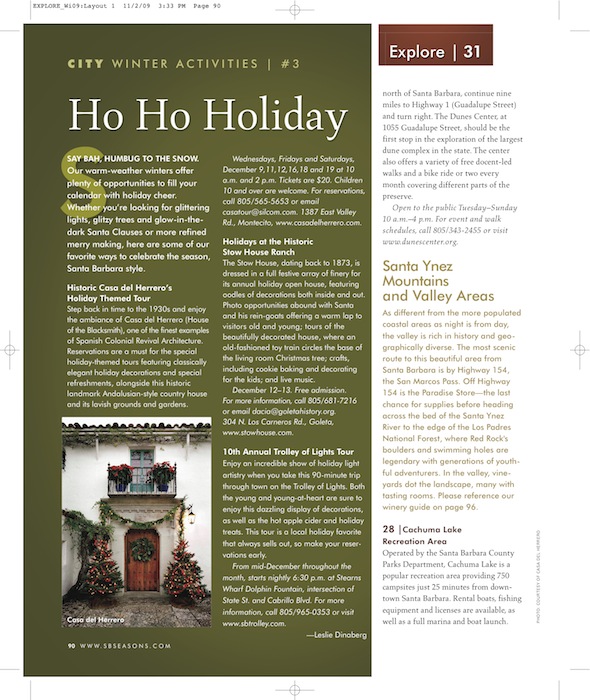
Casa Del Herrero, courtesy photo.

Casa Del Herrero, courtesy photo.

Say bah, humbug to the snow. Our warm-weather winters offer plenty of opportunities to fill your calendar with holiday cheer. Whether you’re looking for glittering lights, glitzy trees and glow-in-the-dark Santa Clauses, or more refined merry making, here are some of our favorite ways to celebrate the season, Santa Barbara style.

Historic Casa del Herrero’s Holiday-Themed Tour

Step back in time to the 1930s and cas enjoy the ambiance of Casa del Herrero (House of the Blacksmith), one of the finest examples of Spanish Colonial Revival Architecture. Reservations are a must for the special holiday-themed tours featuring classically elegant holiday decorations and special refreshments, alongside this historic landmark Andalusian-style country house and its lavish grounds and gardens.

Wednesdays, Fridays and Saturdays, December 9,11,12,16,18 and 19th at 10 a.m. and 2 p.m. Tickets are $20. Children 10 and over are welcome. For reservations call (805) 565-5653 or email casatour@silcom.com. 1387 East Valley Road, Montecito. www.casadelherrero.com.

Holidays at the Historic Stow House Ranch

The Stow House, dating back to 1873, will be dressed in a full festive array of finery for its annual holiday open house, featuring oodles of decorations both inside and out. Photo opportunities abound with Santa and his rein-goats offering a warm lap to visitors old and young; tours of the beautifully decorated house, where an old-fashioned toy train circles the base of the living room Christmas tree; crafts, including cookie-baking and decorating for the kids and live music.

December 12 and 13. Free admission. Call (805) 681-7216 or email dacia@goletahistory.org for more information. 304 N. Los Carneros Road, Goleta. www.stowhouse.com.

10th Annual Trolley of Lights Tour

Enjoy an incredible show of holiday light artistry when you take this 90-minute trip through town on the Trolley of Lights. Both the young and young-at-heart are sure to enjoy this dazzling display of decorations, as well as the hot apple cider and holiday treats. This tour is a local holiday favorite that always sells out, so make your reservations early.

From mid-December and throughout the month meets at 6:30 p.m. nightly at Stearns Wharf Dolphin Foundation, intersection of State Street and Cabrillo Boulevard. For more information call (805) 965-0353 or visit sbtrolley.com.

Originally published in the Winter 2009/10 issue of Santa Barbara Seasons Magazine.


Noozhawk Talks: Leslie Dinaberg Sits Down With Michael Wyrsta

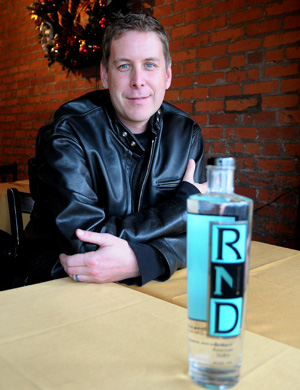
Michael Wyrsta at Opal Restaurant. Photo by Lara Cooper, Noozhawk.

Michael Wyrsta at Opal Restaurant. Photo by Lara Cooper, Noozhawk.

Attacking complicated problems is nothing new to chemist Michael Wyrsta. The
“Gaucho purebred”—who received both his BS and PhD at UCSB—lends his
considerable talents to developing vaccines, solar energy cells, green carbon
technology and eco-friendly building materials and making natural gas into
gasoline and green carbon technology. Now he’s turning his talents to creating
RND Vodka (www.RNDVodka.com), which hit the shelves of Santa Barbara restaurants and
retailers this summer.

Leslie Dinaberg: How on earth did you decide to start this vodka
company?

Michael Wyrsta: (Laughs) That is a really good question. … I was in a liquor store
looking at all the stuff on the shelf and I thought it was pretty unfortunate that all
of the brands on the shelf were pretty much imports.

I mean the good stuff.

… I was like, “why don’t we have something up there that people like or …
people respect or just think that there is some kind of cachet to it?” … So then I
went to lunch with my friend Mark Collins and I said, “You know this is lame. We
should have our own great American vodka.”

He said, “Yeah we should, let’s do it.”

Seriously it was a snap decision.

LD: To try to do it on your own.

MW: Yeah. I wrote a check right there and we just started working on it.

LD: Wow.

MW: We didn’t know anything about making vodka at that time and then we
quickly learned about it. For me as a chemist it’s easy to understand the
chemistry part of it. … But in terms of how do you put a package together, how
do you do all of this stuff we had a lot of stumbling blocks in the
beginning.

Then we got our art director, Kim Kavish involved and she’s great. … She really
helped right the ship and corrected a lot of the mistakes we’ve made in terms of
the design. Then there was a long process of licensing.

LD: So about a year ago you came up with the idea. Did you start developing the
product itself at the same time you started developing the
identity?

MW: Exactly. We have a distillery in Colorado that we worked on our formulation
with.

… What we actually do is ferment our sugar source which comes from corn, and
then go the whole process, fermentation, distillation, purification. We use really
good Colorado Spring water. It’s really clean, it’s really pure and we do our own
filtration, so we do the whole process from grain to bottle.

Then it became a logistic thing. We had to develop the identity, develop the
formulation and then develop the logistics to support all that because we wanted
it to be a unique bottle.

LD: It’s definitely a unique shape. I can also see where this would stand out in a
bar. A lot of vodkas have really pretty designs but they’re just
white.

MW: Exactly. They fade. We call that snoozing on the shelf.

LD: It seems like you’re getting a lot of recognition, including a piece in Sunset
Magazine, especially for how early in the process it is.

MW: Yes, we just launched end of July/early August.

LD: What part of your time is this endeavor?

MW: It does take a lot of my time right now … I have two other companies. A
CO2 company and I also am the CEO and president of a vaccine company up in
San Diego, so I have quite a bit of responsibility with that and I’m really busy.
That’s okay; I like doing all that stuff. For us it’s just something we have to do
until we get up to speed. My wife Inez and my best friend Lindy Lindstrom really
help a lot too.

LD: With high-end vodka is the push more on being in bars and restaurants
versus liquor stores and grocery stores?

MW: We have to be in all of them. We have to be everywhere basically because
they both support each other. … We are an ultra premium vodka, we’re
handmade, so we have more costs, we don’t do mega-scale, which a lot of
people do. So in that respect we’re focused on higher end stores, higher end
restaurants just because of the clientele.

It’s not different than a bottle of wine, if you get a good bottle of wine from Santa
Barbara it’s really expensive but you’re getting something that’s really high
quality.

I’m a scientist, so what I’d like to do is when this thing gets up to speed and we
get some real money coming in and profits, part of our goal is to donate some of
our profits to science education here in Santa Barbara.

LD: That’s great.

MW: Which would be probably through UC Santa Barbara or at that
level.

LD: I was thinking about that because I do a lot of fundraising for the elementary
schools and I can see people objecting to donations from a liquor
company.

MW: And that’s okay, I wouldn’t be against doing anonymous donation because I
understand there’s a perception issue and we wouldn’t want to be encouraging
kids to drink vodka at all. This is isn’t a 9 a.m. vodka; this is a high end sipping
vodka. We’re not promoting that lifestyle so if we were to go that route we would
definitely do something in a more low key, anonymous route.

But for me at least, science is really important and it is to the company too. In a
philosophical sense to us science is one of the few things that has been giving us
answers. We look to it when there is trouble. For example, whether or not it’s
global warming we’re looking towards a whole bunch of solutions but obviously
science plays a part in that. For example, look at the swine flu; we’re looking for a
vaccine to help us out or a drug. People to look to science for answers for really
discrete problems … it’s just sort of a way of thinking about problems and how to
solve them. It’s not about displacing any other belief system or a way of living just
taking stock on how we look at the world and addressing problems head on. I
think that’s important for us and if this is a vehicle to help do that, that’s
great.

LD: Absolutely.

MW: If we can give something back that would be great. That’s how we’re trying
to position it and work it. I live here, Mark lives here, Kim lives here. … We’re
always supporting local events; we did the museum nights for example. We like
to support the arts too, we’ve done Santa Barbara Trustees and the Alumni
Association at UCSB, so we try to be involved in all that stuff.

LD: My best gauge of how good a vodka is, is usually how I feel the next day.
How does one tell a good vodka from a not so good one in terms of taste?

MW: For me-I’m not a heavy drinker and I’m kind of a wimp when it comes to
hard alcohol-so for me I wanted the smoothest, easiest drink of vodka because
ultimately if it’s going to go in a mix, or if you’re going to drink it straight, you want
it to be able to mix well with everything and you want to be able to drink it on the
rocks or with just a little bit of something.

… It has to be really smooth and it has to have a really low burn and really light
feeling … It’s an interesting spirit because it’s very neutral in a lot of ways but
what most people don’t notice there’s a harsh feeling, a burn with a lot of lower
end vodkas and that’s a function of what’s in it. There are other molecules that
are in vodka typically that produce that feeling.

We’ve come up with a formulation that allows up to have a smoother, lighter
feeling. Sunset Magazine recently described it as ethereal and that’s a good way
of describing it.

LD: You’re launching in Santa Barbara at a really good time. There’s this trend of
Farmer’s Market cocktails where people are using all of these fresh ingredients
and sort of the sweet with the sour with the savory, all of this kind of wild stuff
that is pretty new.

MW: I think it’s great. It follows that whole foodie trend so they want high quality
drinks with really fresh ingredients.

LD: I have the list of where it’s sold locally-Roy’s, Opal. Elements, Lazy Acres,
Gelson’s, Liquor and Wine Grotto and on and on. You must have a marketing
person that’s on that.

MW: It’s just me really.

LD: That’s a big job.

MW: Yeah, I know.

LD: How did you come up with the RND Vodka name?

MW: … RND fit a lot with my background in science and markets and also
funding science. It’s a play on research and development, clearly, but it’s also I
always thought it was cool because on your gearbox in a car it’s always RND,
reverse, neutral and drive. So I always thought that was a cool little thing with
both the science and the way you see it every day in your car.

… We wanted to make it a little bit more ambiguous versus just research and
development where you would use an ampersand typically. People might be able
to come up with their own names for it: Rebels Never Die, or Restores Natural
Desires. There are so many things that people have come up with, we have a
bunch of them on our Facebook site. (http://www.facebook.com/pages/RND-
Vodka/102416823144?ref=search&sid=1443134086.1675449040..1)

LD: When you came here for college from Rochester, New York, did you think
you were going to stay?

MW: No. When I first got here for college I was like, “Oh my God where am I?” I
had no idea. It was a different universe. It took me a year to used to it. But then
you adapt. It is really different, I mean it’s almost like a different country, … but
once you figure it out it’s a great place-I love it.

LD: What else do you do when you’re not working?

MW: I love mountain biking; I surf if there’s surf. … I love the ocean and the
mountains so I take advantage of both of those.

LD: If you could pick three adjectives to describe yourself, what would they
be?

MW: Oh no. Three adjectives. Oh God. Busy, really busy. I also think I’m creative
and hopeful.

Vital Stats: Michael Wyrsta

Born: In Rochester, New York, July 6, 1974

Family: Wife Inez

Civic Involvement: Donates to a number of organizations including UCSB Alumni
Association, CALPIRG, Santa Barbara Museum of Art, Acts of Love-Autism
Speaks and the Trustee Association of Santa Barbara.

Professional Accomplishments: Graduated from UCSB in 1996 with a BS in
Microbiology and received a PhD in Materials from UCSB in 2002. Chemist for
start-up ventures, including GRT, Inc, SBA Materials, and BioSolar, Inc;
President and Founder, RND Spirits, Inc.

Best Book You’ve Read Recently: Fooled by Randomness by Nassim Nicholas
Taleb.

Little-Known Fact: “I’ll give you two. I went to a Jesuit High School and I had
long, blond dreadlocks right before I got my PhD.”

Originally published in Noozhawk on December 13, 2009. To read the article on that site click here.

The Next Generation of Dolls

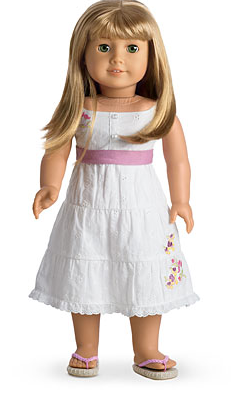
The Gwen Thompson American Girl Doll

The Gwen Thompson American Girl Doll

Shopping for little girls is one of my favorite things about the holidays. Not that balls, books and board games aren’t exciting to shop for, but for a boy-mom like myself, there’s something magical about wandering through the pink-drenched aisles of the girls’ section of a toy store. I’ve heard animated birds chirp and seen fluffy cotton candy clouds burst into a storm of glitter when I shop in the girls’ aisle.

The Barbies are familiar—especially the Barbie Twilight Edward doll, who was on every magazine cover in the universe last month—but the Bratz, Earth Friends, Global Green Pals and Sushiami dolls are glamorous, exotic, foreign creatures. I can’t wait to inspect each and every one.

The Poupettes are pretty cute, and Moxie Girlz Sophia’s tutu is darling, but there’s a different name on my nieces’ list this year—Gwen Thompson. She’s one of the newest characters in the American Girl Doll collection and when I asked to take a look at her, the saleswoman said she’s only available through the American Girl Company.

Uh oh. I was afraid of that. I’ve only ventured into American Girl Place once, but it still scares me.

Actually it’s not just the store that scares me-although one step into this alternate universe where girls and their dolls dress alike, have their “Do’s” done at the Doll Hair Salon and their “Don’ts” repaired at the Doll Hospital is enough to drive a sane adult insane, and make the “It’s A Small World” ride at Disneyland seem downright subtle-the doll scares me too.

Gwen-who costs $95 and that doesn’t include a winter coat-is a homeless American Girl Doll.

Not homeless as in “hasn’t been sold yet and is still living on the shelves of American Girl Place waiting to come home with an eager little girl,” but homeless as in “she doesn’t have a place to live.” I’m guessing she doesn’t see the irony of arriving in a cardboard box.

Conceived as a friend character to Chrissa, the “2009 Girl of the Year” who has her own movie coming out in January, Gwen’s story is told in her history book (which is included in the $95 price). There you learn that her father lost his job and walked out on the family, then her mother lost her job and Gwen and her mom spent several months sleeping in the family car before they got a new place to stay through Sunrise House, a homeless shelter for women and children.

Wow. Now I’m waiting for the doll inspired by Amy Winehouse.

That’s a lot of baggage to lay on a doll. It might even more stressful than Barbie’s WNBA Player, Astronaut, Veterinarian, and Supermodel career path. When Gwen first hit the shelves earlier this year it’s no surprise that she was controversial.

About.com women’s issues writer Linda Lowen wondered, “How does a toy manufacturer reconcile the excesses of privilege with the unmet basic needs caused by deprivation? By creating a character who faces these challenges and by manufacturing a doll in her likeness, is Mattel opening up an important dialogue or slapping a Barbie Band Aid on a social issue that’s been prettified and commodified?”

New York Post columnist Andrea Peyser went so far as to call out the doll as inappropriate “political indoctrination” intended to encourage children to sympathize with the homeless. “It seems obscene that a company that prides itself on teaching impressionable children about history and-you can have your doll’s hair done for $20! -should engage in political preaching,” she wrote, setting off a firestorm of criticism of the company, the most valid of which I thought was that the proceeds from sales should go toward helping actual homeless children. (By giving them food, clothing and shelter, in addition to cartloads of overpriced dolls.)

Said an American Girl Company spokesperson: “The doll is meant to teach tolerance and is part of an outreach program teaching young girls how to spot bullying and stand up and speak out against it.” They have also stated that the dolls “offer valuable lessons about life,” and are “disheartened that there has been any confusion over our fictional characters.”

The company also pointed out that it has given almost $500,000 to HomeAid, a national nonprofit group that helps the homeless find housing.

A $500,000 donation to help the homeless does make this a little more palatable, but I don’t think that the homeless doll will be finding its way into my nieces’ homes anytime soon. On my budget, I’d probably end up like Gwen.

When Leslie’s not playing in the toy aisles, she can be reached at Leslie@LeslieDinaberg.com. For more columns visit www.LeslieDinaberg.com. Originally published in the Santa Barbara Daily Sound on December 11, 2009.

Childhood Pre Postmortem

© Paha_l | Dreamstime Stock Photos & Stock Free Images

© Paha_l | Dreamstime Stock Photos & Stock Free Images

“I guess I’m really a grown-up now” is a thought that has crossed my mind a lot lately.

I think my “kid emeritus” status has less to do with the rings on my trunk — and the wrinkles on my neck — than it has to do with the inescapable passage of time.

This week it was the anticipation of attending the memorial service for the father of a dear old friend that spurred my “I guess I’m really a grown-up” thoughts.

If middle-age has a rite of passage, attending your friends’ parents’ funerals must be it. In our twenties and thirties, our get-togethers were about engagements, weddings and babies. Now they are starting to be about funerals. It’s definitely not as much fun.

Losing a parent may be a common experience once you get to be in your 40s, but that doesn’t make it any less difficult. No matter how much you anticipate the loss – in this case my friend’s father battled cancer for ten years – it’s still a shock.

“My mom was on Hospice care and they told me she had only days to live, but I still didn’t quite believe it when it happened,” said my friend Ron. “It seemed like such a surprise.”

Many people think that once they reach the age of adulthood and get beyond the milestones of marriage and parenthood there are no more surprises. Surprise, surprise — it couldn’t be further from the truth.

“A myth supported by most theories of pre-adult development is that at the end of adolescence you get yourself together and, as a normal, mature adult, you enter into a relatively stable, integrated life pattern that can continue more or less indefinitely,” wrote psychologist Daniel Levinson. “This is a rather cruel illusion since it leads people in early adulthood to believe that they are, or should be, fully adult and settled, and that there are no major crises or developmental changes ahead.”

I’ll never forget how devastated and shocked I was the first time my mom got cancer. I was out of college and living on my own, but I could not have been more crushed by the news if I were a little girl and completely dependent on her.

That was my first dress rehearsal for the death of a parent. Thankfully, even though we’ve had a few more rehearsals over the years, we haven’t gotten to the curtain call yet.

“Our parents project an illusion of permanence,” writes Alexander Levy in “The Orphaned Adult: Understanding And Coping With Grief And Change After The Death Of Our Parents.” “Their death forces us to confront our own mortality.”

“Before we have experienced the death of a parent, we may expect that this will be a fairly minor milestone in our adult development. In fact, we may implicitly believe that once we reach adulthood, particularly if we have children of our own, that our development is more or less complete. We do not expect that there will be major changes in the way we experience the world or react to it. The research … demonstrates that the loss of a parent has profound and wide-ranging consequences for most of us,” wrote Debra Umberson in “Death of a Parent: Transition to a New Adult Identity.”

“It still surprises me that the stupidest little things can bring me to tears,” said my friend Carol, whose father passed away last year. “My dad used to love Nutter Butter cookies, and when I saw that flavor of yogurt last week I just lost it.”

I almost lost it myself when she shared this story. Frankly, every time one of my friends’ parents dies, I feel like it’s yet another dress rehearsal for the day my own parents pass away. I know it’s morbid, but I can’t help myself.

The idea that “we are next in line to die,” as Levy wrote, is the very thing that may actually force us to grow up. And yet – just like my son already knows that growing up is going to include more responsibilities than he wants to undertake – I really don’t want to have to grow up.

Share your thoughts with Leslie@LeslieDinaberg.com. For more columns visit www.LeslieDinaberg.com.Originally published in the Santa Barbara Daily Sound on October 9, 2009.