Mixed Messages

Television by Salvatore Vuono (freedigitalphotos.net)

Television by Salvatore Vuono (freedigitalphotos.net)

Be careful — what your kids watch may be hazardous to their health and your wallet.

If TV is “chewing gum for the eyes,” as Architect Frank Lloyd Wright once said, it may be causing more than tooth decay in children — TV may also be making them fat, according to two new studies.

“The more than 1,000 hours that the average school child will spend in front of the television this year will harm him or her far more than the one second of Janet Jackson’s breast,” said TV-Turnoff Network Executive Director Frank Vespe.

The typical child sees about 40,000 ads a year on TV and the majority of ads targeted to kids are for candy, cereal, soda and fast food, a report by the Kaiser Family Foundation found. In addition, many of the ad campaigns enlist children’s favorite TV and movie characters — Spongebob Cheez-Its, Scooby-Doo Cereal, Teletubbies Happy Meals, to name a few — to pitch products.

Apparently the $12 billion per year spent on advertising to youth works. “Commercials make people want to buy things, like Cox high speed internet,” said 4-year-old Sophia Bordofsky.

Indeed, a series of studies examining product choices found that children recalled content from ads they’d seen, and their preference for a product occurred with as little as a single commercial exposure and grew stronger with repeated exposures, found a recent report by the American Psychological Association. The Kaiser study also found that exposure to food advertising affects children’s food choices and requests for products in the supermarket.

While there’s no doubt that advertisers are selling to children, not everyone is buying. Many parents restrict their children’s viewing. “They do have to do their homework first and they have to take turns picking a show,” said Misty Bordofsky, Santa Barbara mother of four children aged 4 to 13. “Usually they’ll leave the room and go do something else if it’s the show another kid picked,” she said.

Numerous parents may limit their children to watching videos and commercial-free television and a rare few don’t let their kids watch TV at all.

“I am appalled by marketing that targets children with ads for junk food and toys. Young children are not able to understand the inherent bias of an advertisement. They are easy targets,” said Charla Bregante, a Goleta mother of two who is in that 2 percent demographic that does not own a television.

“Most of the advertising during children’s programming is for junk food such as candy, chips, and sugared cereals. Kids are given the message that these foods are desirable and nag their parents to buy them. In addition, children tend to snack more while they are watching TV. Turning off the TV is one of the best ways to fight obesity in children. Almost any other activity will use more energy than sitting in front of a television,” said Bregante.

“While older children and adults understand the inherent bias of advertising, younger children do not, and therefore tend to interpret commercial claims and appeals as accurate and truthful information,” said psychologist Dale Kunkel, a professor of communication at UCSB and senior author of the APA report, which recommends restricting ads targeting children under the age of 8.

“I can tell you that my children rarely nag me for a specific toy or food item. I believe this is because they are not exposed to television advertising and the consumer culture promoted in television programming,” said Bregante, who encouraged families to participate in TV-Turnoff Week, April 19-25 (www.tvturnoff.org).

Is there anything positive for kids on television? Yes, according to Professor Kunkel: “There are lots of positive influences that may result from children’s viewing of certain pro-social or educational programs. The problem is that parents have to mine the media landscape pretty hard to find those occasional nuggets.”

Television is an (almost) inescapable part of modern culture. “With the recent explosion in satellite and digital specialty channels, we now have access to a plethora of both good quality and inappropriate TV content. In this crowded television environment, the key for parents is to search out high quality TV programs for their kids, and whenever possible, enjoy them together as a family,” recommends the Media Awareness Network, a nonprofit organization that focuses on media literacy.

For parents who don’t want to opt out completely, David Kleeman, Director of the American Center for Children and Media, recommends that parents ask the following questions to select viewing that is good for children:

Does the program actively engage my child, physically or intellectually? Television watching doesn’t have to be passive. It can prompt questions, kindle curiosity, or teach activities to pursue when the set is off.

Does my child see others like himself or herself on television? Young children believe that television reflects the real world. To not see people like themselves — in race, ethnicity, or physical ability, for example — may diminish their self-worth. A lack of role models should spark discussion about how TV portrays different types of people.

Do I respect this program? Parents don’t have to like every show their children choose — in fact, young people need their own district culture. But parents should trust that a program’s creators understand and respect how children grow and learn.

Originally published in South Coast Beacon

Making their presence felt

Women's Fund of Santa BarbaraWomen’s Fund getting more bang for bucks

Looking for a low-key, high-impact way to tap into the power of collective philanthropy, Carol Palladini was inspired when she read a Los Angeles Times article about the Everychild Foundation. The idea is simple. Take the time, energy, and money spent on mounting and attending elaborate fund raisers and write a single check once a year.

The appeal was also simple: “Many women in the Santa Barbara area feel not only a need, but an obligation to be a powerful force for good in our community,” Palladini wrote in the invitation letter to the inaugural members of the Women’s Fund of Santa Barbara.

A few short months after that initial request, the Women’s Fund awarded its first donations on Jan. 31, giving $105,000 to the Santa Barbara Neighborhood Clinic’s Eastside Family Dental Clinic and $35,000 to two St. Vincent’s programs, PATHS (Program of Affordable Transitional Housing and Services) and Casa Alegria, an infant and toddler care facility.

“A group of women had been meeting at the Santa Barbara Foundation to talk about women and philanthropy,” explained Palladini. That group eventually evolved into a founding committee that included Palladini, Peri Harcourt, Shirley Ann Hurley, Jean Kaplan, Dale Kern, Joanne Rapp, Elna Scheinfeld, Meredith Scott, Anne Smith, Kay Stern, Marsha Wayne and Fritzie Yamin, as well as Raynette Cornejo, the Santa Barbara Foundation liaison.

Their intention was to take a year to develop the plan for the Women’s Fund, “but people started calling and saying ‘when can we write checks?’ which is amazing because usually you have to cajole and pull money out of people,” said Palladini.

“All it took was a letter of invitation to 500 women and the money started coming in,” said Palladini.

Each member contributes a minimum of $2,500 per year, which is then deposited in Donor Advised Fund administered by the Santa Barbara Foundation. At the end of the year, 90 percent of the funds collected are donated to one or more local nonprofit organizations.

“Our umbrella for giving is meeting unmet needs for women, children and families in the greater Santa Barbara area,” said Palladini. “The main goal is not to divvy it up in little tidbits, so that the impact of collective women’s giving is really felt.”

Granting is decided by a simple majority vote of members. Women who wish to ease the cost of dues may form a donor group, which then shares one vote in how the money is spent.

To join, send a check payable to Women’s Fund of Santa Barbara, c/o Santa Barbara Foundation, 15 E. Carrillo St., Santa Barbara 93101. For more information, contact Palladini at 565.0342 or e-mail her at carolpall@earthlink.net.

Originally published in South Coast Beacon in 2007.

Where Silence is Golden

The Immaculate Heart Center for Spiritual Renewal

A feeling of tranquility and peace welcomes visitors as they enter the grounds of Montecito’s historic estate, La Casa de Maria, and head up the oak tree-lined driveway to the grand stone house in the center of the 26-acre nonprofit interfaith retreat and conference center. Once considered holy ground by the Chumash nation, today La Casa de Maria offers a quiet destination for people of all faiths to escape the stress of everyday life and deepen their spirituality through individual and couples retreats in the intimate surroundings of the Immaculate Heart Center for Spiritual Renewal, or in group gatherings throughout La Casa’s campus.

La Casa’s property was originally part of the San Ysidro Ranch; then became El Prado Rancho, the first lemon orchard in the area; then later became Rancho El Bosque, which brought the addition of the estate house, designed by architect Mary Craig. The home, which now houses the Immaculate Heart Center, remains mostly intact today, featuring stone quarried from nearby San Ysidro Creek, hand-carved teak ceilings, distinctive Italian fireplace mantels, and courtyard tiles from Spain.

“It is a very prayerful surrounding,” says Carol Carrig, the center’s director since 1997. Offering a spiritual bed and breakfast getaway, with delicious organic meals made from produce grown on the property and prepared by the Immaculate Heart Community of former nuns, guests often start out visiting for a few days, then come back again for longer retreats. “They realize that they’re getting in getting in touch with the deeper things that are going on within themselves,” says Carrig.

But beneath the peace and solitude of the center lies a long and storied history, not just of faith, but also of integrity, determination, and vision.

In 1943 Novice Mistress Mother Regina McPartlin, along with 12 novice Sisters of the Immaculate Heart of Mary, turned the estate into a Novitiate, where young women train to become nuns. While they pursued religious life on La Casa’s grounds, the peaceful surroundings were also gaining a reputation in Hollywood. Stars such as Irene Dunne, Loretta Young, and Ricardo Montalban came for retreats, holding prayer services in the Novitiate by day, while staying overnight at the Biltmore. In 1955, La Casa de Maria Retreat House formed and became the first retreat center for Catholic married couples. “Every weekend for probably 15 years, 40 married couples came to La Casa. The priests said mass for them, gave them conferences, they renewed their marriage vows, and had wonderful weekends,” says Stephanie Glatt, director of La Casa de Maria.

During the 1960s, there were conflicts between James Francis McIntyre-the Cardinal Archbishop of Los Angeles who oversaw the Immaculate Heart community-and the sisters’ understanding of the Vatican’s directive to update the church for contemporary times. “McIntyre said, ‘either follow what I say or give up your vows,'” recalls Carrig. “So that’s what we decided to do. To remain a community and to follow what we believed should be the right direction-but everybody had to give up their vows.”

The sisters took the revolutionary step of evolving into the Immaculate Heart Community, an ecumenical group of men and women, both single and married. Rather than fall apart, as many predicted, the Immaculate Heart Community has stayed together and thrived, with almost 200 members still active around the world. The community has operated the Immaculate Heart Center for Spiritual Renewal since 1974, opening its doors for private retreats for people of all faiths.

“It feels like a holy land. Not like Christian, I mean it just feels that the meditation, the peace, the quiet there is special,” says author/psychotherapist Alyce Faye Cleese, one of La Casa’s patrons. She calls the sisters “renegade nuns,” adding, “their story, for their day as women, was an extraordinary piece of women’s lib really-their courage and their bravery and their saying, ‘We’re women, we can do this and we will survive.'”

Today La Casa offers a wide array of programs, such as 12 Step Retreats; the Sacred Art of Living and Dying (for caregivers); Kaballah (Jewish Mysticism) (Jewish Mysticism); Waking up on Earth: Spiritual Life in a Time of Crisis; Centering Prayer Practice Retreats; Recovering Religion as a Work of the Imagination; and Capacitar, which combines Tai Chi, meditation and other practices that integrate spirituality and body wisdom.

In 2005, the Immaculate Heart Community bought back the entire property and is now in the process of a $7.7 million capital campaign. In addition to paying off the mortgage, they also plan to renew the conference buildings, preserve the ecology of the site-including the creating a sustainable agricultural site that protects native plants; developing an organic orchard/garden to provide the produce for the dining rooms; and improving the overall health of the citrus orchard and native Coast Live Oak grove-and develop additional La Casa-sponsored programs. “Part of that is our plan to integrate La Casa de Maria with the greater community and have more people understanding what we’re doing and supporting our program,” says capital campaign chair Christine Garvey, a retired banker. “We’ve mobilized a lot of the neighbors.”

One “neighborly” recruit is capital campaign cabinet member Joan Kreiss, a physician who did AIDS research in Africa before moving to town seven years ago. “What I love about La Casa de Maria is its rich sense of history,” she says. “For our family-and this is particularly important for my children-living next door to La Casa de Maria… gives a sense of context, a sense of being part of a historical continuum.”

“It’s kind of like Peter Pan, you have to believe,” says Cleese. “Not in God, just believing in the goodness of people and the goodness of nature and that something (like La Casa de Maria) is worth existing.”

For more information on La Casa de Maria, call Stephanie Glatt at 969.5031 ext. 204 or visit www.lacasademaria.org.

Originally published in Santa Barbara Magazine

Generation BMX

Young racers test their mettle with their pedals

Faster, higher and often younger than you might imagine, BMX racers are tearing up the dirt at Elings Park every Friday night.

Elings Park BMX (courtesy photo)

Elings Park BMX (courtesy photo)

The sport, which first became popular in the 1970s, is one of the fastest-growing competitions in the country, partially due to the popularity of the X Games and BMX-inspired DVDs, video and computer games. BMX (bicycle motocross) is scheduled to become an Olympic sport in 2008 and, according to Dale Bowers, track director of Santa Barbara BMX, there are three or four local bikers who “could be peaking” at that time.

Several local BMX racers will be competing in the National Bicycle League NBL Grands in Louisville, Ky., this weekend, including Logan Beebe, Chris Burke, Austin Davis, Michael Davis, Austin Hamilton, Jarrett Kolich Kolich, Amber Melgoza, Brianna Wiley and Jason Wiley.

While the level of expertise in Santa Barbara is high, Bowers emphasized that there’s a BMX skill level race for everyone, including beginners — and grownups. If you can ride a bike, you can BMX, which means there are some pretty impressive 5- and 6-year-olds out there.

Racers work their way up, depending on their age and how good they are, said Scott Berry, a 13-year-old La Colina Junior High student.

“I saw commercials on TV and really wanted to try it … we came up on a Friday night and just watched,” he said. “I just liked what I saw and wanted to try it.”

Bowers recommended that interested families follow Scott’s lead: just come to the track and check it out. “It doesn’t cost anything to come in and watch. Not much you can do for free on a Friday night, and its exciting entertainment.”

For participants, too, BMX is very affordable, said Scott’s mother, Debbie Carder.

It costs $45 per year to join the NBL, with a 30-day trial membership available for $30 (which is credited toward the full membership). Races, which take place most Fridays beginning at 6 p.m., are $8, and practices, at 6 p.m. Wednesdays, are $5.

“They’re so helpful, too,” emphasized Carder. “Even the older kids … they take the time to help the little ones. They go out of their way. They’re not snotty. They just take them under their wing … without being asked. It’s kind of like a family in a way.”

Originally published in South Coast Beacon

Talk about a walk

Photo by graur razvan ionut (freedigitalphotos.net)

Photo by graur razvan ionut (freedigitalphotos.net)

After 27 years, these ladies think they’ve hit their stride

It’s been said that walking a mile in someone’s shoes fuels greater understanding — so just imagine what walking three miles together, five days a week, for 27 years, will fuel.

In the case of walking partners Judy Bernstein, Beverley Brier, Natalie Gaynes, Barbara Mizes, Blanca Presser and Phyllis Cox (who joined the group in 1998), they’ve shared laughter, friendship, triumph and sorrow. They’ve also seen how the South Coast has changed in the Patterson Avenue/Kellogg School neighborhood they’ve walked for so many years.

“We have been through the many travails all these years, starting with young children, teenagers, college entrance exams, weddings and now grandchildren…” Brier said. “One gentleman who has seen us walking for years said we look like Pacman, the mouths are all going a mile-a-minute.”

The mouths may be moving quickly, but so are the legs. Even our 20-something photographer was huffing and puffing as we took an early morning walk with these dynamos.

Presser and Gaynes started walking together and the others quickly joined in. Bernstein said she started out trying to get in shape for her first trip to Europe, adding that having a group of friends to exercise with is very motivating.

“It’s so long and so boring and so tiring and when you talk, you don’t notice it,” Bernstein said.

“We solve the world’s problems on our walks,” Brier said.

“But most of them are personal,” Bernstein added.

Cox recalled that she joined the group the year before her daughter got married, and had her friends help guide her through the planning. Last week, Mizes was planning her father’s funeral and Brier was helping with a memorial for a close friend.

While the ladies have serious discussions during their walks, sometimes inspired by their lives and sometimes by the changes they see, they also have fun.

Not only have the women formed friendships among themselves, they’ve gotten to know the neighbors. The men at a residential care home wave each morning and let them know if they’re running late, while the neighborhood dogs expect a pat on the head.

“I cannot tell you how many people that I meet at a dinner party who say, ‘Do I see you walking?'” Mizes said.

The sweat is pouring but the banter stays lively throughout our walk.

Some of their husbands wonder how they have so much to say to each other, but Brier said they’re never at a loss.

“If you want to say something you have to jump in,” said Mizes, who once recruited a member (Ginny Alexander, who has since moved) on a flight to London. She even tried to get the Beacon staffers to join.

“We’ll get you through all of the trials and tribulations,” she said. “Every time you think you’ve got a problem, by the time you go through us giving you input you’ll feel better.”

Thanks. We already do.

Originally published in South Coast Beacon

Crazy Busy or Just Plain Crazy

jesadaphorn, freedigitalphotos.net

jesadaphorn, freedigitalphotos.net

As I write this first sentence, I’m on hold with my insurance company-again. I’m also listening to phone messages, soaking my whites in bleach, taping an episode of “Next Food Network Star,” stretching my quads, doing a few Kegel exercises and sipping my coffee, which I know is bad for me again this month, because I read it in “Prevention” while I was standing in line at Vons this morning.

It’s taken years of practice, but I’ve finally ratcheted my level of multitasking to “Rock Star,” and now I find out that there’s some new research that says multitasking actually slows you down. I had to push my 1:15 ’til 2:30 and ignore my email, but I managed to get myself to the library to get a peek at psychiatrist Edward Hallowell’s book, “Crazy Busy: Overstretched, Overbooked, and About to Snap! Strategies for Coping in a World Gone ADD.”

You don’t think I have time to actually buy and read a book about busyness, do you? But I skimmed it, for free, and I really tried to focus on the book, and only the book, during the 13 minutes I calculated it would take the meter maid to get to my illegally parked car.

The good doctor, who specializes in Attention Deficit Disorder (ADD), says that it is literally impossible to pay conscious attention to doing more than one thing at once. Instead, you end up paying conscious attention to several tasks in succession, and not doing any of them very well. When you switch your brain between tasks you end up wasting, rather than saving, precious time because your brain continually has to restart and refocus.

Are you kidding me? And here I was thinking it might be time to have another baby now that there’s a breast pump with a car adaptor (the Pump in Style) on the market. Just don’t drive over any bumps while you pump.

My husband-who would never dare to sully the experience of watching ESPN by matching a pair of socks, even when they accidentally whack him on the side of the head-has sworn by the do-one-thing-at-a-time-theory for years. Has hell finally frozen over? If not, he can’t possibly be right.

And yet, other experts also support the movement towards uni- tasking. A study at the University of Michigan found that multitasking leads to expensive “time costs.” Team leader Dr. David Meyer says that the additional time required to switch between one task and another tends to increase with the complexity of the chores involved. And that over the long run, the time required to make these switches may lead to a 20 to 40 percent decrease in actual productivity.

A 40 percent decrease? I can’t afford that. As much yammering as I do about how busy I am-and I am actually pretty busy-the reason that I need to multitask is to make sure that I also have time to read novels, catch a movie once in a while and take a long lunch with a friend.

Sometimes I’m almost embarrassed to admit that it’s more important to me have a social life than it is to have a clean house or actually bake the cookies myself. Sometimes there’s this undertone of bragging or one-upmanship when people, especially moms, talk about how busy they are. And I’m always a little self-conscious that I, as the mother of one, will never be as busy as my nut job friends who have four or more children. But I work! C’mon, give a girl a few points.

Of course the trouble with writing about busyness is that it makes you even more hyper-aware of how you spend each moment. It’s exhausting. If I didn’t have to change the laundry loads, write a speech, pick up the trash, and take out the kid, I might take a nap.

Why not find out if you can walk, chew gum, and send an email to Leslie@LeslieDinaberg.com at the same time? For more of Leslie’s columns visit www.lesliedinaberg.com.  Originally published in the Santa Barbara Daily Sound on June 22, 2012.

Halloween Scares up Money and Merriment

Image courtesy of [image creator name] / FreeDigitalPhotos.net

Image courtesy of samattiw/ FreeDigitalPhotos.net

You can buy a lot of wax lips, slutty pumpkin costumes and glow-in-the-dark plastic maggots for $6.9 billion. The National Retail Federation’s (NRF) annual survey, conducted by BigResearch, says that seven in 10 Americans plan to celebrate Halloween this year. That’s up from 64% last year, and is the most celebrants in the National Retail Federation survey’s 10-year history.

More than 30% of adults aged 18 and above plan to attend a party this year, according to a report from Morpace Omnibus. The most active partygoers are adults aged 18-34 (54%) Of course, these are the most active partygoers for Groundhog Day parties and Superbowl parties and Punctuation Day parties too.

Only 29% of people between the ages of 35-54 are attending a Halloween party this year, but I’m sure that has nothing to do with the slutty costume selections and our out-of-shape drinking muscles and everything to do with the fact that Halloween is on a Monday this year and some of us oldsters still really like Dancing With the Stars.

While the holiday has always been an opportunity to let loose and have a bit of fun, there’s a lot more to acquire on Halloween than adorable bite-sized candy bars. That $6.9 billion in spending is up from $5.8 billion a year ago, which is scary good news for retailers.

The BigResearch survey found that the average person plans to spend $72.31 on the holiday, with spending on costumes alone expected to exceed $2.5 billion, spending on candy to reach $2 billion, and $1.88 billion for decorations.

Yowza.

Why are we so enamored with inflatable skeletons, candy corn, and fake cobwebs? I’ve got a few theories:

Halloween is the naughty little sister of Christmas.

There are parties and candy associated with both, but little sis (Halloween) is a lot looser than big sis (Christmas). She doesn’t feel that same sense of tradition and responsibility. She just wants to have fun. Instead of mistletoe, which must be grown or purchased, little sis (Halloween) has cobwebs, which you can find for free at my house. Big sis (Christmas) takes herself so seriously, with all that ritual stuff about keeping traditions alive, not to mention the cooking, the tipping, the shopping, the wrapping, the cards. … No wonder she gets migraines.

Halloween is the new Christmas.

It comes earlier, lasts longer, and gets more expensive every year. While the boatloads of mini Snickers and paper pumpkin decorations that adorn store aisles just minutes after the Valentine’s Day conversation hearts and cupids are put on clearance pale in comparison to the plethora of dancing Santas, candy canes and fake snow, that’s only because my Christmas shopping theory of “one for you, one for me” is finally catching on. Otherwise, Halloween would be winning the consumer consumption race by now since the only “green” thing about it is the glow-in-the- dark goblins. Just think about how many of your Halloween purchases are edible (Reese’s peanut butter cups must be consumed within a week or they will haunt you), potentially delinquent (pumpkins will either end up as roadkill or as a landscape accoutrement to toilet paper), or non-repeatable (like that Sarah Palin costume from 2008).

The Grinch stole Christmas, but the adults stole Halloween.

Increasingly, adults have been elbowing children out of the way to claim Halloween as their own. After all, what’s not to like about a holiday where you can dress up in an esoteric costume and pat yourself on the back for being smarter than other people when you continually have to explain what you are. Or a holiday where you can knock on someone’s door while wearing a mask and don’t have to worry about them calling the cops, or better yet you can eat mini candy bars and fantasize that you’ve become a giant.

Halloween is the baggage-less Christmas.

The very best thing about Halloween is that it’s the only holiday no one can claim you’re “forgetting the true meaning of.” Halloween is all about the two “C’s”: costumes and candy. Think about it. You get to wear slutty or scary (or slutty and scary) costumes and no one gives you a hard time, and then you get to demand chocolate from other people because you did so.

Now that’s my kind of holiday.

Leslie’s favorite Halloween joke is: “What did one ghost say to the other ghost? Do you believe in people?” Send yours to Leslie@LeslieDinaberg.com. For more columns visit www.LeslieDinaberg.com.

Originally published in the Santa Barbara Daily Sound on October 28, 2011.

Do Kids Make You Fat?

Photo by artur84 freedigitalphotos.net

Photo by artur84 freedigitalphotos.net

Only if you add sugar.

I have no doubt that having kids makes your heart fuller and your wallet slimmer, but what about your waistline? According to a study by the University of Iowa College of Medicine and the University of Michigan, living with the little darlings also makes your belly bulge. And I’m not talking about pregnancy pudge here. Nor am I referring to all of that “drinking for two” that most fathers-to-be indulge in.

Nope, an examination of the nutritional cost of parenting found that simply living with children boosts your fat intake by almost five grams a day.

Could this mean that those last few bites of macaroni and cheese, pizza crusts and Girl Scout cookie crumbs actually count as calories? Even if you eat them standing up? What if you don’t want to carry the rest of the soccer snacks all the way back to the car? Or what if you bought the extra box of candy for a good cause? Those calories couldn’t possibly make you fat.

As caring and health-conscious parents, my husband and I do our best to intervene with the Halloween candy, Christmas cookies, gingerbread houses, Hanukah gelt, chocolate Easter bunnies and infinite supply of birthday goodie bags. Was it possible that this conscientious parenting was making us fat?

Before I got too stressed out about all this (and began foraging through the leftover birthday goodie bags for chocolate), I went to the most reliable and accurate source of health information available, Google. What do you know, not only does having kids make you fat, so do a lot of other things.

The International Journal of Obesity asked a group of scientists to weigh in on some of the causes of obesity. Number one was subscribing to The International Journal of Obesity.

Their remaining top ten list: 1. Inadequate sleep (there is definitely a connection to having children there). 2. Endocrine disruptors — substances in some foods that may alter fats in the body (I knew all that celery would end up biting me in the butt). 3. Pleasant temperatures — air conditioning and heating limit calories burned from sweating and shivering. 4. Fewer smokers — less appetite suppression. Also, dying makes you very skinny. 5. Medicines that cause weight gain. 6. Population changes — more middle-aged people in the population, who have higher obesity rates. 7. Older mothers — they tend to have heavier children (because they can’t hear Junior when he asks for that fourth cookie). 8. Genetic influences during pregnancy. 9. Darwinian natural selection — fat people living longer. 10. “Assortative” mating — overweight people procreating with others of the same body type, gradually skewing the population toward the heavy end (and providing a boon for the wedding registry business by providing the “supersize” option for china, bedding, towels and lingerie).

Architecture can make you fat too. That’s right, now they are saying that buildings and the way they are designed can make you fat.

“Take out all the elevators in buildings and people would be more fit,” urges a British architect. Even making stairways easier to find will help encourage fitness. And putting houses closer to shops, restaurants and workplaces will encourage people to walk or ride bikes. That’s right, that suburban ranch house that you bought once you had kids…it’s making you fat.

To counteract this phenomenon, I hear that an aerobics tycoon in Dallas is developing a 51-acre community that will be geared around a comprehensive wellness program.

Homeowners will pay a premium to build their own homes alongside a personal trainer, in 300 hour-long sessions. Only a limited number of cars will be allowed in the complex because guess what–you know what else makes you fat–cars. According to a study of Atlanta residents, there is a correlation between driving and weight gain. Each additional hour spent in a car per day is associated with a 6% increase in the likelihood of obesity. You know where moms spend most of their lives? Cars.

All of which leads me to the obvious conclusion that the witch in Hansel and Gretel must be thin because she built her own house, drives a broom, and eats kids instead of living with them. Hmmm…could this be the new Atkins Diet?

Do kids make you fat? Sound off at by emailing Leslie@LeslieDinaberg.com. For more columns visit www.LeslieDinaberg.com. Originally published in the Santa Barbara Daily Sound on October 7, 2011.

Heating up to Fifty

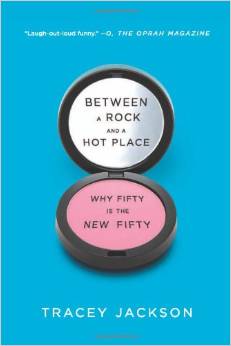
Between a Rock and Hot Place, by Tracey Jackson

Between a Rock and Hot Place, by Tracey Jackson

Let me start out this column by saying that I am not 50 yet.

I am nowhere near 50 years old.

OK, the sum total of my journeys around the sun is not quite 50–yet–but I’m a heck of a lot closer to being 50 than I am to being 30.

The fact that I have difficulty wrapping my head around this oh-so-obvious reality was part of the inspiration for Tracey Jackson‘s humorous new book, Between a Rock and a Hot Place: Why Fifty is Not the New Thirty, a part memoir, part self-help, part rant and always entertaining look at what happens to women when they hit the big Five-O.

“The idea that just because we want to we can turn back the clock and pretend to be thirty is both amusing and insane,” laughed Jackson, speaking to me from the back room of a hair salon. This busy lady fit in our interview during a quick trip home to New York before flying off to D.C. to continue a book tour that includes visits with Kathie Lee and Hoda, Meredith Vierra on “The Today Show” and the Writing Mamas of Corte Madera County.

“Being on a book tour is tiring, but it’s a good kind of whirlwind,” said Jackson, who has had a lot of whirlwinds since her childhood in Santa Barbara, where her extended family still resides. A comedy screenwriter for 17 years–Confessions of a Shopholic and The Guru are some of her better known titles–Jackson writes frankly about being shocked when she got older and the writing jobs started drying up. Ironically, her last screenwriting job was adapting a book called “The Ivy Chronicles,” about a woman who loses her job and reinvents herself.

Jackson also reinvented herself, producing and starring with her daughter in a documentary film called Lucky Ducks, (about the complex relationship boomer parents have with their over-indulged teens), daily blogging and most recently, writing “Between a Rock and a Hot Place.”

All of the hot button middle age stuff is there, with her amusing takes on what could be depressing topics like menopause (“it’s not all in your head, it’s in your vagina”), money (“I didn’t mean to spend it all”), death (“ready or not, here death comes”) and my favorite, “Sex, Estrogen and Not So Much Rock and Roll.”

Of course I immediately turned to the chapter about sex, where Jackson describes in hilarious detail her attempt to spice up her marriage with a trip to a very posh sex store. The resulting misadventures involving Jackson, her husband, a shiny black bag of toys, and Lola Falana (their Chihuahua) made me laugh so hard that I woke up my husband.

With sex, face lifts, finances and sandwich generation challenges of aging parents and exhausting teenagers sitting side-by-side, the book casts a pretty wide net over the issues of “second adulthood.” Jackson said that was her plan from the start.

“When you’re writing a comedic book, which a lot of this is, and then you have to throw in things that aren’t funny, it’s hard. … When you’re writing about death, you’re writing about death so it’s trickier to make that buoyant and make that something that people don’t go ‘OK now I’ve read this really funny chapter about sex and now I’m reading about dying.’ How do you keep that light? … At the end of the day you kind of give in and say OK I’m writing about death, this is not a funny topic any way you cut it, so we just have to kind of go for it. ”

She still manages to get the comedy in– when she talks about death she includes the story of her husband’s spinning teacher dropping dead at the gym. In fact, no matter what the topic, the laughs and hard truths resonate throughout both the book and my conversation with Jackson.

“We aren’t old and we aren’t young; we are in kind of in-between states, passing through the transit lounge of life,” she writes. “No matter how much Botox you get, things will start falling apart: some marriages end, some kids are job, some jobs are terminated, most faces fall and all boobs do. No one bothered to fill us in on this.”

Luckily that’s where Jackson and “Between a Rock and Hot Place” come in.

Tracey Jackson blogs daily at www.traceyjacksononline.com. Maybe Leslie will do that when she’s 50, but for now she writes weekly. Read her columns every Friday in the Santa Barbara Daily Sound or at www.LeslieDinaberg.com. Originally published in the Santa Barbara Daily Sound on March 4, 2011.

How I Lost My Virgo

Virgo by Salvatore Vuono, FreeDigitalPhotos.net

Virgo by Salvatore Vuono, FreeDigitalPhotos.net

I have never really put much faith in astrology and haven’t read my horoscope on a regular basis in years. Still, I’ve always taken a certain pride in being a Virgo. With the beautiful symbol of virginal purity, “Virgos are intellectuals who were born to help others. They are humane and loyal in their jobs and personal lives, preferring calmness and order in life.”

Sounds just like me, right?

Not that I believe that being born under a certain star configuration has influenced my personality in any way. But I’ve always liked the description of Virgo character traits–loyalty, devotion, and feminine charms–figuring if the shoe fits, I may as well squeeze my toes in, alongside fellow Virgos Greta Garbo, Sophia Lauren, Ingrid Bergman and Lauren Bacall.

And now a guy named Parke Kunkle from the Minnesota Planetarium Society has taken my Virgo-ness away from me. He didn’t even buy me dinner first! And now to further insult my virtue, they’re bringing this Ophiuchus character into the mix. That is way too wild for my Virgo sensibilities.

Yet somehow I went to bed a Virgo on Sunday night and woke up a Leo on Monday morning. If I actually believed in horoscopes and all of that stuff, then I’d sure have a lot of rethinking to do.

Not that there’s anything wrong with Leo’s, DiCaprio or otherwise. These “overly creative and energetic lions command everyone’s attention. Brimming with self-confidence, their zeal for life is unmistakable. Leos enjoy taking center stage with a warm, inviting attitude.” My son is a Leo, or at least he used to be. He’s definitely more lion-like than I am, though. I’d love to be brimming with self-confidence and zeal for life.

In fact this whole go-to-bed-a-Virgo-wake-up-a-Leo thing has thrown my self-confidence for a loop. Now that I’ve been deVirgo-ized, I know how Pluto must have felt when it got de-planet-ized.

If I chose a career based on my Zodiac sign, does that mean I’d have to find something Leo-like to do now? And what if all of those “lucky lottery numbers” had actually been lucky for me-but I played the wrong Zodiac sign? I would have to rethink my whole investment strategy.

Wow. What if believing we were astrologically compatible I had married the wrong guy? And what if I had a Virgo tattoo, would I have to have it removed or somehow redrawn into a lion? Are sapphires no longer my birthstone, and do I have to give up my favorite blue earrings?

There must be something we can do to fight this. The Koreans are in my corner. The Korea Astronomy and Space Science Institute released a statement that “the International Astronomical Union, an internationally recognized body regarding astronomical matters, hasn’t made an official announcement on the change of zodiac signs,” with their representative Sul Ah-chim adding that if such a change were to happen, “the decision should be made by the official body.”

Apparently Kunkle fumbled this one.

So, at least for now, Ophiuchus can suck it. I’ll remain a Virgo, even if it’s just in my own mind. Plus I just read another news report that said the new astrology chart is only applicable for people who were born after 2009. I guess that means I’m a Virgo for life!

When Leslie’s not choosing which horoscope to read or ignore, she can be reached at Leslie@LeslieDinaberg.com. Her columns run every Friday in the Santa Barbara Daily Sound. For more columns visit www.LeslieDinaberg.com. Originally published in the Santa Barbara Daily Sound on January 21, 2011.