
La Cumbre principal goes recruiting

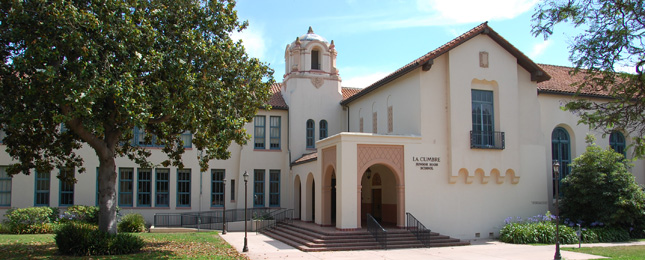
La Cumbre Junior High, courtesy SBUnified.

Touting a closer-knit junior high community, one school aims to turn tide of enrollment

The vibe is different at La Cumbre Junior High these days. While the enrollment numbers are still down, new principal Jo Ann Caines’ dynamic energy seems to be resonating, at least with the people who know the native Santa Barbaran.

Students at Adams School (where she was principal until a few months ago), once a symbol for white flight, are now flocking to La Cumbre.

While only about 450 of the approximately 600 eligible students will attend La Cumbre in the fall, “the composition of our student body is going to be drastically different,” said Caines, “with more of the middle-income and middle- and high-achieving students that didn’t come here before.

“We’ve turned a huge corner thanks to Adams School,” she said, with all but 11 of the more than 100 sixth-graders planning to attend La Cumbre. “So while we’ll be very similar in size, we’ll be hugely different.”

This fall, Caines and assistant principal Jorge Fulco will concentrate on Monroe and Washington schools. Caines has even recruited an Adams fourth-grade parent, Katie Parker, to help her with the outreach.

“Jorge and I have been on the road since Feb. 1 doing outreach,” Caines said. “We gave more tours here … than they have in the prior five years combined.”

Of course, pitching the school is one thing, but telling a compelling story is another — and Caines certainly has one with her reorganization plan.

It might seem to be by design that, when Santa Barbara Community Academy upper-grade students move to La Cumbre’s campus in the fall, the junior high will begin to implement a core knowledge learning community that builds on the same concepts the academy has used successfully. But Caines said she did her research on the core knowledge curriculum (a sequenced, coherent program that uses a grade-by-grade core of common learning) prior to the school board’s decision to move the academy there.

Caines also has a Gifted and Talented Education (GATE)/pre-advanced placement learning community planned, a liberal arts/college preparatory group, and an intensive English development/newcomers community similar to the successful program she implemented at Adams.

Caines emphasized that the communities — which will be separated geographically to make it easier on students — are not tracks.

“Students can participate in any one that they choose or they qualify for,” she said.

Each student will also have a homeroom class where she hopes the smallness of the school will work to its advantage.

“Teachers will not only know their students but the students in that community,” she said.

The staff is coming on board after what Caines characterized as lots of “not easy” discussions.

“Change is hard,” she said. “They’ve been through four principals in two years, so it’s hard to say, ‘Is this really a change or is it going to be different next month kind of thing?’ So what I said to teachers is if it’s not a match for you then you should put in for a transfer because part of what I’m doing is building a new team, and more than anything I want people to be here because they want to be here.”

Three teachers have put in for transfers, but Caines said others are anxious to come to the school because of the new programs.

“Let’s be real. If you asked 100 adults about junior high, 97 of them will say they hated junior high,” she said. “It’s all about friends … Even though we’ll do outreach to the parents, … we’re going to put a lot of energy into the kids, because kids really do decide …They want to go where their friends are.”

Blurred boundaries

Transfers are one of the hot topics of discussion where school needs are concerned. When students transfer in from other districts, the district gets additional money, but intra-district transfers don’t change the funding and campuses like La Colina Junior High (which had only 591 students in 1993-94 and was up to 1,027 students in 2004-05) are getting overcrowded while campuses like La Cumbre Junior High (which had 1,030 students in 1993-94 and now has 433 students) have empty rooms..

Here’s a snapshot look at where secondary students are going (all figures are from the 2004-05 school year):

Junior High

Goleta Valley Junior High School

Incoming: +21 students from other districts; +48 students from within the district (total +69)

Outgoing: -1 student to other districts; -79 students to another school in the district (total -80)

La Colina Junior High School

Incoming: +29 students from other districts; +250 students from within the district (total +279)

Outgoing: -0 students to other districts; -50 students to another school in the district (total –50)

La Cumbre Junior High School

Incoming: +14 students from other districts; +41 students from within the district (total +55)

Outgoing: -2 students to other districts; -257 students to another school in the district (total –259)

Santa Barbara Junior High School

Incoming: +43 students from other districts; +154 students from within the district (total +197)

Outgoing: -2 students to other districts; -107 students to another school in the district (total –109)

High School

Dos Pueblos High School

Incoming: +74 students from other districts; +218 students from within the district (total +292)

Outgoing: -0 students to other districts; -101 students to another school in the district (total –101)

San Marcos High School

Incoming: +61 students from other districts; +325 students from within the district (total +386)

Outgoing: -7 students to other districts; -382 students to another school in the district (total –389)

Santa Barbara High School

Incoming: +151 students from other districts; +268 students from within the district (total +319)

Outgoing: -7 students to other districts; -328 students to another school in the district (total –335)

— Source: PAT SALEY

Originally published in South Coast Beacon on June 2, 2005.

Questions rise as enrollment falls

South Coast freeways are more crowded than ever, but there are fewer bikes in the cul-de-sacs and not as many strollers being pushed toward neighborhood parks.

What’s more, skyrocketing home prices are squeezing out middle-class families and bringing in seniors and upper-income families who tend to have fewer children.

In the 1998-99 school year, the Santa Barbara Elementary School District had 6,201 students. This year there are 5,876 students enrolled, with the numbers projected to fall to 5,770 this autumn. Declining enrollment is expected to hit the junior high schools this fall for the first time since 1996 and spiral into the high schools just two years later.

Why is this a problem? While research backs the common-sense notion that smaller learning environments help boost student achievement, fewer students mean fewer dollars for schools that are already strapped for cash. Fewer students also mean fewer parents who are available and willing to pony up the volunteer hours and fund-raising dollars to help fill in that gap.

In an effort to deal with some of these challenges and make optimal use of the facilities and resources available to the schools, the Santa Barbara School Districts has hired local consultant Pat Saley to assist with updating the Facilities Master Plan, which was last completed in 2003. As part of the initiative, the district will request input from the community about the “big-picture” issues that affect the schools.

In addition to changing demographics and enrollment trends, this includes the possibility of designating additional space for pre-school programs, as well as permanent facility needs for the K-8 Open Alternative School, currently housed at La Colina Junior High; the K-8 Santa Barbara Charter School, currently housed at Goleta Valley Junior High; and the K-6 Santa Barbara Community Academy, currently housed at the downtown district office and at Santa Barbara Junior High, and soon to have some students housed at La Cumbre Junior High.

Also under discussion are what to do with excess space in schools, plans for the two properties the districts own — in Hidden Valley and near San Marcos High — that were once designated for new schools, how new projects should be funded, whether the districts should continue to allow student transfers, and if, hypothetically, an elementary school were to be closed or relocated, how that should be handled.

“We’re asking for input on how to best use our facilities and properties,” Superintendent Brian Sarvis said last week. “None of these decisions have been made … this is the beginning of that process.”

“The idea is to figure out our priorities,” said Saley, who emphasized that the meetings weren’t focusing on individual schools needs yet.

Saley said about 50 people attended the first three community meetings and that she will present a summary of their input to the school board June 14 or June 28.

Santa Barbara School Districts consultant Pat Saley can be contacted at 969.4605 or psaley@silcom.com with any comments or questions.

Originally published in South Coast Beacon on June 2, 2005.

Fausett explains principal rotation idea

Hope School parents were shaken last week when superintendent Gerrie Fausett announced plans to reassign all three of the district’s principals in the fall. So far, the other two schools, Monte Vista and Vieja Valley, appear to not be too stirred.

“It’s created quite an uproar at Hope School,” said Fausett, who became superintendent in January. “I have several calls from other schools saying that they understand. That they like their principal but that they understand the need to have a district perspective and the sharing the wealth with regard to what each principal can bring to the site.”

About 100 Hope parents protested at the district office May 27, the result of a hastily organized phone campaign after Fausett visited teachers at each school to make the announcement the day before. Letters also went out to parents explaining her decision to move Hope principal Patrick Plamondon to Monte Vista, Monte Vista principal Judy Stettler to Vieja Valley and Vieja Valley principal Barbara LaCorte to Hope.

Some Hope parents carried signs that read “Don’t tear the heart out of our school,” to which Fausett responded, “For me, the heart of the school has to do with teachers and students, and that’s what I look at when I try to make these difficult decisions.”

School board members are backing the decision but Fausett said she did not get their consent since the superintendent has the authority to assign management personnel.

Still, the scheduled June 6 board meeting should be a lively one. Hope parents held a meeting May 31 to plan strategy.

Vieja Valley parents were planning a June 1 forum on the decision. A note to parents from the PTA executive board stated, “One of the strengths of our Vieja Valley community is that we are a thoughtful, intelligent group of individuals. We try not to act (and react) purely on emotion, which does not usually lead to good decisions. We like to get the facts and hear various viewpoints.”

Monte Vista parents did not have any immediate organized effort.

Principal shakeups are not an anomaly on the South Coast. In 2001, Isla Vista and Foothill schools switched principals, as did El Rancho and Ellwood schools, according to Goleta Union School District assistant superintendent Daniel Cooperman. Goleta reassigned other principals in the 1980s, he said.

Fausett — who previously served as principal of Santa Barbara Junior High and Washington schools, as well as Santa Barbara’s assistant superintendent of elementary education — said the management moves would strengthen the district and had nothing to do with enrollment trends or closing a school.

“As … we’re working on curriculum or textbook adoption or whatever, Patrick will have the benefit of knowing two-thirds of the district instead of only one-third,” she said.

“It helps principals help superintendents make the right decisions.”

Originally published in South Coast Beacon on June 2, 2005.

Giving it his all—COMMUNITY BEACON: Larry Crandell

Santa Barbara’s favorite emcee has helped raised millions of dollars for local causes. But he can’t be outbid when it comes to community service.

His stationery (created by a 7-year-old admirer) reads, “From the desk of Mr. Santa Barbara, Mr. Montecito & the Godfather of Goleta, the one and only Larry Crandell.” But to most of us, he needs no introduction.

Even if you haven’t had the pleasure of his company one on one, you’ve no doubt seen him on stage, tirelessly raising money for causes ranging from the YMCA, the Boys & Girls Clubs, Hospice, the PARC Foundation, Transition House, the Santa Barbara Athletic Round Table and just about every other nonprofit organization in town.

Crandell estimates he is the master of ceremonies or auctioneer for about 100 charity events a year.

“I have a test. If I’m asked, I do it,” said the decorated World War II bombardier.

If people don’t know Crandell from his carrying of the philanthropic torch, they could certainly recognize him from when he carried the Olympic Torch in 2002, or be acquainted with him through his wife of 54 years, Marcy, or his five children — Larry Jr., Michael, Ashley (now deceased), Steven and Leslie — all of whom were raised in Santa Barbara.

Showing off pictures from his days playing basketball at Syracuse University, where the twinkle in his eye is immediately recognizable even 60 years later, Crandell proudly jokes that his five children, who went to Stanford University and UCSB, weren’t smart enough to follow in his academic footsteps.

Having already launched a successful software company with son Michael, Crandell is developing a new venture with Steven. There could be no better ambassador into the Santa Barbara business community than Larry Crandell, who has hobnobbed with just about everyone.

“When you’ve worked with a common cause there’s a camaraderie that you can’t do just by socializing, so I have access that I think I have the confidence to follow,” he said.

A degree of separation away from Crandell are the many celebrities with whom he’s done events, including Michael Douglas and Dennis Miller.

Humoring local philanthropists like Paul Ridley-Tree, who Crandell jokes is a special man, “he’s bid over $3 million, but he’s never bought anything,” is also a part of his repartee.

“My routine doesn’t change very much,” he admitted. “My secret is to keep changing audiences.

“I feel as though I’m on a victory tour, like a retiring athlete, only I don’t go anywhere and people treat me kindly.

“… At 82, life is sweet, I guess is the best way to put it.”

Originally published in South Coast Beacon on June 2, 2005

Hope principals transferred

Hope School parents were quite shaken last week when superintendent Gerrie Fausett announced her plans to reassign all of the district principals in the fall. But so far the other two district schools, Vieja Valley and Monte Vista, appear to not be too stirred.

“It’s created quite an uproar at Hope School,” said Fausett, who became superintendent in January. “I have several calls from other schools saying that they understand. That they like their principal but that they understand the need to have a district perspective and the sharing the wealth with regard to what each principal can bring to the site.”

About 100 Hope School parents gathered in protest at the district office Friday morning, as the result of a hastily organized phone campaign after Fausett visited teachers at each of the three school sites to make the announcement the day before. Letters also went out to parents explaining her decision to move Hope School principal Patrick Plamondon to Monte Vista School, Monte Vista School principal Judy Stettler to Vieja Valley School and Vieja Valley School principal Barbara LaCorte to Hope School.

Some of the Hope School parents carried signs that read “Don’t tear the heart out of our school,” to which Fausett responded, “For me, the heart of the school has to do with teachers and students, and that’s what I look at when I try to make these difficult decisions. I don’t believe that Patrick is the heart of a school, just like I was not the heart of Santa Barbara Junior High or Washington and that good things happen in the classroom where teachers and kids interact and that’s what it’s all about.”

Fausett stressed that the decision was not made lightly. “As a superintendent you’re hired to make some really tough decisions. This is a decision that has been really tough. I knew it would be tough, and yet, I’m not going about it light heartedly at all, I’ve given it a lot of thought.

School board members are backing the decision but Fausett said she did not get their consent. “The policy says the superintendent shall assess the needs of the district and assign management personnel to meet that need. It is something that the board knew that I was planning, but I didn’t necessarily ask them for their approval or anything,” she said.

Still, the regularly scheduled June 6 board meeting should be quite a lively one. Hope School parents held a meeting May 31 to plan strategy.

Vieja Valley parents were planning a forum on June 1 to provide an opportunity for people to voice their opinions in a “neutral environment.” A note to parents from the PTA Executive Board stated, “One of the strengths of our Vieja Valley community is that we are a thoughtful, intelligent group of individuals. We try not to act (and react) purely on emotion, which does not usually lead to good decisions. We like to get the facts and hear various viewpoints.”

Monte Vista parents did not have any kind of an organized effort as of press time.

This type of principal shakeup is not an anomaly on the South Coast. In 2001, Isla Vista School and Foothill School switched principals, and El Rancho School switched with Ellwood, according to Goleta Union School District assistant superintendent Daniel Cooperman. Goleta also made some other principal reassignments in the 1980s, he said.

Fausett — who previously served as principal of Santa Barbara Junior High, principal of Washington School and as Santa Barbara’s Assistant Superintendent of Elementary Education — characterized the management move as something that’s common in both the private and public sectors.

“I’ve had the experience of being moved from one place to the other and though it’s not necessarily something that you welcome and embrace all the time, but what happens is that once you get settled and started with the new school year and you realize that there are great parents and great kids all over this district and I think our principals need that benefit,” she said. “It benefits our students, but it’s going to benefit our principals as well.”

Asked if the decision to move the principals had anything to do with declining enrollment or closing one of the schools, Fausett said that was not a factor and that the moves are to strengthen the district. “As we’re in principal meetings and we’re working on curriculum or textbook adoption or whatever, Patrick will have the benefit of knowing two-thirds of the district instead of only one-third … it helps principals help superintendents make the right decisions.”

Originally published in South Coast Beacon on June 2, 2005.

Bishop High separates from archdiocese

Setting an independent course for its future, Bishop Garcia Diego High School officially became the first school in Southern California (and one of only a few in the nation) to separate from its governing archdiocese and become an independent, private Catholic high school on May 24, commemorating the announcement with an assembly for students and the press.

Dubbed as “a brand new day for Bishop High,” the principal, Rev. Thomas J. Elewaut, C.J., said that the board of trustees would take over the management of the high school. “We are all committed to ensure a Catholic tradition of Christian secondary education here in Santa Barbara,” he said at the assembly, where leaders of the archdiocese formally signed over the building.

The school began in 1932 as Catholic High and became Bishop Garcia Diego High School in 1959. Elewaut characterized the new management model as a sequel, stating, “It is now commonly accepted that blockbuster movies will have sequels. It is also well known that for sequels to be successful they must carry the moviegoer to new places.”

The board of trustees — which includes Patricia Aijian, John Ambrecht, Keith Berry, David Borgatello, Randal Clark, Eileen Curran, Peter Da Ros, John Gherini, Sr. Angela Hallahan, John Hebda, Carol Hoffer, Ralph Iannelli, Barbara Najera, Carla O’Neill, Lynette Patters and B. Williams — has been open with the community about its intentions to take over Bishop High’s management for more than a year, frequently publishing letters which address the changes in governance. The group has also stated that financial assistance will be made available, on a sliding scale, to every family that cannot afford full tuition of $8,500.

According to Elewaut, “We have celebrated 100 percent college admission by our graduates since 2002. This is our inheritance and our legacy to the future students of Bishop Garcia Diego High School.”

Originally published in South Coast Beacon on May 26, 2005.

Antioch takes an alternative approach to higher education

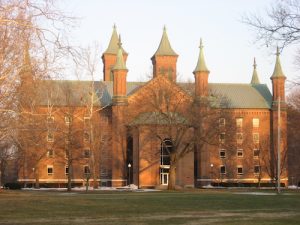
Antioch Hall, Antioch College, courtesy Wikipedia Commons.

Antioch Hall, Antioch College, courtesy Wikipedia Commons.

While undergraduates across the nation sit in enormous lecture halls enduring their required courses and wondering, “What does this theory have to do with me?” undergraduates at Antioch University sit in a cozy group setting and thoughtfully ponder Professor Hymon T. Johnson’s philosophy, “theory without practice is pointless.”

Its all part of the school’s Service-Learning in the Community seminar, which is required for all undergraduates. Johnson recently took his class to the Santa Barbara Zoo, where they hosted 34 special needs children from El Camino, Ellwood and McKinley Schools, as well as eight of their teachers and teacher’s aides. This was all part of Antioch’s Annual Community Service Day, which began five years ago out of his desire to teach students, faculty, and staff the importance of “connecting in the community in which you live.”

The school has a very unique mission, “to make the world a better place.” The class really changes their way of seeing the world, said Johnson, a former UCSB professor and Goleta Union and Crane Country Day School board member.

Kym Mathers, a psychology major, said community service day was a great experience and a bit of stereotype buster. She had three boys in her group and said they were “bright, articulate, with great vocabularies,” adding, “these were not at all what you think of when you say handicapped children.”

Sitting in on one of the service-learning students’ Monday night meetings, they talked about their community service internships and related the text — which includes writings from a variety of academics, as well as the five major religious traditions — to things that were going on in their own lives.

Volunteering in the pediatrics unit at Cottage Hospital, Nicole Weaver, a psychology student, said she absolutely loves it. “I’m learning a lot about how to give my time other people.”

Ryan Ptucha, a communications major who is doing his internship at Devereux, said he was struck by how much attention his special needs charges required.

“I keep having to remember what it is to serve,” said Susan Utter, a psychology student who bemoaned the “dry, clerical tasks” she was asked to perform in her internship at the SLO Hep C Project in San Luis Obispo.

Wendy Barchat , a business major volunteering at the Single Parent Community Resource Center, is herself a single parent, and said it was difficult for her not to do “everything and then some, short of sending a check out of my own pocket,” for the people she was serving, “at the price of my own family.”

When Barchat commented about the difficulty of becoming too involved with the people she was serving, Johnson took that opportunity to lead the class into a lively discussion on codependent relationships and when the best help is no help.

“Critical thinking and diverse perspectives guide our curriculum,” explained Johnson, as his students discussed the writings of work of Ram Dass, Mother Teresa and Dr. Martin Luther King Jr.

“I keep coming across things in the reading that fit exactly what I’m going through in my life,” said Utter.

That’s what should happen, said her professor with a knowing smile. “This is what education is supposed to do, not just fill our heads but also fill our hearts.”

For more information about Antioch University and Service-Learning in the Community call 962.8179 or visit www.antiochsb.edu.

Originally published in SuperOnda Magazine in May 2005.

Vieja Valley wins Math Superbowl

With enough intensity and focus to rival many professional athletes, 431 “mathletes” from 37 local schools competed last week at the 24th Annual South Coast Math Superbowl.

Vieja Valley School took the top prize, defeating 2004 champion Washington School. Kellogg School was in third place, followed by Monte Vista, Cold Spring and Hope Schools.

Each school uses its own screening process to choose the participating mathletes.

At Monte Vista, for example, coach Kim Barney said the entire top math group is given a test to qualify. “I take the top 12 and work with them for about two weeks and then they take another qualifying test and weed it down to five, four team members and one alternate.”

Each school was allowed to field three four-person teams of fourth, fifth and sixth graders. The overall team scores were made up of a combination of individual multiple choice test scores and a team test. There was also a hands-on activity, with separate awards, where teams were challenged to build the tallest freestanding structure they could out of straws, washers and string.

While team members can vary from year to year, Monte Vista’s sixth grade team of Ben Bordofsky, Ryan Gilmore, Johnny Manzo, Ben McKenzie and Amy Ransohoff has been competing together since fourth grade, with the alternates alternating from year to year.

“They’re very motivated to win. They want it again,” said their teacher and coach Lila Allen. The team won in fourth grade and came in second last year, but alas, this year they placed third. They did get a little consolation, however when Bordofsky, Manzo, McKenzie and Ransohoff each won individual medals (Gilmore was the 2005 alternate and not eligible).

Plus, they got the added benefit of “going out for pizza afterward and higher test scores,” laughed Barney.

The winning sixth grade team was from Washington, with Vieja Valley in second place, followed by Monte Vista, Adams, Kellogg and Hope School.

The fifth grade winning team was from Kellogg, followed by Vieja Valley, Washington, Mountain View, Monte Vista and Montecito Union tied for fifth place, and Cold Spring was in sixth place.

Vieja Valley won the fourth grade title, followed by Cold Spring, Kellogg, Washington, Hope and Monte Vista schools.

Hosted by Montecito Union, Cold Spring and Peabody Charter schools the Santa Barbara County Education Office, and Raytheon Vision Systems, representatives awarded individual Olympic-style medals to:

4th Grade School

1st Hanah Koper Vieja Valley

2nd Helen Yang Adams

3rd Eugene Cho Kellogg

4th Agnetta Cleland Vieja Valley

4th Kevin Hempy Vieja Valley

4th Kyle Mayfield Cold Spring

5th Alex Kolarczyk Washington

5th Colin Fristoe Cold Spring

5th Rishika Singh Kellogg

6th Sedric Kim Mountain View

5th Grade School

1st Devin Pearson Adams

2nd Vy-Luan Huynh Kellogg

3rd Ryne Cannon Santa Ynez

4th Thanh-Liem Huynh-Tran Crane

4th Sadnie D’Arcy Montessori

4th Connie Wang Brandon

5th Laura Voyen Kellogg

5th Jackie Botts Mountain View

5th Chloe Warinner Monte Vista

5th Astron Liu Monte Vista

5th Annie Thwing Vieja Valley

6th Avery Schwartz Montecito Union

6th Janine Wilson Kellogg

6th Jake Moghtader Cold Spring

6th Tim Cronshaw Montecito Union

6th Nicholas Carney Monroe

6th Grade School

1st Peter Bang Vieja Valley

2nd Dillon Kraus Washington

2nd Noah Connally Adams

2nd Fabian Chacon Kellogg

2nd Nicholas Below Washington

2nd Ellen Gleason Hope

2nd Qsi Tran Montecito Union

2nd Robie Behlman Adams

3rd Ben Bordofsky Monte Vista

3rd Danny Zandona Washington

3rd Jordan Carlson Adams

3rd Annie Lefley Kellogg

4th Chloe Hughes Roosevelt

4th Matt Swann Hope

4th Johnny Manzo Monte Vista

4th Louis Warne Vieja Valley

5th Cong Dinh Brandon

5th Michael Shaner Brandon

5th Ben McKenzie Monte Vista

5th Nicole Ferrel Roosevelt

5th Melinda Wilson Ballard

5th Kelly Kosmo Mountain View

5th Carly Biedul Crane

5th Sebastian Gomez-Devine Peabody Charter

5th Sergey Sushchikh Isla Vista

5th Simon Manson-Hing Washington

5th Kayvoh Mazooji Peabody Charter

5th Jason Lew May Grisham

5th Amber Wang Ellwood

6th Christian Mkpado Vieja Valley

6th Amy Ransohoff Monte Vista

6th Al Vorosmarthy Isla Vista

6th Aislinn Dunne Cold Spring

Originally published in South Coast Beacon on May 26, 2005.

Family united, a world apart

At home in Santa Barbara, proud mom soldiers on

Winning her own war against worry on the domestic front, longtime military wife Janet (Barens) Flatebo is keeping the home fires burning in Santa Barbara while her husband, son and daughter-in-law are all stationed in Iraq.

She and her husband, Gene Flatebo, both grew up in Santa Barbara. They met at a Sadie Hawkins Dance at San Marcos High, where her father, John Barens, was vice principal. They fell in love and married soon after Janet’s graduation in 1976.

At that point, Gene was already in the Marines, which he soon left to join the Army. When their twin sons, Luke and Richard, were only 5 months old, Gene was assigned to Livorno, Italy.

“I guess I had to grow up really fast,” said Janet, who gave birth to a daughter, Trina, soon after the twins. “I had three kids at age 21 and we were out of the country.”

As Gene moved up the ranks — “he was in the 82nd Airborne, he was Special Forces, he was in Delta, he was a path finder, he was a jump master, and he was in a unit, it’s called a black unit, kind of like the Delta and Special Forces” — the young family moved with him.

Italy and Berlin were some of Janet’s favorite assignments, she said, “because your friends became your family, and they are still your friends today.”

While most of the Army wives she “grew up with” have husbands who have retired and gone on to civilian jobs, Gene, who retired from the Army 11 years ago as a chief warrant officer (CW2), works for Halliburton subsidiary KBR. He volunteered for Iraq in February and will be there “at least another year.” She plans to rendezvous with him in Greece in August.

Meanwhile, she keeps company with her widowed mother, Jean Barens, and stays busy working as a registered dental assistant for Dr. Michael W. Thompson.

While still difficult, being apart has gotten easier thanks to improved communication. When Gene was in the first Persian Gulf War, Janet recalled, “I got maybe two phone calls from him, they were $50 each. … Now he calls every other day.”

Her son, Luke, an Army sergeant stationed at Camp Victory in Baghdad, and his wife, Tina, a staff sergeant stationed in Remagen in Tikrit, e-mail frequently, and even have Web cameras.

“They’ll be there a year to 18 months,” said Janet. Prior to Iraq they were stationed in Korea.

As difficult as it is to have family members so far away and in danger, Janet treasures her life as a military wife. “It was a great life. I would do it all over again,” she said.

And for others, who are just beginning on that path, she advised them to pray, keep busy and not watch too much TV.

“You have to laugh a lot and always support the person who is in harm’s way. Try not to complain … as they are just as worried about you,” she said.

“Also thank anyone who is in the military … if you know anyone who has a loved one in the military let them also know that you are grateful that they are serving our country and keeping us free.

“I don’t think the military hears that enough.”

Originally published in South Coast Beacon on May 12, 2005.

Home for the dying provides living inspiration

Sarah House (courtesy photo)

Sarah House (courtesy photo)

Sarah House opens its doors even wider for those in need

A residential care facility for people who are sick and dying doesn’t exactly conjure up uplifting images. But a visit to Sarah House — which has provided a home, medical care and often end-of-life care for more than 250 individuals living with AIDS — is more inspiring than depressing.

Nancy Lynn recounted what a wonderful time she and her son, and later her granddaughter, had volunteering in the Sarah House kitchen.

“It was a great experience,” said Lynn, who has since become a Sarah House board member. “It’s such a loving, homelike atmosphere, with an opportunity for families to be supportive.”

“Most people come in, and as they are walking out they say this is not at all what I expected,” said executive director Randy Sunday, who successfully navigated through the Legislature recently to expand Sarah House’s services to provide holistic hospice care for the dying poor who are not HIV-positive.

Aiming to be “the next best thing to home,” the inspiration for the facility was to provide a loving, caring place for people in the final days of their lives.

It’s heartbreaking work, but it’s also beautiful work and important work, said house manager Debbie McQuade, who has worked with AIDS Housing Santa Barbara since it began in 1991, with Heath House. Sarah House opened on the Westside in 1994 and it has eight residential care beds and three two-bedroom apartments on the site. AIDS Housing Santa Barbara also serves approximately 25 other individuals who live in independent apartments.

The good news is that fewer people are dying of AIDS, and more are able to move into off-site or “scattered site” housing. The bad news is that facilities like Sarah House are closing in other places, leaving needy people with nowhere to go.

The Santa Barbara community put so much into the creation of Sarah House — named for the late Sarah Shoresman, whose daughter, Linda Lorenzen-Hughes, remains active on the board of directors — that they were determined to find a way to keep it open.

“In order to honor our contract with the public, (we thought) why don’t we try to care for people who are dying and non-HIV,” Sunday said.

The team worked with former Assemblywoman Hannah-Beth Jackson, D-Santa Barbara, to shepherd legislation that would ultimately allow Sarah House to become what Sunday termed the “first social (as opposed to medical) model hospice,” meaning it can be staffed by personnel other than registered nurses and licensed vocational nurses.

The social model allows for more staffing flexibility (for example, nurses aren’t allowed to help cook or clean) and significant cost savings.

Sunday said it costs Santa Barbara Cottage Hospital more than $4,000 a day to care for patients, while it costs Sarah House $250 a day to care for its residents.

The other difference with a social model, which is difficult to quantify, is the “next best thing to being at home” atmosphere.

“You go into a hospital, the first smell that might hit you is something slightly antiseptic. You come in here it’s going to be chicken soup or chile rellenos,” Sunday said. “And as we’re learning or seeing, hospice care is not just care for the dying resident, it’s caring for the loved ones, friends and family around them.”

“I’m so grateful we were able to get mom into such a nice place,” said Jeanette Aroldi-Schall, whose mother, Anne Arnoldi, was cared for at Sarah House before she died last month.

“Really we’re providing a great service, I feel,” said Lynn, adding that the board is working hard to get the message out that Sarah House has now opened its doors wider, to serve all needy members of the community, and that it is also seeking support in the form of monetary donations and volunteers.

For more information visit www.sarahhousesb.org, call 882.1192 or e-mail office@aidshousingsb.org.st.com.

Originally published in South Coast Beacon