The Neurotic Parent Comes to Santa Barbara

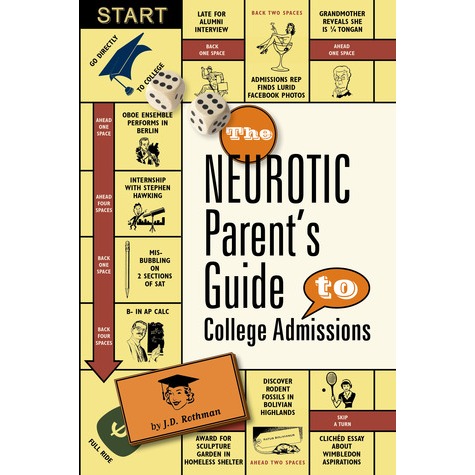
The Neurotic Parent's Guide to College AdmissionsSome people say that getting your kid through the college application process is a lot like childbirth-you have to experience it yourself to really understand it. Unlike with childbirth, where the endorphins kick in and make you forget most of the pain once you hold that precious baby in your arms, the only chemicals associated with getting your child into college are stiff drinks (for the parents) and plenty of aspirin. Luckily, we can now add a healthy dose of laughter to the college admission cocktail, thanks to J.D. Rothman’s new book, The Neurotic Parent’s Guide to College Admissions. With a sassy, sarcastic style that reminded me of The Official Preppy Handbook, Rothman does a spectacular job of skewering the collective craziness that overtakes otherwise rational people during this phase of their lives. At the same time, it’s not just funny but also provides valuable insights and incisive anthropological observations into the process. “There’s a collective neurosis kind of thing that takes place for parents during this time of their lives,” explains Rothman, who is an Emmy-winning television writer and lyricist in her other work life. After an eye-opening college tour with her older son (now a junior at Duke), she started the anonymous Neurotic Parent Blog as a way to reflect on the nutty parents who had “started their kids in college preparatory programs in the fifth grade,” as well as the “thousands of shockingly bright, polite, alert students, all of whom were vying for her son’s (or your daughter’s) spot.” Up until that trip, she had “no idea there was this level of insanity about the college admission process.” The blog quickly caught on and went viral after a post about Cornell’s hotel’s ugly bedspreads. Rothman admits that she too got caught up in the craziness. Some of the other students had out of this world accomplishments, like “discovering galaxies,” so she wondered how her son would ever compete. Like many parent trips, the first one you feel during the college application process is guilt. Rothman writes, “Clearly it is all your fault. While you were letting your child engage in normal activities like summer camp, babysitting and bowling, other kids were interning for their senators, training seeing eye-dogs and starting hedge funds in Sri Lanka. As a result, for every impressive kid, there are 50 even more outstanding ones.” She observes that even parents who were “not neurotic about other things like eating and sleeping still became neurotic about the college admission process. … Thankfully it is usually not both members of a couple,” she laughs. “Thankfully” is right. Though I often want to give therapy bonds as baby shower gifts, this book will make a pretty good substitute. Laughter is clearly the best therapy for Rothman, who offers up an amusing “prayer for the SAT” (please protect me from mis-bubbling and using passive voice, bless my number two pencils and protect their points), two pages of “haikus for the neurotic parent” and an entire chapter about “barista readiness” (a college degree is fine, but at the end of the day, they’d better know how to prepare a venti, sugar-free, nonfat, vanilla soy, double-shot, decaf, no foam, extra hot, peppermint white chocolate mocha). Asked if her current book tour has made her more or less neurotic, Rothman, who will appear at Chaucer’s on Sunday at 2 p.m., says, “definitely more, but now I’m neurotic about selling books.” Of course it doesn’t hurt that her younger son was recently accepted into his “dream school.” Unlike the rest of us there will be no more college applications for her to deal with in the future-unless the kids don’t like being baristas and want to go to graduate school. The upside? That might mean there’s another book in her future, and ours. Since my son’s only in seventh grade-and hasn’t, to my knowledge, written any symphonies or cured any diseases-this is definitely one book I plan to keep on my shelf for future reading. As Rothman says in her “orientation to college angst,” “whether you have a kindergartener or a 12th grader, may your child’s search be full of multiple acceptances, generous merit scholarships and chill roommates.” If they’re not, may you at least retain the ability to laugh at it all! = Spend your tax day in a lively reading and conversation about the insanity of modern college admissions at Chaucer’s Books, 3321 State St. Sunday, April 15 at 2 p.m.

When Leslie’s not stressing about her son’s lack of Olympic curling credentials, Mandarin language and Ethiopian cooking skills, she can be reached at Leslie@LeslieDinaberg.com. For more columns visitwww.LeslieDinaberg.com.  Originally published in the Santa Barbara Daily Sound on April 13, 2012.

The Green Team

Courtesy Sprout Up (EENG)

Courtesy Sprout Up (EENG)

Environmental Education for the Next Generation

I can’t help but smile when I see Strawberry, Banana, Tree and Sun grinning from ear to ear, as they greet Thunder with the thunderous enthusiasm her name deserves. “Yay. Awesome. This is my favorite kind of day,” shout the others. No, this is not some strange morphing of the Nature Channel and H.R. Pufnstuf flashbacks from my childhood. It’s just a regular old Tuesday afternoon, and I’m watching Environmental Education for the Next Generation (EENG) at work in Judy Cosio’s second grade classroom at Monroe Elementary School. This entirely student-run nonprofit organization-connecting student volunteers from different universities with first and second graders to explore hands-on science experiments and promote sustainable action-is the brainchild of Ryland King, a UCSB undergrad. Inspired by his work as a surf camp counselor with a developmentally disabled child and a volunteer stint at Isla Vista School, King started the group in 2009. “I really kind of learned that when one teaches, many people are affected,” he says.

Indeed, many, many are affected by King’s vision. This year alone, EENG (which has
expanded from Santa Barbara to Santa Cruz, San Luis Obispo, and San Francisco)
will connect more than 2,300 elementary school students with college students,
providing the resources for them to traverse the wonders of the natural world
together. Besides Monroe, local participants include Santa Barbara Charter, Foothill,
Isla Vista, Howard, Adams and Hope.

“It’s so expensive to teach science,” says Jenna Ryan, a UCSB volunteer who also
answers to “Thunder,” her “Nature Team” name. “It’s such a bummer because I
think science is the most captivating discipline by far if you have the resources to let
kids get dirty and play with materials and things. The cool thing is that EENG is
totally free of charge to teachers and we volunteer … taking a little bit of the burden
off the school, while still allowing kids to really develop their imagination and jump
into things.”

“As you can see, the kids just love it when they come,” says Ms. Cosio. That’s an
understatement. The kids practically tackle their team leaders with excitement the
moment they walk in the door.

“You can just tell how enthusiastic they are and how empowered they are by the end
of it. … I’m blown away every time by how inspiring it is,” says Ryan.

The lesson I observed was the Environmental Extravaganza, where the kids recap
what they’ve learned over the last eight weeks. Topics include renewable energy
resources, soil science and water conservation. Based on the Jeopardy-style quiz
used to review the lessons with the kids, they definitely knew their stuff.

Forming teams with five or fewer children per volunteer creates an energetic
dynamic between the young students and the college-student volunteers. It looks
like a cross between school and a really great nature camp.

One of King’s goals is to provide positive role models “who have a passion for
education or a care and love for the environment and taking sustainable action …
when eight year olds can speak confidently about topics of sustainable action,
people will listen. … The program doesn’t just end with the kids. When they go home
and talk with their families about using a reusable bag or turning off the lights or
turning off the water after they take a shower or wash their teeth, parents and
family and friends really think twice.”

I can certainly attest to that. I became a lot better at turning off the lights when my
son started monitoring our electricity usage.

It’s not just the teachers, kids and their families that benefit. The college students
are also developing what King calls “professional skills with a soul.”

Ryan, an Environmental Studies major, agrees, noting, “I think that EENG is cool
because it really spans through all of the disciplines. I’m in a group with a
philosophy major and a chemical engineering major and people that aren’t
necessarily the crunchy greenies that maybe I spend most of my time with in my
classes. It’s a really cool thing that you can either connect to the environmental
aspect of it or you connect to the really cool personal aspect of it, the social
entrepreneurship aspect of it and investing in the next generation of young people.”

In addition to mentoring the elementary school students, college students also
mentor each other, training new volunteers as EENG grows.

“I think one thing is that everyone who works with us is so passionate about it that
it isn’t work. For us it’s a bunch of fun,” says King. “It’s hundreds of different college
students that have the same passion about the work that are making EENG what it is
and it’s really a team effort.”

==

For more information about Environmental Education for the Next Generation or to
donate visit www.eeng.org. A gala fundraiser is planned for May 13. Check the
website for further details, as well as additional information on how to bring EENG,
free of charge, to your elementary school.

Originally published in the Santa Barbara Daily Sound on April 6, 2012.

The Bratty Bunch

Photo by David Castillo Dominici, freedigitalphotos.net

Photo by David Castillo Dominici, freedigitalphotos.net

Do you ever have the urge to discipline someone else’s kids?

What about when their parents are sitting right there, yukking it up, chatting with friends or drinking cocktails, and otherwise ignoring the fact that their little brat is:

A.) Talking back to a teacher, lifeguard, parent, or other adult

B.) Tormenting a defenseless younger child

C.) Teasing an older child who could, by all rights, stop the little monster in his tracks, but is too nice (or well-mannered) to do so

D.) All of the above.

Doesn’t it drive you nuts?

I don’t know what I want to do more, put the kid in a time out or throttle the parents.

Now don’t get me wrong, I am hardly the strictest mom in the cul de sac, and my son is definitely not the best behaved on the block, but he knows that no means NO, and stop means STOP, and that there are serious consequences when he doesn’t behave in the way he’s supposed to.

That seems like a pretty basic rule for getting along in society, but you wouldn’t know it from watching some of these rude, self-absorbed, bratty little jerks in action.

I’m not the only one who’s annoyed.

In a recent Newsvine poll, 83 percent of the participants surveyed said that today’s kids are more self-centered than those of past generations.

There are lots of theories about why this has happened. Pediatrician Dr. Philippa Gordon told MSNBC, “I see parents ferociously advocating for their children, responding with hostility to anyone they perceive as getting in the child’s way- from a person whose dog snuffles inquiringly at a baby in a carriage, to a teacher or coach whom they perceive is slighting their child, to a poor, hapless doctor who cannot cure the common cold. There is a feeling that anything interfering with their kid’s homeostasis, as they see it, is an inappropriate behavior to be fended off sharply.”

I understand the impulse to do everything you can to make sure that your child is safe, healthy and happy. That protective instinct is as natural as breathing for most parents.

But somehow my parents, and most of my peers’ parents, managed to avoid coddling us the way so many parents do now. In fact, I remember my parents as being much more concerned about instilling proper behavior toward others (including themselves) than the other way around.

What happened?

Babble.com writer Madeline Holler postulates that, “We Gen Xers, who were so benignly neglected that we now over-compensate as parents by co-sleeping and baby-wearing and opting out. And that we’re so fixated on our children’s well-being that we wind up teaching them that other people’s feelings are less important than our own, that kids should first make sure they feel good, then (if ever) worry about others.”

It could be that.

Or it could be that in a culture that embraces snarky comments from “American Idol” judges, where Fisher Price has a toy called “Mr. Men Mr. Rude” and Mattel battles to control a line of dolls called “Bratz,” downright bratty behavior has become not only acceptable but cool.

But I suspect that the real reason most people give their kids such a free ride when it comes to bad behavior has nothing with over-protectiveness, cultural influence, or worrying about their children’s fragile self-esteem. I’m guessing they’re just exhausted, with too much to do and too little time to do it.

Not that I’m giving the parents a free pass on disciplining their children-and not that I’m going to step in and do it for them anytime soon, tempted as I may be.

But think about this the next time you see one of these sassy little brats at the pool, or the baseball field or the playground. And if he or she belongs to you, think about it extra hard.

Is Generation X raising Generation Rude? Email Leslie@LeslieDinaberg.com. For more columns visit www.LeslieDinaberg.com.  Originally published in the Santa Barbara Daily Sound on March 23, 2012.

Bonding Over Books

Honeymoon-Jenna-McCarthy-214x322Santa Barbara has a lot of great fundraisers, but one of my favorites is the annual CALM (Child Abuse Listening Mediation) Celebrity Authors’ Luncheon.

It’s easy to get excited about buying books, talking about books with other readers and listening to authors talk about books, not to mention a great lunch with a dessert of chocolate ganache and caramel tart with raspberry garnish chocolate ring coulis (they had me at chocolate ganache), and last but foremost on everyone’s mind, a really important and worthy cause.

As I hope most people already know, CALM has led the way in building awareness, providing education and inspiring hope to everyone involved in the effort to prevent child abuse and neglect in the Santa Barbara community for the past 40 years.

Last Saturday was the 26th event of its kind-and the first to be planned by event co- chairs Becky Cohn and Carolyn Gillio. They stepped into the stylin’ stilettos left by former co-chairs Sharon Bifano and Stephanie Ortale, who created and organized CALM’s first Annual Authors’ Luncheon in 1987 and only recently gave up the reins.

Thankfully, they left them in very good hands: the day went off without a hitch.

The theme of the decor was apples-Sunday was Johnny Appleseed Day, and I’m sure you all celebrated by spitting seeds around town: Artist Susan Day’s whimsical artwork, which graced the invitation and program and was raffled off for CALM, showed children reading atop and under an inviting apple tree. The centerpieces were full of apples and the first course was chilled strawberry and apple soup-but spilling the beans felt like the theme of the author interviews.

First up, was actor Joseph Mascalo, who has starred off and on as drug dealing murdering crime lord Stefano DiMera on the soap opera Days of Our Lives since 1982 (and was ostensibly there to talk about the coffee table book Days of Our Lives 45 Years: A Celebration in Photos). He spilled the beans on what it’s really like to work on a series where kidnaping, art theft, assassinations, fake deaths and real long lost evil twins are part of “just another day at the office.” The reality is a whole lot of hard work, as he explained in a charmingly booming voice that had the mostly female audience on the edge of their seats.

Next to spill the beans was Simon Tolkien, author of several British mystery thrillers (including his latest, The King of Diamonds) and a new resident of Santa Barbara. As the grandson of beloved author J.R.R. Tolkien (The Lord of the Rings, The Hobbit) Simon talked movingly about what it was like to grow up with such a famous surname and his bold decision, at the age of 40, to give up his career as a barrister and pursue a career writing novels.

Batting third and definitely leaving no holds barred was Meredith Baxter, an acclaimed actress, who most of us recognize from her years playing Michael J. Fox’s mother on the sitcom Family Ties. What many people didn’t realize, until she notably spilled the beans that she was a lesbian on The Today Show a few years ago, is that she’s also battled breast cancer, survived domestic abuse and has been a sober alcoholic for 19 years. If her book, Untied: A Memoir of Family, Fame, and Floundering, is anything like her frank discussion at the CALM lunch, she definitely has few secrets left to tell.

Last but most definitely funniest, Santa Barbara’s own Jenna McCarthy (who used to banter on KTYD with Matt McAllister in the morning). She elicited nods, laughter and a whole lot of guffaws when she shared insights from her recent book, If It Was Easy They’d Call the Whole Damn Thing a Honeymoon: Living with and Loving the TV- Addicted, Sex-Obsessed, Not-so-handy Man You Married. She spilled the beans on what married life is really like and why sticking with the man (did we really all just marry the same guy?) you’ve got might just be a very good idea after all.

Over the years some of the authors interviewed have included: Sue Grafton, Jane Russell, Barnaby Conrad, Michael Crichton, Julia Child, Ray Bradbury, Fanny Flagg, Maria Shriver and Jonathan Winters. While big names help fill seats and raise money for the child abuse, sexual abuse and incest services and programs at CALM, longtime luncheon goers agree that the “best known celebrity is not always the best interview.” I would have to agree. This year’s panel was among the best I’ve seen.

For more information about CALM visit www.calm4kids.org. For more columns visit www.LeslieDinaberg.com. Originally published in the Santa Barbara Daily Sound on March 16, 2012.

Sex and Housework

Photo artur84, freedigitalphotos.net

Photo artur84, freedigitalphotos.net

Men are astounded by how long women can go without thinking about sex, and women are astounded by how long men can go without thinking about housecleaning.

This explains why my husband can turn on the TV and happily surf skin-e-max while laying on top of a gargantuan pile of unfolded laundry … then still is surprised when I’m not “in the mood.”

Unlocking the mysteries of the male mind is, of course, a topic that has launched a million magazine articles, and the career of Dr. Phil, but he almost never talks about housework.

According to Neil Chetnik’s book about American husbands (VoiceMale-What Husbands Really Think About Their Marriages, Their Wives, Sex, Housework and Commitment), almost every level of happiness and positive feelings in relationships is related to housework.

I wonder if that’s why I’m so attracted to my cleaning lady?

Chetnik, who surveyed almost 300 husbands and did in-depth interviews with 70 others, agrees, it really is about the housework.

“In writing the book, I kept seeing the parallel between housework and sex in the interviews. Men said the happier their wives were in the division of housework, the happier the men were with their sex lives. We even looked at the numbers and found that there’s more sex in the relationship if the wife is happy with the division of housework. It doesn’t have to be exactly equal, the wife just has to think it’s fair.”

That’s what I keep trying to explain to my husband. I’ve got really dry skin on my hands, so doing the dishes and scrubbing the toilets are out. My mother is an exceptional cook, so I never had to learn how to – I can whip up a scrumptious reservation, though. Basically my domestic specialty is doing the laundry. Since that’s really all I can do, then I think it’s only fair that my husband does half of it.

Chetnik says, “When a woman comes in she notices if it’s a mess, it’s often socialized in [her] that [she is] more responsible for the look of the home so if he can recognize that by doing a fair share, then he is often rewarded with sex. She’s not as angry, or burdened and she’s not as tired.”

Got that, honey? All it takes is a few loads of whites. Smoochy smoochy.

It’s not just the actual act of cleaning the house that strikes a nerve with women. As Chetnik says, “It wasn’t till I did this book that I recognized that it’s not just the doing of the housework that’s a burden to women, it’s the worrying about the housecleaning that is a burden.”

It’s not exactly a quid pro quo kind of arrangement.

Chetnik’s research found that there were more men who reported that the sequence was, he does housework, then she has sex — as opposed to, she has sex with him and then he does housework.

He quotes one husband who says, “My wife told me that she’s never more turned on to me then when I’m doing housework, and she’s proven it again and again.” At first he thought she was kind of holding out on him. His initial reaction was to resist that because it did feel like a quid pro quo. But then he realized that it was more about her feeling appreciated. It seems that women who feel their partners are paying attention to them, and to the household, are more appreciative and less tired.

Solely in the interest of scientific inquiry, I think this is worth pursuing, honey. No starch in my collars, please.

What do you think? Is there really a connection between sex and housework? Let us know at Leslie@LeslieDinaberg.com. Originally published in the Santa Barbara Daily Sound on March 2. 2012.

I’d like to thank the Academy

side_oscar“I’d like to thank the Academy, and of course my wonderful husband and adorable son for inspiring me every day. And my fabulous family, friends and loved ones, for sticking by me in those lean years, when it looked like I might never be up on stage accepting this award. I couldn’t have done it without you.”

Since it looks like I won’t be hugging Billy Crystal on stage this Sunday, I thought it was about time that somebody heard my speech. After all, I’ve been practicing my Academy Award acceptance since I was a little girl, effusively thanking my best friend Tatum O’Neill, my husband David Cassidy, my best friend Julia Roberts, my boyfriend Jon Bon Jovi, and my husband John Cusack, depending on which year it was.

At various times I’ve fancied thanking the Academy for recognizing my directing, acting, writing, and-try not to laugh too hard-singing abilities. Despite the fact that the Oscar has yet to be awarded for best singing in the shower, I’m still practicing.

When you picture me giving this speech, envision me with Halle Berry’s body, in a red Valentino gown. My gown preferences have changed over the years-in third grade I was really into the “Little House on the Prairie” books and wanted to wear a red plaid petticoat. In seventh grade I thought strapless Quiana might be cute, and in college I wanted Geena Davis’ elegant long-sleeved gown. But no matter what the dress style, red always looks good for the camera.

Pink is another story. I still haven’t forgiven Gwyneth Paltrow for that ill-fitting pink, “Shakespeare in Love” Oscar night dress, or Penelope Cruz for her pink flamingo gown in 2007. If Penelope Cruz can’t carry off feathers, no one can. I bet you can’t hum a single tune by Bjork, but remember her swan Oscar dress in 2001? Of course you do. That was her career’s swan song, though that ridiculous image is forever embedded in our brains, along with Lady Gaga’s meat dress from another awards show.

Since I’ve been studying the Academy Awards so avidly for so many years-and I don’t seem to have any personal use for this knowledge-I’ll offer some of my sage advice to the nominees.

You’ve got just 45 seconds and more than a billion viewers for your moment of glory. Don’t blow it on a fashion “DON’T.”

DO expect to lose. Despite what your agent, your mother and your hairdresser have told you, prepare yourself for this possibility, then visualize it in your mind. There’s nothing more uncomfortable than watching a newly hatched Oscar loser try to hold back tears on camera. No one is that good of an actor.

DON’T talk too long. One the best Oscar speeches in history was Jane Wyman’s, “I accept this very gratefully for keeping my mouth shut for once.” She was accepting an Oscar in 1949 (I read about this one, I’m not that old!) for playing a mute character in “Johnny Belinda.” “I think I’ll do it again.” And she sat down.

DON’T picture the audience in their underwear, no matter how nervous you get. With most things in life, advice from “The Brady Bunch” is extremely reliable, however this is that rare exception. Try picturing Colin Firth and Brad Pitt (or Scarlett Johansson and Salma Hayek) in their underwear. Not exactly relaxing, is it?

DON’T get political. Your 45-second speech isn’t long enough to say anything meaningful about global warming or the presidential race. If you must be political, bring a visual aid to help communicate your point, such as a sad-looking puppy, or an extremely thin actress.

DO shed a few tears, but not too many. What’s to stop your mother from running up to the podium with a Kleenex?

Which reminds me of the most important advice I have to give to Oscar nominees (and for once, I hope my son is reading): DON’T forget to thank your mother.

Leslie’s all-time favorite line in an Oscar acceptance speech was from Dianne Wiest, who won Best Supporting Actress for “Hannah and Her Sisters” in 1987: “Gee, this isn’t like I imagined it would be in the bathtub.” Share your favorites with Leslie@LeslieDinaberg.com. For more columns visit www.LeslieDinaberg.com.  Originally published in the Santa Barbara Daily Sound on February 24, 2012.

Death to Chit Chat

Photo by stockimages, freedigitalphotos.net

Photo by stockimages, freedigitalphotos.net

“Small talk is one step down from no talk.”-Jason Love

I had a mid-life revelation this week. After a busy weekend standing around bonfires, barbecues and beaches talking about the weather (hot), sports (a good week at Appalachian State), and my child’s school’s spring break week, I realized something: I spend far too much of my time talking about things that don’t really matter-or even hold much interest-to me.

That’s it. I’m done. Terminado. Now that I’m in my “late” mid-forties, and I’m starting to think I don’t want to live to be 100, which makes me middle-aged like, uh, now, it’s high time for me to stop fooling around and take a stand. So here it is: From this day forward I am banishing the banter of small talk from my life.

It’s not that I’m not a talker, I LOVE to talk, especially late at night (just ask my grumpy husband). But time’s a wasting. I’m not getting any younger and I don’t have any more time to waste on idle chit chat when I could be talking about something, well, better.

From now on, no more small talk. Try asking me how I am. Last week I would have automatically answered “Fine. How’s it going?” or some other equally scintillating conversational nugget, but this week I’ll give you a real answer, like, “How did I get to be so old?”

See what I did there? That’s one of the secrets of great conversationalists. I answered a question with a question. OK, it was a rhetorical question, but give me a break. I’m new at this small talk banishment stuff.

But I think I’m onto something with this answering a question with a question thing. Everybody’s favorite thing to talk about is themselves. Plus, I’m a naturally nosy person (hence the journalism career), so this new anti-small talk strategy will work both ways. You get to talk about you-thus making you think I’m charming and witty and interesting to talk to-and I get to find out what I really want to know.

Here’s an example. You ask me about the weather, and I ignore your question and ask you about what you think would change if a woman were president.

Or you make an inane comment about sports, and I’ll ask you when the last time was that you had sex. “Do you really believe in God or do you just like going to church? Are you naturally skinny or anorexic? Has your husband always been a jerk, or is he just having a bad year?”

Isn’t this fun?

Admit it, with the rare exception of earth shattering headlines (“Pearl Harbor Bombed” and “Kennedy Shot” come to mind) these off limits topics are a thousand times more interesting than any current events.

“Did you catch the news today?” might be greeted with “Do you feed your kids healthier food in public than you do when they’re at home?”

“Thank God it’s Friday,” could garner a response from me like, “Have you ever Googled an ex-boyfriend?”

Hey, I didn’t say I was going to be speaking deep thoughts from here on in, I only promised that I’d stop talking about all the things I could care less about and start talking about the things I’m really interested in. So when was the last time you thought about that ex-girlfriend of yours? Were you having sex?

Asking better questions could actually change the world-or at least our social gatherings-if we all joined in and started asking people about the things that used to be considered rude.

Try one of these anti-small talk conversation starters at your next party:

* How do you feel when someone says you’re just like your mother?

* Have you ever been fired?

* If you had to choose to be stuck on a desert island with someone that you know-other than your spouse or significant other-who would you pick? (No, watching Angelina Jolie in a movie doesn’t count as knowing her.)

* If you could go back in time and change one thing about your childhood, what would it be?

* Have you ever gotten drunk and been told you did something you can’t remember doing?

* How much money do you make, and do you think you’re worth it?

* If I were to force you to sing karaoke right now, what song would you pick?

* What would you like to accomplish before you die?

And finally,

* Is 48 really late-middle-aged? (Make sure you ask a senior citizen this one.)

Email email to ask Leslie the burning question you’ve been too polite to ask until now. For more columns visit www.LeslieDinaberg.com. Originally published in the Santa Barbara Daily Sound on February 17, 2012.

Valentine XOXOXO

Photo by Ohmega1982, freedigitalphotos.net

Photo by Ohmega1982, freedigitalphotos.net

It used to be so very, very easy. Everyone got valentines in first grade-even the frogs we already knew would never under any circumstances turn into princes, no matter how sweetly we asked them to “Be Mine” with pink foil hearts or “Bee Mine,” with Bit-O-Honey bars. Boys gave cards to girls and boys, girls gave cards to boys and girls, and there were no quibbles about it. The teacher made us give valentines to everyone, so people knew they didn’t mean I like you like you or anything complicated like that.

Everyone understood the rules and, for the most part, we all had fun. We’d jog to each person’s desk and drop a valentine into their decorated Kleenex box that we’d adorned with hearts, smiley faces and various spellings of “Hapy Valantune’s Day!”

What’s not to like about the chalky candy Sweethearts, with messages like “4 Ever” and “I’m Yours,” and the amusing little cards featuring bug eyed owls crooning, “Whooo do I want for my Valentine,” or baseball playing poppets pleading, “You’ve made a big hit, will I make a good catch?”

How on earth did we grow up and let Valentine’s Day get so very, very stressful?

It used to be a day for light-hearted fun but now-unless you live on a planet far, far away without advertising-Valentine’s Day has become a sneaky, predatory holiday full of unrealistic expectations. It’s a do-or-die litmus test for your romantic relationship. Flowers in a box fail to pass the sniff test, according to a Teleflora commercial (during the Super B$wl, no less), and any jewelry short of a ginormous diamond engagement ring falls disastrously short of expectations if you’ve seen the trailer for any romantic comedy made in the last decade.

For most guys, the very mention of the words “Valentine’s Day” conjures up nightmare memories of frantic last-minute shopping at the drug store followed by yelling, threats of bodily harm and then tears from their disappointed wives or girlfriends. Women tend to fantasize-despite the evidence of every previous experience they’ve EVER had with their loved one-that this will finally be the year he brings champagne, candles, chocolate, roses and Michael Buble to serenade them.

Basically it’s all about love, lingerie and letdowns.

Decades ago when my husband and I were young and in love and didn’t know any better, we decided to avoid the commercialism and stress of the holiday and instituted a Valentine’s Day tradition of making something for each other. None of that wussy Hallmark stuff for us. I may adore roses and chocolate, but we decided that buying something off the shelf for Valentine’s Day was for people who weren’t creative. Our gifts would come straight from our hands, and our hearts.

Oh how naïve we were.

You think picking the perfect card off the shelf is stressful, try writing the perfect poem where something rhymes with “Valentine” and “Klobucher.” You think getting a reservation at a romantic restaurant on Valentine’s Day takes clever planning, try running out of pink glitter and heart shaped doilies at 2 a.m. on February 13th. Over the years I’ve made more crafty projects than Martha Stewart and the Naughty Secretary combined, but
after more than 20 Valentine’s Day love crafts, I’m out of new ideas.

Clearly my romantic chops need defrosting. I decided to consult “1001 Ways to be Romantic” by Gregory Godek, who I had seen talk about romance on Oprah’s show a while back, so he must be the man. Some of his ideas were pretty good.

* Compliment your partner. (I love you even more now than that Valentine’s Day I made you a mix tape, before iTunes made it so ridiculously easy.)

* Check in with each other during the day. (Does texting him at work to ask, “have you made my Valentine yet” count?)

* Make a New Year’s resolution to be a more creative romantic. (Of course, I always do that one.)

* Make plans for Valentine’s Day well in advance! (This year, I’ll move it back to the 13th at 1:00 a.m.)

I still felt the pressure until I read an excerpt from Godek’s next book, “Bring Food. Arrive Naked.” That seems pretty manageable. I started to mull over recipe ideas when this historical note leapt off the page: “The ancient Greeks believed that love resided in the liver, not the heart.” Hmm … do you think champagne goes with chopped liver?

=

When Leslie’s not wishing for a Valentine’s Day that’s well, not chopped liver, she can be reached at Leslie@LeslieDinaberg.com. For more columns visit www.LeslieDinaberg.com. Originally published in the Santa Barbara Daily Sound on February 12, 2010.

Good Libations

KEKO64, freedigitalphotos.net

KEKO64, freedigitalphotos.net

It was the headline I’ve been fantasizing about for all of my adult life: “Study Finds Fruity Cocktails Count as Health Food.” I double-checked the URL, just to make sure I hadn’t accidentally stumbled onto the Onion.

Sure enough, Reuters was actually reporting that, “a fruity cocktail may not only be fun to drink but may count as health food, U.S. and Thai researchers said on Thursday.”

It makes so much sense. I knew I hadn’t been irresponsibly drowning my sorrows in alcohol for the past couple of decades. Those massive quantities of strawberry margaritas consumed over the years really did make me feel better–even in the morning.

I love it when science finally comes around to my way of thinking.

The discovery was pure serendipity–like the discovery of penicillin.

Tucked away in their labs (no doubt downing Red Bull, Mountain Dew, and Jolt cocktails) Dr. Korakot Chanjirakul and colleagues at Kasetsart University in Thailand and scientists at the U.S. Department of Agriculture were exploring ways to help keep strawberries fresh during storage, and accidentally stumbled on evidence that treating the berries with alcohol increased their antioxidant capacity and free radical scavenging activity.

In English, this means that adding ethanol–the type of alcohol found in rum, vodka, tequila and others–boosted the antioxidant nutrients in strawberries and blackberries.

The next time someone gives you a hard time for chugging a pitcher of Tangerine Banana Mango Daiquiris, you get right on your high horse and tell them you’re just conscientiously doing your part to prevent cancer.

Does that rock or what? You can now imbibe with pride.

This means that all those times we brought Margaritas to the Little League games we weren’t senior delinquents. No. We were good Samaritans saving lives.

The report in the Journal of the Science of Food and Agriculture says that any colored fruit might be made even more healthful with the addition of a splash of alcohol. How awesome is that? Look around at the Farmer’s Market. All fruits are colored!

Get this: for those of you that like celery with your Bloody Marys (blech!) or onions with your Martinis (gag!), the antioxidant effect works with vegetables too.

As we all know by now, people who eat more fruits and vegetables have a documented lower risk of cancer, heart disease and some neurological diseases. Add that to a little Leslie logic and you’ve got a double whammy on the rocks: (a) Fruity frilly drinks are whimsical; (b) Scientists like fruity frilly drinks; (c) I like fruity frilly drinks; (d) Therefore, I’m a whimsical scientist.

I’m hoping the next phase of research will prove that adding little cocktail umbrella enhances the antioxidant effect.

Share your favorite fruity frilly girly drinks, we mean health tips, with Leslie at Leslie@leslieDinaberg.com. For more columns visit www.LeslieDinaberg.com. Originally published in the Santa Barbara Daily Sound on July 27, 2007.

The Keeper of the Calendar

Image by digitalart, freedigitalphotos.net

Image by digitalart, freedigitalphotos.net

For as long as I can remember, my girlfriends have been an important part of my life. We’ve graduated from Kool-Aid and cookies to brie and Cabernet and have gone from dissecting Barbie’s hairstyles to debating whether “Blonded by the Light” or “Brazen Raisin” will better cover up our grays, but one thing remains true after all these years: without my girlfriends I’d probably never have made it this far.

My girlfriends are the ones that keep me (relatively) sane. They’re the only ones who really understand my drink order at Starbucks, or my irritation with the ten-items-or-less-line, or my love-hate relationship with Christmas.

This is why girls’ nights out are so important. They’re therapeutic, actually medicinal, and I’m not just talking about the vodka in our martinis. Men are great for a lot of things, and not just killing spiders (which my husband refuses to do) and reaching things on the highest shelves. But you can’t really talk to men about the importance of chocolate, the beauty of a new lipstick, or the ability of the perfect pair of black boots to update your whole wardrobe.

They just don’t get it.

My husband doesn’t really get it at all, but he doesn’t really complain about it either. I tell him I’m going out with my friends, and he looks up from the crossword puzzle, nods, grunts, and maybe, if I’m lucky, tells me to have a good time.

We’ve been together for 19 years and in all that time, he’s made social plans seven times, not including Mother’s Day and my birthday, where I have to remind him about what I want to do at least three times a day for a month beforehand, so I don’t think that really counts.

I’m the keeper of the social calendar and that’s okay, it’s worked for us all these years. At least until recently, when I told him I was leaving the house to meet my girlfriends. He looked up from the crossword puzzle, nodded, grunted, and said, “OK. I’m having boys’ night out on Thursday.”

Excuse me? Did I put that on the calendar? Since when are you scheduling your own “play dates,” honey?

I was sure I had misheard him. But no, come Thursday night he put on a jacket and actually left the house, all by himself. This has got to be a fluke, I thought.

Then it happened again the next week. Uh oh. Was my husband finally realizing how much fun it was to escape his family for a night on the town? This could be big trouble for me.

I thought I could nip the problem in the bud the night we both had plans. After all, a PTA meeting (followed by cocktails, but still, “It’s for the kids”) trumps an action movie, so he would just have to reschedule. I told him this, quite reasonably, I thought. But he just smiled, devilishly, and said, “It’s okay honey, your mom’s going to watch Koss so we can both go out.”

Oh dear. Couldn’t he at last have called his own mom?

The next thing I know he’ll be planning mancations and taking up fly fishing and snow boarding and how will I ever get away to the spa with MY friends if that happens?

I definitely need to stop this train wreck before it’s too late. He needs to tone his social life way down if I’m ever going to be able to keep up with mine.

“Honey,” I begin, in my sweetest most devious voice, “We need to talk.”

“Yeah, I’ve been forgetting to tell you something,” he says.

All right. I bet he’s going to tell me that he’s been spending too much time with his friends and realizes he would much rather be home spending time with his family, while I’m out with the girls.

I smile in anticipation.

“The guys and I are talking about a boy’s weekend. Let’s check the calendar.”

Uh oh, you mean my calendar?

Oh no. I’m doomed.

Share your tips for keeping your man at home with Leslie at email. For more columns visit www.LeslieDinaberg.com. Originally published in the Santa Barbara Daily Sound on January 27, 2012.