Noozhawk Talks: Leslie Dinaberg Sits Down With Kendre Sanborn

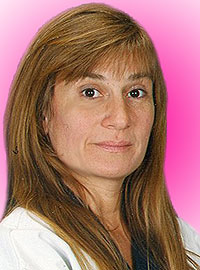
Kendre Sanborn, pausing for a quick reflection at Arroyo Burro Beach, is about as an involved school parent as one can be. (Michelle J. Wong / Noozhawk photo)

Kendre Sanborn, pausing for a quick reflection at Arroyo Burro Beach, is about as an involved school parent as one can be. (Michelle J. Wong / Noozhawk photo)

As president of both the Santa Barbara Area PTA Council and the Hope School
District Educational Foundation, not to mention the busy mother of three children,
Kendre Sanborn certainly has her hands full. Here she tells Leslie Dinaberg
about how she juggles it all.

Leslie Dinaberg: How did you get involved with the area council PTA?

Kendre Sanborn: When I was the Vieja Valley PTA president I hadn’t been on the board before. I knew nothing but wanted to get involved. I thought the best way to learn about PTA was to go through all the trainings that PTA offers and so I kept
seeing the same volunteers over and over again. And when there were issues
going on with our PTA they were really helpful and came to my aid whenever I
needed anything.

LD: And now you’re heading up the whole thing. What area does that
include?

KS: There are 27 schools currently, from Montecito all the way to Goleta. I don’t
know everything that it entails yet because I’m still kind of learning everything,
but we basically meet to make sure that everyone is up to their standards, …
they have all these criteria that they need to follow to be in good standing. It’s our
board’s job to make sure that all those groups are in good standing. Then
another thing the area council does is send out information to the presidents
about legislation that is going on. There are a lot of areas that we cover; we’re
giving information constantly to these PTA presidents.

LD: Is there anything interesting legislatively that is going on?

KS: Right now they are really pushing that the governor doesn’t cut budgets to
schools. They’re also looking at the stimulus package and they’re really keeping
an eye on that, because if each individual state gets money then PTA really
wants to make sure that the schools get money.

LD: You’re also president of the Hope School District Educational Foundation.
What does that group do? (Laughs) <Editor’s Note: Leslie Dinaberg is also on the
board of the Hope School District Educational Foundation>

KS: We do fundraising to enrich the educational programs at Hope, Monte Vista
and Vieja Valley Elementary Schools. And we also work to encourage
collaboration and communication among the three campuses. Right now we’re
working on our Fourth Annual Golf Classic, which will be held May 15th at Glenn
Annie Golf Course.

LD: And what is that fundraiser for?

KS: Well, the state and federal budget cuts have forced our school district to cut
funding for our library program in half. So the golf tournament money will be
used to help restore the library program.

LD: Great cause. Now you also volunteer at your kids’ schools, right?

KS: Yes, my two older kids go to Santa Barbara Middle School and I volunteer
once a week to help serve lunch and then I was helping as an ambassador,
where we talk to potential parents.

LD: What do you do at Vieja Valley?

KS: Wow talking about the things I do makes me realize I have a lot on my
plate. I count and deposit PTA money, volunteer in the classroom once a week,
and I’m on the committee for the honorary service awards. We will soon be in the
process of finding people to honor at our school.

LD: What about the area council event?

KS: The area council usually has a Reflections reception, which is a really neat
thing. They usually put on a reception for all the winners for our area. (The
National PTA Reflections Program is an arts recognition and achievement
program for students, which provides opportunities for students to express
themselves creatively and to receive positive recognition for original works of art.)
Then there’s also an honorary service award event held once a year. This is an
event for all the volunteers who are recognized at their schools to also be
recognized at a community level.

And also with Reflections, if you’re a winner for the area, then the district has a
reception as well, so all of those people attend, and it’s really neat to be
recognized.

LD: Let’s shift a little bit to talk about you. I know you’re really busy with volunteer
work now, but what did you do professionally before you had kids?

KS: I finished my master’s in clinical psychology and I was working on my hours,
you have to complete a certain amount of hours to be certified. During that time I
got married and had my first child. I was fortunate enough to be able to stay
home with him. I really wanted to stay home and be with my baby. So from then
on I stayed home.

LD: I know you’ve traveled a lot. What are some of your favorite trips?

KS: Africa. And more specifically I really like Kenya and Tanzania; also going to
the Artic was really neat. We’ve been to Japan, which was pretty cool. Next week
we’re on our way to Antarctica. I haven’t been before but that’s one of my
husband’s favorite places. … We took Andrew on his first international trip to
Australia and New Zealand when he was 14 months old, and he traveled so well
it made me realize, “wow, we can take him anywhere.” Then the other two just
grew up doing it. They learned how to behave on a plane.

LD: And so do you guys take a big trip every summer?

KS: Yeah. … The funniest thing. Eric was traveling a lot for business at one point
and he had a lot of miles, and he was taking Andrew to some places to help gain
a lot of miles. During the early 90s, a lot of airlines said if you fly here you get
triple the miles, so he would take Andrew to Japan for the weekend just to get
miles, and of course to see Japan. He ended up acquiring a lot of miles.

One time Andrew and I were on a trip and we were coming through Atlanta on
our way home and I was checking in at the counter and the agent said, “Okay our
flight is really full but we can upgrade Andrew, but you’ll be in coach.” And I said,
“okay fine, as long as I’m kind of close to first class.” And they said “fine, so
where is Andrew? And I said, “He’s down here.” He was seven or something and
he was so low to the ground they couldn’t see him. The agent was laughing
saying “oh my gosh; the flight attendants are going to love this. Will he be okay
by himself?” And I said, “oh absolutely”. Our kids have traveled a lot.

… For spring break we’re going to go to Bhutan and Nepal.

LD: Is there any place you’ve never been that you’ve always wanted to go
to?

KS: Yeah, I want to go to India.

LD: Do you guys totally have it down in terms of what to pack? Five people is a
lot of people.

KS: You would be shocked. When we check into hotels people are like “oh, is
this everything?” And we say yes and they are amazed. We totally have it down.
Usually we travel with about two suitcases.

LD: That would impress my husband.

KS: And two backpacks. Now it took a while to get to that (laughs) but when you
start traveling a lot you learn a lot of tricks. For instance you only pack for about a
week, and then you learn to find a place to do laundry and obviously you want to
find the least expensive places to do your laundry, especially with five people.
But sometimes you have to pay high prices but it’s a great way to not over pack. I
definitely miss my shoes when I’m gone.

Vital Stats: Kendre Sanborn

Born: December 5, Santa Monica, California

Family: Husband Eric, children Andrew (13), Emily (11) and Claira (9)

Civic Involvement: Area council PTA President, HSDEF President, Volunteer
Vieja Valley School, Santa Barbara Middle School

Professional Accomplishments: “I’ve definitely seen how organizations work
and what it is like going into an organization and being able to know what I need
to do and get it done. And also being able to get along with people and be
respectful of their issues.”

Best Book You’ve Read Recently: “I love to read. I’m reading ‘The Shack.’ It’s
really interesting because it’s kind of religious but not in a dominating way, it is
not pushing one particular religion. It’s about a way to live your life and relate to
other people.”

Little-Known Fact: “My husband and I have made more than 2,000 loans to
individuals and their families all around the world who are in less fortunate
circumstances than our own – mostly through KIVA.org, a San Francisco based
micro lender.”

Originally published in Noozhawk on February 17, 2009. Click here to read the article on that site.

Noozhawk Talks: Leslie Dinaberg Sits Down With Teri Coffee McDuffie

When it comes to women’s self-defense, you can’t beat confidence — and a well-timed poke under the Adam’s apple.

Teri Coffee McDuffie, courtesy photo

Teri Coffee McDuffie, courtesy photo

“One of the most important things women need to know about their safety is that there are ways you can help avoid being picked as an intended victim,” says Teri Coffee McDuffie, owner and founder of Santa Barbara Women’s Self-Defense. McDuffie talks with Leslie Dinaberg about how she learned to be capable, confident and in control-and how she’s teaching others to do the same thing.

Leslie Dinaberg: How did you get started with Santa Barbara Women’s Self-Defense?

Teri Coffee McDuffie: I’ve been training in martial arts for 26 years. After about five or six years, I realized that the majority around me were men … and I thought, why is that? Women need it far more than men … so why aren’t more women doing this?

I realized it’s because we have much more commitment in life to family, to our husbands, to what’s going on with children and life. Fulltime careers kind of envelop us, and there’s not much time to fully commit to martial arts.

So I thought, how can I take this program that I’m doing in martial arts and take snippets of the best of what I’m learning and create a small program that will be basic and simple and make it something they can do in a short period of time? I designed it about 20 years ago.

LD: Obviously safety is the number one thing, but what about physical fitness?

TCM: Anybody can do it. … We’ve trained people that are 87 years old, kids that are ten years old; we’ve done people with physical disabilities in every way.

… At the Braille Institute because we are teaching the senior citizens over there and some of the people do have sight disability. …. In the fall, we had a class of ten and we’re going back in the springtime. And we volunteer there, that is a lot of fun.

LD: How long is the course?

TCM: In general we have an eight-hour course, and it’s divided numerous ways for people’s convenience.

LD: It sounds like you’re working with a wide variety of ages.

TCM: Yes, but the most frequent group that comes in here are in their 40s and 50s because they seem to be the group that truly understands the need for it in their lives in terms of feeling more completely and fully balanced.

… It’s really hard to get actually the target group for victimization, which is the college age. …We can’t get them to recognize that they can be one of those victims.

LD: I think in the college atmosphere the perception of strangers is different than anywhere else too.

TCM: Absolutely. … But 90 percent of people that are attacked, it’s done by somebody that they’ve met or know.

LD: Really?

TCM: It’s a friend or somebody that they’ve been acquainted with, like somebody bumping into them every day, saying hello, somebody that drops off their mail, somebody that they meet in the grocery store that’s bagging their groceries, that says hi to them, that they have some comfort level with.

LD: That totally flies against my assumptions, because you would think I would know where to find that person and identify them.

TCM: It has to be somebody that’s going to have that kind of vulnerability and the more vulnerable people are going to not react when they are attacked, they are going to be more fearful, they are going to be the victim.

… Everybody can be a target. It’s not about how cute you look. They’re looking for attitude, appearance and how you’re walking around. It’s about how you’re presenting yourself out there in terms of vulnerability. That’s what they’re looking for. It can be anybody.

LD: There’s such a fine line, as a parent, you want to teach your children to be strong and self-confident and cautious, but at the same time you don’t want them to be completely scared of every stranger that talks to them.

TCM: Great, now what you just said right there is what we battle against because we have so many mothers out there saying, “I’m not sure if I can have my daughter take your course because what I’m worried about is she’s going to end up paranoid.”

And we say “No, if your daughter takes this course, she will feel so much more in control because instead of feeling fearful that things will happen to her, she’s going to reverse that and take control of more of her life and take control of situations so things don’t happen to her.

LD: What are some of the things you teach?

TCM: We tell people they have so many different choices. What we start out doing is just showing just a simple strategy. If someone walks up to them and they feel uncomfortable because they’ve violated their space, we give them an option such as saying, “stop” in a big voice, or they just step back instead of stepping forward and put their hands up and use their voice.

LD: How long does it typically take for people until it the strategies become instinctual?

TCM: I think very quickly because we do it frequently during the class.

LD: There’s certain element, at least in my own thought process, of embarrassment. What if that person wasn’t really walking toward me?

TCM: We talk about that it’s okay to be embarrassed and be wrong but be safe. Listen to your instincts, it’s important, and if you’re wrong you’re safe.

… When you’re choked, this one is just a good one to know, you find someone’s Adam’s apple and then right under the Adam’s apple you just take your fingers and expand it straight in. It doesn’t hurt them, but it does make them extremely uncomfortable. No matter how powerful they are, no matter how big they are, they will back off to that. It doesn’t take any strength whatsoever.

LD: That’s also not intimidating. I think some people can’t picture themselves jumping around, but poking someone in the Adam’s apple seems doable.

TCM: Yeah and if somebody jumped on you and all of a sudden they’re choking you, you can reach out in the dark and find the Adam’s apple. We do different scenarios like that. … The things that scare you in your mind, that are so big in your mind and you can have a visual release from that.

LD: You mentioned doing some mobile training where you go into businesses?

TCM: We go into places of business and we do whatever structure works for them. … It’s really good for the employees in terms of morale boosting, because they feel better getting in their cars at night and it’s just a safer environment for everybody.

LD: Do you go to martial arts competitions?

TCM: Yes. I go to national competitions all the time. … It’s wonderful because you get to meet people from all around … year after year you become bonded with those people. We’re one huge family. …I’m going to Korea this year to test for sixth degree in the fall.

LD: If you could be invisible anywhere in Santa Barbara, where would you go and what would you do?

TCM: When the women leave here and have taken the course-if I was invisible, so I didn’t have to be a voyeur-I would like to follow them around a little bit and see how they’re walking around in terms of their attitude and empowerment. How they are looking out in the world.

LD: Can you recognize from the posture of somebody that has been trained in self-defense?

TCM: You bet. From the first day they’ve been in this course to the last day they’ve been in this course, they are like night and day … it’s just amazing.

Vital Stats: Teri Coffee McDuffie

Born: San Francisco, CA; November 13, 1959

Family: Husband, Ian McDuffie

Civic Involvement: Braille Institute, Obama Campaign

Professional Accomplishments: Owner/founder of Santa Barbara Women’s Self-Defense; Five-time national champion, fifth degree black belt; Certified martial arts instructor.

Best Book You’ve Read Recently: Gift of Fear by Gavin DeBecker.

Little-Known Fact: “I’m very shy. A lot of people wouldn’t think I’m very shy but that’s probably what has really driven me to do all of these other things that I’ve done is because I am moving in the opposite direction of what I want to do, which is just curl up and hide in the corner, which is absolutely what I want to help people not do.”

Originally published in Noozhawk on February 15, 2009.

The Irresistible Pull of Irrational Behavior

2118114…is willing to accept that she creates her own reality except for some of the parts where she can’t help but wonder what the hell she was thinking.

Brian Andreas, Storypeople

If you ask my husband, I live most of my days on the flip side of reason.

It’s not that I don’t believe in the principles of logic, it’s just that Leslie Logic has a life-and a mind-of its own. Whether I’m squeezing a three-hour project into a 79-minute block of time, justifying that chocolate calories don’t count if they’re eaten standing up, or complaining that my back hurts as I put another three pounds of “emergency supplies” into my purse, somehow it all makes sense at the time.

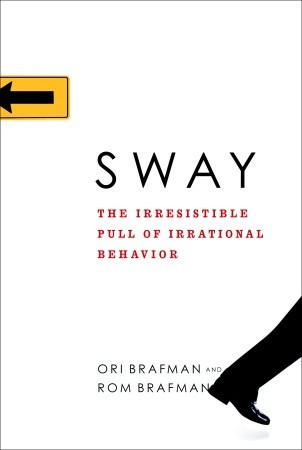
Given my tendencies, it was no surprise that I was tempted to check out, Sway: The Irresistible Pull of Irrational Behavior, a recent bestseller in which authors (and brothers) Ori and Rom Brafman attempt to explore several of the psychological forces that derail rational thinking.

I always like books that make me think twice about truths I hold self-evident, and “Sway” is one of those rare books that explains the obvious in ways that are not obvious at all.

According the Brafman’s there are certain “sway factors” that influence our decision-making, including:

* “Loss aversion” – when we engage in irrational behavior when we perceive potential losses. The bigger the stakes, the higher the risks we are likely to take to avoid those losses.

Ah, like at cocktail parties, where you’re only interested in what your significant other has to say when that cute young thing is flirting with him. Or at Nordstrom, when you’re ready to walk away from those sale-priced black boots that are indistinguishable from the three pairs you have at home, but can’t live without them when another gal comes sniffing at the leather.

* “The swamp of commitment” – where past success using certain strategies reinforces the likelihood of our using the same strategy over and over, even when common sense tells us another way might be more successful in a new situation.

I get this one too, which is why I can’t stop myself from studying the ground every time I go to the Arlington Theatre, where I once found a $20 bill on the floor. Irrational maybe, but apparently this is common enough behavior to be able to write a best selling book about it.

I was somewhat comforted to find that I wasn’t alone in this regard.

Then, when I queried my friends about their irrational behavior, I got all sorts of responses I could relate to, even more than the examples in the book. Like Penny, who “went to the gym and ran six miles, then stopped by See’s Candy on her way home for a snack.” Or Melanie who said she devours “People” magazine whenever she can get her hands on it, even though she doesn’t even know half the people in “People,” thanks to being 40+ years old.

Then there’s Miranda, who shops online when she’s supposed to be working and admits, “I would be so wealthy if I didn’t give a damn about clothes.” And Candace, who pretends to be a health nut with her children but steals candy from their party favor bags to eat when they’re not looking. Or Polly, who says she always blames her husband and her kids when she’s the one running late.

Or Priscilla, who watches “Gossip Girl,” “One Tree Hill” and “90210” with her seven year old daughter, but covers her eyes during the kissing scenes. No wonder these people are my friends. How can I not love Denise, who says her irrational behavior is immediately responding to my emails and ignoring all the work her boss wants her to do? And my favorite response, from Darlene, who wrote, “by the irresistible pull of irrational behavior, do you mean when I say @#$%* it, and do whatever feels good at the time?”

“Yep,” I texted back.

“Well, I’m usually under the influence of wine or margaritas and in the company of friends like you, my dear. Why don’t you stop by after you finish your column tonight?”

When Leslie’s not giving in to the irresistible pull of just about everything but work, she can be reached email . Originally published in the Santa Barbara Daily Sound on February 13, 2009. For more columns visit LeslieDinaberg.com.

Praising the pusher

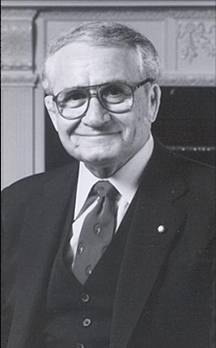
Dr. John Bonica

Dr. John Bonica

Epidural.

During your childbearing years, no four syllables have more power to start arguments than that one, simple word.

They are designed to take away pain, but epidurals also bring on rationalizing, pontificating, preaching, complacency, guilt, self-righteousness, ambivalence, and flat out fear. That syringe is full of much more than simple anesthetic. For many women, it’s a shot of undiluted shame, a guilt-ridden admission that they couldn’t take the pain.

I say so what. Pain is NOT everybody’s friend, and that’s where this wonderful invention comes in. I say we simply celebrate the wonderful man who invented the epidural.

How fitting it is that as Valentine’s Day approaches, we can salute the birthday of the dearly departed Dr. John Bonica, the man who pioneered this wonderful invention for his wife, Emma, who nearly died giving birth to their first daughter.

Forget the diamond- and ruby-studded push presents that are all the rage in certain circles. Can you imagine a more romantic gift than a husband who hands you a large needle full of medicine that will take all the pain away?

Oh baby. I swoon just thinking about it.

Now don’t get me wrong. I know all about the advantages of natural childbirth. After reading a million books on the subject of birth and the importance of having a “birth plan” -not realizing then that my time would have been MUCH better spent reading about parenting-I was planning on going drug free. I really was.

For one thing, needles always give me the heebie jeebies. I have to close my eyes just to get my blood tested, otherwise I worry I might faint from the wooziness.

Plus, I had been through a few surgeries and medical complications at that point, and had always been told I had a high threshold for pain.

I figured natural childbirth would be a snap.

Okay, maybe I’d need to squeeze that tennis ball extra hard and grunt a few times, but how hard could it be?

I was begging for drugs before I even had the hospital gown on.

My fear of needles was absolutely nothing compared to the blazing pain in my back when the contractions started. I would have gladly shot a thousand needles into my body-with my eyes wide open-to make the pain stop.

When the anesthesiologist finally came to give me my epidural, he was handsomer than George Clooney and Brad Pitt combined. And let me tell you, no offense to my husband, but that epidural was better than the sex that got me pregnant in the first place. And because I finally stopped squeezing his hand from the pain, he agreed.

Nothing makes you value human life more than giving birth to a 15-pound baby with a 21-inch-wide head-unless of course it’s trying to do it without an epidural.

Thank you Dr. Bonica.

It’s been a lot of years since Leslie’s epidural, but she still remembers it fondly. Share your labor pains with email . Originally published in the Santa Barbara Daily Sound on February 6, 2009.For more columns visit LeslieDinaberg.com.

Kitchen bitchin

stockimages, freedigitalphotos.net

stockimages, freedigitalphotos.net

Now that we’ve moved to a somewhat bigger house-with cupboards for pots and pans, counter space for ingredients, and a garbage disposal and dishwasher to assist with clean up-I’m running out of excuses not to cook.

Back at the old shack, I used to pretend we were camping, which made the spiders and the dirt more palatable, and my family’s regular diet of takeout burritos and Costco chicken almost justifiable. After all, we were roughing it.

But now that I’ve rescued 300 wedding guests worth of kitchen appliances, cookware, and gadgets from storage, and miraculously found homes for them in our new place, I can no longer plead “unsuitable conditions for food preparation” as a reason not to cook.

I need a new excuse.

See, I’ve got a theory: the cooking gene skips a generation. My mom is an awesome cook. If you ask my son, even her toast is more “dee-licious” than mine. Therefore I was destined to suck in the kitchen.

It’s my Grandma Sylvia’s fault. She was such a bad cook that, according to family legend, she would regularly throw away entire dinners she had ready on the table when my Grandpa came home from work, took one look at the meal, and suggested they go out to eat.

So my mom developed her culinary gifts, at least in part, as a defense against her own mother’s scorched casseroles and burnt briskets. And I never learned to do much in the kitchen because my mom had it under control, and then some.

I am hoping that my kitchen incompetence will give Koss an epicurean incentive. Something good has got to come out of my gastronomic ineptitude-other than a goldmine’s worth of business for Giovanni’s Pizza, that is.

I guess it’s a good sign that Koss is obsessed with the Food Network shows, although most of his favorites seem to involve dangerously fast chopping, strange facts about food, and lighting pyrotechnic cakes on fire, rather than learning any recipes that could be created in our kitchen.

My old kitchen endured a few pyrotechnics-and I don’t mean campfires-but the Food Network will not be filming anything here, unless it’s a comedy.

Despite the scorch marks on my ceiling, I just can’t get all that fired up about cooking. I’ve always been this way. My husband isn’t much help either. He’s fine on the barbecue, as long as there’s only one thing to cook at a time. But it took him six years to master baked potatoes.

Even in our early married days, when we had a nice, big, well-stocked kitchen, and a lot more time on our hands, the most useful “recipe card” we had was the phone numbers of all the local takeout places.

On the plus side, my husband knows I cook like Stevie Wonder. One of my best recipes is to make something awful, have him make even the slightest negative remark-“is this supposed to be the color of veins?”-burst into tears, and voila! No cooking for at least a month.

I wonder if I could send in that strategy to respond to the email I just got titled, “Yippee, another chain recipe swap?”

Yippee indeed.

Not only am I now equipped with pots, pans, and casserole dishes in the new place, but when my neighbor came over to introduce herself, she offered: “You’ll love this neighborhood. We do a potluck every week during Monday Night Football season.”

Oh boy, another cooking opportunity.

I’ll bring the cocktails.

When Leslie’s not slaving away in the kitchen, she can be reached at email . Originally published in the Santa Barbara Daily Sound on January 30, 2009.

Can we talk about texting

sippakorn, freedigitalphotos.net

sippakorn, freedigitalphotos.net

I’m as addicted to my iPhone as the next gal, but when history is happening, I turn off the phone and pay attention.

A group of us gathered at a friend’s store to watch Barack Obama’s Inauguration this week. It was festive, it was fun, it was emotional and it was the experience of a lifetime.

I was proud to be an American-and I was horrified to witness one of the other party guests texting his way through the ceremony. This was an incredible moment in history, something to tell our grandchildren about. He was obviously interested enough in the inauguration to get up early that morning and come to the party to watch it, so what’s it going to take to make him put away the phone for a few minutes?

This guy wasn’t even a teenager, so I can’t attribute his extra long thumbs (otherwise known as texting-itis) to a generational adaptation. My friend Albert is also squarely middle-aged, and yet he texted his way through a concert at the Granada the other night.

What it is up with that anyway?

Are we really so addicted to our gadgets that there has to be a law to stop people from texting while driving? My first reaction when I saw the signs about the new law outlawing texting while driving was a big fat “duh.” But I’m starting to think it might really be needed.

I read in the LA Times recently that Americans now send about 75 billion text messages a month and I’m okay with that.

Really, I am.

Texting is an excellent way to contact a friend late at night without worrying about waking them up. Or it’s a great tool to communicate information without taking time out to have a conversation.

But when real life is going on-especially big, important, historic moments in real life are going on-the cell phones should be turned off. No debate, no discussion, no exceptions, no texting.

Even small, insignificant moments in real life should take priority over texting. I can’t remember the last time I had dinner with my teenage nephews and they weren’t texting under the table.

On occasion, I used to have to say, “Hey my eyes are up here,” to keep leering eyes from staring at my cleavage. Now I have to say, “Hey my eyes are up here,” to stop them from staring at their cell phone screens.

Granted, that may be more of a comment on the current state of my cleavage than anything else, but still, I think we need some simple text-etiquette lessons.

If there’s something significant going on that you’ve gathered together with others to experience, then put away your cell phone. This goes for presidential inaugurations, rock concerts, movies, and dinners with families and friends.

If you’re operating heavy machinery, then focus on the ten tons of steel you’re controlling, not the three ounces of plastic keyboard that can easily wait until break time.

It’s none of my business if you want to spend a significant fraction of your 1,440 minutes a day checking the number of pokes and prods you got on Facebook, but that’s not how I want to spend my time. So, if there’s another person across from you-especially if it’s me-give them your attention, not your cell phone.

And not your land line either, for that matter. It really irks me when I go to the trouble to go to a store, in person, and the person working there stops helping me to answer the phone.

It also really irks me when I go to the trouble to have dinner/lunch/coffee with a friend, and the person stops our conversation to answer the phone or respond to a text.

Yes, I understand that there are emergencies with kids and work, cars that need to be serviced and deals that need to be closed, and if you really need to take the call or respond to the message then I’ll still be your friend, but the proper response to such an interruption is, “excuse me.”

Even “xq me” is better than simply treating the flesh and blood people you’re with as less important than whoever is trying to connect with you on the phone.

So in answer to that text you just sent me, “Y r u mad @ me?” I’d really like to look you in the eye and say, “because you’re being rude,” but hey, my eyes are up here.

When Leslie’s not ranting about cell phones she’s really a very pleasant person who can be reached at Leslie@LeslieDinaberg.com. For more columns visit www.LeslieDinaberg.com. Originally published in the Santa Barbara Daily Sound on January 23, 2009.

Surviving the move

Ambro/FreeDigitalPhotos.net

Ambro/FreeDigitalPhotos.net

I’m not a pack rat-I’m more of a pack mule.

But as we move to our new nest this weekend, I’m determined to shed some of those splintery twigs and raggedy feathers I’ve been hauling around for too long.

With that end in mind, this week I’ve been playing a not-so-fun game of “What in the world was I thinking?” as I struggle to pack up all of our worldly possessions and move about a mile away from the shack we’ve been residing in for the past eight years.

You would think that living in extremely tight quarters would have already inspired me to downsize considerably. You would think that a person who lives and works in a seven square foot space-that she has to share with a husband and small child, who also have a little bit of stuff-would realize that keeping five copies of every issue of the newspaper she worked for four years ago is a little bit impractical-not to mention a fire hazard.

You would think that a person like that might have thrown away the double prints of the blurry outtakes from her son’s first birthday or the once funny cards from her own 30th birthday. You would think that a person like that might not have kept the snack schedule from the 2004 t-ball season, the takeout menu from a favorite Thai restaurant that’s been shuttered since 2005, the Axxess Book catalog from 2006, and the cell phone charger from 2007.

Getting rid of those things years ago would have been logical. I also should have gotten rid of the twelve years of scrapbooking magazines I’ve had taking up shelf space, the unflattering day glow green sweater I wore once, and the really cute brown boots that make my feet scream-and not in a good way.

What in the world was I thinking keeping all of this stuff around?

It’s long past time for us to move. I would never have agreed to move into the shack in the first place if I thought it would take eight years to get out. Then entropy and poverty set in. Plus the rent was cheap and the school district was good and until recently, we were winning the battle against the termites and all of the ancient light fixtures were still working and the shower wasn’t leaking onto the floor of my closet.

What in the world was I thinking keeping all of this stuff around?

Somehow it took getting a demolition notice to get us moving. And when I say moving, I mean moving with a really quick deadline, to get me to get rid of all this stuff. I guess I’m just a deadline-driven kind of gal. I like deadlines. I never miss a deadline. Seriously, ask my editors. I might ask for an extension every once in a blue moon, but I NEVER miss a deadline.

Deadlines give me structure and discipline and a reason to get out of bed. I just have to think of moving like a deadline for a really huge project that I’ll be really happy about once it’s over.

Of course, unlike finishing a magazine article, a book, or even filling out insurance forms, I’ll have less money when I’m done moving-not to mention even more work to do once I get to the new place.

Let’s face it, I’ll be happy to “have moved,” but moving itself is pure hell. It’s as if some masochist combined the worst elements of torture, dust allergies, scavenger hunts, paper cuts, and physical aches and pains into one brutal, emotionally punishing, very expensive episode. Not to mention that once the packing is done there are hours of lifting, dragging, kicking, screaming, hoisting and herniating to look forward to.

Plus, did I mention the paper cuts? I really hate the paper cuts.

Did you know an estimated 42 million Americans move each year? There’s a whole Google’s worth of insightful information, like, “Moving is one of the most stressful times in a person’s life.” (No kidding?) Or helpful tips like, “Put all boxes into one room so you don’t have to run around the house like a madman on the big day.” (If I could put all my boxes in one room then I wouldn’t have too much stuff now, would I?)

I wish I could say that I was the only one in my family with too much stuff. Unfortunately I discovered a graveyard for outdated computers and stereo equipment in my husband’s home office. So what if that old laptop doesn’t work anymore, it still serves an important purpose-covering the stain on the carpet made by the leaky lava lamp he was going to fix “someday.”

My son has an archive of smiley face notes from his first grade teacher, Dum Dum Pops wrappers he was saving to get x-ray glasses, and beach debris he was planning to sell to Grandma “someday.”

But that’s okay because by Saturday morning all of those items will be carefully packed and labeled in boxes, and by Saturday afternoon they’ll be in our new house.

I hear it’s a great garage sale neighborhood.

When Leslie can locate her computer, and cable guy comes to hook up the Internet “between Monday at noon and the next solar eclipse” she can be reached at Leslie@LeslieDinaberg.com. Originally published in the Santa Barbara Daily Sound on January 16, 2009.

Noozhawk Talks: Leslie Dinaberg sits down with Maria Herold

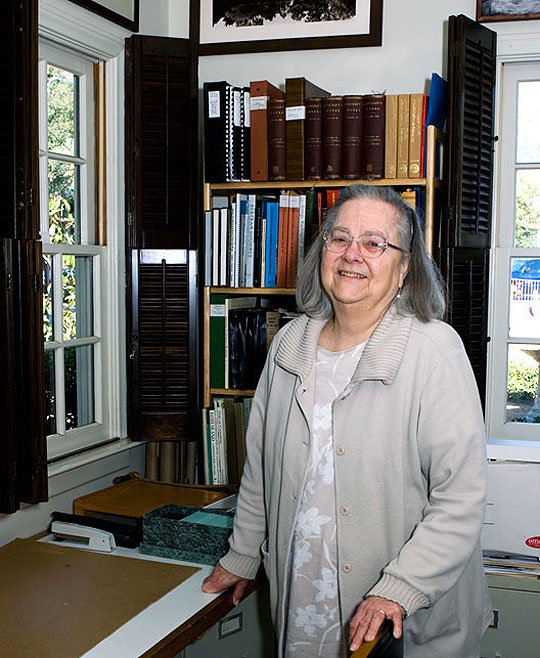
Maria Herold, longtime curator of the Montecito Association’s history committee, is an enthusiastic resource for those conducting obscure research or exploring land-use background. (Elite Henenson / Noozhawk photo)

Maria Herold, longtime curator of the Montecito Association’s history committee, is an enthusiastic resource for those conducting obscure research or exploring land-use background. (Elite Henenson / Noozhawk photo)

As longtime curator of the Montecito History Committee, Maria Herold knows-
literally-where the bodies are buried and the tales behind some of the most
storied families and legendary estates. Here she sits down with Leslie Dinaberg
to discuss some of her own history.

Leslie Dinaberg: How did you get involved with the Montecito History Committee?

Maria Herold: When I retired I decided that I would like to do something useful and I looked
around. I first looked into Recording for the Blind and Dyslexic, and I wasn’t quite
ready for their structure. I had heard that somebody was needed up here, so I
dropped in and have been here ever since. (Laughs) I just showed up!

LD: And when was that?

MH: I think about 1991.

LD: What did you retire from before that?

MH: Well, immediately before that I took care of babies … I wasn’t looking for a
job, but people asked me to take care of their babies because the hours were
perfect, my husband was a teacher and most of the people who asked me to
take care of their babies were teachers.

LD: Has history always been an interest of yours?

MH: Absolutely, because of the fact that my family has been involved with the
history of California and that has always been in the back of my mind. My
grandfather immigrated to America in 1873 and first worked in Sonoma County
and then settled in Northern Santa Barbara County and worked as a supervisor
on an old Spanish land grant.

He went back to Switzerland after he had worked here for 30 years. I was born in
Switzerland, and then I came to America when I was 16. He came when he was
15 and I came when I was 16. He came walking over the Isthmus of Panama and
I came on a freighter through the Panama Canal-so that’s history.

LD: Did you come with your family?

MH: Yes. The whole family came. … (My father) decided that instead of going to
the Santa Maria area, where he was born … he looked for the nearest place that
had a college and at that time there was a little college up on the Riviera so we
came here because of the college on the Riviera. I was the oldest child and he
wanted to be able to send me to college locally.

LD: You have an interesting history so I can see where your interest comes from.
What kinds of things do people come to the Montecito History Committee to
research?

MH: Everything from what is the story of my house or who is the architect or how
come my house is the way it is, to I heard about the Para Grande, or I heard
about the San Ysidro Ranch. Or I heard about somebody from New York who is
following a history of a person who started out in Europe, went to New York and
then ended up dying in Santa Barbara and inspiring a story of the ghost of a
countess in a local house. It gets that elaborate.

Then, of course, people who want to know the history of a street or of a property
that they want to buy. Or there is a legislation or development and, if they’re
smart, they come here and see what the history is. There are very few people
who are smart, but they manage to keep me busy, very, very busy.

I wish more people would come in because it is always ignorance that causes
problems, legal and otherwise. And in the community it creates a great deal of
problems where people are really not well informed on the history of Montecito.
And the same thing in Santa Barbara, the same thing in Goleta. If people knew
the histories there would be much less confrontation.

LD: Do you have a favorite project you’ve been involved with?

MH: I love it that the Pearl Chase Society once gave a mandate to a lady that
they were giving grants to look into part of the history of Montecito. And they
funded this lady, not me because I’m a volunteer, I don’t take money, except for
as a gift to the History Committee. But they funded this lady to work with me in
putting together a history of a particular section. We picked this section of
Montecito and looked into it in detail, starting with a map from 1871 and then
following the history of that section up to the present time. It was a fascinating
project. It took us months and literally months and months but it ended up in two
ring books of information with lots of pictures and everything else.

LD: What part of Montecito did you look at?

MH: We looked at the area between Jameson Lane (south), San Ysidro Road
(west), Hixson Road and Santa Rosa Lane (east) and Santa Rosa Lane (north).
That encompassed old farmland that had been well known farms in the 1870s
and 1880s and 1890s and also included one of the two most historic parts of
Montecito, which is Romero Hill. So we got all kinds of background with Romero
Hill and with the farming community and now having developments, so we have
everything there on how it developed since 1871.

LD: Do the other local libraries know about your resources?

MH: It depends on who they talk to at the library … I do know that UCSB is
aware of us, the Santa Barbara Historical Society sends us people all the time,
people who come into the library and say what should I do to find out about this
and that and something else, the librarians here (at the Montecito Library) send
me people all the time. So between the Santa Barbara Historical Society and the
local library we have a lot of referrals. Also there seems to be somehow people
seem to have become aware somewhere on the Internet of our existence
because I’ve had calls from all over the continent.

LD: What is the oldest structure in Montecito?

MH: What they call the Monsignor Adobe, which is a misnomer, but everybody
calls it the Monsignor Adobe. It’s a two-story Monterey and was built long before
the Monterey Adobe was built … The Monsignor Adobe is the most classic
building, I adore it. And yet it is the oldest building that’s still excellent.

LD: And what street is it on?

MH: It’s on the bottom of Sheffield Lane where Sheffield runs into North Jameson
Lane and it’s a land marked house.

LD: This sounds like very fun and very interesting work for you.

MH: Yes, but a lot of work. I would dearly adore having a helper.

LD: It seems like there should be a college student that would be
interested.

MH: Well, you know, people keep telling me that I should get involved with
Westmont students, etc. but the thing is they leave after a year, so all that is lost.
The continuity is shot down. What I need is an apprentice who will take over
because I’m not going to last forever.

LD: You’re still going strong, though.

MH: I’m 76 years old. Start counting (laughs).

LD: What else do you do like to do when you’re not volunteering at the historic
committee?

MH: For a long while I worked at Recording for the Blind and Dyslexic, which I
adored, just adored. But I can’t do it anymore. I’ve had several operations for
cancer so this is quite a trip. I used to work hours and hours over there and I just
loved it, but I can’t do it anymore. Then I’m involved with music all the time, I
always have been. I’ve been an accompanist and stuff like that. I’m still a
member of a choir, I sing with a group every Sunday but this is strictly amateur
music, but I’ve always done music.

LD: So is your group you sing with a church choir?

MH: No, it’s just a group that gets together, we all can read music, we get
together and we sing what is called early music, a capella early music and we
don’t perform, we do it for the fun of exploring early music.

LD: That’s really fun. That’s a great little local activity. If you could pick three
adjectives to describe yourself, what would they be?

MH: Old-fashioned, excitable, and enthusiastic.

Vital Stats: Maria Herold

Born: August 14, 1932, in Zurich, Switzerland.

Family: Husband George Herold; six grown children, Ann Herold, Matthew
Herold, Tina DaRos, Mark Herold, Monica Christensen, and Joseph Herold; eight
grandchildren and one great grandchild.

Civic Involvement: Volunteer curator with the Montecito History Committee, very
active with Mount Carmel Church, former volunteer for Recording the Blind and
Dyslexic.

Professional Accomplishments: Runs the Montecito History Committee archives;
formerly took care of babies in her home.

Best Book You’ve Read Recently: The Zookeeper’s Wife, by Diane
Ackerman.

Originally published in Noozhawk on January 12, 2009. Click here to read the story on that site.

Giving Back: Chuck Slosser

Chuck Slosser (courtesy photo)

Chuck Slosser (courtesy photo)

With the same engaging grin and focused attention that have pried philanthropic purse strings loose since he came to town in 1981, Chuck Slosser says he’s excited to tackle retirement after 18 years as executive director of the Santa Barbara Foundation.

What an amazing ride it has been. When Slosser, now 66 took the helm of the Santa Barbara Foundation–Santa Barbara County’s largest private source of funding for nonprofit programs–it had a staff of three, roughly $30 million in assets, and was giving out a few million in scholarships and grants a year.

Compare that to today’s foundation–under Slosser’s leadership, it now has a staff of 23, more than $300 million in assets, and donates about $27 million each year. He’s justifiably proud, but still ready for a slower pace, saying, “I thoroughly enjoyed the foundation and the work that we’ve done here and the great things that have happened in the community as a result. I’ve never objected to the 9 to 5, but it’s really the 5 to 9.”

Slosser and his wife of almost 38 years, Stephanie, who retired from UC Santa Barbara’s biology department three years ago, plan to travel, play golf and do yoga. He’s also interested in playing more basketball (he’s got a regular game at the Boys and Girls Club), taking Spanish lessons, picking up a guitar and a dissertation that have been collecting dust, and perhaps doing some consulting. He smiles. “I really do feel like a kid in a candy store. I want to do that, and I want to do that, and I can’t wait.”

Clearly, Slosser is a man with many interests, which is why the diverse Santa Barbara Foundation was “a dream job come true.” With an infinite variety of grant recipients–Music Academy of the West, Page Youth Center, Special Olympics, Council on Alcoholism & Drug Abuse, Santa Barbara Neighborhood Clinics, Red Cross, St. Vincent’s, Legal Aid, Transition House, Girls Inc. and Wildlife Care Network, to name a few — the foundation was a perfect place for this Renaissance man.

Originally published in Santa Barbara Magazine in January 2009.

This year I resolve to

resolutionsI make my New Year’s resolutions daily. I just strive to be a better person and I always believe in karma.Jay-Z

Cheers to a new year and another chance for us to get it right. Oprah Winfrey

A New Year’s resolution is something that goes in one year and out the other.Leslie Dinaberg’s South Coasting Column, 2004

Like many ridiculously optimistic and otherwise rational people, I always take some time at the end of December to reflect on my accomplishments of the past year and set goals for the next one. The idea is to come up with a list of goals that will help transform me into a kinder, nicer, more organized, healthier, richer person with a better figure, a well-behaved family, and a much cleaner house.

Okay, so maybe my 2008 accomplishments weren’t all that stellar, but a look back at the history of my New Year’s resolutions tells me that at least I’m continuing to make some progress every year.

Resolution #1

1988: I will get back to the weight on my Driver’s License.

1997: I will get back to my weight when I got married.

2005: I will follow my new diet religiously until I get back to my pre-pregnancy weight.

2009: I will try to develop a realistic attitude about my weight, focus on getting healthy, buy myself pretty clothes and develop my personality. (Confession: I’d like to take credit for this line, but truthfully it’s what my father said about me the first time he saw me when I was an hour old.)

Resolution #2

1992: I will not spend my money frivolously and save enough money to put a down payment on a small house in Santa Barbara.

1998: I will not spend any money at all on anything, under any circumstances, and save enough to put a down payment on a small house in Isla Vista, with the help of my parents and anyone else who might want to invest.

2003: I will not spend my money frivolously and save enough to put a down payment on a small used car.

2006: I will stop buying so many new pairs of shoes.

2008: I will try to keep my expenses below 110 percent of my income.

2009: I will stop crumpling my tax deductible receipts into teeny tiny balls of paper that raise my husband’s blood pressure every year come April.

Resolution #3

2003: I will stop smoking.

2004: I will stop smoking.

2005: I will stop smoking.

2006: I will stop smoking.

2007: I will stop smoking.

2008: I will stop smoking.

2009: I will stop smoking. (Confession: I never started smoking in the first place, but I always like to give myself one easy thing that I know I can accomplish to make myself feel better about this whole New Year’s resolution thing.)

Resolution #4

2003: I will spend more time with my family.

2006: I will spend more quality time with my family.

2008: I will redefine quality time with my family to mean that we all have to be awake, with no one yelling, but not necessarily doing the same activity in the same room at the same time.

December 22, 2008: Screw the family. I will carve out some quality time for myself, by myself, and not feel guilty about it. (Written immediately after disembarking from a five-day cruise with my extended family.)

2009: I will spend more quality time with my family and my dear friends, but only after spending enough quality time with myself to not be grumpy.

Resolution #5

1998: I will treat my body as a temple and eat only healthy, organic foods.

2000: I will only order out for pizza once a week.

2003: I will remember that Chuck’s Mai Tais do not count as a serving of fruit, even though they come with an orange slice and a maraschino cherry. The celery in a Brophy Brother’s Bloody Mary doesn’t count as a vegetable either.

2006: I will sit down with my family and eat a healthy, balanced meal at least once a week.

2008: I will eat a piece of dark chocolate and I will drink a glass of red wine every night, but only for the good of my health.

2009: Ditto.

Resolution #6

1982: I will write a book before I’m 30.

1995: I will write a book before I’m 40.

2005: I will read at least 10 books a year whose titles I’m not embarrassed to talk about.

2007: I actually wrote a few books. So what If they’re shorter than this column and the graphics are kind of cheesy. I have my own ISBN numbers.

2008: I co-authored a book and it’s actually pretty good. I will do my best to help sell “Hometown Santa Barbara” so I can actually make some money this year.

2009: I will write a novel before I’m 50.

Resolution #7

1993: I will not fight with my boyfriend about household chores.

1994: I will not fight with my husband about household chores.

1999: My husband will stop pretending he knows how to fix the car and I will stop pretending I am the least bit competent in the kitchen.

2007: My husband will stop pretending he doesn’t see the pile of laundry that needs to be folded and I will stop pretending I don’t know how to plunge the toilet and pump my own gas.

2009: My husband will make sure I have gas in my car if I give him enough warning when the tank is low and I will stop making New Year’s resolutions on behalf of other people.

Resolution #8

2003: I will not fight with Koss about cleaning up his toys.

2005: I will not fight with Koss about doing his chores.

2006: I will not fight with Koss about his homework, doing his chores and cleaning up his dirty sweat socks.

2007: I will not fight with Koss about his homework, doing his chores and cleaning up his dirty sweat socks and his sweaty t-shirts.

2008: I will not fight with Koss about his homework, doing his chores, cleaning up his dirty sweat socks and his sweaty t-shirts, and how much time he spends on the computer.

2009: Koss will be responsible for his own homework, his own chores and his own dirty clothes. But I am still his mother and I can make resolutions for him if I want to!

Resolution #9

2008: I will put away money that I would have spent on lattes in a little jar every day and maybe when I retire I’ll be able to afford an R.V. that I can park somewhere in Santa Barbara.

2009: Who am I kidding? I can’t live without lattes. Pass the Equal, and the wine and chocolate while you’re at it.

Cheers to a New Year and may all your troubles last as long as my New Year’s resolutions.

Share your resolutions with Leslie by emailing email . Originally published in the Santa Barbara Daily Sound on January 2, 2009.