The Soup Takes Bronze

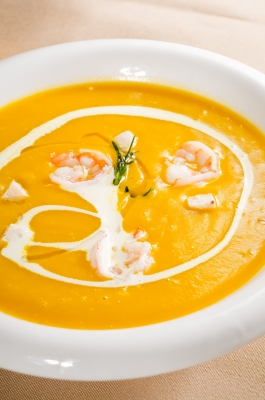
Photo KEKO64, freedigitalphotos.net

Photo KEKO64, freedigitalphotos.net

Over the years I’ve written a few books, oodles of magazine articles, countless columns and an amazing number of thank you notes, but until recently I had never, ever, ever written a recipe. In all honesty, I had hardly even looked at a recipe, let alone tried to follow one.

I know some people, like my mom or my friend Katie, who can take a few ingredients, some fresh vegetables, a pair of chopsticks, a pot and a few spices, and miraculously transform into Chef MacGyver, tossing and throwing and shaping and forming whatever’s in the cupboard into delicious concoctions.

I am not even remotely one of those people. In the past year or so I’ve mastered a couple of simple things and everyone is dutifully impressed, but still, my kitchen has seen more than a few fires in its day, and my most used “recipe card” has the phone numbers of all the local takeout places.

But then I got inspired.

I first read about the YMCA’s clever fundraiser a few weeks ago: the Soup de l’YMCA soup-making contest, where for a mere $25 donation contestants competed for bragging rights, having their recipe published in the Santa Barbara Independent and a place on the menu at State & A Restaurant. I was impressed by the creativity of the fundraising idea and figured I’d write a column to help them get more entries in the recipe contest. The Santa Barbara YMCA and I go way back.

I took gymnastics lessons there as a gawky, 5’8″ 12-year old, and realized that the distance from the top of the balance beam to the semi-padded floor mats was way too far to fall on a regular basis. But still, it was fun. And I displayed my participation ribbons proudly on my bulletin board.

Then I tried to use my height advantage and played basketball at the YMCA, soon realizing that, unfortunately, a certain amount of pesky running up and down the court was required, beyond my being able to reach the basket with my outrageously long arms. Still, I enjoyed the competition part and I still have a soft spot for the Y.

Wanting to give them some support, I read the contest rules carefully and found that all soup entries had to include at least one major ingredient that begins with one of these letters: Y-M-C-A.

Y-M-C-A, I just happened to have the perfect Y-M-C-A connection. My old friend Eric Anzalone is the Leather Guy in the Village People. Seriously. My old friend Eric Anzalone is the Leather Guy in the Village People. I had interviewed him once before and he was hilarious, in a way that only a guy you went to high school with who now wears leather chaps as his work uniform can be. So of course I jumped on the opportunity to do it again.

“What kind of soup would the Village People eat?” I asked, since it literally takes a village to raise enough money for youth programs these days.

“Well, we’re kind of boring,” said Eric, though I know he’s anything but. “Some of our favorite items we always ask for when we travel are REAL black licorice (not the cheap jelly bean anise stuff), Buffalo wings, anything from Taco Bell, the fettuccine Alfredo that you can only get at Alfredo’s in Rome (when we are in Rome, we always reserve a group table…we are on the wall of fame there).”

“I can’t really do much with Roman fettuccine, unfortunately. What else?” I asked.

“Cheetos, Cheez-Its, Bacardi and Coke, and Vegemite! And beer, a deli tray, assorted breads, fresh vegetables with dip, fresh fruit platter, coffee and assorted teas, hummus, Red Bull, beer, Gatorade, Coke (Coca Cola brand only) a case of beer, honey, mustard, mayo (Best Foods/Hellmann’s, not that Miracle Whip salad dressing), a box of Ziploc Baggies and barbecue ribs,” he said.

Sensing a beer theme -which is absolutely no surprise if you know Eric- I used that as my inspiration for my “It Takes a Village (People) Soup” recipe. Unfortunately with his busy international travel schedule (seriously, these guys sell out gigs all over the world, and sang and danced their way into the Guinness Book of World Records a few weeks ago, when it was finally certified that 40,148 adoring fans had performed the largest YMCA dance ever during the halftime show at the Brut Sun Bowl, in El Paso, Texas) by the time I actually did the interview and wrote the recipe, the contest deadline was upon us and my column deadline had come and gone.

I decided to enter my recipe into the contest anyway.

We laugh a lot at our house, but I have never heard a louder roar from my husband than when I got the message from Georgette at the YMCA that I was a finalist in the soup recipe contest. Except perhaps when I told my sister, who said, “Yeah right. And I’m going to compete in the spelling bee.”

Believe it or not (and yes, just writing this makes me giggle), there were more than six entries and my soup recipe made the top five finalists. The chef at State & A actually made it taste pretty good. By the time I tasted all five soups, had a few happy hour priced adult beverages, and endured the shock and mock surprised “this doesn’t taste half bad” feedback from my friends and family who had come out to support me at the contest, I actually thought I had about a one in five change of being the winner-especially since three of the four judges were personal friends.

I behaved like a good sport when poet Chryss Yost’s “Sopa de la Reina” took the top prize. It turns out she also knew some of the judges personally. And I guess she actually cooks, too.

Despite my bringing in an extra large group of family and friends to vote for me, Lisa Bull’s “Fiesta Chicken Tortilla Soup” won the “audience favorite” award for the night. “I think your soup was definitely third place, mom,” said my sweet son with the permanently damaged taste buds. “You got the bronze.”

Indeed, a bronze medal in my first plastic chef cooking competition is nothing to sneeze at. It was actually a lot of fun. I still need somebody to explain the joy of cooking to me someday, but the joy of competition, hey, that’s something I learned a long time ago at the local YMCA.

=

It Takes a Village (People) Soup

Ingredients:

3 oz. Yellow Snow IPA (from Rogue Ales Brewery)

3 oz. Molson Golden Beer

3 oz. Coors Light Beer

3 oz. Amstel Light Beer

2 cups cauliflower

1 Tbsp butter

1/2 cup chopped onion

1 minced garlic clove

1 tsp Worcestershire sauce

14 oz. chicken broth

3 Tbsp cornstarch

1 cup cream

1 cup milk

2 cups shredded yellow cheddar cheese

Cook the cauliflower in a small saucepan with enough water to cover it, over medium heat until tender, 5 to 10 minutes. Drain.

Melt the butter in a large pot over medium heat. Add the onion, garlic and Worcestershire sauce. Stir occasionally and cook until the onion is tender and translucent. Add the beers and bring it to a boil.

Drink the remaining beer in each bottle and the warm soup aroma will start to smell delicious, in fact you’ll start to feel warm all over. Add the chicken broth and let it come back to a boil then stir in the cauliflower.

Combine the cornstarch and three Tbsp of water in a small bowl. Let dissolve and set aside. Stir in the cheddar and milk and cream into the soup until the cheese is melted. Add the cornstarch mixture and continue stirring until the soup thickens. Serve with Cheez-Its and, of course, beer.

Share your soup recipes with Leslie@LeslieDinaberg.com. For more columns visit www.LeslieDinaberg.com. Originally published in the Santa Barbara Daily Sound on March 5, 2010.

iMemories

iphone-4s-devicesI used to have a pretty good memory, but now there’s an app for that.

I used to have a pretty good memory. Now I have an iPhone.

Actually, I used to pride myself on having a great memory; at least I think I did. To tell you the truth, it’s a little bit fuzzy. I know I used to be really good at Trivial Pursuit. Remember that game? I was much better at Trivial Pursuit than I am at Sequence, where the cards are all face down and you have to remember where they are and put matching sets together. Wait that’s not Sequence, that’s another game. Concentration? I know it’s not Scrabble. I’ll have to email my sister to find out the name of that game. One of her daughters was really good at that game.

Anyway, as I said, I used to have a pretty good memory. At least I think I did. Now I don’t have to remember anything anymore because I can look it up on my iPhone-as long as I remember to charge my battery.

I recently read somewhere-I wish I could remember where-that you shouldn’t worry if you pick up the phone and can’t remember who you were going to call. But if you can’t remember how to use the phone, then it’s time to worry.

Boy, that’s a relief. I still know how to use the phone, although if I lost it I might not be able to figure out how to find my way home without its GPS app.

Now what was I saying? Oh yeah, I used to have a pretty good memory but now that I have so much information at my fingertips I don’t really need to remember so many things, which is good, because I can’t do that anymore.

The one thing I’ve never been good at remembering are people’s names. Somehow I always find myself thinking up fictional new names for them before I’ve memorized the originals. Don’t you think Lindsey Vonn seems more like a Bunny McPhearson and Jon Hamm should really be named Dirk McHandsome? I’ve got nicknames for people I’ve never even met, but when I meet new people I tend to forget their names instantaneously, before they’ve even made their way into my brain.

I would worry that this issue with names was a sign of old age, but I’ve been doing it as long as I can remember, which is still pretty long.

There are two ways I get around this name-forgetting problem (I suppose paying better attention would also work, but somehow that is much too hard for me). One, I hope that someone else whose name I don’t remember comes up to us and I can instruct them to introduce themselves or, two, I hand over my iPhone and ask the new person to put their name and their number into it. Of course the danger with this is that I end up making social plans with people I don’t know, while I barely have time to see my close friends and family. Luckily I can still text them or keep up with them on Facebook using my iPhone.

But I still can’t remember the name of that Memory game that my niece was so good at. Maybe I can find it online on my phone. There it is. It’s called “Memory.” Huh. Memory. Doesn’t it seem more like it should be named Concentrate McBoardGame?

Share your hazy reflections with Leslie@LeslieDinaberg.com. For more columns visit www.LeslieDinaberg.com. Originally published in the Santa Barbara Daily Sound on February 26, 2010.

Fanning the Flames For the Winter Olympic Games

TeamUSAOne of my favorite things about the Olympics is that they allow me to root for America’s quest for world domination without a bit of ambivalence. Unlike the complicated wars and diplomatic situations our country gets involved with, for often incomprehensible reasons, the winners and losers of the Olympic Games are fairly clear cut, with none of those pesky gray areas to fret about. Go USA!

The competition between the Summer and Winter Olympics is a little bit murkier.

It might be easy to assume that because I grew up in Santa Barbara, the Summer Olympics would always get the gold. Volleyball, swimming, gymnastics, water polo, diving, basketball, tennis-these were the sports I played and watched, so I could easily appreciate the athleticism required to be the best in the world at any of the summer sports.

The Winter Olympics are a bit more foreign to me. Curling, Luge, Bobsleds—I’m never quite sure what these events are about. Not that this stops me from putting in some marathon TV hours. I’m staying up well past midnight this week to do my part for the Olympic team, yet no one’s giving me million dollar endorsement deals. I don’t even get a free Nike Jacket, and the snowboard team’s plaid ones are really cute. Heck, at this point I’d settle for a Gatorade.

But even more than the exotic challenge of figuring out some of the rules, the thing about the Winter Olympics that keeps me faithfully glued to the TV—for many, many more hours than can possibly be healthy—is the drama. Almost all of the winter sports have the possibility for huge airborne, gravity-defying success or even more ginormous, dream-crashing failure.

The brutally cold hard fact that so many of these athletes could bite it and get seriously hurt is what keeps me on the edge of my seat for the Winter Olympics. Just uttering the name “Skeleton” (a sport where people lie face down on a sled and go careening down a frozen track without any brakes) runs a chill down my spine. The same thing with “Biathlon.” Did anyone really think it was safe to combine cross-country skiing with speed trials and shooting? Next thing we know they’ll make it a “Triathlon” and bring in Curlers to throw rocks.

The Winter Olympics could be a great action adventure movie. I can just see the trailer: Exotically handsome Apolo Ohno (Oh! No!) courageously fights off two South Koreans who knock each other out, and then victoriously clutches the American flag on the short track. Meanwhile, injured Lindsey Vonn “America’s fastest bikini-model-not-named-Danica Patrick,” whooshes her way downhill for an impressive gold medal victory. Could a romance be brewing between these two?

But wait, there’s danger around the corner, as a quick cut reel of dramatic wipeouts, snow snuffs and faceplants reveals the anguished falls of the Netherlands’ speed skater Annette Gerritsen, France’s skier Anthony Benna, Russian speed skater Yulia Nemaya, Canada’s cross country skier Ivan Babikov, Chinese short track skater Nannan Zhao and German pairs skater Robin Szolkowy, fading into a final shot of Canadian hockey player Marie-Philip Poulin practically eating the net.

And that’s just the first few days of action.

Watching the ice skating in particular, I feel like a rubber-necker at a car crash, anxiously waiting for a triple axel to turn into a bone-bursting accident or a salchow to spin into a crushing calamity. Pairs skating even has a move called the death spiral. You don’t see that in beach volleyball. No wonder I can’t look away.

Pass the popcorn. I’m gonna be here awhile.

When Leslie’s not glued to her TV screen for the winter games, she can be reached at Leslie@LeslieDinaberg.com. For more columns visit www.LeslieDinaberg.com. Originally published in the Santa Barbara Daily Sound on February 19, 2010.

Relationship Research

Photo  by stockimages, freedigitalphotos.net

Photo by stockimages, freedigitalphotos.net

I’ve tried to get my husband into therapy for years – and failed miserably. Why is it that those who are most in need of psychological help are the least able to see it?

Anyway, when I saw an advertisement asking for married couples to participate in a UCSB study on close relationships, I jumped at the chance to get my husband on the couch, even if it was only under the guidance of some 19-year-old psychology students. Not only would Zak finally have the opportunity for some long overdue self-reflection (contemplating one’s navel doesn’t count), but also there was 60 bucks in it for us if we attended two sessions.

Talk about a win-win. They even promised us free parking and snacks.

It was surprisingly easy to talk Zak into going. He was actually excited. On our drive out to UCSB he said, “When they ask about our occupations, do we fight crime or do crime?”

“Honey, I think you should just tell the truth and get as much out of the session as you can,” I said.

“Right. We fight crime,” he said.

Yeah, sure. Whatever gets you onto that couch, dear.

After a brief introduction by a spectacled graduate student in a white lab coat who was, I swear, no more than 14 years old, Zak and I were put into two separate rooms to do some tests.

The first exercise was a series of questions about our relationships. We had to weigh our answers on a scale of one (where you strongly disagreed with the statement) to seven (where you strongly agreed with the statement) or a scale of one (I’m not at all like my mother, how dare you) to nine (I’m exactly like my mother, so deal with it) and so on.

I immediately became utterly and thoroughly confused.

I contemplated using my cell phone to call Zak in the room next door to help me with the test. Would wanting to work together show that we had a healthy relationship or that I was being a complete neurotic idiot? I reminded myself that there couldn’t possibly be any “wrong” answers, and tried to answer the questions the way a healthy person would, giving myself props for refraining from calling Zak as I opened my veins and sweated out answers.

A sample question: “How much time do you spend thinking about your relationship with your spouse?” Does wishing he looked like Brad Pitt count?

Or how about this one, “In my conversations with others, I don’t like to talk about things that don’t interest me.” Who likes to talk about things that don’t interest them? I find boredom extremely exciting, but only if I get to use the time to fantasize about Brad Pitt.

So far this study wasn’t really doing much to bring me closer to my husband, although we did go out to lunch with our stipend.

For our final session, they flipped a coin to decide which spouse would do which activity. Zak got to do a puzzle (something that’s incredibly fun and easy for him) while I had to give a speech (something that’s exceptionally painful and stressful for me).

Hmmm … I wondered just how random that little coin toss was as I contemplated my speech instructions, to fill five minutes, as though I were on an interview for my ideal job. While I can fill thousands of column inches writing about myself, actually talking about myself for five minutes felt like an eternity. Luckily Zak stepped in with some questions, coaxing me into describing how working no more than 25 hours a week would benefit my future employer (I’d be in such a good mood if I could sleep in till 9 every morning!) and why the loan of a company car (preferably a convertible) would help reduce my stress and therefore enhance my creativity.

The researchers found our silly banter to be symptomatic of a healthy relationship. Who knew? We later found out that we had been observed by the psych team the whole time. Thank goodness we didn’t turn the waiting room into a “What’s the craziest place you’ve ever made whoopee?” response, as my husband had suggested earlier.

They explained that the study was designed to help understand how spouses help each other cope with stressful life events and how that relates to marital satisfaction.

I didn’t have the heart to tell our grad student (who actually was 24, even if she looked 12) that the tests weren’t really that stressful, especially when she seemed so pleased with our performance. When Zak and I reviewed our answers we found that despite our contention that his father and my mother would make a terrible couple, we were actually more alike that we thought.

If he’s more like me than I thought, maybe he doesn’t really need therapy after all.

I told Zak, column comedy opportunity aside, participating in the study actually left me feeling pretty good about our relationship.

“That’s good,” he said, “because it really took very little work on my part.”

And that just might be the real secret to a healthy close relationship. That and fighting crime together.

Share your relationship secrets with Leslie @LeslieDinaberg.com. For most columns visit www.LeslieDinaberg.com. Originally published in the Santa Barbara Daily Sound on February 5, 2010.

Musing on Money and Marriage

Photo: stockimages, freedigitalphotos.net

Photo: stockimages, freedigitalphotos.net

“That’s it?” I want to crumple up my 1099 forms in disgust every January when I see, glaring at me in black and white, how little I get paid for pouring my heart and soul onto the page (and increasingly the computer screen) as a freelance writer.

“This year it’s actually good that you didn’t make much money,” says my husband, Zak, looking at me over a half-full bottle of beer. “In fact, go back to last year and make even less, and then make a whole lot more this year.” This is his version of financial planning. Apparently we neglected to make estimated tax payments, so the less money I make the less we’ll have to pay up in April.

Oh the unexpected joys of being underemployed.

It wasn’t always like this.

When we first started dating, Zak was the underemployed one. While I was bringing in the relatively big-ish bucks as a marketing executive, he was a struggling screenwriter. He always made enough to pay his own way, but barely. If we wanted to go out to a restaurant with real silverware and cloth napkins, it was definitely on me.

This went on for years-six to be exact, but who’s counting? I wasn’t making that much money but compared to him I was rolling in it, and if there were any luxuries I wanted (like Charmin toilet paper and something besides Top Ramen for dinner) we both understood that I would have to foot the bill.

Then, in a flash of Hollywood’s magic wand, Zak’s income gained an extra digit. My left hand gained a great big diamond and we started planning a ridiculously expensive wedding, which I decided to devote the next several months of my life to planning. Who needs a day job when your husband-to-be makes enough to make your paycheck look like a pittance?

And so it went for a few years. Sure, I did some writing, but mostly I enjoyed myself. It’s amazing all of the fun things you can find to fill your days when you don’t have that pesky burden of the nine to five lifestyle.

For better or for worse, it didn’t last.

Zak’s Hollywood trajectory plummeted almost as suddenly as it rose, and before I knew it I was back working fulltime as the main breadwinner, and Zak was the one who was underemployed and mostly stayed home with our son. For the last ten years we’ve flip-flopped, both taking turns with making the primary income and being the on-call parent.

I knew this was unusual, but didn’t quite realize how un-mainstream it was until the Pew Center came out with a study recently, that found wives were the dominant income-provider in one of five marriages, and more notably, that this was big news. The New York Times ran five freaking stories about this trend.

A trend which is, frankly, no big surprise: Men are still the major contributors of household income — with 78 percent making at least as much or more than their wives — but the percentage of women whose income has outpaced their husband’s has jumped from just 4 percent in 1970 to 22 percent now.

That’s what they call coming a long way, baby?

I asked my friends to see if many of them made more money than their husbands do. The vast majority said something to the effect of, “No, but I’d sure love to-and believe me he’d be thrilled about it.”

No kidding.

Among those who did make more money than their husbands, it seemed to be something they took in stride. For the most part, their respective career paths and earning potential were predictable at the time they got married. Although my friend Inez said she was surprised-and angry-to find out she made less than her husband when they got married, as she was better educated and clearly had a job with more responsibility.

“Honestly, it fired me up to ask for-and eventually receive-a long overdue promotion. My husband was cheering me on the entire time.”

As Allie said, “Having a good salary was one of my main goals coming out of college. I was never counting on marrying someone rich. I wasn’t really counting on getting married in the first place.”

“It has definitely been something we have had to work on together and it has often been with resentment and bad feelings,” said Carla. “If you had asked me about making more money five, ten or 15 years ago, my responses would have been different. It’s something we continue to work at and even change roles sometimes. It’s all good and part of the process. Money is hard, but not what drives the love, and certainly not the marriage.”

I’ll be thinking of that while I travel back to last year in order to work less. And while I’m there, maybe I’ll pick up some shares of Apple. Now that’s sound financial planning.

Share your musings on money and marriage with Leslie@LeslieDinaberg.com. For more columns visit www.LeslieDinaberg.com. Originally published in the Santa Barbara Daily Sound on January 29, 2010.

Dear Scumbag

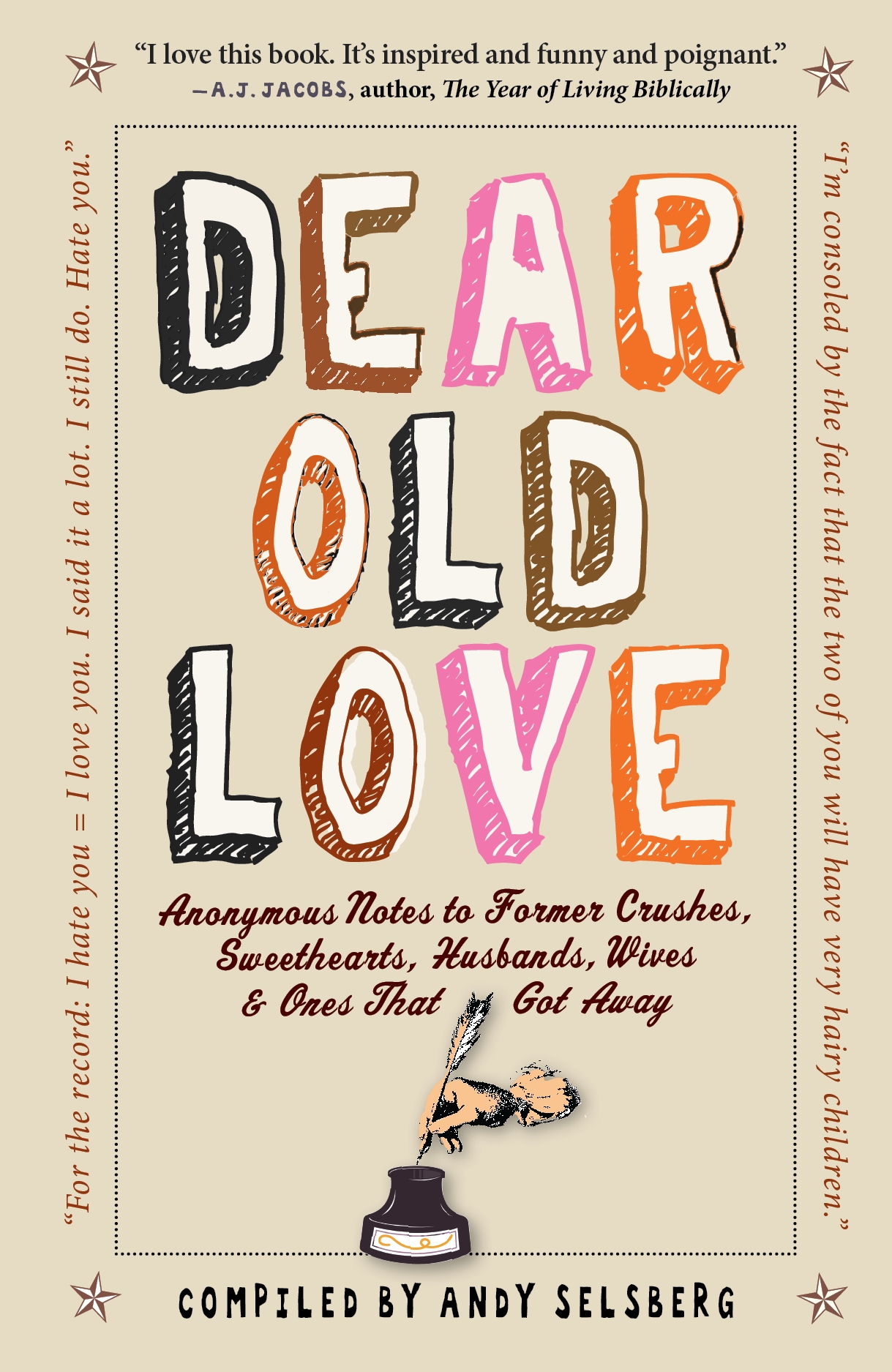
Dear-Old-Love-cover-artThe limitless wisdom of the broken heart can only be surpassed by its vindictiveness.

Andy Selsberg captures both aspects of love gone bad in his new book, “Dear Old Love: Anonymous Notes to Former Crushes, Sweethearts, Husbands, Wives and Ones That Got Away,” which caught my eye at Chaucer’s this week.

For those of us who have wasted months, and possibly years, of their lives crafting the perfect zinger we woulda shoulda coulda come up with decades ago, this book is a revenge fantasy come true.

It’s also pretty funny.

Selsberg, curator of a website aptly titled www.dearoldlove.com, has been collecting short missives to ex-loved ones (or at least ex-liked-a-lot ones) and put them together in a collection that made me laugh out loud, with just a bit of bitterness for good measure.

Think about it. What would you say to an ex if he-or she-didn’t know it was you?

Ranging from bitter to flirtatious and sometimes downright disturbing, these confessional tidbits – “Your underwear is the only thing I remember from eighth-grade Spanish” and “I may have exaggerated my devotion to sports to win you, but my love of sitting, eating and watching things was genuine” – provide even more proof than the ongoing sales of Celine Dion records that “Breaking up is Hard to Do” and “There Must be 50 Ways to Leave Your Lover.”

People rarely move on completely when it comes to matters of the heart, and this book, which the publisher calls a “toxic fusion of bittersweet memories, unforgettable heartache, and saccharine nostalgia that have plagued all of us at some point in our lives,” is a great way to laugh the melancholy away.

Some of my favorites had to do with family: “I didn’t want to have children with you, because I saw how you micromanaged your cat.”

“I really did want to be a grandparent with you. It’s just that getting to that point would have been an interminable slog.”

“Love’s not a competition, but I’m winning. Your mom took my side, your best friend talks to me more than he does you, and your brothers still support me. But I still want you back.”

Fame: “I’ll be waiting for you after your mild fame evaporates.”

And grammar: “I knew we wouldn’t last because you used the wrong version of ‘you’re’ in almost every one of your emails.”

Grooming was also an issue for many, with contributions like, “I’m consoled by the fact that the two of you will have very hairy children,” “I guess I have a thing for Jewfros now,” and “Even though the last time we saw each other you were in handcuffs and shackles, it was the fact that your hair looked terrible that made me laugh,” making me laugh out loud.

“I don’t care that we broke up, I only want you to still want me” was a common, bittersweet theme, in entries like, “When I ran into you at the coffee shop, your hair looked more gray. I like to believe that means you can’t live without me,” and, “I’m fine without you. I just can’t stand the idea that you can get along without me”-both sentiments that I can relate to.

But my favorite entry of all was more bitter than sweet: “Every day, I check the paper for your obituary.”

Talk about getting the last word. All in all it’s a satisfying journey to see disgruntled lovers have their final say-even if it’s only strangers who are actually listening.

In case you need help crafting your submission to www.dearoldlove.com check out www.dearjohn.com and don’t forget to share your letter with Leslie@LeslieDinaberg.com. For more columns visit www.LeslieDinaberg.com. Originally published in the Santa Barbara Daily Sound on January 22, 2010.

Fly on the Wall

Photo: Jeroen van Oostrom, freedigitalphotos.net

Photo: Jeroen van Oostrom, freedigitalphotos.net

If eavesdropping were an Olympic sport, I would have a gold medal and a sponsorship deal with Verizon. Can you hear me now? I sure hope so! From the time I was very young I’ve been ridiculously fascinated by other people’s conversations.

One of my earliest memories is sitting in the hallway (after being sent to bed) and snooping on the adult conversation at my parent’s dinner parties. I didn’t understand half of what they were talking about-Harvey Wallbangers, Mia Farrow, Dick and Liz-but that didn’t stop me from wanting to listen.

When I read the Harriet the Spy and Nancy Drew books I started keeping an eavesdropping notebook, dotting my i’s with little hearts and writing down interesting snippets of conversation I overheard. Despite my lack of skill in martial arts and Mandarin, I think I would have been a great CIA Agent. Going on stakeouts, drinking stale coffee, cracking wise with colleagues and writing things down sounds like great fun to me. I absolutely love to observe and report.

I was once sure I had uncovered a huge murder-suicide-extortion plot at the Good Earth Restaurant, where I overheard a couple of guys in an adjacent booth talking about babes, blood and bribes-until I saw the movie on Lifetime Television. So much for my spy skills; that’s probably why I became a journalist.

I always ask people what they would want to do if they could be invisible. It floors me when people say they’ve never thought about this. Seriously? Never. I think about invisibility several times a day. It’s always been my preferred superpower and I often imagine how much fun it would be to be a fly on the wall in other people’s lives. An invisible fly with big ears.

I just like to listen to other people. Their voices, their slang, what they say and what they don’t say but so clearly communicate with their body language. I can’t get enough of it. At heart I’m a peeper, a lurker, a voyeur.

Reuters writer Christinne Muschi complains about “the social media arms race,” and bemoans that “Somehow, somewhere, we all want to know, minute by minute, what each other is doing … Do we? I can understand some of the occasional useful aspects of networking and canvassing large amounts of people instantly, but to me most twittering is voyeurism cloaked as social networking, navel gazing re-cast as information gathering.”

Where’s the downside? I find much of it fascinating.

It’s not always the content of the communication that interesting to me-I can only handle so many stories about pets and mean bosses, and most Reality TV talk bores me to tears-sometimes it’s the context. Like when members of Congress were tweeting during the middle of the President’s last State of the Union address-apparently they need to have that movie theater reminder posted: “Please refrain from the use of cell phones during the following presidential presentation.”

The new-ish phenomenon of paying for tweeting puts this kind of communication in another light entirely. The Daily Beast reported that Kim Kardashian (who is famous for being uh, famous I guess) commands $10,000 per post on Twitter. At 71 bucks a character I would think she’d be able to come up with something more interesting than, “Have u guys ever tried Popchips? They are kind of amazing!” and “Look who joined me for my Carls Jr Facebook lunch!!!”

That’s almost enough to make me swear off Twitter the same way I did live television, since now I can time shift via DVR and skip through commercials with my TV remote.

I guess I’m saying they need to invent a social media where people don’t know that they’re posting bits of their lives. And I’m exempt from participating, but still get to watch and listen. And I’m an invisible fly who dots her i’s with hearts. And there’s a gold medal for me. That’s all I’m saying.

Do you think Twitter’s only for twits? Share your thoughts with Leslie@LeslieDinaberg.com. For more columns visit www.LeslieDinaberg.com. Originally published in the Santa Barbara Daily Sound on January 15, 2010.

Playing to Win

© Amysuem | Dreamstime Stock Photos & Stock Free Images

© Amysuem | Dreamstime Stock Photos & Stock Free Images

When did playing to win become politically incorrect? While there are certainly buckets full of residual benefits from playing sports, THE OBJECT OF THE GAME IS TO WIN.

Look it up if you don’t believe me.

The object of basketball is to score the most baskets. The object of football is to score the most touchdowns. The object of baseball is to bring the most batters in. THE OBJECT OF THE GAME IS TO WIN.

Which is precisely why the steam bursting out of my ears is enough to propel my entire body through a series of hoops every time I hear a phrase like “the score is fun to fun.”

The game should be fun, but the score is supposed to be a number! And part of learning to play a game, possibly the most important part for many kids, is learning to lose-which is something you can’t do when “the score is fun to fun.”

I can’t tell you how thrilled I was to go to a scorekeeper’s clinic for my son’s basketball league this week. It wasn’t that the three-point play of tapping my foot, doing the homework handoff and my buzzer-beater run out of the house the instant my husband got home from work was particularly elegant. Nor was the explanation of when to hit the buzzer, and why fouls require a slash and free throws a circle all that scintillating. I was just happy to see that in basketball you keep score and the results are right up there on the light board for all to see.

Believe me, I’m not advocating bad sportsmanship, but I think they’re missing an important point when the youth basketball league sends out a beginning of season letter to parents saying we should redefine the word “winner.”

Merriam-Webster defines a winner as “one that wins; one that is successful especially through praiseworthy ability and hard work; a victor especially in games and sports.”

There is nothing wrong with that definition, but the league insists-with the best of intentions I am sure-on redefining the word “winner.”

“To help our children get the most out of competitive sports, we need to redefine what it means to be a ‘winner,'” the letter states. “Winners are people who make maximum effort, continue to learn and improve, refuse to let mistakes (or fear of making mistakes) stop them.”

These are all certainly worthy goals to teach our children, and definitely a good reminder to the coaches. But losing graciously is also an important part of life that I fear may get lost on the playing field when winners are defined as people who try hard, persist in their efforts and ultimately improve.

I’m a huge fan of good sportsmanship (which is what our league is really defining), fair play, improvement, effort, and learning – but none of those things have anything to do with winning and losing. I’d be the first to tell you that I’ve had plenty of “moral victories” against bad sports, but that’s not always what the win/loss column looks like.

In our house (and not coincidentally the houses that both my husband and I grew up in) the rule is that sometimes you win, sometimes you lose-it’s all part of playing the game-and if you can’t be a considerate winner or a gracious loser then you don’t get to play at all.

When our son was very young it wasn’t unusual for a game to be called on account of tears or tantrums, but he learned quickly that if you can’t behave like a good sport then you don’t get to play at all. It seems to me that rather than redefining winning, this is a much better lesson for youth sports to be teaching our kids.

What’s so bad about playing to win? Share your thoughts with Leslie@LeslieDinaberg.com. For more columns visit www.LeslieDinaberg.com. Originally published in the Santa Barbara Daily Sound on January 8, 2010.

Lucy Stoners

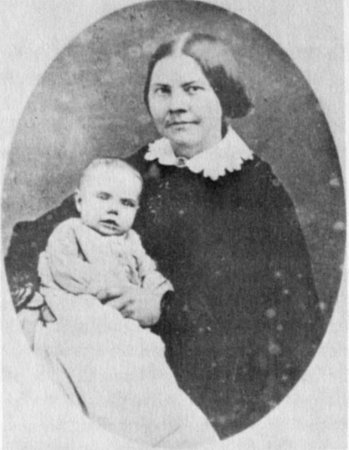
Lucy Stone and her daughter

Lucy Stone and her daughter

I, Leslie Dinaberg, nee Dinaberg, am a Lucy Stoner. This may surprise some people-or explain some things about how I write my columns-but the time has come to discuss my radical views.

I don’t think of myself as an extremist, but I guess I am, at least according to a survey done by the Center for Survey Research at Indiana University. In a national poll, 71 percent of respondents agreed that it is better for women to change their name upon marriage.

Seriously, this study was presented at the American Sociological Association’s Annual Meeting. Seventy-one percent!

That just blew me away. Unlike Lucy Stone (1818-1893), an American suffragist and abolitionist married to Henry Blackwell, who made a national issue of the right to keep one’s own surname as part of her efforts for women’s rights, most women who marry today still take their husband’s name.

An informal study of the holiday cards we received this year backs up that data. The vast majority of my high school and college friends who are married took their husband’s name.

For the most part these are not women who moved from their parents’ homes in with their husbands. These are not shrinking violets by any means. These are accomplished women with educations, careers, and independent lives. So why did they change their names when they got married?

I wish I could say I understood it. But honestly, I don’t. When my sister got married and changed her name she said it was because they wanted to be Duggan Family, not the Dinaberg-Duggan Family.

I agree, hyphens can be awkward. Zak and I briefly discussed hyphenating our names when we got married, but “Dinaberg” is a mouthful all by itself and when you add “Klobucher” to it there’s no way we’d ever be able to fit it all on a credit application. “Kloboberg” and “Dinucher” didn’t exactly roll off the tongue either. Besides, I’d been Leslie Dinaberg for almost 30 years at that point. I had no interest in becoming someone else when I got married.

I kept my name because it was my name-I was used to it, and replacing it with my husband’s made me feel like I was pretending to be my mother-in-law. I didn’t want to slam the door on the person I had worked so hard to become; besides, I was the last of the Dinabergs with no sons in my generation to “carry on” the name. Despite the mispronunciations, I just couldn’t stomach being the one to kill it off.

Piercings and tattoos have become commonplace, and pantyhose are harder and harder to find, but in this one area people have stayed conservative. I don’t get it. The number of women (5-10 percent) who have kept their names has held steady since the baby-boom generation began to marry, according to a New York Daily News interview with Lauren Hamilton, one of the Indiana University researchers. “The results were surprisingly conservative,” she said. “Even though there is a general movement toward neutral language, like saying chairperson instead of chairwoman, people seemed to feel it was better for a woman to change her last name to her husband’s.”

“The figures were a bit sobering for us because there seems to be change in so many areas. If names are a core aspect of our identity, this is important,” said Brian Powell, another researcher at Indiana University. “There are all these reports and indicators that families are changing, that men are contributing more, that we’re moving toward a more equal family, yet there’s no indication that we’re seeing a similar move to equality when it comes to names.”

“A wife should no more take her husband’s name than he should hers. My name is my identity and must not be lost,” said Lucy Stone. Get it? Women who choose not to use their husbands’ surnames are called “Lucy Stoners”-or Leslie Dinabergs.

Leslie’s not alone; the Lucy Stone League has a web page at www.lucystoneleague.org. Tell her what you think at Leslie@LeslieDinaberg.com. For more columns visit www.LeslieDinaberg.com. Originally published in the Santa Barbara Daily Sound on December 18, 2009.

Noozhawk Talks: Leslie Dinaberg Sits Down With Michael Wyrsta

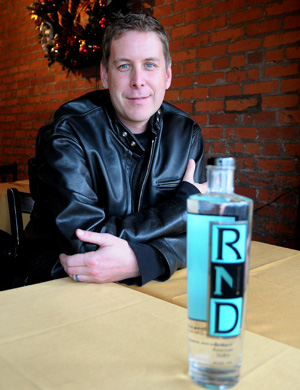
Michael Wyrsta at Opal Restaurant. Photo by Lara Cooper, Noozhawk.

Michael Wyrsta at Opal Restaurant. Photo by Lara Cooper, Noozhawk.

Attacking complicated problems is nothing new to chemist Michael Wyrsta. The
“Gaucho purebred”—who received both his BS and PhD at UCSB—lends his
considerable talents to developing vaccines, solar energy cells, green carbon
technology and eco-friendly building materials and making natural gas into
gasoline and green carbon technology. Now he’s turning his talents to creating
RND Vodka (www.RNDVodka.com), which hit the shelves of Santa Barbara restaurants and
retailers this summer.

Leslie Dinaberg: How on earth did you decide to start this vodka
company?

Michael Wyrsta: (Laughs) That is a really good question. … I was in a liquor store
looking at all the stuff on the shelf and I thought it was pretty unfortunate that all
of the brands on the shelf were pretty much imports.

I mean the good stuff.

… I was like, “why don’t we have something up there that people like or …
people respect or just think that there is some kind of cachet to it?” … So then I
went to lunch with my friend Mark Collins and I said, “You know this is lame. We
should have our own great American vodka.”

He said, “Yeah we should, let’s do it.”

Seriously it was a snap decision.

LD: To try to do it on your own.

MW: Yeah. I wrote a check right there and we just started working on it.

LD: Wow.

MW: We didn’t know anything about making vodka at that time and then we
quickly learned about it. For me as a chemist it’s easy to understand the
chemistry part of it. … But in terms of how do you put a package together, how
do you do all of this stuff we had a lot of stumbling blocks in the
beginning.

Then we got our art director, Kim Kavish involved and she’s great. … She really
helped right the ship and corrected a lot of the mistakes we’ve made in terms of
the design. Then there was a long process of licensing.

LD: So about a year ago you came up with the idea. Did you start developing the
product itself at the same time you started developing the
identity?

MW: Exactly. We have a distillery in Colorado that we worked on our formulation
with.

… What we actually do is ferment our sugar source which comes from corn, and
then go the whole process, fermentation, distillation, purification. We use really
good Colorado Spring water. It’s really clean, it’s really pure and we do our own
filtration, so we do the whole process from grain to bottle.

Then it became a logistic thing. We had to develop the identity, develop the
formulation and then develop the logistics to support all that because we wanted
it to be a unique bottle.

LD: It’s definitely a unique shape. I can also see where this would stand out in a
bar. A lot of vodkas have really pretty designs but they’re just
white.

MW: Exactly. They fade. We call that snoozing on the shelf.

LD: It seems like you’re getting a lot of recognition, including a piece in Sunset
Magazine, especially for how early in the process it is.

MW: Yes, we just launched end of July/early August.

LD: What part of your time is this endeavor?

MW: It does take a lot of my time right now … I have two other companies. A
CO2 company and I also am the CEO and president of a vaccine company up in
San Diego, so I have quite a bit of responsibility with that and I’m really busy.
That’s okay; I like doing all that stuff. For us it’s just something we have to do
until we get up to speed. My wife Inez and my best friend Lindy Lindstrom really
help a lot too.

LD: With high-end vodka is the push more on being in bars and restaurants
versus liquor stores and grocery stores?

MW: We have to be in all of them. We have to be everywhere basically because
they both support each other. … We are an ultra premium vodka, we’re
handmade, so we have more costs, we don’t do mega-scale, which a lot of
people do. So in that respect we’re focused on higher end stores, higher end
restaurants just because of the clientele.

It’s not different than a bottle of wine, if you get a good bottle of wine from Santa
Barbara it’s really expensive but you’re getting something that’s really high
quality.

I’m a scientist, so what I’d like to do is when this thing gets up to speed and we
get some real money coming in and profits, part of our goal is to donate some of
our profits to science education here in Santa Barbara.

LD: That’s great.

MW: Which would be probably through UC Santa Barbara or at that
level.

LD: I was thinking about that because I do a lot of fundraising for the elementary
schools and I can see people objecting to donations from a liquor
company.

MW: And that’s okay, I wouldn’t be against doing anonymous donation because I
understand there’s a perception issue and we wouldn’t want to be encouraging
kids to drink vodka at all. This is isn’t a 9 a.m. vodka; this is a high end sipping
vodka. We’re not promoting that lifestyle so if we were to go that route we would
definitely do something in a more low key, anonymous route.

But for me at least, science is really important and it is to the company too. In a
philosophical sense to us science is one of the few things that has been giving us
answers. We look to it when there is trouble. For example, whether or not it’s
global warming we’re looking towards a whole bunch of solutions but obviously
science plays a part in that. For example, look at the swine flu; we’re looking for a
vaccine to help us out or a drug. People to look to science for answers for really
discrete problems … it’s just sort of a way of thinking about problems and how to
solve them. It’s not about displacing any other belief system or a way of living just
taking stock on how we look at the world and addressing problems head on. I
think that’s important for us and if this is a vehicle to help do that, that’s
great.

LD: Absolutely.

MW: If we can give something back that would be great. That’s how we’re trying
to position it and work it. I live here, Mark lives here, Kim lives here. … We’re
always supporting local events; we did the museum nights for example. We like
to support the arts too, we’ve done Santa Barbara Trustees and the Alumni
Association at UCSB, so we try to be involved in all that stuff.

LD: My best gauge of how good a vodka is, is usually how I feel the next day.
How does one tell a good vodka from a not so good one in terms of taste?

MW: For me-I’m not a heavy drinker and I’m kind of a wimp when it comes to
hard alcohol-so for me I wanted the smoothest, easiest drink of vodka because
ultimately if it’s going to go in a mix, or if you’re going to drink it straight, you want
it to be able to mix well with everything and you want to be able to drink it on the
rocks or with just a little bit of something.

… It has to be really smooth and it has to have a really low burn and really light
feeling … It’s an interesting spirit because it’s very neutral in a lot of ways but
what most people don’t notice there’s a harsh feeling, a burn with a lot of lower
end vodkas and that’s a function of what’s in it. There are other molecules that
are in vodka typically that produce that feeling.

We’ve come up with a formulation that allows up to have a smoother, lighter
feeling. Sunset Magazine recently described it as ethereal and that’s a good way
of describing it.

LD: You’re launching in Santa Barbara at a really good time. There’s this trend of
Farmer’s Market cocktails where people are using all of these fresh ingredients
and sort of the sweet with the sour with the savory, all of this kind of wild stuff
that is pretty new.

MW: I think it’s great. It follows that whole foodie trend so they want high quality
drinks with really fresh ingredients.

LD: I have the list of where it’s sold locally-Roy’s, Opal. Elements, Lazy Acres,
Gelson’s, Liquor and Wine Grotto and on and on. You must have a marketing
person that’s on that.

MW: It’s just me really.

LD: That’s a big job.

MW: Yeah, I know.

LD: How did you come up with the RND Vodka name?

MW: … RND fit a lot with my background in science and markets and also
funding science. It’s a play on research and development, clearly, but it’s also I
always thought it was cool because on your gearbox in a car it’s always RND,
reverse, neutral and drive. So I always thought that was a cool little thing with
both the science and the way you see it every day in your car.

… We wanted to make it a little bit more ambiguous versus just research and
development where you would use an ampersand typically. People might be able
to come up with their own names for it: Rebels Never Die, or Restores Natural
Desires. There are so many things that people have come up with, we have a
bunch of them on our Facebook site. (http://www.facebook.com/pages/RND-
Vodka/102416823144?ref=search&sid=1443134086.1675449040..1)

LD: When you came here for college from Rochester, New York, did you think
you were going to stay?

MW: No. When I first got here for college I was like, “Oh my God where am I?” I
had no idea. It was a different universe. It took me a year to used to it. But then
you adapt. It is really different, I mean it’s almost like a different country, … but
once you figure it out it’s a great place-I love it.

LD: What else do you do when you’re not working?

MW: I love mountain biking; I surf if there’s surf. … I love the ocean and the
mountains so I take advantage of both of those.

LD: If you could pick three adjectives to describe yourself, what would they
be?

MW: Oh no. Three adjectives. Oh God. Busy, really busy. I also think I’m creative
and hopeful.

Vital Stats: Michael Wyrsta

Born: In Rochester, New York, July 6, 1974

Family: Wife Inez

Civic Involvement: Donates to a number of organizations including UCSB Alumni
Association, CALPIRG, Santa Barbara Museum of Art, Acts of Love-Autism
Speaks and the Trustee Association of Santa Barbara.

Professional Accomplishments: Graduated from UCSB in 1996 with a BS in
Microbiology and received a PhD in Materials from UCSB in 2002. Chemist for
start-up ventures, including GRT, Inc, SBA Materials, and BioSolar, Inc;
President and Founder, RND Spirits, Inc.

Best Book You’ve Read Recently: Fooled by Randomness by Nassim Nicholas
Taleb.

Little-Known Fact: “I’ll give you two. I went to a Jesuit High School and I had
long, blond dreadlocks right before I got my PhD.”

Originally published in Noozhawk on December 13, 2009. To read the article on that site click here.