
Dance Fever

Image by sattva, freedigitalphotos.net

Image by sattva, freedigitalphotos.net

I love to dance. At concerts, in my living room, in my car, at my desk, in the shower, it doesn’t really matter where. If a good song comes on-whether it’s live, on the radio, on my iPod, or just in my head-I’m compelled to start bopping a body part or two.

I don’t care if I’m dancing with myself. Sure it’s nice to have a husband who likes to join along, but it’s definitely not as essential as I once thought it was. I remember when I was in my 20’s and one of my friends was contemplating marrying a guy who didn’t like to dance. I counseled her against it because I couldn’t imagine spending decades alone on the dance floor.

I didn’t know at that point that by the time she celebrated her tenth anniversary, every adult function we went to the dance floor ratio would be 20 women for every single man. But even if we were all out there dancing by ourselves, no one would care anymore.

Besides, it’s fun to dance to your own tune.

Sometimes my son joins me and sometimes he just laughs at me as I try to restrain myself around his friends. I get it. I know I look silly but I don’t really care.

I used to care. I used to care way too much about a lot of stupid things. But now I look at my younger self-conscious self through the rear view mirror and she makes me laugh out loud and remind myself to dance like no one’s watching, but not caring if they do.

There’s something about middle-aged people rocking out that makes me smile just thinking about it. Our aging bodies may be weighing us down, but somehow music takes us to a lighter place. I can’t think of a better gift.

A lot of grey-ish heads were bopping in the audience at the Lobero this week when Joan Armatrading performed. I loved it. The fact that many of us in the audience (possibly even most of us) had first seen Armatrading perform decades ago only added to the fun both on and off stage. No one cared if they had two left feet-and some of us had as many as three or four-it was all about having fun and enjoying the music.

Plus no one had their kids there to make fun of them.

Apparently mocking your parents’ moves is a universal childhood rite-of-passage. Even Madonna’s teenage daughter Lourdes reportedly got embarrassed, covered her face and blogged about her mom’s dorky enthusiastic dancing at a recent Jay-Z concert.

“My mom was dancing the entire time which is LOL now that I think about it,” she wrote, “but in the moment I was just like, ‘mom, no, please no.'”

If Madonna can no longer be “cool” while dancing, then surely there’s no hope for the rest of us.

That’s okay. I can live with that-just don’t ask me to stop dancing.
Share your dance fever with Leslie@LeslieDinaberg.com. For more columns visit www.LeslieDinaberg.comOriginally appeared in the Santa Barbara Daily Sound on August 31, 2010.

History in the Making

Boehm Family Photo by V. Smith, courtesy Boehm Group

Boehm Family Photo by V. Smith, courtesy Boehm Group

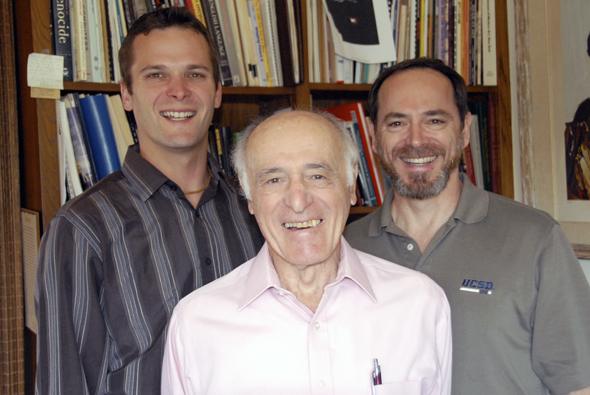
Eric Boehm & Family

Honoring the past while looking toward the future has been a recurring theme throughout the 92 years of Eric Boehm’s life and his most recent venture, Boehm Biography Group, brings together three generations of his own family-son Steven, 49, and grandson Jeff, 25-to help others preserve their heritage and create meaningful legacies.

Boehm’s brush with history began just before World War II in 1934, when his German-Jewish parents’ prescient concerns about their son’s future stirred them to ship 16-year-old Eric from Hof, Germany, to live with his aunt and uncle in Youngstown, Ohio. “If you have to leave home, my suggestion is the time to leave is when you’re 16 years old, because you are young enough to adapt and old enough to be looking for adventure,” twinkles Eric, as he recalls his early life in America.

By the time his parents and brother had escaped Germany in 1941, Eric had received a B.A. from the College of Wooster and was working on his M.A. from Tufts University’s Fletcher School of Law and Diplomacy. Those diplomatic skills came into play almost immediately, when he served a critical role in helping dissolve the Supreme Command of the Luftwaffe in Germany at the end of World War II. In a life with many high points, this experience stands out as one of the most significant, says Eric, whose work as an intelligence officer and interrogator is detailed in a new book, The Enemy I Knew (Zenith Press, 2009) by Steven Karras.

After leaving the military, Eric continued to work for the U.S. government in Germany as part of the press scrutiny board, reviewing German newspapers to glean information. While there, he met his wife, Inge Pauli. His cocker spaniel puppy played matchmaker for the couple. ” I took him to work with me every once in a while and he would disappear. He kept going upstairs looking and seeing if Fraulein Pauli was there,” laughs Eric. “She had been feeding him.”

The couple married in a double wedding ceremony with Eric’s brother and sister-in-law in Blake Wood, Illinois in 1948 and worked together until Inge died a decade ago. They had four children: two girls that died as children and two sons, Ronald and Steven, who live in Santa Barbara. If not for an encounter with anti-Semitism from a chemical company, Eric might have become a chemist rather than a historian. He was shattered after losing a job he thought was a sure thing. His history professor pulled some strings, and, unbeknownst to Eric at the time, created a job for him at the University of Massachusetts. While completing his doctoral studies at Yale, Eric published a collection of personal accounts of survival in Nazi Germany.

This passion for preserving knowledge led Eric and Inge to found historical bibliography company ABC-CLIO in 1955. The family and the company moved to Santa Barbara in 1960, soon after they spotted the while town en route to Los Angeles for a vacation. “We said you know, this is a nice place. On our way back let’s stop,” says Eric. “Then we took a hotel room by the beach … and one night here turned into two nights and three nights and four nights and while we were here we looked at houses.” The rest, as they say, is history.

Son Ronald now runs what has grown to become an international academic publishing enterprise.

About five years ago, the family founded Boehm Group. “At 87, I was too young to retire, but I was too old to spell bibliography, so I spelled biography,” smiles Eric, who credits his health and longevity mostly to good genetics. “My father died at 98, and I had a great grandfather who died at 98. The name of one of my ancestors is Liverecht, which translates to ‘live right,’-that’s what I try to do.”

In addition to producing individuals’ biographies to preserve family stories and institutional biographies, such as an upcoming coffee table book commemorating the 100th anniversary of Santa Barbara City College, Boehm Group plans to develop an online program that will offer college degrees in biography, explains Jeff, who is responsible for the technical project management.

“I see huge potential and it’s in the family business-plus I get to spend time with my grandfather and my father,” says Jeff, who affectionately calls his “Opa” (German for grandpa) Eric only when they’re in work mode. “I thought that I’d want to spend time doing something on my own, but this is something exciting that they’re starting new and I’m creating it with them.”

“The idea of working together, making it a family enterprise had meaning to me that I enjoyed,” says Eric. “What greater thing could you have than having a grandfather working with his son and grandson? It’s a real joy.”

Originally published in Santa Barbara Magazine In Spring 2010.

I Wish I’d Thought of That

Image by Stuart Miles, freedigitalphotos.net

Image by Stuart Miles, freedigitalphotos.net

Jon Stewart had a guy on the other night named William Rosen who wrote a book called, “The Most Powerful Idea in the World: A Story of Steam, Industry, and Invention.”

The most powerful? Seriously? Not that I have anything against steam engines but I highly doubt that they were the most powerful idea in the world, if that’s what the book is about. I’m assuming it is because what else would it be about? Steaming your cappuccino? The invention of the steam bath? I’m guessing saunas, while pleasant enough, aren’t that big a deal.

Anyway, I didn’t actually watch Jon Stewart’s interview with this guy because I was really tired from catching up on episodes of “The Colbert Report” because of the whole DirecTV, DVR, time-shifting your TV watching thing. Now that’s a powerful invention. Being able to watch “Mad Men” at 7 p.m. while the rest of your Facebook friends are still talking about how they can’t wait to see what happens to Don and Betty Draper later that night and you already know. Talk about feeling drunk with power, knowledge, wealth and overall superiority. Muahaha! Now that’s the kind of thing I want to invent.

Like this website I heard about recently, www.runpee.com, which does the research in advance so you come to the theater already knowing the best time to go to the bathroom when you’re at the movies. Brilliant. There’s nothing worse than sitting through an endless piece of family entertainment, such as “The Karate Kid” remake-which could have lost an entire hour without losing a single second of its entertainment value-while wiggling in your seat for 30 minutes because you think that the movie has to be over any minute now, for the last 30 minutes.

Another great idea is Switch Gear Jewelry (www.switchgearkit.com). I won a set of these mix and match earrings and they’re one of those simple genius ideas that make you think, “Wow, I should have thought of that.” Basically, it is a kit that gives you tons of options to create your own earrings on the spot (no tools) using various combinations of interchangeable hoops, chains, and funky architectural materials such as metal, rubber and tortoise shell. It’s totally fun and super easy. Again, why didn’t I think of that?

Then there’s the Java Log (www.pinemountainbrands.com) for your fireplace. Hello? What a great idea this is. Every time I throw out my coffee grounds I think I should do something with these. I can’t believe I didn’t think of this idea before Rod Sprules, the guy who’s now making millions selling these green firelogs that not only divert 12 million pounds of coffee grounds from landfills each year, they also make great smelling fires, and give you a caffeine buzz to boot!

Probably my favorite new invention of all is from Daniel Wright, the author of “Patently Silly” and proprietor of the website www.patentlysilly.com. This guy is a college engineering major turned comedian, who now makes his living making fun of other people’s inventions. His website and book feature zany ideas-all of which have real patents-such as an Apparatus for Cat’s Cradle Game, a Hip Hop Aerobic Exercise Doll and a Thong Diaper. Talk about a patently obviously brilliant idea. He didn’t even have to invent anything, he just had to write about silly things that other people invented!

I wish I’d thought of that.

Share your invention ideas with Leslie@LeslieDinaberg.com. For more columns visit www.LeslieDinaberg.comOriginally published in the Santa Barbara Daily Sound on July 30, 2010.

The Girl Who Stared Into Space

Image by marcolm, freedigitalphotos.net

Image by marcolm, freedigitalphotos.net

Last Sunday I went to the beach to relax with my husband and son. It was a perfect warm day, with just the right amount of sea breeze. I had warned them both earlier that I wasn’t in the mood to socialize. I just wanted to veg out with the sand in my toes and a book under my nose.

We spotted friends a few yards up the shoreline but I wasn’t in the mood to socialize. I was determined to $#% relax that afternoon, as I ever so (im)patiently explained to my loved ones. They were supposed to read their books too.

That was our plan.

I was going to $#% relax if it killed me.

I had said so-clearly-before we left the house.

The tall guy immediately took off on a walk, while the short one read his book and I read mine. “Ah summer,” I thought lazily. “This is exactly what I needed. Pure bliss.”

That blissful feeling lasted a whole 45 minutes till I turned the last page of Richard Russo’s “That Old Cape Magic” (good book, by the way) at the exact same moment the short one turned the last page of Cory Doctorow’s “For the Win.”

I handed him my iPhone to play with (hey, it was an emergency) and dug in my beach bag for another book.

Now, if I were to have my own version of “The Girl Who Fixed the Umlaut” it would be “The Girl Who Never Ever EVER Wanted to Run Out of Books to Read,” as evidenced by the 18 unread books I have sitting by the bedside and the other 247 I have in various rooms around the house.

I am never ever EVER without a book to read and yet I didn’t seem to have another one in my bag. This couldn’t be happening to me! I was always prepared with an extra book (or two or three), yet there I was sitting on the beach with perfect weather and a child who was uncharacteristically tired enough to sit there contentedly playing a game on my phone with little or no interaction required on my part-and no book to read!

I honestly had no idea what to do with myself.

I was so un-used to having the luxury of a few minutes just to space out that it took a little while for this to option occur to me.

I’m so used to always having a child to entertain, a project to think about, an article to work on, a book to read, a problem to solve or a friend to talk to that the idea of sitting and staring out at the vastness of the ocean took a while to sink in.

Then it took me a while to remember how to do it. To simply sit and do nothing and allow my thoughts to wander where they may, with no specific purpose or direction.

To simply be.

To relax and enjoy the sounds of the birds and the warmth of the sunshine and the salty smell of the ocean and the gritty sand between my toes was pure bliss once I got the hang of it.

Who knows, by the end of August maybe I’ll actually be “The Girl Who Stared Into Space-and Liked It” after all.

Share your summer stories with Leslie@LeslieDinaberg.com. For more columns visit www.LeslieDinaberg.comOriginally published in the Santa Barbara Daily Sound on July 23, 2010.

Dude Food

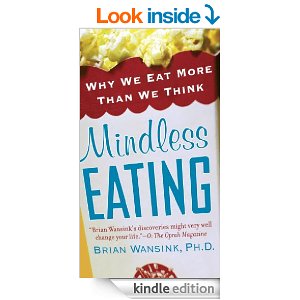
516AmvTQJnL._BO2,204,203,200_PIsitb-sticker-v3-big,TopRight,0,-55_SX278_SY278_PIkin4,BottomRight,1,22_AA300_SH20_OU01_Is there really such a thing as dude food? If you were an alien looking in on our culture of Burger King and Yoplait ads you would certainly think so. But how much of our “dude food” and “chick picks” food preferences are based on cultural and gender stereotypes and messaging? A lot, according to “Mindless Eating: Why We Eat More Than We Think,” a book I recently picked up.

The author, Brian Wansink, is the director of Cornell University’s Food and Brand Lab and a professor of consumer behavior. We—the American consumer—are the lab rats for this scholar of the drive through window and the office candy bowl. I must say, we make pretty interesting subjects.

The average person makes more than 200 food decisions a day-and can’t explain most of them-according to Wansink. But society certainly seems to play a role.

While most traditional diet and nutrition books focus on what dieticians and health practitioners know, this book focuses on what psychologists and marketers know, and offers some new insight into why we eat what we eat.

For example, Wansink’s research found that 40 percent of people, both men and women, identified their favorite comfort foods as relatively healthy fare like soup, pasta, steak, and casseroles.

However, when it came time to rate a list of the foods they personally found the most comforting, “men and women might well have been from Mars and Venus,” writes Wansink. Women chose ice cream, chocolate and cookies as their most comforting foods. Throw in red wine and a Meg Ryan DVD and you’ve pretty much got my “cure for a stressful day” shopping list. Men, on the other hand, chose ice cream, soup and pizza or pasta as their comfort food faves.

The explanation for these preferences?

“When we asked men why they preferred pizza, pasta and soup over cakes and cookies, men generally talked about how good they tasted and how filling they were.” But when the researchers probed a little more they got additional feedback from the men that those foods made them feel cared for, important, or the focus of attention of either their wife or their mother.

No wonder they found them comforting.

When women were asked about those same foods, they found them less comforting because they thought about having to make them-or how hard their mothers had worked to make them-and then having to clean up after making them. In other words, despite the ease of picking up the phone and calling Rusty’s, which I guess they don’t have in Ithaca, some of the so-called comfort foods signaled discomfort for the women.

“For women, snack-like foods-candy, cookies, ice cream, chocolate-were hassle-free. (I guess they’re not making handmade truffles or Cherry Garcia.) Part of their comfort was to not have to make up or clean up anything. It was both effortless and mindless eating,” writes Wansink.

This book definitely made me wonder if the reason so many men behave like Hoover vacuums when it comes to food is that they aren’t usually the ones to clean up afterwards. It also made me wonder (be still my heart) if the younger generation of men, who willingly drink Diet Cokes and eat Cesar salads without making jokes about keeping their girlish figures, might also be more willing to pick up the vacuum.

Share your thoughts on dude food and chick picks with Leslie@LeslieDinaberg.com. For more columns visit www.LeslieDinaberg.com. Originally published in the Santa Barbara Daily Sound on July 16, 2010.

Off the Record

Image by Stuart Miles, freedigitalphotos.net

Image by Stuart Miles, freedigitalphotos.net

“Abracadabra” is a magic word. So are “salagadoola mechicka boola bibbidi-bobbidi-boo.”

Even “please,” “thank you” and “I’m sorry” have magical properties sometimes.

However, “off the record” is not a magic enchantment spell with supernatural powers to change both the future and the past.

I repeat: “off the record” is not a magic phrase.

“Off the record” is a mutually agreed upon transaction, the terms of use of which should be discussed with a reporter before the person talking “off the record” actually discloses any information.

I don’t know why this is so confusing for people, but obviously it is.

If you really need to confide in someone, tell a priest, tell your doctor or tell your lawyer, but don’t tell a journalist—unless you want him or her to do something about it. True confidentiality is what pets are for. If you must talk to someone about a private subject and you don’t want it repeated, tell it to your dog or cat. Those are the only beings that you can guarantee won’t share your confidences.

When you say something to a journalist, think first about who it is that you’re talking to. Journalists are people who tell stuff to other people for a living. We love to tell people stuff. We get off on telling other people things they didn’t know before. Information is our currency, our life blood, our only substitute for barely making a living wage.

Think before you talk and talk (about whether or not what you’re saying is on the record) before you really talk. Then talk to Gen. Stanley McChrystal if you still don’t understand why this is important. I hear he’s got some time on his hands these days.

This is not to say that there aren’t perfectly legitimate reasons for telling a journalist something “off the record.” We can and will keep a secret if we say we will. It goes back to that “mutually agreed upon” part of the equation I talked about earlier.

If, for example, something really bad is going on but you don’t want to be fired-or killed-talking to a journalist “off the record” might be a good way to set the wheels in motion to do something about it. I know this, because I’ve seen it in a movie. For example, if you’re being chased by a black-ops, rogue faction of the government, give me a call.

Sometimes there might be a need to provide background information or context for a story, stuff you don’t want to be quoted about, or even “double super secret background,” which is stuff you really, really, really don’t want to be quoted about. The old, “I could tell you but then I’d have to kill you” kind of information that many of us deal with on a day-to-day basis, at least in the movies.

And let’s face it; some gossip is just too juicy to keep to yourself. But come to think of it, that’s probably what Twitter is for. I haven’t quite figured that one out. But “off the record” is something I’m pretty clear about and you should be too.

Just keep in mind that while the line between edit and advertising has become blurred in many publications-along with the line between bloggers and journalists, professionals and hobbyists, and fact and opinion-newspaperman H.L. Mencken defined news as “what somebody does not want to see in print. The rest is public relations.”

Or, as Rolling Stone writer Michael Hastings wrote, when he took to Twitter to defend himself against criticism of his recent cover story which resulted in the firing of Gen. McChrystal, “Hard not to respond to this without going back to an old saying. I’m paraphrasing: Reporting is what someone somewhere doesn’t want known. Everything else is advertising.”

Share your journalistic pet peeves-on the record-with Leslie@LeslieDinaberg.com. For more columns visit www.LeslieDinaberg.comOriginally published in the Santa Barbara Daily Sound on July 9, 2010.

Why it’s okay to swoon

TwilightAt the last Twilight movie, my girlfriend and I decided there should be a drinking game where you did a shot every time Jacob (18-year-old actor Taylor Lautner) took off his shirt and you heard the gasping chorus of all the teenage girls in the theater.

When you gasp you gulp. When you gasp you gulp. Big gasp. Big gulp.

Had we been playing I would have been just as tipsy as the Clearasil crowd.

I know that some people will be appalled to hear that even middle-aged moms can still swoon at the sight of a beautiful teenaged werewolf man-boy. I can understand their reaction. Every year I get a little closer to having a teenaged son of my own and then I understand their reaction even more. But here’s the thing: somewhere inside every grown up lives the child-and the teenager-they used to be.

Admittedly, I may be more in touch with my inner 13-year-old than many of my peers-though certainly not the ones who attended Tuesday’s night’s Angels Foster Care benefit screening of Eclipse at the Arlington Theatre. This is sometimes great and sometimes downright annoying, but it definitely helps me appreciate pop culture.

When I watch the Twilight movies I’m not someone’s mom and I’m not someone’s wife, I’m a teenaged girl, just like the rest of Team Jacob.

Clearly I’m not alone.

Describing the indescribable pull of the Twilight series (both books and movies), a 36-year-old mother of two told CNN reporter Breeanna Hare: “As grown women we know that we never forget our first love, the first time our heart was really broken. I just think that so many women can kind of identify with the experiences and emotions and underlying message of how difficult it is to make choices in life.”

New York Magazine columnists Em & Lo eloquently put it, “Twilight taps into a time when passion is as much about fantasy as reality, before drunken college hookups, before booty calls, before scheduling sex into a marriage. Twilight reinvents sex for women who might have placed it at the bottom of a to-do list.”

Some of my friends feel the same way (though not passionately enough to let me use their real names).

“Every time I look at R-Pat (tabloid-speak for Robert Pattinson, who stars as dreamy vampire Edward in the films), I feel like I am 12 years old again,” says Gena.

“Of course we don’t read the books or watch the movies for their literary merit,” laughs Serena, another mom friend. “But Twilight is the ultimate teenager girl’s fantasy. Two beautiful, sweet and undemanding boys fall madly in love with a plain, ordinary Jane. How can any woman, of any age, resist the spell of that daydream?”

Author Stephenie Meyers sounds a little surprised by the attraction to these characters. She told Time magazine, “I didn’t write these books specifically for the young-adult audience. I wrote them for me. I don’t know why they span the ages so well, but I find it comforting that a lot of thirtysomethings with kids, like myself, respond to them as well-so I know that it’s not just that I’m a 15-year-old on the inside.”

I think she’s wrong-Meyers is a 15-year-old inside, and a 9-year-old and a 25-year-old and so on. We all are. But sometimes it takes a cultural phenomenon like Twilight for us to realize it.

Share your Twilight theories with Leslie@LeslieDinaberg.com. For more columns visit www.LeslieDinaberg.comOriginally appeared in the Santa Barbara Daily Sound on July 2, 2010.

Peace Love Dirt

Courtesy Live Oak Music Festival (Instagram)

Courtesy Live Oak Music Festival (Instagram)

Welcoming summer at Live Oak Music Festival

The salty smell of Coppertone. A colorful explosion of tie-dyed t-shirts and low-backed beach chairs. A cacophony of live music out in the sun and under the stars. That first sip of an ice cold Cadillac Margarita where the sweet kiss of Grand Marnier meets the sour tang of lime-laced tequila. Summer has finally arrived and I couldn’t have conjured up a better place to greet it than the Live Oak Music Festival.

Believe it or not, this was my first journey to this timeless spot, nestled in the peaceful Santa Ynez Valley, just minutes away from my Santa Barbara home, but worlds away from my fall-winter-springtime life in the carpool lane.

I know it seems like an oxymoron to say that a live music festival featuring a kaleidoscope of sounds ranging from traditional folk, bluegrass, gospel, to blues, jazz, classical, pop, world music and pirate aurghs could actually be peaceful, but somehow this one was.

Unlike some of the musical festivals I’ve been to in recent years, at Live Oak there was no mosh pit to fear, no skunkweed stink and no stale beer spills to accidentally step into. It was just an eclectic mix of great opportunities to hear, make and learn about music in a pleasant atmosphere alongside a community of several thousand genuinely friendly people relaxing and enjoying themselves. What a great way to welcome the summer.

No wonder people have been coming back here for 22 years.

It was Rickie Lee Jones who finally lured us to Live Oak. I was first introduced to her spacey, jazzy, sad chick sounds when I was in college, and thought “We Belong Together” was the most romantic song on earth. I still can’t resist Johnny the King walking in the streets without her in the rain looking for a leather jacket and a girl who wrote her name forever.

Her “Flying Cowboys” CD tunefully distracted me while her album of standards (“Pop Pop”) amused me through my commute during my driving years of living in Los Angeles. Zak was a fan too. We’d seen Rickie Lee Jones perform half a dozen or so times over the years, mostly in dark, smoky clubs, so we jumped at the chance to see her outside under the giant oak trees. The fact that it was Father’s Day was a bonus, as the rest of my family (and a few friends) jumped at this unique way to celebrate the holiday.

As usual, she didn’t disappoint. The sound was great, the setting unparalleled and I still love her music just as much as I did the first time I heard it.

I didn’t have any idea what to expect from the rest of the artists and was happily surprised. Starting with the high energy antics of Baka Beyond, who fuse African music from the Cameroon rainforest with Celtic fiddling, and sing about things like peace and porridge. Then there was the amazing jazz organist Dr. Lonnie Smith, who you really have to see-and hear-to believe; followed by the folksy rock tunes of Josh Ritter, an indie artist who is making a dent in the mainstream big-time, having recently been discovered and marketed by Starbucks.

They were all enjoyable but I have to say I took as much pleasure in people watching as I did the music.

Where else can you see (and Solstice doesn’t count) an absurdly fun parade led by an octogenarian Grandma in a purple tutu; a tribe of Zinka-nosed surf rats; a blissed-out hippie swaying to a tune that only he can hear; a weathered cowboy hosing down the dusty path as a bevy of tiny fairies hand out wishing dust; joined by a 50-ish brunette with a stylish haircut, Prada shoes, and a pair of ladybug wings and a yupped-out backpacker couple loaded down with the entire REI catalog worth of coolers and chairs?

My son liked playing soccer the best and I think my dad enjoyed his nap, so three generations of our family and friends all found something to like under the giant oaks this Father’s Day.

“This is a really cool thing. We should do it again next year,” said my mom, smiling and passing some more food. I couldn’t agree more.

What signals summer to you? Email Leslie@LeslieDinaberg.com. For more columns visit www.LeslieDinaberg.com. Originally published in the Santa Barbara Daily Sound on June 25, 2010.

Suck it Up Buttercup

© Pkruger | Dreamstime Stock Photos & Stock Free Images

© Pkruger | Dreamstime Stock Photos & Stock Free Images

I had one of those yowza, take-a-deep-breath-and-try-not-to-cry parental moments the other day with my son.

We were talking about the school talent show, of all things. He had originally planned to form a band with a group of his buddies but all of their “rehearsals” had deteriorated into impromptu soccer games and water fights, so the budding Beatles never blossomed. They never even came up with a name for the band, which, as we all know, is the best part of being in a band.

Instead, a group of the boys decided to form a mime troupe and neglected to invite Koss. There’s a sentence I never imagined I’d write. Not that he had the slightest desire to climb his way out of an imaginary box-after years of seeing his father mock mimes, the mere idea of giving it a try was a genetic impossibility-but Koss was still sad that he hadn’t been asked.

I felt sure his friends hadn’t meant to hurt his feelings, and Koss agreed. But when I helpfully suggested that he let them know how he felt, he rolled his eyes at me and said the words I’ll never forget: “Mom, guys don’t do that. We act like nothing happened and move on.”

Why don’t you just mime an imaginary dagger stabbing through my broken heart?

When in the world had my tender, sweet, communicative little boy become, well, a guy?

Sure there had been symptoms over the years: plenty of fart jokes, burps, air guitars, sweaty socks and ESPN. But a certain tenderness had remained in my boy, despite all of the testosterone-fortified mayhem. I even worried that he was too tender sometimes. He cried more readily than most of his buddies and would obsess in great detail and for long periods of time when his razor-sharp radar detected a minute slight from a teacher or a friend. Truthfully, his hypersensitivity reminded me of my own thin skin and I worried about the future of his tender heart in the big, bad world.

My husband, who has never been accused of sensitivity, would often address Koss’s tender moments with a joking cackle of, “suck it up, buttercup.” My father, who never had any sons of his own, taught his grandson that, “pain is your friend,” a catch-all phrase meant to address any pain, physical or emotional, that might possibly prevent you from scoring the next goal, kicking the next ball or simply getting up and getting on with it.

Not that there was any overt sexism involved in these terse responses to life’s ups and downs. I had heard the “pain is your friend” adage from dad plenty of times over the years, and I think the stink of the stinkeye I gave my husband the one and only time he dared to tell me to “suck it up, buttercup” was more than sufficient to shut down that mode of communication-permanently. I’m just saying that my husband and father aren’t insensitive solely to Koss, they’re insensitive to everyone. Very egalitarian.

Resilience is a good thing to develop, right? But I still can’t help feeling sad that my little boy is becoming a big guy, which unfortunately seems to include the requisite rite of passage of sucking his emotions right back into his pointy little Adam’s apple.

No wonder there’s a lump stuck in my throat.

Sound off about sucking it up to Leslie@LeslieDinaberg.com. For more columns visit www.LeslieDinaberg.com Originally appeared in the Santa Barbara Daily Sound on June 18, 2010.

Gored by the Truth

Al and Tipper Gore's wedding day, May 19, 1970, at the Washington National Cathedral, courtesy

Al and Tipper Gore’s wedding day, May 19, 1970, at the Washington National Cathedral, courtesy Wikipedia.

“Marriage has no guarantees. If that’s what you’re looking for, go live with a car battery.”

— Erma Bombeck

I was shocked and sad when I heard about the toppling of Tipper and Al Gore‘s marriage. Talk about an inconvenient truth.

With all of the fawning and fanning and cyber-ink devoted to Barack and Michelle Obama’s wedded bliss, I thought crowning them the king and queen of Washington couples so early in their residency was a bit premature. Al and Tipper, on the other hand, seemed to have gone the distance and come out smiling and holding hands. They had even bought a sunny, retirement estate in Montecito, for gosh sakes.

What could possibly have gone wrong?

After so many years in the political hot seat of D.C., I thought they’d be sailing into the Santa Barbara sunset for their golden years. Getting over the painful loss to George Bush, the Gores seemed to be on a roll. Al won a Nobel Peace Prize and an Oscar in 2007, and seemed to be well on his way toward distancing himself from his formerly wooden political punch line persona. And Tipper always seemed to be smiling by his side, happy with the role of helpmate.

Of course the news of the Gore’s separation brought back memories of their famous kiss at the 2000 Democratic Convention. Sure, some found it a bit painful to watch, but don’t forget, back in those days it seemed like the sight of a happy political couple was an oxymoron.

Even now, despite the Obamas’ seemingly solid partnership, there aren’t many examples of long-married-happily-married couples in what one astute Washington Post reader called our “national neighborhood,” so any tension in the ranks can make other married couples feel a little nervous. Instead of that momentary feeling of, “Wow, if they’re still happily married, there must be some hope for the rest of us,” like we did after the convention, Al and Tipper’s breakup feels like, “Huh, if these two people can’t make a go of it, what hope do the rest of us have?”

Not that my faith in marriage or your faith in marriage or anyone else’s faith in marriage-except possibly the Gores’ daughter Karenna who announced she was splitting from her husband of 13 years just a week after her parents announced their separation after 40 years of marriage-should have anything to do with anyone else’s wedded bliss. But still, “it’s more threatening to us if we see a couple we thought were happy just drift apart,” as sociologist Andrew Cherlin told the Post. “If even well-behaved people get divorced after 40 years, then some of us will worry about what our own marriages will be like later in life.”

Thankfully, I have yet to experience one of those, “If those two can split up then is the earth still round and will the sun still rise?” uncouplings among my close circle of friends. Still, I’ve experienced enough vicarious break-ups to know one inconvenient truth-you can never really know or understand what’s really going on in another person’s relationship.

Email Leslie@LeslieDinaberg.com with your vote on which Gore should get the Santa Barbara mansion if they divorce. For more columns visit www.LeslieDinaberg.com. Originally published in the Santa Barbara Daily Sound on June 11, 2010.