
Breast Resource Center finds a new home

The Breast Resource Center of Santa Barbara welcomed visitors to its new home on June 23. Among those gathered at the nonprofit’s homey new cottage, across the street from Oak Park at 525 W. Junipero St., were some of the early founders of center, which serves as an emotional and educational support center for breast cancer patients, survivors and their families.

Nancy Oster, the organization’s first president of the board, reminisced about the group’s beginnings in 1997. Among people with breast cancer, “every community has a grapevine of women you connect with eventually,” said Oster. But it takes a while for newly diagnosed women to make those connections.

Oster and other survivors, along with healthcare professionals, including cancer research pioneer Dr. Susan Love, who had recently come to town, began brainstorming about creating a center in Santa Barbara.

“We had a wish list of things we’d like to see,” said Evie Sullivan, who has been treasurer of the board since its inception.

“We wanted a place that was close to the hospital, near the bus, it would be nice to have a living room, and a kitchen to cook up some chicken soup or something,” recalled Oster. “We also thought it might be nice to have window boxes.”

Two weeks later Dorothy Shea called and generously offered to lend one of three houses in the Cottage Hospital area to the group. “One of them (at 526 W. Pueblo St.) even had window boxes,” said Oster.

The group quickly organized itself as a legal nonprofit and moved in. Staffed and furnished entirely by volunteers, the original carpets and fixtures came from oncology social worker Debbie Hobler, a noted author and one of the BRC’s original board members.

Of primary importance was that newly diagnosed women would feel comfortable at the Breast Resource Center.

“The first day we opened, there was a woman who was about 80 years old, waiting for us at the door,” recalled Judy Blanco, who began volunteering at the BRC and became its first paid employee in 1998. “She said, ‘you know, it is healing just being here.'”

The center’s move, necessitated by a plan by the Cancer Center of Santa Barbara to develop a new facility that will encompass the entire block of Pueblo Street and more, allows more space for programs, but it will also be the first time the organization has had to pay more than a token $1 a year toward rent.

Luckily there are several fundraisers on the horizon, including the Fay Hobbs run on July 17 and the Santa Barbara Triathlon on Aug. 27 and 28.

The center’s new home feels just a homey as the old one.

“It’s still a place where strangers end up hugging,” said Hobler.

Blanco agreed. “Nobody leaves here without hugs.”

For more information on the Breast Resource Center call 569.9693 or visit www.breastresourcecenter.org.

Originally published in South Coast Beacon on June 30, 2005.

Zoo campers to dive into ocean, water exploration

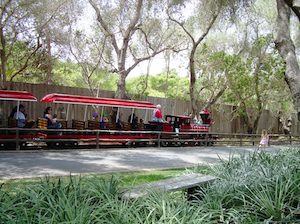
Santa Barbara Zoo Train, courtesy Wikipedia Commons.

Santa Barbara Zoo Train, courtesy Wikipedia Commons.

Summer visitors to the Santa Barbara Zoo will look beyond the East Beach view to the vast world of the ocean, as two full years of activities begin to educate the public about the “Wonders of Water.”

“The populace of the United States is uneducated about the issues concerning water,” said Nancy H. McToldridge, the zoo’s chief operating officer. She is hoping to help change that by weaving water messages into all of the zoo’s events, promotions and educational programs, starting with zoo camp, which began its first session this week.

“Summer camp, that’s where it all starts. … It’s the most incredible program we have and the most important contribution that we make to the community,” said McToldridge.

“Anybody who works in a zoo or an aquarium or … in … conservation or anything that has to do with animals and wild places can trace their love of that back to some experience they had when they were very young.”

Education curator Heather Johnson, who began volunteering in 1986 as a junior zookeeper while attending Dos Pueblos High, is also bringing water awareness into the camp curriculum and school programs.

Wildlife Academy campers (sixth-seventh grade) will be able to have three full weeks of aquatic biology.

“That’s a special thing for us because the Wildlife Academy students are at a point in their lives where they are really exploring careers in science,” she said. “So they’re going to be taking field trips to the beach, they’re going to be actually doing a lot of things with the bird refuge, they’ll be taking water quality tests from all of our water habitats here at the zoo and they will be talking with our professionals … to find out how we ensure that there’s healthy habitats.”

Campers will also learn about native aquatic animals by conducting a census on East Beach.

This age group is fantastic to work with, Johnson said.

“They are starting to get very much into Animal Planet and Discovery Channel and choosing what they might want to pursue as career paths. … We’re hoping that we might inspire them to take some more science and math.”

Younger campers will also experience the wonders of water. First- and second-grade students will be talking about oceans and watery habitats, while Zoo Cadets (third through fifth grade) will learn about “what kind of animals need to live in the deep, deep, deep waters, the funky creatures that live down there in the dark, the ones that are almost see-through and have those funny characteristics that have like lights on their heads and things like that,” Johnson said.

Energy was high as the camp’s counselors finished up their training last week.

“You have an incredible opportunity with these 3-year-old, 4-year-old, 10-year-old minds that are wide open and you have the opportunity to be the person that makes a difference in that person’s life,” McToldridge told her charges.

“You may never know what you’ve done. … That a half-hour that you spent with one child may lead to an incredible discovery that will save animals and save people.”

Space is still available at the Santa Barbara Zoo’s camp for children aged 3 to entering seventh grade. Sessions run through Aug. 19, with camp hours from 9 a.m.-2 p.m. and extended care from 7:30 a.m.-5:30 p.m. Cost is $157 per week for camp and $225 per week with extended hours, with discounts for zoo members. For more information visit www.sbzoo.org or call 962-5339.

Ocean Education:

Everyday choices have an impact on the ocean and its many inhabitants. Here are some simple ways that families can help, from the American Zoo and Aquarium Association.

• Participate in beach and stream cleanups.

• Put trash in its proper place.

• Plant native plants.

• Make smart seafood choices. For a free guide, visit www.montereybayaquarium.org/cr/seafoodwatch.asp.

• Reduce oil use and limit run-off.

• Save water and electricity.

• Be pet smart. Ask your pet store for MAC (Marine Aquarium Council)-certified fish and be sure to scoop up pet poop.

• Don’t leave fishing lines behind.

• Follow boating laws to prevent problems for wildlife.

Originally published in South Coast Beacon on June 23, 2005.

Giving it his all—COMMUNITY BEACON: Larry Crandell

Santa Barbara’s favorite emcee has helped raised millions of dollars for local causes. But he can’t be outbid when it comes to community service.

His stationery (created by a 7-year-old admirer) reads, “From the desk of Mr. Santa Barbara, Mr. Montecito & the Godfather of Goleta, the one and only Larry Crandell.” But to most of us, he needs no introduction.

Even if you haven’t had the pleasure of his company one on one, you’ve no doubt seen him on stage, tirelessly raising money for causes ranging from the YMCA, the Boys & Girls Clubs, Hospice, the PARC Foundation, Transition House, the Santa Barbara Athletic Round Table and just about every other nonprofit organization in town.

Crandell estimates he is the master of ceremonies or auctioneer for about 100 charity events a year.

“I have a test. If I’m asked, I do it,” said the decorated World War II bombardier.

If people don’t know Crandell from his carrying of the philanthropic torch, they could certainly recognize him from when he carried the Olympic Torch in 2002, or be acquainted with him through his wife of 54 years, Marcy, or his five children — Larry Jr., Michael, Ashley (now deceased), Steven and Leslie — all of whom were raised in Santa Barbara.

Showing off pictures from his days playing basketball at Syracuse University, where the twinkle in his eye is immediately recognizable even 60 years later, Crandell proudly jokes that his five children, who went to Stanford University and UCSB, weren’t smart enough to follow in his academic footsteps.

Having already launched a successful software company with son Michael, Crandell is developing a new venture with Steven. There could be no better ambassador into the Santa Barbara business community than Larry Crandell, who has hobnobbed with just about everyone.

“When you’ve worked with a common cause there’s a camaraderie that you can’t do just by socializing, so I have access that I think I have the confidence to follow,” he said.

A degree of separation away from Crandell are the many celebrities with whom he’s done events, including Michael Douglas and Dennis Miller.

Humoring local philanthropists like Paul Ridley-Tree, who Crandell jokes is a special man, “he’s bid over $3 million, but he’s never bought anything,” is also a part of his repartee.

“My routine doesn’t change very much,” he admitted. “My secret is to keep changing audiences.

“I feel as though I’m on a victory tour, like a retiring athlete, only I don’t go anywhere and people treat me kindly.

“… At 82, life is sweet, I guess is the best way to put it.”

Originally published in South Coast Beacon on June 2, 2005

Visiting Nurse & Hospice Care of Santa Barbara

Visiting Nurse and Hospice Care, courtesy photo.

Mother’s Day Luncheon

“Honoring and remembering our mothers” was the theme of the annual luncheon to benefit the charity care mission of Visiting Nurse & Hospice Care of Santa Barbara at the Coral Casino on May 5.

Always a tearjerker, the event singles out two mothers each year, one living and one who has passed away.

Peter Douglas spoke movingly of his mother, Anne Douglas, who then upstaged her son with a witty acceptance. Then Jerry Rubinstein shared his fond memories of his mother Yetta Rubinstein, as well as his gratitude for the services his family received from Hospice VNA when Yetta died in 2001.

Emcees Debby Davison and Larry Crandell kept things lively while honorary event chairs Judy and Peter Murphy spoke about the good work that Hospice VNA does in the community. The weather didn’t cooperate, but the unexpected rain didn’t prevent event chairwomen Nancy Kimsey and Barbara Kummer and their committees from smoothly running the silent auction and luncheon, which raised over $125,000.

Originally published in South Coast Beacon on May 12, 2005.

Home for the dying provides living inspiration

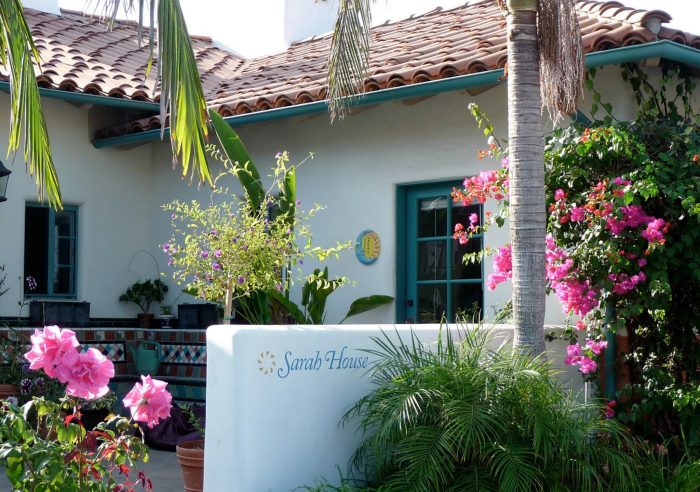
Sarah House (courtesy photo)

Sarah House (courtesy photo)

Sarah House opens its doors even wider for those in need

A residential care facility for people who are sick and dying doesn’t exactly conjure up uplifting images. But a visit to Sarah House — which has provided a home, medical care and often end-of-life care for more than 250 individuals living with AIDS — is more inspiring than depressing.

Nancy Lynn recounted what a wonderful time she and her son, and later her granddaughter, had volunteering in the Sarah House kitchen.

“It was a great experience,” said Lynn, who has since become a Sarah House board member. “It’s such a loving, homelike atmosphere, with an opportunity for families to be supportive.”

“Most people come in, and as they are walking out they say this is not at all what I expected,” said executive director Randy Sunday, who successfully navigated through the Legislature recently to expand Sarah House’s services to provide holistic hospice care for the dying poor who are not HIV-positive.

Aiming to be “the next best thing to home,” the inspiration for the facility was to provide a loving, caring place for people in the final days of their lives.

It’s heartbreaking work, but it’s also beautiful work and important work, said house manager Debbie McQuade, who has worked with AIDS Housing Santa Barbara since it began in 1991, with Heath House. Sarah House opened on the Westside in 1994 and it has eight residential care beds and three two-bedroom apartments on the site. AIDS Housing Santa Barbara also serves approximately 25 other individuals who live in independent apartments.

The good news is that fewer people are dying of AIDS, and more are able to move into off-site or “scattered site” housing. The bad news is that facilities like Sarah House are closing in other places, leaving needy people with nowhere to go.

The Santa Barbara community put so much into the creation of Sarah House — named for the late Sarah Shoresman, whose daughter, Linda Lorenzen-Hughes, remains active on the board of directors — that they were determined to find a way to keep it open.

“In order to honor our contract with the public, (we thought) why don’t we try to care for people who are dying and non-HIV,” Sunday said.

The team worked with former Assemblywoman Hannah-Beth Jackson, D-Santa Barbara, to shepherd legislation that would ultimately allow Sarah House to become what Sunday termed the “first social (as opposed to medical) model hospice,” meaning it can be staffed by personnel other than registered nurses and licensed vocational nurses.

The social model allows for more staffing flexibility (for example, nurses aren’t allowed to help cook or clean) and significant cost savings.

Sunday said it costs Santa Barbara Cottage Hospital more than $4,000 a day to care for patients, while it costs Sarah House $250 a day to care for its residents.

The other difference with a social model, which is difficult to quantify, is the “next best thing to being at home” atmosphere.

“You go into a hospital, the first smell that might hit you is something slightly antiseptic. You come in here it’s going to be chicken soup or chile rellenos,” Sunday said. “And as we’re learning or seeing, hospice care is not just care for the dying resident, it’s caring for the loved ones, friends and family around them.”

“I’m so grateful we were able to get mom into such a nice place,” said Jeanette Aroldi-Schall, whose mother, Anne Arnoldi, was cared for at Sarah House before she died last month.

“Really we’re providing a great service, I feel,” said Lynn, adding that the board is working hard to get the message out that Sarah House has now opened its doors wider, to serve all needy members of the community, and that it is also seeking support in the form of monetary donations and volunteers.

For more information visit www.sarahhousesb.org, call 882.1192 or e-mail office@aidshousingsb.org.st.com.

Originally published in South Coast Beacon

Taran honored for making a difference

“If you want to get something done, ask a busy person,” goes the conventional wisdom. “If you want to get something done, get Sissy involved with it,” say friends of Sissy Taran.

They weren’t kidding.

The Montecito resident, along with husband Bernie and daughters Francine and Nadine, recently returned from Israel, where she helped dedicate the Center for Emergency Medicine at Hadassah Medical Center in Ein Kerem.

The Tarans were part of the largest donor mission in the history of Hadassah, the Women’s Zionist Organization of America, and were among nearly 700 donors from across the United States who gave $50 million to build the state-of the-art emergency center.

Taran, who serves as vice president of membership for the 460-member Hadassah group in Santa Barbara, said the trip was amazing, particularly given the recent announcement that the Hadassah Medical Organization was nominated for the 2005 Nobel Peace Prize.

“(The hospital) is called an island of peace for both Jews and Palestinians … because it does take care of so many people,” Taran said.

“I’ve just been on such a high. I’ve been lucky that I’ve been fortunate enough that my husband and I can help make the world a better place. That’s our belief.”

Taran was also recently honored as the “Queen of Hearts” by Hadassah Southern California. She sits on the organization’s cabinet and has received commendations from Gov. Arnold Schwarzenegger; Sens. Barbara Boxer, D-Calif., and Dianne Feinstein, D-Calif.; and Los Angeles Mayor James K. Hahn; as well as lawmakers, state officials and the Los Angeles Police Department.

The honorary dinner, held in Woodland Hills, was a benefit for the pediatric hemato-oncology departments of the Ein Kerem hospital.

“I just found something that I could become passionate about,” Taran said. “I kind of found my spirituality through Hadassah.”

Taran is also a board member of Congregation B’nai B’rith, a member of CALM (Child Abuse and Listening Mediation) Auxiliary, and is involved with the Anti-Defamation League and the Coalition Against Gun Violence.

The Tarans also work with children from Cleveland and Franklin schools as part of the Fighting Back Mentor Program and tutor for the Read Right now Program.

And somehow she fits in time to baby-sit her grandson, Ethan, and “finds time for bridge and the mahjong, the important things in life, ” she laughed.

Originally published in South Coast Beacon on May 5, 2005.

Rape Crisis Center’s Wall of Witness Debuts

Courtesy Santa Barbara Rape Crisis Center.

Eloquently illustrating the potential of art to heal, empower and assist with social change, Santa Barbara Rape Crisis Center unveiled the Wall of Witness on April 4 in an opening reception to mark the beginning of Sexual Assault Awareness Month.

A mural and collection of artwork and poetry contributed by the community and exploring the theme of “Believe Me: Celebrating the Courage and Resilience of Sexual Assault Survivors,” the Wall of Witness concept was created by local Artist Brandon Stontag, who called it “an opportunity for me to contribute to the valiant efforts of SBRCC.”

He continued, “I think it is a great idea to use art as a vehicle for
educating and increasing awareness. It is my hope that the mural will be inspirational, comforting and healing.”

“I am in awe of what is here visually,” said Congresswoman Lois Capps, an honorary board member of SBRCC who plans to reintroduce legislation to develop a process for health professionals to screen for evidence of sexual assault.

Poets Sojourner Kincaid Rolle and Theo Burnes, and artist Judi Weisbart spoke movingly about their contributions.

“This wall speaks so many words of such incredible worth,” said Weisbart. “Abuse is something that as humankind we must erase from this planet.”

KRUZ radio personality Bonnie Campbell, who is training to be an SBRCC advocate, was the emcee for the event. Other speakers included SBRCC board president Sylvia Hendlin and executive director Elsa Granados, who concluded the event by encouraging the audience — and make a commitment by a show of hands — to talk to others in the community about sexual assault.

“We want this message to permeate the community,” she said.

The Wall of Witness will travel to various Sexual Assault Awareness Month events and supporting venues, including:

– April 5-9: La Casa de la Raza, 601 E. Montecito St.

– April 9: Believe Me Dance-Off, Alano Club, 235 E. Cota St., 8 p.m., $10

– April 10-16: The Coffee Grinder, 910 Linden Ave., Carpinteria

– April 14: UCSB Take Back the Night March and Rally, Anisq Oyo Park, 5:30 p.m.

– April 17-23: Santa Barbara City College Library, 721 Cliff Drive

– April 23: Benefit Dance, La Casa de la Raza, 601 E. Montecito St., 7 p.m. — 1 a.m., $25

– April 27: Denim Day Rally, Santa Barbara City College Library, 721 Cliff Drive

– April 25-29: Dos Pueblos High School. 7266 Alameda Ave., Goleta

Originally published in South Coast Beacon on April 7, 2005.

Environmental center named to UN commission

Santa Barbara’s own Center for the Study of the Environment was recently appointed by the U.S. Department of State to serve on the United States National Commission for the United Nations Educational, Scientific, and Cultural Organization (UNESCO).

The United States re-entered UNESCO just last October, and will hold its first annual conference in Washington, D.C. June 6 and 7, where CSE will join a prestigious group which includes the American Association for the Advancement of Science, the National Academy of Sciences, the National Academy of Engineering, The American Geological Institute, The American Physical Society, National Geographic Society, and the Woods Hole Oceanographic Institute.

Professor Emeritus from UCSB and the former Chair of the University’s Environmental Studies Program, Daniel B. Botkin founded CSE in Santa Barbara in 1991 as a non-profit organization to conduct objective, independent, scientific analyses of complex environmental issues.

Independent research was a key tenet in founding the organization. Otherwise, as noted by Botkin on the CSE website, “You start with a good idea and end up with a bureaucracy.”

“The idea was to set up an organization independent of the other institutions, really to be able to provide good scientific and educational data around the environment, to really give the best possible information free of any particular bias … trying to make it as scientifically independent as possible,” said CSE vice president Mark Marzolla.

The mission of CSE is to “serve all facets of society by providing science-based analysis that identify optimal solutions for environmental concerns.” The objective is to generate options that address the problems at hand without subordinating information or evaluation to the bias of various political viewpoints.

“In this time of increasing world tensions, communications among nations about education, science, and culture can help alleviate misunderstandings of many kinds,” said Botkin, adding “participation in the U. S. Commission fits well with the educational and scientific goals of the Center.”

In making this appointment, Secretary of State, Colin Powell, wrote “I am confident that the Center for the Study of the Environment will contribute significantly to the value of the Commission’s work.”

Additional information about the U S National Commission for UNESCO can be found at www.state.gov/p/io/unesco or at CSE’s website, www.naturestudy.org,

Originally published in South Coast Beacon on March 10, 2005.

Hospice offers tips for dealing with grief in the workplace

“People who grieve the death of a loved one are going to grieve it wherever they are,” said Hospice of Santa Barbara executive director Gail Rink, adding, and that includes the workplace.

Educating local businesses about how to deal with grief in the workplace and the free services Hospice provides was the subject of a Feb. 24 luncheon.

“It’s a passion for me that you people get a message,” said Rink, as she spoke eloquently about her struggles at work — even in an office that deals daily with death and dying — after her brother was murdered in Georgia. “Death is a very personal event and grief is a very personal event.”

When a coworker suffers a loss, feelings and symptoms of grief can take weeks, months and even years to manifest. “We have triggers in grief that come out of the blue — we can’t control them,” said Joanne Talbot, director of counseling services for Hospice.

There are still ripples in the workplace from the 2002 drowning death of 14-year-old Katie Janeway at Los Banos pool, said acting Santa Barbara Parks & Recreation Director Nancy Rapp. She said she saw a lot of different reactions.

“We had staff who were in denial, we had people who absolutely couldn’t function at all, and everything in between,” said Rapp, who brought in Hospice counselors as part of the response team. They were flexible and provided bilingual counseling when needed, and it was all free, she said.

When one of the counselors in the Department of Rehabilitation died suddenly, Kathy Humphries also brought in Hospice to help. The staff not only had to deal with their own grief, they also had to deal with reactions from that counselor’s clients. “Joanne came in to talk to people about their memories of those people,” said Humphries.

After the death of a coworker, employees can be distracted by emotions that range from confusion to chaotic pain, from dismay to devastation. Hospice advises that organizing an employee support group can provide an avenue for staff to discuss their feelings openly and address ways to deal with grief as a cohesive group.

When a coworker is grieving the death of a loved one, that grief will inevitably be brought into the workplace. Employers should be aware that returning to the workplace can be overwhelming and employees may be tempted to quit for fear of failure or to reduce the pressure on them. Hospice advises employers concerned about the loss of productivity to also consider the alternative cost of replacing an otherwise well-trained employee. Coworkers are told to listen but know they can’t resolve the grief, ask if they can help out, include the grieving person in work projects, ask occasionally about deceased, and alert a supervisor if they seem to be getting worse.

For more information about the free services available from Hospice of Santa Barbara, call 563.8820 or visit www.hospiceofsantabarbara.org.

Grief in the Workplace: What you should know

  • Hidden grief costs U.S. companies more than $75 billion annually, according to the Grief Recovery Institute.
  • Approximately 30 days of work is lost for each employee grieving the death of a loved one.

Grief in the Workplace: What to say

A simple word means a great deal when a person suffers a loss. Saying the “wrong” thing hurts less than saying nothing at all.

Appropriate words include:

“I am sorry to hear about your loss.”

“I heard about your loss. I don’t know what to say.”

A simple shared memory is helpful. “Remember the story you told me about … [the deceased].”

Avoid these phrases:

“You’ll get over it.”

“I know how you feel.” Each person’s loss is unique.

“It was God’s will,” or “God never gives us more than we can bear,” or “At least she isn’t suffering.”

— Source: National Hospice Organization

Originally published in South Coast Beacon on March 3, 2005.

Las Positas residents urge council to get a plan

“We need a general plan update, and guess what, it’s happening,” said Santa Barbara City Councilman Brian Barnwell, hitting the heart of the city’s response to a group of Las Positas Valley residents who called for a comprehensive plan to address the development and traffic issues in their area.

An estimated 75 people packed the council chambers on March 1, representing groups such as the Allied Neighborhood Association, Veronica Springs Neighborhood Association, Hidden Valley Residents Association and others who were concerned about piecemeal planning in that area, parts of which are under city control and parts of which fall under country jurisdiction.

Critics of the planning process cited two pending projects — the Hillside House proposal of up to 127 units and the Veronica Meadows project (owned by Mark Lee), which calls for 24 two-story homes off Las Positas Road — as particular areas of concern. The rebuilding Cottage Hospital, potential development at Elings Park and the future of Earl Warren Showgrounds were also mentioned as projects that would impact the quality of life in the Las Positas Valley.

Speaking for the Allied Neighborhood Association, Lloyd Applegate said, “If Santa Barbara is to live within its resources, it behooves us to determine just what the city’s resources are before risking to do further damage to our quality of life.”

Others contended that Santa Barbara already has a thorough planning process and there’s no need to undergo a comprehensive study of the Las Positas valley.

“It’s incorrect to assert that the city considers projects on a piecemeal basis,” said county planner John Polansky, who works with the city on many projects.

“We are very comfortable with the city’s current planning process,” said Pam Flynt, executive director of Hillside House, which elected to annex its property to the city, rather than remain in the county during this development phase.

The council will have a joint session with the Planning Commission on March 10, at which time the Las Positas area will be discussed as part of the overall General Plan.

Originally published in South Coast Beacon on March 3, 2005.