Ladies, Let Your Inner Diva Shine for an Evening

The dazzling divas of Momentum 4 Life will be back kicking up their heels for a good cause at Fess Parker’s DoubleTree Resort on Friday, May 16th. This year’s women only festivities will benefit Alpha Resource Center‘s Family First Program, a parent-directed program which assists parents of children with special needs to gain knowledge and skills to enable their children to be all they can be through parent support, information, referral, and educational workshops.

Momentum 4 Life Founder Dawn Schroeder said the training group voted to support the Family First Program after hearing firsthand stories from ten different members who have children with special needs that received services from the Family First Program. “The vote was overwhelming in favor of supporting the needs and wishes of our group and Family First it was. It is so nice to be able to help each other out,” she says.

Founded by Schroeder in Santa Barbara, Momentum 4 Life provides a structure for individuals to form training teams to challenge themselves, train for an athletic event and give back to the community. Teams may consist of groups of women, men, co-ed or children and may train for triathlons, biathlons, 5K, 10K, half or full marathons.

As with the two previous “Divas” events (which supported the Breast Resource Center the first year and the Cancer Center last year), this year’s festivities will be a fun opportunity for a ladies night out.

In addition to the philanthropic motivation, Schroeder says, “The Diva event was formed as a way for women only to get out for an evening of fun and celebrate being a woman with glamorous hair, make up, skin care, beautiful nails, a limo ride, a red carpet walk, and singing like a diva in the karaoke contest. If this does not sound like the perfect fit for you, then relax and enjoy some appetizers, wine tasting, a massage, chocolate goodies, and have your palm or tarot cards read–there is something for every woman.”

If you’re stuck on what to give for Mother’s Day–which is May 11th, the weekend before the event–tickets are still available for $75 before May 1 and $100 after that date. In addition, Tiffany & Co., who is sponsoring the event along with Mentor Corporation and Fess Parker’s DoubleTree Resort, will have a special promotion: a $25 purchase of a key to Tiffany’s vault could yield exclusive “bling” items worth between $500 and $700.

” This event will help so many in many different ways,” says Schroeder. “First and most importantly it will benefit Family First and their excellent efforts and resources. And it will help every woman who attends to feel special, important and valued–especially the week after Mother’s Day–we want to honor the mothers of special needs children and extend the Mother’s Day weekend a little longer to all mothers who deserve more than just the one day a year. It is a feel good opportunity for everyone.”

For more information or to buy tickets online visit www.SBDivas.com.

Originally published in Noozhawk on April 25, 2008.

New Book Guides Parents In Understanding Autism

Autism Booklets There is no one-size-fits-all treatment or approach to the developmental disability, but help is available.

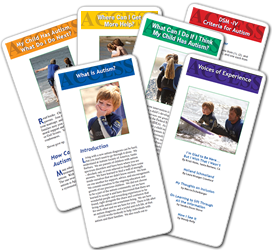
In honor of April’s celebration of Autism Awareness Month, the Santa Barbara chapter of the Autism Society of America (ASASB) (www.asasb.org) has released a new guidebook for parents. Spearheaded by board president Marcia Eichelberger and vice president Sandy Shove, “Autism and Your Child: A Guidebook for Parents,” offers a concise package of valuable information for parents of children who have just been diagnosed with Autism.

Autism is a complex developmental disability that typically appears during the first three years of life. The result of a neurological disorder that affects the functioning of the brain, autism impacts the normal development of the brain in the areas of social interaction and communication skills. Children and adults with autism typically have difficulties in verbal and non-verbal communication, social interactions, and leisure or play activities.

According to data from the ASASB, ten Years ago, one in 10,000 individuals had Autism. Two years ago, one in 500 individuals had Autism and last year one in 250 Individuals had Autism. Today it is believed that 1 in 150 individuals have Autism. The overall incidence of Autism is consistent around the globe, but is four times more prevalent in boys than girls. Autism knows no racial, ethnic, or social boundaries, and family income, life, and educational levels do not affect the chance of Autism’s occurrence.

Despite the growing prevalence of Autism, there are a wide variety of strategies and treatments being used with varying degrees of success. There is no one-size-fits-all treatment or approach, which makes it especially difficult for parents to access the information they need to help their children.

“I often tell people, ‘if you know one person with Autism, that means you know one person with Autism,'” says Shove, explaining that therapies and treatments that work for one person won’t necessarily work for another.

Part of the motivation for putting together the guidebook was their own extremely frustrating firsthand experience wading their way through the maze of information.

“When Sandy and I, when our children were diagnosed–mine was diagnosed about 12 years ago and Sandy’s was diagnosed about 8 years ago–there was nothing available for the doctor to even hand to us. There was no website, there was no support group, there was nothing,” says Eichelberger.

The guidebook is the result of many years of work “compiling resources, securing grant funding, participating in county-wide and tri-county inter-agency meetings, and inviting input from parents and professionals alike,” Eichelberger says. “We are particularly proud that it is available in both English and Spanish, and is available in both hard copy and on our website.”

In addition to publishing the guidebook–which includes sections explaining what Autism is, the diagnostic criteria, what to do if you think your child has Autism, where to go to get more help, and a particularly moving section called “Voices of Experience,” with parents sharing their personal stories–ASASB recently started its first auxiliary chapter in north county.

In honor of Autism Awareness Month, ASASB is co-sponsoring the Cambridge Center Conference on Autism: Evidence Based Practices on Friday, April 25th at the Santa Ynez Valley Marriott in Buellton. “We’ve had an amazing response to the conference,” says Shove.

“This is a remarkable opportunity for local parents and professionals to hear first-hand from international experts in the field of Applied Behavioral Analysis,” says Eichelberger. The conference covers a wide range of topics designed to help parents, teachers and caregivers of people with Autism.

Keynote speakers include: Andrew Bondy, Ph.D., BCBA, on “Teaching the Language of Emotions to Children with Autism;” Gina Green, Ph.D., BCBA, on “Evidence-Based Practice: What is it and Why is Everybody Talking About it;” Rob Holdsambeck, Ph.D., BCBA, and Hank Pennypacker, Ph.D., on “Adding Precision to Measurement and Reality to Predictions in Treatments of Persons with Autism;” Jane Howard, Ph.D., BCBA, on “Improving the Social and Communication Skills of Children with Autism Using the Science of Behavior Analysis;” and Janet Twyman, Ph.D., BCBA, on “Early Literacy Instruction for Learners with Autism Spectrum Disorders.” (www.behavior.org)

=

Additional Information About Autism

If you think your child might be Autistic:

∑ First check out the list of typical childhood development milestones. (http://www.asasb.org/Milestones.cfm) If it turns out that your child does have developmental delays, early intervention services are your greatest gift to your child, because most major research on learning concludes that intervention before age five has the greatest chance of reducing/eliminating developmental delays–including Autism.

What are some of the common concerns that parents have for kids that eventually get diagnosed with some form of Autism?

∑ The most common concerns expressed by parents to pediatricians prior to the diagnosis of autism are:

1. Lack of speech and/or had words and lost them.

2. Child seems deaf.

3. Child does not make eye contact with parent/caregiver.

4. Child has unusual, odd behaviors including severe tantrums, self-injurious behavior, is difficult to control, engages in self-stimulatory behaviors (flapping, rocking, spinning, etc.).

5. Child ignores or does not play with other children.

There are great differences among people with autism.

∑ Some individuals may exhibit only mild language delays, while others may have no functional speech. Regardless of language skills, social interactions are typically a challenge for most individuals with autism. They may have average or above average verbal, memory, or spatial skills, yet find it difficult to be imaginative or join in a game of softball with their friends. Others more severely affected may need greater assistance in handling day-to-day activities like crossing the street or making a purchase.

∑ Contrary to common belief, many children and adults with autism will make eye contact, show affection, smile, laugh, and express a variety of other emotions, though perhaps in varying degrees. Like others, they respond to their environment in positive and negative ways. The autism may affect their range of responses and make it more difficult to control how their bodies and minds react.

∑ People with autism live normal lives and some of the behaviors associated with autism may change or disappear over time.

“The parent to parent connection is really critical,” says Shove.

∑ One of the most important services offered by ASASB are support groups.

∑ There is no pressure to share any more of your personal story than you want to with anyone.

∑ Our speakers come to share information. Follow-up questions and answer time is available and time to chat with others, but you can leave at your convenience.

∑ There is also an online listserve for parents of children with autism SBATA@yahoogroups.com. To join send an email to info@asasb.org.

–Source: Autism Society of America, Santa Barbara

Originally published in Noozhawk on April 17, 2008.

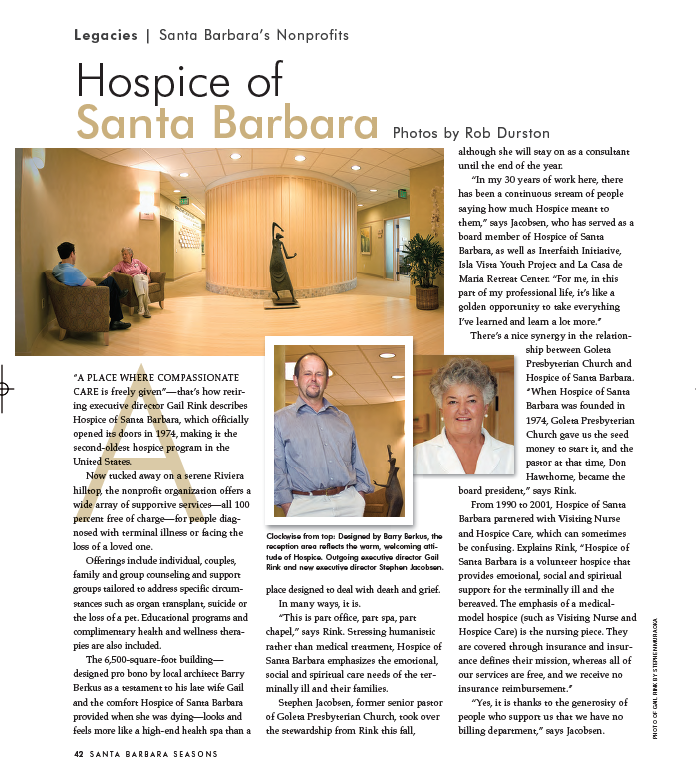
Legacies: Hospice of Santa Barbara

“A PLACE WHERE COMPASSIONATE CARE is freely given”—that’s how retiring executive director Gail Rink describes Hospice of Santa Barbara, which officially opened its doors in 1974, making it the second-oldest hospice program in the United States.

Now tucked away on a serene Riviera hilltop, the nonprofit organization offers a wide array of supportive services—all 100 percent free of charge—for people diagnosed with terminal illness or facing the loss of a loved one.

Offerings include individual, couples, family and group counseling and support groups tailored to address specific circumstances such as organ transplant, suicide or the loss of a pet. Educational programs and complimentary health and wellness therapies are also included.

The 6,500-square-foot building—designed pro bono by local architect Barry Berkus as a testament to his late wife Gail and the comfort Hospice of Santa Barbara provided when she was dying—looks and feels more like a high-end health spa than a place designed to deal with death and grief.

In many ways, it is.

“This is part office, part spa, part chapel,” says Rink. Stressing humanistic rather than medical treatment, Hospice of Santa Barbara emphasizes the emotional, social and spiritual care needs of the terminally ill and their families. Stephen Jacobsen, former senior pastor of Goleta Presbyterian Church, took over the stewardship from Rink this fall, although she will stay on as a consultant until the end of the year.

“In my 30 years of work here, there has been a continuous stream of people saying how much Hospice meant to them,” says Jacobsen, who has served as a board member of Hospice of Santa Barbara, as well as Interfaith Initiative, Isla Vista Youth Project and La Casa de Maria Retreat Center. “For me, in this part of my professional life, it’s like a golden opportunity to take everything I’ve learned and learn a lot more.”

There’s a nice synergy in the relationship between Goleta Presbyterian Church and Hospice of Santa Barbara.

“When Hospice of Santa Barbara was founded in 1974, Goleta Presbyterian Church gave us the seed money to start it, and the pastor at that time, Don Hawthorne, became the board president,” says Rink.

From 1990 to 2001, Hospice of Santa Barbara partnered with Visiting Nurse and Hospice Care, which can sometimes be confusing. Explains Rink, “Hospice of Santa Barbara is a volunteer hospice that provides emotional, social and spiritual support for the terminally ill and the bereaved. The emphasis of a medical model hospice (such as Visiting Nurse and Hospice Care) is the nursing piece. They are covered through insurance and insurance defines their mission, whereas all of our services are free, and we receive no insurance reimbursement.”

“Yes, it is thanks to the generosity of people who support us that we have no billing department,” says Jacobsen.

“Historically that has really been important in this organization. Our board has always been committed to providing free services,” Rink adds.

Looking to the future, board president Roger Heroux says, “The vision is to grow because there is a lot of work to be done. Not only do we want to grow and expand the clinical aspects of this organization, we want to penetrate the Hispanic community in a big way…. (Also) we’ve got to make sure that our infrastructure is solid…to make sure that we’ve got the capability internally to deal with the growth. And finally we want to collaborate with a couple of like-minded organizations that will serve as a good referral source to us, but who also share our commitment to this process.”

“I think that it will be a different kind of leadership,” says Rink. “I’m a fundamental program person and have been in the business a long time (27 years as a hospice social worker/counselor) and Steve has been affiliated with the business for a long time. I built the fundamentals, he’ll build the future.”

To find out more about Hospice of Santa Barbara, call (805) 563-8820 or visit www.hospiceofsantabarbara.org.

Leslie Dinaberg

Originally published in the Winter 2008/09 issue of Santa Barbara Seasons Magazine. To read the story as it appeared, click here and here.

Las Aletas Serves Up a Smash at Annual Tennis Event

Las Aletas will host its 17th Spring Smash Tennis Tournament, Fashion Show and Luncheon on Friday, April 18. Known as a fun and friendly women’s doubles competition, tennis will be played at private courts throughout Montecito and Santa Barbara, with lunch and the fashion show featuring clothes from the Tennis Shop of Montecito and Natasha Boutique at a private home in Hope Ranch.

Proceeds from the event will be used to support Las Aletas’ three philanthropic projects: Operation School Bell, which provides clothing for low-income children in the Goleta school district; Operation Bookshelf, which provides homebound patrons with books from the Goleta library; and Kids on the Block, which brings puppet performances to local schools to educate children about subjects such as safety, bullying and getting along with others.

In addition to tournament proceeds, there will be a raffle at the event. “Each year the items get better and bigger. We are so excited about the donations this year, said Heidi Stilwell, who is co-chairing the tournament with Jan McGuire.

“We have some fantastic items up for raffle, including vacation condo stays in Mammoth and Utah,” said Stilwell. “This is, of course, all to fund our organization’s philanthropic activities, which include Operation School Bell, Kids on the Block, Operation Book Shelf, as well as helping out at the Santa Barbara Assistance League Thrift Store.” Las Aletas is an auxiliary of the Assistance League, and was originally created as a way for the daughters and daughters-in-laws of Assistance League members to get involved with philanthropy.

Spots are still available for both the tournament and the luncheon/fashion show. The cost is $60 for tennis players (including luncheon and fashion Show) or $35 for the luncheon/fashion show only. For more information call McGuire at 805.964.0515 or email lasaletastennis@hotmail.com.

Originally published in Noozhawk on April 9, 2008.

Women’s Festival Debuts

wf-logoThe inaugural Women’s Festivals launched in Santa Barbara March 7-9th and Arizona March 14-16th. Founded by local businesswoman Patty DeDominic and her partner Mary Schnack, these conferences were created to “celebrate the accomplishments of women and inspire others to realize their dreams,” with forums focusing five key areas: personal, professional, philanthropic, political, and planet.

The Saturday morning “personal” panel on “Transition: The Best is Yet to Come,” was thought-provoking for the approximately 50 people (predominately women) that attended.

Introducing the panel, Alberto G. Alvarado, the Los Angeles district director for the U.S. Small Business Administration, started out the morning with a laugh when he asked the audience, “When does a woman most enjoy a man’s company?” The answer: “When she owns it.”

Then it was on to a dynamic discussion of transitions–both in life and in business–with four very different women.

“Your experiences turn to lessons and hopefully those lessons turn to wisdom,” said Tessa Warschaw, Ph.D., founder of Big Thinking Women and the author of “Winning by Negotiation,” and “Resiliency: How to Bounce Back Faster, Stronger, Smarter.” As you age, “if you don’t have your marbles and you don’t have cash, you’re in trouble,” said Warschaw.

“If you live in the future or in the past, you’re wasting your time,” said Linda LoRey, President and CEO of Frederick’s of Hollywood, who related her story of taking the company public and in the same year becoming a mother for the first time at age 52. “You can do it all, but you can’t do it all at once,” she said, though it sounds like she, at least, can do an awful lot at once.

Maureen Ford, an entrepreneurial education expert and author of “The Turning Point,” said that a dream about her dead mother inspired her to write the book for which all profits go toward Women for Women International, a nonprofit humanitarian organization dedicated to financial, educational, and interpersonal support of women survivors of war, poverty and injustice.

Joan Frentz, author of “Life Begins at 60,” who works as a personal trainer in Carpinteria, talked about the importance of staying in good physical health. “The good and bad news is that we’re going to live to be 100,” said the impressively spry 72-year-old. “We have to take care of ourselves to make those years worthwhile.”

A fundamental objective of the festivals was “to bring together a unique gathering of extraordinary women to share their experiences and wealth of knowledge with the goal of transforming the lives of participants,” according to the organizers. Other featured speakers included: Dr. Susan Love, U.S. Representative Lois Capps (D-CA), Sara Miller McCune and LeVar Burton.

Originally published in Noozhawk on March 25, 2008.

Leslie Dinaberg Sits Down With Ken Saxon

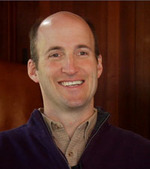
Ken Saxon

Ken Saxon

Since arriving in town 12 years ago, Ken Saxon has served on the boards of some our most successful community endeavors, including the Santa Barbara Scholarship Foundation and the Santa Barbara Foundation. Now he’s taking his experience with the unique challenges nonprofit leaders face and using it to develop a new program called “Courage to Lead.”

LD: What first brought you to Santa Barbara?

KS: My wife Jo and I moved here when our twins were 1-1/2 years old. We felt that this would be a great place to raise children and it’s really turned out to be that. I remember we came at the beginning of June and two days after we showed up was the second annual Big Dog Parade … and a couple of weeks later was Solstice and then there was July 4th and then there was Fiesta and we just thought this town was one giant parade just to welcome us to Santa Barbara.

LD: I know you left a business in the Bay Area. What is your business now?

KS: What I’ve been doing for most of the last 12 years is I’ve taken my business skills and applied them to the nonprofit sector, mostly as a volunteer. … The venture that I’m most involved with right now is a program called Courage to Lead. I’ve worked with a lot of nonprofit executive leaders, and one of the conclusions that I’ve come to from this dozen years of experience of working with them, is that I think they have a harder job than business leaders because business leaders have one bottom line they are managing to. Nonprofit leaders have at least two: a financial bottom line and a social benefit bottom line. At the same time they have less resources to draw upon and also a lot less has been invested in them.

… Also I find that nonprofit leaders are very isolated from one another. Sometimes there’s a sense that only they know what the challenges are and sometimes there’s a sense of competition. … So I helped to develop Courage to Lead. … The goal is to nurture and support them in renewing themselves and in rekindling their passion and commitment for their work. And because it’s done in a group in retreat over time, they build a deep community and they provide each other with mutual support and inspiration. … The program is based on the work of a national group called the Center for Courage and Renewal.

LD: What stage are you in the development of the program?

KS: We are launching a group this year that’s going to start in November and they are going to meet quarterly in retreat for at least a year up in Mount Calvary Retreat Center for two days at a time. … From May 7-9th, we’ve arranged for an introductory retreat … people who are potentially interested are invited to come and experience what one of these retreats is like.

LD: Is there a religious or a spiritual component to it?

KS: There’s not a religious component. Spiritual is always a challenging word because it means so many different things to different people, but yes, there’s a spiritual component in that people are given opportunities and time for reflection and inspiration relative to core questions of meaning and mission and passion and they are given space to reflect and hear their inner voice and to tap into what it is that most motivates them in life that they want to do in the world. And I would call that a spiritual. But the text and things that we use most often is actually poetry and other inspired readings that help people think about their careers and their lives on a deeper level, rather than kind of a religious text.

LD: How will you select people the first people?

KS: We have gone out to leaders in the nonprofit and philanthropic world and we have asked for nominations of nonprofit leaders that they feel would benefit from this experience given who they are and where they are in their careers. But it is also open for application. We have a website that is CourageToLeadNP.org, where people can get more information about it. … We talk about environmental sustainability but there’s a big discussion as the nonprofit sector continues to grow it’s filling a huge need in our society, but whether we can run it in a way that is sustainable, rather than just burning everybody out. That’s a tough question. I’d like Courage to Lead to be part of the answer.

LD: I think you have a unique perspective in that you’re still in your 40s and able to devote yourself to nonprofit work fulltime.

KS: Absolutely, but it doesn’t mean that other people can’t be involved. The Katherine Harvey Fellows are an example. Another example is Craig Zimmerman and I created a group called FUND, Families Uniting to Nurture Dreams. There are 20 families with children who are mostly between the ages of 6 and 16, and we got together partly to raise college scholarships for local kids, but the biggest thing that we do is we create opportunities for our children to learn about the community and really about their world through hands-on ways of getting involved in the community.

… Our group the last three years has partnered in something called Project Healthy Neighbors that is done by Casa Esperanza and Santa Barbara County and Doctors Without Borders … they put on a health fair to try to try to attract the local homeless population to come in and get check ups, to get their immunizations and to get referred out to other services that they might need … (My son Griffin) was down with me at Casa Esperanza handing out the bags to the people that came through.

…The only way I know people in town is either through my kids, their school, but mostly it’s through volunteerism, the nonprofit boards and so on and what a generally terrific group of people. I’ve developed so many relationships with people that I like and respect through volunteering.

Some people move here and want to engage and other people move here and want to hide out and that’s fine and that’s their choice, but it’s awfully fun to engage.

Vital Stats: Ken Saxon

Born: Baltimore, Maryland, January 9, 1962.

Family: Wife Jo and 13-year old twins Griffin and Hope.

Civic Involvement: Courage to Lead; Santa Barbara Foundation; Katherine Harvey Fellows Program; Santa Barbara Scholarship Foundation; Santa Barbara Middle School; Eleos Foundation: Unitarian Society; FUND (Families United to Nurture Dreams); Foundation for Santa Barbara City College.

Professional Accomplishments: “I ran a business in the Bay Area for a dozen years (FARM, First American Records Management) that was acknowledged as both a financial success and a really fine place to work and really good at customer service and I’ve been a volunteer leader here. I approach things like, as the chair of the scholarship foundation, I didn’t approach that in any way differently than being board chair of my company. … I do look at my volunteer service here as professional.”

Little-Known Fact: “My kids perform in this musical theatre group called the Adderly School, and a year or two ago they created an opportunity for parents who were willing to subject themselves to it to have the same experience as their kids did, and so I was up on stage for three nights at Victoria Hall in ‘Mama Mia.’ … I performed on stage for the first time since 8th grade and the last time.”

Originally published in Noozhawk on March 18, 2008.

CALM’s 22nd Annual Celebrity Author’s Luncheon

CALM-logoCALM’s (Child Abuse Listening Mediation) 22nd Annual Celebrity Authors’ Luncheon last weekend was, as always, a rousing success, thanks in large part to the dynamic duo of Sharon Bifano and Stephanie Ortale, who have co-chaired the event every year since its inception in 1987.

Board president Meredith Scott gave a lovely tribute to retiring executive director Anna M. Kokotovic, PhD. That, along with a moving video presentation produced by Surf Media Communications, brought the work that CALM does in the community to the forefront of the luncheon–to prevent, assess, and treat child abuse by providing comprehensive, services for children and their families–inspiring the approximately 500 supporters at the luncheon to dig deep into their pockets to help abused children.

Retired KEYT anchor Debby Davison and Borders Books’ Kate Schwab interviewed an interesting panel of authors: Lisa See (Peony in Love), Andrew Klavan (Damnation Street), Deborah Rodriguez (Kabul Beauty School) and Gary David Goldberg (Sit, Ubu, Sit).

See’s book follows the lives of two young Chinese women in remote 19th century China. Her comparison of the tortures of female foot binding to the “plastic boobs” of today’s women (“they’re both painful things done to women as status symbols for men”) had the mostly female crowd in stitches.

When asked about the vivid characters he creates, Klavan said, “I really enjoy the fact that people are immensely different.” Another vivid character was Rodriguez herself, a hairdresser from Michigan who went to Afghanistan as a relief worker and ended up training Afghan women to do modern beauty treatments. “I mean Taliban are but this perm was really bad too,” said Rodriguez, describing the woman who inspired her to start the Kabul Beauty School.

“I couldn’t believe that you could make a living doing what I got to do,” said (Family Ties and (Spin City creator Goldberg, who spoke about writing a memoir about his life as a television writer/producer.

They joined the ranks of more than 70 authors interviewed over the years, including Sue Grafton, Jane Russell, Barnaby Conrad, Michael Crichton, Julia Child, Ray Bradbury, Fanny Flagg, Maria Shriver and Jonathan Winters.

In addition to purchasing books by the interviewed authors (with a portion of the proceeds going to CALM), authors Mindy Bingham, Polly Bookwalter, Joe Bruzzese, Jack Canfield, Kathryn Cushman, William Davis, Karen Finell, David Gersh, Beverly Jackson, Susan Jorgensen, Jennie Nash, Katie Nuanes, Sissy Taran and Flavia Weedn were also on hand to sign books and donate part of the proceeds to CALM.

For more information about CALM, visit www.calm4kids.org.

Originally published in Noozhawk on March 12, 2008.

American Riviera Wine Auction to Benefit Direct Relief International

Foxen Winery’s Bill Wathen and Dick Dore will be honored with the “Santa Barbara Vintners’ Foundation Humanitarian Award” at their biannual 2008 American Riviera Wine Auction weekend, March 14 and 15, with all proceeds benefiting Direct Relief International.

John Cleese will be presented with the “Santa Barbara Vintners’ Foundation Wine Diplomat Award,” and Andrew Firestone will host the event. Firestone, who will soon marry Serbian model Ivana Bozilovic, has also asked his friends to make donations to Direct Relief International in lieu of gifts.

The two-day event will include a weekend of wine tasting and elegant dining involving Santa Barbara County’s finest winemakers and chefs, in addition to highlighting the humanitarian work being done by Direct Relief International. Both nights will feature wine tasting and auctions featuring wine lots and winery parties at renowned local vineyards.

The weekend starts Friday night with “Viva Vino,” featuring entertainment from Cuban band Somas Son and salsa dancing at the Direct Relief International Warehouse in Goleta. Hungry Cat, Brothers at Mattie’s Tavern, and Seagrass will provide food, with wine tasting provided by eight Santa Barbara Vintners.

Saturday night is the black-tie gala “Wine, Dine and all that Jazz!” at the Four Seasons Biltmore. It will include a gourmet dinner created by nationally renowned chef Suzanne Goin, paired with an array of the region’s award winning wines, and entertainment provided by the Nate Birkey Jazz Group and a live auction led by celebrity auctioneer Ursula Hermacinski.

The American Riviera Wine Auction is part of an eight-year collaboration between Direct Relief International and Santa Barbara’s wine makers. This partnership has helped raise $1 million for the efforts of Direct Relief International, a Santa Barbara-based nonprofit organization focused on improving the quality of life by bringing critically needed medicines and supplies to local healthcare providers worldwide. Recently, Direct Relief International played an integral role in providing aid to victims of the San Diego Wildfires, Cyclone Sidr in Bangladesh, and victims of the storms which ravaged the Southeast United States and took the lives of 52 people just weeks ago.

Tickets for Friday, March 14th can still be purchased by contacting Mann Productions at Mann.Productions@sbcglobal.net or by calling 323 314 7000. Tickets for Saturday, March 15th are sold out (wait list only).

Originally published in Noozhawk on March 3, 2008.

Grief Book Benefits Hospice and the Temple

The sun shined on Hospice of Santa Barbara and Congregation B’nai B’r61DjnDCK+3L-1._BO2,204,203,200_PIsitb-sticker-arrow-click,TopRight,35,-76_AA300_SH20_OU01_ith Sunday afternoon at a special event honoring the publication of Sissy Taran’s new book, The Sun Will Shine Again: Life Lessons from a Year of Grieving, (www.thesunwillshineagain.com) with all proceeds going to support the two organizations.

“This is the first time in history of Hospice of Santa Barbara that we’ve ever sponsored a book,” said Executive Director Gail Rink, who interviewed Taran and Rabbi Steve Cohen about their experiences working together. Taran and Rabbi Cohen wrote the book–which documents Taran’s first year of grieving the death of her husband Bernie–through a series of conversations. They met once a week for seven months, primarily at the Breakwater Restaurant, to share the journey Sissy went through.

Rabbi Cohen said he viewed the project as a unique opportunity to learn more about the grief process. He was with the Taran family when they learned of Bernie’s cancer diagnosis, and with them shortly afterward when he passed away. “It was a wonderful but very short-lived period of intimacy,” which he welcomed the opportunity to extend through collaboration on the book project.

He initially decided to become a rabbi because it was important to him to be close to people in key moments of their lives, and saw this project as a rare opportunity for that type of closeness.

One of the most important lessons he learned was that there is not a linear progression from devastation to happiness, Rabbi Cohen said.

“We walk it all differently, but it’s our individual walk. So this, somehow, and I don’t know why, this book was burning within me. Somehow. Because I’ve never written and if I had to sit down at a computer I still wouldn’t have written a book,” said Taran, who taped all of her sessions with Rabbi Cohen and pieced together the book from the transcripts, with the help of editor Laurie Deans Medjuck. “We ended up throwing out about 75 percent of it,” said Taran.

Even though she was, and still is grieving, Taran said she doesn’t feel sorry for herself. “How can you have pity for yourself when you have someone who’s there for you with so much love,” she said of her collaboration with Rabbi Cohen.

“I don’t know how I or Sissy or any of us would have faced this journey alone,” said

Congresswoman Lois Capps, who was widowed in 1997. “You’ve created a beautiful thing out of most deep and personal pain. What a lesson and what a gift!”

Through writing this book I found something within me that wanted to help myself and other people, said Taran. “Today’s benefit is my way of giving back to two organizations close to my heart.”

Originally published in Noozhawk on February 12, 2008.

Leslie Dinaberg Sits Down With Sissy Taran

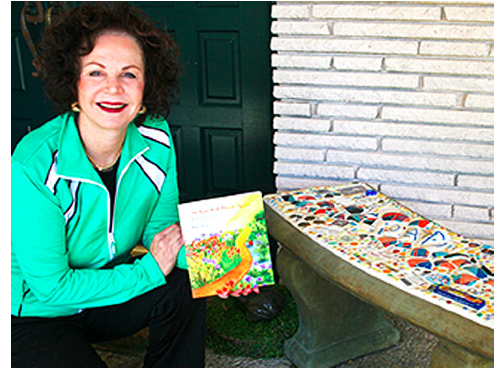
Author Sissy Taran, courtesy Noozhawk

Author Sissy Taran, courtesy Noozhawk

A combination of laughter and tears helped Sissy Taran survive the sudden death of her husband Bernie, in June 2005. “There aren’t any magical answers to survive the loss of a loved one,” says Sissy, but she hopes to help others by bringing that same bittersweet combination of humor and compassion to her new book.

Leslie Dinaberg: Tell me about The Sun Will Shine Again: Life Lessons from a Year of Grieving? How did you come to write the book?

Sissy Taran: People kept asking me how I was doing, and I had no answer. Usually I’m not shy and I’m not at a loss for words … Finally I came up with, “Well I’ll just write a book.” (laughs) That was my response to “how are you doing” because I didn’t know how to say it any other way.

So (five months after her husband’s death) I’m at the temple…and I see the Rabbi’s door open and I decide I’m going in and I’m going to ask the Rabbi to write a forward for this book that I’m going to write.

Now I have no idea how to write a book. I don’t have the foggiest idea how to write a book. But the door was open, so I went in and I spent an hour with him and when I was through, I said, “Gee, do you want to co-author this book with me?” … Then I went home and I called my neighbor (Laurie Deans Medjuck) to ask her how to write a book. … She ended up being the editor.

…The Rabbi started to interview me, he interviewed me for seven months, an hour and a half, every week, and I spoke, we spoke, 500 pages, 100,000 words. … The whole book came from the transcripts.

LD: Did you feel like in reflecting on what you had said originally that your feelings about some things had changed?

ST: What happened was I didn’t feel like the same person anymore. When we started writing it and making it into the book, it was this person I watched grow. This person I watched from the very beginning of her baby steps. It was almost like taking myself and putting myself over here and being totally removed and watching the growth and how she became empowered and looking at it now, two years later, I still look at her as another human being. It’s fascinating.

LD: How much of how you feel now do you think has to do with the act of writing the book, as opposed to going through the whole grief process?

ST: Well, interesting enough, I didn’t think of the book as being cathartic. It was only after I did it, it was like visiting a therapist, but I didn’t know that.

… We were doing something for somebody else. It wasn’t for me. I was writing this because there was nothing available I felt that people could relate to. So I had a project and I like projects.

LD: One of the things that really struck me was how you always think about someone grieving the big things like holidays, but not how many little day-to-day reminders there are.

ST: I think probably the turning point for me was putting in the new driveway. … when we make a decision we bounce it off of people. … But in the driveway I didn’t do that. In the driveway I shook hands with the person that put in the driveway. I didn’t have a contract, I didn’t bounce it off of anybody and I said, this was it. Now I didn’t know at the time that that was going to be as monumental in my life … when I drive up to the driveway every single day … and I drive up to those rocks. Those are MY rocks. I did that.

… we walk it all differently, but it’s our individual walk. So this, somehow, and I don’t know why, this book was burning within me. Somehow. Because I’ve never written and if I had to sit down at a computer I still wouldn’t have written a book.

LD: But it’s interesting how you came up with a way that worked for you and you were able to do it and it felt comfortable and it reads like you too. And I think there are a lot of levels to relate to it.

ST: The interesting part was that I thought that it would be much more about Bernie and it ended up not being. It started out where the rabbi and I were co-authors. It didn’t turn out that way, because he’d ask a question and I’d spend an hour talking. And then it turned out that it became a legacy to my mother.

So it changed its direction. Bernie was the vehicle for me to experience all of this, but the lessons that I learned as a child and the things and the sayings that she taught me, that was really the bread and butter of it. … Throughout this book you will find quotations from my mother, Buddie Shrier. Some of these I found after she died, written on lists or pieces of paper and collected in a small wooden box. Others were simply things I heard her saying on an everyday basis. The life lessons they express form the foundation of my life and had an enormous influence on how I coped as I mourned the loss of my husband. … So for me, this is really a tribute to her. So as it started it out, where it was co-authored with the rabbi. Didn’t happen. Where it was about Bernie, didn’t happen. It’s my journey.

LD: It’s interesting too that you say that because that’s something that has struck me about people that I’ve known that have lost a spouse. One of my friends lost her husband when she was pretty young and she’s gone to accomplish things professionally that she would never have done if she were married, because she wouldn’t have had to. It’s definitely an example of one of those one door closes another one opens kind of thing. …

ST: That’s right. And it’s a choice, Leslie. It’s really, really a definite choice and you can watch those who do it and you can watch those who don’t do it and I think we’re born genetically with our certain DNA that we’re positive or we’re negative and then you have a choice after that. And my choice and was to do this, to make a difference.

… I’m just along for the ride and wherever it goes, it goes.

LD: Well it’s a great accomplishment to have written a book and have it sitting in front of us here, even if it never goes anywhere else. The fact that you wrote it and you got everything you got out of writing it. And the product itself is a whole other journey.

ST: I did it and I love it. You know it’s interesting, I look at it, and just like they can’t ever take your education away from you, I am always going to be a published author.

Vital Stats: Sissy Taran

Born: Detroit, Michigan, November 26, 1944.

Family: Three grown daughters, Tiffany, Francine and Nadine; Son-in-laws Scott and Zach; and grandchildren Ethan and Blythe.

Civic Involvement: Mentor to two children in the Council on Alcoholism and Drug Abuse’s Fighting Back program; CALM; Anti-Defamation League; Coalition Against gun Violence; Hadassah; B’nai B’rith Temple.

Professional Accomplishments: Former elementary school teacher who has been honored with outstanding service awards from the Beverly Hills and Santa Barbara PTAs.

Little-Known Fact: “My dad was part of the Kennedy administration and I was raised on a ranch outside of Bakersfield.”

Benefit for Hospice of Santa Barbara and Congregation B’nai B’rith

On Sunday, February 10, from 2 to 4 p.m., Hospice of Santa Barbara’s Executive Director Gail Rink will interview Sissy Taran and Rabbi Steve Cohen about their experiences working on “The Sun Will Shine Again: Life Lessons from a Year of Grieving.” Then refreshments will be served and all book sales from that day will go directly to Hospice and the Temple.

Originally published in Noozhawk on February 3, 2008.