HELPING THE HOMELESS

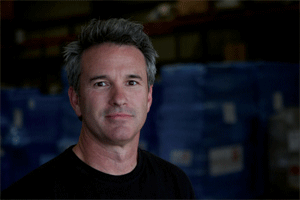
DR. LYNNE JAHNKE

If you mention Dr. Lynne Jahnke’s name to a homeless person, they might not know who you’re talking about. But if you mention her by her street nickname–“Dr. J”–their eyes light up and it’s a whole different story. “Yeah, I know Dr. J,” says Mitch, a Santa Barbaran who sleeps near the train tracks and spends his days at the downtown public library. “She’s cool. She’ll fix you right up with what you need.”

Jahnke–along with social worker Ken Williams and sometimes her assistant, Klea Kalionzes–hits the streets of Santa Barbara twice a week in search of homeless people in need of medical treatment. Often, her base of operations is a Volkswagen van filled with gear and space for “the guys to put their shopping carts if I need to take them to the hospital or the clinic,” she says. Sometimes, she’ll simply strap on a backpack full of medical supplies and cold water and go in search of homeless camps where she can help the sick and injured.

Street medicine is a long road from oncology, Jahnke’s first specialty. After practicing as a cancer specialist for almost ten years in San Francisco and Chicago, she came to town in 2000 to work at the Cancer Center of Santa Barbara. But two years ago, while in her mid-40s, Jahnke retired from oncology–“rewarding, meaningful work,” she says, “but I just decided I’d had enough oncology.” In a serendipitous turn of events, she met some people who were working with the homeless, and found her new calling. “It’s completely different but it feels great,” she says. “These people really have nothing–they’re so grateful if you give them a Tylenol or a Band-Aid. They can’t believe that a doctor is actually going out on the street and seeing them there.”

Although she loved being a cancer doctor, Jahnke says she continues to work with the homeless “because working in primary care with the homeless reminds me of the open heart and desire to help people that made me want to become a doctor 25 years ago. The patients are so kind and grateful for my care and the many other people who provide services to the homeless are wonderful to work with as well.”

Though she considers herself “retired,” and receives just a small stipend, when she’s not doing street rounds, Jahnke can be found three days a week at the lower eastside Casa Esperanza Homeless Shelter clinic, which offers 30 medical beds for patients released from the hospital who are still too ill to go back out on the streets. “I do a lot in coordinating the hospital discharges. I have working relationships with the doctors there,” says Jahnke.

Working with the homeless is a regular reminder to Jahnke of how fortunate she is. “This is why I went to medical school,” she says. “To take care of people who really need it.”

Originally published in Santa Barbara Magazine in Fall 2008.

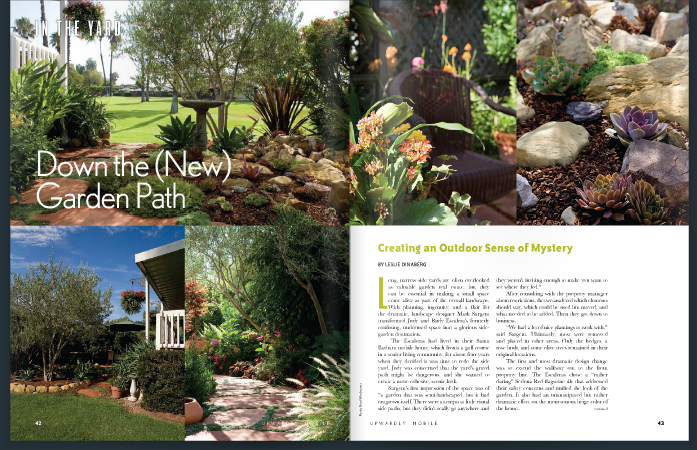
Down the (New) Garden Path

This story as it appeared in Upwardly Mobile Magazine

This story as it appeared in Upwardly Mobile Magazine

Long, narrow side yards are often overlooked as valuable garden real estate, but they are especially useful as a way to make small spaces come alive and feel as is they’re part of the landscape. With planning, ingenuity, and a flair for the dramatic, landscape designer Mark Sargent transformed Judy and Rudy Escalera’s formerly confusing, underused space into a glorious side garden destination.

The Escaleras had lived in their Santa Barbara mobile home–in a senior living community next to a golf course–for about four years, when they decided it was time to redo the side yard. Judy was concerned that the gravel path might be dangerous, and she wanted to create a more cohesive, scenic look.

Sargent’s first impression was of “a garden that was semi-landscaped, but it had outgrown itself. There were attempts at little visual side paths but they didn’t really go anywhere and they weren’t inviting enough to make you want to get on them to see where they stopped.”

After consulting with the property manager about restrictions and an analysis of what should stay, what could be used but moved, and what should go in the garden, the two set a budget of $12,000, and got to work.

“We had a lot of resources, a lot of nice plantings to work with,” says Sargent. Though many of the plants were removed and placed in other areas, nothing stayed in its original place except a rose bush, hedges and some olive trees.

The first and most dramatic design change was extending the walkway out to the front property line. The Escaleras chose a “rather daring” Sedona Red flagstone tile that not only addressed the safety concerns and unified the look of the garden, it also had the unintended consequence of warming up the beige color of the house.

Initially Judy wanted to repaint the house when the side yard was done, but the reflection of the tile changed the color. “It was a clever accident,” explains Sargent. “It turns out the Sedona Red ties in so well that it made the house look like it was the right color.”

“Another thing that we did was change the steps at the side of the house,” says Judy. “We changed the design so that it had a little landing and the rail comes down like open arms, sort of saying ‘hi, here we are, welcome.’ You follow that beautiful red pathway and then on up into the different areas in the garden.”

Creating a pathway with a variety of interesting groupings of plantings–including Plumeria, Loropetalum, Aloe, Hydrangea, Jacob’s Ladder, Agave, Little Ollie, and Azalea–“helped give a sense of largeness to the garden so that the stairs didn’t just go marching straight down to the front door in a boring way,” says Sargent.

They also incorporated a birdbath, succulent rock garden, patio, an antique garden bench, and a water feature into the space. “It’s amazing that you can fit in so much and still end up not feeling overwhelmed by objects and feel that you actually have places to go,” says Sargent.

Other than trimming the olive trees and the hedges, the Escaleras are able to maintain the garden themselves, an important consideration for seniors and people on a budget. “I love to putter around,” says Judy. “It just gives me so much pleasure.”

Originally published in Upwardly Mobile Magazine

Noozhawk Talks: Leslie Dinaberg Sits Down With Amy Kovarick

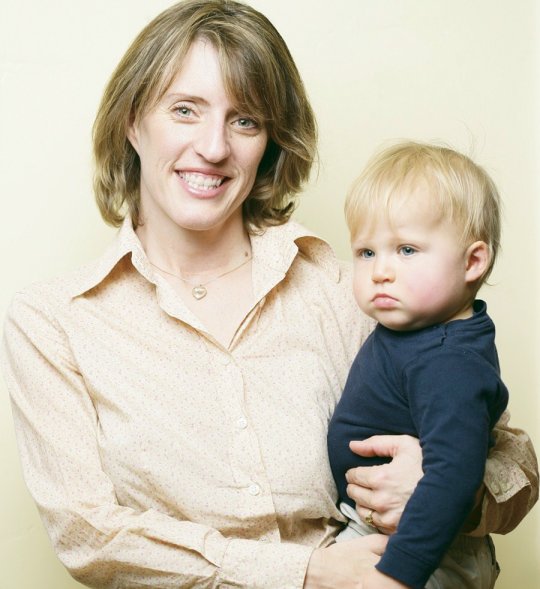
Amy Kovarick (courtesy photo)

Amy Kovarick (courtesy photo)

As a wife, mother and life coach, Amy Kovarick is a master of multitasking, and she’s helping others find balance in their lives, too.

By Leslie Dinaberg

Wife, mother, life coach, counseling psychologist, radio host and author of Baby on Board: Becoming a Mother Without Losing Yourself, Carpinteria-based Amy Kovarick knows a lot about multi-tasking.

Leslie Dinaberg: So you got started as a life coach after leaving the corporate world?

Amy Kovarick: Yes. I got married at 39 and Matt was born when I was 40, so it was a tremendous change. And finding where the ambitious kind of career Amy fit now with all of these other hats was part of my journey. One company I have, Empowered Motherhood, (Empoweredmotherhood.com) is very much about that. How do you keep close to yourself and true to who you are and yet bring your best to your kids?

… that’s kind of the heart of coaching, whether it’s Empowered Motherhood where it’s a mother community … or my private coaching practice (Amykcoaching.com) where I work with people across the country. The coaching part, no matter who I’m working with, is looking at that balance across your life.

… I’ve got folks who come for career issues, relationship issues, health issues, really right across the board. But it always comes down to balance, which one is falling off the load and have you even stopped to think about where you fit in and what you want, what’s interesting to you nowadays?

LD: It sounds like we could all use some of that.

AK: (Laughs) I think the best coaches are the ones that truly believe they don’t have answers for someone. They think you know deep down inside what’s best for your life and are good at just bringing out who you are. But the tricky part or the tough part about coaching is that there’s all that self-reflection and kind of the touchy feely part, coupled with a bunch of accountability and action items. That’s what drew me to coaching was the combination of the soft side with the no nonsense lets move side.

LD: What kinds of people typically come to you?

AK: A good example is the owner of this restaurant (Corktree Cellars in Carpinteria). She didn’t need to be fixed, she didn’t have a problem, she had a goal … I’ve worked with a lot of entrepreneurs, both men and women and a bunch of executives. I do corporate contracts where the corporation is paying me to coach some of their top leadership in reaching their peak performance if you will. But what I love about that is it is still the same, it’s one on one, there’s nobody there on the phone but them and I’m not working with their board of directors or their boss, it’s still weaves in issues from across their life.

I have a new woman that took on her first president role and so she’s been VP, she’s been this and that, but she’s a mom, she’s got two kids and she’s got all of the issues with that, plus she’s a new female president, in a new company that she doesn’t know these people, a bunch of men that are working for her and reporting to her and the coaching with her is full of all of the things you would imagine.

There are a lot of practical business things but there is the okay, how do you show up and be your full self and be as bold as you want to be and don’t be afraid of stepping on toes, but yet be effective. That’s what I love about my work.

One of my favorite long-term clients was a young girl going through college in New York and her father was footing the bill because he wanted her to be very successful. There’s a different kind of pace of just really working through her journey of becoming an adult and she’s graduated and is down in Australia at the Great Barrier Reef, she’s a conservation biologist.

… So the dreams differ, one wants to be the best leader, one wants to open a restaurant, one wants to be a marine biologist, so it sounds very different, different ages and walks of life, but it is all the same thing of who are you, what do you want to do, how are you going to get there–and that’s what fascinates me. That’s what keeps me in it is every person is different and no two coaching sessions look alike.

LD: In a way it sounds like what writing does, you sort of get to live other lives because you’re finding out so much about what other people are doing.

AK: Yes. And I get I thrive on one on one, real conversations, not a lot of superficial stuff. I’m terrible at networking or parties where you have to just chitchat. That’s my worst thing. So when I get to do my coaching, these people share a lot. And they come pretty unguarded, even my tough male executives.

LD: Do you get people that are motivated to change something?

AK: Yes. Change, grow. It’s people who even though they all look so different on the surface, the common thread is this desire to grow, to not just be successful because it’s not always about people wanting monetary success, it’s this almost fierce desire to not be static, to not stay the status quo. They want to keep pushing out their barriers, and some people for sure come with a problem, come with I’m really unhappy at work, I’m really unhappy in my relationship, I would like to meet someone, I would like to lose 50 pounds. Sometimes there is a very specific problem and they are all willing to look at themselves to take responsibility. By the nature of no one is going to hire me and pay my fees if they are a victim. … People who show up and want to work with me, they’re serious about their life.

… Often I get asked, well how is this different than therapy … the big difference is therapy often is about healing or fixing and it often goes into the past and the whys. How did I get here? Whereas coaching is about where are you now. Coaching is much more about present and future and very seldom do I go to the whys or what happened with your parents. That’s just not part of the conversation even though that’s really valuable but it’s not what I do.

LD: If you could be invisible anywhere in Santa Barbara, where would you go and what would you do?

AK: If I could get into my husband’s head. He’s a very private guy and as he said last night, “you know more about me than anyone in my entire life has every known.” But it’s like pulling teeth.

Vital Stats: Amy Kovarick

Born: Newport, Rhode Island, April 23

Family: Husband Mike Musson; Stepdaughters Layla, 20; Fina, 18 ; and Meli, 15; and son Matt, 2-1/2.

Professional Accomplishments: Author of “The Empowered Mother,” host of the radio show “Empowered Mother,” MA in Counseling Psychology, PCC (Professional Coach Credential), member of the International Coach Federation, has worked with hundreds of people in North America helping them reach their dreams.

Best Book You’ve Read Recently: Age of Turbulence, by Allen Greenspan

Little-Known Fact: I was in the Air Force and worked at the Pentagon.

Originally published in Noozhawk in July 2008. (Click here to read the story online.)

Leslie Dinaberg Sits Down With Gay Browne

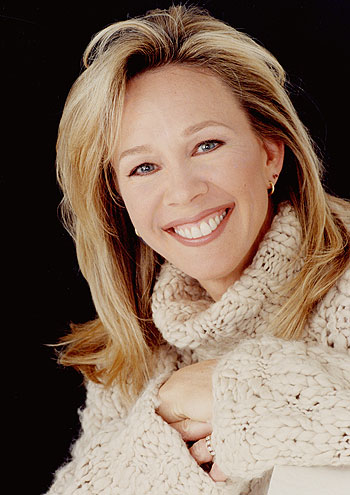
Gay Browne

Gay Browne

The Greenopia founder publishes city guides to help consumers find environmentally friendly businesses. A Santa Barbara book is due out … soon.”

“Eat, shop, live green” is the mantra for Montecito mom Gay Browne. Her company, Greenopia, publishes Zagat-style city guides to help busy consumers find earth-friendly businesses. The Los Angeles book came out in 2006, San Francisco in 2007 and New York in 2008. She plans to expand to multiple cities across the country, including Santa Barbara, which “I promised the mayor I would do this year.”

Leslie Dinaberg: Tell me about the Greenopia books and website?

Gay Browne: It started because I have been a lifelong asthmatic and I’ve always been super conscientious about my health. … My oldest son was born with autism-related learning issues, and then I learned about him, and all of these illnesses led me to understanding that how you lead your daily life, can make a big difference in your health. … We built a house in 1994 that was the first environmental house in West Los Angeles, and in building the house I learned a whole lot inside out what goes into buildings and all of the environmental stuff and so I got fascinated about it.

…I thought I’ll create a guide, like a Michelin Guide and I’ll vet the businesses and services and I’ll give people a roadmap in clothes, in paints, in carpets in almost everything that they have an eco-friendly alternative solution.

LD: What has the response been to the books?

GB: It’s been phenomenal. … We have really done phenomenally well for being a new venture.

LD: So when you do a guide do you hire field researchers to go walk around?

GB: The way we do it is we go and we put an ad on Craig’s List or the local university, they all have environmental departments. …We’re trying to figure out a to work with universities to help cultivate their students, as well as help cultivate our criteria.

LD: That’s a great idea.

GB: The Bren School here at UCSB did a study of our research criteria of our 52 categories and they gave us some recommendations as well as a lot of good credits. And then recently we won an award from the EPA on our work for educating consumers for sustainability and climate change, which is good validation for us. But that’s how we go, we go into cities, we hire people and grid the cities, just like on a map. … And they have these 52 categories they use, they ask the questions, we put in all the data and then we come out with a leaf score of one to four leaves.

… The leaf score is not to penalize businesses for not being green, the leaf score rating is really for the consumers to know how much green is in that place, because if you were to look at a list of stores and it was McDonald’s, Shakey’s, Chinese food and a natural health store, the only reason you know that the natural health store has more health stuff is because of the name. Otherwise they could all have organic vegetables and fruits. So what we’re trying to do is give the four-leaf rating to those stores that offer more environmental friendly alternatives so the consumer who is more choosy will know.

LD: How would you think that Santa Barbara would rate?

GB: It’s small. I have to say I think we’re a little behind in the food department. There is not as much alternative for buying organic food as there is other places. Vons has a very small section of organic food. There’s the Farmer’s Market, which I personally never can get to because my kids always have sports on those days. … I think that Santa Barbara has a healthier lifestyle and the people are healthier but … I don’t see as many of the support services, like the pool guy, I want it to have no chemicals. They are not that experienced in doing that. Homebuilders, they are actually a little better, but certain categories are not as well versed. However the people that are here are more committed to living a healthy life. I don’t think that businesses have caught up with the desires that people have. … I promised the mayor I would do a guide by the end of the year, if not January 1st for sure by Earth Day.

LD: I can’t wait to see it.

GB: I started this because I became conscious about my life and I wanted other people to start being conscious about what their lives are … we have to start being really conscious of how we treat each other and how we use our resources and what our behaviors are to the planet. … My goal is treat the planet kindly, as well as each other, I think that somehow in businesses globalization that people forgot along the way that we can’t just swallow up everything.

LD: With these publications and this business that’s all over the place, how much do you need to travel?

GB: That’s a problem … there’s only one of me. … I do have to travel often. … I’m not unlike most moms with a passion. If you’ve got a passion and you’re a mom, you are dedicated to making it work. It’s hard on my kids when I’m gone. … But the good news is my husband is older and he’s semi-retired so he is around almost all the time. His office is in LA but because he’s semi-retired he goes in only every other week for two days, so it wouldn’t be possible without his financial support and his flexibility with his schedule.

LD: It sounds like you’re really, really busy, but when you’re not so busy, what do you like to do?

GB: Hang with my family. I love to play golf and tennis but I don’t play tennis or golf very much. I love to hike. I try to squeeze in a hike whenever I can, which is about once a month, and I do Yoga twice or three times a week. If I have free time I do something with the kids.

LD: If you could pick three adjectives to describe yourself, what would they be?

GB: I would say that I’m optimistic, energetic, and persistent or tenacious. If you ask my husband those are kind of an annoying three words. I tend not to get batted down until I really get batted down!

LD: I think to start any kind of a business yourself–especially something that no one has really done before–you would have to be tenacious.

GB: Right, or just naïve. You should probably be both. People say you never would have done this if you knew how hard it would be. I say not in a million years. It’s been way more work and way more money than I thought, but today when I heard that (green newsletter) Ideal Bite sold to Disney for $20 million and I have a meeting with Disney tomorrow, I’m thinking, well, maybe there’s hope.

LD: I would imagine that probably the money motivation is great, but it’s not just the money motivation.

GB: No, not at all. If I can get one mother to know that she should get her mercury tested before she has children to save her the headache and all the things I went through, or one mother who has a child with allergies to avoid allergy shots when she switches to an organic mattress because it has less molds and dust, it would make my life perfect. Money is a validation as a woman that I appreciate as an independent person, but I’m doing this because of my passion.

Vital Stats: Gay Browne

Born: Lexington, Ky., April 21, 1960, which is fitting since sometimes it falls on Earth Day.

Family: Husband, Tony; children Alex (Young) 19, Colin, 9, and Katie, 7

Civic Involvement: Works with local environmental groups such as theCommunity Environmental Council and the Environmental Defense Center. “I’m also trying to work more with the mayor’s office in supporting policies that have to do with the environment.”

Professional Accomplishments: Founder of Greenopia. Before that, spent five years working in public relations and 10 years in media advertising, including Star MagazineTravel and Leisure Magazine and the Los Angeles Times.

Best Book You’ve Read Recently: I loved Elizabeth Gilbert’s Eat, Pray, Love. I’m also reading The Comeback, which is case studies about women going back to work.

Little-Known Fact: “I just recently began telling people that I had an eating disorder at one point in my life. I didn’t used to actually admit that very often. … Given the chance of spending the day the way I choose, I will find a hammock or a couch and lie there almost all day and read. … People think because I’m energetic that I don’t need quiet time, but I really do need quiet time. They underestimate my need for quiet. That’s why I moved to Santa Barbara, because it was quiet.”

Did you know?

Healthful tips from Greenopia:

» If every American ate just one meal a week made of locally and organically raised meats and produce, it would reduce the country’s oil consumption by more than 1.1 million barrels of oil every week.

» Among conventionally raised produce, apples, bell peppers, celery, cherries, grapes (imported), lettuce, nectarines, peaches, pears, potatoes, spinach and strawberries are the highest in pesticides. The list of conventionally raised fruits and vegetables that are lowest in pesticides includes asparagus, avocados, bananas, broccoli, cabbage, eggplant, kiwi, mangoes, onions, pineapples, sweet corn (frozen) and sweet peas (frozen).

» Replace PVC shower curtains with a natural fiber or nylon alternative. That plastic smell comes from the toxic chemicals that make PVC (polyvinyl chloride).

» Pack leftovers in reusable glass containers instead of disposable plastic bags or containers, which are made from petroleum. Recycling helps a little, but only a fraction actually gets recycled. Additionally, items that are used once then discarded will sit in landfills or blow into waterways and cause harm.

» Buy local and reduce carbon emissions. The average piece of produce travels 1,500 miles to get a grocery store.

» Research has demonstrated that when compared with other household actions that limit carbon dioxide, taking public transportation can be more than 10 times greater in reducing the greenhouse gas. It takes one solo commuter of a household to switch his or her daily driving to using public transportation to reduce the household carbon footprint by 10 percent.

Originally published in Noozhawk on July 14, 2008.

Leslie Dinaberg Sits Down With Sue Adams

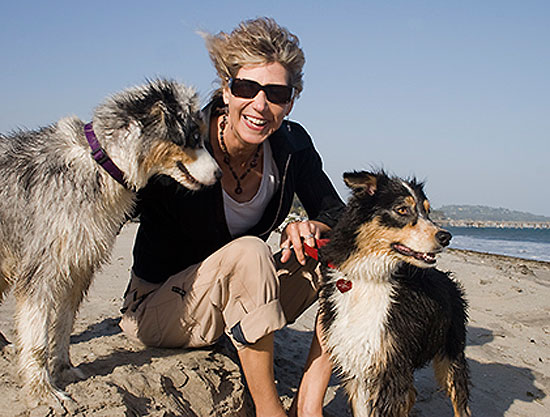
Sue Adams (courtesy photo)

Sue Adams (courtesy photo)

Since moving to Santa Barbara in 1957 to attend UCSB, Sue Adams has made her mark on our town in a myriad of different ways. Whether fighting for the rights of the homeless, advocating for the preservation of historic landmarks or working to get discounted healthcare for the poor, Adams pours her passion and remarkable energy into everything she does.

Leslie Dinaberg: Your husband Sam had a 34-year career as a track and field coach at UCSB. What was that like?

Sue Adams: He was gone weekends and didn’t get home till seven at night because of the team’s efforts, endeavors, training, so I pretty much had control of the household. … Our daughter Wendy was born with a lot of physical anomalies. What people would call a handicap, for her they were just challenges and she had probably about nine serious things wrong, including cleft lip and palate, kidneys that wouldn’t work, a heart that was defective, a huge series of things that we had to be in the hospital a lot to reconstruct.

And so Wendy was in fact the bionic woman, she was just an amazing individual …our second child was born about 15 months later, and his name is John and he and Wendy were best friends. And continued to take care of each other all of their young adult lives until Wendy passed away when she was 34.

LD: Wow. And now you’re a caregiver for your husband, who has Alzheimer’s. How do you manage to still do so much volunteer work?

SA: I think that it’s really important that I continue to say yes because I think I will then have something left.

…I like my balance as far as community giving, being a preservationist, being concerned about the beauty of this community and preserving it, the growth and how it grows and also the social causes. Trying to keep this community balanced, from being grasping and greedy to giving back as much as people can give. I think this is the reason why this community has thrived.

LD: Now you’re involved with the Courthouse Legacy Foundation and Save the Missions, what else?

SA: In the preservation world, I’m always a member of Citizens Planning Association…I’m also a member of the Historic Landmarks Advisory Commission for the County (HLAC). I’ve been in that for years, struggling to keep landmarks from being demolished. …. So that part is one hat and the other hat is the social justice hat and that is what are we doing about our homeless. … I think we need to be a little bit more brotherly and sisterly towards those that are compromised. … I’m the Board of Casa Esperanza and truly believe in funding those institutions that are getting people back on their feet. To know that within the last month 64 people were taken out of homelessness and put into housing makes my day.

LD: That’s great.

SA: That is great. … Giving credit where credit is due is what my real theme is. It’s not me, it’s never me, it’s knowing the people who know how to get the job done. That’s who I am, is I know who to call. I know who to call, and that’s basically what this community is all about, it’s volunteerism. People who actually roll up their sleeves and do their work. … Along with that is the St. Cecilia Society, which is one of my fondest passions, and that is one of the oldest charities in Santa Barbara.

LD: And that’s healthcare?

SA: Providing payment for healthcare. Saint Cecilia was the patron saint of music … the women who founded the St. Cecilia Society had marvelous musical talent. … They all came to Santa Barbara as a result of the forming of Cottage Hospital and the Sansum Clinic … (they were the wives of the doctors) and they all loved music and they got together and would jam. … So they decided to have fundraisers. … And then they provided money for a bed at Cottage Hospital for the poor. That was how they began…and that tradition continues.

LD: That’s such a nice history.

SA: It’s wonderful. To be a part of that is absolutely wonderful. The humanitarianism of that is that when you make a phone call to a provider …and say, “I understand that you have a bill in collections that is $7,000. I would like to negotiate with you and pay the balance on that account. Would you consider a discount of 40%?” And they are saying are you out of your mind? … And about two days later they call me back and say you’ve got it for 50% off.

LD: Wow, that’s amazing.

SA: Isn’t that wonderful? Now it doesn’t happen all the, but it does happen with a lot of other people in the medical community. …We leverage our money a great deal by telling people how wonderful they can be.

LD: That’s great. And are volunteers making those kinds of phone calls?

SA: I make that call, but the board is the one who decides, they determine how many people we can help a month.

LD: Are you able to do that part of your volunteer work from home when you’re here with Sam? I would imagine you do have a fair number of meetings out of the house.

SA: Well at board meetings, Sam has become a fixture. … I do a lot of work for them and if those people cannot handle Sam in the room then there’s something wrong. They need to be aware of the fact that people are compromised and they are part of your community just as much as everybody else is.

LD: How active is he able to be?

SA: Every day I insist that we take a walk. …. It’s very important to keep him moving and … he needs to be dressed and bathed and his food prepared. He wouldn’t be able to get in and out of bed without support, so I’m very needed.

LD: I’m sure he wouldn’t have wanted you to be devoting yourself 100%.

SA: …Sam grew up with that ethic that nothing was as important as taking care of the house and his needs. He was an anachronism. … When I started my business back in 1978 (the Footnote shoe store) the dynamics of our family went crashing because Sam was furious that I was competing, that I had another life.

… One of the reasons why I needed to go to work was because we had tremendous medical bills with Wendy. She was in the hospital with probably 50 different surgeries.

LD: How long did you have the store?

SA: The Goleta store was 15 years and then we ended up in the Santa Barbara store and so that was really 19 years.

It was wonderful. I loved it. It was so great. I just really enjoyed it. People never forget it too.

LD: So did you sell the Footnote or close it?

SA: They say after the loss of a child, that you should stay in business or do what you’re doing for at least a year. … I stayed in business for a year, but Wendy, in the last month before her death she said, “Mom, retail is wonderful but it’s starting to tell on you. Get into something else. Do something else. Find another thing to do. You are loving being a part of something bigger.” That time I was part of the Coalition to Provide Support and Shelter to Santa Barbara’s Homeless, that was the precursor to Casa Esperanza, and so she said, “You really do well with that, mom.”

LD: That’s interesting that your daughter sort of nudged you in that direction.

SA: Yes, she definitely nudged me in that direction. I think you can count money for just so long and think that most often you’re not affected by the bottom line financial aspects of life and I’m a dreamer, I am who I am because I am a woman of dreams and to be grounded by money is not necessarily a good place for me. It is for many because they can handle it better than I, but I didn’t want to be focused only on money. It’s not good for my soul.

LD: Other than your book clubs, is there anything that you do that is really just for you?

SA: Gardening. Natural beauty reduces me to tears and if I can help promote it in my own backyard it’s an environment that gives me great pleasure

LD: If you could pick three adjectives to describe yourself, what would they be?

SA: Shy, insecure, and needing to help.

LD: It’s interesting to me that you describe yourself as shy but you’re pounding down the doors of insurance companies for other people.

SA: You can be courageous for others. But I still have to catch my breath right before I start talking.

Vital Stats: Sue Adams

Born: Oakland, CA, November 29, 1938

Family: Husband Sam, daughter Wendy (deceased), son John, daughter-in-law Aster and granddaughters Kaiya (age 4) and Mateya (age 2).

Civic Involvement: Pearl Chase Society; Courthouse Legacy Foundation; Citizens Planning Association; Save the Missions; Historic Landmarks Advisory Commission for the County; Casa Esperanza; St. Cecilia Society; CAMA; Community Kitchen.

Professional Accomplishments: Steno pool at UCSB; Preschool Teacher at El Montecito Early School; Owner of the Footnote shoe store.

Little-Known Fact: “In my next life, I would love to be a great dancer. I haven’t been given that this lifetime and I guess what I’m doing is dancing the best I can in another way.”

Originally published in Noozhawk on June 2, 2008. Click here to read the article on that site.

Leslie Dinaberg Sits Down With Marcia Meier

Marcia Meier (Cathy Rowell/Noozhawk photo)

Marcia Meier (Cathy Rowell/Noozhawk photo)

As owner/director of the Santa Barbara Writers Conference, Marcia Meier is more than up to the challenge of retaining the legacy of excellence the conference has enjoyed for the past 36 years. She recently added a poetry conference, a young writers program and master classes designed just for professional writers.

Leslie Dinaberg: I want to compliment you on what you’ve done with the Writers Conference. You’ve been able to retain the flavor of what Barnaby and Mary Conrad created, but you’ve also made some really nice changes.

Marcia Meier: I’ve really worked hard to do that. I really wanted to maintain that sense of community, that sense of encouragement that the faculty give to the students and the welcoming feel that most people have, but I also wanted to improve and increase the offerings in terms of what we offer for classes and workshops. And also bring in more varied speakers–from literary to commercial fiction to poetry to nonfiction writers. I also wanted to start a Young Writers Program. That’s probably the thing I’m most proud of.

LD: That’s great. What ages are the young writers?

MM: High school kids. And they come and for a pretty deeply discounted rate they get to do the entire conference. … Plus we do a special Young Writers Program, so they meet with an agent from New York for pizza. They get to meet with several agents over the course of the week. They get to meet with some of our speakers on an individual basis … I put them together with those kids for an hour and it’s just really cool.

LD: That’s one of the things I find so frustrating is there’s so little instruction in schools for creative writing.

MM: It’s interesting that you bring that up. I’m going to start a program in the high schools next fall. It’s called SBWC in the schools.

LD: That’s great.

MM: It’s offering free after school creative writing classes taught by our faculty for the conference. We’re going to Start with Dos Pueblos next fall and hopefully Santa Barbara…I’m working with donors right now to try to get the money together. … There’s very little place for creative writing in Santa Barbara schools. I mean they have the curriculum that they have to teach and they just don’t get much chance for that kind of outlet.

My hope is that it will get to some kids who don’t have any other way to express their feelings and there is no judgment. Hopefully the way it will work is they will come, they’ll have an hour to come, write for half an hour and then have an hour to have some feedback from the instructor and amongst themselves to improve their work and bring it back the next time. Kind of essentially what we do at the workshops. I think it will be really great for the kids.

LD: Let’s talk about your own writing. You’ve got this wide background as a reporter, a writer and an editor. What’s your favorite kind of writing to do?

MM: That’s a really interesting question. I have done almost every kind of writing and right now I’m doing some freelancing for Central Coast Magazine and Santa Barbara Magazine and I just got an assignment from the Los Angeles Times travel section, so I’m doing a lot of nonfiction, but I think what feeds me most is my poetry and my fiction writing. …I’ve written more poetry in the last few years than I probably have in the last 20, and I think I’m almost going to pull it together as a collection and call it “Parking Lot Poetry,” because most of them I’ve written have been sitting in a parking lot waiting for my daughter to get out of basketball practice or waiting to pick her up from school or waiting to take her to piano.

LD: It sounds like the nonfiction writing you’re doing is pretty deadline and assignment driven. Do you find it hard to transition to writing things that are not so deadline driven?

MM: Yes. You know what my biggest problem is? I put them off. The stuff I think that really feeds me more than anything else I put off because I have all these other things I’m working on and I feel like I’ve got responsibilities to follow through with. And because I have a teenage daughter and my mom lives with me, she’s in her 80s and needing more care. …One of my biggest challenges this year I’ve really tried hard to set aside time to write. So Tuesday mornings I say I’ve committed myself to writing on Tuesday mornings. It doesn’t always work that way but sometimes it does.

LD: That was always an interesting thing for me in the past when I’ve gone to the Writers Conference because you get such a mish-mash of sort of people who make their living as writers, people who do something completely different and people who are kind of doing that and something else. There’s always that balance.

MM: I think, one of the things that brings people back all the time is it gives them that week of time to actually write. There are some people that come to the conference and they don’t even go to the workshops. They just take that week off so then they can write, absorb, network with other writers and then maybe take an occasional workshop, but also listen to the speakers and have that freedom to not have to feel like you’re obligated to take care of the day-to-day stuff, but you’re free to write.

LD: So talking about your book about Santa Barbara (“Santa Barbara: Paradise on the Pacific”), what are some of your favorite local spots?

MM: I spend a lot of time at Hendry’s Beach, because I have two dogs and we walk every day and I love to walk on the beach. I try to do it around the tides, I watch for the tides and we walk as far as we can. And I love Ellwood …I love to go up to the mountains; Santa Ynez Valley is also one of my favorite places to go. I love to go downtown in the evening on the weekends. I go to the movies and then go hang out at Borders and have coffee and look at the books. I really love to do that.

LD: Tell me a little bit about this year’s conference.

MM: We have great speakers coming. Of course, Ray Bradbury, he’s been coming for 36 years. He’s amazing. … We have Joseph Wambaugh… Luis Alberto Urrea, who wrote “The Hummingbird’s Daughter,” he’s a wonderful literary writer. We’ve got Jane Heller. … We’re going to give Sue Grafton an honors award …Gayle Lynds is going to do a workshop for us, Catherine (Ryan Hyde) is going to do a master class. We’ll have agents and editors day as usual.

LD: What are master classes?

MM: We ask an author of relatively accomplished author to come in and teach a three-day workshop where we focus on a particular aspect of writing and it’s a little more in-depth.

LD: How many volunteers do you have?

MM: Last year we had about 40-45 volunteers, and this year there will probably be fewer only because we one of our sponsors is Borders and they have offered to do all of the conference merchandise for us. …They are also doing a pre-conference launch party at the downtown store on the Friday night before the conference. That’s going to be open to the community.

LD: If you could pick three adjectives to describe yourself, what would they be?

MM: Tall, that’s kind of the obvious one. I think optimistic and, all of these things are running through my head, but I think probably kind.

Vital Stats: Marcia Meier

Born: Muskegon, Michigan.

Family: Daughter Kendall, 15, and mother Helen, age 83, who has lived with her for seven years.

Civic Involvement: “I’ve cut back over the last couple years. I don’t do a lot. I try to go to book gatherings and stuff that is related to the conference. For a long time I was involved with a lot of groups like the Mental Health association and Transition House, I sat on their board for a while and I cut a lot of that out. My life is too busy.”

Professional Accomplishments: Reporter/Editor with a number of newspapers in California; Editorial Page Editor, Santa Barbara News-Press; Director of Marketing/Community Relations and Journalism Instructor at Westmont College: Freelance Writer; Owner/Director Santa Barbara Writers Conference.

Little-Known Fact: “I was horse crazy in high school. My horse, Ginger, was the love of my life all through high school.”

Originally published in Noozhawk (click here) on May 26, 2008.

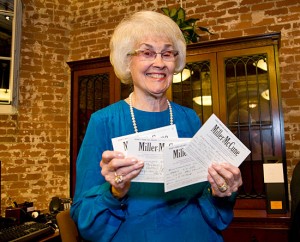
Leslie Dinaberg sits down with Sara Miller McCune

Philanthropist and entrepreneur Sara Miller McCune has taken her passion for public policy and poured it into her newest venture, the Miller-McCune Center for Research, Media & Public Policy and its magazine and Web site. (Helene Glassman photo) (courtesy Noozhawk)

Philanthropist and entrepreneur Sara Miller McCune has taken her passion for public policy and poured it into her newest venture, the Miller-McCune Center for Research, Media & Public Policy and its magazine and Web site. (Helene Glassman photo) (courtesy Noozhawk)

At a time in her life when many people are focused on hitting the links, Sara Miller McCune has instead hit the ground running with her newest venture, the Miller-McCune Center for Research, Media and Public Policy, which produces a magazine and website that meld the worlds of academic research with hard-hitting reporting. It’s a perfect fit for Miller McCune, who also co-founded (with her late husband George McCune) SAGE Publications in 1965, an international publisher of academic journals and textbooks, and the nonprofit McCune Foundation, in 1990, which focuses on social justice issues in Santa Barbara and Ventura Counties.

Leslie Dinaberg: Tell me about your new magazine, Miller-McCune? Where did the idea come from?

Sara Miller McCune: I’ve been thinking about doing it since the 1980s when we started what I call an idea file … then it became two files because we had too many ideas. We actually talked (about a merger) with a couple of magazines over those years … but it didn’t happen.

Finally the SAGE Publications board, after hearing me talk about this dream that I’ve had all these years, just said, “shut up. Here’s x much money, go and start one.” So that’s this all came about.

LD: Congratulations. So you’ve got two issues down?

SMM: Two issues out and another issue in preparation. We’re going to do six this year and then either six or seven. The plan is by the time we’re in year five to do ten issues a year.

LD: Is there some sort of organized synergy with the authors that you work with at SAGE Publications and Miller-McCune Magazine?

SMM: No it’s a disorganized synergy. They really have no responsibility as a SAGE author or a contributor to one of SAGE’s journals, to publish anything in the magazine. It’s more a matter of do they want to be read by 100,000 people and for a lot of social scientists that’s very attractive. For example, this lead article is by the outgoing president of American Academy of Political and Social Science, where he is comparing European policies to American and showing why Europeans are doing better.

LD: What is the target audience for this magazine?

SMM: There are several target audiences: leaders of youth organizations; elected officials, state, local and federal; social scientists who are interested in their research affecting and influencing public policy; public policy workers at all levels, who are interested in using research to make policy, and then they’re not just kind of guessing or experimenting on their own; people who are involved in substantive work; NGOs; philanthropists; and then a certain number of scientists from things like Environmental Studies; there’s an emerging area of interdisciplinary research out at UCSB that is, say at the Sage Center for Study of the Mind, it’s gathering people from all different disciplines. It’s not just neuroscience and it’s not just the classic sense of political science and ethics, it’s a melding of that with people who are interested in language and how it affects people, people who are interested in how the brain works and how that affects the body and affects behavior and then affects the behavior of individuals meshing together into what we call societies.

So the audience keeps getting bigger and bigger from the molecule to ultimately the globe. I have never been very good at science, so I’m not really someone who works with molecules and I don’t think that one person necessarily comes up with solutions to global problems and actually makes those solutions happen. For that you need a collection of linked individuals and I hope this 100,000 eventually becomes, say 500,000 and makes a difference in that–but then I’ll be six under.

I’ve already bought the plot. That’s another story. I had 45 minutes to spare one day.

LD: Where did you go?

SMM: The cemetery that overlooks the ocean, because there wasn’t a Jewish cemetery in town. So I walk in and I say, “I’ve got 45 minutes … Do you have any with a view?”

We get in the golf cart and he takes me to look at two parcels. There was one on the side overlooking the ocean and there was one on the other side of the path where still you could see the ocean but not as well, and the price is $2,000 difference. … So I said, “How come there’s a $2,000 difference when they’re just on different sides of the path but within six feet of each other?” And he said, “Oh well in that one you have an ocean view.” And I said, “I’ll be six feet under, what do I care?”

He says, “Well you can put a little bench in like those people and your children will come and visit you.” I said, “You don’t know my step-kids. Let’s go back to the office and I’ll either buy the one which is cheaper or I’m outa here.” So he made out the paperwork, I wrote the deposit and that’s my lot.

LD: Ocean-view adjacent property.

SMM: Yes, the one that’s across the path from the ocean. (Laughs) With no bench.

LD: Can you tell me about some of your humanitarian work?

SMM: This September, Mollie of Trattoria Mollie and I and a couple of people in Montecito are going to start a school for girls in Africa, which is another place I’ve worked, and I think Direct Relief International is involved in that.

LD: It’s great that you’re doing that.

SMM: Yeah, it’s interesting and I think in time these things can be replicated in other areas. That is a lot of the basis of things that I publish, the boring stuff that is all about evaluation, replication, can we get the same results in different places.

LD: The magazine does seem like a good opportunity to get some of that kind of information into the more general public’s hands.

SMM: You’re right. That’s the whole purpose of it.

…The print magazine has a slightly different character than the website partly because Michael Todd (editor of the website) and John Mecklin (editor of the magazine) are very different and their networks are different and the things that people are interested in are different, and also, of course, the deadlines are enormously different between having six issues in print a year and going five times a week online.

LD: I know at one point you were interested in purchasing the Santa Barbara News-Press, is that still an interest?

SMM: Well, I think that A, I never got an answer, and B, they are involved in a lawsuit which is going to run for several more years, according to something I was reading in the papers. I’ve never been a big fan of publishers trying to settle things by litigation. I think it’s a waste of subscription money and that’s other people’s money, whether it’s advertiser’s money or subscriber’s money, it’s other people’s money. Now I think you know Wendy has enough money that she may choose to spend on litigation but I’ve never felt that that was a good use of my resources…

And in the meantime the community suffers, and this is a great community. I don’t like to see a community as terrific as ours being punished by this sort of thing, so that’s another reason I said I would buy it. But there was no answer, there’s obviously no interest there. There must be other items on the agenda. I don’t think it’s going anywhere and I’ve got other fish to fry.

We only have so many years on this earth and my stepson has a saying that money is a renewable resource, time is not. And as a breast cancer survivor I agree with him.

LD: What else do you do when you’re not working?

SMM: I love going to the theatre and I love reading. I always make sure I have at least 40 unread books within reach of whatever bed I am in.

LD: A woman after my heart.

SMM: Because there is a chance that I might get up at 2 a.m. and the bookstore won’t be open and I will be frantic. And have nothing to read. We cannot allow this to happen. And even a pile of unread New York Times that always seem to be around will not do at 2 a.m. It has to be a mystery or it has to be a biography of somebody that I really, really, really like. Or it has to be some kind of bodice ripper or something.

…Then, in more normal hours I take people to the theatre. I like plays, I like opera, I like musical comedies, and I like farces. The more farcical, the more I laugh. I love Shakespeare when it’s performed well, so usually I see that in either London or Oxford.

LD: How much of your time do you spend in Santa Barbara?

SMM: I would say at least half.

LD: How did you end up coming to live in Santa Barbara?

SMM: I was widowed 1990, and George and I had always loved to come to Santa Barbara to work and still have a lot of authors and friends on the faculty at UCSB. I am, in fact, on the USCB Foundation and have been since around 1993, and I’ve given money and we still have a lot of authors at UCSB, it’s a very good school, it just keeps improving.

I was having a New Year’s Eve dinner with three faculty couples … and we must have worked our way through a lot of champagne, a lot of champagne, and so we were making our New Year’s toasts as 1992 became 1993 and the words just came out of my mouth, I didn’t expect them to. But I said, “by this time at the end of the year I’m going to be living here,” and then we had more champagne. That May I started looking for a house and by August I had one. And then I had 103 boxes of books in my living room…If I moved again, which I’m not going to, it would be 200 boxes.

LD: If you could be invisible anywhere in Santa Barbara, where would you go and what would you do?

SMM: That’s a weird question. Do you ask everybody that?

LD: I do actually.

SMM: I don’t like spying on people. I don’t do it. I mean I’m either there visibly and vocally or I’m not there at all.

Vital Stats: Sara Miller McCune
Born: Manhattan, February 4th

Family: Widowed in 1990, husband was publisher George McCune. Stepmother to four grown children, four grandchildren and two great grandsons “so far.”

Civic Involvement: President of the nonprofit McCune Foundation; President of the nonprofit Miller-McCune Center for Research, Media and Public Policy; UCSB Foundation; Granada Theatre Restoration Project; Santa Barbara Center for the Performing Arts; American Academy of Political and Social Science; Lifetime Fellow, Fielding Graduate Institute.

Professional Accomplishments: Founder and Executive Chair of SAGE Publications, a leading international publisher of academic journals and textbooks with more than 800 employees in the United States, New Deli, Singapore and London.

Favorite Book: Collected Plays of Shakespeare

Little-Known Fact: “I was once the star of an off, off Broadway production, when I was a teenager. It was based on a book by Henry James called The Innocents. Instead of the lead being the brother Miles, the role was Millicent, and that was me. I got to be really mean and nasty although on the outside I was all good.”

Originally published on Noozhawk on May 10, 2008.

Leslie Dinaberg Sits Down With Thomas Tighe

Thomas Tighe (courtesy of Direct  Relief International)

Thomas Tighe (courtesy of Direct Relief International)

Since Thomas Tighe arrived in Santa Barbara to head up Direct Relief International eight years ago, the nonprofit humanitarian medical organization has made cash grants of more than $30 million and furnished over $850 million of essential medicines, equipment, and supplies to support health services for low-income people in 88 developing countries and all 50 United States. Clearly, this is a guy who gets things done.

LD: How has Direct Relief changed since you first came to town?

TT: I hope it’s better. Really what I was hired to do was to take it to the proverbial next level–but don’t mess up what’s good about it. …With Direct Relief we’ve tried to stay true to our roots and be what we always were, but bring it forward and apply some new tools and some new energy to, sadly, the same issue. There’s still poverty that is chronic and deep and oppressive. …. The expansion to helping out much more extensively in the United States was something that was really modeled on what had been. We had always tried to fill the gaps here in Santa Barbara, but not get in the way of government or get in the way of business. It’s the same thing. Those gaps are all over the place, including our own country, so it’s been helpful to be able to do more without really fundamentally changing your sense of what the organization is all about.

LD: You’ve certainly been successful.

TT: I’m really sensitive to the fact that Direct Relief is 60 years old. I’m just the most recent person in my particular job but the organization is something that others have built and many have contributed enormously to. It’s always a little unseemly for me to receive disproportionate thanks for work that thousands of people have done. To give people on the board their due, there are 60 board meetings a year here. It’s an enormous commitment of time. Stan Hatch, our chairman, I’m sure he’s putting in over a thousand hours of his time. … The quality of the commitment is just huge and has been for a long time.

LD: Does the idea of global citizenship seem like it’s more in people’s consciousness now than it was eight years ago?

TT: I think so. There’s a general consciousness of world events that is probably actually worse in some regards, because you only hear about foreign countries when something really bad happens. The attention-grabbing events tend to be bad and it tends to actually foster fear about what is going on out there. But I think underneath that there is a recognition that the world is getting smaller. We’re getting so stitched together through forces of globalization in an economic sense that there are winners and losers and I think an appreciation for the underlying human common element has emerged today.

LD: Direct Relief is this incredibly successful, wide-reaching global organization, yet it is located in a warehouse in Goleta. Does it feel like this organization could be anywhere other than where it is?

TT: I don’t think if you were going to start it today you would start it here, because it is not in the hub of global health or pharmaceutical stuff. But I think one of the many good things about being here is it is an intersection of all sorts of interesting people who either live here now or live here part-time who have an incredible depth of experience and insight into things in the world. There is no company in the United States that wouldn’t want to have our board of directors. These folks have really achieved remarkable success in their professional lives in all sorts of different walks of life. So Santa Barbara is the common element. Having that type of talent in such a small place is extraordinary and we’ve really benefited from the location.

And it’s a great place to have meetings because people will come to them. (Laughs)

LD: Did you always want to do humanitarian work?

TT: I really wanted to be major league baseball player, but I was not even close to being good enough to being a major college player. It was not a well-planned career path that I pursued, but it was much more a series of composite events that have led me to be doing what I’m doing now. First and foremost was probably just joining the Peace Corps after law school, which was a really bad career move. I finished law school and I passed the bar and then went to Thailand for a few years. … Then going back to Washington I was lucky enough to go from being a Peace Corps volunteer to a lawyer on a senate committee that dealt with the Peace Corps’ oversight. … I was lucky to have a series of jobs I really liked, found interesting and led to something else that I really like and found interesting and they’ve led me here– which I love and find really interesting.

… My best advice I give people is to write for their college daily newspaper. It’s the best training. … Really almost any job, any policy job, you need to communicate well in writing. There’s a discipline and a skilled kind of thought process that you have to go through before you can put the words down. You actually have to get it before you can write it.

LD: That’s funny because a few of my interns over the years have joined the Peace Corps.

TT: It’s great training … just think how many times (as a writer) you’re assigned to something and you have no idea about it, but you knew how to find out, and then you had to convey to people who were like you the day before and hadn’t heard about it and you had to get it right and you had to make it accessible without dumbing it down so much that it became devoid of meaning and that’s really a critical skill.

LD: I guess no matter what business you’re in; you’ve got to tell your story.

TT: You’ve got to make it accessible and without making it overly emotional or maudlin or anything. You’ve got to really do justice to the people we’re trying to help out because they’re great people, they’re not objects that should be pitied, they are just people who found themselves in a lousy situation. And the staff does it really well.

LD: Are you on the road very much?

TT: Maybe about 20 percent of the time … It’s a mixture of international travel, which is increasingly not as important because of the other folks in our organization are totally capable of representing the organization at any level of sophistication. … A lot of it is just talking to folks in companies or different organizations that might be interested in working with us or helping us out or figuring out a way that we can work together.

LD: Is it primarily people in the healthcare field or are there others that could potentially help out?

TT: It’s both. The healthcare companies have been great to Direct Relief for decades. Some of the companies that have really engaged with us in the past few years in an expansive way have been Google and Fed Ex. … I think we were one of the first nonprofit organizations that Google gave basically free advertising to on the Internet. So it’s allowed millions of people to find us that wouldn’t have found us because Google gave us an ad words campaign, and people find most of their information online.

Then Fed Ex has allowed us to get this incredible expansion to help out nonprofit clinics around the country, like we’d always tried to do with the Santa Barbara Neighborhood Clinic, fill gaps that arise in their program with resources that we could get donated. … So we’ve been able to expand that program now to all 50 states, it’s an over $100 million program run by Damon Taugher here on our staff. Fed Ex has delivered every shipment that we’ve sent domestically, free of charge, for the past three years. That’s been a few thousand individual shipments containing over four million full courses of prescription medicines for patients. Our costs of running that program are really low because Fed Ex has given us this incredible transportation subsidy.

So if we can find companies who are doing part of what we are trying to do and we can talk to them about doing it as an in-kind contribution, it sure keeps the need to raise money down. You know, we always need money to do something else with, but we don’t always need money to raise money to buy a good or a service.

LD: What you like to do when you’re not working?

TT: We have four kids, so spending time with my wife and four kids doing beach stuff or usually outdoor stuff. We like to spend time together and that’s such a treat in life to be able to spend time and particularly around here, there’s so much to do.

LD: If you could pick three adjectives to describe yourself, what would they be?

TT: Hopeful, graying rapidly and enthused.

Vital Stats: Thomas Tighe
Born: August 21 in Waukesha, Wisconsin

Family: Wife Carrie, and children Travis (14), Andrew (12), Griffin (10) and Megan (7).

Civic Involvement: Montecito Union School, Santa Barbara Middle School, Visiting Faculty Member at UCSB’s Masters Degree program in Global and International Studies.

Professional Accomplishments: Peace Corps Volunteer; Lawyer in the U.S. Senate, worked with Foreign Relations and Veterans Affairs Committees; Chief Operating Officer and Chief of Staff for the Peace Corps; President and Chief Executive Officer of Direct Relief International

Little-Known Fact: “I was a novice Buddhist Monk when I was in the Peace Corps for a very short time, for about a week.”

Originally published on Noozhawk on April 28, 2008.

Kids Around Town

Yellow Bird Music

Yellow Bird Music (courtesy photo)

Yellow Bird Music (courtesy photo)

Starting as young as three months, at Yellow Bird Music children up to 12 years old can explore the world in brand new ways through a variety of music, movement and art classes. Musical exploration, art, yoga, piano, choir, drum lessons, and summer camps are available at Yellow Bird. Owner Alexandra Adams-Arreguin combines a Kindermusik-based curriculum–which includes whimsically-titled classes such as “Do-Si-Do” and “Hello Weather, Let’s Play Together”–with innovative additions including performances by local musicians, giving children an up-close and personal opportunity to view musical expression by professionals.

“I just love working with kids,” says Adams-Arreguin. “The effect that music has on a child is one of the most positive and creative methods for them to discover themselves. I truly believe that every child has something to give and a song to share.”

YELLOW BIRD MUSIC 2726 De La Vina Street, Santa Barbara, 805-898-9070, yellowbirdmusic.com

Arts Alive Creativity Center

Where else in town but Arts Alive Creativity Center can you find a Brownie troop doing ceramics, preschool-age thespians picking our costumes for a play, and teenagers popping their way through a hip-hop class? Arts Alive offers a panoply of creative pursuits for the young and young-at-heart. Past classes have included comic book making, fashion illustration, sewing, photography, drama, fiber art, painting, knitting, digital creations, harmonica lessons, creative clay, and singing.

New owner Laura Eliseo, who took over the space in January with partner Anthony Parisi, says she plans to continue with Arts Alive’s eclectic children’s curriculum and camp program, as well as incorporate new classes such as recycled glass creations and additional dance classes to complement those offered by Santa Barbara Dance Arts (formerly known as Santa Barbara Jazz Dance Academy), which shares the space and offers children’s classes in jazz, ballet, tap, hip-hop and more.

ARTS ALIVE CREATIVITY CENTER 1 North Calle Cesar Chavez, Suite 100, Santa Barbara, 805-963-2ART, artsalivesb.com

More Great Stuff For Kids

KINDERMUSIK WITH KATHY 1213 State Street, Suite I, Santa Barbara, 805-884-4009, kindermusikwithkathy.com/

Kindermusik, the world’s leader in music and movement curricula for parents and children ages newborn to 7 years old, uses research in child development to provide developmentally appropriate music and movement experiences.

MY GYM 3888 State Street, Santa Barbara, 805-563-7336, my-gym.com/

An award-winning program designed to help children aged three months thru 13 years develop strength, balance, coordination, flexibility and social skills through music, dance, games, and gymnastics.

BEACH STAR GYMNASTICS 4193 Carpinteria Ave., Suite 7,

Carpinteria, 805-684-9900, http://members.cox.net/beachstarsgym/

A “recreational” gymnastics facility, focusing on the fun aspects of gymnastics for children from 18 months to 16 years old.

SBPARENT.COM P.O. Box 60135, Santa Barbara, 805-448-2426

An easy-to-access central location for all the information that parents need, including listings and links to camps, activities, childcare, preschool, party planning and more.

SBPEP.ORG P.O. Box 6154, Santa Barbara, 805-564-3888

The nonprofit volunteer-run PEP (Postpartum Education for Parents) offers numerous programs to help parents and families thrive with their new children.

Originally published in Santa Barbara Magazine in 2008.

Ventura Goes Green

Image courtesy of <a href="http://www.hortongroup.com/" target="_blank">Horton Group</a>

Image courtesy of Horton Group

Earth Day is April 22, but you can celebrate the earth every day of the year by incorporating green building and remodeling practices into your home. Allen Associates Green Resources Manager Karen Feeney shares these tips:

Take a look at your operating efficiency. You’ll save money on utilities by making greener choices for your home. For example, a remodel is the perfect opportunity to put in a high efficiency furnace. “There are so many energy efficient systems that are out there right now, that are 90 to 97 percent efficient, so if you can put in a new heating system it’s going to make your house more comfortable because it’s going to work really well and also it’s not burning up fossil fuels to operate.”

Green doesn’t necessarily mean more expensive. Especially when you look at your long-term costs. “You’ve got that house for several years of your life, so it’s really a wise choice to go ahead and make some of those adjustments in your home because if you look at the lifespan of a home, you’re bringing your costs down and saving money.”

Improved insulation is one of the most cost effective ways to improve your home’s energy efficiency. Even if you are not taking down any walls, but you are going to repaint, you can go into an old house and you can drill small holes at the top and the bottom of the walls and blow in cellulose, which is recycled newspaper, or foam insulation, and that fills up the entire cavity and makes the home more airtight. Then you simply patch the holes and repaint the walls.

Tighter windows also improve insulation, bringing down your heating and cooling costs. “You can go in and do replacement on windows and do it very inexpensively. You can take, let’s say an aluminum framed single paned window and put in a window that fits in that same place that’s double-paned that can be a very energy efficient window.”

Carpets can be one of your home’s biggest health hazards. In part due to dust, mold, lead, and asbestos in the home, more than 38 percent of Americans suffer from allergies. “When you put a new carpet in your home and then you take it out ten years later, it can weigh three times more than the original carpet, especially if you have a dog or a lot of dirt tracked in…there’s documentation that if you take a carpet out of the home where somebody has asthma or allergies that their health improves immensely.”

For more Earth Day green living tips, check out these special events.

Midtown Green Home and Garden Tour
A self-guided home tour emphasizing sustainable building and/or gardening practices to see how others in the community are already using “green” principles. Sponsored by the Midtown Ventura Community Council and the City of San Buenaventura. Saturday, April 19, 10 A.M. to 4 P.M. $10. Tickets are available at Arketype Architects Inc., 275 S. San Clemente, 653.5088. For more information call Dan Long at 653.6573 or e-mail at sandmand@pacbell.net.

Earth Day Expo
Businesses and non-profit groups will share information that will help citizens “go green,” save energy, and save money. Sponsored by the Midtown Ventura Community Council and the City of San Buenaventura. Saturday, April 19, 10 A.M. to 4 P.M. Free. City of Ventura Sanjon Maintenance Yard, 336 Sanjon Road.

Free Green Building Workshop
Come celebrate Earth Day by learning from local building experts at Allen Associates how you can make your home healthier, energy efficient, more durable, and still stay within your budget. Tuesday, April 22, 7 to 9 P.M., Elizabeth Topping Room, E.P. Foster Library, 651 E. Main Street, Ventura. Free. Call 641.0839 to reserve a spot.

Originally published in Ventana Monthly in April 2008.

Image courtesy of Horton Group.