
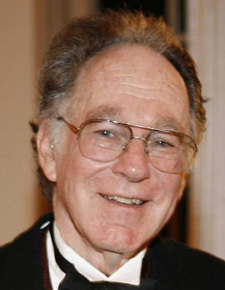
Leslie Dinaberg Sits Down With Nathan Rundlett

Nathan S. Rundlett, courtesy photo

Nathan S. Rundlett, courtesy photo

Sharing his passion for classical music is a labor of love for Nathan Rundlett. In 1994, he and his wife Marilyn Gilbert brought opera to town by founding the nonprofit Opera Santa Barbara. An accomplished baritone, now retired from his dual careers as a singer/high school chemistry teacher, Rundlett devotes much of his time these days to working with the nonprofit Santa Barbara Music Club, a group that presents free concerts and workshops to the community and provides musical education scholarships to young people.

Leslie Dinaberg: How did you get involved with the Santa Barbara Music Club?

Nathan Rundlett: I got interested in the club because it fulfilled a need that I felt when I moved to Santa Barbara (in 1981). I had sort of lost touch with my musical connections, which were in Los Angeles. Here was a great opportunity to perform the music that I loved. I wasn’t working as a musician anymore formally, so this was a great chance just once in a while to get something nice together and present it to an audience. …This club has been in existence, I think, 38 years.

LD: Prior to moving here, where did you perform in Los Angeles?

NR: … I sang in operas and shows and I taught and I sang in a large Methodist church. I also sang for a large Jewish synagogue. I also sang for an Italian restaurant. … We decided to come up to Santa Barbara and I just sort of cut all those ties and started going in a different direction. And got involved in the music club and did a few other odd little things, a few little shows and plays…Then my wife and I decided to fund the opera company.

There was no opera, there was no opera audience– so we created it. We raised money and set up a board, set up a 501(c) 3, gave it a name. Opera Santa Barbara was our baby. And after six years of running it we left it.

LD: So your wife, Marilyn Gilbert, is a singer as well?

NR: Yes, she’s a very fine singer.

LD: Is that how you met?

NR: Yes. I met her singing at Temple Sinai on Wilshire Boulevard. We met over the high holidays. … She is also an attorney, semi-retired now. She has sung has sung in music club, often, and we have sung together in the music club, duet programs and so on. It’s been very enjoyable.

LD: What are your responsibilities for the music club?

NR: My responsibility so far has been trying to pick up loose ends … what I want to do, as Vice President is development. Go into new areas, involve young people more and form better connections with schools. And also focus a lot more on the scholarship program. I think it’s our strong suit.

LD: Tell me about that.

NR: Our scholarship program has been there since almost the beginning. And we had some…distinguished, elderly music lovers, benefactors, teachers and lovers of music. One of them died and left us money and the other one just gave a lot of money and so we built up this nice fund to do scholarships with and now I’m hoping–this is just a wild idea–to turn it into an endowment, so we can live off the principal and keep it for many, many years… But I think that the scholarship program is one of the strongest things that we do, because that brings music ahead, classical music particularly, we’re interested in classical music. It brings it forward into the future and involves young people.

LD: And the scholarships go specifically toward instruction?

NR: Yes, it’s only instruction and the teacher and the student have to be residents of Santa Barbara County, so it’s local local, it’s only local which I like.

LD: What is your musical training?

NR: I was trained in college…I became interested in opera singing, briefly considered a career in it, and so I took private lessons in LA from an Italian teacher and I got involved in singing small productions and so on. I went to several coaches… I didn’t take a formal musical training. I wasn’t a music major or music minor. I was actually a chemistry major and a math minor.

LD: Oh wow, that’s probably very unusual, right?

NR: Yeah. But I love performing and I’ve done a lot of singing and acting.

LD: So have you always made your living in the arts or did you do something else?

NR: I taught high school chemistry for 30 years and I did all this other music kind of on the side.

LD: Where did you teach?

NR: I taught in Los Angeles, Granada Hills, Mission Hills, and in Camarillo.

LD: And you were performing at the same time?

NR: Yes, it worked out to be ideal because my school day was finished early and there were lots of rehearsals that didn’t start until late afternoon or evening … then the summers were free and the holidays, a lot of free time to do my music. For a while there I was making about equal amount of money teaching school and singing.

LD: Other than your performances with the music club, do you perform anywhere else in town?

NR: Ever since we left the opera company what we’ve been doing is putting on fundraisers. We put on a couple of Spanish operas for the Legal Aid Foundation… My wife and I did a series of two-person plays last year … For the Anti Defamation League we did performance of “Trial by Jury” by Gilbert and Sullivan. We did also Gilbert and Sullivan for the Santa Barbara Legal Aid Foundation. That was amazing. We did a big performance in the courthouse … the play is about a courtroom trial, so we did the trial in the courtroom …

LD: What else do you like to do?

NR: Well my second passion besides music is woodworking. I like making fine furniture, and cabinet making is my main passion. I took up carving recently and attended several seminars in Williamsburg, VA related to period furniture. …

LD: Do you have a favorite song or a favorite piece of music?

NR: My favorite piece of music to sing, of all time, was the prologue from the opera “Pagliacci.”

LD: How would you describe yourself?

NR: I love music and I love music performance. I enjoy life

I enjoy my family, particularly my great relationship with my wife. We have a wonderful marriage. So those are the important things I guess to me, music, life and my family and my wife.

Vital Stats: Nathan Rundlett

Born: Somerville, Mass; February 23, 1938

Family: Wife Marilyn Gilbert, children Anne, Kirsten, Steven, and Elisabeth (all in their 40s), 14 grandchildren

Civic Involvement: Santa Barbara Music Club, Legal Aid, Anti-Defamation League

Professional Accomplishments: Taught chemistry for 30 years, and developed new programs in field of education. Third place winner in Metropolitan Opera auditions for the west coast of the United States. Founder of Opera Santa Barbara.

Little-Known Fact: “At one time my passion was running, maybe nobody would know that looking at me now but in high school and college, track and field was a passion.”
Originally published in Noozhawk on January 7, 2008.

Noozhawk Talks: One on one with David Starkey

David Starkey (courtesy photo)

David Starkey (courtesy photo)

Spending five minutes chatting with David Starkey is enough to make any writer feel like a slacker. The Poet-Playwright-Nonfiction Author-Editor-Santa Barbara City College Professor-Television Show Host is a busy guy. It’s no wonder that family members–he is a father/stepfather to eight children–mime him typing on a keyboard when they play Charades.

Leslie Dinaberg: What are you doing these days?

David Starkey: Right now I’m working on a book length memoir. … I just finished writing a creative writing textbook, which combines four genres, poetry, drama, fiction, and nonfiction. I have three books of poetry out in the last year and a book, Living Blue in the Red States … that I edited. It’s about progressives living in conservative parts of the country.

LD: Are you able to incorporate it into your teaching at City College?

DS: I haven’t yet. If we had a class on political writing or something like that I might. … I wrote a play about Alzheimer’s. We had a stage reading at this little theatre in Ojai, Theatre 150. …. It is called Crossing the Bar.

LD: Do you have somebody in your family that has Alzheimer’s?

DS: No. I read an article in the LA Times about this camp outside San Francisco where people who are caretakers take their loved ones who live with them up for a weekend so they can get a break, because it’s so overwhelming. … The caregivers are together, the Alzheimer’s patients are together and they finally join up at the end. And a hidden conflict is that this woman has made a deal with her husband that if she finally goes too far she wants him to kill her. So the play is him trying to make up his mind whether or not to go through with it.

LD: Sounds really interesting.

DS: It seemed to me like there was a kind of crazy poetry in a lot of the ways that you hear people with Alzheimer’s speaking. It sounds almost like avant-garde poetry. …

LD: Are you still hosting the Creative Community Show (on Santa Barbara TV Channel 21)?

DS: Yeah, we just won another award. There’s a body that all the community and educational access stations belong to, nationwide, and they submit shows and the last two years it’s won the best talk show in the country.

LD: Congratulations.

DS: Yeah. I’m not sure what the competition is, but it’s a neat thing. … What I enjoy about this is meeting interesting people and getting a chance to talk to them.

LD: Coming from Chicago to Santa Barbara, what’s your take on the cultural arts scene here?

DS: … I think it’s pretty lively for a small town. It’s extraordinary. I know that some of the artists that I speak with say that we’re a community that claims to embrace the arts and yet ultimately it’s more lip service than not. I don’t know. As a poet I don’t really expect to get much money anyway, so it’s not that big a deal to me. There happen to be a lot of people to interview for my TV show, so that’s nice. But I do think that we have a pretty thriving community and even if there are problems.

LD: How do you do all these different things? Do you just never sleep?

DS: I guess I get enthusiastic about things, and I think I’m pretty good at finishing off. So if I have an idea that kicks around with me for a while, I’ll just look for ways to make sure it happens.

LD: Just the fact that you’re showing me these four books that you’ve had published in the last year and the play and you’re in a band (with poet Barry Spacks) and you’re teaching and you have a pretty young daughter, it’s impressive. That’s a lot to get done.

DS: I guess I feel when I get enthusiastic about something I just follow it. And I guess I get enthusiastic about a lot of different things.

LD: That’s great.

DS: And you know a lot of the things that I do are things that can be accomplished in real time in a relatively short span of time. So for instance, to write a poem and to revise it, you can do that in small chunks of time. … I try to make sure that I get a little something done every day. I think that’s important when you’re working on a really long project. When I wrote that creative writing textbook I tried to do that. School inevitably gets in the way, grading papers and stuff like that.

LD: I know how hard it is to work with kids in the house. The idea of writing something where your deadlines are self-inflicted is very impressive to me.

DS: You sort of feel like you want to finish it so badly, because if you don’t do it now you know you never will … there’s obviously gender issues involved in this. When I was with my first wife she worked and I was at home a lot with the kids and while they would ask me for things a little, I think I was able to ignore them in a way that a mom can’t. Or to address them more quickly … I guess that’s partly the way that my mind works. It can focus really intently on a task and then switch off and then switch back on, and I know that some others don’t work that way.

LD: What do you like to do when you’re not working?

(Loud laugh from wife Sandy in the other room) Work.

DS: To me that’s not work. Since I was a little kid, I wanted to be a writer. So that’s what I want to do, that’s my thing. And it might seem like work or it might seem like a way to get me out of this family (laughs).

LD: So seriously, what else do you like to do?

DS: I spent a lot of time on the City College Creative Writing Program where he is the director). I got some release time this year, so we have a website, http://creativewriting.sbcc.edu/ if you could put that in your story I’d be grateful. … I’ve been Fundraising for that. We’ve got some generous donors that put some money in to bring writers to campus to fund contests. …

LD: What kinds of students are in the creative writing program?

DS: There’s a real community college profile–you’ve got the person with the PhD in English literature and the person who’s never written anything who’s just signed up because it fit into their class schedule. It’s always interesting that way.

Vital Stats: David Starkey

Born: June 28, 1962, in Sacramento, CA

Family: wife Sandy, children Elizabeth (23), Carly (21), Stephen (15), Miranda (6) and stepchildren, Serena (24), Andrea (20), Julia (17) and John (10)

Civic Involvement: Creative Community Show, SBCC Creative Writing Program

Professional Accomplishments: Seven small press books of poems, editor and contributor, four full length plays produced, three plays with staged readings, five 10 minute plays, professor of English and Director of Creative Writing program at SBCC

Little-Known Fact: That he has so many children and step children (8 in total)

Originally published in Noozhawk on November 28, 2007

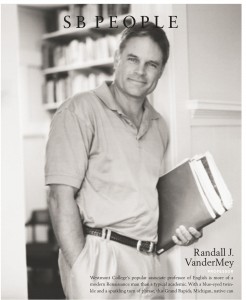
SB People: Randall J. VanderMey

Randall Vandermey in Santa Barbara Magazine

Randall Vandermey in Santa Barbara Magazine

Westmont College‘s popular English professor is more of a modern Renaissance man than a typical academic. With a blue-eyed twinkle and a sparkling turn of phrase, this Grand Rapids, Michigan, native who’s been at Westmont since 1990 can engage you in intellectual conversations about art, poetry and religion as fluidly and captivatingly as he can turn the dialogue toward the joys of getting down on the floor to play blocks with his 2-year-old granddaughter, Jasmine Marie.

Despite his many literary accomplishments–he’s written eight books, published short fiction, nonfiction and poetry, and produced three plays–VanderMey is really a teacher at heart, who describes the Christian liberal arts college as having “an atmosphere that’s really quite filled with trust and joy.”

It wasn’t always that way. “When I came to Westmont 16 years ago, I would say that, at best, the spiritual climate was sketchy,” says VanderMey, who credits the leadership of former President Stan Gaede (who left in 2005) for much of the turnaround.

These days, “People’s politics differ and religiously differ, maybe academic politics differ. But still my colleagues are people I could have lunch with, talk with, respect.”

A highlight of VanderMey’s professional and personal life was escorting 43 students through a semester in Europe in 2003, where they spent four months traveling through 23 cities in 12 countries. One of the best parts of the trip was spending a week each in four different religious communities: the abbey on the Isle of Iona in Scotland, where Celtic monks are believed to have produced the Book of Kells, a marvelous example of medieval illumination; Woodbrooke Quaker Study Centre in the United Kingdom; a Catholic monastery in Teze, France; and the Schloss Mittersill Study Centre in Austria, which VanderMey describes as a castle housing a Protestant evangelical community.

As a professor, VanderMey prizes and encourages independent thought. “I guess I have a model in my mind of what kind of student I want to produce–a student who’s a little bit contrary. They should be willing to stand up for themselves against what they read, not to be hostile to it, but to think for themselves,” says VanderMey. This idea, he acknowledges, “might surprise people who think of a Christian college as a place where students are taught to think in lock step. But that’s not how Westmont is and that’s not how I am at Westmont. I want to make them better critical thinkers and open-minded. I mean, if the Christian faith can’t stand up to critical thinking, why embrace it?”

That critical examination of faith is a recurring theme in VanderMey’s work. “I’m writing out of my core convictions, which is why things germinate for 10 years before I write them,” he says, over lattes at downtown’s Finestra cafe. While certainly heartfelt, his work is also a bit irreverent. For example, his 1993 book, God Talk, is a critical look at “the triteness and truth in Christian cliches,” taking on routine phrases such as, “God wants you to succeed,” “Act of God,” and “There must be a reason,” and examining what people really mean when they use them. Writes VanderMey: “The habit of using stock phrases can sometimes be not only a symptom, but also a cause of spiritual paralysis.”

Language, both spiritual and otherwise, is a topic close to VanderMey’s heart. He’s the author of The College Writer: A Guide to Thinking, Writing and Researching, which is now in its second edition. And locals may know VanderMey’s work from the 2004 production Kenosis, a theatrical staging of his spiritual poetry set to contemporary music, which played at the Center Stage Theater. He has also taught poetry writing classes (partnering with Peri Longo) at Hospice of Santa Barbara and is currently at work on another textbook, with the working title of The Contrary Reader.

He writes and teaches with the same zest for life he embraces with his family. VanderMey–who loves golfing and bowling–is an enthusiastic grandpa and 54-year-old father and stepfather to four grown children (Gabrielle VanderMey, Julia and Jason Clark, and Mike Sakkers), as well as the self-proclaimed “biggest fan” of his wife Dana VanderMey, who is the supervisor of volunteers for Hospice of Santa Barbara.

There’s never a dull moment at home, says VanderMey, whose daughter Gabrielle and stepdaughter Julia were both married in Santa Barbara this summer, coincidentally to two young men named Matt.

VanderMey, who once considered writing a book about marriage communication, chuckles at what kind of advice he might offer the newlyweds. An editor discouraged him from writing the book, asking why– with so many experts–they would want a marriage book from him.

There’s that twinkle in VanderMey’s eyes again. “I’m thinking about making it a humor book,” he says. “My wife (who can sometimes be found doing stand up comedy at Soho) is a very funny lady.”

Originally published in Santa Barbara Magazine

SB Magazine story on Randall Vandermey