
Parting shot

The court of public opinion is a tough one in which to play ball. It’s charged with emotion, unpredictable and, ultimately, the victories won are hollow and imprecise. Do the squeakiest wheels actually represent a majority opinion, or merely a loud one?

In the case of the proposed beach basketball courts, we’ll probably never know.

Presented with a disproportionate amount of public criticism, and few supporters willing to get into the game, architect Barry Berkus recently withdrew his support for the project he’d once offered to shepherd.

“There are not a lot of hours in the day,” said Berkus, who devotes 25 percent of his time to philanthropic endeavors. “This has really turned ugly because the aggressive people went after me personally. There are a lot of letters that weren’t published, a lot of people who will not get into a fray. It’s a shame that a few can take away the dream of many … I guess I’m going to learn how to play drums on the beach.”

An active opponent of the project, Mike Larbig, said he got involved initially to try to protect the quality of his local (Shoreline) park. When that site was shot down, the new father of twins said he thought long and hard about whether to continue to fight the project. Ultimately, frustration over the process was what kept him going. Proponents never really demonstrated this big public need or desire for a court, said Larbig.

Indeed the biggest unanswered question in the whole fiasco — other than “What would Pearl Chase think about courts at the beach?” — is whether we have enough basketball courts to fulfill the community’s needs. The available public courts are in ill repair, according to Berkus. Others argue there are plenty of perfectly good courts sitting unused around town. The letters to the editors keep on coming, but the concrete facts are few and far between.

“No, there has never been a needs assessment,” said Billy Goodnick, project coordinator for the Santa Barbara Parks and Recreation Department.

Nor has the Santa Barbara School District done a study of basketball court use, said spokeswoman Barbara Keyani.

At the end of a recent Santa Barbara City Council meeting, Councilman Gregg Hart offered his post-game analysis. Unfortunately, many of the major players in the court of public opinion had already gone back to the office to file their stories.

“I am saddened by the level of discourse in this debate. The vitriolic, mean-spirited attacks on Mr. Berkus … his motives. This is about providing a recreational opportunity for the community,” said Hart.

But sports are about a lot more than recreation. One of the fundamental values they teach is to respect the other team. In tennis, if there’s a question about a line call, you must decide in favor of your opponent. In other words, give them the benefit of the doubt.

Both Berkus’ drive to build the courts, and his opposition’s desire to preserve the beachside integrity should be commended, not criticized. Acting with the best of intentions, at least they had the courage to get in the game.

It’s not for nothing that in basketball — win or lose — you shake hands at the end of the game. It’s one court where actions speak louder than words.
Originally published in South Coast Beacon on July 24, 2003.

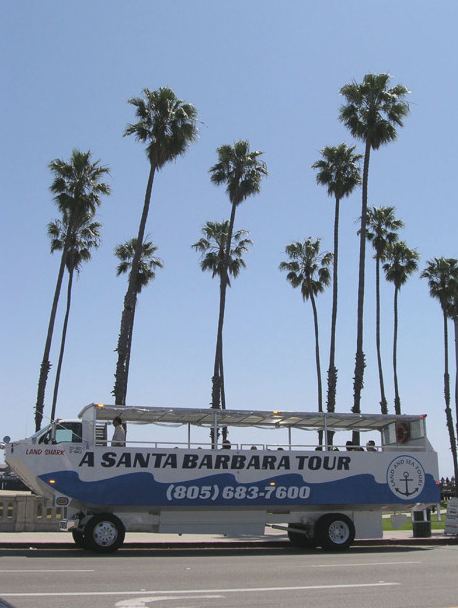
Landshark may not be beached

Landshark, courtesy photo.

Landshark, courtesy photo.

“This shark doesn’t bite,” at least not according to J.P. Manoux, “second mate” of the Land Shark Hydra Terra vehicle, which was beached by the Santa Barbara City Council at its meeting July 1.

According to Manoux, the waterfront staff spent months “thoroughly researching the safety and sensibility of this kind of business in Santa Barbara” and expected routine approval for a one-year license agreement with the city.

Manoux’s brother Andre — who owns the $250,000 amphibious vehicle and its booking company, Land & Sea Tours — was so certain the council meeting would go smoothly, he spent the afternoon getting his Coast Guard certification.

Skipping the meeting proved a costly mistake. J.P. Manoux said the council did not vote with a completely educated point-of-view, citing misinformation about the size, noise and aesthetics of the vehicle. He is now attempting to salvage an agreement by providing the council with extensive documentation. The size of vehicle and the noise levels actually compare favorably to charter buses, according to J.P. Manoux.

Despite the Manoux’s effort to “be very respectful of the city’s position” they’ll face some rough waters in their attempt to win council approval. “When we vote on an issue, we cannot reconsider it for 90 days,” said Mayor Marty Blum.

Though the Land & Sea Tours license agreement, which would have yielded the city 5 percent of the Land Shark’s sales, is moot until October, Andre Manoux has not given up hope. He is asking the council to grant an exception to the existing ordinance that prohibits vehicles over 33 feet from entering the harbor parking lot, effectively land-locking the Land Shark. Waterfront Director John Bridley said, “The intent of that code was for parking purposes. We do have (larger) vehicles, unfortunately, that do enter the parking lot now, for purposes of delivery, drop offs, beer trucks, UPS trucks, and charter boat operators. … However, we’ve gotten our direction from the city council. We’re not expecting or anticipating further action.”

In addition to trying to fight city hall, Land & Sea Tours is also in search of community support for the unique vehicle. Last week its phone message pushed proponents to call Mayor Blum, and this week’s message urged calls to council members as well. The pros and cons seem to be about even, according to Blum. “People are aware but not incensed. I had people stop me on the street to say thanks (for not allowing the vehicle).”

Keeping the vehicle out of the water may be easier for the council than keeping it off the streets. With harbor access denied, in order to remain commercially viable the Land Shark will run eight 45-minute land tours per day, instead of the four 90-minute amphibious tours planned. “We are a licensed sight-seeing tour business. Now we’re sort of forced to spend more time on the streets if we’re to run as a business. …We don’t want that and they don’t want that,” said J.P. Manoux.

Originally published in South Coast Beacon on July 10, 2003.

New members take their places in city council history

When Brian Barnwell, Helene Schneider and Das Williams were sworn in as members of the Santa Barbara City Council on Tuesday, in addition to their new responsibilities they also received a place in history alongside such luminaries as John Nidever, who served on the council for one week, then resigned in 1856; Edith Hancock, the first woman elected to the council in 1947; S.L. (Bud) Eyman, who had an angry citizen throw a pie in his face during a council meeting in the 1970s; and Charles E. Cook, who was assassinated 1862 after serving for six months.

Along with their new seats on the dais, Barnwell, Schneider and Williams also took their places in the fifth edition of “Civic Leadership in Santa Barbara,” which traces the history of the Santa Barbara City Council from 1826 to the present. The book (available at the public library) is a labor of love by former Mayor and Councilman Hal Conklin, who began the effort in 1990 with the assistance of Carrol Villanueva, a UCSB intern.

“I’ve always loved California history. It’s been a passion of mine ever since I was a kid,” said Conklin, who holds the record for longest city council service, leaving public office after more than18 years (due to term limits). “Coming to the city of Santa Barbara of course you’re seeped in history all the time. When I was on the council I was acutely aware that I was in a long line of secession,” said Conklin, who now serves as the director of public affairs for Southern California Edison.

First incorporated as a city in 1850, most of the members of Santa Barbara’s Common Council, as it was called, were reputed to be wealthy landowners, with recognizable local surnames turned street names, such as Carrillo and De la Guerra. Among the laws of the day were a Public Intoxication Ordinance establishing a fine of $100 for any white proprietor or landlord and a fine of $2 for any Indian with the same offense and a Hog Ordinance “to prevent hogs from running at large within the limits of the city.”

While the sow problem seems to be under control, it will be up to the new council to try to weave a silk purse from the city coffers currently being drained by the state, as well as deal with pressing regional issues like neighborhood preservation, a housing shortage, the environment, traffic and growth.

Originally published in South Coast Beacon on January 8, 2003.