
Moratorium goes, plan proceeds

“It’s only for a year” was a mantra heard repeatedly in the Goleta City Council’s discussion of interim general plan policies on Monday night. While the city’s first general plan is not likely to be completed for two to three years, the council provided staff with specific direction on the draft and is likely to approve an interim plan on Mar. 1.

A diverse group from the community offered their input. In fact, just about every developer in town opined on the plan, as did representatives from the Santa Barbara Audubon Society, the League of Women Voters, South Coast Livable Communities, Goleta Valley Beautiful, Goleta Housing Leadership Council, and predictably, community members who have commercial and residential projects in the pipeline.

In the interest of fairness to projects in development — some of which have gone through several years of review — the council decided to exclude them from the new rules and to use Monday’s date, Jan. 26, as the cutoff for projects designated as “in the pipeline.”

“I don’t think it’s fair to change rules in the middle of the game,” said Councilwoman Jonny Wallis.

The objectives of the interim general plan policies — which are scheduled to go back to the council for final review and public comment on Mar. 1 — are twofold. “We are trying to craft a set of appropriate rules that communicate our expectations to the applicants at the door,” said councilman Jack Hawxhurst. “We are also trying not to take up too much staff time.”

Insufficient staff has been a problem that has plagued the city since its incorporation and, according to Assistant City Manager Luci Romero Serlet, Goleta is still having problems recruiting qualified employees. Regarding staffing the planning department, where applicants have faced significant delays, “Not all of the people that are qualified to be planners find this kind of assignment something they want to get into,” said Serlet. “And contracting isn’t always a suitable option.”

Inadequate staffing was one of the reasons given for the moratorium on approvals of certain development proposals. The moratorium was one of the first actions taken by the council when the city incorporated in February 2002. However, on Monday the council voted unanimously to let the moratorium expire on Feb. 13. “We have accomplished a great deal with this moratorium and it’s time to move on,” said Mayor Cynthia Brock.
Originally published in South Coast Beacon on January 29, 2004.

Habitat gets land for condos

Building momentum for its first “ground-up” project in Santa Barbara, Habitat for Humanity has secured federal funding to purchase property near La Cumbre Road and will soon break ground on three, three-bedroom condominiums.

“With these funds we have achieved 75 percent of our fund-raising goal,” Habitat Executive Director Joyce McCullough said in accepting a $240,000 loan of HOME Program funds to buy the property from the city.

While the Housing Authority frequently works with nonprofit groups to develop rental housing for low-income people, the Habitat venture at 3965 Via Lucero is a very rare opportunity to be able to provide very low-income people with ownership opportunities, said Simon Kiefer, project planner for the city.

One of the principal concepts of a Habitat project is “sweat equity.” Homeowner families must contribute 500 hours of work toward building their home. They also must have a total family income between 30 percent and 50 percent of the area median income (estimated to be $30,000 per year for a family of four here). In addition, “We will look for families who currently have inadequate living conditions,” said McCullough.

The founding members of Habitat for Humanity of Southern Santa Barbara County — Bill Graves, Sarah Rettinger and Ben Ewart — knew it would be difficult to select a site in Santa Barbara and start building from scratch as a first project, said McCullough. Instead, some of their initial projects were remodeling the warehouse for Surgical Eye Expeditions; building a handicapped-access bathroom for Irene Dorado, who has multiple sclerosis; rehabilitation of Laguna Cottages for seniors; repairing the home of Bob and Mary Gilbert; and conversion of the Banana Bungalow Youth Hostel into a temporary homeless shelter.

Kiefer estimated that escrow on the Via Lucero property would close by the end of February. Groundbreaking will be soon afterward. Architect Vadim Hsu is just about ready to go to the Planning Commission for approvals, said McCullough.

“It should all dovetail nicely,” she said.

People can get involved right away by sending money or helping to coordinate community meetings for potential homeowner applicants.

“We’ll have building opportunities available once the site preparation is completed,” said McCullough, who can be reached at 692.2226.

Originally published in South Coast Beacon on January 22, 2004.

City updates neighborhood guidelines

In July the Santa Barbara City Council debated whether to update neighborhood preservation guidelines. On Tuesday — in a striking example of the difference three new faces on the City Council have made — the question was how.

Individuals, as well as representatives from neighborhood associations, the League of Women Voters and the Citizens Planning Association all spoke in favor of going forward with the update.

“Good planning is fostered by comprehensive planning. With the major changes going on in the city, the push for affordable housing, the update of the Housing Element, the Demolition Ordinance, etc., it’s extremely important that the NPO be properly updated at this time,” said Naomi Kovacs, CPA’s executive director. “It’s one of the principle ordinances, if not the most important one, affecting our single family neighborhoods.”

The most debated point in the NPO proposal was the steering committee. Staff recommended a team of representatives from the City Council and related commissions, however the public disagreed. “We believe that some neighborhood representation is better than none,” said Sylvia Glass of the Grove Lane Neighborhood Association.

“An NPO ordinance committee without public representation from the neighborhoods would be perceived as a slap in the face to the neighborhoods,” agreed Councilman Das Williams.

In a rare disagreement with staff proposal, the City Council voted unanimously to expand the steering committee to include two representatives from the Allied Neighborhood Association. They will join Council Members Brian Barnwell and Helene Schneider in leading the NPO update, along with representatives from the Architectural Board of Review, Historic Landmarks Commission and Planning Commission.

In addition, the council unanimously approved a $35,000 consulting contract with RRM Design Group and an additional $10,000 in related expenses (reduced from the original $85,000 proposal). The work will start with a series of neighborhood “visual survey” workshops to determine the dominant aesthetic and size of the majority of homes in each neighborhood.

“There are times when the use of a consultant is the most economic and efficient way to proceed. It is the financially sound decision to make,” said Councilman Roger Horton in approving the expenditure.

Originally published in South Coast Beacon on January 15, 2004.

Veterans voice frustration over shift to Santa Maria

We’re all familiar with the inconvenient HMO requirement to consult with a primary physician before seeing a specialist, but what would you do if that specialist was 70 miles away in Santa Maria?

Scream? Rant? Cry?

That’s precisely the reaction of the more than 150 veterans who gathered Friday to voice their concerns about the Veterans’ Administration plan to shift the majority of its services to a clinic being built in the North County.

“What kind of a message are we sending to our 160,000 troops that are serving in Iraq? … The fact is that you have made a promise to our generation. Keep it,” said Vietnam veteran Bob Lewis.

Its leaky roof and inadequate facilities aside, the VA clinic at 4440 Calle Real received kudos from veterans who expressed concern that a clinic in Santa Maria would compromise their care.

“The clinic has done so much to help people,” said Bert Brounstein, a disabled Vietnam veteran who underwent 18 operations in other VA facilities he compared to prisons, before coming to Santa Barbara specifically for the high quality of care.

For approximately 10 years, $6 million in federal funds have been allocated for facility improvements in Santa Barbara. However, VA administrator Charles Dorman said the agency has not been able to find a suitable site, despite working with Moreland Corp. for the last decade.

There was talk of using part of Goleta Valley Cottage Hospital for the VA, but it never seemed to go anywhere, said Cottage Health System spokeswoman Janet O’Neill. (Goleta Valley hospital vice president) Diane Wisby sent a letter to the VA in October to discuss the hospital’s willingness to discuss options, said O’Neill.

“We were interested and we’re certainly still interested,” she said.

Some veterans expressed interest in fund raising to try to keep the VA services here, notably Larry Crandell, who has helped raise millions of dollars for local causes.

“If it’s just a matter of money, give us a chance to raise some money so I don’t have to go 70 miles to get services,” said Crandell.

The choice of Santa Maria over Santa Barbara is a monetary decision, said Dorman, who urged disgruntled veterans to contact their elected representatives.

Originally published in South Coast Beacon on January 14, 2004.

Housing forums strike environmental nerve

Nowhere is the mass of contradictions that make up the South Coast’s collective consciousness more evident than when the topic of housing opens its rickety gate.

In response to “some apparent, deep-seated conflicts among usual allies in the South Coast,” where “the long tradition of ‘no (or slow) growth’ seems to be at odds with housing advocates’ efforts to provide more low-, moderate-income and workforce housing on the South Coast,” Santa Barbara County Action Network recently sponsored a series of community forums on housing and the environment.

“We can’t have it both ways,” said SBCAN Board member Mickey Flacks. In summarizing what she learned at the forums, Flacks said, “We want affordable housing but only for the right kind of people … we want ag lands but we don’t want density … The community will have to decide what is most important and what we are willing to give up in order to get (that).”

What is most important was much debated at the forums. For some, such as Barbara Greenleaf, protecting agricultural land is a priority. She described the county’s plans to develop the San Marcos Growers property (near Hollister and Turnpike avenues) as “where environmental and affordable housing interests clash.”

“Ag land in Goleta is incredibly well-suited to be retained. (It is) a very valuable part of our community and I don’t think we want to lose it, said Linda Krop, a panelist, who is senior counsel for the Environmental Defense Center.

Activist Dan Ancona countered, “We are not in an Ag land crisis … we’re not even in a view crisis … we’re in a housing crisis.”

Jobs, housing and transportation all have to be handled together, said Bob Ferris, a panelist and the executive director of the Community Environmental Council. While panelists agreed on that notion in concept, they differed in terms of the steps they recommend.

Gerry DeWitt called for banning market-rate housing. “It would be great if people would start talking about rent control again,” said Krop, who also advocated targeting major employers to help get their employees out of cars. “It can be done, but it’s not going to happen overnight,” she said.

It may not happen overnight, but “part of the answer is political activism,” said moderator Pedro Nava, SBCAN’s president, who is running for Hannah-Beth Jackson’s 35th-District assembly seat.

Prompted in part by the state-mandated process for the City and County Housing Element Updates, as well as the recent incorporation of Goleta, the discussions were sponsored by the Citizens Planning Association and the South Coast Livable Communities group, along with SBCAN.

Originally published in South Coast Beacon on December 23, 2003.

Holiday bonuses fall out of season

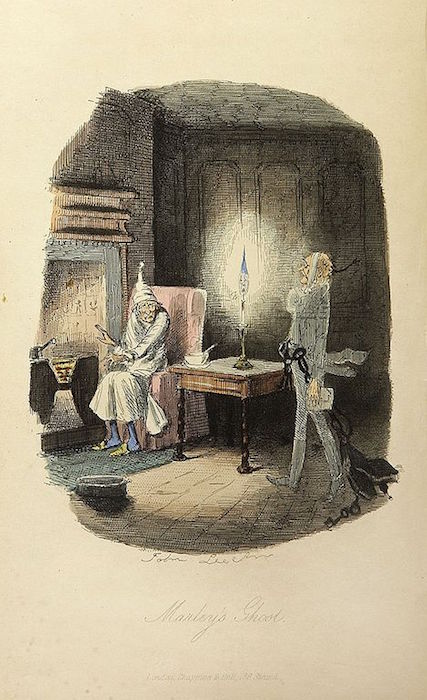
Marley's ghost, from Charles Dickens: A Christmas Carol. In Prose. Being a Ghost Story of Christmas. With Illustrations by John Leech. London: Chapman & Hall, 1843. First edition. Courtesy Wikipedia Commons.

Marley’s ghost, from Charles Dickens: A Christmas Carol. In Prose. Being a Ghost Story of Christmas. With Illustrations by John Leech. London: Chapman & Hall, 1843. First edition. Courtesy Wikipedia Commons.

More employers instead tie cash gifts to worker performance

Scrooge is alive and well and working in the business world. According to a recent study by Hewitt Associates, the Grinch will quash the “visions of bonuses” in many workers’ heads this year, with nearly two-thirds (65 percent) of U.S. organizations saying they would not offer holiday bonuses.

For people who used to count on a little extra cash around the holidays, this serves as yet another reminder of how much the traditional relationship between workers and employers has changed. A generation ago, many business owners were likely to consider workers part of the family and gave them gifts of certain rewards around holiday time. Nowadays, rewards have been replaced by the idea that employee bonuses should reflect productivity and profits, said Roger Herman, a workplace consultant and futurist. “It’s a cultural shift,” he said.

The number of companies offering variable pay or pay-for-performance plans has increased from 51 percent in 1991 to nearly 80 percent in 2003, according to Hewitt’s data. With companies placing greater emphasis on performance, Hewitt’s Ken Abosch is not surprised by the resulting shift in bonus philosophy.

“Companies continue to move away from entitlement awards to awards based on performance,” he said. “In fact, most organizations are seeking a direct connection between performance and awards, and are now focusing on variable pay incentives, which are designed to help employees concentrate on company goals and objectives, while eliminating entitlement issues that often arise with a holiday bonus plan.”

Locally, the Santa Barbara Human Resources Association (SBHRA) found that 45 percent of companies surveyed don’t offer a year-end or holiday bonus/gift, said Jenni-Marie Peterson, citing statistics from a benefits survey conducted in 2002.

While bonuses might be fading into the sunset, the office holiday party tradition endures. Hewitt found that 68 percent of companies plan to host a holiday party this year, with $11,050 as the median amount spent on parties.

Originally published in South Coast Beacon on December 18, 2003.

Case against art dealers hinges on technicality

The fate of a pair of local art dealers may rest on Judge Frank Ochoa’s ruling on a legal technicality that will determine whether the People versus James O’Mahoney and Ronald Gillio goes to trial.

After a lengthy pretrial hearing during which they were accused of taking advantage of the late Josef Muench, an internationally known photographer, the judge is expected to rule whether case law regarding “theft from an elder by a caretaker” is applicable. The more broadly defined elder-abuse statues were not in effect when the incident involving transferring of the rights to Muench’s photographs took place in 1996.

During closing arguments on Dec. 15, Deputy District Attorney Gordon Auchincloss argued that Muench, who was 92 when he met the defendants, suffered from dementia and that “it was obvious this man could not handle his own business affairs.”

Characterizing the defense arguments that the art dealers ended up losing money on the deal as “like saying that a drug dealer that went out and bought $10,000 worth of heroin and sold it for $5,000 isn’t guilty of dealing drugs because he didn’t make a profit,” Auchincloss made a number of allegations against the two, including claims that the original agreement with Muench was forged.

Admitting that the case against Gillio was more problematic than the one against O’Mahoney, Auchincloss nonetheless contended, “Both defendants should be held to answer as charged.”

“Lack of evidence is not evidence,” said Stephen Balash, Gillio’s attorney, who argued that the case against his client did not hold up to scrutiny.

O’Mahoney’s attorney said, “In the area of his photography, Muench was as sharp as a tack.” He also stressed that his client’s relationship to Muench was not that of a caretaker, prompting Judge Ochoa to request a brief on the matter from the District Attorney. Ochoa is expected to rule on whether the case will go to trial today at 1:30 p.m.

Originally published in South Coast Beacon on  December 18, 2003.

Franceschi plan draws split crowd

If the Franceschi Park Master Plan fails to deliver planned improvements to the park, it certainly won’t be from a lack of community input. More than 100 people filled the Santa Barbara City Council chambers Tuesday night to give their comments about the plan, which has been in the works since 1998.

“The park is really a great horticultural treasure,” said Mayor Marty Blum, who approved the plan in a unanimous vote. “I hope I live long enough to see it in all its glory.”

The most debated element was the Pearl Chase Society‘s proposal to start a $250,000 endowment for the rehabilitation of Franceschi House, with an eventual plan to raise $2.1 million for the building that would then be used as a museum/library, a staff residence and for small weddings and events. While the social functions would be limited to one per weekend and only 30 guests, that seemed to be an area of great concern to some.

The granddaughter of the park’s benefactor, Dina Franceschi Fenzi, said, “The house must be a place for the study of botany, not weddings … The El Encanto is right down the road.”

“The uses outlined seem to go against the vision of the man for whom this park is named,” said Ann Beth, vice president of the Riviera Association. “He was more concerned about growing a zucchini than serving one as crudites.”

Of the 41 people who spoke out, 21 were opposed and 20 in favor of the master plan, according to Mayor Blum’s tally.

Ultimately, the council agreed with neighbors like Wendy Hawksworth, who spoke in support of the master plan. “It’s not going to disrupt the character of the park … really, its going to enhance the character of the park.”

Originally published in South Coast Beacon on December 18, 2003.

Entrada project takes step forward, back

The renovation of the Californian Hotel took center stage last week in the long-debated Entrada de Santa Barbara project. A partnership between developer Bill Levy and the Ritz-Carlton, the timeshare project was approved by the Planning Commission on Dec. 11, 2001 after more than 36 public hearings and failed appeals to both the Santa Barbara City Council and the California Coastal Commission. The developers — known collectively as Santa Barbara Beach Properties — have yet to apply for building permits to begin scheduled construction in January.

Pending now is a determination by Community Development Director Paul Casey as to whether proposed revisions to the project are in substantial conformance with the project that was approved for the lower part of State Street, near the beach.

While the revisions include a reduction in units, an increase in commercial/retail space, some design changes and relocation of the lobby and valet areas from the Californian Hotel property to across the street, staff has labeled those changes as “either beneficial or benign.” The plan to phase the building permits, with the Californian Hotel property renovation taking place third, instead of first as initially anticipated, “is the major issue in question,” according to Casey.

At the Planning Commission meeting on Dec. 4, community members and some commissioners expressed concern that there were no guarantees in place that the Californian Hotel would ever be built. “Everything that needs to be done has to be done,” said Assistant City Attorney Steve Wiley regarding assurances for the project. “There’s no such thing as bonded for something like this.”

Wiley also pointed out that the Carrillo Hotel — which remained leveled at the corner of Carrillo and Chapala Streets for several years — is a completely different situation, where the city required the demolition of the property, for safety reasons, before the renovation funding was in place.

The Californian Hotel is also seismically unfit, but is not eligible for demolition as long as there are approved plans in place, said city officials.

The city has hired an independent consultant, at the Levy group’s expense, to analyze any other factors that will affect the probability that the Californian Hotel property will be developed. The consultant is “just kind of getting started on the report,” said Casey, who would not commit to a date that he expected to make the ruling on substantial conformance. We are working on how to protect the city’s interest in the best way we can, he said.

Originally published in South Coast Beacon on December 11, 2003.

Schneider, Williams and Barnwell take City Council seats

The certified final numbers for the Santa Barbara City Council race are in, with no real surprises. As projected, Helene Schneider took first place, followed by Das Williams and Brian Barnwell. The three incumbents are going through training this month, said Mayor Marty Blum. They will take office Jan. 6.

An analysis of the precincts showed that Schneider had steady support all over town. Williams had his strongest showings in the Eastside and Westside neighborhoods, which have not historically had strong voter turnout. Barnwell had the strongest appeal in the areas dominated by homeowners, the Mesa, San Roque and Rivera in particular.

Write-in candidate Bruce Rittenhouse’s final vote tally was 2,638, placing him seventh behind incumbent council members Schneider’s 8,597; Williams’ 8,169; and Barnwell’s 7,955 votes; and well as fourth place finisher Babatunde Folayemi’s 6,933 votes; Scott Burns’ 6,622; and Michael Magne’s 6,557. Rittenhouse ended up ahead of Carlos Quintero’s 1,337 votes; Bob Hansen’s 1,011; and Robert Cawley’s 721 votes.

Originally published in South Coast Beacon on December 4, 2003.