Vieja Valley wins Math Superbowl

With enough intensity and focus to rival many professional athletes, 431 “mathletes” from 37 local schools competed last week at the 24th Annual South Coast Math Superbowl.

Vieja Valley School took the top prize, defeating 2004 champion Washington School. Kellogg School was in third place, followed by Monte Vista, Cold Spring and Hope Schools.

Each school uses its own screening process to choose the participating mathletes.

At Monte Vista, for example, coach Kim Barney said the entire top math group is given a test to qualify. “I take the top 12 and work with them for about two weeks and then they take another qualifying test and weed it down to five, four team members and one alternate.”

Each school was allowed to field three four-person teams of fourth, fifth and sixth graders. The overall team scores were made up of a combination of individual multiple choice test scores and a team test. There was also a hands-on activity, with separate awards, where teams were challenged to build the tallest freestanding structure they could out of straws, washers and string.

While team members can vary from year to year, Monte Vista’s sixth grade team of Ben Bordofsky, Ryan Gilmore, Johnny Manzo, Ben McKenzie and Amy Ransohoff has been competing together since fourth grade, with the alternates alternating from year to year.

“They’re very motivated to win. They want it again,” said their teacher and coach Lila Allen. The team won in fourth grade and came in second last year, but alas, this year they placed third. They did get a little consolation, however when Bordofsky, Manzo, McKenzie and Ransohoff each won individual medals (Gilmore was the 2005 alternate and not eligible).

Plus, they got the added benefit of “going out for pizza afterward and higher test scores,” laughed Barney.

The winning sixth grade team was from Washington, with Vieja Valley in second place, followed by Monte Vista, Adams, Kellogg and Hope School.

The fifth grade winning team was from Kellogg, followed by Vieja Valley, Washington, Mountain View, Monte Vista and Montecito Union tied for fifth place, and Cold Spring was in sixth place.

Vieja Valley won the fourth grade title, followed by Cold Spring, Kellogg, Washington, Hope and Monte Vista schools.

Hosted by Montecito Union, Cold Spring and Peabody Charter schools the Santa Barbara County Education Office, and Raytheon Vision Systems, representatives awarded individual Olympic-style medals to:

4th Grade School

1st Hanah Koper Vieja Valley

2nd Helen Yang Adams

3rd Eugene Cho Kellogg

4th Agnetta Cleland Vieja Valley

4th Kevin Hempy Vieja Valley

4th Kyle Mayfield Cold Spring

5th Alex Kolarczyk Washington

5th Colin Fristoe Cold Spring

5th Rishika Singh Kellogg

6th Sedric Kim Mountain View

5th Grade School

1st Devin Pearson Adams

2nd Vy-Luan Huynh Kellogg

3rd Ryne Cannon Santa Ynez

4th Thanh-Liem Huynh-Tran Crane

4th Sadnie D’Arcy Montessori

4th Connie Wang Brandon

5th Laura Voyen Kellogg

5th Jackie Botts Mountain View

5th Chloe Warinner Monte Vista

5th Astron Liu Monte Vista

5th Annie Thwing Vieja Valley

6th Avery Schwartz Montecito Union

6th Janine Wilson Kellogg

6th Jake Moghtader Cold Spring

6th Tim Cronshaw Montecito Union

6th Nicholas Carney Monroe

6th Grade School

1st Peter Bang Vieja Valley

2nd Dillon Kraus Washington

2nd Noah Connally Adams

2nd Fabian Chacon Kellogg

2nd Nicholas Below Washington

2nd Ellen Gleason Hope

2nd Qsi Tran Montecito Union

2nd Robie Behlman Adams

3rd Ben Bordofsky Monte Vista

3rd Danny Zandona Washington

3rd Jordan Carlson Adams

3rd Annie Lefley Kellogg

4th Chloe Hughes Roosevelt

4th Matt Swann Hope

4th Johnny Manzo Monte Vista

4th Louis Warne Vieja Valley

5th Cong Dinh Brandon

5th Michael Shaner Brandon

5th Ben McKenzie Monte Vista

5th Nicole Ferrel Roosevelt

5th Melinda Wilson Ballard

5th Kelly Kosmo Mountain View

5th Carly Biedul Crane

5th Sebastian Gomez-Devine Peabody Charter

5th Sergey Sushchikh Isla Vista

5th Simon Manson-Hing Washington

5th Kayvoh Mazooji Peabody Charter

5th Jason Lew May Grisham

5th Amber Wang Ellwood

6th Christian Mkpado Vieja Valley

6th Amy Ransohoff Monte Vista

6th Al Vorosmarthy Isla Vista

6th Aislinn Dunne Cold Spring

Originally published in South Coast Beacon on May 26, 2005.

Bishop High separates from archdiocese

Setting an independent course for its future, Bishop Garcia Diego High School officially became the first school in Southern California (and one of only a few in the nation) to separate from its governing archdiocese and become an independent, private Catholic high school on May 24, commemorating the announcement with an assembly for students and the press.

Dubbed as “a brand new day for Bishop High,” the principal, Rev. Thomas J. Elewaut, C.J., said that the board of trustees would take over the management of the high school. “We are all committed to ensure a Catholic tradition of Christian secondary education here in Santa Barbara,” he said at the assembly, where leaders of the archdiocese formally signed over the building.

The school began in 1932 as Catholic High and became Bishop Garcia Diego High School in 1959. Elewaut characterized the new management model as a sequel, stating, “It is now commonly accepted that blockbuster movies will have sequels. It is also well known that for sequels to be successful they must carry the moviegoer to new places.”

The board of trustees — which includes Patricia Aijian, John Ambrecht, Keith Berry, David Borgatello, Randal Clark, Eileen Curran, Peter Da Ros, John Gherini, Sr. Angela Hallahan, John Hebda, Carol Hoffer, Ralph Iannelli, Barbara Najera, Carla O’Neill, Lynette Patters and B. Williams — has been open with the community about its intentions to take over Bishop High’s management for more than a year, frequently publishing letters which address the changes in governance. The group has also stated that financial assistance will be made available, on a sliding scale, to every family that cannot afford full tuition of $8,500.

According to Elewaut, “We have celebrated 100 percent college admission by our graduates since 2002. This is our inheritance and our legacy to the future students of Bishop Garcia Diego High School.”

Originally published in South Coast Beacon on May 26, 2005.

Visiting Nurse & Hospice Care of Santa Barbara

Visiting Nurse and Hospice Care, courtesy photo.

Mother’s Day Luncheon

“Honoring and remembering our mothers” was the theme of the annual luncheon to benefit the charity care mission of Visiting Nurse & Hospice Care of Santa Barbara at the Coral Casino on May 5.

Always a tearjerker, the event singles out two mothers each year, one living and one who has passed away.

Peter Douglas spoke movingly of his mother, Anne Douglas, who then upstaged her son with a witty acceptance. Then Jerry Rubinstein shared his fond memories of his mother Yetta Rubinstein, as well as his gratitude for the services his family received from Hospice VNA when Yetta died in 2001.

Emcees Debby Davison and Larry Crandell kept things lively while honorary event chairs Judy and Peter Murphy spoke about the good work that Hospice VNA does in the community. The weather didn’t cooperate, but the unexpected rain didn’t prevent event chairwomen Nancy Kimsey and Barbara Kummer and their committees from smoothly running the silent auction and luncheon, which raised over $125,000.

Originally published in South Coast Beacon on May 12, 2005.

Home for the dying provides living inspiration

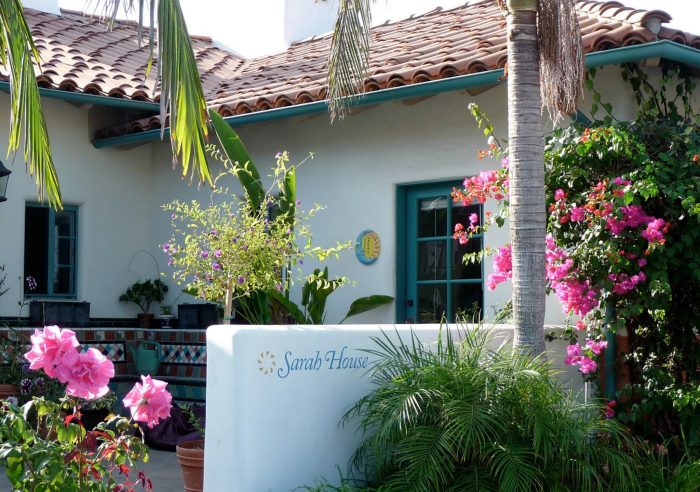
Sarah House (courtesy photo)

Sarah House (courtesy photo)

Sarah House opens its doors even wider for those in need

A residential care facility for people who are sick and dying doesn’t exactly conjure up uplifting images. But a visit to Sarah House — which has provided a home, medical care and often end-of-life care for more than 250 individuals living with AIDS — is more inspiring than depressing.

Nancy Lynn recounted what a wonderful time she and her son, and later her granddaughter, had volunteering in the Sarah House kitchen.

“It was a great experience,” said Lynn, who has since become a Sarah House board member. “It’s such a loving, homelike atmosphere, with an opportunity for families to be supportive.”

“Most people come in, and as they are walking out they say this is not at all what I expected,” said executive director Randy Sunday, who successfully navigated through the Legislature recently to expand Sarah House’s services to provide holistic hospice care for the dying poor who are not HIV-positive.

Aiming to be “the next best thing to home,” the inspiration for the facility was to provide a loving, caring place for people in the final days of their lives.

It’s heartbreaking work, but it’s also beautiful work and important work, said house manager Debbie McQuade, who has worked with AIDS Housing Santa Barbara since it began in 1991, with Heath House. Sarah House opened on the Westside in 1994 and it has eight residential care beds and three two-bedroom apartments on the site. AIDS Housing Santa Barbara also serves approximately 25 other individuals who live in independent apartments.

The good news is that fewer people are dying of AIDS, and more are able to move into off-site or “scattered site” housing. The bad news is that facilities like Sarah House are closing in other places, leaving needy people with nowhere to go.

The Santa Barbara community put so much into the creation of Sarah House — named for the late Sarah Shoresman, whose daughter, Linda Lorenzen-Hughes, remains active on the board of directors — that they were determined to find a way to keep it open.

“In order to honor our contract with the public, (we thought) why don’t we try to care for people who are dying and non-HIV,” Sunday said.

The team worked with former Assemblywoman Hannah-Beth Jackson, D-Santa Barbara, to shepherd legislation that would ultimately allow Sarah House to become what Sunday termed the “first social (as opposed to medical) model hospice,” meaning it can be staffed by personnel other than registered nurses and licensed vocational nurses.

The social model allows for more staffing flexibility (for example, nurses aren’t allowed to help cook or clean) and significant cost savings.

Sunday said it costs Santa Barbara Cottage Hospital more than $4,000 a day to care for patients, while it costs Sarah House $250 a day to care for its residents.

The other difference with a social model, which is difficult to quantify, is the “next best thing to being at home” atmosphere.

“You go into a hospital, the first smell that might hit you is something slightly antiseptic. You come in here it’s going to be chicken soup or chile rellenos,” Sunday said. “And as we’re learning or seeing, hospice care is not just care for the dying resident, it’s caring for the loved ones, friends and family around them.”

“I’m so grateful we were able to get mom into such a nice place,” said Jeanette Aroldi-Schall, whose mother, Anne Arnoldi, was cared for at Sarah House before she died last month.

“Really we’re providing a great service, I feel,” said Lynn, adding that the board is working hard to get the message out that Sarah House has now opened its doors wider, to serve all needy members of the community, and that it is also seeking support in the form of monetary donations and volunteers.

For more information visit www.sarahhousesb.org, call 882.1192 or e-mail office@aidshousingsb.org.st.com.

Originally published in South Coast Beacon

Group aims to influence its sphere

The unincorporated "Noleta" area between Goleta and SB, photo by Antandrus, courtesy Wikipedia Commons.

The unincorporated “Noleta” area between Goleta and SB, photo by Antandrus, courtesy Wikipedia Commons.

That fine line between the cities of Santa Barbara and Goleta — alternately known as “Noleta,” “Santaleta,” “the unincorporated county” and “home” to approximately 30,000 residents of the 93110, 93111 and part of the 93105 ZIP codes — took a step toward becoming part of Santa Barbara on Tuesday, thanks to the petition efforts of a group called the West Santa Barbara Committee.

Some of that area’s residents’ growing unease is the result of a governmental phenomenon known as a “sphere of influence,” in which a city may designate a contiguous unincorporated area as a potential prelude to annexation.

Fueled in part by concern that the city of Goleta will include plans for the area in its General Plan, the West Santa Barbara Committee collected more than 4,000 signatures favoring Santa Barbara’s sphere of influence, as it was years ago.

“Now we have Goleta doing its General Plan and hidden from view is a potential land grab for the entire unincorporated area. We know this is happening,” said Steve Engles, committee chairman.

However, Bob Braitman, executive director of the Local Agency Formation Commission, or LAFCO, told the Santa Barbara City Council that Goleta did not have any designs on the unincorporated area.

“The city of Goleta says their boundaries are appropriate,” he said.

LAFCO, which will ultimately decide the fate of the incorporated area, is in the process of doing a state-required Municipal Service Review of the zones and, when that is completed in the next month or so, Santa Barbara council members indicated they would likely be supportive of the efforts to put “Santaleta” into the city’s sphere of influence.

Originally published in South Coast Beacon on May 12, 2005.

Hospital construction to begin in June

Construction is expected to begin in June on the rebuilding of Santa Barbara Cottage Hospital, the largest and most expensive project in the city’s history. As anticipated, the Santa Barbara City Council unanimously gave the go-ahead on April 26. Officials estimate the hospital won’t be completed until 2013.

Cottage Health System Chief Executive Officer Ron Werft outlined the rigorous review process the project has undergone over the past 26 months, including 31 meetings with the City Council, Planning Commission, Architectural Board of Review and other commissions of the city; 20 meetings with city staff and 19 neighborhood meetings.

“All of us who have worked on this project have a great deal of pride in it,” he said.

While the current cost estimate hovers near $415 million, officials fear the cost could be much higher, with some mentioning — for the time in the life of the project — that public funds may be needed to help pay for the hospital.

Cottage had initially vowed to pay for the project without taxpayer dollars, relying on a plan to sell private bonds, use hospital reserves and foundation money and raise funds in the community.

“We may need your financial assistance,” said Cottage board member Dr. Nicholas Vincent, who suggested the cost of the hospital could rise to $460 or $480 million.

However, Cottage Health System CFO Joan Bricher disagreed, saying, “We are very confident that we are able to provide the city with our own fiscal ability to complete this project and it’s our job to do so and we take that very seriously.”

Commenting on the relatively-quick-for-Santa Barbara 26-month review process, Planning Commission Chairman Jonathan Maguire said, “this is probably the largest and most complicated development that our city will ever see. If this development were anything but Cottage Hospital, I bet we would still be a long way from where we are today.”

The hospital will remain open throughout the eight-year construction effort. Cottage is working to meet a state deadline that requires all hospitals to be earthquake safe that time.

Originally published in South Coast Beacon

Local private schools expand enrollment and facilities

While the public schools continue to struggle with declining enrollment and budgetary crises, some local private schools — like San Roque and El Montecito — are expanding, adding more grades and additional real estate to their offerings.

San Roque School expands to high school

San Roque School will offer a full course of classes for 9th and 10th grade students at its new campus at 2300 Garden St. beginning in the fall. Dubbed as one of the first progressive high schools in the area, San Roque plans to expand its offerings at the new campus through 12th grade by the time the 10th grade class gets there, said Headmaster Mike Hagan.

“There are a lot of educators out there that are very frustrated by a confining system that is based on politics and adult agendas and not necessarily on research and solid theory about how children or people engage with learning,” said Hagen, emphasizing the child-originated, teacher-framed curriculum philosophy which drives all of the programs at San Roque,

“This … is a really unique opportunity to have to only be accountable to what is best for children,” he said. “When we leave here, every decision we make is how does this benefit children? How does this help facilitate their emotional, their intellectual development? … And behind every decision, whether it’s the height of a sink that has water that is going to be filtered in it, so it’s safe, to the choice of personnel and materials that will help children stay excited about learning.”

At San Roque, rigorous academics are incorporated into real life experiences. For example, in a recent production of Into the Woods, students trained for the performance with theatrical actors and vocal coaches and had a small professional orchestra accompany the performance.

“If we give that idea to children that we’ll always give them the best help that we can, then they feel real important and they do their really best work,” said music director Donna Massello-Chiacos.

“They feel like professionals, they are actors. They’re not learning, about drama. They are actually participating so that they learn about the work of professionals and how professionals go about it and then they engage in that work,” said Hagen.

El Montecito School begins offering junior high

Building one grade at time, El Montecito School is adding a 7th grade to its upper school campus at 632 E. Canon Perdido St. in the fall. The plan is to go up to 8th grade, said Headmaster Jeannine Morgan.

Parents and students don’t want to leave, said Morgan. “We feel like we’re a big family. … Because we’re a Christian school we can build character and we can do things other people can’t do. … Our little motto is, ‘Where Character Meets Wisdom,’ and we have the privilege of really being able to do it in a unique way because we can really respond to absolutes, you know, what’s right and what’s wrong.”

The preschool program, which began in 1958, is critical to the whole school’s success, Morgan said. “Our key is not only that character meets wisdom but we also want to teach kids how to love learning and the younger you get them the easier that is to do. It’s a fantastic foundation for whenever they leave, wherever they go.”

The older kids love to interact with the young ones, and Morgan said they facilitate that whenever possible. For example, “last year the 6th graders … earned a reward from their teacher and they asked if they could come spend time in the preschool. … They played games with them and they read stories with them … they just love being with them. … This year’s 6th graders are writing creative stories and when they are done with their stories they’re going to bring them and they are going to share them in the preschool classrooms.”

Ideally, she would like to combine the lower school (now housed at 1455 East Valley Road in Montecito) and the upper school into one campus. They’ve been actively looking for a site, but real estate is expensive and hard to come by and Morgan wants to make sure that any expansion is done with sensitivity.

“We’re carefully taken steps of growth to make sure that its not going to jeopardize any other part of the program that we have. What the key for us is that we don’t lose what we have in any growth step. We want to continue with who we are and what we have, with anything that we do.”

For more information about El Montecito School, call 969.1482 or visit www.elmontecito.org. For more information about San Roque School, call 697.3717 ext. 128.

Originally published in South Coast Beacon on April 7, 2005.

Rape Crisis Center’s Wall of Witness Debuts

Courtesy Santa Barbara Rape Crisis Center.

Eloquently illustrating the potential of art to heal, empower and assist with social change, Santa Barbara Rape Crisis Center unveiled the Wall of Witness on April 4 in an opening reception to mark the beginning of Sexual Assault Awareness Month.

A mural and collection of artwork and poetry contributed by the community and exploring the theme of “Believe Me: Celebrating the Courage and Resilience of Sexual Assault Survivors,” the Wall of Witness concept was created by local Artist Brandon Stontag, who called it “an opportunity for me to contribute to the valiant efforts of SBRCC.”

He continued, “I think it is a great idea to use art as a vehicle for
educating and increasing awareness. It is my hope that the mural will be inspirational, comforting and healing.”

“I am in awe of what is here visually,” said Congresswoman Lois Capps, an honorary board member of SBRCC who plans to reintroduce legislation to develop a process for health professionals to screen for evidence of sexual assault.

Poets Sojourner Kincaid Rolle and Theo Burnes, and artist Judi Weisbart spoke movingly about their contributions.

“This wall speaks so many words of such incredible worth,” said Weisbart. “Abuse is something that as humankind we must erase from this planet.”

KRUZ radio personality Bonnie Campbell, who is training to be an SBRCC advocate, was the emcee for the event. Other speakers included SBRCC board president Sylvia Hendlin and executive director Elsa Granados, who concluded the event by encouraging the audience — and make a commitment by a show of hands — to talk to others in the community about sexual assault.

“We want this message to permeate the community,” she said.

The Wall of Witness will travel to various Sexual Assault Awareness Month events and supporting venues, including:

– April 5-9: La Casa de la Raza, 601 E. Montecito St.

– April 9: Believe Me Dance-Off, Alano Club, 235 E. Cota St., 8 p.m., $10

– April 10-16: The Coffee Grinder, 910 Linden Ave., Carpinteria

– April 14: UCSB Take Back the Night March and Rally, Anisq Oyo Park, 5:30 p.m.

– April 17-23: Santa Barbara City College Library, 721 Cliff Drive

– April 23: Benefit Dance, La Casa de la Raza, 601 E. Montecito St., 7 p.m. — 1 a.m., $25

– April 27: Denim Day Rally, Santa Barbara City College Library, 721 Cliff Drive

– April 25-29: Dos Pueblos High School. 7266 Alameda Ave., Goleta

Originally published in South Coast Beacon on April 7, 2005.

San Marcos nursing students go on rounds

San Marcos High student nurses were still beaming from their recent trip to Boston for the National Youth Leadership Forum on Nursing. There they had the chance to meet like-minded students from all over the country, job-shadow nurses at several Boston hospitals, and hear from medical experts about the different aspects of a nursing career.

“It was … a once-in-a-lifetime opportunity,” said senior Katie Coy, who has been accepted to the nursing program at Azusa Pacific University.

“Fun,” “educational,” “awesome” and “even better than expected” were some of the reviews given by the six seniors who attended the conference. All of them are third-year students in the school’s Health Academy, now enrolled in the C.N.A. (Certified Nursing Assistant program) class in cooperation with Santa Barbara City College.

What’s not to be excited about?

Gloria M. Ochoa observed the electrophysiology lab, Brenda Rubio worked in a transplant unit, and Coy and Rachel Myers got to experience the cardiac unit. Courtney Giers learned how to draw blood and Maria Gutierrez even got to see a baby being born.

All of the girls left their experience even more convinced that they want to be nurses.

“I want more,” said Ochoa. “Usually I expect hospitals to be cold places, where you get done what you need to be done and you’re out of there. But that’s not how it is, actually. It’s warm, they’re friendly, and they all work together. It’s like a family.”

The girls will soon get to experience that nursing camaraderie again. After completing internships at Samarkand, in April they will start new internships, at Santa Barbara Cottage Hospital.

“We’re thrilled to have the kids here working,” said Pat Doherty, director of volunteer services. “They have a week or two in a variety of areas within in the hospital for them to observe, learn about the different areas and be mentored by the staff.”

Doherty noted that several students who went through the San Marcos program three years ago are now student nurses at the hospital and studying at SBCC.

In addition to their trip, the students said meeting other teens made them realize how unique the San Marcos program is.

“I didn’t hear of anything like the Health Academy,” Giers said.

Originally published in South Coast Beacon on March 24, 2005.

Santa Barbara police say gang activity is on rise

School board hears good news, bad news in latest report

Gang activity is increasing on Santa Barbara’s streets. Arrests are up 51 percent, from a total of 189 in 2002, to 369 gang-related arrests in 2004, a Santa Barbara police official told the Santa Barbara school board Feb. 8.

“The good news is that when it comes to schools, we have seen very few isolated incidents during this past year,” said police Sgt. Ralph Molina, attributing that to the strong relationship between schools and police.

According to Molina, one of the reasons for the increased activity is that older gang members who were incarcerated are now back on the streets. “They begin to go out and recruit and their numbers begin to increase,” he said.

Molina estimated that there are 3,000 gang members in Santa Barbara County, with approximately 1,000 of them in Santa Barbara, Goleta and the unincorporated area in between. He estimated there were about 600 gang members in Santa Barbara alone, with 40 percent of them under the age of 18 and about half of that group in junior high.

Board members requested the presentation after a recent expulsion of a student involved with gangs.

“My experience is that about 90 percent of these kids that are gang members, are pretty good kids,” said Molina, who has worked in the gang unit for the past 13 years.

“They just have a lot of serious problems and they turn to that lifestyle without knowing an alternative. … You’ve got to find out what they’re all about if you’re going to deal with them, you can’t just arrest them and put them in jail.”

Molina said he is also seeing a connection between gangs and drugs.

“A huge connection,” he said. “All the other cities outside of Santa Barbara have had that problem for years, where it’s been gangs and drugs. … The last couple of years we’ve seen a huge increase with gangs and selling of drugs.”

Molina said he is also seeing a lot of large gang fights, especially among younger members.

“The kids between 13 and 17 are keeping us busy. … That seems to be the core of the activity.”

There is also some evidence of increased gang activity among girls, but it’s harder to document, Molina said. “They’ll portray themselves as the girlfriends … we know that they are associating. … We’ve seen an increase on the girls and there’s been a couple rumors that they’re trying to form their own gang, but that we haven’t seen yet.”

As a result of the increased activity, in January 2004 Santa Barbara police brought back the youth services unit and increased the enforcement level, which may explain some of the increase in number of arrests, Molina said. He added that he would like to see the school district reinstitute a program in which officers taught classes on gang violence. Funding for the program dried up a few years ago.

When asked by board member Nancy Harter whether there was a correlation between loss of funding for these types of programs and increased gang activity, Molina said he wasn’t sure.

“There’s always more we can do,” he said. “The schools do a good job. There are a lot of community-based organizations that really get involved. (We need) everyone working together to deal with this.”

Originally published in South Coast Beacon on March 17, 2005.