Teachers get Technical

Learning doesn’t stop in the summer — for students or for their teachers — and some local educators are just as excited about using new technologies as, well, kids in a computer store.

In four separate training sessions this summer, teachers can learn strategies for integrating technology into their classroom to help take advantage of the resource they now have — thanks to the Computers for Families program — every student has a computer at home.

Teachers from Brandon School, Carpinteria Family School, Cesar Chavez Charter School, Hollister School, Isla Vista School, La Patera School, Santa Barbara Community Academy, Solvang School and Vieja Valley School were visibly excited at a session led by Steve Keithley last week at the Santa Barbara County Office of Education.

“I think what we have to offer is pretty much cutting edge in education,” said Keithley, the county’s coordinator of instructional media services. In addition to sponsorship from Computers for Families, Keithley offered special thanks to Coldwell Banker and Bob Ruccione for sponsoring lunch for the trainees and providing each teacher with a free custom website, which they learned to use that day.

“Fold your hands and put them in your lap, so you won’t be tempted to surf while your colleagues are teaching,” joked Keithley, as La Patera School’s Judy Jenkins and Tara Svensson guided their fellow teachers through a “really thorough lesson plan” about the physics of roller coasters. This is just one of many teacher tools found on Unitedstreaming, a county service which makes over 40,000 video clips available, all of which are correlated to the California state standards.

Teachers now have the ability to make a play list of films available for students who finish their class work early, as well as insert video clips into homework, along with quizzes to ensure that students understand the material they’ve just viewed.

“Are they going to want to take a practice quiz with movies in it more than practice with a book? Of course they will,” said Keithley.

“This is great as a study device. It gives them immediate feedback and they know the right answer now,” said Hollister School teacher Kimberley Shingle, who was excited to have another month to fool around with the technology before she goes back to teach with it at school.

“I never knew about any of this before,” said Carpinteria Family School teacher Lori Lee Collins.

“It’s really cool,” agreed Leanne Patterson, from Cesar Chavez Charter School. She and her colleague Nate Monley were particularly interested in the bilingual selections, since Cesar Chavez is a dual language immersion school.

“Having visual stimuli available, such as photos and videos, to go with a written request really helps EL (English Learner) students,” Keithley said. “It also helps teachers assist students in multiple grades and with differing ability levels.”

In addition to learning to create websites and integrate digital media into their lessons, teachers also learned how to use the new pen drives and scan converters they were provided with, free of charge, for attending the training.

With so much to learn in just one day, how can the teachers possibly absorb it all?

They can’t, said Keithley.

The learning really doesn’t stop in the summer. “When you’ve got so many resources … it’s really much better to master a piece of it,” he said.

“Then share it with a friend.”
Originally published in South Coast Beacon on July 7, 2005.

Hope trustees ratify principal reassignment

In recognition of the “diversity of opinion” with regard to Superintendent Gerrie Fausett’s reassignment of the Hope School District‘s principals, the board of trustees voted unanimously to ratify the decision, despite that they were not required to do so.

Joseph Liebman was not at the July 1 meeting, where his colleagues took the opportunity to publicly query Fausett about her decision to move Hope School principal Patrick Plamondon to Monte Vista School, Monte Vista’s Judy Stettler to Vieja Valley School, and Vieja Valley’s Barbara LaCorte to Hope.

“What are the key benefits of principal rotation?” asked board member Todd Sosna.

“The most important thing is to have administrators who are well –versed in more than one section of the district,” said Fausett.

Board member Elizabeth Owen asked Fausett to address rumors that the principal rotation was connected to the possible closure of Hope School.

“We have no plans to close Hope,” countered Fausett, adding that any decisions about whether to minimize or maximize enrollment in the three school district, which has about one-third transfer students, would be made in a public forum.

The possibility of the district switching its funding to Basic Aid — the model used by the Montecito and Goleta Schools to ensure funding even with declining enrollment — has been floated in the Hope District for years, and will likely be on the table again in the fall, along with trying to cure the district’s budget woes with a parcel tax, a strategy that failed with voters in 2003.

As for the timing of the principal move, Fausett said “our scores are so close” that it is likely that one or two schools may be designated with program improvement status under the No Child Left Behind Act, and she was concerned that doing a move after that would be perceived as punishment for the principals.

Unhappiness over the rotation has already had some fallout. Fausett said that the Hope District Foundation Auction, which raised over $70,000 last year, would probably not happen this year. The controversy has also motivated some parents to become more active in board politics. Hope School parent Craig Malley brought a video camera to record the meeting for others.

Ed Adams, a Hope School parent who has said the board and superintendent didn’t follow the proper process in making the rotation decision, told them, “Guaranteed we will be here watching what goes on to see that in all decisions you follow the process that you’re supposed to.”

A few people have suggested that the news would have been accepted much more favorably if the principals had been part of the announcement. But Fausett said that wasn’t possible.

“Trust me when I tell you I would have done anything to keep this board and this community from going through what we have gone through. There is a reason why I did it the way I did it. It wasn’t the easiest way, but I had to do it that way. ”

Originally published in South Coast Beacon in 2005.

Honors program gets reprieve

An outcry from parents about the principals’ decision to drop the honors programs at Santa Barbara, La Colina and Goleta Valley junior highs has prompted the school board to put the item back on its agenda next week.

While La Cumbre Junior High will roll out a new curriculum in the fall — offering separate learning communities for Core Knowledge, Gifted and Talented Education (GATE)/ pre-advanced placement, liberal arts/college preparatory and intensive English development/newcomers — the other three principals have said they are raising the bar for all students by putting average and above-average students in class together. Some parents believe that the decision will have a negative effect on the roughly 15 percent to 20 percent of students who have been on the honors track, a group that performs well but doesn’t qualify for GATE.

With affluent Montecito parents talking about forming a charter junior high school and others considering moves to private school, many fear that the elimination of honors will make it more difficult to for the schools to remain socioeconomically and ethnically diverse, particularly Santa Barbara Junior High.

“The Honors Track is an attractive option that influenced our decision to leave private school,” wrote SBJH parent George Gonzales in a letter to the board. “While we can’t fault the outstanding level of instruction provided by the district, the general environment causes many parents from different ethnic backgrounds to proceed cautiously. Continuation of the Honors Track will reassure many of us that sending our children to public school is the right decision.”

Indeed the percent of Anglo students at SBJH has shrunk from 41 to 31 percent, since the 2002-2003 school year, according to Lanny Ebenstein, a former board member who has contracted with the district to create enrollment projections.

“To eliminate honors programs at Santa Barbara Junior High would intensify this detrimental trend,” he said.

SAGE (Supporters of Advanced and Gifted Education), a new group formed to advocate for high achieving students, has also come out in support of continuing the honors programs.

“Every taxpayer wants value for their money. Tracking, or segmentation, enables instruction to be geared, paced and outcomes evaluated appropriately making the highest and best use of both time and money,” wrote SAGE president Denice Adams in a letter to the board.

The trustees are expected make a decision on the honors program at its next meeting at 7 p.m. July 12, 720 Santa Barbara St.

Originally published in South Coast Beacon on July 7, 2005.

Breast Resource Center finds a new home

The Breast Resource Center of Santa Barbara welcomed visitors to its new home on June 23. Among those gathered at the nonprofit’s homey new cottage, across the street from Oak Park at 525 W. Junipero St., were some of the early founders of center, which serves as an emotional and educational support center for breast cancer patients, survivors and their families.

Nancy Oster, the organization’s first president of the board, reminisced about the group’s beginnings in 1997. Among people with breast cancer, “every community has a grapevine of women you connect with eventually,” said Oster. But it takes a while for newly diagnosed women to make those connections.

Oster and other survivors, along with healthcare professionals, including cancer research pioneer Dr. Susan Love, who had recently come to town, began brainstorming about creating a center in Santa Barbara.

“We had a wish list of things we’d like to see,” said Evie Sullivan, who has been treasurer of the board since its inception.

“We wanted a place that was close to the hospital, near the bus, it would be nice to have a living room, and a kitchen to cook up some chicken soup or something,” recalled Oster. “We also thought it might be nice to have window boxes.”

Two weeks later Dorothy Shea called and generously offered to lend one of three houses in the Cottage Hospital area to the group. “One of them (at 526 W. Pueblo St.) even had window boxes,” said Oster.

The group quickly organized itself as a legal nonprofit and moved in. Staffed and furnished entirely by volunteers, the original carpets and fixtures came from oncology social worker Debbie Hobler, a noted author and one of the BRC’s original board members.

Of primary importance was that newly diagnosed women would feel comfortable at the Breast Resource Center.

“The first day we opened, there was a woman who was about 80 years old, waiting for us at the door,” recalled Judy Blanco, who began volunteering at the BRC and became its first paid employee in 1998. “She said, ‘you know, it is healing just being here.'”

The center’s move, necessitated by a plan by the Cancer Center of Santa Barbara to develop a new facility that will encompass the entire block of Pueblo Street and more, allows more space for programs, but it will also be the first time the organization has had to pay more than a token $1 a year toward rent.

Luckily there are several fundraisers on the horizon, including the Fay Hobbs run on July 17 and the Santa Barbara Triathlon on Aug. 27 and 28.

The center’s new home feels just a homey as the old one.

“It’s still a place where strangers end up hugging,” said Hobler.

Blanco agreed. “Nobody leaves here without hugs.”

For more information on the Breast Resource Center call 569.9693 or visit www.breastresourcecenter.org.

Originally published in South Coast Beacon on June 30, 2005.

Parents plead to retain principal

Superintendent remains firm on transfer decision

Despite impassioned pleas from some parents to either delay or rescind her decision to shuffle the principals in the Hope School District, Superintendent Gerrie Fausett held firm to her plan to move Hope School principal Patrick Plamondon to Monte Vista School, Monte Vista’s Judy Stettler to Vieja Valley School, and Vieja Valley’s Barbara LaCorte to Hope in the fall.

At a board meeting on June 6, Fausett admitted, “the manner in which this decision has been disseminated to staff and parents was less than artful. It could have been communicated in a much better fashion,” a complaint which was at the heart of the comments from many of the approximately 300 parents and teachers gathered at the meeting.

Fausett outlined the scenario in which she told the principals of her decision, then visited teachers at each site, one by one, and urged them not to speak to each other until she had the chance to visit each school individually.

“Some parents knew about the change before others did. Please know, that was never my intent,” she said.

However, what many speakers took issue with was the fact that parents, teachers and the principals themselves had not been consulted prior to the decision, an area in which Fausett held firm.

“Staffing is one of my unique responsibilities and I have the perspective and the responsibility to make these kinds of decisions. It’s not a responsibility I should or will delegate,” she said. “The legacy of this district is to include parents whenever possible in the decisions affecting schools. Some of those decisions about personnel should not include parents.”

“We believe that you’ve made an honest mistake … I truly believe that it was not the correct process,” said Hope parent Ed Adams, who has been instrumental in organizing a petition “to object to the process by which this involuntary transfer of principals was done.”

Some Monte Vista parents also organized a petition, presented by parent Mary Vance, expressing their support of the principal rotation, thanking Stettler for her service and welcoming Plamondon to the school.

While the 60+ people who spoke at the meeting were about evenly split for and against the decision, the school board members all spoke out in favor of Superintendent Fausett’s judgment, citing her long track record in the local education community (she is a former Monte Vista School parent, as well as the former principal of Santa Barbara Junior High, principal of Washington School and Santa Barbara’s Assistant Superintendent of Elementary Education) as rationale for their support.

“She has a lot of experience in education, I don’t,” said board member Joe Liebman.

“There is always a better way,” said board member Elizabeth Owen. “I don’t believe she made a rash decision.”

Concluding the long evening, board president Steven Weintraub said, “I hope we’ll allow an incident like to become a stepping stone and not a stumbling block.”

Fausett hopes to be able to coordinate another meeting with the teachers before the end of the school year, “to try to send them off on a summer vacation with a sense of calm and security.”

LaCorte will get a head start at Hope School by serving onsite as summer school principal for all three schools. Fausett said, “Barbara likes doing it and I think looks at this summer especially as a chance to get to know the campus and some of the folks there, which is, of course, a great idea.”

Fausett said she also hopes to offer several summer opportunities for parents and students to meet their new principals before school begins.

Originally published in South Coast Beacon on June 9, 2005.

La Cumbre principal goes recruiting

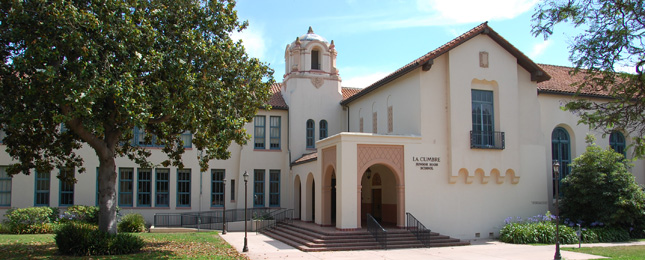
La Cumbre Junior High, courtesy SBUnified.

Touting a closer-knit junior high community, one school aims to turn tide of enrollment

The vibe is different at La Cumbre Junior High these days. While the enrollment numbers are still down, new principal Jo Ann Caines’ dynamic energy seems to be resonating, at least with the people who know the native Santa Barbaran.

Students at Adams School (where she was principal until a few months ago), once a symbol for white flight, are now flocking to La Cumbre.

While only about 450 of the approximately 600 eligible students will attend La Cumbre in the fall, “the composition of our student body is going to be drastically different,” said Caines, “with more of the middle-income and middle- and high-achieving students that didn’t come here before.

“We’ve turned a huge corner thanks to Adams School,” she said, with all but 11 of the more than 100 sixth-graders planning to attend La Cumbre. “So while we’ll be very similar in size, we’ll be hugely different.”

This fall, Caines and assistant principal Jorge Fulco will concentrate on Monroe and Washington schools. Caines has even recruited an Adams fourth-grade parent, Katie Parker, to help her with the outreach.

“Jorge and I have been on the road since Feb. 1 doing outreach,” Caines said. “We gave more tours here … than they have in the prior five years combined.”

Of course, pitching the school is one thing, but telling a compelling story is another — and Caines certainly has one with her reorganization plan.

It might seem to be by design that, when Santa Barbara Community Academy upper-grade students move to La Cumbre’s campus in the fall, the junior high will begin to implement a core knowledge learning community that builds on the same concepts the academy has used successfully. But Caines said she did her research on the core knowledge curriculum (a sequenced, coherent program that uses a grade-by-grade core of common learning) prior to the school board’s decision to move the academy there.

Caines also has a Gifted and Talented Education (GATE)/pre-advanced placement learning community planned, a liberal arts/college preparatory group, and an intensive English development/newcomers community similar to the successful program she implemented at Adams.

Caines emphasized that the communities — which will be separated geographically to make it easier on students — are not tracks.

“Students can participate in any one that they choose or they qualify for,” she said.

Each student will also have a homeroom class where she hopes the smallness of the school will work to its advantage.

“Teachers will not only know their students but the students in that community,” she said.

The staff is coming on board after what Caines characterized as lots of “not easy” discussions.

“Change is hard,” she said. “They’ve been through four principals in two years, so it’s hard to say, ‘Is this really a change or is it going to be different next month kind of thing?’ So what I said to teachers is if it’s not a match for you then you should put in for a transfer because part of what I’m doing is building a new team, and more than anything I want people to be here because they want to be here.”

Three teachers have put in for transfers, but Caines said others are anxious to come to the school because of the new programs.

“Let’s be real. If you asked 100 adults about junior high, 97 of them will say they hated junior high,” she said. “It’s all about friends … Even though we’ll do outreach to the parents, … we’re going to put a lot of energy into the kids, because kids really do decide …They want to go where their friends are.”

Blurred boundaries

Transfers are one of the hot topics of discussion where school needs are concerned. When students transfer in from other districts, the district gets additional money, but intra-district transfers don’t change the funding and campuses like La Colina Junior High (which had only 591 students in 1993-94 and was up to 1,027 students in 2004-05) are getting overcrowded while campuses like La Cumbre Junior High (which had 1,030 students in 1993-94 and now has 433 students) have empty rooms..

Here’s a snapshot look at where secondary students are going (all figures are from the 2004-05 school year):

Junior High

Goleta Valley Junior High School

Incoming: +21 students from other districts; +48 students from within the district (total +69)

Outgoing: -1 student to other districts; -79 students to another school in the district (total -80)

La Colina Junior High School

Incoming: +29 students from other districts; +250 students from within the district (total +279)

Outgoing: -0 students to other districts; -50 students to another school in the district (total –50)

La Cumbre Junior High School

Incoming: +14 students from other districts; +41 students from within the district (total +55)

Outgoing: -2 students to other districts; -257 students to another school in the district (total –259)

Santa Barbara Junior High School

Incoming: +43 students from other districts; +154 students from within the district (total +197)

Outgoing: -2 students to other districts; -107 students to another school in the district (total –109)

High School

Dos Pueblos High School

Incoming: +74 students from other districts; +218 students from within the district (total +292)

Outgoing: -0 students to other districts; -101 students to another school in the district (total –101)

San Marcos High School

Incoming: +61 students from other districts; +325 students from within the district (total +386)

Outgoing: -7 students to other districts; -382 students to another school in the district (total –389)

Santa Barbara High School

Incoming: +151 students from other districts; +268 students from within the district (total +319)

Outgoing: -7 students to other districts; -328 students to another school in the district (total –335)

— Source: PAT SALEY

Originally published in South Coast Beacon on June 2, 2005.

Questions rise as enrollment falls

South Coast freeways are more crowded than ever, but there are fewer bikes in the cul-de-sacs and not as many strollers being pushed toward neighborhood parks.

What’s more, skyrocketing home prices are squeezing out middle-class families and bringing in seniors and upper-income families who tend to have fewer children.

In the 1998-99 school year, the Santa Barbara Elementary School District had 6,201 students. This year there are 5,876 students enrolled, with the numbers projected to fall to 5,770 this autumn. Declining enrollment is expected to hit the junior high schools this fall for the first time since 1996 and spiral into the high schools just two years later.

Why is this a problem? While research backs the common-sense notion that smaller learning environments help boost student achievement, fewer students mean fewer dollars for schools that are already strapped for cash. Fewer students also mean fewer parents who are available and willing to pony up the volunteer hours and fund-raising dollars to help fill in that gap.

In an effort to deal with some of these challenges and make optimal use of the facilities and resources available to the schools, the Santa Barbara School Districts has hired local consultant Pat Saley to assist with updating the Facilities Master Plan, which was last completed in 2003. As part of the initiative, the district will request input from the community about the “big-picture” issues that affect the schools.

In addition to changing demographics and enrollment trends, this includes the possibility of designating additional space for pre-school programs, as well as permanent facility needs for the K-8 Open Alternative School, currently housed at La Colina Junior High; the K-8 Santa Barbara Charter School, currently housed at Goleta Valley Junior High; and the K-6 Santa Barbara Community Academy, currently housed at the downtown district office and at Santa Barbara Junior High, and soon to have some students housed at La Cumbre Junior High.

Also under discussion are what to do with excess space in schools, plans for the two properties the districts own — in Hidden Valley and near San Marcos High — that were once designated for new schools, how new projects should be funded, whether the districts should continue to allow student transfers, and if, hypothetically, an elementary school were to be closed or relocated, how that should be handled.

“We’re asking for input on how to best use our facilities and properties,” Superintendent Brian Sarvis said last week. “None of these decisions have been made … this is the beginning of that process.”

“The idea is to figure out our priorities,” said Saley, who emphasized that the meetings weren’t focusing on individual schools needs yet.

Saley said about 50 people attended the first three community meetings and that she will present a summary of their input to the school board June 14 or June 28.

Santa Barbara School Districts consultant Pat Saley can be contacted at 969.4605 or psaley@silcom.com with any comments or questions.

Originally published in South Coast Beacon on June 2, 2005.

Fausett explains principal rotation idea

Hope School parents were shaken last week when superintendent Gerrie Fausett announced plans to reassign all three of the district’s principals in the fall. So far, the other two schools, Monte Vista and Vieja Valley, appear to not be too stirred.

“It’s created quite an uproar at Hope School,” said Fausett, who became superintendent in January. “I have several calls from other schools saying that they understand. That they like their principal but that they understand the need to have a district perspective and the sharing the wealth with regard to what each principal can bring to the site.”

About 100 Hope parents protested at the district office May 27, the result of a hastily organized phone campaign after Fausett visited teachers at each school to make the announcement the day before. Letters also went out to parents explaining her decision to move Hope principal Patrick Plamondon to Monte Vista, Monte Vista principal Judy Stettler to Vieja Valley and Vieja Valley principal Barbara LaCorte to Hope.

Some Hope parents carried signs that read “Don’t tear the heart out of our school,” to which Fausett responded, “For me, the heart of the school has to do with teachers and students, and that’s what I look at when I try to make these difficult decisions.”

School board members are backing the decision but Fausett said she did not get their consent since the superintendent has the authority to assign management personnel.

Still, the scheduled June 6 board meeting should be a lively one. Hope parents held a meeting May 31 to plan strategy.

Vieja Valley parents were planning a June 1 forum on the decision. A note to parents from the PTA executive board stated, “One of the strengths of our Vieja Valley community is that we are a thoughtful, intelligent group of individuals. We try not to act (and react) purely on emotion, which does not usually lead to good decisions. We like to get the facts and hear various viewpoints.”

Monte Vista parents did not have any immediate organized effort.

Principal shakeups are not an anomaly on the South Coast. In 2001, Isla Vista and Foothill schools switched principals, as did El Rancho and Ellwood schools, according to Goleta Union School District assistant superintendent Daniel Cooperman. Goleta reassigned other principals in the 1980s, he said.

Fausett — who previously served as principal of Santa Barbara Junior High and Washington schools, as well as Santa Barbara’s assistant superintendent of elementary education — said the management moves would strengthen the district and had nothing to do with enrollment trends or closing a school.

“As … we’re working on curriculum or textbook adoption or whatever, Patrick will have the benefit of knowing two-thirds of the district instead of only one-third,” she said.

“It helps principals help superintendents make the right decisions.”

Originally published in South Coast Beacon on June 2, 2005.

Hope principals transferred

Hope School parents were quite shaken last week when superintendent Gerrie Fausett announced her plans to reassign all of the district principals in the fall. But so far the other two district schools, Vieja Valley and Monte Vista, appear to not be too stirred.

“It’s created quite an uproar at Hope School,” said Fausett, who became superintendent in January. “I have several calls from other schools saying that they understand. That they like their principal but that they understand the need to have a district perspective and the sharing the wealth with regard to what each principal can bring to the site.”

About 100 Hope School parents gathered in protest at the district office Friday morning, as the result of a hastily organized phone campaign after Fausett visited teachers at each of the three school sites to make the announcement the day before. Letters also went out to parents explaining her decision to move Hope School principal Patrick Plamondon to Monte Vista School, Monte Vista School principal Judy Stettler to Vieja Valley School and Vieja Valley School principal Barbara LaCorte to Hope School.

Some of the Hope School parents carried signs that read “Don’t tear the heart out of our school,” to which Fausett responded, “For me, the heart of the school has to do with teachers and students, and that’s what I look at when I try to make these difficult decisions. I don’t believe that Patrick is the heart of a school, just like I was not the heart of Santa Barbara Junior High or Washington and that good things happen in the classroom where teachers and kids interact and that’s what it’s all about.”

Fausett stressed that the decision was not made lightly. “As a superintendent you’re hired to make some really tough decisions. This is a decision that has been really tough. I knew it would be tough, and yet, I’m not going about it light heartedly at all, I’ve given it a lot of thought.

School board members are backing the decision but Fausett said she did not get their consent. “The policy says the superintendent shall assess the needs of the district and assign management personnel to meet that need. It is something that the board knew that I was planning, but I didn’t necessarily ask them for their approval or anything,” she said.

Still, the regularly scheduled June 6 board meeting should be quite a lively one. Hope School parents held a meeting May 31 to plan strategy.

Vieja Valley parents were planning a forum on June 1 to provide an opportunity for people to voice their opinions in a “neutral environment.” A note to parents from the PTA Executive Board stated, “One of the strengths of our Vieja Valley community is that we are a thoughtful, intelligent group of individuals. We try not to act (and react) purely on emotion, which does not usually lead to good decisions. We like to get the facts and hear various viewpoints.”

Monte Vista parents did not have any kind of an organized effort as of press time.

This type of principal shakeup is not an anomaly on the South Coast. In 2001, Isla Vista School and Foothill School switched principals, and El Rancho School switched with Ellwood, according to Goleta Union School District assistant superintendent Daniel Cooperman. Goleta also made some other principal reassignments in the 1980s, he said.

Fausett — who previously served as principal of Santa Barbara Junior High, principal of Washington School and as Santa Barbara’s Assistant Superintendent of Elementary Education — characterized the management move as something that’s common in both the private and public sectors.

“I’ve had the experience of being moved from one place to the other and though it’s not necessarily something that you welcome and embrace all the time, but what happens is that once you get settled and started with the new school year and you realize that there are great parents and great kids all over this district and I think our principals need that benefit,” she said. “It benefits our students, but it’s going to benefit our principals as well.”

Asked if the decision to move the principals had anything to do with declining enrollment or closing one of the schools, Fausett said that was not a factor and that the moves are to strengthen the district. “As we’re in principal meetings and we’re working on curriculum or textbook adoption or whatever, Patrick will have the benefit of knowing two-thirds of the district instead of only one-third … it helps principals help superintendents make the right decisions.”

Originally published in South Coast Beacon on June 2, 2005.

Antioch takes an alternative approach to higher education

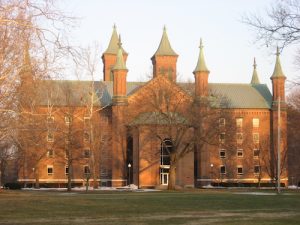
Antioch Hall, Antioch College, courtesy Wikipedia Commons.

Antioch Hall, Antioch College, courtesy Wikipedia Commons.

While undergraduates across the nation sit in enormous lecture halls enduring their required courses and wondering, “What does this theory have to do with me?” undergraduates at Antioch University sit in a cozy group setting and thoughtfully ponder Professor Hymon T. Johnson’s philosophy, “theory without practice is pointless.”

Its all part of the school’s Service-Learning in the Community seminar, which is required for all undergraduates. Johnson recently took his class to the Santa Barbara Zoo, where they hosted 34 special needs children from El Camino, Ellwood and McKinley Schools, as well as eight of their teachers and teacher’s aides. This was all part of Antioch’s Annual Community Service Day, which began five years ago out of his desire to teach students, faculty, and staff the importance of “connecting in the community in which you live.”

The school has a very unique mission, “to make the world a better place.” The class really changes their way of seeing the world, said Johnson, a former UCSB professor and Goleta Union and Crane Country Day School board member.

Kym Mathers, a psychology major, said community service day was a great experience and a bit of stereotype buster. She had three boys in her group and said they were “bright, articulate, with great vocabularies,” adding, “these were not at all what you think of when you say handicapped children.”

Sitting in on one of the service-learning students’ Monday night meetings, they talked about their community service internships and related the text — which includes writings from a variety of academics, as well as the five major religious traditions — to things that were going on in their own lives.

Volunteering in the pediatrics unit at Cottage Hospital, Nicole Weaver, a psychology student, said she absolutely loves it. “I’m learning a lot about how to give my time other people.”

Ryan Ptucha, a communications major who is doing his internship at Devereux, said he was struck by how much attention his special needs charges required.

“I keep having to remember what it is to serve,” said Susan Utter, a psychology student who bemoaned the “dry, clerical tasks” she was asked to perform in her internship at the SLO Hep C Project in San Luis Obispo.

Wendy Barchat , a business major volunteering at the Single Parent Community Resource Center, is herself a single parent, and said it was difficult for her not to do “everything and then some, short of sending a check out of my own pocket,” for the people she was serving, “at the price of my own family.”

When Barchat commented about the difficulty of becoming too involved with the people she was serving, Johnson took that opportunity to lead the class into a lively discussion on codependent relationships and when the best help is no help.

“Critical thinking and diverse perspectives guide our curriculum,” explained Johnson, as his students discussed the writings of work of Ram Dass, Mother Teresa and Dr. Martin Luther King Jr.

“I keep coming across things in the reading that fit exactly what I’m going through in my life,” said Utter.

That’s what should happen, said her professor with a knowing smile. “This is what education is supposed to do, not just fill our heads but also fill our hearts.”

For more information about Antioch University and Service-Learning in the Community call 962.8179 or visit www.antiochsb.edu.

Originally published in SuperOnda Magazine in May 2005.