
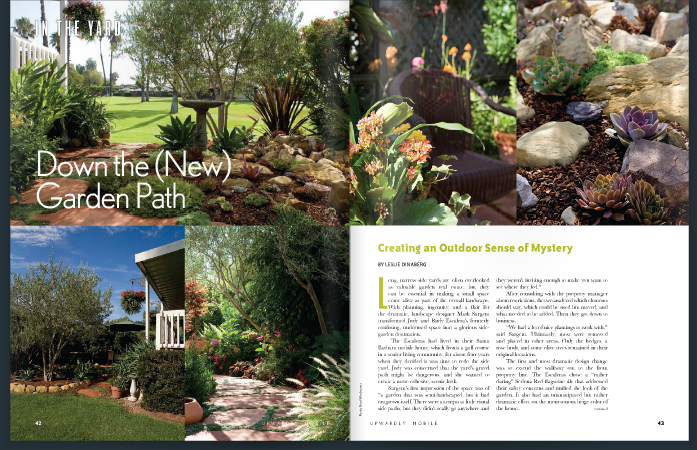
Down the (New) Garden Path

This story as it appeared in Upwardly Mobile Magazine

This story as it appeared in Upwardly Mobile Magazine

Long, narrow side yards are often overlooked as valuable garden real estate, but they are especially useful as a way to make small spaces come alive and feel as is they’re part of the landscape. With planning, ingenuity, and a flair for the dramatic, landscape designer Mark Sargent transformed Judy and Rudy Escalera’s formerly confusing, underused space into a glorious side garden destination.

The Escaleras had lived in their Santa Barbara mobile home–in a senior living community next to a golf course–for about four years, when they decided it was time to redo the side yard. Judy was concerned that the gravel path might be dangerous, and she wanted to create a more cohesive, scenic look.

Sargent’s first impression was of “a garden that was semi-landscaped, but it had outgrown itself. There were attempts at little visual side paths but they didn’t really go anywhere and they weren’t inviting enough to make you want to get on them to see where they stopped.”

After consulting with the property manager about restrictions and an analysis of what should stay, what could be used but moved, and what should go in the garden, the two set a budget of $12,000, and got to work.

“We had a lot of resources, a lot of nice plantings to work with,” says Sargent. Though many of the plants were removed and placed in other areas, nothing stayed in its original place except a rose bush, hedges and some olive trees.

The first and most dramatic design change was extending the walkway out to the front property line. The Escaleras chose a “rather daring” Sedona Red flagstone tile that not only addressed the safety concerns and unified the look of the garden, it also had the unintended consequence of warming up the beige color of the house.

Initially Judy wanted to repaint the house when the side yard was done, but the reflection of the tile changed the color. “It was a clever accident,” explains Sargent. “It turns out the Sedona Red ties in so well that it made the house look like it was the right color.”

“Another thing that we did was change the steps at the side of the house,” says Judy. “We changed the design so that it had a little landing and the rail comes down like open arms, sort of saying ‘hi, here we are, welcome.’ You follow that beautiful red pathway and then on up into the different areas in the garden.”

Creating a pathway with a variety of interesting groupings of plantings–including Plumeria, Loropetalum, Aloe, Hydrangea, Jacob’s Ladder, Agave, Little Ollie, and Azalea–“helped give a sense of largeness to the garden so that the stairs didn’t just go marching straight down to the front door in a boring way,” says Sargent.

They also incorporated a birdbath, succulent rock garden, patio, an antique garden bench, and a water feature into the space. “It’s amazing that you can fit in so much and still end up not feeling overwhelmed by objects and feel that you actually have places to go,” says Sargent.

Other than trimming the olive trees and the hedges, the Escaleras are able to maintain the garden themselves, an important consideration for seniors and people on a budget. “I love to putter around,” says Judy. “It just gives me so much pleasure.”
Originally published in Upwardly Mobile Magazine

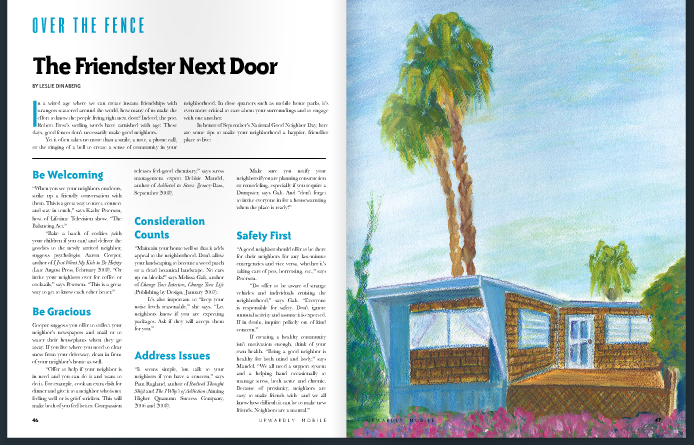
Over the Fence: The Friendster Next Door

Story in Upwardly Mobile MagazineIt’s summertime and the living is easy. The beer is perfectly chilled, the steaks are on the grill and you’re admiring the sunset with your loved one. All of a sudden your neighbor screeches to a stop, rock music blaring, and starts unloading kegs, chips and fireworks from his car–for the fourth time that week.

Neighbors: love them or hate them, you have no choice but to deal with them, especially in close quarters like a mobile home park. Here are some strategies to help minimize conflicts with your neighbors and make your summertime go just a little bit easier.

The key to a stress-free summer is anticipating problems before they happen.

  •  Introduce Yourself

You’d be surprised how many people don’t know their neighbors these days. Don’t wait until you have a problem to meet the people next door. Bring over a bottle of wine or some fresh strawberries from the Farmers Market and just say hello. Even if a problem has already occurred, try to get to know them at least a little before making a complaint.

  •  Be a Good Communicator

Keep your neighbors informed before you do something that might affect them, like hosting a big party or getting a new dog. Informing your neighbors ahead of time allows them to make plans or tell you how your project will affect them. And getting their input in advance lets you act in a way that will help avoid problems. Also, if your neighbor does something that you like, tell them you noticed the yard work or the new paint job. It will be easier to talk later when they do something that you don’t like.

  • Follow the Golden Rule

Treat your neighbors the way you would like to be treated. Be considerate about noise from vehicles, tools, stereos, group activities, and pets. Don’t forget to consider the view from your neighbor’s yard. Those extra car parts in your driveway may not bother you, but your neighbor may not like looking at them.

What to do if there is a problem.

  • Track It

Note the date, what occurs, and anything else that you think might be helpful. It’s possible that the problem (such as late night noise) may not occur as often as you think it does. In any event, clear documentation will help you talk to your neighbor and help make your case to the police or the courts if it comes to that.

  • Your Neighbors Can’t Resolve a Problem if They Don’t Know About It

It is often the case that neighbors are not aware that their actions are negatively affecting others. Nine times out of ten, people are willing to make changes if you approach them respectfully to work out a solution.

  • Assume the Best

If your neighbor does something that irritates you, don’t assume that it was done on purpose; instead operate under the assumption that the neighbor doesn’t know their 3 a.m. hot tub party kept you awake.

  •  Don’t Let Your Irritation Fester–Focus on the Issue at Hand

By communicating early in a calm and pleasant manner, you take a big step toward resolving the problem. Don’t wait until a minor irritation becomes a major issue and makes it difficult to discuss. Separating the person from the problem will allow you take care of the problem while maintaining your relationship with your neighbor.

  •  Stay Calm and Listen Thoughtfully

You don’t have to agree with them or justify your behavior, but if you can listen and not react defensively, then their anger will likely subside and there is a good chance of working things out. Try to understand how your neighbor feels about an issue and why. For example, people can become very defensive when they think their pets–or their children–are being maligned. Understanding their position will increase the likelihood of a solution that works for you both.

  • Take a Break

If you need to, take a break to calm down and think about what you and your neighbor have discussed. Arrange a time to finish the conversation later. Don’t try to problem solve when you are having a heated discussion.

  •  Communicate Constructively

Always keep in mind that talking things over directly is the best way to handle problems, and avoid going to law enforcement or the courts. Turning to outsiders to resolve your neighbor issues should only be a last resort.

Originally published in Upwardly Mobile Magazine on June 1, 2008. Click here to read online in the magazine.

SHEAR GENIUS

Art Luna, courtesy photo

Art Luna, courtesy photo

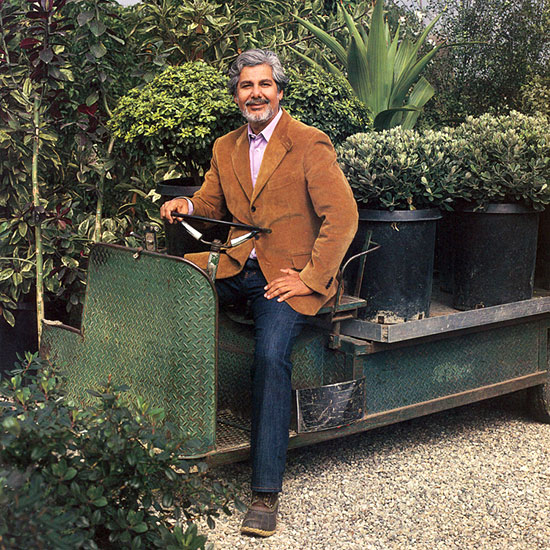
Designer Art Luna is planting roots in our local soil

Enhancing nature’s gifts is nothing new for Art Luna. Long before he developed a reputation as a top-notch landscape designer, he was known as a swanky celebrity hair stylist–which he still is. But more and more often these days, he’s trading his scissors for gardening shears. His formally structured, yet free-flowing creations are now gracing landscapes on both coasts, including New York City, Los Olivos, Montecito, Santa Barbara, and Carpinteria.

His passion for gardening began with the creation of an outdoor garden waiting room for his Hollywood salon, then was sparked here during a visit to Lotusland in 2002, with esteemed British gardening book author Anna Pavord. She advised Luna to always remember, “Structure first, flowers second.”

Building the structure first was embedded in his approach as a hair stylist. Suddenly it all clicked for Luna: “Think of it as if you’ve built this beautiful house out of green, and then you furnish it with furniture that is flowers.”

Here, Luna shares his expert take on our local offerings:

Favorite Places

ABE NURSERY3894 Via Real, Carpinteria, 805-684-3335.
Richard Abe has lovely material. He doesn’t let anything leave his nursery that isn’t of good quality. Also, I can buy 70 to 100 of one thing to do mass plantings–that’s really important for me.”

EYE OF THE DAY 4620 Carpinteria Ave., Carpinteria, 805-566-0778, eyeofthedaygdc.com. “They have an amazing eye for pottery and shape. There is always really good statuary, which I think is the dying art of the garden. I think people are a little freaked out about statuary in terms of the garden. … It can be lovely if done right.”

LOTUSLAND GARDEN SHOP 695 Ashley Rd., Montecito, 805-969-3767 ext. 101, lotusland.org/shop.html. “They always have wonderful things there, such as bird feeders for the trees and bird nests for the cages.”

RUE DE LILLIE ANTIQUES 2496 Lillie Ave., Summerland, 805-695-8180, . “I go there for beautiful antique bird cages and unique things like unusual lanterns and mirrors.”

SAN MARCOS GROWERS 125 S. San Marcos Rd., Santa Barbara, 805-683-1561, smgrowers.com. “I try to buy all of my flowers from local vendors. This one is amazing. It’s all good quality, and they usually have anything that you want.”

TURK HESSELLUND NURSERY 1255 Coast Village Rd., Montecito, 805-969-5871. “If I want to buy a pot with a beautiful plant to put it on the steps of a garden, I know I’ll find something very interesting and lovely here.”

Favorite Plants
African BoxwoodI love the red vein, that it has, how small the leaf shape is, the color olive green that it is. Here in Santa Barbara, especially, the greens that are more olive and gray do well in the landscape.”

Agave “The shapes are so magnificent–it’s just mind-blowing how they can survive under the poorest of conditions and then be the focal point of a garden with their dramatic shapes and colors.”

Gardenias “You have to have the most perfect conditions for a successful gardenia–they love food. I love those glossy tropical flowers like gardenia, rhododendron, and philodendron for a border.”

Pittosporum “One of the most underrated plants ever–I love its silvery sheen.”

Salvia Waverly “I love it because it attracts hummingbirds and butterflies, but not bees.”

Originally published in Santa Barbara Magazine, 2008.