
Young Jews embark on rites of passage with Bar/Bat Mitzvah

Photo by Peter van der Sluijs, courtesy Wikipedia Commons.

Photo by Peter van der Sluijs, courtesy Wikipedia Commons.

While the passage from childhood to adulthood is murky, at best, for many of us, virtually all societies determine a specific age that separates the children from the adults — the age when an individual assumes his communal and religious responsibilities to society.

For Jews, the establishment of becoming a Bar Mitzvah at 13 years plus one day for boys and a Bat Mitzvah at 12 years plus one day for girls, has historically been viewed as a first step in a young person’s acceptance of the obligations to family and community as a responsible Jew.

Though Jews have wrestled with the problem of how to safeguard the spiritual elements of Judaism in an age that openly embraces materialism, most Santa Barbara Bar and Bat Mitzvah celebrations are relatively low key, at least when compared to what goes on other places.

Jennifer Lebell, whose son, Jacob, recently had his Bar Mitzvah, recalls a family Bar Mitzvah, which took place in Canada. “It was the most amazing thing I’ve ever seen in my life, ” she said of the ceremony, which she described as being “very light on the Judaism.”

“There’s this elaborate stage and then there’s this little stage with a flowered archway and these (two 15-year-old) glamour girls are on each arm of the Bar Mitzvah boy, as the master of ceremonies said, ‘And now, may we present…’ and it totally darkens, and then actual fireworks come out of the arch,” she laughed.

“I mean it was such a stereotypical … Hollywood would have just gone nuts. … It was so bizarre. We knew that if we were going to do anything, that was the one thing that we were not going to do.”

Avoiding the glitzy route, the Lebells elected instead to take the path advised by Rabbi Jeffrey Salkin in his book, Putting God on the Guest List. “Decide as a family what you are celebrating and what this moment in your life means. This decision will help guide you through the rest of the planning stages.”

For the Lebells, this meant enrolling Jacob into Hebrew school (a large part of the Bar Mitzvah involves reading from the Torah in Hebrew) when he was in fourth grade.

“Learning to read in Hebrew was a special challenge for Jake because he has a learning disability,” said his mom. His teachers weren’t very optimistic, but his mother was determined. “It just proves that you can do something if your mom puts your mind to it,” she said.

“When I started working on my Bar Mitzvah, it was mostly about my parent’s expectations and their faith that I could master this stuff,” said Jacob. “It seemed too big and I was in denial, even as I went to my weekly classes. Eventually, it all started to make sense, and so what I learned is that if I keep showing up and have the right motivation, even huge things like this are doable.”

“One of the things during this ritual that I really love is the handing down of the Torah,” said Jennifer. “The Torah is taken from the ark by the rabbi and given to the oldest direct family member, in this case Grandma Malca and Grandpa Don, who then pass it to us (the parents), and then we pass it to Jacob who then processes around the sanctuary holding it allowing everyone else to touch it too. The other aspect I find significant is the grueling study and the humbling presentation before community. It really seems to give them acknowledgement for what they have done and confidence that if they can do this, they can do anything.”

For some families, instead of the traditional Torah reading and reception after the services that the Lebells did, this involves celebrating with another kind of journey. For example, last summer Madeleine Bordofsky and her father Michael took a trip to Europe to explore their Jewish roots. While Madeleine is definitely enjoying attending the Bar and Bat Mitzvah parties of her friends, describing one of them as “the best party ever,” she said, “I’d rather have a trip.”

Another important part of the ritual is a good deed, or a mitzvah, as part of the initiation into adulthood. A percentage of the total cost of the reception food is typically donated to Mazon, an organization that helps feed hungry people nationwide. Since money is commonly given as a Bar or Bat Mitzvah gift, most people designate a portion of their gifts to go to charity. For example, Jacob Lebell was planning to donate to Direct Relief International’s Tsunami Relief Fund.

While some may debate whether it’s realistic for a 13-year-old to be considered an adult, most Jews view the Bar or Bat Mitzvah ceremony as just the beginning of the acceptance of responsibility.

As Jacob wrote, “Through the entire time of writing this speech, the rabbi, the cantor, my folks and my godmother kept asking me what does being a Jew and having a Bar Mitzvah mean to me. I still don’t really know, but I do know I have begun to find out.”

=

What is a Bar Mitzvah?

Historically Bar Mitzvah and later Bat Mitzvah is the ceremonial occasion that marks the time when a young person is recognized as an adult in the Jewish community and is responsible for performing mitzvot. For example, before children are Bar/Bat Mitzvah, they do not need to fast on Yom Kippur.

The ceremony consists of the young person chanting the blessings, and his or her Torah portion, which is the Torah portion of the week.

Over time the Bar/Bat Mitzvah celebration party has evolved. The custom is to serve a special meal to commemorate the mitzvah taking place. Moreover with extended families spread out over the country, the Bar/Bat Mitzvah is also an opportunity for families to reunite and spend time together.

Children begin studying for their Bar/Bat Mitzvah by going to school some years before they actually turn Bar/Bat Mitzvah age.

In the year leading up to the event the person begins more intense training focused specifically on their Torah portion and the accompanying prayers. The day the young person is Bar/Bat Mitzvah is the first time he or she will have ever been called to the Torah.

In addition to preparing one’s Torah portion, the preparatory year serves as a chance for the young person to begin thinking about what being a Bar/Bat Mitzvah really means. In some synagogues the young person may make a commentary on their portion and try to apply the teachings of Torah to his or her own life.

Spotlight on B’Nai Brith

There are 28 young people scheduled to have Bar or Bat Mitzvahs at Congregation B’Nai Brith this year, said Cantor Mark Childs, who teaches the students at their final preparation stage. Of those 28, 13 are girls, he said.

“We’re a reform, progressive liberal synagogue, so we give equal status to both genders. You might find fewer girls being Bat Mitzvah in an orthodox setting,” Childs said.

Bar and Bat Mitzvahs are usually scheduled far in advance. For example, Childs said he put one on the calendar this week for June 2007.

While some students begin to study Hebrew in kindergarten, “even as young a preschool,” according to Jennifer Lebell, who has three children, “it really starts to get intense in fourth grade.”

For grades kindergarten through third, religious school is on Sunday mornings. In fourth grade, a Wednesday afternoon class is added. In seventh through 10th grade, students begin to attend a junior high and high school class on Wednesday nights, rather than Sundays.

In addition, when their Bar Mitzvah date is set, “they have private tutoring nine months before the date,” said Childs. After the Bar or Bat Mitzvah, conversational Hebrew becomes an elective, he explained, with further classes devoted to religious study. “We have a 90 percent retention rate after Bar Mitzvah, then they are confirmed at the end of 10th grade.”

While it’s tough to keep up that schedule in high school, “it’s a test of their priorities,” said Childs. “We hope that religious education is going to remain a primary priority.”

Originally published in South Coast Beacon on February 24, 2005.

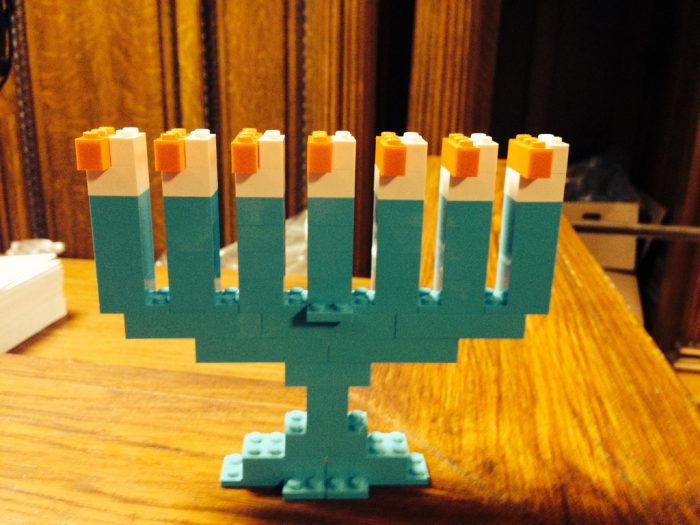
Building blocks of Hanukkah tradition

Lego Menorah by Elijah, flickr.com.

Lego Menorah by Elijah, flickr.com.

Santa Barbara’s Hanukkah festivities began a new way Tuesday night, when many families gathered at La Cumbre Plaza to build a six-foot-tall menorah out of Legos.

Young and old alike had a great time celebrating by lighting the candles for the first night of Hanukkah, playing the dreidel game to earn chocolate coins or gelt, and eating traditional foods like latkes and doughnuts.

Both latkes (potato pancakes) and doughnuts are eaten on Hanukkah because they are fried in oil, which symbolizes the miracle of the oil found in a lamp in a decimated temple. It seemed to be only enough to burn for one night yet, miraculously, it burned for eight days. This is why the menorah is lighted for eight nights and Hanukkah is also known as the Festival of Lights.

Throughout the eight-day holiday, families play the dreidel game and eat traditional foods. Most families also exchange gifts, although in some families, only the children receive presents.

“We celebrate Hanukkah by lighting the candles each night, singing the traditional songs and reading books. Of course, there is always a little gift attached to the celebration. Mostly, it is just being together and enjoying this very festive holiday,” said Shaunah Smith.

With so many mixed marriages, many families create their own, modified versions of the Hanukkah celebration.

Tisha Levy was raised a Catholic, but her husband is Jewish and they are raising their two sons to be Jewish. When Hanukkah comes around she decorates her entire house in blue and white, including a tree with only Hanukkah ornaments. “We have this Merry Hanukkah Troll doll on the top,” she laughed.

Her sister also made her a stunning silver wreath with blue glass dreidels and Jewish stars, which decorates her front door each December.

Like most families, every night the Levys light the candles and say the Hanukkah prayers. “It’s really interesting to try to teach the kids not to blow out the candles (like birthday candles),” she said. She also reads Hanukkah books to her sons, like “My Merry Hanukkah” and “Jalapeño Bagel.”

Other popular children’s titles include “A Confused Hanukkah;” “Hanukkah, oh Hanukkah;” “Spin the Dreidel;” and “Papa’s Latkes.”

Levy noted there actually are some positive aspects to Hanukkah becoming a more commercial holiday. “My mother-in-law told me when her kids were growing up it was really hard-to-find Hanukkah wrapping paper and toys and books and stuff,” she said.

That’s certainly not the case anymore.

To join in the Hanukkah celebration and learn more about the traditions, why not participate in some of these free, upcoming events:

Erev Shabbat/Hanukkah with the Congregation B’nail B’rith Band Friday, 7- 8:15 p.m.; Congregation B’nai B’rith, 1000 San Antonio Creek Road; 964.7869 x16.

Hanukkah Children’s Book Reading Sunday, 10-11:30 a.m.; Borders, 7000 Marketplace Drive; 683.1544.

Family Hanukkah Celebration and Concert featuring storyteller Michael Katz Sunday, 4-5:30 p.m.; Congregation B’nai B’rith, 1000 San Antonio Creek Road; 964.7869 x16.

=

Rolling the Dreidel

Playing the dreidel game is a lot of fun for children of all ages. The four letters that appear on the four corners of a dreidel allude to the miracle of Hanukkah. They spell out Nes (N-miracle), Gimel (G-great), Hay (H-happened) and Shin (S-there, meaning in Israel).

To begin the game, each player should have about 20 items (chocolate coins, or gelt, peppermint candies, chips, etc.).

Each person puts one piece of candy in the middle of the table. Then each person takes a turn at spinning the dreidel. The Hebrew letter on each side of the dreidel tell you what to do:

= If you roll a Nun you neither pay nor gain anything.

= If you roll a Gimel you win everything.

= If you roll a Hay you win half.

= If you roll a Shin you lose everything.

When only one piece of candy or no candy is left in the middle each player adds another piece of candy. When a player has all the candy, that person wins!

To play online visit www1.sbchabad.org/holidays/chanukah/Games/dreidel/default.asp

Originally published in South Coast Beacon on December 9, 2004.

Choosing children

Life without kids is inconceivable to some, but the results can be challenging, too

When you tell Beth Goodman‘s story in broad strokes – as Dr. Laura, Bill O’Reilly and Oprah Winfrey have done – it’s easy to pass judgment.

Even Goodman admitted, “I can understand … if you present this … should a single woman who can’t afford to take care of all four babies be allowed to go to a sperm bank and get pregnant with quadruplets, … the logical mind says no. I mean that makes no sense.”

But a closer look at Goodman’s journey into motherhood offers a more complex story of a woman who – like many others – longed to have a baby, tried unsuccessfully for many years, and finally, with her 40th birthday approaching, turned to medical science in a last-ditch effort to answer the call of her biological clock.

“I had a good plan to raise one child as a single person,” said Goodman.

She had her schedule worked out so she would conceive and work through her busy summer and fall seasons as a floral designer.

One child I could take with me to a lot of flower-buying excursions. I could have the baby wrapped next to my body when I was doing floral design,” she said. “I knew that I would have to have help, day care during certain periods … but there was a lot of time that I would get to be alone with the child and I was very confident that this was something I could do.”

Even though Goodman had been through in vitro fertilization procedures in her 20s, when she was married, and was well aware such methods can lead to multiple births, she was not emotionally, physically or financially prepared for more than one baby.

“I had been very clear with the doctors from the beginning that selective reduction was not something I would consider and that multiples was not something I could do,” she said.

In fact, Goodman was so clearly insistent she didn’t want more than one baby that she went against the advice of her doctor, William Schoolcraft, a renowned fertility specialist she traveled to Colorado to work with. He recommended implanting four eggs, but Goodman was so worried about the possibility of having twins, she insisted he implant only three eggs, bringing her changes of conceiving down to 35 percent from about 60 percent.

“This was the last chance I felt I had, this was all the money, this was all the time, and I said, ‘You know, in my heart I just feel like three is the right number,'” said Goodman. “It was kind of an awkward moment really because this guy’s the best medical doctor and I am sort of indulging my gut feeling with going with three, but I did.”

While she was in Colorado receiving fertility treatments, Goodman unexpectedly fell in love with a man she felt sure was meant to be the father of her child.

“He would lay on my belly and talk to the eggs, the babies …whatever they were and we would tell them that we loved them all but that it would be very hard for us if all three of them were to stay. And that we would leave it up to them who would go and who would stay but we really were hoping to have a child and that we loved them all, but that you guys work it out.”

They worked it out all right.

Back in Santa Barbara and nine weeks pregnant, Goodman found out that not only had all three embryos implanted, but that one of her eggs had split. She was pregnant with quadruplets. Goodman was devastated. “I just cried,” she recalled.

Sitting in Dr. Alex Soffici’s office, staring at the four little heartbeats on her ultrasound, one of Goodman’s first thoughts was, “I know I don’t have what it takes to kill one of these babies. … I can’t call into being through my choices four lives and then decide oh, oops, this is really inconvenient for me. … We all just went into shock.”

Although she knew in her heart she wouldn’t do selective reduction, Goodman said she still talked to Soffici about it and learned that it was particularly risky because the twins shared a blood supply to some degree and they weren’t certain which ones were the twins.

“Who we thought were the twins were … Cason and Barrett, but we did not find out until all of them were born that Luke and Cason are the twins. So we would have made a mistake and Luke would be here today maybe handicapped,” she said. “With that risk and the risk of losing the whole pregnancy and everything, I just felt like I would not make that choice.”

Next she looked to adoption as the only other alternative to keeping all of the babies. Years before, she and her husband had been on the other side of the adoption equation, presenting themselves as potential adoptive parents, but the marriage broke up before they found a baby. This time, Goodman worked with an adoption attorney, Doug Donnelly, and narrowed her choice to a very wealthy family on the East Coast.

Her children would have been raised by two parents on a 500-acre horse farm, with a private plane, a sailboat, the opportunity to travel the world and grandparents on the premises to boot.

“I felt like I was being so selfish to keep them,” said Goodman.

Plus, most of her family was pressuring her to give some of the children up for adoption, with her ex-husband and many close friends also chiming in. But in her gut, Goodman said she knew that “adoption was not an option.” She envisioned a future when she would be back on her feet financially and sitting with two of her children wondering what the other two were doing.

“I thought, I’m going to prove to them that I love them enough to do this, and I’m going to prove to everyone that love is enough. Of course, it’s not; you have to have money to pay the bills. But the commitment to love, I really think is what brought the help that came. And I couldn’t have done it alone.”

While her boyfriend didn’t stick it out, many others did, including childhood friend Kathryn Kalionzes, who is now Goodman’s partner in a new line of customized children’s clothes that combines Kalionzes’ fashion background with Goodman’s floral designs. AlisaElaine will have its premiere trunk show Nov. 25-27. Check www.alisaelaine.com for further details.

With her parents and siblings in her corner and her finances starting to come back together, Goodman is planning a “gratitude party” as the quads get ready to celebrate their first birthday on Nov. 11.

Despite the challenges of raising quads, Goodman has managed to find time to journal their journey and hopes to publish a book.

A recent entry on her website, www.bethsbabies.com, reads: “As we approach the babies’ first birthday, all together as one, big, happy, healthy family, I know in my heart that I am just where I am supposed to be.”

Originally published in South Coast Beacon

One woman refuses to become a victim

OCTOBRE ROSE 2015 » Dépistage du cancer du sein, courtesy Ris.world.

OCTOBRE ROSE 2015 » Dépistage du cancer du sein, courtesy Ris.world.

Channeling her anger into action, nurse Mary Vaughan is using her own battle with inflammatory breast cancer as an opportunity to spread the word about this rare, highly aggressive and often misdiagnosed disease.

A year ago she wasn’t sure she would still be alive to tell her story. She had triumphed over breast cancer once, in 1999, when she was diagnosed with ductal carcinoma in situ, the most common type of noninvasive breast cancer. Because her mother had breast cancer, Vaughan chose an aggressive treatment, a bilateral mastectomy (removal of both breasts) and had immediate reconstruction with silicone implants.

Her doctor at USC told her the cancer had only a 1 percent chance of coming back without chemotherapy or radiation, so Vaughan opted to get back to work and get on with her life.

By 2003 she thought the ordeal was over.

She was wrong.

In April 2003 she developed a severe breast infection. Doctors prescribed antibiotics, which seemed to do the trick. But three months later she woke up to a rash covering much of her chest. Her oncologist thought it was contact dermatitis. Still concerned, Vaughan asked the doctors with whom she worked to take a look. Everyone assured her it wasn’t cancer.

Finally she went to her dermatologist, Dr. Gary Novatt.

“He took one look at it and started talking about cancer,” Vaughan said. “He saved my life, I guess.”

A biopsy confirmed Vaughan’s worst fear at the time: the breast cancer was back.

She went to see her doctor at USC, who told her it was inflammatory breast cancer, or IBC, the most aggressive form of breast cancer and that she had less than a 50 percent chance of living five years.

Her treatment choices weren’t great. With the assistance of Dr. Susan Love, Vaughan opted to participate in a clinical trial at UCLA.

That was a little over a year ago. She began to see improvement right away and is continuing to get her energy back.

“In the beginning, I didn’t have any altruistic motives to go out and save humanity, I just wanted to save my own life,” said Vaughan.

While that still seems unlikely, she is using whatever time she has left to spread the word about IBC.

After communicating via e-mail with patients around the world, Vaughan has concluded: “Misdiagnosis is the most common thing that happens with this kind of cancer.

“Maybe if more people were aware of the symptoms, fewer would be misdiagnosed.”

What To Look For

Inflammatory breast cancer has a number of symptoms, including:

– One breast becomes much larger than the other one (often sudden)

– Warmth and swelling (often sudden)

– Redness or pinkness that may look like an infection

– Itching or pain in the breast that won’t go away

– Dimpling of the skin that looks like the skin of an orange

– Ridges or thickened areas of skin

– Nipple discharge, retraction or flattening

– Change in the color of the areola

– Swollen lymph nodes on the neck or under the arm

– A lump (although often there is no lump)

Source: The Susan G. Komen Breast Cancer Foundation

Originally published in South Coast Beacon on October 21, 2004.

Stitching Together Memories of Lost Loved Ones

The grieving process is not complete without a way to acknowledge the loss.

Saturday’s date — Sept. 11 — is one that will forever send a chill down Americans’ spines, but other anniversaries are equally significant for those who have lost a loved one.

“Anniversaries are about memories, not ‘dates’… we sometimes forget the exact date over time, but the circumstances and feelings linger forever,” said Gail Rink, executive director of Hospice of Santa Barbara.

“Engagements, marriages, births, new house, divorces, graduations … all are ‘anniversaries’ that contribute to the history of family life,” she said. “The most difficult anniversary is the anniversary of a death; all other anniversaries are ‘joyful,’ death is sorrowful. Death is final, an ending, it signals to the grieving survivors that life has permanently changed.”

Dr. Jim Jones recently experienced the first anniversary of the death of his wife, Dianne Riffle, who died in August 2003 after a brief but intense battle with pancreatic cancer. As a physician himself, Jones said that once he saw the results of her CT Scan, “I knew she was a dead duck.” He immediately took a leave of absence from his job at Pacific Oaks Medical Center to spend as much time as he could with his wife.

Jones, himself a survivor of Hodgkin’s disease, has long had a penchant for making things by hand. His Goleta home showcases beautiful handmade tools, lamps, woodwork and other fruits of his creative labors, which he called his “attempt at immortality.”

After his wife’s death, when he couldn’t bear to part with her clothing, Jones decided to make a commemorative quilt out of the fabrics that held special memories of their times together, and essentially retold the story of her life.

“These are the Hawaiian shirts we wore on our honeymoon,” said Jones, pointing out the cotton, flannel and silk squares he had lovingly pieced together.

“Retelling the events leading up to the death also helps the survivor heal. Remembering who was there, final words … even remembering feelings of guilt and regret, can help to bring perspective to a life altering moment,” Rink explained.

Making that quilt, which he sewed with surgical sutures, took up a lot of empty, lonely hours.

“I was transferring some of my attachment from her to our stuff,” he said.

The quilting ritual was addictive. Jones made himself another quilt for snuggling on the sofa, while the first sits on the bed he and his wife once shared. He also made quilts for Riffle’s two grown children.

“Sharing the grief helps to heal the sorrow,” Rink said.

Jones has also been sharing his grief with fellow members of Hospice of Santa Barbara’s young widow/widowers support group.

“The first six months or so I didn’t give a damn about anything,” he said. But it helped to be with others who had lost a spouse and were “at the next stage.”

The group also gave him useful advice on how to deal with the anniversary of Riffle’s death. Have a plan, they advised.

“Do you want to take the day off from work? Who do you want with you? Do you want to visit the burial site? Is there a special food you will prepare?” Rink said.

“Well-meaning family and friends will advise the grieving survivor about what they should do. Our family and friends do this because they care about the survivor’s well being.

“It’s important that you decide what is best for you. Grief is very personal, one strategy does not fit all,” said Rink, who added that this same pre-planning for death anniversaries applies to birthdays, holidays, wedding anniversaries and other occasions when loved ones will most be missed.

Whatever your feelings of grief, Rink advised: “Confront and prepare for them head-on. Trying to avoid the anniversary can compound the renewed sadness. Memories and feelings are always with us. We carry them wherever we go.”

For more information about Hospice of Santa Barbara call 563.8820.

Originally published in South Coast Beacon on September 9, 2004.

Everything’s just perfect

Photo: Pexels.com.

Photo: Pexels.com.

Jesse Phillips is on a roll, and not just because he bowled a 300 game.

San Marcos High senior Jesse Phillips rolled his way into the history books last month when he bowled a perfect 300 game during the adult/youth summer league at Zodo’s — Bowling & Beyond.

“In the history of Santa Barbara, I’m the only junior bowler to ever shoot a 300,” said the 16-year-old Phillips, who started bowling when he was 13.

Recalling his 300 game, Phillips said: “I took it frame by frame. … Your heart starts beating pretty fast as soon as you’re at about eight strikes. Everybody stops bowling around you and they start watching. All the lanes were silent.

In addition to the thrill of victory, Phillips will receive a $150 scholarship from Zodo’s and a YABA (Young American Bowling Alliance) 300 Ring.

It’s like a Super Bowl ring for bowlers, Phillips explained.

“I seem to excel in tournaments more than practice, just because of the thrill of it,” he said.

Phillips and his partner, KC Ogata, won the state doubles championship last year. Phillips also placed sixth in all events, seventh in Junior Gold and eighth on Team USA.

He won his first title in the majors division last season, competing against top youth bowlers, as well as members of the Cal Poly San Luis Obispo and UCSB bowling teams. Phillips was also recently honored as the Junior Amateur Tour Farm Club Rookie of the Year. He hopes to turn professional after his 18th birthday.

“That’s my goal in life, to be a pro bowler,” said the former Pony Baseball all-star pitcher.

Phillips said he tries to bowl at least four times a week, bowling in as many leagues as he can and playing in lots of tournaments.

“My mom’s been very supportive,” said Phillips, who also praised his coaches — Tom Shepard, Toshi Ogata, Dave Koppa and Bob Angulo — and Laura Shepard, Zodo’s youth director.

“There is no greater feeling of pride then watching the youths you mentor achieving success, not only in their bowling accomplishments but also in their lives,” said Shepard, who is working to start bowling clubs at the local high schools and eventually make bowling a CIF sport.

“Teaching athletes to excel in their sport is small in comparison to the life lessons we teach hoping to pass on lifelong skills on the way. These youths are our extended family and knowing that you made a difference in some of their lives is my ‘300’ every day.”

Originally published in South Coast Beacon on September 9, 2004.

Going long

Like the chorus line of old ladies with walkers traipsing across the stage of The Producers, the 172 members of the Ninety Plus Club honored at the 19th Annual “Celebration of Life” Birthday Luncheon exhibited vitality, athleticism and a sense of humor as they navigated the overflow crowd at the DoubleTree Resort on Nov. 21.

The event, organized by the City of Santa Barbara’s Parks and Recreation Department and funded by Santa Barbara Securities, The Hutton Foundation, the Santa Barbara Foundation and the DoubleTree Resort, was designed to honor the combined 15,899 years of wisdom and longevity of some of Santa Barbara’s most inspirational figures.

Oldest among the group was track & field legend John Whittemore of Montecito, who turned 104 on Nov. 20. Whittemore — a life-long resident who competed as recently as 18 months ago and still holds five world masters records — said he started competing in both track and baseball at Santa Barbara High. He offered this life advice: “It’s easier to keep out of trouble than get out of trouble.”

Also sharing sage advice was 92-year-old Elizabeth Johnson, who gave “enjoy life and have a great sense of humor” as her secret to a long life. Johnson, one of the first female comedy writers during the golden age of radio, certainly knows a lot about humor. “I wrote for Bergen and McCarthy and W.C. Fields and Judy Garland and Lucille Ball,” she said. Recently married to family friend Harry Johnson, whom she’s known for 50 years, Elizabeth beamed, “Harry’s always had a great sense of humor. We have a lot of fun together,” she said of her younger husband, who is only 87.

Host Larry Crandell introduced and joked with the attendees who had reached the century mark, including Whittemore; Tillie Ackerman, whose brother Rich was there but “he’s only 97”; Mary Hill; Frances Stewart; Emily Thies; Elizabeth Curtis and Leslie Gray.

Las Positas Park (now Elings Park) Founder Jerry Harwin was among the 90+ members tearing up the dance floor to the tunes of the Jerry Dokken Band. “Next year we’ll have to have a bigger dance floor,” said Santa Barbara Mayor Marty Blum. Other entertainment included a sing-along and a number by the Razzle Dazzle Silver Follies Dancers, a dance group of over-50 ex-professionals, founded earlier this year by Glory Lamb.

As they trooped out of the dining room, full from a gourmet meal, the seniors were handed birthday gift bags made by local Girl Scouts and filled with handmade gifts and books of local history for them to enjoy.

Originally published in South Coast Beacon on November 27, 2003.