New Book Guides Parents In Understanding Autism

Autism Booklets There is no one-size-fits-all treatment or approach to the developmental disability, but help is available.

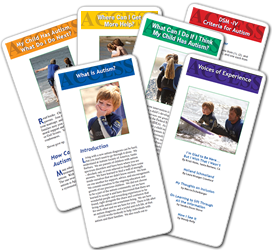
In honor of April’s celebration of Autism Awareness Month, the Santa Barbara chapter of the Autism Society of America (ASASB) (www.asasb.org) has released a new guidebook for parents. Spearheaded by board president Marcia Eichelberger and vice president Sandy Shove, “Autism and Your Child: A Guidebook for Parents,” offers a concise package of valuable information for parents of children who have just been diagnosed with Autism.

Autism is a complex developmental disability that typically appears during the first three years of life. The result of a neurological disorder that affects the functioning of the brain, autism impacts the normal development of the brain in the areas of social interaction and communication skills. Children and adults with autism typically have difficulties in verbal and non-verbal communication, social interactions, and leisure or play activities.

According to data from the ASASB, ten Years ago, one in 10,000 individuals had Autism. Two years ago, one in 500 individuals had Autism and last year one in 250 Individuals had Autism. Today it is believed that 1 in 150 individuals have Autism. The overall incidence of Autism is consistent around the globe, but is four times more prevalent in boys than girls. Autism knows no racial, ethnic, or social boundaries, and family income, life, and educational levels do not affect the chance of Autism’s occurrence.

Despite the growing prevalence of Autism, there are a wide variety of strategies and treatments being used with varying degrees of success. There is no one-size-fits-all treatment or approach, which makes it especially difficult for parents to access the information they need to help their children.

“I often tell people, ‘if you know one person with Autism, that means you know one person with Autism,'” says Shove, explaining that therapies and treatments that work for one person won’t necessarily work for another.

Part of the motivation for putting together the guidebook was their own extremely frustrating firsthand experience wading their way through the maze of information.

“When Sandy and I, when our children were diagnosed–mine was diagnosed about 12 years ago and Sandy’s was diagnosed about 8 years ago–there was nothing available for the doctor to even hand to us. There was no website, there was no support group, there was nothing,” says Eichelberger.

The guidebook is the result of many years of work “compiling resources, securing grant funding, participating in county-wide and tri-county inter-agency meetings, and inviting input from parents and professionals alike,” Eichelberger says. “We are particularly proud that it is available in both English and Spanish, and is available in both hard copy and on our website.”

In addition to publishing the guidebook–which includes sections explaining what Autism is, the diagnostic criteria, what to do if you think your child has Autism, where to go to get more help, and a particularly moving section called “Voices of Experience,” with parents sharing their personal stories–ASASB recently started its first auxiliary chapter in north county.

In honor of Autism Awareness Month, ASASB is co-sponsoring the Cambridge Center Conference on Autism: Evidence Based Practices on Friday, April 25th at the Santa Ynez Valley Marriott in Buellton. “We’ve had an amazing response to the conference,” says Shove.

“This is a remarkable opportunity for local parents and professionals to hear first-hand from international experts in the field of Applied Behavioral Analysis,” says Eichelberger. The conference covers a wide range of topics designed to help parents, teachers and caregivers of people with Autism.

Keynote speakers include: Andrew Bondy, Ph.D., BCBA, on “Teaching the Language of Emotions to Children with Autism;” Gina Green, Ph.D., BCBA, on “Evidence-Based Practice: What is it and Why is Everybody Talking About it;” Rob Holdsambeck, Ph.D., BCBA, and Hank Pennypacker, Ph.D., on “Adding Precision to Measurement and Reality to Predictions in Treatments of Persons with Autism;” Jane Howard, Ph.D., BCBA, on “Improving the Social and Communication Skills of Children with Autism Using the Science of Behavior Analysis;” and Janet Twyman, Ph.D., BCBA, on “Early Literacy Instruction for Learners with Autism Spectrum Disorders.” (www.behavior.org)

=

Additional Information About Autism

If you think your child might be Autistic:

∑ First check out the list of typical childhood development milestones. (http://www.asasb.org/Milestones.cfm) If it turns out that your child does have developmental delays, early intervention services are your greatest gift to your child, because most major research on learning concludes that intervention before age five has the greatest chance of reducing/eliminating developmental delays–including Autism.

What are some of the common concerns that parents have for kids that eventually get diagnosed with some form of Autism?

∑ The most common concerns expressed by parents to pediatricians prior to the diagnosis of autism are:

1. Lack of speech and/or had words and lost them.

2. Child seems deaf.

3. Child does not make eye contact with parent/caregiver.

4. Child has unusual, odd behaviors including severe tantrums, self-injurious behavior, is difficult to control, engages in self-stimulatory behaviors (flapping, rocking, spinning, etc.).

5. Child ignores or does not play with other children.

There are great differences among people with autism.

∑ Some individuals may exhibit only mild language delays, while others may have no functional speech. Regardless of language skills, social interactions are typically a challenge for most individuals with autism. They may have average or above average verbal, memory, or spatial skills, yet find it difficult to be imaginative or join in a game of softball with their friends. Others more severely affected may need greater assistance in handling day-to-day activities like crossing the street or making a purchase.

∑ Contrary to common belief, many children and adults with autism will make eye contact, show affection, smile, laugh, and express a variety of other emotions, though perhaps in varying degrees. Like others, they respond to their environment in positive and negative ways. The autism may affect their range of responses and make it more difficult to control how their bodies and minds react.

∑ People with autism live normal lives and some of the behaviors associated with autism may change or disappear over time.

“The parent to parent connection is really critical,” says Shove.

∑ One of the most important services offered by ASASB are support groups.

∑ There is no pressure to share any more of your personal story than you want to with anyone.

∑ Our speakers come to share information. Follow-up questions and answer time is available and time to chat with others, but you can leave at your convenience.

∑ There is also an online listserve for parents of children with autism SBATA@yahoogroups.com. To join send an email to info@asasb.org.

–Source: Autism Society of America, Santa Barbara
Originally published in Noozhawk on April 17, 2008.

Legacies: Hospice of Santa Barbara

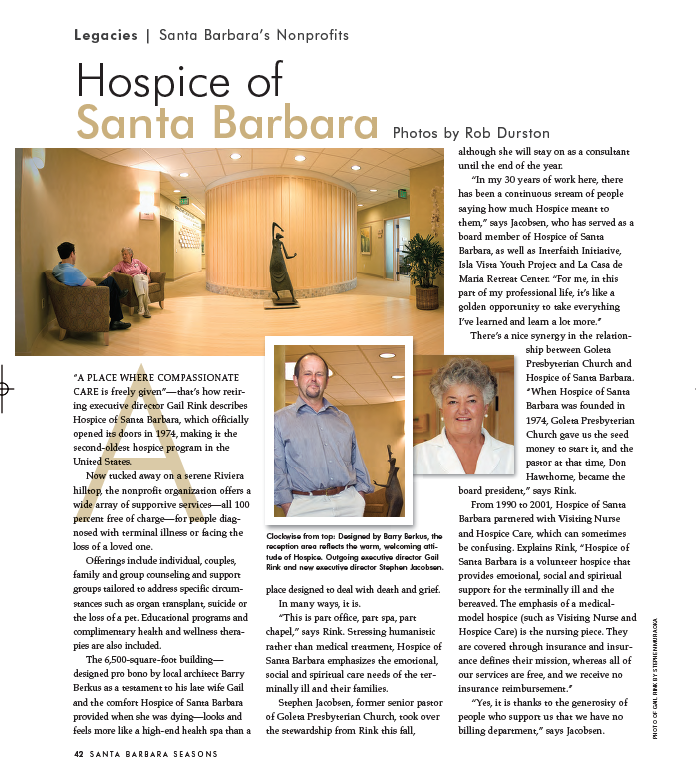
“A PLACE WHERE COMPASSIONATE CARE is freely given”—that’s how retiring executive director Gail Rink describes Hospice of Santa Barbara, which officially opened its doors in 1974, making it the second-oldest hospice program in the United States.

Now tucked away on a serene Riviera hilltop, the nonprofit organization offers a wide array of supportive services—all 100 percent free of charge—for people diagnosed with terminal illness or facing the loss of a loved one.

Offerings include individual, couples, family and group counseling and support groups tailored to address specific circumstances such as organ transplant, suicide or the loss of a pet. Educational programs and complimentary health and wellness therapies are also included.

The 6,500-square-foot building—designed pro bono by local architect Barry Berkus as a testament to his late wife Gail and the comfort Hospice of Santa Barbara provided when she was dying—looks and feels more like a high-end health spa than a place designed to deal with death and grief.

In many ways, it is.

“This is part office, part spa, part chapel,” says Rink. Stressing humanistic rather than medical treatment, Hospice of Santa Barbara emphasizes the emotional, social and spiritual care needs of the terminally ill and their families. Stephen Jacobsen, former senior pastor of Goleta Presbyterian Church, took over the stewardship from Rink this fall, although she will stay on as a consultant until the end of the year.

“In my 30 years of work here, there has been a continuous stream of people saying how much Hospice meant to them,” says Jacobsen, who has served as a board member of Hospice of Santa Barbara, as well as Interfaith Initiative, Isla Vista Youth Project and La Casa de Maria Retreat Center. “For me, in this part of my professional life, it’s like a golden opportunity to take everything I’ve learned and learn a lot more.”

There’s a nice synergy in the relationship between Goleta Presbyterian Church and Hospice of Santa Barbara.

“When Hospice of Santa Barbara was founded in 1974, Goleta Presbyterian Church gave us the seed money to start it, and the pastor at that time, Don Hawthorne, became the board president,” says Rink.

From 1990 to 2001, Hospice of Santa Barbara partnered with Visiting Nurse and Hospice Care, which can sometimes be confusing. Explains Rink, “Hospice of Santa Barbara is a volunteer hospice that provides emotional, social and spiritual support for the terminally ill and the bereaved. The emphasis of a medical model hospice (such as Visiting Nurse and Hospice Care) is the nursing piece. They are covered through insurance and insurance defines their mission, whereas all of our services are free, and we receive no insurance reimbursement.”

“Yes, it is thanks to the generosity of people who support us that we have no billing department,” says Jacobsen.

“Historically that has really been important in this organization. Our board has always been committed to providing free services,” Rink adds.

Looking to the future, board president Roger Heroux says, “The vision is to grow because there is a lot of work to be done. Not only do we want to grow and expand the clinical aspects of this organization, we want to penetrate the Hispanic community in a big way…. (Also) we’ve got to make sure that our infrastructure is solid…to make sure that we’ve got the capability internally to deal with the growth. And finally we want to collaborate with a couple of like-minded organizations that will serve as a good referral source to us, but who also share our commitment to this process.”

“I think that it will be a different kind of leadership,” says Rink. “I’m a fundamental program person and have been in the business a long time (27 years as a hospice social worker/counselor) and Steve has been affiliated with the business for a long time. I built the fundamentals, he’ll build the future.”

To find out more about Hospice of Santa Barbara, call (805) 563-8820 or visit www.hospiceofsantabarbara.org.

Leslie Dinaberg

Originally published in the Winter 2008/09 issue of Santa Barbara Seasons Magazine. To read the story as it appeared, click here and here.

Ventura Goes Green

Image courtesy of <a href="http://www.hortongroup.com/" target="_blank">Horton Group</a>

Image courtesy of Horton Group

Earth Day is April 22, but you can celebrate the earth every day of the year by incorporating green building and remodeling practices into your home. Allen Associates Green Resources Manager Karen Feeney shares these tips:

Take a look at your operating efficiency. You’ll save money on utilities by making greener choices for your home. For example, a remodel is the perfect opportunity to put in a high efficiency furnace. “There are so many energy efficient systems that are out there right now, that are 90 to 97 percent efficient, so if you can put in a new heating system it’s going to make your house more comfortable because it’s going to work really well and also it’s not burning up fossil fuels to operate.”

Green doesn’t necessarily mean more expensive. Especially when you look at your long-term costs. “You’ve got that house for several years of your life, so it’s really a wise choice to go ahead and make some of those adjustments in your home because if you look at the lifespan of a home, you’re bringing your costs down and saving money.”

Improved insulation is one of the most cost effective ways to improve your home’s energy efficiency. Even if you are not taking down any walls, but you are going to repaint, you can go into an old house and you can drill small holes at the top and the bottom of the walls and blow in cellulose, which is recycled newspaper, or foam insulation, and that fills up the entire cavity and makes the home more airtight. Then you simply patch the holes and repaint the walls.

Tighter windows also improve insulation, bringing down your heating and cooling costs. “You can go in and do replacement on windows and do it very inexpensively. You can take, let’s say an aluminum framed single paned window and put in a window that fits in that same place that’s double-paned that can be a very energy efficient window.”

Carpets can be one of your home’s biggest health hazards. In part due to dust, mold, lead, and asbestos in the home, more than 38 percent of Americans suffer from allergies. “When you put a new carpet in your home and then you take it out ten years later, it can weigh three times more than the original carpet, especially if you have a dog or a lot of dirt tracked in…there’s documentation that if you take a carpet out of the home where somebody has asthma or allergies that their health improves immensely.”

For more Earth Day green living tips, check out these special events.

Midtown Green Home and Garden Tour
A self-guided home tour emphasizing sustainable building and/or gardening practices to see how others in the community are already using “green” principles. Sponsored by the Midtown Ventura Community Council and the City of San Buenaventura. Saturday, April 19, 10 A.M. to 4 P.M. $10. Tickets are available at Arketype Architects Inc., 275 S. San Clemente, 653.5088. For more information call Dan Long at 653.6573 or e-mail at sandmand@pacbell.net.

Earth Day Expo
Businesses and non-profit groups will share information that will help citizens “go green,” save energy, and save money. Sponsored by the Midtown Ventura Community Council and the City of San Buenaventura. Saturday, April 19, 10 A.M. to 4 P.M. Free. City of Ventura Sanjon Maintenance Yard, 336 Sanjon Road.

Free Green Building Workshop
Come celebrate Earth Day by learning from local building experts at Allen Associates how you can make your home healthier, energy efficient, more durable, and still stay within your budget. Tuesday, April 22, 7 to 9 P.M., Elizabeth Topping Room, E.P. Foster Library, 651 E. Main Street, Ventura. Free. Call 641.0839 to reserve a spot.

Originally published in Ventana Monthly in April 2008.

Image courtesy of Horton Group.

Women’s Festival Debuts

wf-logoThe inaugural Women’s Festivals launched in Santa Barbara March 7-9th and Arizona March 14-16th. Founded by local businesswoman Patty DeDominic and her partner Mary Schnack, these conferences were created to “celebrate the accomplishments of women and inspire others to realize their dreams,” with forums focusing five key areas: personal, professional, philanthropic, political, and planet.

The Saturday morning “personal” panel on “Transition: The Best is Yet to Come,” was thought-provoking for the approximately 50 people (predominately women) that attended.

Introducing the panel, Alberto G. Alvarado, the Los Angeles district director for the U.S. Small Business Administration, started out the morning with a laugh when he asked the audience, “When does a woman most enjoy a man’s company?” The answer: “When she owns it.”

Then it was on to a dynamic discussion of transitions–both in life and in business–with four very different women.

“Your experiences turn to lessons and hopefully those lessons turn to wisdom,” said Tessa Warschaw, Ph.D., founder of Big Thinking Women and the author of “Winning by Negotiation,” and “Resiliency: How to Bounce Back Faster, Stronger, Smarter.” As you age, “if you don’t have your marbles and you don’t have cash, you’re in trouble,” said Warschaw.

“If you live in the future or in the past, you’re wasting your time,” said Linda LoRey, President and CEO of Frederick’s of Hollywood, who related her story of taking the company public and in the same year becoming a mother for the first time at age 52. “You can do it all, but you can’t do it all at once,” she said, though it sounds like she, at least, can do an awful lot at once.

Maureen Ford, an entrepreneurial education expert and author of “The Turning Point,” said that a dream about her dead mother inspired her to write the book for which all profits go toward Women for Women International, a nonprofit humanitarian organization dedicated to financial, educational, and interpersonal support of women survivors of war, poverty and injustice.

Joan Frentz, author of “Life Begins at 60,” who works as a personal trainer in Carpinteria, talked about the importance of staying in good physical health. “The good and bad news is that we’re going to live to be 100,” said the impressively spry 72-year-old. “We have to take care of ourselves to make those years worthwhile.”

A fundamental objective of the festivals was “to bring together a unique gathering of extraordinary women to share their experiences and wealth of knowledge with the goal of transforming the lives of participants,” according to the organizers. Other featured speakers included: Dr. Susan Love, U.S. Representative Lois Capps (D-CA), Sara Miller McCune and LeVar Burton.

Originally published in Noozhawk on March 25, 2008.

Leslie Dinaberg Sits Down With Ken Saxon

Ken Saxon

Ken Saxon

Since arriving in town 12 years ago, Ken Saxon has served on the boards of some our most successful community endeavors, including the Santa Barbara Scholarship Foundation and the Santa Barbara Foundation. Now he’s taking his experience with the unique challenges nonprofit leaders face and using it to develop a new program called “Courage to Lead.”

LD: What first brought you to Santa Barbara?

KS: My wife Jo and I moved here when our twins were 1-1/2 years old. We felt that this would be a great place to raise children and it’s really turned out to be that. I remember we came at the beginning of June and two days after we showed up was the second annual Big Dog Parade … and a couple of weeks later was Solstice and then there was July 4th and then there was Fiesta and we just thought this town was one giant parade just to welcome us to Santa Barbara.

LD: I know you left a business in the Bay Area. What is your business now?

KS: What I’ve been doing for most of the last 12 years is I’ve taken my business skills and applied them to the nonprofit sector, mostly as a volunteer. … The venture that I’m most involved with right now is a program called Courage to Lead. I’ve worked with a lot of nonprofit executive leaders, and one of the conclusions that I’ve come to from this dozen years of experience of working with them, is that I think they have a harder job than business leaders because business leaders have one bottom line they are managing to. Nonprofit leaders have at least two: a financial bottom line and a social benefit bottom line. At the same time they have less resources to draw upon and also a lot less has been invested in them.

… Also I find that nonprofit leaders are very isolated from one another. Sometimes there’s a sense that only they know what the challenges are and sometimes there’s a sense of competition. … So I helped to develop Courage to Lead. … The goal is to nurture and support them in renewing themselves and in rekindling their passion and commitment for their work. And because it’s done in a group in retreat over time, they build a deep community and they provide each other with mutual support and inspiration. … The program is based on the work of a national group called the Center for Courage and Renewal.

LD: What stage are you in the development of the program?

KS: We are launching a group this year that’s going to start in November and they are going to meet quarterly in retreat for at least a year up in Mount Calvary Retreat Center for two days at a time. … From May 7-9th, we’ve arranged for an introductory retreat … people who are potentially interested are invited to come and experience what one of these retreats is like.

LD: Is there a religious or a spiritual component to it?

KS: There’s not a religious component. Spiritual is always a challenging word because it means so many different things to different people, but yes, there’s a spiritual component in that people are given opportunities and time for reflection and inspiration relative to core questions of meaning and mission and passion and they are given space to reflect and hear their inner voice and to tap into what it is that most motivates them in life that they want to do in the world. And I would call that a spiritual. But the text and things that we use most often is actually poetry and other inspired readings that help people think about their careers and their lives on a deeper level, rather than kind of a religious text.

LD: How will you select people the first people?

KS: We have gone out to leaders in the nonprofit and philanthropic world and we have asked for nominations of nonprofit leaders that they feel would benefit from this experience given who they are and where they are in their careers. But it is also open for application. We have a website that is CourageToLeadNP.org, where people can get more information about it. … We talk about environmental sustainability but there’s a big discussion as the nonprofit sector continues to grow it’s filling a huge need in our society, but whether we can run it in a way that is sustainable, rather than just burning everybody out. That’s a tough question. I’d like Courage to Lead to be part of the answer.

LD: I think you have a unique perspective in that you’re still in your 40s and able to devote yourself to nonprofit work fulltime.

KS: Absolutely, but it doesn’t mean that other people can’t be involved. The Katherine Harvey Fellows are an example. Another example is Craig Zimmerman and I created a group called FUND, Families Uniting to Nurture Dreams. There are 20 families with children who are mostly between the ages of 6 and 16, and we got together partly to raise college scholarships for local kids, but the biggest thing that we do is we create opportunities for our children to learn about the community and really about their world through hands-on ways of getting involved in the community.

… Our group the last three years has partnered in something called Project Healthy Neighbors that is done by Casa Esperanza and Santa Barbara County and Doctors Without Borders … they put on a health fair to try to try to attract the local homeless population to come in and get check ups, to get their immunizations and to get referred out to other services that they might need … (My son Griffin) was down with me at Casa Esperanza handing out the bags to the people that came through.

…The only way I know people in town is either through my kids, their school, but mostly it’s through volunteerism, the nonprofit boards and so on and what a generally terrific group of people. I’ve developed so many relationships with people that I like and respect through volunteering.

Some people move here and want to engage and other people move here and want to hide out and that’s fine and that’s their choice, but it’s awfully fun to engage.

Vital Stats: Ken Saxon

Born: Baltimore, Maryland, January 9, 1962.

Family: Wife Jo and 13-year old twins Griffin and Hope.

Civic Involvement: Courage to Lead; Santa Barbara Foundation; Katherine Harvey Fellows Program; Santa Barbara Scholarship Foundation; Santa Barbara Middle School; Eleos Foundation: Unitarian Society; FUND (Families United to Nurture Dreams); Foundation for Santa Barbara City College.

Professional Accomplishments: “I ran a business in the Bay Area for a dozen years (FARM, First American Records Management) that was acknowledged as both a financial success and a really fine place to work and really good at customer service and I’ve been a volunteer leader here. I approach things like, as the chair of the scholarship foundation, I didn’t approach that in any way differently than being board chair of my company. … I do look at my volunteer service here as professional.”

Little-Known Fact: “My kids perform in this musical theatre group called the Adderly School, and a year or two ago they created an opportunity for parents who were willing to subject themselves to it to have the same experience as their kids did, and so I was up on stage for three nights at Victoria Hall in ‘Mama Mia.’ … I performed on stage for the first time since 8th grade and the last time.”

Originally published in Noozhawk on March 18, 2008.

Noozhawk Talks: Leslie Dinaberg sits down with Nancy Harter

Nancy Harter, courtesy photo

Nancy Harter, courtesy photo

After eight years of service of service on the Santa Barbara School Board, Nancy Harter has earned some reflection time. She talks about what it was like to sit on the board, and what she has planned for the future.

Leslie Dinaberg: How did you get interested in running for school board?

Nancy Harter: In March of 2000 when the secondary bond (a $67 million bond to
improve the infrastructure and modernization of aging campuses)
was on the ballot, Irene Falzone and I co-chaired the campaign. She was a
Santa Barbara High parent at the time; I was a Dos Pueblos parent. Once I got
through that election I started to become a regular at board meetings, then I
decided to run in November.

LD: Are your kids out of the school system now?

NH: Yes, long since. People run who don’t currently have kids in the system and
I think that they can do a terrific job, but for me, a big part of being on the school
board was having that network and knowing at least a couple of staff members
on every single campus and on some campuses knowing a lot of the staff
members, so when issues would come up you had people to call, people to
network with and find out what would be the impact would be on the school.

LD: I think you get less agenda-driven information if you’re calling them as
someone that you’ve known for a while, as opposed to as a board
member.

NH: Right, for me it made a big difference. Actually one of my favorite columns of
yours was the one about going to the PTA meetings because that’s what
happens, you start going to the PTA meetings, you take on more and more
responsibility, the next thing you know you’re the president and then low and
behold, the next thing you know you’re running for school board.

LD: The whole thing has been interesting to me because I started covering
school issues before my son was in school. My perspective definitely changed
having been involved on the inside.

NH: Yes, your perspective changes. You personally have a lot more invested and
there’s just that unbelievable personal connection.

LD: That probably gives you a good insight too.

NH: I think it did. My kids attended the Goleta Elementary Schools but for
secondary, I was a secondary parent from 1992 until 2005, so for 13
years.

LD: Were you ready to be done?

NH: I wouldn’t say that, because there are still issues simmering on the stove
that I would really like to be a part of but, you know, better to leave a day early
than a day late was how I felt about it. I really was not anxious to do another
campaign. Sort of the upside and the downside of school boards in Santa
Barbara is that really good people always run, but it’s an election. You can’t just
assume that you’ll be able to retain your seat without running a
campaign.

LD: What were some of the highlights of your school board experience?

NH: … A big part of it was building relationships, creating a bigger network,
creating relationships with other agencies. The City of Santa Barbara for
instance, we’ve got a great relationship with them now and it was virtually non-
existent when I came on to the board.

… Another big piece for me was the whole paying it forward sort of piece. When I
came on to the board it was a great board-Fred Rifkin, Claire Van Blaricum,
Bob Noel, Steve Forsell-and Claire really helped me with my campaign and
mentored me as a new board member. I took that responsibility really seriously,
so there wasn’t a single election cycle that went by in my eight years where I
didn’t encourage somebody to run, help them with their campaign and then help
them get started on the board.

LD: Are you going to stay involved in local politics or local school issues?

NH: For me it’s about educational policy. I’m not interested in running for
anything else, I’m really happy to be involved in the nonprofit world and efforts
surrounding the schools but I don’t think I’ll ever run for anything again. (Laughs)
It’s a really different skill set to put yourself out there and sell yourself to
somebody with that tape running in your head of your mother saying that the
least interesting topic of conversation is yourself, it’s just hard to put yourself out
there. But I find it very easy to work with other people and collaborate with other
people over issues to come to resolution. I’m not a natural born campaigner,
that’s for sure.

LD: When we scheduled this interview I thought it would be completely non-
controversial, but I did read your op-ed piece in Noozhawk and I have to ask you
about the Bob Noel editorial. Why did you finally write that?

NH: You know, I’m not interested in rehashing it. I stand by what I said and I
don’t need to keep beating the drum. It really had to do with calling for the
superintendent’s resignation and then not participating in the process. … it was
more about the method than about the message.

LD: Is there anything you wish you would have said or done differently in
retrospect?

NH: … I’m not a regretful person, so I would say no. I think I worked really hard
to keep a high level of discourse, and that was the kind of board that I came on
to, and I think I succeeded.

LD: So what’s next?

NH: I have always been involved in the nonprofit world and I’m taking on some
new nonprofit responsibilities and I would just really like to pour myself into that in
the short term and then see how things play out. There’s no grand plan in place.
You acquire this incredible body of knowledge about educational policy and then
you go off the board and it’s like, so now where do I take this? So hopefully there
will be some opportunities that allow me to tap into that expertise, but I don’t
know what they are yet.

LD: Do you have any advice for anyone considering local public office?

NH: I think a lot of people don’t run because they think that as a school board
member that you have some sort of legacy building obligation, that somehow you
need to create some new program or accomplish some grand achievement and I
really think that that is a mistake. I think that you can build a legacy by coming
really well prepared to every single school board meeting, by talking to your
friends and neighbors about issues and getting different opinions. I don’t think it
has to be something physical left behind when you’re done with your
term.

I think that there are a lot of really smart capable people out there who have a
really passionate interest in schools and then talk themselves out of it. And we’re
lucky in this area in Santa Barbara and in all of our surrounding school districts;
there are a lot of really smart people who are willing to run for school board. But
you know I don’t think that people should be, certainly they shouldn’t be scared
away by the issues. You know you’re involved in group think, you’re problem
solving with other people, the burden isn’t solely on you. But also, I think people
get scared away when they read in the paper about the occasional inflammatory
public comment and that’s not every board meeting.

LD: I would imagine you would have to get used to that somewhat too, not that it
would ever become easy.

NH: Well if you have a good internal compass you know which public comments
to pay attention and to take to heart, and you know which to just flip the switch
and just not pay any attention.

… I think we’re lucky, especially in the secondary district, we’re one of the few
areas where everybody takes advantage of the public school system with a
handful of exceptions and I think the secondary is one of those school districts
where you probably have the biggest group of haves and have nots who come
together every school day. And that doesn’t happen in a lot of communities.

… When you have a really bad night at a school board meeting, the best antidote
is to get to a school campus some time before the end of the week because the
energy is just unbelievable on any of the campuses. I really like it.

Vital Stats: Nancy Harter

Born: San Francisco, April 29, 1953

Family: Husband Larry; daughter Anne, age 28; son Jake, age 25; and daughter
Julia age 21.

Civic Involvement: Santa Barbara School Board; Santa Barbara Education
Foundation; Future leaders of America, Berkeley Alumni Association’s
Achievement Award Program; joining the Planned Parenthood Action Fund in
January.

Professional Accomplishments: Eight years on the Santa Barbara School Board;
Masters Degree in English, taught freshman English at the University of
Nebraska; has a law degree but never practiced law. “My oldest was born my
third year of law school, so my involvement in the world has almost always been
nonprofits.”

Best Book You’ve Read Recently: Mountains Beyond Mountains: The Quest of
Dr. Paul Farmer, a Man Who Would Cure the World, by Tracy Kidder, but I
usually read fiction.

Originally published in Noozhawk on February 29, 2008.

Behind the Scenes at the Election Office

If the seventh and eighth grade students from Anacapa School are any kind of a barometer, then, as the national media predicts, young people are engaged in this presidential election with an extraordinary level of interest.

County Clerk, Recorder and Assessor Joe Holland took the students on a behind-the-scenes tour of the election office on Thursday to demonstrate what happens to the 35,000 absentee ballots that had already been received by that day (he expects that 50,000 of the 183,000 Santa Barbara County registered voters will have voted by mail by election day).

With the increasing numbers of people that vote by mail, “election day is actually 29 days long now,” Holland explained to founding headmaster Gordon Sichi’s American History and Society class.

The first step in the envelope’s journey to being counted is the signature on the outside, explained Holland. “There’s a bar code on there that tells us who you are. So when we receive that envelope back, we send it through a machine that’s called an ASR, automatic signature recognition machine. It goes through and compares your signature with the signature that we have on file for you with your voter registration card, and if it matches then it accepts it. If it doesn’t match, like for me, I’m Joseph E. Holland, if I leave out the ‘E’ it won’t match. So then what we do with the ones that don’t match, we’ll actually have a person pull that up, oh look at it’s the same J and the S and the PH, and accept it. But this machine actually accepts about 80 percent of all the envelopes that are returned,” he said.

If someone sends in an envelope without a signature, the elections office tries to contact him or her in order to have him or her sign the ballot so that it can be counted. Once the signatures are verified, the next step is to open the envelopes. The eighth grade students who had taken the elections office tour the year before were impressed to see that a new automated ballot-opening machine had replaced the tables of people with letter openers.

“How much did the new machine cost?” asked a student.

“We’re leasing it right now, but it’ll cost us about $80,000 to buy,” answered Holland.

“Is it worth it?” asked another student.

Holland thinks it is. The machine, which can open about 5,000 envelopes per hour, cuts them open on three sides to make sure that no ballots are stuck inside. Part of the reason for this security measure, he explained, is that in the 1992 primary there was a really close race for county supervisor (between Willy Chamberlin and Bill Wallace, who eventually won the seat). The recount results found that about ten absentee ballots were still in their envelopes and had not been counted. In addition, there are also privacy issues with having the envelopes opened by hand which are avoided by using the machine.

Once the ballots are opened they unfold them and run them through the tallying machines, which are the same machines found in the county’s 215 precincts on Election Day. The results will not be available until 8:05 p.m. on election night. Until then they are then stored on a computer, which is kept under high security. Only two people have access to the machine, and there are cameras all over the office to make sure no one tries to get in the locked room where it is kept, said Holland.

“What about a hacker getting into the results?” asked a student.

That’s a good question, acknowledged Holland, explaining that there is no Internet access allowed in the room, for that very reason. Another new security measure in place for this year is the secretary of state has given a directive to all counties not to modem results over phone lines, as was done in the past. Instead the results will be driven in to the elections office, which in the case of far away precincts like New Cuayama, may delay the tallying of the final results by as much as two and a half hours.

“If the election is really close, we may not know who won in California until all of the absentee ballots are counted,” said Holland. He has up to 29 days to certify the final results of the election.

The students got to vote in a mock election, where Thomas Jefferson, Abraham Lincoln, John F. Kennedy, Dwight D. Eisenhower and Franklin D. Roosevelt vied for president. Roosevelt and Kennedy tied with only four votes each, but there were 11 write-in votes, which weren’t officially counted.

“I wrote in Barak Obama,” said eighth grader Emily Welkowitz, who wore an “Obama ’08” bumper sticker on her back.

“I think it’s totally interesting,” said eighth grader Jessica DiMizio. “I like all the new machines and stuff. Last year we saw them opening the absentee envelopes and it was just a bunch of people sitting around a big table.”

Part of the philosophy of Anacapa School is to bring the students into the community, said Sichi. “I can go anywhere in this town with a little notice and people will open up their businesses to us. People in Santa Barbara are so generous.” He planned to follow up the field trip with a lesson on voting machines and a discussion of the controversies surrounding them.

When asked if they talked a lot about the presidential primary in class, eighth grader Haley Yuhas said: “Oh yeah, that’s all we talk about. It’s great. It’s really, really interesting.”

Originally published in Noozhawk on February 5, 2008.

Leslie Dinaberg Sits Down With Sissy Taran

Author Sissy Taran, courtesy Noozhawk

Author Sissy Taran, courtesy Noozhawk

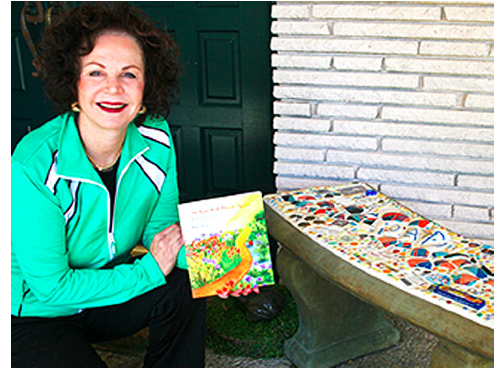
A combination of laughter and tears helped Sissy Taran survive the sudden death of her husband Bernie, in June 2005. “There aren’t any magical answers to survive the loss of a loved one,” says Sissy, but she hopes to help others by bringing that same bittersweet combination of humor and compassion to her new book.

Leslie Dinaberg: Tell me about The Sun Will Shine Again: Life Lessons from a Year of Grieving? How did you come to write the book?

Sissy Taran: People kept asking me how I was doing, and I had no answer. Usually I’m not shy and I’m not at a loss for words … Finally I came up with, “Well I’ll just write a book.” (laughs) That was my response to “how are you doing” because I didn’t know how to say it any other way.

So (five months after her husband’s death) I’m at the temple…and I see the Rabbi’s door open and I decide I’m going in and I’m going to ask the Rabbi to write a forward for this book that I’m going to write.

Now I have no idea how to write a book. I don’t have the foggiest idea how to write a book. But the door was open, so I went in and I spent an hour with him and when I was through, I said, “Gee, do you want to co-author this book with me?” … Then I went home and I called my neighbor (Laurie Deans Medjuck) to ask her how to write a book. … She ended up being the editor.

…The Rabbi started to interview me, he interviewed me for seven months, an hour and a half, every week, and I spoke, we spoke, 500 pages, 100,000 words. … The whole book came from the transcripts.

LD: Did you feel like in reflecting on what you had said originally that your feelings about some things had changed?

ST: What happened was I didn’t feel like the same person anymore. When we started writing it and making it into the book, it was this person I watched grow. This person I watched from the very beginning of her baby steps. It was almost like taking myself and putting myself over here and being totally removed and watching the growth and how she became empowered and looking at it now, two years later, I still look at her as another human being. It’s fascinating.

LD: How much of how you feel now do you think has to do with the act of writing the book, as opposed to going through the whole grief process?

ST: Well, interesting enough, I didn’t think of the book as being cathartic. It was only after I did it, it was like visiting a therapist, but I didn’t know that.

… We were doing something for somebody else. It wasn’t for me. I was writing this because there was nothing available I felt that people could relate to. So I had a project and I like projects.

LD: One of the things that really struck me was how you always think about someone grieving the big things like holidays, but not how many little day-to-day reminders there are.

ST: I think probably the turning point for me was putting in the new driveway. … when we make a decision we bounce it off of people. … But in the driveway I didn’t do that. In the driveway I shook hands with the person that put in the driveway. I didn’t have a contract, I didn’t bounce it off of anybody and I said, this was it. Now I didn’t know at the time that that was going to be as monumental in my life … when I drive up to the driveway every single day … and I drive up to those rocks. Those are MY rocks. I did that.

… we walk it all differently, but it’s our individual walk. So this, somehow, and I don’t know why, this book was burning within me. Somehow. Because I’ve never written and if I had to sit down at a computer I still wouldn’t have written a book.

LD: But it’s interesting how you came up with a way that worked for you and you were able to do it and it felt comfortable and it reads like you too. And I think there are a lot of levels to relate to it.

ST: The interesting part was that I thought that it would be much more about Bernie and it ended up not being. It started out where the rabbi and I were co-authors. It didn’t turn out that way, because he’d ask a question and I’d spend an hour talking. And then it turned out that it became a legacy to my mother.

So it changed its direction. Bernie was the vehicle for me to experience all of this, but the lessons that I learned as a child and the things and the sayings that she taught me, that was really the bread and butter of it. … Throughout this book you will find quotations from my mother, Buddie Shrier. Some of these I found after she died, written on lists or pieces of paper and collected in a small wooden box. Others were simply things I heard her saying on an everyday basis. The life lessons they express form the foundation of my life and had an enormous influence on how I coped as I mourned the loss of my husband. … So for me, this is really a tribute to her. So as it started it out, where it was co-authored with the rabbi. Didn’t happen. Where it was about Bernie, didn’t happen. It’s my journey.

LD: It’s interesting too that you say that because that’s something that has struck me about people that I’ve known that have lost a spouse. One of my friends lost her husband when she was pretty young and she’s gone to accomplish things professionally that she would never have done if she were married, because she wouldn’t have had to. It’s definitely an example of one of those one door closes another one opens kind of thing. …

ST: That’s right. And it’s a choice, Leslie. It’s really, really a definite choice and you can watch those who do it and you can watch those who don’t do it and I think we’re born genetically with our certain DNA that we’re positive or we’re negative and then you have a choice after that. And my choice and was to do this, to make a difference.

… I’m just along for the ride and wherever it goes, it goes.

LD: Well it’s a great accomplishment to have written a book and have it sitting in front of us here, even if it never goes anywhere else. The fact that you wrote it and you got everything you got out of writing it. And the product itself is a whole other journey.

ST: I did it and I love it. You know it’s interesting, I look at it, and just like they can’t ever take your education away from you, I am always going to be a published author.

Vital Stats: Sissy Taran

Born: Detroit, Michigan, November 26, 1944.

Family: Three grown daughters, Tiffany, Francine and Nadine; Son-in-laws Scott and Zach; and grandchildren Ethan and Blythe.

Civic Involvement: Mentor to two children in the Council on Alcoholism and Drug Abuse’s Fighting Back program; CALM; Anti-Defamation League; Coalition Against gun Violence; Hadassah; B’nai B’rith Temple.

Professional Accomplishments: Former elementary school teacher who has been honored with outstanding service awards from the Beverly Hills and Santa Barbara PTAs.

Little-Known Fact: “My dad was part of the Kennedy administration and I was raised on a ranch outside of Bakersfield.”

Benefit for Hospice of Santa Barbara and Congregation B’nai B’rith

On Sunday, February 10, from 2 to 4 p.m., Hospice of Santa Barbara’s Executive Director Gail Rink will interview Sissy Taran and Rabbi Steve Cohen about their experiences working on “The Sun Will Shine Again: Life Lessons from a Year of Grieving.” Then refreshments will be served and all book sales from that day will go directly to Hospice and the Temple.

Originally published in Noozhawk on February 3, 2008.

Women’s Heart Health

courtesy stockimages via freedigitalphotos.net

courtesy stockimages via freedigitalphotos.net

The simple facts are enough to make any woman’s heart skip a beat.

Heart disease, stroke, and other cardiovascular diseases are the number one cause of death in American women, claiming more than 460,000 lives each year. That’s more than the next five causes of death combined, including all forms of cancer. According to a 2007 study by the American Heart Association, cardiovascular disease causes about one female death per minute.

“The lifetime risk of dying of cardiovascular disease is nearly one in three for women,” said Dr. Lori Mosca, a cardiologist working with the American Heart Association. “This underscores the importance of healthy lifestyles in women of all ages to reduce the long-term risk of heart and blood vessel diseases.”

While heart disease becomes more prevalent as people get older, even children need to take care of their heart health. “From the second you start eating food … you’re really affecting the plaque on the artery walls, so you really need to be conscious of that whether you’re 14 years old, 30 years old or 60 years old,” said Liz Adams, executive director of the Santa Barbara, San Luis Obispo, and Ventura County branches of the American Heart Association.

Getting the word out about the importance of early awareness of cardiovascular disease is a passionate cause for Santa Barbara County Supervisor Janet Wolf, who had a heart attack in 2004, at age 50, and has since gone on to train in the Woman-Heart Program at the Mayo Clinic to become a women’s heart health spokeswoman. Wolf testified in Congress on behalf of the Heart Disease Education, Research and Analysis, and Treatment (HEART) for Women Act, co-sponsored by Congresswoman Lois Capps, and is very active in the community as an advocate for greater awareness for women about heart disease. She emphasizes the importance of being aware of your family history (her father had triple bypass surgery in his 50s), as well as maintaining a healthy exercise program and diet.

“We need to work harder about letting people know about the increase of heart disease among women,” says Wolf. “We must be proactive.”

It’s also particularly important for women to be aware of their symptoms and take swift action when needed. “My gut assumption about what happens with women is we’re traditionally the caretakers, we’re the last ones to actually stop and say is there something wrong with me,” said Adams. “Instead we’re worried about our kids, our family, husband, and a lot of times women will start to feel pain in their chest–which for women tends to be more of a grasping anxiety feel than an actual elephant on the chest, which is what a man experiences–and so they think ‘oh it’s just stress, I’ll go to sleep and tomorrow morning I’ll be okay,’ and they don’t get immediate help like their male counterparts are doing.”

Both heart attacks (where a blood clot on the artery walls prevents blood from flowing to the heart) and strokes (where a blood clot prevents oxygen from going to the brain) are life-and-death emergencies where every second counts.

Some heart attacks are sudden and intense, like in the movies, where no one doubts what’s happening. But most heart attacks start slowly, with mild pain or discomfort. The most common symptom is chest pain or discomfort. Other symptoms are discomfort in other areas of the upper body besides the chest, such as the arms, the back, neck, jaw or stomach; shortness of breath; or breaking out in a cold sweat, nausea or lightheadedness. Experts advise calling 9-1-1 as almost always the fastest way to get lifesaving treatment.

The American Stroke Association says the warning signs of stroke are sudden numbness or weakness of the face, arm or leg, especially on one side of the body; sudden confusion, trouble speaking or understanding; sudden trouble seeing in one or both eyes; sudden trouble walking, dizziness, loss of balance or coordination; or sudden, severe headache with no known cause. As with heart attacks, don’t delay in calling 9-1–1 if you experience these symptoms. A clot-busting drug can reduce long-term disability for the most common type of stroke if given within three hours of the start of symptoms.

Not all heart related ailments are easily identified.

It was about three years ago, at age 48, when cardiology nurse and Santa Barbara City College Associate Professor RN/MM Evan McCabe began having chest pain and tingling up her left arm while walking up a hill on campus. When she saw her cardiologist her tests were normal, but she continued to have chest pain when she exercised. After a series of tests and visits to a woman’ s health clinic at Cedar’s Sinai Hospital in Los Angles, McCabe was diagnosed with Endothelial Dysfunction, a disease in which the blood vessels function abnormally and constrict rather than dilate when you exercise.

“I felt really lucky because my doctors listened to me and very lucky in that I had the knowledge base to know when something is not right,” said McCabe, who now has her symptoms under control with medication.

Sometimes other cardiovascular diseases will mimic the symptoms of a heart attack or stroke. In 2007, Ada Connor, director of programs for the Alpha Resource Center of Santa Barbara, thought she was having a heart attack. But when she went to the hospital for an angiogram, they found no blockages in her arteries. They later found out that a virus had settled in her heart, creating a condition called Cardiomyopathy, in which the heart muscle becomes inflamed and doesn’t work as well as it should. In her case it took about 12 weeks of treatment to get her heart back to normal functioning.

“It was pretty scary,” says Connor, the single mother of two teenagers. “But to have gotten a clean bill of heart health was pretty amazing…this really opened my eyes to how lucky I am. I’m very thankful.”

Heart problems can strike women at any age. Laura Pinner, who grew up in Santa Barbara and is now an 18-year-old student at UCLA, caught a virus that settled in her heart when she was only four weeks old. It caused congestive heart failure, and then Cardiomyopathy, which she still lives with today.

“Heart disease is so unknown. It is a silent killer. It also tends to be a, ‘that cant’ happen to me, I’m not a 60-yearold male’ disease,” said Pinner, who has been a volunteer with the American Heart Association for most of her life. “People, women especially, need to be educated that heart disease can happen to anyone. When people know this, then they will have the drive, and provided with education they need, to take actions to prevent heart disease. You can take steps to save yourself, and loved ones, from heart disease. …It is crucial that attention is drawn to how many women are affected by heart disease, in order to decrease the number of women dying and affected by the disease.”

Ten Ways You Can Help Yourself Prevent Heart Disease From the American Heart Association

1. Schedule a yearly checkup.

Have your blood pressure, cholesterol and glucose levels checked on an annual basis and ask your doctor to help you reach or maintain a healthy weight.

2. Get physical.

Get a minimum of 30 minutes of exercise most days of the week.

3. Drink more water.

Take a water bottle with you wherever you go to keep you hydrated.

4. Eat healthy.

5. Control cholesterol.

To help keep your cholesterol levels down, eat foods low in saturated fat and trans fat, such as lean chicken or turkey, fruits and veggies, low-fat or fat-free dairy products and whole grains.

6. Cut down on salt.

To help lower high blood pressure, watch your salt intake.

7. Quit smoking.

8. Maintain a healthy weight.

Excess weight increases your risk of heart disease, stroke and diabetes.

9. Stay positive.

If you get off your exercise schedule, have a cigarette, or eat a fattening meal, immediately get back on track toward re-establishing a healthy lifestyle.

10. Give yourself credit

To maintain momentum with exercising, losing weight, or quitting smoking, keep track of your achievements and reward yourself by doing something you enjoy.

Originally published in Coastal Woman

Women’s Fund of Santa Barbara Grants $600,000 to Local Nonprofits

Women's Fund of Santa Barbara“Collaborative efforts are part of the future of philanthropy,” said Natalie Orfalea, addressing the Women’s Fund of Santa Barbara’s annual luncheon on Jan. 28.

As chairwoman of the Orfalea Fund and co-founder of the Orfalea Family Foundation, Orfalea is an expert on collaborative giving, and was instrumental in developing her foundation’s partnership with the Women’s Fund. With Orfalea matching all of the money raised by the Women’s Fund, it was able to award $600,000 to support the work of eight local nonprofit organizations: Angels Foster Care of Santa Barbara, Casa Pacifica, Family Service Agency, Girls Inc. of Greater Santa Barbara, Isla Vista Youth Projects, People’s Self-Help Housing, Storyteller Children’s Center and Transition House.

This brings the total amount given to the community by the Women’s Fund to $1,425,000, in just four short years of existence. The grassroots group was founded by a small group of women — chairwoman Carol Palladini and Perri Harcourt, Shirley Ann Hurley, Jean Kaplan, Dale Kern, Joanne Rapp, Elna Scheinfeld, Meredith Scott, Kay Stern, Anne Smith Towbes, Marsha Wayne and Fritzie Yamin — who were interested in contributing to the community without having to sell tickets, make decorations, solicit auction items or spend valuable resources to bring in funding for nonprofit organizations.

It’s a simple, yet powerful, idea that’s growing in the philanthropic community: Why not take the time, energy and money spent on producing and attending elaborate fund-raisers and write a single check once a year to put that money where it’s most needed.

The concept of giving circles — pooling resources with other donors to have a bigger impact — is catching on, too, not just with the Women’s Fund but within the Women’s Fund as well. To become a member of the Women’s Fund, a woman simply writes a tax-deductible check for $2,500 once a year and in return receives one vote to decide where the funds will be distributed. When the group started in 2004, it targeted women who could easily make the $2,500 donation required to participate.

In recent years, the circle of giving has widened to include group members — often younger women in the community who can’t afford the entire $2,500 donation — who pool their money and share one vote. SBParent.com has put together two of these groups, and there are 28 other sets of women who are neighbors, coworkers, friends and acquaintances who also contributed to the fund as group members, with anywhere from two to 12 members pooling their funds to come up with the required $2,500.

The idea of the money donated going directly to help people, rather than being spent on events or fund-raising expenses appealed to SBParent’s Julie Sorenson and Rachael Steidl. Other members said they joined the group to meet like-minded women or to learn more about the nonprofit organizations serving the community. Assisted by the Santa Barbara Foundation, the research committee does all the legwork to identify causes that align with the Women’s Fund goal of giving to meaningful projects affecting women, children and families.

The largest gift awarded by the Women’s Fund this year was a $150,000 leadership grant to Storyteller Children’s Center, for its $2.5 million expansion campaign that will be launched in 2008. Storyteller, which provides high-quality free preschool for homeless and at-risk children, will use the funds to help establish a second center on De la Vina Street. The organization will serve 1,000 homeless and at-risk children and their families in the next decade, said executive director Terri Allison.

“One in every five children in Santa Barbara County lives in poverty,” Allison said. And while these funds will greatly expand the availability of services, “for every child who joins Storyteller, we must place one on our waiting list.”

Family Service Agency’s 211 Human Services Helpline was awarded $95,000, an amount that will provide one-third of the funding needed to carry on the operation of the helpline when government funds expire in 2008.

Angels Foster Care of Santa Barbara was awarded $85,000 to pay for a licensed social worker to recruit, screen, train and support 20 foster families, doubling the number of infants and toddlers that were placed in foster care in 2007.

“These parents risk their own broken hearts,” said executive director Meichelle Arntz, “and this money allows us to provide them with additional support.”

Isla Vista Youth Projects, which lost state funds in 2007, received $60,000 for a family advocate and counselor for one year. This gap funding will restore programs to keep low-income families healthy through regular medical and dental care.

Girls Inc. of Greater Santa Barbara was awarded $55,000 for its Teen Mentoring Program. Thise program expansion will allow girls 13 to 18 years old to participate in Girls Inc. for the first time locally. In the past the agency only served girls up to age 12.

Casa Pacifica received $55,000 to purchase three cars to enable caseworkers and mental health professionals to deliver 24/7 mobile emergency services for youth in immediate psychiatric crisis and to provide assistance for families with youth who are at risk for being placed in foster care.

People’s Self-Help Housing was granted $50,000 to fund a third educator for its year-round specialized mentoring learning program that serves school-aged children in low-income families.

Transition House also received $50,000, which will provide gap funding for the salary of one case manager for a year. Transition House case managers meet one-on-one with at-risk families to craft solutions to help them restore self-sufficiency.

As if helping these worthy organizations weren’t reward enough, oversight committee chairwoman Jo Gifford told the crowd of approximately 150 women that she recently learned that givers are happier than nongivers, less depressed, and full of the hormones that reduce stress.

“So with that in mind, I stand before the happiest, least depressed and least stressed women in Santa Barbara,” she said.

For more information about the Women’s Fund of Santa Barbara visit www.womensfundsb.org or contact Jo Gifford at 805.969.3320 or mjog@cox.net.

Originally published in Noozhawk and SBParent.com on January 30, 2008.