Leslie Dinaberg Sits Down with Cecilia Rodriguez

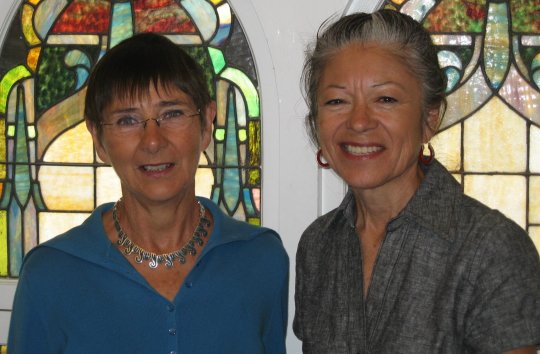
Anna Kokotovic, left, former executive director of CALM (Child Abuse Listening & Mediation), gave new Executive Director Cecilia Rodriguez her start with the organization more than 20 years ago. (Jennifer Guess photo)

Anna Kokotovic, left, former executive director of CALM (Child Abuse Listening & Mediation), gave new Executive Director Cecilia Rodriguez her start with the organization more than 20 years ago. (Jennifer Guess photo)

Starting as a volunteer in 1984, CALM‘s (Child Abuse Listening & Mediation) new Executive Director Cecilia Rodriguez has proven her passion for protecting children from abuse. Now she wants to focus on prevention, reaching out to young families to help break the cycle of abuse.

Leslie Dinaberg: So you started as a volunteer at CALM?

Cecilia Rodriguez: Yes, when my own children were very little and I was trying to get away from my life as a full time mom. I wanted to be able to talk about something more than diapers and baby stuff, which is fine but when I got involved here at CALM as a volunteer, within minutes I realized that this was what I would do for the rest of my life. That’s why I warn volunteers when they come here, I say “beware this agency has a way of grabbing you.” The mission is just so compelling and we’re protecting the most vulnerable in our community and helping families to grow and change and break the cycle of abuse.

LD: So you went graduate school and became a marriage and family therapist.

CR: Yes and Dr. Anna Kokotovic, the executive director at the time, offered me a position doing intensive in-home therapy, doing treatment at people’s homes, in the streets, in schools. Wherever families hung out, that’s where I hung out.

… The wonderful thing about in-home work is that you really get a much clearer picture of what’s going on than you do when they come to the office. You rely here on what they tell you, but when you go there and you see the conditions that they are living under, the stressors that they are facing, the challenges, and the poverty. Then you realize that some of the things we innocently ask people to do in their homes are just not possible. So we have to adapt it so that it’s something that really will work for them.

LD: How willing are people to have this kind of an intervention of people coming into their homes?

CR: I am always so humbled–and I’m going to start crying because I always cry about this–that people trust us enough to allow us to come into their home. I am always so touched by that, and it just shows you the level of distress that they’re in, or they are seeking so much, they want support.

LD: What programs are you emphasizing now?

CR: … My focus now, as executive director, is to focus more on prevention than on trying to repair the problem after it has occurred. With teenagers it would be so much better not to get to that place. That’s why we’re really emphasizing preschool, emphasizing preschool aged children aged 0 to 5, the younger the better. And it’s not the children we’re focusing on, it’s the parents so that we can support them to be better families, to listen to their children to be supported themselves. You know, a lot of parents haven’t been supported, didn’t get optimum family situations and so they just repeat what was done. If in their family they were raised in a really punitive family environment, they will tend to do the same thing unless we can intervene. … We try to target young families, even before they have their babies. We get referrals from obstetricians and pediatricians and the Public Health Department when there are certain risk factors and then we begin working with them on bonding and attachment issues from day one.

…We have a whole team of home visitors called Great Beginnings, and they are the ones that go to homes of the very young children.

LD: You have a lot of different programs and a lot of things going on, but what is your perception of the needs of Santa Barbara County versus what you’re able to provide.

CR: Well, there’s always more need than we’re able to provide and again, the need is I think, because I’ve been doing this for a lot of years, and I’m tired of coming in after the fact when abuse has happened and then we react by wrapping our CALM services around the family. That’s why I want to focus on support and prevention efforts, teaching parents how to be better parents and families how to be there for one another. There are so many stressors in families’ lives these days and it’s getting even more challenging now, financial stressors, our economy, that’s adding another, and our families have always been stressed in that way because we work often with families of lower social economic class, so it’s always challenging for them, but then it’s even more challenging now.

LD: Obviously, there are people that have higher risk backgrounds than others, but in some ways everybody has that potential to go too far.

CR: Right. We all have the capacity to abuse given a certain set of circumstances, given certain life stressors I think we can, like you say, cross the line or lose sight of what we’re supposed to do with our children.

LD: In addition to earlier, is there anything else that you feel like is a shift from what’s been done in the past?

CR: Support for preschools. That’s also where I see that children who are experiencing neglect or are growing up in stressful situations where they are exposed to domestic violence, they are not ready to learn; they’re not ready for kindergarten. You know kids are getting kicked out of preschool, this is shocking to me … If you can’t make it in preschool oh my gosh. But you know, when kids are aggressive that’s an automatic “we can’t deal with you here” because they hurt other children. And not every preschool does that, kicks kids out, but there are some, and we see kids here who can’t make it in preschool setting. It is sad. So what we’re doing is we’re partnering with, for instance, Storyteller, and we’re offering support to children and the teachers so that we can help these children to be successful so they’re ready on day one in kindergarten they are ready to learn.

LD: That’s really important.

CR: Yes because what happens if they’re not ready and they’re disruptive from day one they get tagged, you know these kids they get tagged, even in preschool, as the problem kids and they’re going to be problem, problem, problem and they’re going to fail in school.

LD: That’s really sad.

CR: This is a great fact that I uncovered the other day. Do you know that our volunteers provide us with 10,000 hours a year of volunteer time? We have volunteers provide childcare. What our families tell us is one of the most helpful things that we do. When they come here for an appointment they can bring their kids and the kids will be taken care of.

LD: When you’re not working what do you like to do?

CR: I am a total gym rat. I’m an exercise junkie. I go to the Goleta Valley Athletic Club. What’s really important about this work is that it can be very stressful work, of course, you can take a lot home with you, and self-care is very important and I try to model that for the staff. We really stress the importance of when you’re not here when you’re not working, surrounding yourself with beauty, with culture, with laughter, good books, whatever it is that feeds your soul, that’s what you need to do when you’re not here.

So I work out because I’m a fanatic about it, just because it makes me feel good, and also I’m a gardener, My garden is my pride and joy. I love my garden so I’m always out there in my garden. And I have a really solid family, which also helps.

Vital Stats: Cecilia Rodriguez

Born: Los Angeles, November 25, 1957

Family: Husband Bob Stanley; two grown children, Tom who lives in Bellingham, WA, and Clare, who lives in Granada, Spain.

Professional Accomplishments: Art Teacher at Marymount in the 1970s, staff member at CALM for more than 22 years.

Best Book You’ve Read Recently: Kabul Beauty School by Deborah Rodriguez

Little-Known Fact: “I love Cheetos. That is my junk food of choice. About every six months I have a Cheetos attack and I just totally give into it.”
Originally published in Noozhawk in September 2008. Click here to read the story on that site.

HELPING THE HOMELESS

DR. LYNNE JAHNKE

If you mention Dr. Lynne Jahnke’s name to a homeless person, they might not know who you’re talking about. But if you mention her by her street nickname–“Dr. J”–their eyes light up and it’s a whole different story. “Yeah, I know Dr. J,” says Mitch, a Santa Barbaran who sleeps near the train tracks and spends his days at the downtown public library. “She’s cool. She’ll fix you right up with what you need.”

Jahnke–along with social worker Ken Williams and sometimes her assistant, Klea Kalionzes–hits the streets of Santa Barbara twice a week in search of homeless people in need of medical treatment. Often, her base of operations is a Volkswagen van filled with gear and space for “the guys to put their shopping carts if I need to take them to the hospital or the clinic,” she says. Sometimes, she’ll simply strap on a backpack full of medical supplies and cold water and go in search of homeless camps where she can help the sick and injured.

Street medicine is a long road from oncology, Jahnke’s first specialty. After practicing as a cancer specialist for almost ten years in San Francisco and Chicago, she came to town in 2000 to work at the Cancer Center of Santa Barbara. But two years ago, while in her mid-40s, Jahnke retired from oncology–“rewarding, meaningful work,” she says, “but I just decided I’d had enough oncology.” In a serendipitous turn of events, she met some people who were working with the homeless, and found her new calling. “It’s completely different but it feels great,” she says. “These people really have nothing–they’re so grateful if you give them a Tylenol or a Band-Aid. They can’t believe that a doctor is actually going out on the street and seeing them there.”

Although she loved being a cancer doctor, Jahnke says she continues to work with the homeless “because working in primary care with the homeless reminds me of the open heart and desire to help people that made me want to become a doctor 25 years ago. The patients are so kind and grateful for my care and the many other people who provide services to the homeless are wonderful to work with as well.”

Though she considers herself “retired,” and receives just a small stipend, when she’s not doing street rounds, Jahnke can be found three days a week at the lower eastside Casa Esperanza Homeless Shelter clinic, which offers 30 medical beds for patients released from the hospital who are still too ill to go back out on the streets. “I do a lot in coordinating the hospital discharges. I have working relationships with the doctors there,” says Jahnke.

Working with the homeless is a regular reminder to Jahnke of how fortunate she is. “This is why I went to medical school,” she says. “To take care of people who really need it.”

Originally published in Santa Barbara Magazine in Fall 2008.

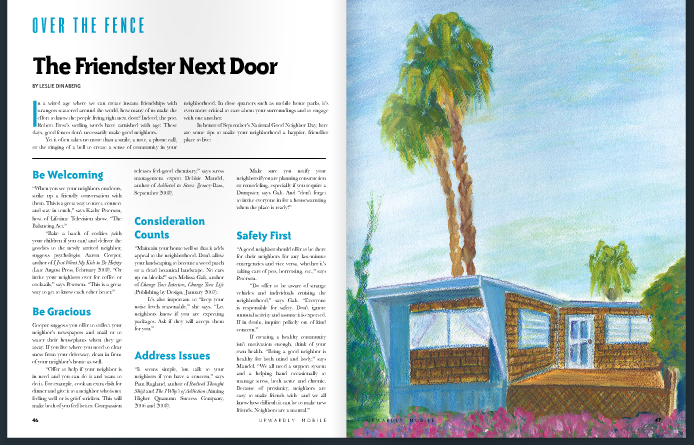
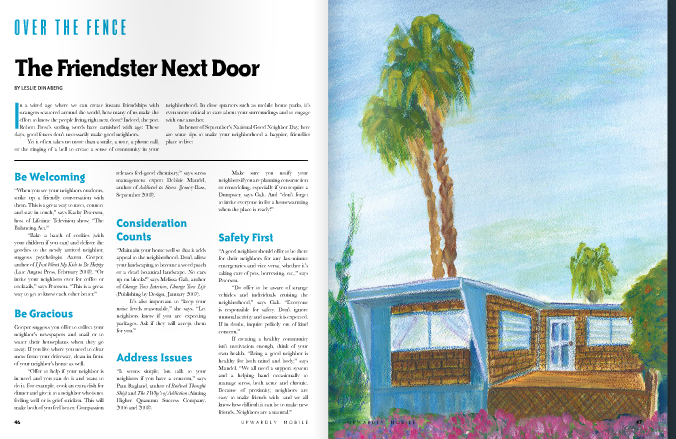
Won’t You Be a Good Neighbor (The Friendster Next Door)

This story as it originally appeared in Upwardly Mobile Magazine

This story as it originally appeared in Upwardly Mobile Magazine

It’s sad but true that in an age where we’re wired 24/7 and can–and do–create community anywhere, we often don’t know the people who live right next door. With all due respect to Robert Frost, good fences don’t really make good neighbors.

With as little effort as a smile, a note, a phone call or the ringing of a bell you can help create a sense of community in your neighborhood. Neighborliness is always nice, but when you live in close quarters such as mobile home parks, it’s even more critical to care about your surroundings and engage with one another.

In honor of National Good Neighbor Day on September 28, here are some tips to make your neighborhood a happier, friendlier place to live:

Be Welcoming
“When you see your neighbors outdoors, strike up a friendly conversation with them. This is a great way meet, connect and stay in touch,” says Kathy Peterson, host of Lifetime Television show, “The Balancing Act.”

“Bake a batch of cookies (with your children if you can) and have them deliver the goodies to the newly-arrived neighbor, suggests psychologist Aaron Cooper, author of “I Just Want My Kids To Be Happy.” “Or invite your neighbors over for coffee or cocktails,” says Peterson. “This is a great way to get to know each other better.”

Be Gracious
Cooper suggests you offer to collect your neighbors’ newspapers and mail or water their houseplants, when they go away. Or when clearing snow in your driveway, or sweeping, clean a path in front of your neighbor’s home as well.

“Offer to help if your neighbor is in need and you can do it and want to do it. For example, cooking an extra dish for dinner and giving it to a neighbor who is not feeling well or is grief-stricken, will make both of you feel better. Compassion releases feel-good chemistry,” says stress management expert Debbie Mandel, author of “Addicted to Stress.”

Consideration Counts
“Maintain your home well so that it adds appeal to the neighborhood. Don’t allow your landscaping to become a weed patch or dead botanical landscape, and no cars up on blocks,” says Melissa Galt, author of “Change Your Interiors, Change Your Life.”

“Keep your noise levels reasonable,” she says. “Let neighbors if you are expecting packages and ask them if they can accept them for you.”

Address Issues
“It seems simple, but talk to your neighbors if you have a concern,” says Pam Ragland, author of “The 7 Why’s of Addiction” and “Radical Thought Shift.”

Make sure you notify your neighbors if you are planning construction or remodeling, especially if you require a dumpster, says Galt, adding, “don’t forget to invite everyone in for a room or housewarming when the place is ready!”

Safety First
“A good neighbor should offer to be there for their neighbors for any last minute emergencies and vice versa whether it’s taking care of pets, borrowing, etc.,” says Peterson.

“Do offer to be aware of strange vehicles and individuals cruising the neighborhood; everyone is part of safety. Don’t ignore unusual activity and assume it is expected; if in doubt, inquire politely out of kind concern,” says Galt.

If creating a healthy community isn’t motivation enough, think of your own health. “Being a good neighbor is healthy for both mind and body,” says Mandel. “We all need a support system and a helping hand occasionally to manage stress both acute and chronic. Because of proximity, neighbors are easy to make friends with–and we all know how difficult it can be to make new friends. Neighbors are a natural!”

Originally published in Upwardly Mobile Magazine

Legacies: Storyteller

storytellerThe infectious chirping of children’s laughter greets visitors. Pigtails fly as a little girl rounds the playground on a tricycle, her smile as bright as the sun. This scene could take place at any of Santa Barbara’s high quality preschool programs, with one exceptional difference–this is Storyteller Children’s Center and these children are homeless.

Founded in 1988 by volunteers who pushed aside cots at Transition House to make space for a small group of children, Storyteller has a come a long way from those humble beginnings.

“We started out as a half-day program for about ten kids,” says Executive Director Terri Allison, who co-wrote the initial proposal to fund a childcare center for homeless children when she worked for the Community Action Commission. The children thrived and the program grew, incorporating in 1991 and moving to First Congregational Church, then to a dedicated center in 1999.

As the program matured, so did its goals. “In the beginning, the group was very focused on providing a safe space for kids,” says board president Jon Clark. “Now we’re looking in a more focused way at the children and their families and what they need. … In particular because of the living situations these children are in, it really is on Storyteller to provide educational experiences, nutrition and all those things that will help them grow.”

Most families are referred through word-of-mouth or from other agencies such as Transition House, Domestic Violence Solutions, St. Vincent’s, Department of Social Services and Child Protective Services.

“A teacher sits down with every family for at least an hour … to establish a level of trust with them and also to figure how we can help,” Allison says. In addition to early childcare and education services, offerings include on-site counseling, family services and case management; parent support groups and education workshops; mental health and disability services; health, vision and dental screenings and nutrition services.

“The teacher helps set goals with the parents and we monitor them on a monthly basis,” Allison says. “We know that the best way to affect change is through the whole family, so parents to have the skills that they need, as well as the children.”

“Parents who leave their children with us are expressing tremendous trust in the people that work at Storyteller,” says Clark. “Once that trusting relationship is developed, there is so much that we can do to help them deal with their family issues and parenting issues. That was a real eye-opener when we realized that the relationship between the organization and the families and the trust that developed was such a huge asset.”

Studies of graduates and their families show a marked improvement in their social and economic status and Storyteller is working with UCSB to research the longer-term impact of its programs. “What we’re trying to do is to make meaningful changes in the lives of children and their families that are going to play out over time,” says Clark.

“There is so much scientific evidence about the huge differences that quality preschool education can make in later years,” says Allison. Experts agree that investment in high quality education for young children has substantial economic payoffs–for every $1 invested, $3 to $16 is returned from decreased jail time and increased physical and mental health.

One of the biggest challenges for Storyteller is trying to focus on the depth of services to individual families and still offer a breadth of services to the community. The waiting list for children continues to grow. Allison cites research that there is only one licensed childcare space for every three eligible children in Santa Barbara County–regardless of a family’s ability to pay.

Still, Storyteller is doing its best to help more children. Celebrating its 20th anniversary this year, the organization opened a second facility, thanks in large part to the generosity of the Orfalea Foundation, who bought the building and is leasing it back to Storyteller rent-free for ten years, enabling Storyteller to mount a $3.2 million capital campaign for the expansion.

Last spring Storyteller was able to increase capacity from 29 to 50 children in the two preschools. By September of 2009 they expect to have 72 children enrolled.

“It’s really amazing to think of how far we’ve come,” says board member J.P. Sharp, a volunteer since 1994. “It was a real grassroots organization of helping children and helping parents and really teaching them how to parent. This is still a wonderful place to visit and volunteer.”

Originally published in Santa Barbara Seasons Magazine in Fall 2008.

Noozhawk Talks: Leslie Dinaberg Sits Down With Amy Kovarick

Amy Kovarick (courtesy photo)

Amy Kovarick (courtesy photo)

As a wife, mother and life coach, Amy Kovarick is a master of multitasking, and she’s helping others find balance in their lives, too.

By Leslie Dinaberg

Wife, mother, life coach, counseling psychologist, radio host and author of Baby on Board: Becoming a Mother Without Losing Yourself, Carpinteria-based Amy Kovarick knows a lot about multi-tasking.

Leslie Dinaberg: So you got started as a life coach after leaving the corporate world?

Amy Kovarick: Yes. I got married at 39 and Matt was born when I was 40, so it was a tremendous change. And finding where the ambitious kind of career Amy fit now with all of these other hats was part of my journey. One company I have, Empowered Motherhood, (Empoweredmotherhood.com) is very much about that. How do you keep close to yourself and true to who you are and yet bring your best to your kids?

… that’s kind of the heart of coaching, whether it’s Empowered Motherhood where it’s a mother community … or my private coaching practice (Amykcoaching.com) where I work with people across the country. The coaching part, no matter who I’m working with, is looking at that balance across your life.

… I’ve got folks who come for career issues, relationship issues, health issues, really right across the board. But it always comes down to balance, which one is falling off the load and have you even stopped to think about where you fit in and what you want, what’s interesting to you nowadays?

LD: It sounds like we could all use some of that.

AK: (Laughs) I think the best coaches are the ones that truly believe they don’t have answers for someone. They think you know deep down inside what’s best for your life and are good at just bringing out who you are. But the tricky part or the tough part about coaching is that there’s all that self-reflection and kind of the touchy feely part, coupled with a bunch of accountability and action items. That’s what drew me to coaching was the combination of the soft side with the no nonsense lets move side.

LD: What kinds of people typically come to you?

AK: A good example is the owner of this restaurant (Corktree Cellars in Carpinteria). She didn’t need to be fixed, she didn’t have a problem, she had a goal … I’ve worked with a lot of entrepreneurs, both men and women and a bunch of executives. I do corporate contracts where the corporation is paying me to coach some of their top leadership in reaching their peak performance if you will. But what I love about that is it is still the same, it’s one on one, there’s nobody there on the phone but them and I’m not working with their board of directors or their boss, it’s still weaves in issues from across their life.

I have a new woman that took on her first president role and so she’s been VP, she’s been this and that, but she’s a mom, she’s got two kids and she’s got all of the issues with that, plus she’s a new female president, in a new company that she doesn’t know these people, a bunch of men that are working for her and reporting to her and the coaching with her is full of all of the things you would imagine.

There are a lot of practical business things but there is the okay, how do you show up and be your full self and be as bold as you want to be and don’t be afraid of stepping on toes, but yet be effective. That’s what I love about my work.

One of my favorite long-term clients was a young girl going through college in New York and her father was footing the bill because he wanted her to be very successful. There’s a different kind of pace of just really working through her journey of becoming an adult and she’s graduated and is down in Australia at the Great Barrier Reef, she’s a conservation biologist.

… So the dreams differ, one wants to be the best leader, one wants to open a restaurant, one wants to be a marine biologist, so it sounds very different, different ages and walks of life, but it is all the same thing of who are you, what do you want to do, how are you going to get there–and that’s what fascinates me. That’s what keeps me in it is every person is different and no two coaching sessions look alike.

LD: In a way it sounds like what writing does, you sort of get to live other lives because you’re finding out so much about what other people are doing.

AK: Yes. And I get I thrive on one on one, real conversations, not a lot of superficial stuff. I’m terrible at networking or parties where you have to just chitchat. That’s my worst thing. So when I get to do my coaching, these people share a lot. And they come pretty unguarded, even my tough male executives.

LD: Do you get people that are motivated to change something?

AK: Yes. Change, grow. It’s people who even though they all look so different on the surface, the common thread is this desire to grow, to not just be successful because it’s not always about people wanting monetary success, it’s this almost fierce desire to not be static, to not stay the status quo. They want to keep pushing out their barriers, and some people for sure come with a problem, come with I’m really unhappy at work, I’m really unhappy in my relationship, I would like to meet someone, I would like to lose 50 pounds. Sometimes there is a very specific problem and they are all willing to look at themselves to take responsibility. By the nature of no one is going to hire me and pay my fees if they are a victim. … People who show up and want to work with me, they’re serious about their life.

… Often I get asked, well how is this different than therapy … the big difference is therapy often is about healing or fixing and it often goes into the past and the whys. How did I get here? Whereas coaching is about where are you now. Coaching is much more about present and future and very seldom do I go to the whys or what happened with your parents. That’s just not part of the conversation even though that’s really valuable but it’s not what I do.

LD: If you could be invisible anywhere in Santa Barbara, where would you go and what would you do?

AK: If I could get into my husband’s head. He’s a very private guy and as he said last night, “you know more about me than anyone in my entire life has every known.” But it’s like pulling teeth.

Vital Stats: Amy Kovarick

Born: Newport, Rhode Island, April 23

Family: Husband Mike Musson; Stepdaughters Layla, 20; Fina, 18 ; and Meli, 15; and son Matt, 2-1/2.

Professional Accomplishments: Author of “The Empowered Mother,” host of the radio show “Empowered Mother,” MA in Counseling Psychology, PCC (Professional Coach Credential), member of the International Coach Federation, has worked with hundreds of people in North America helping them reach their dreams.

Best Book You’ve Read Recently: Age of Turbulence, by Allen Greenspan

Little-Known Fact: I was in the Air Force and worked at the Pentagon.

Originally published in Noozhawk in July 2008. (Click here to read the story online.)

Leslie Dinaberg Sits Down With Sue Adams

Sue Adams (courtesy photo)

Sue Adams (courtesy photo)

Since moving to Santa Barbara in 1957 to attend UCSB, Sue Adams has made her mark on our town in a myriad of different ways. Whether fighting for the rights of the homeless, advocating for the preservation of historic landmarks or working to get discounted healthcare for the poor, Adams pours her passion and remarkable energy into everything she does.

Leslie Dinaberg: Your husband Sam had a 34-year career as a track and field coach at UCSB. What was that like?

Sue Adams: He was gone weekends and didn’t get home till seven at night because of the team’s efforts, endeavors, training, so I pretty much had control of the household. … Our daughter Wendy was born with a lot of physical anomalies. What people would call a handicap, for her they were just challenges and she had probably about nine serious things wrong, including cleft lip and palate, kidneys that wouldn’t work, a heart that was defective, a huge series of things that we had to be in the hospital a lot to reconstruct.

And so Wendy was in fact the bionic woman, she was just an amazing individual …our second child was born about 15 months later, and his name is John and he and Wendy were best friends. And continued to take care of each other all of their young adult lives until Wendy passed away when she was 34.

LD: Wow. And now you’re a caregiver for your husband, who has Alzheimer’s. How do you manage to still do so much volunteer work?

SA: I think that it’s really important that I continue to say yes because I think I will then have something left.

…I like my balance as far as community giving, being a preservationist, being concerned about the beauty of this community and preserving it, the growth and how it grows and also the social causes. Trying to keep this community balanced, from being grasping and greedy to giving back as much as people can give. I think this is the reason why this community has thrived.

LD: Now you’re involved with the Courthouse Legacy Foundation and Save the Missions, what else?

SA: In the preservation world, I’m always a member of Citizens Planning Association…I’m also a member of the Historic Landmarks Advisory Commission for the County (HLAC). I’ve been in that for years, struggling to keep landmarks from being demolished. …. So that part is one hat and the other hat is the social justice hat and that is what are we doing about our homeless. … I think we need to be a little bit more brotherly and sisterly towards those that are compromised. … I’m the Board of Casa Esperanza and truly believe in funding those institutions that are getting people back on their feet. To know that within the last month 64 people were taken out of homelessness and put into housing makes my day.

LD: That’s great.

SA: That is great. … Giving credit where credit is due is what my real theme is. It’s not me, it’s never me, it’s knowing the people who know how to get the job done. That’s who I am, is I know who to call. I know who to call, and that’s basically what this community is all about, it’s volunteerism. People who actually roll up their sleeves and do their work. … Along with that is the St. Cecilia Society, which is one of my fondest passions, and that is one of the oldest charities in Santa Barbara.

LD: And that’s healthcare?

SA: Providing payment for healthcare. Saint Cecilia was the patron saint of music … the women who founded the St. Cecilia Society had marvelous musical talent. … They all came to Santa Barbara as a result of the forming of Cottage Hospital and the Sansum Clinic … (they were the wives of the doctors) and they all loved music and they got together and would jam. … So they decided to have fundraisers. … And then they provided money for a bed at Cottage Hospital for the poor. That was how they began…and that tradition continues.

LD: That’s such a nice history.

SA: It’s wonderful. To be a part of that is absolutely wonderful. The humanitarianism of that is that when you make a phone call to a provider …and say, “I understand that you have a bill in collections that is $7,000. I would like to negotiate with you and pay the balance on that account. Would you consider a discount of 40%?” And they are saying are you out of your mind? … And about two days later they call me back and say you’ve got it for 50% off.

LD: Wow, that’s amazing.

SA: Isn’t that wonderful? Now it doesn’t happen all the, but it does happen with a lot of other people in the medical community. …We leverage our money a great deal by telling people how wonderful they can be.

LD: That’s great. And are volunteers making those kinds of phone calls?

SA: I make that call, but the board is the one who decides, they determine how many people we can help a month.

LD: Are you able to do that part of your volunteer work from home when you’re here with Sam? I would imagine you do have a fair number of meetings out of the house.

SA: Well at board meetings, Sam has become a fixture. … I do a lot of work for them and if those people cannot handle Sam in the room then there’s something wrong. They need to be aware of the fact that people are compromised and they are part of your community just as much as everybody else is.

LD: How active is he able to be?

SA: Every day I insist that we take a walk. …. It’s very important to keep him moving and … he needs to be dressed and bathed and his food prepared. He wouldn’t be able to get in and out of bed without support, so I’m very needed.

LD: I’m sure he wouldn’t have wanted you to be devoting yourself 100%.

SA: …Sam grew up with that ethic that nothing was as important as taking care of the house and his needs. He was an anachronism. … When I started my business back in 1978 (the Footnote shoe store) the dynamics of our family went crashing because Sam was furious that I was competing, that I had another life.

… One of the reasons why I needed to go to work was because we had tremendous medical bills with Wendy. She was in the hospital with probably 50 different surgeries.

LD: How long did you have the store?

SA: The Goleta store was 15 years and then we ended up in the Santa Barbara store and so that was really 19 years.

It was wonderful. I loved it. It was so great. I just really enjoyed it. People never forget it too.

LD: So did you sell the Footnote or close it?

SA: They say after the loss of a child, that you should stay in business or do what you’re doing for at least a year. … I stayed in business for a year, but Wendy, in the last month before her death she said, “Mom, retail is wonderful but it’s starting to tell on you. Get into something else. Do something else. Find another thing to do. You are loving being a part of something bigger.” That time I was part of the Coalition to Provide Support and Shelter to Santa Barbara’s Homeless, that was the precursor to Casa Esperanza, and so she said, “You really do well with that, mom.”

LD: That’s interesting that your daughter sort of nudged you in that direction.

SA: Yes, she definitely nudged me in that direction. I think you can count money for just so long and think that most often you’re not affected by the bottom line financial aspects of life and I’m a dreamer, I am who I am because I am a woman of dreams and to be grounded by money is not necessarily a good place for me. It is for many because they can handle it better than I, but I didn’t want to be focused only on money. It’s not good for my soul.

LD: Other than your book clubs, is there anything that you do that is really just for you?

SA: Gardening. Natural beauty reduces me to tears and if I can help promote it in my own backyard it’s an environment that gives me great pleasure

LD: If you could pick three adjectives to describe yourself, what would they be?

SA: Shy, insecure, and needing to help.

LD: It’s interesting to me that you describe yourself as shy but you’re pounding down the doors of insurance companies for other people.

SA: You can be courageous for others. But I still have to catch my breath right before I start talking.

Vital Stats: Sue Adams

Born: Oakland, CA, November 29, 1938

Family: Husband Sam, daughter Wendy (deceased), son John, daughter-in-law Aster and granddaughters Kaiya (age 4) and Mateya (age 2).

Civic Involvement: Pearl Chase Society; Courthouse Legacy Foundation; Citizens Planning Association; Save the Missions; Historic Landmarks Advisory Commission for the County; Casa Esperanza; St. Cecilia Society; CAMA; Community Kitchen.

Professional Accomplishments: Steno pool at UCSB; Preschool Teacher at El Montecito Early School; Owner of the Footnote shoe store.

Little-Known Fact: “In my next life, I would love to be a great dancer. I haven’t been given that this lifetime and I guess what I’m doing is dancing the best I can in another way.”

Originally published in Noozhawk on June 2, 2008. Click here to read the article on that site.

Over the Fence: The Friendster Next Door

Story in Upwardly Mobile MagazineIt’s summertime and the living is easy. The beer is perfectly chilled, the steaks are on the grill and you’re admiring the sunset with your loved one. All of a sudden your neighbor screeches to a stop, rock music blaring, and starts unloading kegs, chips and fireworks from his car–for the fourth time that week.

Neighbors: love them or hate them, you have no choice but to deal with them, especially in close quarters like a mobile home park. Here are some strategies to help minimize conflicts with your neighbors and make your summertime go just a little bit easier.

The key to a stress-free summer is anticipating problems before they happen.

  •  Introduce Yourself

You’d be surprised how many people don’t know their neighbors these days. Don’t wait until you have a problem to meet the people next door. Bring over a bottle of wine or some fresh strawberries from the Farmers Market and just say hello. Even if a problem has already occurred, try to get to know them at least a little before making a complaint.

  •  Be a Good Communicator

Keep your neighbors informed before you do something that might affect them, like hosting a big party or getting a new dog. Informing your neighbors ahead of time allows them to make plans or tell you how your project will affect them. And getting their input in advance lets you act in a way that will help avoid problems. Also, if your neighbor does something that you like, tell them you noticed the yard work or the new paint job. It will be easier to talk later when they do something that you don’t like.

  • Follow the Golden Rule

Treat your neighbors the way you would like to be treated. Be considerate about noise from vehicles, tools, stereos, group activities, and pets. Don’t forget to consider the view from your neighbor’s yard. Those extra car parts in your driveway may not bother you, but your neighbor may not like looking at them.

What to do if there is a problem.

  • Track It

Note the date, what occurs, and anything else that you think might be helpful. It’s possible that the problem (such as late night noise) may not occur as often as you think it does. In any event, clear documentation will help you talk to your neighbor and help make your case to the police or the courts if it comes to that.

  • Your Neighbors Can’t Resolve a Problem if They Don’t Know About It

It is often the case that neighbors are not aware that their actions are negatively affecting others. Nine times out of ten, people are willing to make changes if you approach them respectfully to work out a solution.

  • Assume the Best

If your neighbor does something that irritates you, don’t assume that it was done on purpose; instead operate under the assumption that the neighbor doesn’t know their 3 a.m. hot tub party kept you awake.

  •  Don’t Let Your Irritation Fester–Focus on the Issue at Hand

By communicating early in a calm and pleasant manner, you take a big step toward resolving the problem. Don’t wait until a minor irritation becomes a major issue and makes it difficult to discuss. Separating the person from the problem will allow you take care of the problem while maintaining your relationship with your neighbor.

  •  Stay Calm and Listen Thoughtfully

You don’t have to agree with them or justify your behavior, but if you can listen and not react defensively, then their anger will likely subside and there is a good chance of working things out. Try to understand how your neighbor feels about an issue and why. For example, people can become very defensive when they think their pets–or their children–are being maligned. Understanding their position will increase the likelihood of a solution that works for you both.

  • Take a Break

If you need to, take a break to calm down and think about what you and your neighbor have discussed. Arrange a time to finish the conversation later. Don’t try to problem solve when you are having a heated discussion.

  •  Communicate Constructively

Always keep in mind that talking things over directly is the best way to handle problems, and avoid going to law enforcement or the courts. Turning to outsiders to resolve your neighbor issues should only be a last resort.

Originally published in Upwardly Mobile Magazine on June 1, 2008. Click here to read online in the magazine.

Leslie Dinaberg Sits Down With Marcia Meier

Marcia Meier (Cathy Rowell/Noozhawk photo)

Marcia Meier (Cathy Rowell/Noozhawk photo)

As owner/director of the Santa Barbara Writers Conference, Marcia Meier is more than up to the challenge of retaining the legacy of excellence the conference has enjoyed for the past 36 years. She recently added a poetry conference, a young writers program and master classes designed just for professional writers.

Leslie Dinaberg: I want to compliment you on what you’ve done with the Writers Conference. You’ve been able to retain the flavor of what Barnaby and Mary Conrad created, but you’ve also made some really nice changes.

Marcia Meier: I’ve really worked hard to do that. I really wanted to maintain that sense of community, that sense of encouragement that the faculty give to the students and the welcoming feel that most people have, but I also wanted to improve and increase the offerings in terms of what we offer for classes and workshops. And also bring in more varied speakers–from literary to commercial fiction to poetry to nonfiction writers. I also wanted to start a Young Writers Program. That’s probably the thing I’m most proud of.

LD: That’s great. What ages are the young writers?

MM: High school kids. And they come and for a pretty deeply discounted rate they get to do the entire conference. … Plus we do a special Young Writers Program, so they meet with an agent from New York for pizza. They get to meet with several agents over the course of the week. They get to meet with some of our speakers on an individual basis … I put them together with those kids for an hour and it’s just really cool.

LD: That’s one of the things I find so frustrating is there’s so little instruction in schools for creative writing.

MM: It’s interesting that you bring that up. I’m going to start a program in the high schools next fall. It’s called SBWC in the schools.

LD: That’s great.

MM: It’s offering free after school creative writing classes taught by our faculty for the conference. We’re going to Start with Dos Pueblos next fall and hopefully Santa Barbara…I’m working with donors right now to try to get the money together. … There’s very little place for creative writing in Santa Barbara schools. I mean they have the curriculum that they have to teach and they just don’t get much chance for that kind of outlet.

My hope is that it will get to some kids who don’t have any other way to express their feelings and there is no judgment. Hopefully the way it will work is they will come, they’ll have an hour to come, write for half an hour and then have an hour to have some feedback from the instructor and amongst themselves to improve their work and bring it back the next time. Kind of essentially what we do at the workshops. I think it will be really great for the kids.

LD: Let’s talk about your own writing. You’ve got this wide background as a reporter, a writer and an editor. What’s your favorite kind of writing to do?

MM: That’s a really interesting question. I have done almost every kind of writing and right now I’m doing some freelancing for Central Coast Magazine and Santa Barbara Magazine and I just got an assignment from the Los Angeles Times travel section, so I’m doing a lot of nonfiction, but I think what feeds me most is my poetry and my fiction writing. …I’ve written more poetry in the last few years than I probably have in the last 20, and I think I’m almost going to pull it together as a collection and call it “Parking Lot Poetry,” because most of them I’ve written have been sitting in a parking lot waiting for my daughter to get out of basketball practice or waiting to pick her up from school or waiting to take her to piano.

LD: It sounds like the nonfiction writing you’re doing is pretty deadline and assignment driven. Do you find it hard to transition to writing things that are not so deadline driven?

MM: Yes. You know what my biggest problem is? I put them off. The stuff I think that really feeds me more than anything else I put off because I have all these other things I’m working on and I feel like I’ve got responsibilities to follow through with. And because I have a teenage daughter and my mom lives with me, she’s in her 80s and needing more care. …One of my biggest challenges this year I’ve really tried hard to set aside time to write. So Tuesday mornings I say I’ve committed myself to writing on Tuesday mornings. It doesn’t always work that way but sometimes it does.

LD: That was always an interesting thing for me in the past when I’ve gone to the Writers Conference because you get such a mish-mash of sort of people who make their living as writers, people who do something completely different and people who are kind of doing that and something else. There’s always that balance.

MM: I think, one of the things that brings people back all the time is it gives them that week of time to actually write. There are some people that come to the conference and they don’t even go to the workshops. They just take that week off so then they can write, absorb, network with other writers and then maybe take an occasional workshop, but also listen to the speakers and have that freedom to not have to feel like you’re obligated to take care of the day-to-day stuff, but you’re free to write.

LD: So talking about your book about Santa Barbara (“Santa Barbara: Paradise on the Pacific”), what are some of your favorite local spots?

MM: I spend a lot of time at Hendry’s Beach, because I have two dogs and we walk every day and I love to walk on the beach. I try to do it around the tides, I watch for the tides and we walk as far as we can. And I love Ellwood …I love to go up to the mountains; Santa Ynez Valley is also one of my favorite places to go. I love to go downtown in the evening on the weekends. I go to the movies and then go hang out at Borders and have coffee and look at the books. I really love to do that.

LD: Tell me a little bit about this year’s conference.

MM: We have great speakers coming. Of course, Ray Bradbury, he’s been coming for 36 years. He’s amazing. … We have Joseph Wambaugh… Luis Alberto Urrea, who wrote “The Hummingbird’s Daughter,” he’s a wonderful literary writer. We’ve got Jane Heller. … We’re going to give Sue Grafton an honors award …Gayle Lynds is going to do a workshop for us, Catherine (Ryan Hyde) is going to do a master class. We’ll have agents and editors day as usual.

LD: What are master classes?

MM: We ask an author of relatively accomplished author to come in and teach a three-day workshop where we focus on a particular aspect of writing and it’s a little more in-depth.

LD: How many volunteers do you have?

MM: Last year we had about 40-45 volunteers, and this year there will probably be fewer only because we one of our sponsors is Borders and they have offered to do all of the conference merchandise for us. …They are also doing a pre-conference launch party at the downtown store on the Friday night before the conference. That’s going to be open to the community.

LD: If you could pick three adjectives to describe yourself, what would they be?

MM: Tall, that’s kind of the obvious one. I think optimistic and, all of these things are running through my head, but I think probably kind.

Vital Stats: Marcia Meier

Born: Muskegon, Michigan.

Family: Daughter Kendall, 15, and mother Helen, age 83, who has lived with her for seven years.

Civic Involvement: “I’ve cut back over the last couple years. I don’t do a lot. I try to go to book gatherings and stuff that is related to the conference. For a long time I was involved with a lot of groups like the Mental Health association and Transition House, I sat on their board for a while and I cut a lot of that out. My life is too busy.”

Professional Accomplishments: Reporter/Editor with a number of newspapers in California; Editorial Page Editor, Santa Barbara News-Press; Director of Marketing/Community Relations and Journalism Instructor at Westmont College: Freelance Writer; Owner/Director Santa Barbara Writers Conference.

Little-Known Fact: “I was horse crazy in high school. My horse, Ginger, was the love of my life all through high school.”

Originally published in Noozhawk (click here) on May 26, 2008.

A Passion for History Brings Heroic Tale to Life

Refusenik documentary has West Coast Premiere at the Plaza de Oro Theater

Finding a career that combines her interests in art, social justice, history and international politics is a dream come true for filmmaker Laura Bialis. Her documentary, Refusenik, (www.refusenikmovie.com) which chronicles the thirty-year international movement to free Soviet Jews, opens Friday night at the Plaza de Oro Theater. The movie will run for a week and Bialis will be there on Sunday at the 2 p.m. and 5 p.m. screenings to answer questions about her experiences making the film, which has been described as “a tapestry of first-person accounts of heroism, sacrifice, and ultimately, liberation,” as told through the eyes of activists on both sides of the Iron Curtain–many of whom survived punishment in Soviet Gulag labor camps.

The screenings are a coming home of sorts for Bialis, a 1991 San Marcos High graduate, whose parents–Ellen and Gary Bialis–still live in Santa Barbara. She had her first job as an intern, working for Rod Lathim at the now-closed Access Theatre. “It’s interesting because that was a nonprofit, and now I’m running a nonprofit for the arts and Rod is on the board of my nonprofit,” said Bialis.

She’s certainly come full circle.

An avid historian and film buff, Bialis created the Foundation for Documentary Projects (http://documentaryprojects.org) as a way to fuse her love of history with her passion for filmmaking. Her 1999 film, Tak For Alt– Survival of a Human Spirit, (http://www.takforalt.net/) told the story of Holocaust survivor turned Civil Rights activist Judy Meisel, a Santa Barbara resident. The film chronicles Meisel’s journey back to Eastern Europe to re-trace her wartime journey: from the Kovno Ghetto through the Stutthof Concentration Camp, and ultimately on to Denmark, where she was liberated and restored to health by an outpouring of Danish compassion.

Tak For Alt enjoyed a brief theatrical distribution, aired on PBS and won many awards–from Anti-Defamation League and the Academy of Motion Picture Arts and Sciences, among others–and is now being used by teachers in over thirty states, and has been implemented into history curricula in many school districts.

The seeds for the development of “Refusenik” were actually planted at a screening of “Tak For Alt” in Omaha, Nebraska. After every screening, people would come up to me and want me to make a movie about them or their grandmother or someone else they knew, laughed Bialis. ” We were inundated with all these requests, but these people in Omaha were just adamant that I meet this activist, Shirley Goldstein. She actually gave the first seed grant for the movie. We used it to do a trailer which we used to raise the money to make Refusenik.”

While the story of the “Refuseniks” isn’t widely known, it’s a powerful one. In the early 1960s, reports came to the West of blatant anti-Semitism in the Communist-controlled Soviet Union. For example, the government was closing synagogues, the study of Hebrew was forbidden, Soviet Jews were required by law to carry “internal passports” identifying their Jewish heritage, and they were barred from studying at many universities and refused entrance into selected professions. Yet those who asked permission to emigrate were told they could never leave, effectively making the Soviet Jews prisoners in their own country.

Bialis interviewed more than 100 people and shot more than 200 hours of interview footage to tell the story of the “Refuseniks,” who took the unprecedented step of publicly challenging the communist regime. The film chronicles their stories of courageous activism and tales of hardship: the development of an underground Hebrew school; risky smuggling of information to the West; fear of being arrested; shock of being brought to trial on trumped up charges; and suffering in prison or in exile merely for demanding freedom.

“My first degree (she did her undergraduate work at Stanford, followed by USC film school) is in history, so I actually approached it like I was doing some sort of archiving project,” she said. “I started out by asking people about how they were involved … it was such a grassroots movement. The rallies would get hundreds of thousands people involved.”

Eventually, the activists’ incessant demands pushed the issue and legislators enacted a law limiting the amount of business the United States would conduct with countries that violated human rights–the first time the United States placed restrictions on a country for rights abuses of its own population. Nuclear disarmament negotiations with the USSR included American demands for a change in Soviet emigration policies and in 1989, the Soviet Union finally succumbed to international pressure and the gates were opened.

“It might be the most successful human rights movement of all time,” said Bialis. “At the end of the movement 1.5 million Jews got out of the Soviet Union. It was a very inspiring thing.”

She worked on the project for five years, traveling around the world to track down different pieces of the story. “Though it’s about a historical movement, this is a really timely issue because there are still human rights violations going on around the world. Sometimes we need to be reminded of what is possible if you believe that what you’re doing is right.”

Refusenik opens Friday, May 23, 2008 at the Plaza de Oro Theater, 371 South Hitchcock Way, Santa Barbara, 805.963.9503 (http://www.movietickets.com/house_detail.asp?exid=met&house_id=2278).

Originally published in Noozhawk on May 20, 2008.

Ladies, Let Your Inner Diva Shine for an Evening

The dazzling divas of Momentum 4 Life will be back kicking up their heels for a good cause at Fess Parker’s DoubleTree Resort on Friday, May 16th. This year’s women only festivities will benefit Alpha Resource Center‘s Family First Program, a parent-directed program which assists parents of children with special needs to gain knowledge and skills to enable their children to be all they can be through parent support, information, referral, and educational workshops.

Momentum 4 Life Founder Dawn Schroeder said the training group voted to support the Family First Program after hearing firsthand stories from ten different members who have children with special needs that received services from the Family First Program. “The vote was overwhelming in favor of supporting the needs and wishes of our group and Family First it was. It is so nice to be able to help each other out,” she says.

Founded by Schroeder in Santa Barbara, Momentum 4 Life provides a structure for individuals to form training teams to challenge themselves, train for an athletic event and give back to the community. Teams may consist of groups of women, men, co-ed or children and may train for triathlons, biathlons, 5K, 10K, half or full marathons.

As with the two previous “Divas” events (which supported the Breast Resource Center the first year and the Cancer Center last year), this year’s festivities will be a fun opportunity for a ladies night out.

In addition to the philanthropic motivation, Schroeder says, “The Diva event was formed as a way for women only to get out for an evening of fun and celebrate being a woman with glamorous hair, make up, skin care, beautiful nails, a limo ride, a red carpet walk, and singing like a diva in the karaoke contest. If this does not sound like the perfect fit for you, then relax and enjoy some appetizers, wine tasting, a massage, chocolate goodies, and have your palm or tarot cards read–there is something for every woman.”

If you’re stuck on what to give for Mother’s Day–which is May 11th, the weekend before the event–tickets are still available for $75 before May 1 and $100 after that date. In addition, Tiffany & Co., who is sponsoring the event along with Mentor Corporation and Fess Parker’s DoubleTree Resort, will have a special promotion: a $25 purchase of a key to Tiffany’s vault could yield exclusive “bling” items worth between $500 and $700.

” This event will help so many in many different ways,” says Schroeder. “First and most importantly it will benefit Family First and their excellent efforts and resources. And it will help every woman who attends to feel special, important and valued–especially the week after Mother’s Day–we want to honor the mothers of special needs children and extend the Mother’s Day weekend a little longer to all mothers who deserve more than just the one day a year. It is a feel good opportunity for everyone.”

For more information or to buy tickets online visit www.SBDivas.com.

Originally published in Noozhawk on April 25, 2008.