Board extends comment deadline for county Draft Housing Element

The Hollister Area Neighborhood Association (HANA) scored a minor victory when the Santa Barbara County Board of Supervisors agreed to extend the deadline for public comment on the Draft Housing Element until Monday, Oct. 27.

The deadline extension was at least partially in response to a petition circulated by HANA and signed by 1,300 to 1,400 residents, to oppose re-zoning and developing the Hollister corridor between Turnpike and Patterson in the unincorporated part of the county, according to HANA spokesperson/consultant Dennis Baker.

Santa Barbara County 2nd District Supervisor Susan Rose and her executive staff assistant, Alissa Hummer, met with HANA members on Sept. 15 to discuss a variety of issues related to the Housing Element. HANA presented Rose with a number of demands related to the housing element and protection of agricultural zoning and open spaces in the county, but the extension of the deadline for public comment was the only concession granted.

HANA initially grew out of concern over proposed re-zoning and development of the San Marcos Growers property at 125 S. San Marcos Rd., which the neighbors learned about from a newspaper article, said Barbara Greenleaf, HANA Steering Committee Member. “It was such a shock to all of us that we turned out angered beyond belief. I don’t know why the planning department was so stunned. …This is a precious community resource and the fact that (Developer Michael) Towbes is already measuring … for the Berber rugs, is very discouraging,” she said.

“… There’s no interest in what the residents have to say in this area about the development, especially about the San Marcos property, which is agricultural property,” Baker said.

“… People are speaking up, but they’re speaking out on all sides of this issue,” said Hummer, who mentioned that in addition to HANA and other neighbors of the proposed development areas, she has also heard from “a number of people who support more housing, and more workforce housing.”

Rose was out the country and unavailable for comment.

“We’ve had a fair amount of phone calls and emails, but not yet a lot in terms of official comment to be included … I’ve been primarily answering a lot of questions,” said County Planner Alicia Harrison.

A public hearing on the Housing Element will go before the Planning Commission after the Oct. 27 deadline for written public comment and comments are also received from the state, Harrison said. She said she anticipates the hearings will begin this winter and that the Housing Element will go before the Board of Supervisors in early spring.

The Draft Housing Element is available online at www.countyofsb.org/plandev/comp/programs/housing/2003 or at the Planning and Development offices, 123 E. Anapamu St., Santa Barbara, CA 93101. Written comments may be sent to that address or emailed to aharris@co.santa-barbara.ca.us.

Originally published in South Coast Beacon on October 2, 2003.

Born on a day of infamy

For any American who witnessed the events of Sept. 11, 2001, the date will always hold a chilling significance. For Santa Barbara paramedic Daniel Lee, however, that date is also the anniversary of a very happy event — the birth of his son, Connor.

“It was incredible,” said Lee, who was on duty with American Medical Response, or AMR, at the time of the attacks on the World Trade Center and the Pentagon a continent away. Connor wasn’t due until Sept. 21, he said. But Lee’s older son, Christian, was born early, so when his wife, Melissa, called him at work and said she needed to go to the doctor, he knew it was probably time for their baby to be born.

Once at the hospital with Melissa in labor, “my wife was yelling at me saying, ‘ turn off that blankety-blankety TV.’ I just couldn’t do it,” said Lee. “My wife was mad at me for two months after because I couldn’t get my eyes off the TV.”

Also at the hospital that morning was Dr. Daniel Craviotto, an orthopedic surgeon who shares a Sept. 11 birthday with young Connor Lee.

“I did a hip-replacement surgery,” said Craviotto. “Afterward I came out in the waiting room, (at Goleta Valley Cottage Hospital) where it’s normally quiet. It was so unreal. I could hardly even talk to the family (about the surgery) because I was looking out of corner of my eye at the TV.”

“For the previous two hours I was operating while everyone else was up-to-date,” said Craviotto. “Besides being on my birthday, I guess (it was) just an overriding sense of what was happening.”

Dr. Dennis Phelps, a fellow orthopedic surgeon who also was born on Sept. 11, said, “I called Dan and told him, from now on our birthday has the same connotation as Pearl Harbor Day.”

Phelps said he will never forget that day.

“I awoke early in the morning and was checking e-mail,” he recalled. “I got an e-mail from a friend reminiscing about a previous wonderful birthday we spent together in Provence, France. The last comment on the e-mail was ‘Oh, my gosh, a plane just hit the World Trade Center.’

“I thought some idiot who is learning how to fly has somehow managed to hit one of the most important buildings in the world,” he said.

“Then I went to work out … and when I got to the athletic club, folks were gathered around the TV. I got there just as the second plane hit the second tower. The realization of what happened was just mind-boggling,” said Phelps. “It was a totally different connotation for that day. Not only that day, but for years to come. A very powerful, sobering moment. Things were under a cloud.”

“I didn’t even celebrate with my family that year,” said Julie Schmandt, who turned 17 on the day of the worst terrorist attacks in U.S. history. “I was going to have a little dinner. During the day I didn’t really do anything except watch it on TV.

“A lot of people forgot about it that year,” said Schmandt, a Santa Barbara native who is now a sophomore at Northern Arizona University.

“I don’t really celebrate on the day anymore because no one really wants to. This year I’ll probably do something over the weekend but not on my actual birthday,” she said. “That’s the one thing, I get a lot of phone calls, because everyone remembers it’s my birthday now.”

“No one will ever forget his birthday,” Lee said of his son’s nativity. “That’s a great day, other than what happened to our country.”

Originally published in South Coast Beacon on September 11, 2003.

Housing plan update a monumental task

What do you get when you put about 100 people in a room to talk about housing? About a hundred different opinions.

County planning commissioners learned that answer when they met Aug. 27 for a briefing on the 2003-2008 Draft Housing Element, or DHE, a wide-ranging planning document required by the state as part of the General Plan.

While the initial agenda called for a briefing only, with no public testimony, commission chairman Robert Needham allowed more than 20 people to comment after a presentation by Deputy Planning Director Lisa Plowman and planners Alicia Harrison, Jeff Lindgren and Patsy Stadelman. Members of the Montecito Planning Commission also attended the briefing, which was followed by a visit to 11 proposed South Coast Housing Opportunity Sites (See sidebar).

Fewer than 5 percent of residents can afford the South Coast median home price, which rose to $900,000 in June from $779,000 in 2002, according to documents provided by the county. This fact alone makes the task of updating the DHE a huge challenge for county planners. Throw in neighborhood compatibility issues, urban agriculture, limited land inventory, uncertainty in the length of the development approval process, restrictive zoning ordinances, economic downturns, rising land and building costs, and traffic and environmental concerns, and it adds up to a county full of differing perspectives to address.

“Housing is certainly a topic on everybody’s mind,” Harrison said.

Between June and July county planners held about eight different community workshops. “At the last one in Goleta we had between 200 and 300 people attend,” Harrison said.

As part of the update, state law requires local governments to adequately plan to meet the existing and projected housing needs of all economic segments of the community, Stadelman said in her portion of the presentation.

When analyzing local population growth over the last five years, county planners found an 82 percent natural increase (births minus deaths) and 18 percent net migration. Using those figures, the South Coast is expected to grow by 39,500 residents by 2030, and the North County is expected to grow by 82,530, according to the county.

“It becomes apparent that we do need to plan for this growth,” Harrison said.

In addition to having enough housing, of primary concern is providing housing that people can afford. According to state guidelines, “overpaying for housing,” means people are paying 30 percent or more of their income for housing. Using prototypical income levels for a teacher, a firefighter and secretary, a retired couple and a computer programmer and systems analyst — all would be overpaying.

The county’s solution: “Efficient use of land basically reduces the cost of housing,” Harrison said.

But higher density development is a topic of much debate throughout the community. The Hollister Area Neighborhoods Association, or HANA, recently organized in response to the county’s housing proposals, and is circulating petitions for to the Board of Supervisors in protest of the high-density development plans.

“We are concerned about government managing land,” said Don Close, who represented HANA at the meeting.

“We must view this as an opportunity to address real housing issues,” said David Fortson, executive director of the Santa Barbara County Action Network.

“The reality is that no one wants to see more growth. We believe there should not be another market-rate home built in Santa Barbara County. Regarding the jobs/housing balance, if we do not address our housing situation it becomes worse,” he said.

“I do not envy your job,” said Leo Havener, general manager for Vandenberg Community Services District, appropriately summing up the mood of the meeting and the challenges ahead for planners.

The next step will be to send the draft update to the state for review and comment. The Planning Commission and the Board of Supervisors will review the document concurrently. Comments are expected in about 60 days.

The public is invited to download copies of the DHE at www.countyofsb.org/plandev/ comp/programs/housing/ 2003/DraftHousingElement.htm

Originally appeared in South Coast Beacon on September 4, 2003.

Case against Hall in hands of the jury

She said/she said … and now it’s up to the jury to decide whether Judge Diana Hall or her former lover, Deidra Dykeman, is more credible. Hall was charged with four misdemeanors, including driving under the influence, driving with a blood-alcohol level higher than .08 percent, domestic battery and brandishing a weapon.

She is also charged with two felonies: dissuading a witness by force or threat (use of gun is a special allegation) and damaging or obstructing a phone used to call the police. If Hall is found guilty of a felony, she will be removed from the bench and barred from ever practicing law again.

In tying up their cases late Tuesday, defense attorney Jack Earley portrayed Hall as the victim of a vengeful lover trying to hang on to the relationship, while prosecutor Kimberly Smith chided Earley for “blaming the victim” tactics and depicted Hall as erratic and deceitful.

Painting herself as the victim because she felt her judicial career “would be over” if it came out that she was a lesbian, Hall said, “I felt like I was basically a prisoner to the relationship … My lifestyle was perceived as straight … I could not live an openly gay relationship.” Hall said that keeping her privacy about her sexuality was a priority since the beginning of the relationship and that over time Dykeman became obsessed with “outing” her by acknowledging their relationship in public.

Adding to the dissonant aspects of the trial were two other Santa Maria Courthouse figures who served as witnesses. Defense witness Nancy Canter, whose husband is a judge, spoke of her friendship with Hall, and attended the entire trial (after testifying) in support of Hall, while prosecution rebuttal witness Judge Barbara Beck, an openly gay woman, testified that she had encouraged Hall to treat Dykeman with more respect. “I tried to assure Diana that (her being a lesbian) really didn’t matter to anyone in the community,” Beck said.

In explaining the events of last Dec. 21, Hall said that when she told Dykeman the relationship was over, Dykeman threatened to call 9-1-1 and “ruin my career.”

Dykeman’s testimony about the night in question paints a very different picture of an irrational, violent Hall, drinking excessively and threatening to shoot one of their dogs.

While the 9-1-1 tapes appeared to support Dykeman’s version of the events, Hall said she never threatened Dykeman. In fact, Hall testified, “I heard her on the phone (to the 9-1-1 operator) … yelling all of these absurdities. I never touched her. … Then I heard her say I had a gun. I had nothing in my hand.”

Describing Dykeman as “totally crazy,” Hall got into her car to “go down to the Solvang Courthouse and either stay there or call some friends.” Police officers on their way to her home stopped Hall and arrested her less than a mile away, after she failed a field sobriety test.

The seven-woman, five-man jury began deliberations late Tuesday afternoon. As of press time they had not yet reached a verdict.

Originally published in South Coast Beacon on August 28, 2003.

Locally grown

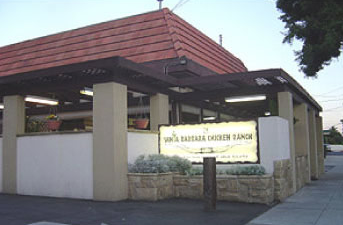
"My business is not tourist based; we have the same customers coming back. If you can keep your employees then you can recognize those customers and provide them a place where the staff knows them," said Matt Benko, owner of the Santa Barbara Chicken Ranch. Courtesy photo.

“My business is not tourist based; we have the same customers coming back. If you can keep your employees then you can recognize those customers and provide them a place where the staff knows them,” said Matt Benko, owner of the Santa Barbara Chicken Ranch. Courtesy photo.

Does “buying local” really make a difference? In addition to leaving more money in the community by keeping their profits here, local business owners also cite long-standing employees, customer service, product distinctiveness and community involvement as advantages to “buying local.”

“My business is not tourist based; we have the same customers coming back. If you can keep your employees then you can recognize those customers and provide them a place where the staff knows them,” said Matt Benko, owner of the Santa Barbara Chicken Ranch. “Continuity of staff is critical. It takes a good six months or more to train a cook,” said Benko, who took over the restaurant (and renamed it) when his mother died in 1992. He has one 15-year kitchen veteran, “the first guy my mom hired,” and many other veteran staffers.

Blue Booth, owner of Vices and Spices for 28 years, also emphasized the importance of staff continuity. “One of the things that we do is we’re really focused on real personalized attention. The way we can accomplish that is having the same staff over a long period of time.”

At least 10 of the 30 Chaucer’s Book’s employees have been there more than 10 years, said Mahri Kerley, who in November will celebrate her 29th year as the bookstore’s owner. The staff has undergone extensive training, she said, and “it’s not an easy thing to do.”

Product distinctiveness is another advantage noted by local business owners. “The main thing that sets us apart is that we use mesquite charcoal and only charcoal,” said Benko. It’s cheaper and easier to use gas but the taste isn’t as authentic. Comparing chains such as Taco Bell to local Mexican restaurants, “the spiciness, the flavor goes away as you try to appeal to a lot more people. They blandify it.” But restaurant owners get better quality food when they say, “this is my product” and don’t try to appeal to the masses, said Benko.

While large chain bookstores have enough space to “hold dances in their aisles,” said Kerley, “in almost any section you can think of, I think we’ve got a much better selection than you’ll find in the chains. I like to think the whole store is distinct.”

Being customer-service oriented is another advantage cited by Kerley. ” We can get pretty well anything by special order.” She also points out that Chaucer’s customers do not prepay for special orders.

A personalized touch is important, said Chris Martin, co-owner of Mojo Coffee in Goleta, who trains employees to be themselves and “not be a certain way that the corporations are programmed into teaching their employees.”

Benko also mentioned flexibility as a selling point. “Local restaurants can do things that national chains can’t do. If somebody says ‘This isn’t what I ordered,’ you have the ability to just give them what they want. Whereas (with) a national chain, it’s much harder for them to do that. They have to be more concerned with theft, because they’ve got this on a grand scale.”

Martin also mentioned flexibility in dealing with both employees and customers as an important local business advantage. Six of his 10 employees have been with Mojo from the beginning, and the only reason the four others left is “because they graduated. It’s just a whole better working relationship.”

All of the local business owners mentioned the importance of giving back to the community by providing donations and discounts to schools and other nonprofit groups. “I donate and get involved as much as I can,” said Martin, who has adopted two local elementary schools and a local high school through the County’s “Adopt a School Program.”

“I give gift certificates to every school and church that asks,” said Benko.

While the intangible benefits to the community such as charitable support and customer service are difficult to quantify, in an analysis of local merchants versus chain retailers in the Austin, Texas, area, Civic Economics found that “local merchants generate substantially greater economic impact than chain retailers.” In fact, the study found that for every $100 in customer spending at a national chain, “the total economic impact was only $13, while that same amount spent with a local merchant yields more than three times the local economic impact ($45).”

Other than the Civic Economics study, however, there has been very little objective, fact-based analysis of whether or not “buying local” really makes a difference in a community.

In some areas there are tax incentives given to attract large retailers, but that doesn’t appear to be the case here. “If they have a business and they sell out of that building, the sales tax is going to that area, regardless of whether it’s a huge corporation or not,” said Brian Richard, head of property tax for Santa Barbara County.

The Four Seasons Biltmore Hotel, Sak’s, Trader Joe’s, Sears and Borders were all mentioned by the Santa Barbara Chamber of Commerce’s Steve Cushman as being very active in the business community.

Costco is also active, said Mike Edwards of the Goleta Valley Chamber of Commerce. Barbara Keyani, spokesperson for the Santa Barbara School District, also lauded Costco for its generosity.

Also citing the community support of larger corporations was Judy Hawkins, development director for Women’s Economic Ventures, a local, nonprofit organization dedicated to helping women entrepreneurs. “We are very lucky to have quite a bit of very generous corporate support.”

Ultimately the uniqueness of this area may be what keeps local businesses thriving, despite increased competition from chains.

“In my experience, Santa Barbara is different from a lot of places,” Benko said. “People are willing to go to Farmer Boy’s over Denny’s, even though (Denny’s is) right across the street. I think Santa Barbara people almost actually resist (the chains) because they don’t want it to become L.A.”

Originally published in South Coast Beacon on August 7, 2003.

Parting shot

The court of public opinion is a tough one in which to play ball. It’s charged with emotion, unpredictable and, ultimately, the victories won are hollow and imprecise. Do the squeakiest wheels actually represent a majority opinion, or merely a loud one?

In the case of the proposed beach basketball courts, we’ll probably never know.

Presented with a disproportionate amount of public criticism, and few supporters willing to get into the game, architect Barry Berkus recently withdrew his support for the project he’d once offered to shepherd.

“There are not a lot of hours in the day,” said Berkus, who devotes 25 percent of his time to philanthropic endeavors. “This has really turned ugly because the aggressive people went after me personally. There are a lot of letters that weren’t published, a lot of people who will not get into a fray. It’s a shame that a few can take away the dream of many … I guess I’m going to learn how to play drums on the beach.”

An active opponent of the project, Mike Larbig, said he got involved initially to try to protect the quality of his local (Shoreline) park. When that site was shot down, the new father of twins said he thought long and hard about whether to continue to fight the project. Ultimately, frustration over the process was what kept him going. Proponents never really demonstrated this big public need or desire for a court, said Larbig.

Indeed the biggest unanswered question in the whole fiasco — other than “What would Pearl Chase think about courts at the beach?” — is whether we have enough basketball courts to fulfill the community’s needs. The available public courts are in ill repair, according to Berkus. Others argue there are plenty of perfectly good courts sitting unused around town. The letters to the editors keep on coming, but the concrete facts are few and far between.

“No, there has never been a needs assessment,” said Billy Goodnick, project coordinator for the Santa Barbara Parks and Recreation Department.

Nor has the Santa Barbara School District done a study of basketball court use, said spokeswoman Barbara Keyani.

At the end of a recent Santa Barbara City Council meeting, Councilman Gregg Hart offered his post-game analysis. Unfortunately, many of the major players in the court of public opinion had already gone back to the office to file their stories.

“I am saddened by the level of discourse in this debate. The vitriolic, mean-spirited attacks on Mr. Berkus … his motives. This is about providing a recreational opportunity for the community,” said Hart.

But sports are about a lot more than recreation. One of the fundamental values they teach is to respect the other team. In tennis, if there’s a question about a line call, you must decide in favor of your opponent. In other words, give them the benefit of the doubt.

Both Berkus’ drive to build the courts, and his opposition’s desire to preserve the beachside integrity should be commended, not criticized. Acting with the best of intentions, at least they had the courage to get in the game.

It’s not for nothing that in basketball — win or lose — you shake hands at the end of the game. It’s one court where actions speak louder than words.

Originally published in South Coast Beacon on July 24, 2003.

Landshark may not be beached

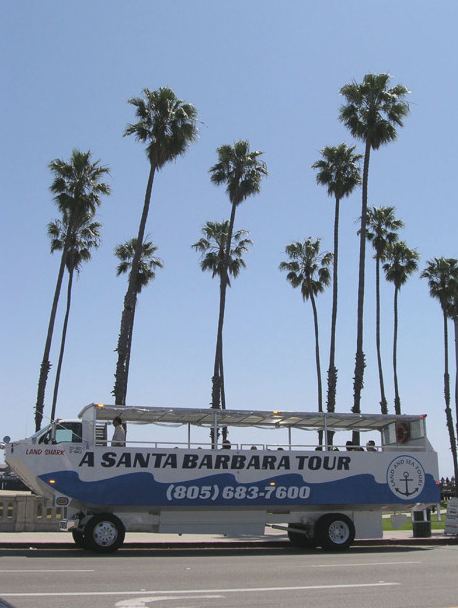
Landshark, courtesy photo.

Landshark, courtesy photo.

“This shark doesn’t bite,” at least not according to J.P. Manoux, “second mate” of the Land Shark Hydra Terra vehicle, which was beached by the Santa Barbara City Council at its meeting July 1.

According to Manoux, the waterfront staff spent months “thoroughly researching the safety and sensibility of this kind of business in Santa Barbara” and expected routine approval for a one-year license agreement with the city.

Manoux’s brother Andre — who owns the $250,000 amphibious vehicle and its booking company, Land & Sea Tours — was so certain the council meeting would go smoothly, he spent the afternoon getting his Coast Guard certification.

Skipping the meeting proved a costly mistake. J.P. Manoux said the council did not vote with a completely educated point-of-view, citing misinformation about the size, noise and aesthetics of the vehicle. He is now attempting to salvage an agreement by providing the council with extensive documentation. The size of vehicle and the noise levels actually compare favorably to charter buses, according to J.P. Manoux.

Despite the Manoux’s effort to “be very respectful of the city’s position” they’ll face some rough waters in their attempt to win council approval. “When we vote on an issue, we cannot reconsider it for 90 days,” said Mayor Marty Blum.

Though the Land & Sea Tours license agreement, which would have yielded the city 5 percent of the Land Shark’s sales, is moot until October, Andre Manoux has not given up hope. He is asking the council to grant an exception to the existing ordinance that prohibits vehicles over 33 feet from entering the harbor parking lot, effectively land-locking the Land Shark. Waterfront Director John Bridley said, “The intent of that code was for parking purposes. We do have (larger) vehicles, unfortunately, that do enter the parking lot now, for purposes of delivery, drop offs, beer trucks, UPS trucks, and charter boat operators. … However, we’ve gotten our direction from the city council. We’re not expecting or anticipating further action.”

In addition to trying to fight city hall, Land & Sea Tours is also in search of community support for the unique vehicle. Last week its phone message pushed proponents to call Mayor Blum, and this week’s message urged calls to council members as well. The pros and cons seem to be about even, according to Blum. “People are aware but not incensed. I had people stop me on the street to say thanks (for not allowing the vehicle).”

Keeping the vehicle out of the water may be easier for the council than keeping it off the streets. With harbor access denied, in order to remain commercially viable the Land Shark will run eight 45-minute land tours per day, instead of the four 90-minute amphibious tours planned. “We are a licensed sight-seeing tour business. Now we’re sort of forced to spend more time on the streets if we’re to run as a business. …We don’t want that and they don’t want that,” said J.P. Manoux.

Originally published in South Coast Beacon on July 10, 2003.

Rising Up

There’s a startlingly small degree of separation between the general population and mental illness. One out of every three people is personally affected — either they or someone close to them are mentally ill — said Denee Jordan, clinical director of Phoenix of Santa Barbara, a nonprofit mental health agency.

Dedicated to both treatment of the mentally ill and education of the general public, the Phoenix team is “putting a lot of mythology of mental illness to rest just by being here in a neighborhood,” said executive director John Turner.

The neighborhoods are 107 East Micheltorena St., home to Phoenix House, a transitional residential treatment facility; and 1231 Garden St., headquarters for Ada’s Place, a less structured transitional care facility. Also under consideration is an additional property at 37 Mountain Drive.

“In some cases the clients are indistinguishable from other people. With services and medication some of the mentally ill can live lives that are normal,” Turner said.

The agency, which celebrated its 30th anniversary last year, serves clients with a variety of conditions, predominantly schizophrenia. Two years ago it added a dual-diagnosis program for mental illness and drug addiction. Usually the two illnesses are treated separately, but according to Turner, these clients need specialized treatment.

“There’s no definitive line between mental illness and substance abuse but you can’t clearly see the difference in the two behaviors” said Jordan.

The staff has been trained to understand the complex relationship between sobriety and mental health. The Phoenix program is based on an adaptation of 12-step principles used by Alcoholics Anonymous. The county is also starting a dual-diagnosis certification program that will eventually be open to the public, said Jordan.

It’s not that the mentally ill are more susceptible to addiction, “but I think that the outcome can be worse. They’re already struggling with organizing their thoughts, without introducing substances,” she said.

“Someone with mental illness symptoms may use street drugs to cope with the symptoms,” said Turner. While there are now fewer side effects associated with antipsychotic drugs, they’re still very uncomfortable, said Jordan. Getting the mentally ill to stay on their medication is a huge challenge. “It has a lot of adverse side effects. The general population thinks they just don’t want to stay on it because they’re not behaving themselves,” a misconception, according to Jordan.

Emphasizing the importance of medication compliance, Turner said one of the keys to success is for staff to check in daily with clients in the outpatient program who may be ambivalent about taking their prescriptions. “Really good rapport is key for a good relationship between staff and client.”

While Turner admits that “introducing the concept of recovery into mental health is fairly novel,” his team is committed helping clients live as normally as possible. Among the guiding values of Phoenix are being creative and seeing “fun, humor and artistic expression as central to a full life.”

In addition to her clinical work, Jordan is also a professional ballet dancer with the Plexis Dance Theatre, which performed a piece on schizophrenia last year.

“I’m a great believer in how we can really shift people from maladaptive to functional,” said Turner, who has a masters in social anthropology. “I’m interested in the mix of community and mental health. It’s exciting to see people discover recovery.”

Originally published in South Coast Beacon on July 10, 2003.

One nation, many voices

Patriotism, defined simply by Merriam-Webster as “love for or devotion to one’s country” has become anything but simple in our recent political climate. Throughout our nation’s history, radicals, reformers, as well as those in the middle of the political road, have viewed their actions as profoundly patriotic. What better time to reflect on its meaning than this week, as we celebrate Independence Day. Here is what some South Coast residents had to say when asked, “What does patriotism mean to you?”


“Patriotism to me isn’t blindly following the bellwether of the most powerful political trend. … Patriotism IS the unrelenting need to challenge the forces that seek to undermine all that our Forefathers created.” —Charles Rice, Gay Santa Barbara.org


” Patriotism is also not about waving the flag. … It is found in the responsibility we take in our daily lives to build the community we call America. Patriotism is about being well informed about what is going on in the world … being registered to vote and voting … offering constructive and civil praise and criticism to our government and being free to do so; and, it is about believing and supporting our rights granted under the Constitution.” —Marty Blum, Santa Barbara mayor

“Patriotism is the love of a nation that protects our freedom and human rights.” — Jane and George Arakelian, Jerusalem natives, Santa Barbara residents

“Patriotism … means believing that my country and the freedom it gives each individual to make the most of himself, is a unique and precious treasure that is not found anywhere else in the world.” — Sandee Beckers, community volunteer

“Pride in being an American — no hyphens in front or back of that. Joy in seeing the glorious American flag with its brilliant stars and stripes while visiting foreign nations. Love of our magnificent natural resources. Enjoying the friendship that is so typical of Americans.” –Jean Blois, Goleta city councilwoman

” … For me, patriotism means being ‘always ready’ to answer the call (whatever the mission may be) and to be an active and positive member of my local community.”– Lt. Bryan Clampitt, Coast Guard, Channel Islands Harbor

“I’ll give you two quotes (from other people). Patriotism is the last refuge of scoundrels. Peace is patriotic.” — Mickey Flacks, community activist

“Patriotism does not mean my country right or wrong. It means being an informed citizen. One who votes. One who embraces America’s founding principles and speaks out when those principles are endangered or ignored. It means questioning the notion that America has a divine mandate to rule the world. Real patriots seek peace.”– Linda Stewart-Oaten, writer


“It’s really too bad that patriotism has become identified with a particular conservative political ideological position and that isn’t true about the history of American patriotic expression. People’s commitment to America is not to be measured by whether they wrap themselves in flags, but what they do to make the country as good as it wants to be, and preserve its values.”– Richard Flacks, UCSB professor

“Patriotism means standing up for individual rights and limited government. For liberty to prevail, we must be forever on guard against every form of tyranny.”– Gregory Gandrud, Carpinteria city councilman

“I feel patriotism means standing behind our service men and women that defend our country every day, no matter what our political views are.” — Lola Georgi, wife of Col. Daniel Georgi

“… Being patriotic is a little bit like being married. You love your spouse and more often than not feel like they are the absolute perfect fit for you. Occasionally, you may disagree on various issues, but it doesn’t mean that you stop loving and supporting them. And when the chips are down, boy, you had better be there, defending them with all your heart.”– Ashley Snyder, mother of three

“Patriotism is an addictive escape that is self-servingly pawned off on the public by corporations and governments in order to wrest freedom from individuals and prevent us from facing and overcoming our fears.” — Justin Weaver, concert manager

“Patriotism is where a person does everything they can to help all people find happiness.”– Tobias Larouche, salesman

“Patriotism is a love for your country and strong desire to protect our hard-earned constitutional rights. There is also a hope that your country will live up to your expectations by taking care of all of its citizens, using honesty and integrity, and being a positive role model for the rest of the world.” —Catherine Dishion, United Nations Association, Santa Barbara Chapter

“Patriotism is about defending our way of life, our values, and remembering those who sacrificed their lives defending our freedoms. … I like to remember the thousands of Native American men and women who have sacrificed and served in the U.S. military — from the Revolutionary War right up through the war in Iraq — so that all of us who live on this land may be free. — Jon Gregory, general manager, Chumash Casino


“Patriotism for me is the act of celebrating those who vehemently disagree with me and recognizing that our debate, and the fundamental right to disagree, is what unites us as a country.”– Ben Romo, political consultant, Romo & Associates

“… Pride of country, love of family and children, respect for differences of cultures and more, basking and relaxing in the beauty of our local community and most important, getting teary-eyed each time we sing ‘God Bless America’ and watch our flag march by!”– Catherine Lee, executive director, Montecito Association

“Patriotism is being proud of your country.”– Marley Taylor, Girl Scout cadet, age 12

Originally published in South Coast Beacon on July 4, 2003.

Exit strategies

With the impending departure of Fidelity National Financial to Jacksonville, Fla., and the speculation that other large employers may follow their lead and flee, one has to ask, how friendly is this community to businesses?

Rumors abound that Santa Barbara’s other Fortune 500 company, Tenet Healthcare, may also be pulling up stakes, but company spokesman Steven Campanini denied that.

“A move is not under active consideration,” he said. “Leaving Santa Barbara is not even on our radar screens.

“Although,” he laughed, “I’m not happy with the weather this week.”

June gloom aside, the weather is undoubtedly one of our region’s greatest advantages. But despite the lush climate, is Santa Barbara a friendly place to do business?

It ranked 31st on Forbes magazine’s 2003 “Best Places for Business and Careers,” based on a variety of weighted criteria. The areas in which Santa Barbara scored the best were crime rate and education, and it ranked lower on cost of doing business and housing afford-ability. A 2002 metropolitan — rather than city — ranking, conducted by Forbes and the Milken Institute, also ranks the Santa Barbara-Santa Maria-Lompoc area at No. 31.

Some doubt the veracity of this type of ranking.

“There’s no real scientific measure of business friendliness,” said Bill Watkins, executive director of the UCSB Economic Forecast Project. “The problem with those sort of ranking systems is that they’re based on somebody’s value judgments of what is best. Given our environment, (our level of business-friendliness) is appropriate. If unemployment were higher it might be different.”

A report by the Public Policy Institute of California appears to support Watkins’ position, stating, “The idea that there is a single business climate in the state that is applicable for all businesses and regions is too simplistic.”

Despite the oversimplification, when the California Technology, Trade and Commerce Agency was questioned about the number of businesses leaving California, it said data was not tracked by the government, instead pointing to research from Fortune magazine (No. 1 state with 53 Fortune 500 companies; 15 of the “100 best companies to work for”); Inc. magazine (No. 1 for “fastest-growing companies”); and Forbes (five of the top 25 fastest-growing tech companies).

“We consider it to be very friendly here,” said Raytheon spokesman Ron Colman. “We have no plan at all to move.”

While Raytheon Vision Systems, formerly SBRC, recently purchased a new building in Lompoc, and plans to locate 40 employees there by year-end, Colman said that expansion was predicated on the specific need for a clean-room facility and has no implication for future expansion into the North County at the expense of the South Coast.

“In a weak economy we tend to be a little more friendly,” said Steve Cushman, executive director of the Santa Barbara Region Chamber of Commerce.

“In the North County, there’s more available square footage … they’ve created more incentives … the approval process is faster and more dependable.”

Regarding the permitting process, Dave Gustafson, Santa Barbara’s assistant community development director, cited ongoing efforts to streamline the development approval process.

“I don’t think we’re all that unpredictable,” he said.

On the housing issue, he continued, “We are constantly looking at land-use strategies to try to accomplish affordable housing for the workforce.”

State-mandated constraints such as insurance and workers’ compensation are also a business concern over which “the city has no control,” said City Councilman Dan Secord.

“Employers must pay the freight for richer benefits to the injured worker,” he said.

Secord urged an active business retention program for the city to “express the city’s caring for business, whose productivity in jobs and taxes make the other city services possible.”

Thus far, Goleta city officials have not announced any plans for business retention or future outreach programs. Calls to Mayor Jack Hawxhurst for comment on business issues were not returned.

The city of Santa Barbara is planning a series of meetings with different business segments in the community to see how it can best address their needs, Gustafson said.

“Businesses want to be appreciated,” Cushman said.

Cushman cited Alias-Wavefront and Openwave (formerly Software.com) as companies that followed a familiar scenario of starting here, getting acquired or merging, and eventually having the parent company question the expense and travel inconveniences of being located in Santa Barbara.

While Tenet seems to be staying for the moment, “Vetronix is on the edge,” Cushman said. “We’re hoping they’ll stay.”

When questioned about the city’s efforts to try to retain Fidelity, senior vice president Daniel Kennedy Murphy said, “As far as I know, nothing really was done.”

Meanwhile, Fidelity chairman William Foley was quoted by Jacksonville’s First Coast News as saying, “Jacksonville actually wants to have us. California likes having us, but it isn’t very concerned about not having us.” Foley declined to return a Beacon reporter’s phone calls on this matter.

“I think it (the Fidelity move) was a surprise to us,” Gustafson said.

“I think there was not anything we could have done to stop it. Florida gave them $12 million worth of subsidies … We don’t have the financial tools to compete,” he added.

As for preemptive gestures to secure Tenet’s future in Santa Barbara, Campanini said there’s been “no interaction with the city that I’m aware of. You would have to ask the mayor’s office.”

Gustafson answered queries to Mayor Marty Blum.

“Over time there’ve been lots of meetings with Tenet. Many, many meetings with them,” he said.

“I don’t know, to be honest with you, about with Fidelity. I believe there’s one pending with Tenet’s new chairman.”

On the business growth vs. lifestyle issue, he said, “If we were looking to attract large Fortune 500 companies there might be environmental issues to that growth. This gets into the whole growth, and quality of life balance.”

Originally published in South Coast Beacon on June 19, 2003.