
Santa Barbara police say gang activity is on rise

School board hears good news, bad news in latest report

Gang activity is increasing on Santa Barbara’s streets. Arrests are up 51 percent, from a total of 189 in 2002, to 369 gang-related arrests in 2004, a Santa Barbara police official told the Santa Barbara school board Feb. 8.

“The good news is that when it comes to schools, we have seen very few isolated incidents during this past year,” said police Sgt. Ralph Molina, attributing that to the strong relationship between schools and police.

According to Molina, one of the reasons for the increased activity is that older gang members who were incarcerated are now back on the streets. “They begin to go out and recruit and their numbers begin to increase,” he said.

Molina estimated that there are 3,000 gang members in Santa Barbara County, with approximately 1,000 of them in Santa Barbara, Goleta and the unincorporated area in between. He estimated there were about 600 gang members in Santa Barbara alone, with 40 percent of them under the age of 18 and about half of that group in junior high.

Board members requested the presentation after a recent expulsion of a student involved with gangs.

“My experience is that about 90 percent of these kids that are gang members, are pretty good kids,” said Molina, who has worked in the gang unit for the past 13 years.

“They just have a lot of serious problems and they turn to that lifestyle without knowing an alternative. … You’ve got to find out what they’re all about if you’re going to deal with them, you can’t just arrest them and put them in jail.”

Molina said he is also seeing a connection between gangs and drugs.

“A huge connection,” he said. “All the other cities outside of Santa Barbara have had that problem for years, where it’s been gangs and drugs. … The last couple of years we’ve seen a huge increase with gangs and selling of drugs.”

Molina said he is also seeing a lot of large gang fights, especially among younger members.

“The kids between 13 and 17 are keeping us busy. … That seems to be the core of the activity.”

There is also some evidence of increased gang activity among girls, but it’s harder to document, Molina said. “They’ll portray themselves as the girlfriends … we know that they are associating. … We’ve seen an increase on the girls and there’s been a couple rumors that they’re trying to form their own gang, but that we haven’t seen yet.”

As a result of the increased activity, in January 2004 Santa Barbara police brought back the youth services unit and increased the enforcement level, which may explain some of the increase in number of arrests, Molina said. He added that he would like to see the school district reinstitute a program in which officers taught classes on gang violence. Funding for the program dried up a few years ago.

When asked by board member Nancy Harter whether there was a correlation between loss of funding for these types of programs and increased gang activity, Molina said he wasn’t sure.

“There’s always more we can do,” he said. “The schools do a good job. There are a lot of community-based organizations that really get involved. (We need) everyone working together to deal with this.”

Originally published in South Coast Beacon on March 17, 2005.

Environmental center named to UN commission

Santa Barbara’s own Center for the Study of the Environment was recently appointed by the U.S. Department of State to serve on the United States National Commission for the United Nations Educational, Scientific, and Cultural Organization (UNESCO).

The United States re-entered UNESCO just last October, and will hold its first annual conference in Washington, D.C. June 6 and 7, where CSE will join a prestigious group which includes the American Association for the Advancement of Science, the National Academy of Sciences, the National Academy of Engineering, The American Geological Institute, The American Physical Society, National Geographic Society, and the Woods Hole Oceanographic Institute.

Professor Emeritus from UCSB and the former Chair of the University’s Environmental Studies Program, Daniel B. Botkin founded CSE in Santa Barbara in 1991 as a non-profit organization to conduct objective, independent, scientific analyses of complex environmental issues.

Independent research was a key tenet in founding the organization. Otherwise, as noted by Botkin on the CSE website, “You start with a good idea and end up with a bureaucracy.”

“The idea was to set up an organization independent of the other institutions, really to be able to provide good scientific and educational data around the environment, to really give the best possible information free of any particular bias … trying to make it as scientifically independent as possible,” said CSE vice president Mark Marzolla.

The mission of CSE is to “serve all facets of society by providing science-based analysis that identify optimal solutions for environmental concerns.” The objective is to generate options that address the problems at hand without subordinating information or evaluation to the bias of various political viewpoints.

“In this time of increasing world tensions, communications among nations about education, science, and culture can help alleviate misunderstandings of many kinds,” said Botkin, adding “participation in the U. S. Commission fits well with the educational and scientific goals of the Center.”

In making this appointment, Secretary of State, Colin Powell, wrote “I am confident that the Center for the Study of the Environment will contribute significantly to the value of the Commission’s work.”

Additional information about the U S National Commission for UNESCO can be found at www.state.gov/p/io/unesco or at CSE’s website, www.naturestudy.org,

Originally published in South Coast Beacon on March 10, 2005.

Kids put the squeeze on the boundaries of cuisine

Photo by Mojpe, Pixabay.com.

Photo by Mojpe, Pixabay.com.

“When it comes to feeding your kids, everyone’s a critic,” warned my friend Lori.

Sure the food police may be creeping around cafeteria corners and leering at grocery carts, but I’ve come to realize that when it comes to kids and food, there are a lot more hypocrites than critics.

I, for one, am happy when my son eats at all.

Can he really be the only kid in the United States who has never — not a single day in his young life — managed to down the federally-recommended three servings of vegetables, two servings of fruit and two servings of milk per day?

And I’m told, by other concerned parents who are apparently better able to shove food into their children’s small orifices, that when he turns seven he’ll need even more fruits and vegetables. At this rate, he’ll need a broccoli I.V. and brussel sprout drip or he’ll never be able to catch up

Who are these kids that are eating all of these fruits and vegetables? I’ve certainly never met them.

I called the USDA, and they put me in touch with the five-year-old boy who actually follows all of their guidelines. His name is Oliver Q. Stump, and he lives in Denver, CO. He’s in great health, reading at a fourth grade level, and is exceptionally well mannered. However, I found him to be an exceedingly dull conversationalist.

Have a Butterfinger, Oliver. You need to lighten up.

The rest of us can only try. At their Valentine’s Day party, my son’s kindergarten class not only had cookies and cupcakes on the sign-up sheet, but also fruit and vegetables.

I was impressed. Unfortunately, none of the produce actually made it to the party, and I was surprised to find that when the kids opened their Valentine’s cards, at least half of them contained candy.

Were these the same moms that complained about unhealthy croutons in the school’s salad bar?

I had been buying red and pink foil chocolate concoctions for weeks, but it never would have occurred to me to share them with my son, let alone his classmates — and it’s not just because I don’t share chocolate.

While I’ve been following the progress of “healthy chocolate” research at Mars Inc. for years (according to the New York Times, dark chocolate Dove bars are now loaded with more cardiovascularly-friendly flavanols than many green teas), I know better than to make five-year-olds into lab rats.

I prefer my selective scientific gullibility to work only in my favor, not against the integrity of my son and his friends.

“I want to teach my kids that carrots are just as much of a treat as M & Ms,” said my friend Jody.

Good idea, though there’s a reason they never made Willy Wonka and the Rutabaga Factory into a movie.

If it actually worked, there would be a bunch of orange-tinted kids on the playground instead of a bunch of fat kids. For those of you who didn’t get the memo, or have been living under a rock for the past decade, this will be big news: Kids are eating too much junk food and not getting enough exercise.

In other words, they’re acting like adults.

“Can we go to McDonald’s for dinner, Mommy?” asks my son. “They have salads.”

This is how he tries to sell me on McDonald’s, with the temptation of a 12,000 calorie salad — for me. Nonetheless, “Would you actually eat something if I take you there?” I plead.

That’s how low the bar can drop in our house sometimes.

My son, who is five and weighs less than his three-year-old cousin, is almost never hungry. That is, unless he’s sucking up to Grandma or it’s time to go to bed. Then he suddenly gets an appetite.

Anyone who’s ever met me knows this is clearly not genetic.

Ever look up “food issues” in a psychology journal?

My mom was the one who gave me Tab in my fourth grade lunch box and gave out pencils on Halloween.

My dad was the one who made me the top seller every Girl Scout cookie season. He would eat them before I could even make the rounds of the neighbors, a weakness later discovered by the SBCC women’s volleyball team, who made a fortune by storing their fundraising candy bars in his office one year.

My husband is the tall, skinny guy who, after years of cutthroat “eat all your vegetables” contests with his siblings, has not had anything green pass his lips (other than a beer on St. Patrick’s Day) since he left home for college.

And I am the one who rejoiced at the healthy kids meal we recently had at Bubba Gump’s in Long Beach, which included carrot sticks and celery with the chicken strips and fries.

My heart went pitter-patter when Koss actually ate a carrot.

So what if he mistook it for a French fry, he still swallowed.

Like I said, the bar is low.

Originally published in South Coast Beacon on March 3, 2005.

Las Positas residents urge council to get a plan

“We need a general plan update, and guess what, it’s happening,” said Santa Barbara City Councilman Brian Barnwell, hitting the heart of the city’s response to a group of Las Positas Valley residents who called for a comprehensive plan to address the development and traffic issues in their area.

An estimated 75 people packed the council chambers on March 1, representing groups such as the Allied Neighborhood Association, Veronica Springs Neighborhood Association, Hidden Valley Residents Association and others who were concerned about piecemeal planning in that area, parts of which are under city control and parts of which fall under country jurisdiction.

Critics of the planning process cited two pending projects — the Hillside House proposal of up to 127 units and the Veronica Meadows project (owned by Mark Lee), which calls for 24 two-story homes off Las Positas Road — as particular areas of concern. The rebuilding Cottage Hospital, potential development at Elings Park and the future of Earl Warren Showgrounds were also mentioned as projects that would impact the quality of life in the Las Positas Valley.

Speaking for the Allied Neighborhood Association, Lloyd Applegate said, “If Santa Barbara is to live within its resources, it behooves us to determine just what the city’s resources are before risking to do further damage to our quality of life.”

Others contended that Santa Barbara already has a thorough planning process and there’s no need to undergo a comprehensive study of the Las Positas valley.

“It’s incorrect to assert that the city considers projects on a piecemeal basis,” said county planner John Polansky, who works with the city on many projects.

“We are very comfortable with the city’s current planning process,” said Pam Flynt, executive director of Hillside House, which elected to annex its property to the city, rather than remain in the county during this development phase.

The council will have a joint session with the Planning Commission on March 10, at which time the Las Positas area will be discussed as part of the overall General Plan.

Originally published in South Coast Beacon on March 3, 2005.

Raytheon brings science back to school

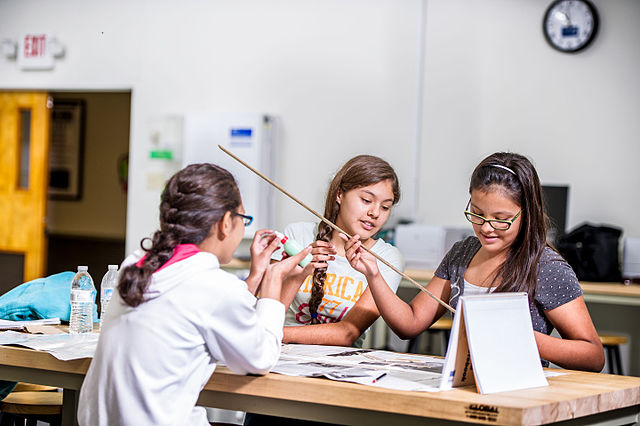
CMS Girls Engineering Camp, photo by Texas A&M University, courtesy Wikipedia Commons.

CMS Girls Engineering Camp, photo by Texas A&M University, courtesy Wikipedia Commons.

Washington School hosts “Introduce a girl to Engineering Day”

There’s a guy I know who was so concerned about the disproportionate number of women in math and science that when his daughter was born, he vowed that every time she was complimented on her looks, he would add the postscript, “and she’s good at math and science too.”

The aerospace company Raytheon is also concerned about the number of women going into math and science, but it’s taking another tack than my friend.

“Three Cheers to Engineers!” was the slogan at Washington Elementary School on Feb. 25, where Raytheon hosted an “Introduce A Girl to Engineering Day” for more than 60 upper grade students.

“Math Rocks!” was one of the four learning stations, where students were challenged to build moveable cars out of candy, cookies and frosting (similar to ginger bread houses), where each of the ingredients had a point-value, and the points couldn’t add up to more than 300.

“The best part is eating the cars when you’re done,” said Sarah Strickland, one of several financial analysts who helped plan the project.

Electrical Engineer Lisa Dunn, who just two years ago was the president of UCSB’s Society of Women Engineers, worked with a group of kids constructing boats out of tin foil. They used their engineering skills to make a seaworthy craft and their math skills to figure out the maximum number of pennies their boats would float.

Software Engineer Ben Burleson was the “balloon flinker,” helping the students test gravity, using foam cups filled with packing peanuts and attached to helium balloons.

Helium also played a critical role in the hovercraft experiment, where students like Gwen Archambault and Korrina Harmsen created floating vehicles out of balloons and paper plates.

Materials and Process Engineer Elizabeth Mallon gave the keynote speech, explaining the difference between engineering and science to students, who were eager to find out what the different industries are that use these skills and what kind of education is needed.

“They asked a lot of questions,” said Mallon. It’s not like high school presentations where they’re too cool — or too shy — to ask.

“Women are very smart and clever and we want to get more of them in our workforce,” said Francisco Cabrera, in explaining to the students (including a few boys) why Raytheon had sponsored the event.

Raffle prizes included an autographed book about Sally Ride, junior science kits, fiber optic lead pencils and more, including the grand prize — a home planetarium star theatre, which went to Caitlin Connor.

Raytheon also donated engineering books, videos and bookmarks to the Washington School library and all of the participating students received “Three Cheers to Engineers!” t-shirts, as well as goodie bags, said Isabel Villegas, the Human Resources representative who coordinated the whole event, as part of Raytheon’s observation of National Engineering Week.

Last year the company hosted Kellogg School students at Raytheon, but spokesman Ron Colman said next year they’ll pick another elementary school and bring the program to the students, since they got an even better turnout than expected.

Raytheon also hosted a week of job shadowing with members of UCSB’s National Society of Black Engineers, which included an engineering competition, an ice cream social and a free hot dog lunch.

“We’re hoping to hire some of the students that came in,” said Villegas, adding that last year’s AS president Jamie Fitz-Gerald is now working at Raytheon.

Originally published in South Coast Beacon on March 3, 2005.

Hospice offers tips for dealing with grief in the workplace

“People who grieve the death of a loved one are going to grieve it wherever they are,” said Hospice of Santa Barbara executive director Gail Rink, adding, and that includes the workplace.

Educating local businesses about how to deal with grief in the workplace and the free services Hospice provides was the subject of a Feb. 24 luncheon.

“It’s a passion for me that you people get a message,” said Rink, as she spoke eloquently about her struggles at work — even in an office that deals daily with death and dying — after her brother was murdered in Georgia. “Death is a very personal event and grief is a very personal event.”

When a coworker suffers a loss, feelings and symptoms of grief can take weeks, months and even years to manifest. “We have triggers in grief that come out of the blue — we can’t control them,” said Joanne Talbot, director of counseling services for Hospice.

There are still ripples in the workplace from the 2002 drowning death of 14-year-old Katie Janeway at Los Banos pool, said acting Santa Barbara Parks & Recreation Director Nancy Rapp. She said she saw a lot of different reactions.

“We had staff who were in denial, we had people who absolutely couldn’t function at all, and everything in between,” said Rapp, who brought in Hospice counselors as part of the response team. They were flexible and provided bilingual counseling when needed, and it was all free, she said.

When one of the counselors in the Department of Rehabilitation died suddenly, Kathy Humphries also brought in Hospice to help. The staff not only had to deal with their own grief, they also had to deal with reactions from that counselor’s clients. “Joanne came in to talk to people about their memories of those people,” said Humphries.

After the death of a coworker, employees can be distracted by emotions that range from confusion to chaotic pain, from dismay to devastation. Hospice advises that organizing an employee support group can provide an avenue for staff to discuss their feelings openly and address ways to deal with grief as a cohesive group.

When a coworker is grieving the death of a loved one, that grief will inevitably be brought into the workplace. Employers should be aware that returning to the workplace can be overwhelming and employees may be tempted to quit for fear of failure or to reduce the pressure on them. Hospice advises employers concerned about the loss of productivity to also consider the alternative cost of replacing an otherwise well-trained employee. Coworkers are told to listen but know they can’t resolve the grief, ask if they can help out, include the grieving person in work projects, ask occasionally about deceased, and alert a supervisor if they seem to be getting worse.

For more information about the free services available from Hospice of Santa Barbara, call 563.8820 or visit www.hospiceofsantabarbara.org.

Grief in the Workplace: What you should know

  • Hidden grief costs U.S. companies more than $75 billion annually, according to the Grief Recovery Institute.
  • Approximately 30 days of work is lost for each employee grieving the death of a loved one.

Grief in the Workplace: What to say

A simple word means a great deal when a person suffers a loss. Saying the “wrong” thing hurts less than saying nothing at all.

Appropriate words include:

“I am sorry to hear about your loss.”

“I heard about your loss. I don’t know what to say.”

A simple shared memory is helpful. “Remember the story you told me about … [the deceased].”

Avoid these phrases:

“You’ll get over it.”

“I know how you feel.” Each person’s loss is unique.

“It was God’s will,” or “God never gives us more than we can bear,” or “At least she isn’t suffering.”

— Source: National Hospice Organization

Originally published in South Coast Beacon on March 3, 2005.

Book introduces kids to idea of fire safety

“In truth, a match is more lethal than a gun in many ways,” said Richard Lambert, author and producer of Go For Safety, a new home fire safety program for children that includes a charmingly illustrated book, and companion CD.

Lambert, president of the Idea Bank, a Santa Barbara-based producer of training videos, CDs and DVDs, said he got the idea of using a gopher game show to teach fire safety (get it … Go For Safety) while having breakfast at the Good Earth Restaurant.

“It just sort of came to me,” he said. “One of the things we’re challenged by when you tell a story is that we are all sort of professional TV watchers in this country,” he said.

The story uses two competing teams of gophers: Gino, Tina and Vinnie Vanilla, who live under Brooklyn, and their challengers, Larry, Louise and Pralina LeClaire from the bayous of southern Louisiana. The distinct accents help children distinguish which characters are talking on the companion CD, which features songs — with music by local artist Mark Henderson and lyrics by Johnny Elkins — and special segments about matches and lighters; smoke alarms; escape plans; and advice like “crawl low under smoke” and “stop, drop and roll.”

Also available are a DVD and lesson plans, including sheet music and coloring activities, designed for use with children aged 7 to 9.

A Santa Barbara native (Lambert Road in Carpinteria was named for his great-great-grandfather), Lambert formed the Idea Bank while living in Arizona in 1983. He returned to Santa Barbara in 1989 as issues of fire safety were becoming better known and his clientele moved in that direction.

In addition to Go For Safety, which will be available at Amazon.com starting next week, Lambert has produced several videos/DVDs on juvenile fire setting, arson awareness and home fire safety, as well as public service announcements that are used by fire departments across the country. Up to now, the Idea Bank’s primary clientele has been public information officers and public safety professionals. This project is the company’s first foray into the consumer market, and Lambert is excited about it.

“Only 16 states in this country require fire safety education in their schools (and California is not one of them). This is a huge problem,” he said. “Smokey the Bear has been around for a long time. I’m trying to reach them with a little bit more energy and updated songs.

“There’s a lot of room at the top … in terms of things that can be done creatively.”

Originally published in South Coast Beacon on March 3, 2005.

County honors women helping women

“Women Change America” was the theme when the Santa Barbara County Board of Supervisors and its Commission for Women honored several local organizations for their ongoing service to women and families on March 1, in honor of Women’s History Month.

First district commissioner Cynthia Thurber presented the honors to Santa Barbara Rape Crisis Center for being a “safe haven for women who have been assaulted sexually.”

SBRCC executive director Elsa Granados said she was proud to receive the award, because whenever the organization gets recognition it raises the visibility of sexual violence and more women begin to access their services.

Second district commissioner Magdalena Torres honored Villa Majella‘s maternity home and outreach program.

“It’s an honor for me today to represent all of the founders, directors, staff, volunteers and donors who have worked for the past 23 years to serve women and newborns in our community,” said program director Mary Andrews-Dalbey. “Above all, I applaud the women who have faced challenges and overcome obstacles in a choice to mother their babies. For many, it became the motivation to turn their lives around. They are what we’re all about.”

Prior to receiving the award, Andrews-Dalbey noted how closely many of the organizations that provide services to women and families work together. For example, after living at Villa Majella for up to two months after giving birth, mothers and their babies are often referred to St. Vincent’s for housing and childcare services. SBRCC and the fourth district honoree, Domestic Violence Solutions, often work closely together as well.

Third district supervisor Brooks Firestone selected the UCSB women’s basketball team as service organization of the year, for its Gaucho Outreach Program, which has been involved with a number of public service projects, including Adopt-a-Highway clean-up on Highway 217 and “Lil’ Gaucho” Clinics held at local schools, said commissioner Mary Ellen Brooks.

“I really think that our community outreach is the classic win-win situation. It is a great ‘Habit of Excellence’ for our women — giving to others and making them feel connected to our community,” said coach Mark French. “Also, it’s good role-modeling for local kids to see the Gauchos take time out of their busy day and do something besides play basketball.”

The fifth district also honored the American Association of University Women.

In past years the Commission for Women has chosen a woman of the year and a teen of the year rather than honoring service organizations. Brooks said it changed its focus in 2005 in order to help bring more exposure to these groups and also to encourage more women to get involved in the community.

For more information on the Commission for Women call 568.3410 or email scantil@co.santabarbara.ca.us.

Originally published in South Coast Beacon on March 3, 2005.

J.R. Richards, former Santa Barbara High Principal

Santa Barbara High School’s colors were green, gold and black this week, as the Dons mourned the death of former principal J.R. Richards, who died unexpectedly on Saturday. He was 63 years old.

Affectionately known around town as “J.R.,” Richards was the only graduate of Santa Barbara High to serve as the school’s principal. He was a mathematics teacher in the Santa Barbara High School District for 25 years, becoming assistant principal at Santa Barbara High School in 1993 and serving as principal from 1995 until the summer of 2003.

“He was the most connected person I think I’ve ever met. Everybody he ever dealt with walked away feeling like he totally cares about him. He established a loyalty in people that came from his own loyalty to them. He made you feel like you were really worth something,” said Peter van Duinwyk, a colleague for 30 years, who retired from Santa Barbara High with Richards in 2003. “He got kids — and teachers — to put out that extra five percent that made all the difference in the world. …Whether on the playing field or state test taking, it’s all related.”

“He had a great sense of humor and was a good teacher,” said Santa Barbara High Teacher Bruce Lofthus, who also taught with Richards at Dos Pueblos High School. He was one of the people responsible for getting me back into teaching. “Just one of those very enthusiastic people. You knew that he was interested in young people and it showed,” said Lofthus, noting that Richards also taught math to his two daughters. “They thought he was great.”

“It is hard for me to think about Santa Barbara High School without thinking about J.R. and his dedication to the staff, students, and school community,” said Superintendent Deborah Flores.

“The more said about him, the better,” said van Duinwyk. “He’s such a community jewel, we want to talk about him as much as possible so that others can follow. … As an administrator, I’d go up and ask him questions. His answer always was, ‘if its good for kids, lets start there.’ And it wasn’t necessarily the thing that everybody approved of. That was his standard.”

Richards’ high standards have lived on at Santa Barbara High. “He instilled so much in the kids and the staff,” said Patty Diaz, his longtime secretary. “The staff knows to put the kids first.”

“He had a lot of stuff done to him that was not equitable, not fair. But he never had a bad word to say about anyone. It was a pure joy to have him around for the additional year that we got him. And that he was able to go out on his own terms,” said Diaz.

Funeral arrangements are pending.

Originally published in South Coast Beacon on February 24, 2005.

CALM Author’s Lunch Serves Up Food for Thought

Greg Behrendt (He’s Just Not That Into You), Joyce Dudley (Santa Barbara County Senior Prosecutor and author of (Justice Served), Karen Joy Fowler (The Jane Austen Book Club), Harley Jane Kozak ((Dating is Murder), Helie Lee ((The Absence of Sun) and Robert K. Tanenbaum ((Hoax) will join the ranks of the more than 70 authors who have informed, amused and moved Santa Barbara audiences for the past 18 years at the annual CALM (Child Abuse Listening Mediation) Celebrity Authors’ Luncheon.

About 800 people are expected to attend this year’s event, which will be held on March 5 from 10 a.m. to 2 p.m. at Fess Parker’s DoubleTree Resort.

Co-chairwoman Sharon Bifano said she was originally inspired almost 20 years ago, by Erma Bombeck’s Celebrity Authors’ Luncheon, to benefit the Kidney Association in Scottsdale, Arizona. When she moved to Santa Barbara and found out that CALM was looking for a new fundraiser, Bifano and co-chairwoman Stephanie Ortale stepped up to create CALM’s first Annual Authors’ Luncheon in 1987.

Unlike many philanthropic events, which pass the chairman’s responsibility on every year, Bifano and Ortale have managed to stick with the author’s lunch, as a team, since the very beginning.

While Bifano said, with a twinkle in her eye, that, “it hasn’t gotten easier,” the income and prestige have grown each year, along with the receipts. “We had 198 people at the first one,” she said. “I think we made about $200.”

Today, at $100 per ticket, the event routinely sells out.

“The success is really a compliment to Sharon and Stephanie,” said Marty Silverman, the CALM Auxiliary’s Second Vice President.

“It’s been a real learning experience,” said Bifano, who credits the late Paul Lazarus with the idea to use a lively interview format with the authors, rather than simply have them make speeches, as many events do.

KEYT anchor Debby Davison and Borders Books’ Kate Schwab will keep the proceedings dynamic, asking the authors questions about the writing process, their inspirations and even their personal lives.

Over the years some of the authors interviewed have included: Sue Grafton, Jane Russell, Barnaby Conrad, Michael Crichton, Julia Child, Ray Bradbury, Fanny Flagg, Maria Shriver and Jonathan Winters.

While big names help fill seats and raise money for the child abuse, sexual abuse and incest services and programs at CALM, Bifano cautions that the “best known celebrity is not always the best interview.” She cites “the two boys who own Three Dog Bakery” (Dan Dye and Mark Beckloff, authors of All-Natural Paw-Lickin Treats for Your Dog and the Three Dog Bakery Cookbook) as among the most entertaining interviews in past years. Another favorite was Iris Chang (The Rape of Nanking). “After the interview all of her books were sold.”

While helping a good cause motivates the authors, as does the chance to spend a weekend in Santa Barbara, Bifano said, “Most people come because we sell a lot of books.”

In addition to purchasing books by the interviewed authors (with a portion of the proceeds going to CALM), the following authors will also be available for book signing: Susan Branch, Jack Canfield (who will also serve as master of ceremonies), Deanna Moreau Cohen, Alan Glasser, Erin Graffy, Valerie Hobbs, Karen Langley, Ann Marie Parisi, Donal Sweeney, M.D. and Flavia Weedn.

Tickets are $100 and are available by calling 682.3925. For more information about CALM, visit www.calm4kids.org.

Originally published in South Coast Beacon on February 24, 2005.