An Interview with Scott and Sheri Martin

When Scott and Sheri Martin looked to buy their first home, using Coastal Housing Partnership (CHP) made the difference between being able to buy “something” and buying a house they really wanted, without compromising.

Both Scott and Sheri grew up in Santa Barbara — attending San Marcos High School, Santa Barbara City College, and UCSB — all the while watching real estate prices skyrocket over the years.

“Even for two professionals that were making good salaries in Santa Barbara, it’s still a daunting task to get into a home,” said Scott, a Strategic Business Consultant.

They pondered their options for a couple of years before Sheri, a first grade teacher at Adams School, went on the CHP website (www.coastalhousing.org) to research mortgage lenders.

One of their first calls was to Christine Errea, at Chase Home Finance, a CHP discount provider that offers back 100% of the processing fee, credit report fee and 1/8% of the interest rate on first mortgages.

“The people on the network are fantastic,” said Scott, giving high praise to both Errea and real estate agent Kristiann Wightman, who owns Presidio Properties, another Homebuyers Assistance Program Participating Organization, which offers buyers back 40% of the broker commission.

With the combined discounts from Chase and Presidio, the Martins were able to purchase a three-bedroom, two-bathroom home in Solvang, which includes an unobstructed view of the entire valley from their backyard.

“We were able to find the place we really wanted to get into, and it was made possible. That’s the thing that CHP really did for us,” said Scott. “We didn’t have to make compromises and that’s what we were honestly, very concerned about for a long time.”

In addition to singing the praises of CHP to their colleagues, the Martins also want to let employers know what a great benefit CHP membership is.

Citing the common complaint of high employee turnover in Santa Barbara County, Scott said, “… If it helps them maintain their employee base and deepen their bench, it’s not just good for the homebuyer, it’s good for the employer too.”

Originally published in the Coastal Housing Partnership Newsletter

An Interview with Jonathan and Kathy Abad

The third time may be the charm for most people, but Jonathan and Kathy Abad had to go through eight unclosed escrows on different houses in order to finally buy their home in Goleta last year with the help of Coastal Housing Partnership (CHP).

Unlike many first-time homebuyers, the Abads had some real estate experience when they came to CHP for assistance, having purchased, upgraded and sold several mobile homes in the area while building up equity to buy a house of their own.

Since 1987, we would move just about every two years to maximize our profits, explained Kathy, who works for Hispanic Business Inc. Once they felt they had built up enough capital, they looked at homes for about a year and a half before finally purchasing their home.

“We basically wanted the biggest amount of property for our buck,” said Kathy. Plus, as parents of two young children, they wanted at least three bedrooms, plus a den to use as a home office.

“We saved a good 12 grand (working with CHP),” said Jonathan. The Abads worked with realtor Kristiann Wightman, (who owns Presidio Properties, a Homebuyers Assistance Program Participating Organization, which offers buyers back 40% of the broker commission) and though they didn’t get a mortgage loan through CHP, they got a discounted loan from a friend who matched the price of CHP’s discount.

In addition to the cost savings from CHP, the Abads were impressed with the educational services offered.

“If we would have known about them five years earlier, it would have really helped us out to learn faster than we would have on our own,” said Jonathan, who works for the Housing Authority of the City of Santa Barbara. “They are there to really answer your questions and you’re not learning from a specific realtor that has a vested interest …you are getting a lot of point of views from people at these kind of workshops.”

He added, “I wish I knew about this six, seven years ago when we started doing this. It would have saved us so much work.”

Originally published in the Coastal Housing Partnership Newsletter

Embracing the joys of laziness

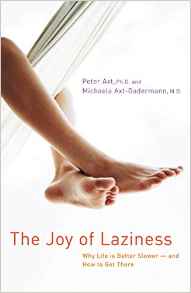
The Joy of LazinessPreparing to embark on a week of holiday leisure, I inventoried my reading material and came across the book I’ve been waiting for my whole life. It’s called The Joy of Laziness. The early bird may get the worm, but late sleepers live longer, according to this wonderful book by German Scientists Peter Axt and Michaela Axt-Gadermann.

You hear that, mom–and every single boss who has dared to give me the stink eye when I stumbled in a few minutes late because I needed that triple latte more than I needed to be on time–late sleepers live longer!

According to The Joy of Laziness, everybody has a limited amount of life energy at his or her disposal. The speed with which this energy is consumed determines your life span. Every day we encounter countless demands on our energy, such as stress, hurry, frustration, cold, sleep deprivation, poor nutrition and an inappropriate fitness regimen. A lifestyle that uses a lot of energy accelerates the aging process, makes you more susceptible to illness, and can even shorten your life.

In other words, laziness rocks! And I’m not the only one who thinks so. I’ve got German scientists behind me on this.

My theory is that the only reason we don’t embrace our laziness more openly–and less guiltily–is those darn pilgrims. All that nonsense about every hour needing to be spent productively and idle hands being the devil’s workshop is just that: nonsense.

Most men I know already embrace the laziness rocks theory. They don’t even notice the dust bunnies hopping off the sofa as they plop themselves on to it. And it would never occur to them to wash the dishes immediately after a meal, or fold clothes as soon as they come out of the laundry. They may be on to something there.

The women I know, on the other hand, have an almost impossible time relaxing just for the heck of it. They join book clubs, so they’ll have some justification to read for pleasure, and get dogs, so they’ll have an excuse to walk on the beach.

My friend Suzanne, who is a stay at home mom, says that she feels guilty for playing with her kids unless her house is perfectly spotless.

“You’re a stay at home MOM, not a stay at home MAID,” I reminded her. Her perfectly clean house always leaves me with a sense of wonder. That is, I wonder how much happier she would be if she stopped cleaning and took the time to read People Magazine, watch Grey’s Anatomy and play computer games like I do.

Nonessential household duties have no hold on me. I hate to do things like wash dishes and make beds when I know that the next day there’ll just be more dirty dishes and more unmade beds. Doing the same housework over and over again makes me feel like a hamster on a wheel to nowhere. Look, it’s a sink full of dishes. Look, it’s a sink full of dishes again! Ooh, look, the dishes are here again!

Sure it’s wonderful to have a clean house and a home cooked meal, but I would much rather write a few more stories and pay someone else to provide those things for me. Especially since the domestic arts are not exactly where my talents lie.

I’ll confess, the worst grade I ever got in high school, I kid you not, was in home economics.

Admitting I’m not a domestic goddess takes a lot of the pressure off, especially this time of the year. One of the great advantages of not cooking–or not cooking well–is you get to be the one who brings wine and cheese and crackers to Thanksgiving dinner.

In addition to not having to ruin my makeup while slaving over a hot stove, there are actually intellectual advantages to idleness. According to the book How to Be Idle by Tom Hodgkinson, Einstein launched his theory of relativity by wondering what it would be like to ride on a sunbeam; Newton discovered gravity while sitting in an orchard; and the Harry Potter character popped into J.K. Rowling’s mind as she was gazing out a train window.

I’ll be counting my blessings that a few more people have figured out that laziness rocks, and also makes you healthier, smarter and more creative. And by the way, have you read the latest positive news about dark chocolate and red wine? We’ve got a lot to be grateful for this Thanksgiving–except for those stupid Pilgrims.

Originally published in the Santa Barbara Daily Sound.

SB People: Randall J. VanderMey

Randall Vandermey in Santa Barbara Magazine

Randall Vandermey in Santa Barbara Magazine

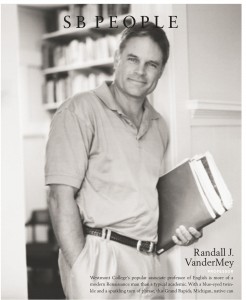
Westmont College‘s popular English professor is more of a modern Renaissance man than a typical academic. With a blue-eyed twinkle and a sparkling turn of phrase, this Grand Rapids, Michigan, native who’s been at Westmont since 1990 can engage you in intellectual conversations about art, poetry and religion as fluidly and captivatingly as he can turn the dialogue toward the joys of getting down on the floor to play blocks with his 2-year-old granddaughter, Jasmine Marie.

Despite his many literary accomplishments–he’s written eight books, published short fiction, nonfiction and poetry, and produced three plays–VanderMey is really a teacher at heart, who describes the Christian liberal arts college as having “an atmosphere that’s really quite filled with trust and joy.”

It wasn’t always that way. “When I came to Westmont 16 years ago, I would say that, at best, the spiritual climate was sketchy,” says VanderMey, who credits the leadership of former President Stan Gaede (who left in 2005) for much of the turnaround.

These days, “People’s politics differ and religiously differ, maybe academic politics differ. But still my colleagues are people I could have lunch with, talk with, respect.”

A highlight of VanderMey’s professional and personal life was escorting 43 students through a semester in Europe in 2003, where they spent four months traveling through 23 cities in 12 countries. One of the best parts of the trip was spending a week each in four different religious communities: the abbey on the Isle of Iona in Scotland, where Celtic monks are believed to have produced the Book of Kells, a marvelous example of medieval illumination; Woodbrooke Quaker Study Centre in the United Kingdom; a Catholic monastery in Teze, France; and the Schloss Mittersill Study Centre in Austria, which VanderMey describes as a castle housing a Protestant evangelical community.

As a professor, VanderMey prizes and encourages independent thought. “I guess I have a model in my mind of what kind of student I want to produce–a student who’s a little bit contrary. They should be willing to stand up for themselves against what they read, not to be hostile to it, but to think for themselves,” says VanderMey. This idea, he acknowledges, “might surprise people who think of a Christian college as a place where students are taught to think in lock step. But that’s not how Westmont is and that’s not how I am at Westmont. I want to make them better critical thinkers and open-minded. I mean, if the Christian faith can’t stand up to critical thinking, why embrace it?”

That critical examination of faith is a recurring theme in VanderMey’s work. “I’m writing out of my core convictions, which is why things germinate for 10 years before I write them,” he says, over lattes at downtown’s Finestra cafe. While certainly heartfelt, his work is also a bit irreverent. For example, his 1993 book, God Talk, is a critical look at “the triteness and truth in Christian cliches,” taking on routine phrases such as, “God wants you to succeed,” “Act of God,” and “There must be a reason,” and examining what people really mean when they use them. Writes VanderMey: “The habit of using stock phrases can sometimes be not only a symptom, but also a cause of spiritual paralysis.”

Language, both spiritual and otherwise, is a topic close to VanderMey’s heart. He’s the author of The College Writer: A Guide to Thinking, Writing and Researching, which is now in its second edition. And locals may know VanderMey’s work from the 2004 production Kenosis, a theatrical staging of his spiritual poetry set to contemporary music, which played at the Center Stage Theater. He has also taught poetry writing classes (partnering with Peri Longo) at Hospice of Santa Barbara and is currently at work on another textbook, with the working title of The Contrary Reader.

He writes and teaches with the same zest for life he embraces with his family. VanderMey–who loves golfing and bowling–is an enthusiastic grandpa and 54-year-old father and stepfather to four grown children (Gabrielle VanderMey, Julia and Jason Clark, and Mike Sakkers), as well as the self-proclaimed “biggest fan” of his wife Dana VanderMey, who is the supervisor of volunteers for Hospice of Santa Barbara.

There’s never a dull moment at home, says VanderMey, whose daughter Gabrielle and stepdaughter Julia were both married in Santa Barbara this summer, coincidentally to two young men named Matt.

VanderMey, who once considered writing a book about marriage communication, chuckles at what kind of advice he might offer the newlyweds. An editor discouraged him from writing the book, asking why– with so many experts–they would want a marriage book from him.

There’s that twinkle in VanderMey’s eyes again. “I’m thinking about making it a humor book,” he says. “My wife (who can sometimes be found doing stand up comedy at Soho) is a very funny lady.”

Originally published in Santa Barbara Magazine

SB Magazine story on Randall Vandermey

Purse-u-ing the perfect purse

Photo by Linnaea Mallette, publicdomainpictures.net.

Photo by Linnaea Mallette, publicdomainpictures.net.

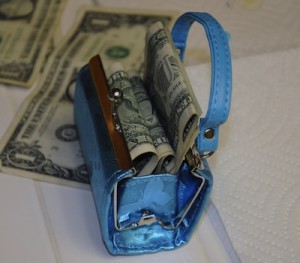
I’ve been searching for the perfect purse for about 30 years and I’ve finally come to a conclusion: there is no such thing. If you’ve ever tried to dance, as I did recently, with your everyday purse hanging from your shoulder because you can’t fit your digital camera and reporter’s notebook into your party purse, you know what I mean.

The perfect purse has got to be able to hold everything you need, yet still look stylish and feel light.

I think I’ve almost mastered the hold everything part.

My friend Ramey used to joke that anything you ever needed could be found in my purse. Can opener? Check. Band-Aid? Check. Sweatshirt? Check. Tire iron? Check. … Just kidding, I got rid of that years ago!

But I do think I’m a shoo-in to dominate on Survivor, the Purse Frontier, where contestants have to live off the contents of their handbags. After all, I am the reigning champion of “The Purse Game,” a baby shower thriller where you score points for matching a list of items with things in your handbag. I’ve got a whole closet full of jelly-bean-filled-baby-bottle-prizes, but I know my big score is coming soon, which is why I keep finding innovative new items to store in my purse, like that glittery pink Swiss army knife keychain that once said “princess” and now says “prin,” or those handy-dandy dissolvable Listerine mouthwash strips.

Since my son was little, he’s thought my purse was like Mary Poppins’ magic bag, filled with toys and treats and things to keep him relatively clean and quiet. Now that Koss is 7, my purse has become the receptacle of choice for his treasures, not just mine. I’m dumbfounded when I hear other moms talking about emptying their son’s pockets before doing laundry. My kid doesn’t want to look “bulky” and besides, I am Koss’s pockets — or at least my purse is — which is one of the reasons why we had to institute the “you can only take one small rock/shell/glass treasure home from the beach” rule.

When my husband tries to hand me his sunglasses, his wallet, or a frog he just found, that’s where I draw the line. My purse is heavy enough already.

I feel a little bit guilty when they make special requests, (“Mom, do you have a purple glitter crayon and some string cheese?” “Honey, do you have our 1992 tax returns and that New Yorker I’ve been wanting to read?”) then are utterly shocked when I’m not packing their little hearts’ desires.

I wish I could carry around the refrigerator and the filing cabinet with me but my purse is getting a little heavy. Besides, where would the shoe rack go?

In fact it’s so heavy that it’s leaving a permanent mark on my right shoulder. I wonder if there’s a way to make that look stylish, like the next hot thing after piercing and tattooing.

Unfortunately, as you can see from a recent inventory — wallet, keys sunglasses, cell phone, Band-aids, Kleenex, lip balm, lipstick, dental floss, floss sticks, paperback book, magic 8-ball, post-its, Tylenol, pens, notebook, camera, water, hair pick, mints and two changes of clothing — there’s absolutely nothing I could do without.

Believe me, I’ve tried. I have a closet full of nearly new (and now woefully out of style) handbags that aren’t big enough to fit all of life’s essentials. I once got stuck overnight in the Newark Airport with nothing to read and a terrible gift shop selection. There are 5,873 squares on the roof of the United Airlines terminal and I will never again leave home without extra reading material. As for the bottle of water, well, I was once stuck in the Sahara Hotel in Las Vegas.

With the exception of last weekend, I do try to lighten things up a bit when I go out at night. That’s when the party purses come out. But these can be tricky too. Some of those adorable little Judith Leiber rhinestone numbers won’t even hold a credit card and a lipstick, let alone car keys. If you need to bring sunglasses, you’re really up a creek. I think what I really need is a purse-onal assistant to schlep my bag, like all the movie stars have when they walk the red carpet.

Yes, that’s what’s missing in my life.

But I wouldn’t want an assistant digging through my bag. Who knows what embarrassing things she might find there. There are only so many places to hide a body. As the Illinois State Supreme Court found, “a woman’s purse occupies a peculiar status and is a possession in which a woman expects supreme privacy.”

And in the interest of full disclosure, the handbag inventory I provided here isn’t quite complete.

Now, for the three straight men and my father who made it all the way through this column — you win! I have your prize right here. … Just a sec … I know it’s in here somewhere…

Originally published in the Santa Barbara Daily Sound.

A Tale of Two Trips

Family travel by Traveloscopy, courtesy Flickr.com.

Family travel by Traveloscopy, courtesy Flickr.com.

It was the best of times, it was the worst of times, it was the age of childhood, it was the age of parenthood, it was the epoch of excitement, it was the epoch of dullness, it was the season of laughter, it was the season of bickering.

It was August, and it was family vacation time.

It is not often that a 30-12-year-old woman has the opportunity to vacation separately with her family of origin (mom, dad, and 30-10-year-old sister) and her family of record (husband and 7-year-old son)–and certainly not within the course of a week.

There are reasons that these double family vacations haven’t really caught on. Most people have a lot more common sense than I do.

This kind of travel time warp doubleheader is definitely not for the faint of heart, stomach or ear.

Traveling with Zak and Koss (my husband and son, or my “roomies”) is always an adventure into the great unknown. Each new phase of our son’s maturity comes without warning, so we never know how he’s going to behave from vacation to vacation. One summer he was napping through five-hour car trips and the next it was, “Are we there yet?” “I’m hungry,” “Can I get a toy?” and “Are we there yet?” every two seconds.

On the other hand, traveling with my parents and sis (my “homies”) is an adventure into the well-trodden paths of the past. My whole life flashed before me many times during the week, and not just in deja vu over the ultra-competitive card games and battles over the shower schedule. When my dad is behind the wheel, you take your life into your hands. Other people dream of snakes on a plane, but the only scarier thing I can imagine besides dad driving in the rain, in the dark, on unfamiliar Colorado mountain roads, is his reaction to having my sister and mom point out that he just drove over the median strip and wouldn’t he rather let one of them drive instead?

Unlike the rest of my homies, I have no illusions about my driving skills, although I do often wonder whether to attribute them to nature or nurture. My dad deserves credit for teaching me to use the brakes on an empty freeway, and my mom (otherwise known as “GPS Joannie”) gives my dad at least a 33-mile heads up every time he is within a half an hour of the next required turn. With this gene pool to draw on, it’s hard for me to believe that my husband doesn’t appreciate my navigational skills when we travel down unfamiliar highways.

Should I be insulted that on our recent trip up the coast–take Highway One for a million, zillion, windy, narrow miles, then look for the signs to Monterey–Zak trusted the map to our second grader, rather than rely on the Dinaberg sense of direction? Not only did Koss get us to our hotel without a single wrong turn, he managed to avoid all cries of “Are we there yet?” by plugging himself into DVDs, books (“Snakes in a Car,” anyone?), and inexplicably, the soundtrack from “Rent,” while skillfully shunning exposure to any of that pesky scenery that his dad and I find so appealing.

Despite our differing levels of enthrallment with the Pacific Ocean, for the rest of our trip, my roomies and I were in perfect sync on almost everything. This was the first vacation I can remember where we were able to choose our restaurants without the added consideration of what kind of toy came with the kid’s meal. I could lose sight of my son for more than a second without feeling the symptoms of a heart attack, and wishing I had the nerve to use one of those kid leashes. Sure I was still the parent, but my roomies and I could be buddies too, equally sharing in the coolness of the aquarium’s jellyfish and our amusement at the sea lions that “wrestled” right under our noses at one waterfront restaurant.

Traveling with my homies, on the other hand, brought out my inner teenager. I couldn’t help but bristle a little when, for each and every outing (including going downstairs to the hotel gym) my mom made sure I had a sweater and a room key. And while we didn’t have to sneak the champagne at this particular family wedding, mom did hand me my place card, decide when it was time to leave, and remind me to make sure to go pee and say thanks to my host and hostess.

On the other hand, traveling with my homies allowed me to bask in the magic of uninterrupted sleep in the morning and uninterrupted reading time in the afternoon. I had almost forgotten what a pleasure it was to read a single book in the course of a day, and not be responsible for anyone else’s teeth, clothes or bedtime story. While I spend plenty of time with my homies year round, it was nice to be able to have the luxury of long, adult conversations about art, politics, and family. OK, so it was People Magazine versus Us, Hilary Clinton’s hair, and how funny it was to see Grandma Evie dancing to “My Hump,” … but nobody interrupted us to ask for dessert or needing help with the TV remote. Except my dad, that is.

It’s funny how going on vacation with your parents can make you feel both old and young at the same time. Come to think of it, so can spending time with your kids.

Is Leslie the only one crazy enough to try a roomie/homie doubleheader? Let her know at email

Originally appeared in the Santa Barbara Daily Sound on September 1, 2006.

Why Do Men Have Nipples

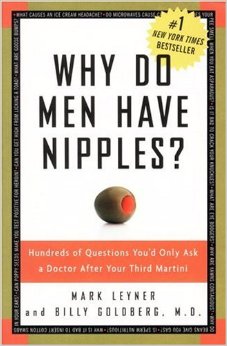
Why do Men Have Nipples? BookWhy? Because it’s an awfully catchy title.

The screaming titles in the window of Barnes & Noble caught my eye: “Why Do Men Have Nipples?” and its sequel, “Why Do Men Fall Asleep After Sex?” by humorist Mark Leyner and Dr. Billy Goldberg. Sure, “Dr. Billy” sounds like he should be playing with a plastic stethoscope, but I could forgive him his name if the books actually delivered the answers to these mysterious questions. After all, the obstetrician that delivered my son was Dr. Howie Mandel, and I’ve almost gotten over that one.

Did these books really have the answers to these long-pondered questions that had been taking up my valuable brain space for almost as long as, “Why did the chicken cross the road?” I decided to investigate.

Since the books are subtitled, respectively, “Hundreds of Questions You’d Only Ask a Doctor After Your Third Martini” (nipples) and “More Questions You’d Only Ask a Doctor After Your Third Whiskey Sour” (sleep), I decided to pour myself a glass of wine and ponder the imponderable in my quest for factoid fun.

The merlot seemed like a good choice, given my history of falling asleep after my third glass of just about anything resembling a martini and the fact that we had no whiskey in the house. Does anyone actually know how to make a whiskey sour anymore? It sounds like something Dudley Moore drank in “10.”

Like most college graduates, I had already spent countless drunken hours contemplating the mystery of why men have nipples, and unless I had missed a memo, knew that that answer was an unsatisfying, “nobody really knows.”

Just to be sure, I double-checked. According to the authors, while only females have mammary glands, we all start out in a similar way in the embryo. The embryo follows a female template until about six weeks, when the male sex chromosome kicks in. At that point males have already developed nipples.

It takes men six weeks to develop nipples, but at 40 years old, my husband still has to be reminded how to wipe the sink down properly after shaving and put the seat down after peeing? I’ve got a few ideas for Dr. Billy’s next title, like “Why Are Men Such Babies When They Get Sick?” and “Why Can’t Men Write Down a Phone Message When There are Notepads All Over the House?” and “Why Did You Say You Were Listening to Me When Clearly You Weren’t?”

Actually, Dr. Billy has an answer for that last one. He says it’s not that men listen less than women. Get this, it’s that they listen “differently.” This sounds suspiciously like not keeping score in T- Ball and pretending the kids won’t know the difference. However, according to Dr. Billy, “Men use one side of their brain whereas women use both sides. And when men hear women’s voices they hear those voices in different areas of the brain than women — they hear women’s voices in the same area of the brain they use to process complex musical sounds — so you can extrapolate the women’s voices are more complex. … And more difficult for us to listen to.”

So women use our whole brain to listen and men only use half a brain when they listen to women. And why did that chicken cross the road? Maybe he wasn’t listening when his wife asked for directions.

When she’s not pondering life’s eternal questions, Leslie can be reached at email

Originally published in the Santa Barbara Daily Sound on August 18, 2006.

Can the Homeless and the Business Community Coexist?

An update on some of the latest efforts

California conjures images of endless summers filled with surf, sun and sand, but increasingly, those beach bum images of the past are being replaced by those of an entirely differently type of bum: aggressive panhandlers. After all, if you had to spend the winter on the streets, wouldn’t you rather be in San Diego than Detroit? While the attractiveness of the state’s mild weather is understandable, it comes at a high cost. Panhandling can have significant negative economic impacts on the surrounding businesses. Here’s a brief look at what some communities are doing to combat the problem.

Many cities are using legislation to crack down on homeless persons living in public spaces. According to the latest U.S. Conference of Mayors Hunger and Homelessness report, despite an overall increase in unmet needs for emergency shelter, there has been an increase in criminalization of the homeless between an initial survey in 2002 and a 2005 survey of 224 American cities. For example, the survey found a 12 percent increase in laws prohibiting begging in certain public places and an 18 percent increase in laws that prohibit aggressive panhandling–bringing the total number of cities prohibiting aggressive panhandling to 45 percent, while 21 percent have prohibitions on begging of any kind.

There was also a 14 percent increase in laws prohibiting sitting or lying in certain public spaces and a 3 percent increase in laws prohibiting loitering, loafing, or vagrancy–bringing the total number of cities prohibiting camping in particular public places to 28 percent, with 39 percent prohibiting loitering in particular public areas.

In addition to legal efforts, business organizations are working to educate the public about how to handle panhandling. For example, the downtown Chico Business Association is actively encouraging business owners, employees, residents and visitors “to redirect their generosity to the institutions best suited to helping the homeless and struggling citizens.” The organization provides a list of such institutions and encourages people to donate to them, rather than directly rewarding those people who beg on the street. Similar efforts are also underway in Santa Barbara, San Luis Obispo and Santa Maria.

Most effective are a combination of two very different strategies, according to strategic planning firm Civic Strategies, Inc. One is a carrot-and-stick approach, which works best for the “temporarily homeless” that are down on their luck. In this instance, cities crack down on aggressive panhandling and other quality of life violations while offering easily accessible alternatives, such as 24-hour gateway centers that direct homeless people to shelters, job training and drug treatment.

The other strategy is aimed at the “chronically homeless,” people with serious mental illnesses, physical ailments, drug addictions or all three. The strategy that works for these people, who are the most disruptive groups of homeless people and most expensive (because they are frequently arrested and often end up in emergency rooms) is to give them access to decent housing, intensive health care and drug treatment facilities and accept that they’ll be long-term wards of the city.

Other constructive alternatives to criminalization include coordinated outreach efforts, where police and social workers or volunteers work together to place people in shelters and provide mental and physical health assistance, as well as job advice and training. The Pasadena Police Department and the Los Angeles Department of Health have partnered to form the Homeless Outreach Psychiatric Evaluation (HOPE) Team to work in this way.

There’s also another strategy that’s just taking shape: an end to “dumping.” In Los Angeles, officials discovered that police from other jurisdictions were driving homeless people from their jails to downtown L.A. and letting them out there because downtown had the services, and the suburbs didn’t. This has led to a demand that suburban areas take care of their own homeless problems, backed by a recent survey in the L.A. area that found there were as many people living on the streets and in the parks of the San Fernando and San Gabriel valleys as in the central city.

In Northern California, officials are also realizing that the homeless are not just an urban phenomenon. The Association of Bay Area Governments is working to attack the problem regionally, by tracking the homeless across the region to see how they move through institutions (soup kitchens, work programs, jails, hospitals, shelters, etc.) and among localities, with an aim to better understand the problem and design programs that work.

“If you want people to shop in your community, to come to your community, you have to address this problem so the homeless are not a barrier,” Berkeley’s Mayor Tom Bates said. “We can’t do this alone. We have to do it together.”

Originally published in California Centers Magazine on July 1, 2006.

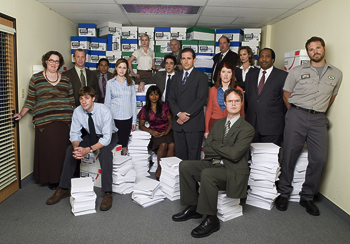
At This Office, It is OK to Show Up Late

The Office, courtesy Wikipedia.

The Office, courtesy Wikipedia.

You know what I miss most about my day job — besides the paycheck? I miss the water cooler.

It’s not that we don’t have plenty of cold drinks and snacks available here at home. I’m perfectly well sweetened, salted, and hydrated–repeat–repeat again–with a special emphasis on sweets during a certain time of the month. Believe me, I’ve got the literal water cooler covered, except for the whole “free” part.

What I miss is the water cooler chitchat about the latest episode of Grey’s Anatomy and The Sopranos. I looked forward to our Monday morning quarterbacking of Tony and Carmela’s latest relationship upheaval or Meredith’s most recent ill-advised conquests.

Our little chats were like standing play dates that lasted 13 weeks, not counting re-runs.

Now that school’s out, I can’t even kibbitz with the PTA moms about the latest episode of Sponge Bob. I’m already feeling withdrawals, and it’s only the first week of summer.

Ironically, now that I no longer have an office to go to, I’ve come to appreciate the pleasures of The Office on TV. I came a little bit late to this delightfully deadpan show, where inappropriate remarks, petty behavior, and zero productivity are all in a day’s work.

And unlike the real offices I’ve worked in, at the Dunder-Mifflin paper company, no one ever has the energy to go out to lunch, let alone talk about important political and social events like TV shows.

The workplace scenarios are oh-so adult and familiar, even though the humor is oh-so wonderfully, and quoteably juvenile. If only I still had a cubicle to toss lines over like, “This is our receptionist, Pam. If you think she’s cute now you should have seen her a couple of years ago!” Or another favorite: “You know what they say about a car wreck, where it’s so awful you can’t look away? This is like a car wreck that you want to look away from but you have to stare at it because your boss is making you.”

My teenage nephews appreciate the show as much as I do, which comes in handy, since I no longer have office-mates to discuss it with.

We can hardly wait for the July 13 “webisodes” to begin. I’m betting they’ll be about Toby, the HR guy, who is, in my humble opinion, a character with a lot of unexplored potential. As Michael (the boss) says, “Toby is in HR, which technically means he works for corporate, so he’s really not a part of our family. Also, he’s divorced, so he’s really not a part of his family.”

His HR-like HR-policies have been the driver behind most of my favorite moments at “The Office.”

For example, when Toby talks with Michael about inappropriate fraternizing with employees, Michael summons the troops to make one of his infamous announcements.

“Attention everyone, hello! Yes, I just want you to know that this is not my decision but from here on out, we can no longer be friends. And when we talk about things here, we must only discuss work-associated things. And uh, you can consider this my retirement from comedy. And in the future if I want to say something funny, or witty, or do an impression I will no longer, ever, do any of those things.”

Jim, who is actually the only character on the show who resembles anyone I’ve ever worked with, then says, “Does that include ‘That’s what she said?'” (See what I mean about the nephews appreciating it?)

Michael replies, “Mmm hmm, yes.”

Jim: “Wow. That is really hard. (My nephews are rolling on the floor at this point, as is my husband.) You really think you can go all day long? (On the show, Michael nearly bursts trying not to say it.) Well, you always left me satisfied and smiling.”

So much for dignity, I am practically peeing my pants by the time Michael finally says, “That’s what she said!”

Did you see that one? Wasn’t it hysterical? OK, you’re drafted. You are now officially my new water cooler buddies. I’m so happy that we can be that kind of friends.

That’s what she said!

Leslie is clearly desperate for some office humor. If you’ve got any to spare, email Leslie@LeslieDinaberg.com. That’s what she said!

Originally published in the Santa Barbara Daily Sound on June 30, 2006.

Wading my Way Through Swimsuitophobia

Swimsuits of Binibining Pilipinas 2008, by Paul Chin from Manila City, Philippines, courtesy Wikipedia Commons.

Swimsuits of Binibining Pilipinas 2008, by Paul Chin from Manila City, Philippines, courtesy Wikipedia Commons.

“Mommy only goes in the water when we’re on vacation,” my son told his buddy when we ventured to the pool last week. The poor kid didn’t even realize I knew how to swim until a couple of years ago, when an unfortunate heat wave forced me to don a swimsuit for the first time since he was born.

It’s not that I don’t know how to swim; it’s just that I’ve got a bad case of swimsuitophobia. Scientists have still been unable to find a cure for this malady, despite my countless hours at the gym, and hundreds of pounds lost and found, and lost and found again, Swimsuitophobia affects nearly every woman I know. In fact, the fear of buying a bathing suit has replaced fear of public speaking and leaving the house without wearing clean underwear as the number one fear for women over age 30.

The rational side of me — yes, I do have one, dear — realizes that I’m a mom; my body has already done its duty for the survival of the species. I’m 30-12 years old, and I’ve got far more miles on me than were covered by warranty. Plus, I’m smart, and some people think I’m funny.

After all, it’s just a bathing suit, and everyone is going to be checking out the teenage girls anyway.

But still, the idea of putting on a bathing suit in public terrifies me. I can barely do it by myself.

Body image and Big Mac issues aside, I think the root of swimsuitophobia lies in the dressing rooms. Does anyone really want to know what their back fat looks like from 17 different angles? Think of all the homeless people Nordstrom’s could house if they had a companywide mandate to purchase only two mirrors per dressing room. As an added bonus, they would probably sell more bathing suits.

I was this close to whipping out my credit card and buying a tasteful turquoise suit there the other day. The color was perfect, and it seemed to fit most of my body just fine in the first 13 mirrors I looked at. Then lo and behold, parts of me oozed out disloyally on the sides. Apparently my rebellious body wasn’t willing to be confined by the 37-way stretch of this season’s Lycra. How did my left boob get under my right arm? And where did the other one go? How many people does that rear end belong to? It was like one of those clown cars, only buttocks kept piling out of it.

Within moments the store’s funhouse mirrors exposed every Hershey Bar and popcorn tub I had eaten in the past year — even the ones I had consumed standing up to avoid the calories.

All of the sudden the lights in the dressing room got brighter, bringing into full focus my stretch marks, my leg veins, and lack of a tan. I needed to shave my legs, wax, get a tummy tuck, pedicure, liposuction, therapy, and a spark plug change. This was rapidly becoming a very expensive swimsuit.

Meanwhile, my sweet little boy was squeezed in there with me, offering helpful little comments like, “Is it supposed to look like that?” And, “It’s okay, dad can always take me to the pool.”

Needless to say, we left without the suit.

My son told my husband about the shopping trip, and asked him why he didn’t help mommy pick out her bathing suits. He mumbled something about, “Finely honed survival skills,” and then reminded him that, “Mommy only goes in the water on vacation.”

My son nodded in agreement, but then looked a little perplexed. “Then why don’t we ever go on vacation?”

If you really want help Leslie with her swimsuitophobia, she’s available for free travel during the entire month of August. Email your itinerary to email.

Originally published in the Santa Barbara Daily Sound on June 2, 2006.