Father Knows Best

Image by nongpimmy

Image by nongpimmy

Though he spent a lot of my childhood hard at work on the football fields of Santa Barbara City College–calling plays, not mowing the lawn–and a lot of my adulthood on the golf course, playing poker, or retired on the couch–in deep snoring thought–my father still manages to provide his children and grandchildren with a lot of hard-earned, sensible advice.

While most fathers offer cliched wisdom about how they walked miles to school in the snow, or earned just pennies an hour for backbreaking labor, my Dad is nothing if not an original.

One of his favorite expressions is, “pain is your friend.” Thanks to my Dad this sage advice (good for skinned knees and bloody noses, bad for PMS) gets lobbed around our household almost daily. Ask any of my son’s soccer, basketball, chess or baseball teammates and coaches, and they will tell you that this is Koss’s favorite phrase. As the fortunate–or unfortunate–recipient of two generations worth of pent up Dinaberg testosterone, Koss now gets the advantage of Coach Bob’s advice on a regular basis.

Growing up with a football coach father, my mom, sister and I would often reflect on what a good thing it was that we didn’t have any boys in our family. I don’t think it’s a coincidence that my sister and I both married guys who prefer golf, swimming and channel surfing to any sport where they might actually get hit.

Luckily for Grandpa Bob, Koss, his only male grandchild, loves to wrestle, tackle and play rough. Thanks to Gramps, Koss has embraced the idea of “pain is your friend” wholeheartedly. This is a good thing because as an only child, he needs all the friends he can get.

“Developmental tasks” are another favorite Dad-ism. With pain as our friend, if we couldn’t manage to play through it, we could always learn from it. Anything we didn’t want to do–like paint the sundeck or tar the roof–was a “developmental task” in Dad’s mind. Same thing with anything we wanted to do but couldn’t–like going to a parent-free party because “everyone else was going”–they all became “developmental tasks” for my sister Pam and I to learn from.

When I went through my own labor and delivery, I repeated both of these adages to myself, Dad, and I’m sorry to report that pain was most certainly NOT my friend, and my “developmental task” was to learn that I should have demanded an epidural at least two weeks before delivery.

I don’t think I ever realized it at the time, but those themes of learning from things that are painful or out of your control have played a big part in my life.

Time has a sneaky way of rewriting history.

Legend has it that the first thing my Dad said to my mom when he saw me at birth was: “Don’t worry, honey. We’ll buy her pretty clothes and develop her personality.”

Granted, this was 1963, I had a forceps-dented forehead, and the only labor fathers participated in those days was pacing the hospital halls and handing out cigars, so seeing this very un-Gerber-baby-like creature might have been a bit of a shock.

Why he repeats the story every birthday is another matter–yet here I am, sharing my pain with my friends. Thanks, Dad. Happy Father’s Day.

Share your father’s wisdom with email. For more columns visit www.LeslieDinaberg.com.
Originally appeared in the Santa Barbara Daily Sound on June 13, 2008.

Leslie Dinaberg Sits Down With Charles Caldwell

United Way’s Charles Caldwell has a lead role in the Power of Partnership Initiative for Santa Barbara, an ambitious, collaborative effort involving many community organizations. (Lou Fontana / Noozhawk photo)

United Way’s Charles Caldwell has a lead role in the Power of Partnership Initiative for Santa Barbara, an ambitious, collaborative effort involving many community organizations. (Lou Fontana / Noozhawk photo)

With a business card that touts his credentials as “Master of Mythology, Captain of Results,” it’s no surprise that United Way‘s Charles Caldwell has been tasked with heading up one of Santa Barbara’s “most ambitious and audacious” planning efforts to date.

Leslie Dinaberg: Can you explain what the Power of Partnership Initiative is?

Charles Caldwell: The Power of Partnership Initiative is a collaborative effort by many different organizations to see if we can create a long-term plan for children, seniors and families. Is there a way to work where we can come together and we can find some agreement and prioritize some of the most important things for us to focus on as we move down the road?

… For most organizations and individuals who work in the field, the future looks a little daunting or it looks challenging for a variety of different reasons. Less and less dollars … plus the very nature of the issues that are affecting children, families and seniors are growing more and more complex. Once upon a time you could have a single need or a single issue and then there would be one group that could fill that need and the child and the family would get back up on its feet and be ready to go. However, most of the systems we have in place were really built at a time of a more homogenous society where there weren’t the same kinds of needs as we have now.

LD: That’s an interesting way of looking at it.

CC: Our system as a whole has had some difficulty in being able to adapt and to focus on those changing needs, even though there have been Herculean efforts to do so.

… As funding is getting tighter … the pie is getting cut thinner, so as that happens, how is our community supposed to maintain its basic infrastructure and adapt to the changing future?

LD: So you initially addressed these issues as part of United Way’s internal planning with nonprofits and other stakeholders?

CC: Right. What they said is, “We think there needs to be some system for planning as a way of doing and we need a neutral facilitator who is helping with our strategic planning process.” … They said, “Somebody needs to get all these groups together so we can communicate as we look towards the future.”

And we said, “Who should do that?” The first person said, “United Way,” and then the next person said, “Yeah, United Way should do that,” and the next person said, “Yeah, United Way should do that.”

I was sitting in the back of the room with our president/CEO, Paul Didier, and we both looked up astonished because we weren’t holding these to jump into some giant community process.

… I get to the family session, very similar conversation. … Seniors same thing. So we went to our board and spoke to them, and they said, again, we weren’t looking to take this on, but it’s very interesting, go out and talk to community leaders, see what they think.

… It turned out, person after person–Bill Cirone, Brian Sarvis and Ron Werft– said, “this sounds like something our community really needs, what can I do to help?” We kept meeting with people and they kept saying the same thing. We met with Salud Carbajal, and Marty Blum and Paul Cordeiro down in Carpinteria and again and again they said, “this is audacious, this is challenging, but we need it in some way for approaching the future.”

LD: It sounds like an echo of what we’ve been hearing for years about the need to work together, but to actually take on the project is something else entirely.

CC: What became apparent from the beginning was that we needed to have a different kind of plan. We began to do research around the county … What began to become to become clear was that we needed to focus on a future plan that would be aspirational, that would be based on building on our community’s strengths rather than looking at what are the greatest needs, what are the greatest deficits, what are the gap based issues that we have to deal with.

…. United Way will pull the community together, but this is not a United Way plan, this is a community plan. To make that happen there had to be other funders and foundations who were willing to join in … pretty soon the Orfalea Fund came on board, the Santa Barbara Foundation, Hutton Foundation, the Bower Foundation, some of the real kind of proactive, great community foundations stepped up and said, “yeah, that’s great, let’s do this.”

LD: And one of the ways people can give their input is through filling out the community survey at http://www.partnershipsb.org/index.php?pr=Survey.

CC: Yes. And as we have that vision, we have those goals, then we begin to prioritize those goals and to develop strategies to achieve those goals, not over the next couple of years, but over ten years.

LD: It sounds really challenging.

CC: My conviction, as we’ve crafted this and we’ve talked to different individuals, is that the people out there, as well as the ones who work in the field, really want to believe that we can make measurable improvements on some of these issues.

Hopefully most people already know that there are so many wonderful different organizations and individuals that are just doing a tremendous amount of work in our community and that’s part of what makes our community so wonderful. … Yet literally billions of dollars are spent in the county, between private and public sources, to impact the lives of people and they do.

However when you step back and look at the broader picture, almost nobody that we’ve talked to has said that the basic conditions in our community are better than they were five-ten-15 years ago. What I have heard from individuals is if we’re doing all this activity, if we’re spending all this money, we’re impacting all these people and we’ve got the results to show that we’re doing it, all these groups do, and yet you look around and we’re not measurably improving some of these issues.

We need to rethink how we’re going about this–and that’s a little bit where we’re at.

LD: Has there been any discussion that this may entail some sacrifice?

CC: There has. I think that you’ve really put your finger on one of the greatest challenges for this initiative, which is can our community lift its viewpoint to those children and families or seniors and families that are out there and say what is the best thing for them? … People who work in the field said, “we understand that this is challenging and if we were able to do this, that there are some threats inherent to this. But you have to understand that those threats are already there. That funding is already being sliced thinner and thinner and thinner.”

… So it is absolutely a challenge and we as a community will be able to meet that challenge in direct relationship to the emphasis that we place on improving the lives of those people out there.

LD: That makes a lot of sense. This program is really interesting, but I also want to talk to you about yourself. Have you always worked in the nonprofit world?

CC: No, when I first came here I worked at the Earthling Bookshop; I was one of the managers of the Earthling Bookshop for about six, seven years.

LD: I miss the Earthling.

CC: I know. It still brings a sigh and a tear to almost everyone I talk to. And partly just for their feelings and partly for our changing community and that was an emblem in a sense of what Santa Barbara used to kind of hold a little bit more.

LD: What else do you do when you’re not working?

CC: A lot of my time is spent either through work or helping out with my mom, Doris, who is 82. She lives in town and she’s been living independently even after a heart attack and stroke. … I’ve been helping her out with a wide variety of needs. Outside of that, I have a close-knit group of friends that I’ve known for most of my time here.

LD: If you could pick three adjectives to describe yourself, what would they be?

CC: Passionate, original and authentic.

LD: If you could be invisible anywhere in Santa Barbara, what would you do?

CC: Go right up on stage at the bowl when one of my favorite bands or singers is performing…like Tony Bennett, Steely Dan, or the Raconteurs.

Vital Stats: Charles Caldwell

Born: August 19, 1963, in South Pasadena.

Family: Mother and brother both live in Santa Barbara.

Professional Accomplishments: Manager, Earthling Bookstore; Marketing Consultant, New York Times; Director of Special Projects, United Way.

Best Book You’ve Read Recently: The Passion of the Western Mind: Understanding the ideas that have shaped our worldview, by Richard Tarnas

Little-Known Fact: “I love to go fly-fishing in Montana!”

Originally published in Noozhawk on June 10, 2008. Click here to read the story on that site.

Leslie Dinaberg Sits Down With Sue Adams

Sue Adams (courtesy photo)

Sue Adams (courtesy photo)

Since moving to Santa Barbara in 1957 to attend UCSB, Sue Adams has made her mark on our town in a myriad of different ways. Whether fighting for the rights of the homeless, advocating for the preservation of historic landmarks or working to get discounted healthcare for the poor, Adams pours her passion and remarkable energy into everything she does.

Leslie Dinaberg: Your husband Sam had a 34-year career as a track and field coach at UCSB. What was that like?

Sue Adams: He was gone weekends and didn’t get home till seven at night because of the team’s efforts, endeavors, training, so I pretty much had control of the household. … Our daughter Wendy was born with a lot of physical anomalies. What people would call a handicap, for her they were just challenges and she had probably about nine serious things wrong, including cleft lip and palate, kidneys that wouldn’t work, a heart that was defective, a huge series of things that we had to be in the hospital a lot to reconstruct.

And so Wendy was in fact the bionic woman, she was just an amazing individual …our second child was born about 15 months later, and his name is John and he and Wendy were best friends. And continued to take care of each other all of their young adult lives until Wendy passed away when she was 34.

LD: Wow. And now you’re a caregiver for your husband, who has Alzheimer’s. How do you manage to still do so much volunteer work?

SA: I think that it’s really important that I continue to say yes because I think I will then have something left.

…I like my balance as far as community giving, being a preservationist, being concerned about the beauty of this community and preserving it, the growth and how it grows and also the social causes. Trying to keep this community balanced, from being grasping and greedy to giving back as much as people can give. I think this is the reason why this community has thrived.

LD: Now you’re involved with the Courthouse Legacy Foundation and Save the Missions, what else?

SA: In the preservation world, I’m always a member of Citizens Planning Association…I’m also a member of the Historic Landmarks Advisory Commission for the County (HLAC). I’ve been in that for years, struggling to keep landmarks from being demolished. …. So that part is one hat and the other hat is the social justice hat and that is what are we doing about our homeless. … I think we need to be a little bit more brotherly and sisterly towards those that are compromised. … I’m the Board of Casa Esperanza and truly believe in funding those institutions that are getting people back on their feet. To know that within the last month 64 people were taken out of homelessness and put into housing makes my day.

LD: That’s great.

SA: That is great. … Giving credit where credit is due is what my real theme is. It’s not me, it’s never me, it’s knowing the people who know how to get the job done. That’s who I am, is I know who to call. I know who to call, and that’s basically what this community is all about, it’s volunteerism. People who actually roll up their sleeves and do their work. … Along with that is the St. Cecilia Society, which is one of my fondest passions, and that is one of the oldest charities in Santa Barbara.

LD: And that’s healthcare?

SA: Providing payment for healthcare. Saint Cecilia was the patron saint of music … the women who founded the St. Cecilia Society had marvelous musical talent. … They all came to Santa Barbara as a result of the forming of Cottage Hospital and the Sansum Clinic … (they were the wives of the doctors) and they all loved music and they got together and would jam. … So they decided to have fundraisers. … And then they provided money for a bed at Cottage Hospital for the poor. That was how they began…and that tradition continues.

LD: That’s such a nice history.

SA: It’s wonderful. To be a part of that is absolutely wonderful. The humanitarianism of that is that when you make a phone call to a provider …and say, “I understand that you have a bill in collections that is $7,000. I would like to negotiate with you and pay the balance on that account. Would you consider a discount of 40%?” And they are saying are you out of your mind? … And about two days later they call me back and say you’ve got it for 50% off.

LD: Wow, that’s amazing.

SA: Isn’t that wonderful? Now it doesn’t happen all the, but it does happen with a lot of other people in the medical community. …We leverage our money a great deal by telling people how wonderful they can be.

LD: That’s great. And are volunteers making those kinds of phone calls?

SA: I make that call, but the board is the one who decides, they determine how many people we can help a month.

LD: Are you able to do that part of your volunteer work from home when you’re here with Sam? I would imagine you do have a fair number of meetings out of the house.

SA: Well at board meetings, Sam has become a fixture. … I do a lot of work for them and if those people cannot handle Sam in the room then there’s something wrong. They need to be aware of the fact that people are compromised and they are part of your community just as much as everybody else is.

LD: How active is he able to be?

SA: Every day I insist that we take a walk. …. It’s very important to keep him moving and … he needs to be dressed and bathed and his food prepared. He wouldn’t be able to get in and out of bed without support, so I’m very needed.

LD: I’m sure he wouldn’t have wanted you to be devoting yourself 100%.

SA: …Sam grew up with that ethic that nothing was as important as taking care of the house and his needs. He was an anachronism. … When I started my business back in 1978 (the Footnote shoe store) the dynamics of our family went crashing because Sam was furious that I was competing, that I had another life.

… One of the reasons why I needed to go to work was because we had tremendous medical bills with Wendy. She was in the hospital with probably 50 different surgeries.

LD: How long did you have the store?

SA: The Goleta store was 15 years and then we ended up in the Santa Barbara store and so that was really 19 years.

It was wonderful. I loved it. It was so great. I just really enjoyed it. People never forget it too.

LD: So did you sell the Footnote or close it?

SA: They say after the loss of a child, that you should stay in business or do what you’re doing for at least a year. … I stayed in business for a year, but Wendy, in the last month before her death she said, “Mom, retail is wonderful but it’s starting to tell on you. Get into something else. Do something else. Find another thing to do. You are loving being a part of something bigger.” That time I was part of the Coalition to Provide Support and Shelter to Santa Barbara’s Homeless, that was the precursor to Casa Esperanza, and so she said, “You really do well with that, mom.”

LD: That’s interesting that your daughter sort of nudged you in that direction.

SA: Yes, she definitely nudged me in that direction. I think you can count money for just so long and think that most often you’re not affected by the bottom line financial aspects of life and I’m a dreamer, I am who I am because I am a woman of dreams and to be grounded by money is not necessarily a good place for me. It is for many because they can handle it better than I, but I didn’t want to be focused only on money. It’s not good for my soul.

LD: Other than your book clubs, is there anything that you do that is really just for you?

SA: Gardening. Natural beauty reduces me to tears and if I can help promote it in my own backyard it’s an environment that gives me great pleasure

LD: If you could pick three adjectives to describe yourself, what would they be?

SA: Shy, insecure, and needing to help.

LD: It’s interesting to me that you describe yourself as shy but you’re pounding down the doors of insurance companies for other people.

SA: You can be courageous for others. But I still have to catch my breath right before I start talking.

Vital Stats: Sue Adams

Born: Oakland, CA, November 29, 1938

Family: Husband Sam, daughter Wendy (deceased), son John, daughter-in-law Aster and granddaughters Kaiya (age 4) and Mateya (age 2).

Civic Involvement: Pearl Chase Society; Courthouse Legacy Foundation; Citizens Planning Association; Save the Missions; Historic Landmarks Advisory Commission for the County; Casa Esperanza; St. Cecilia Society; CAMA; Community Kitchen.

Professional Accomplishments: Steno pool at UCSB; Preschool Teacher at El Montecito Early School; Owner of the Footnote shoe store.

Little-Known Fact: “In my next life, I would love to be a great dancer. I haven’t been given that this lifetime and I guess what I’m doing is dancing the best I can in another way.”

Originally published in Noozhawk on June 2, 2008. Click here to read the article on that site.

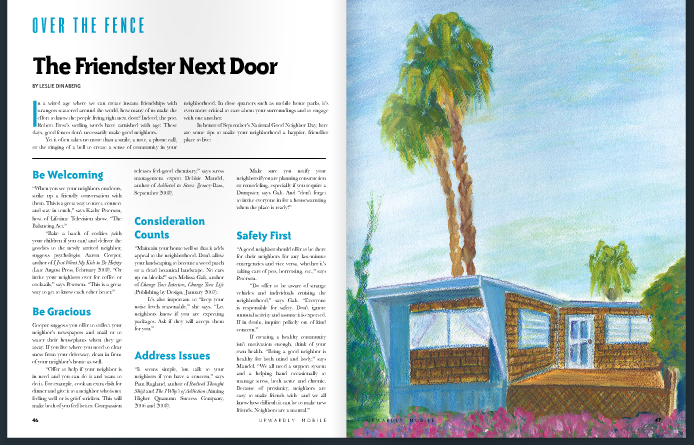
Over the Fence: The Friendster Next Door

Story in Upwardly Mobile MagazineIt’s summertime and the living is easy. The beer is perfectly chilled, the steaks are on the grill and you’re admiring the sunset with your loved one. All of a sudden your neighbor screeches to a stop, rock music blaring, and starts unloading kegs, chips and fireworks from his car–for the fourth time that week.

Neighbors: love them or hate them, you have no choice but to deal with them, especially in close quarters like a mobile home park. Here are some strategies to help minimize conflicts with your neighbors and make your summertime go just a little bit easier.

The key to a stress-free summer is anticipating problems before they happen.

  •  Introduce Yourself

You’d be surprised how many people don’t know their neighbors these days. Don’t wait until you have a problem to meet the people next door. Bring over a bottle of wine or some fresh strawberries from the Farmers Market and just say hello. Even if a problem has already occurred, try to get to know them at least a little before making a complaint.

  •  Be a Good Communicator

Keep your neighbors informed before you do something that might affect them, like hosting a big party or getting a new dog. Informing your neighbors ahead of time allows them to make plans or tell you how your project will affect them. And getting their input in advance lets you act in a way that will help avoid problems. Also, if your neighbor does something that you like, tell them you noticed the yard work or the new paint job. It will be easier to talk later when they do something that you don’t like.

  • Follow the Golden Rule

Treat your neighbors the way you would like to be treated. Be considerate about noise from vehicles, tools, stereos, group activities, and pets. Don’t forget to consider the view from your neighbor’s yard. Those extra car parts in your driveway may not bother you, but your neighbor may not like looking at them.

What to do if there is a problem.

  • Track It

Note the date, what occurs, and anything else that you think might be helpful. It’s possible that the problem (such as late night noise) may not occur as often as you think it does. In any event, clear documentation will help you talk to your neighbor and help make your case to the police or the courts if it comes to that.

  • Your Neighbors Can’t Resolve a Problem if They Don’t Know About It

It is often the case that neighbors are not aware that their actions are negatively affecting others. Nine times out of ten, people are willing to make changes if you approach them respectfully to work out a solution.

  • Assume the Best

If your neighbor does something that irritates you, don’t assume that it was done on purpose; instead operate under the assumption that the neighbor doesn’t know their 3 a.m. hot tub party kept you awake.

  •  Don’t Let Your Irritation Fester–Focus on the Issue at Hand

By communicating early in a calm and pleasant manner, you take a big step toward resolving the problem. Don’t wait until a minor irritation becomes a major issue and makes it difficult to discuss. Separating the person from the problem will allow you take care of the problem while maintaining your relationship with your neighbor.

  •  Stay Calm and Listen Thoughtfully

You don’t have to agree with them or justify your behavior, but if you can listen and not react defensively, then their anger will likely subside and there is a good chance of working things out. Try to understand how your neighbor feels about an issue and why. For example, people can become very defensive when they think their pets–or their children–are being maligned. Understanding their position will increase the likelihood of a solution that works for you both.

  • Take a Break

If you need to, take a break to calm down and think about what you and your neighbor have discussed. Arrange a time to finish the conversation later. Don’t try to problem solve when you are having a heated discussion.

  •  Communicate Constructively

Always keep in mind that talking things over directly is the best way to handle problems, and avoid going to law enforcement or the courts. Turning to outsiders to resolve your neighbor issues should only be a last resort.

Originally published in Upwardly Mobile Magazine on June 1, 2008. Click here to read online in the magazine.

Keeping it in the Family

Alyce and Janelle Parsons Give Traditional Apprenticeship a Woman’s Touch

Entrepreneurial genes run deep in the Parsons family. “All of the kids got our MBAs at the dinner table,” says Janelle Parsons.

“And that is literal, we weren’t the kind of family that left our jobs at the door. We just worked it out at the dinner table every night,” laughs Alyce Parsons, President and Chief Operating Officer of Parsons Group Inc., a Santa Barbara-based company, which owns and manages independent and assisted-living communities around the country.

Janelle–the oldest of Alyce’s four children and her only daughter– manages Parsons Group’s three properties in Texas and oversees marketing for the company, which also includes a property in Arizona, as well as the nonprofit Garden Court in downtown Santa Barbara, the nonprofit Friendship Manor in Goleta, and The Gables of Ojai, a swanky retirement community nestled in the foothills of the Santa Ynez mountains.

Alyce says her daughter was destined to go into business. “Janelle didn’t play with dolls, she played office. She said, ‘No dolls, give me a tablet!'” When Janelle was in sixth grade she opened a candy store at the Carrillo Hotel, a low-income senior housing project, which the Parsons owned until it was demolished and replaced by Hotel Andalucia in downtown Santa Barbara (now Canary Hotel).

“When all four kids lived at home we’d have a family meeting every morning. We called it ‘Logistics.’ Janelle would chair the meeting, figuring out who was going to be where when,” says Alyce.

Alyce says she views her business relationship with Janelle as similar to men that have traditionally had sons as apprentices. “I happen to be her mother and she happens to be my daughter but the dynamics of the relationship are very similar in the sense that I have a responsibility to my business to produce an employee that has the skills necessary to do the job. From a business perspective I have to be able to be a leader to Janelle, I have to be a mentor to her. I have to be developing her as an employee to take on a pretty big responsibility. Guys have been doing that since the beginning of time.”

“The family rule is you have to prove yourself outside of the company in order to be invited in,” says Janelle, who worked elsewhere for six years before her mom invited her in, “after she saw I could do it somewhere else.”

“I just feel privileged to be able to be a woman in that position to be able to give her really the skills at a pretty high level. I mean we’re a $24 million company. … It’s not pretend, it’s real and to be able to do that for my daughter, it’s so exciting to be able to share it with her,” says Alyce. “Not only from a professional standpoint but also from a work standpoint. I mean she grew up with me being a fulltime worker woman. So she knows how to do that too.”

While Janelle and her husband Kevin Nimmons don’t have children, they plan to have them someday. When they do, “I’m going to work,” she says. “My mom worked the whole time when we were growing up and we’re not worse for the wear because of it. It worked out really well because we all are part of the business because of it, so I feel like I can do that too.”

The Parsons have managed to combine business with family very successfully. Janelle’s father Bob (Alyce’s husband) runs the real estate development side of the business and her brother Blake will come on board this year.

” I think that if you go into a family business you just have to be prepared to work twice as hard as everybody else because there is that stigma, you’re the daughter, there’s a lot of stuff that goes with that, so you need to prove to everyone that you’re there because of what you can offer the company, not because of who you are,” says Janelle.

The younger Parsons sons, Gavin and Cameron, are still in college, but Alyce says they may be interested in coming on board someday and she wants them to be prepared. “I want everybody to at least understand the business because at this point, they’re stockholders. They need to be able to make intelligent long-term decisions as stockholders, so they need to know the business from that perspective. Whether or not they contribute professionally is really up to them. They may or may not have the skill set.”

Even when they’re not working side by side in their Victoria Street office, Alyce and Janelle talk several times a day. And yes, sometimes they do disagree.

“Janelle has her way of telling me, ‘Look I’ve had enough of that subject, drop it,'” laughs Alyce. “Then that’s followed sometimes by tears and then we go into mother daughter mode.”

Janelle says the hardest part is having a bad day at work. Normally you might call your mom to vent about work. “…You hear your mom’s voice and then you immediately start crying because it’s your mom and then you think gosh, I shouldn’t be crying in front of you.”

Switching between work and family mode can be pretty funny sometimes. “She’ll call me and say, ‘you haven’t been my mom for a week now. Will you just be my mom? Can we just talk?'” says Alyce.

Janelle says it’s a balancing act. “There are a few different hats that my mom and have to have the whole time. So it’s mom, I need you to be my mom right now. Mom I need you to be my mentor. Mom can you be my boss? And we preempt everything with those labels and we’ve learned the balance and the dance, I guess, that it is to work together.”

While the Parsons women are all work when they need to be, they also manage to fit in some play. “Sometimes when we go on the road we’ll be a little bit deviant and we’ll plan a shopping trip,” says Alyce. “We love shopping at the Galleria in Houston so we’ll go a half day early and shop for the afternoon. I don’t think men do that.”

Originally published in Coastal Woman on June 1, 2008.

Third Gradeitis

I don’t need to flip my calendar page to June to know that the end of the school year is near. I merely need to look at my alarm clock to realize that I’m running alarmingly late in getting my son to school again. We’ve got a bad case of third gradeitis at my house.

I know we’re supposed to wake up chipper and happy now that sunny days are here, but we’ve been taking advantage of those sunny days with leisurely late nights and now the waking up early is killing me.

My first sacrifice to the snooze button was making the beds–you’re just going to mess them up, anyway, right? Next was my every-once-in-while practice of actually “cooking” breakfast. Now we’re lucky if any of us sits down for an apple or a Starburst before we run out of the house ’cause we’re late. And I’m sure the teacher has noticed that Koss has worn his baseball uniform for three days in a row. There are just too many games. I don’t have the time to actually peel it off of him and wash it.

I can hear the beach calling my name, but every time I pick up the phone, it’s someone from the PTA, or the school, asking for help with something or other. I’m sure my public declaration of yes-aholism didn’t help. Our home life is falling to pieces and I haven’t got the time–or the energy–to put it back together right now. Besides, that beach looks so enticing. Maybe just a few hours on the sand after school, we’ve got lots of time before it gets dark.

Our slow deterioration is evident everywhere you look. My son’s backpack is held together with yards of finger knitting (thank you Mrs. Brown for teaching him such a useful skill). His lunch box smells like rotten eggs, even though I swear I’ve never packed them. Still, I refuse to replace those fall essentials till school starts next year. Same with his pants, which are now the pedal pushers I try to convince him that all the cool boys are wearing.

Meanwhile I’m all stocked up on swim goggles and sunscreen. Isn’t it summer yet?

I can’t believe Koss actually had homework last night. I thought California state law was that all reading, writing and arithmetic stopped immediately–so party time could begin–once the standardized testing was over. The aim may be “no child left behind,” but the target for the last month of school is more like my college spring break in Mazatlan, where many of my brain cells still reside.

I can’t believe how many parties and activities they cram into the last few weeks of school. Just this month we’ve had Spring Sing, a golf tournament, a Noche Mexicana celebration, two PTA meetings, three foundation meetings, a read in, an open house, a school board meeting, the Spring Boutique, talent show signups (which mean talent show talent development), Science Night, a beach party, the talent show, an end-of-year party and various teacher appreciation tidbits to buy, bake and accidentally burn in the oven.

“Uh, Mommy, the smoke alarm’s going off again!”

Not to mention how many checks there are to write. Do they really still want money for the ad in the program of the fundraising event that got cancelled because the whole school came down with a bad case of third gradeitis?

I can’t wait for summer, when I’ve got ten whole weeks to work my magic spell of sun, Slurpees and sleepovers to undo all the good habits Koss’s teachers have worked so hard to inspire in him.

Sorry guys. You had your turn with him and now it’s mine. We’ll be sleeping in mornings and hanging out on the beach in the afternoons. I can hardly wait.

Originally published in the Santa Barbara Daily Sound on May 30, 2008.

Leslie Dinaberg Sits Down With Marcia Meier

Marcia Meier (Cathy Rowell/Noozhawk photo)

Marcia Meier (Cathy Rowell/Noozhawk photo)

As owner/director of the Santa Barbara Writers Conference, Marcia Meier is more than up to the challenge of retaining the legacy of excellence the conference has enjoyed for the past 36 years. She recently added a poetry conference, a young writers program and master classes designed just for professional writers.

Leslie Dinaberg: I want to compliment you on what you’ve done with the Writers Conference. You’ve been able to retain the flavor of what Barnaby and Mary Conrad created, but you’ve also made some really nice changes.

Marcia Meier: I’ve really worked hard to do that. I really wanted to maintain that sense of community, that sense of encouragement that the faculty give to the students and the welcoming feel that most people have, but I also wanted to improve and increase the offerings in terms of what we offer for classes and workshops. And also bring in more varied speakers–from literary to commercial fiction to poetry to nonfiction writers. I also wanted to start a Young Writers Program. That’s probably the thing I’m most proud of.

LD: That’s great. What ages are the young writers?

MM: High school kids. And they come and for a pretty deeply discounted rate they get to do the entire conference. … Plus we do a special Young Writers Program, so they meet with an agent from New York for pizza. They get to meet with several agents over the course of the week. They get to meet with some of our speakers on an individual basis … I put them together with those kids for an hour and it’s just really cool.

LD: That’s one of the things I find so frustrating is there’s so little instruction in schools for creative writing.

MM: It’s interesting that you bring that up. I’m going to start a program in the high schools next fall. It’s called SBWC in the schools.

LD: That’s great.

MM: It’s offering free after school creative writing classes taught by our faculty for the conference. We’re going to Start with Dos Pueblos next fall and hopefully Santa Barbara…I’m working with donors right now to try to get the money together. … There’s very little place for creative writing in Santa Barbara schools. I mean they have the curriculum that they have to teach and they just don’t get much chance for that kind of outlet.

My hope is that it will get to some kids who don’t have any other way to express their feelings and there is no judgment. Hopefully the way it will work is they will come, they’ll have an hour to come, write for half an hour and then have an hour to have some feedback from the instructor and amongst themselves to improve their work and bring it back the next time. Kind of essentially what we do at the workshops. I think it will be really great for the kids.

LD: Let’s talk about your own writing. You’ve got this wide background as a reporter, a writer and an editor. What’s your favorite kind of writing to do?

MM: That’s a really interesting question. I have done almost every kind of writing and right now I’m doing some freelancing for Central Coast Magazine and Santa Barbara Magazine and I just got an assignment from the Los Angeles Times travel section, so I’m doing a lot of nonfiction, but I think what feeds me most is my poetry and my fiction writing. …I’ve written more poetry in the last few years than I probably have in the last 20, and I think I’m almost going to pull it together as a collection and call it “Parking Lot Poetry,” because most of them I’ve written have been sitting in a parking lot waiting for my daughter to get out of basketball practice or waiting to pick her up from school or waiting to take her to piano.

LD: It sounds like the nonfiction writing you’re doing is pretty deadline and assignment driven. Do you find it hard to transition to writing things that are not so deadline driven?

MM: Yes. You know what my biggest problem is? I put them off. The stuff I think that really feeds me more than anything else I put off because I have all these other things I’m working on and I feel like I’ve got responsibilities to follow through with. And because I have a teenage daughter and my mom lives with me, she’s in her 80s and needing more care. …One of my biggest challenges this year I’ve really tried hard to set aside time to write. So Tuesday mornings I say I’ve committed myself to writing on Tuesday mornings. It doesn’t always work that way but sometimes it does.

LD: That was always an interesting thing for me in the past when I’ve gone to the Writers Conference because you get such a mish-mash of sort of people who make their living as writers, people who do something completely different and people who are kind of doing that and something else. There’s always that balance.

MM: I think, one of the things that brings people back all the time is it gives them that week of time to actually write. There are some people that come to the conference and they don’t even go to the workshops. They just take that week off so then they can write, absorb, network with other writers and then maybe take an occasional workshop, but also listen to the speakers and have that freedom to not have to feel like you’re obligated to take care of the day-to-day stuff, but you’re free to write.

LD: So talking about your book about Santa Barbara (“Santa Barbara: Paradise on the Pacific”), what are some of your favorite local spots?

MM: I spend a lot of time at Hendry’s Beach, because I have two dogs and we walk every day and I love to walk on the beach. I try to do it around the tides, I watch for the tides and we walk as far as we can. And I love Ellwood …I love to go up to the mountains; Santa Ynez Valley is also one of my favorite places to go. I love to go downtown in the evening on the weekends. I go to the movies and then go hang out at Borders and have coffee and look at the books. I really love to do that.

LD: Tell me a little bit about this year’s conference.

MM: We have great speakers coming. Of course, Ray Bradbury, he’s been coming for 36 years. He’s amazing. … We have Joseph Wambaugh… Luis Alberto Urrea, who wrote “The Hummingbird’s Daughter,” he’s a wonderful literary writer. We’ve got Jane Heller. … We’re going to give Sue Grafton an honors award …Gayle Lynds is going to do a workshop for us, Catherine (Ryan Hyde) is going to do a master class. We’ll have agents and editors day as usual.

LD: What are master classes?

MM: We ask an author of relatively accomplished author to come in and teach a three-day workshop where we focus on a particular aspect of writing and it’s a little more in-depth.

LD: How many volunteers do you have?

MM: Last year we had about 40-45 volunteers, and this year there will probably be fewer only because we one of our sponsors is Borders and they have offered to do all of the conference merchandise for us. …They are also doing a pre-conference launch party at the downtown store on the Friday night before the conference. That’s going to be open to the community.

LD: If you could pick three adjectives to describe yourself, what would they be?

MM: Tall, that’s kind of the obvious one. I think optimistic and, all of these things are running through my head, but I think probably kind.

Vital Stats: Marcia Meier

Born: Muskegon, Michigan.

Family: Daughter Kendall, 15, and mother Helen, age 83, who has lived with her for seven years.

Civic Involvement: “I’ve cut back over the last couple years. I don’t do a lot. I try to go to book gatherings and stuff that is related to the conference. For a long time I was involved with a lot of groups like the Mental Health association and Transition House, I sat on their board for a while and I cut a lot of that out. My life is too busy.”

Professional Accomplishments: Reporter/Editor with a number of newspapers in California; Editorial Page Editor, Santa Barbara News-Press; Director of Marketing/Community Relations and Journalism Instructor at Westmont College: Freelance Writer; Owner/Director Santa Barbara Writers Conference.

Little-Known Fact: “I was horse crazy in high school. My horse, Ginger, was the love of my life all through high school.”

Originally published in Noozhawk (click here) on May 26, 2008.

A Passion for History Brings Heroic Tale to Life

Refusenik documentary has West Coast Premiere at the Plaza de Oro Theater

Finding a career that combines her interests in art, social justice, history and international politics is a dream come true for filmmaker Laura Bialis. Her documentary, Refusenik, (www.refusenikmovie.com) which chronicles the thirty-year international movement to free Soviet Jews, opens Friday night at the Plaza de Oro Theater. The movie will run for a week and Bialis will be there on Sunday at the 2 p.m. and 5 p.m. screenings to answer questions about her experiences making the film, which has been described as “a tapestry of first-person accounts of heroism, sacrifice, and ultimately, liberation,” as told through the eyes of activists on both sides of the Iron Curtain–many of whom survived punishment in Soviet Gulag labor camps.

The screenings are a coming home of sorts for Bialis, a 1991 San Marcos High graduate, whose parents–Ellen and Gary Bialis–still live in Santa Barbara. She had her first job as an intern, working for Rod Lathim at the now-closed Access Theatre. “It’s interesting because that was a nonprofit, and now I’m running a nonprofit for the arts and Rod is on the board of my nonprofit,” said Bialis.

She’s certainly come full circle.

An avid historian and film buff, Bialis created the Foundation for Documentary Projects (http://documentaryprojects.org) as a way to fuse her love of history with her passion for filmmaking. Her 1999 film, Tak For Alt– Survival of a Human Spirit, (http://www.takforalt.net/) told the story of Holocaust survivor turned Civil Rights activist Judy Meisel, a Santa Barbara resident. The film chronicles Meisel’s journey back to Eastern Europe to re-trace her wartime journey: from the Kovno Ghetto through the Stutthof Concentration Camp, and ultimately on to Denmark, where she was liberated and restored to health by an outpouring of Danish compassion.

Tak For Alt enjoyed a brief theatrical distribution, aired on PBS and won many awards–from Anti-Defamation League and the Academy of Motion Picture Arts and Sciences, among others–and is now being used by teachers in over thirty states, and has been implemented into history curricula in many school districts.

The seeds for the development of “Refusenik” were actually planted at a screening of “Tak For Alt” in Omaha, Nebraska. After every screening, people would come up to me and want me to make a movie about them or their grandmother or someone else they knew, laughed Bialis. ” We were inundated with all these requests, but these people in Omaha were just adamant that I meet this activist, Shirley Goldstein. She actually gave the first seed grant for the movie. We used it to do a trailer which we used to raise the money to make Refusenik.”

While the story of the “Refuseniks” isn’t widely known, it’s a powerful one. In the early 1960s, reports came to the West of blatant anti-Semitism in the Communist-controlled Soviet Union. For example, the government was closing synagogues, the study of Hebrew was forbidden, Soviet Jews were required by law to carry “internal passports” identifying their Jewish heritage, and they were barred from studying at many universities and refused entrance into selected professions. Yet those who asked permission to emigrate were told they could never leave, effectively making the Soviet Jews prisoners in their own country.

Bialis interviewed more than 100 people and shot more than 200 hours of interview footage to tell the story of the “Refuseniks,” who took the unprecedented step of publicly challenging the communist regime. The film chronicles their stories of courageous activism and tales of hardship: the development of an underground Hebrew school; risky smuggling of information to the West; fear of being arrested; shock of being brought to trial on trumped up charges; and suffering in prison or in exile merely for demanding freedom.

“My first degree (she did her undergraduate work at Stanford, followed by USC film school) is in history, so I actually approached it like I was doing some sort of archiving project,” she said. “I started out by asking people about how they were involved … it was such a grassroots movement. The rallies would get hundreds of thousands people involved.”

Eventually, the activists’ incessant demands pushed the issue and legislators enacted a law limiting the amount of business the United States would conduct with countries that violated human rights–the first time the United States placed restrictions on a country for rights abuses of its own population. Nuclear disarmament negotiations with the USSR included American demands for a change in Soviet emigration policies and in 1989, the Soviet Union finally succumbed to international pressure and the gates were opened.

“It might be the most successful human rights movement of all time,” said Bialis. “At the end of the movement 1.5 million Jews got out of the Soviet Union. It was a very inspiring thing.”

She worked on the project for five years, traveling around the world to track down different pieces of the story. “Though it’s about a historical movement, this is a really timely issue because there are still human rights violations going on around the world. Sometimes we need to be reminded of what is possible if you believe that what you’re doing is right.”

Refusenik opens Friday, May 23, 2008 at the Plaza de Oro Theater, 371 South Hitchcock Way, Santa Barbara, 805.963.9503 (http://www.movietickets.com/house_detail.asp?exid=met&house_id=2278).

Originally published in Noozhawk on May 20, 2008.

Dos Pueblos Inaugurates New Theater Complex with Beauty and the Beast

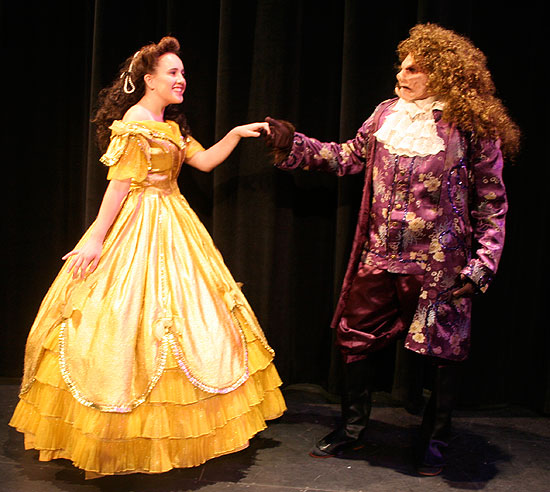
Belle (Emily Day) and Beast (Blake Bainou) play leading roles in Dos Pueblos High’s production of Beauty and the Beast this weekend. (Dos Pueblos High photo)

Belle (Emily Day) and Beast (Blake Bainou) play leading roles in Dos Pueblos High’s production of Beauty and the Beast this weekend. (Dos Pueblos High photo)

The long wait is finally over. When Dos Pueblos High School opened in 1966, a lack of funds prevented the construction of a theater, and for more than 40 years students made due with a 135-seat converted classroom for their productions.

Now those original Dos Pueblos students can finally take their grandchildren to see the school’s first production in its new $14 million Performing Arts Center. Dos Pueblos Charger Theater will present “Beauty and the Beast” on May 22, 23 and 24 at 7 pm, with an additional matinee on May 24 at 2:00 pm.

“The purpose of this show is basically community outreach and to get people aware of the department and the new theatre,” says Theater Director Clark Sayre.

The crew has been hard at work behind the scenes getting the production ready for it’s Thursday night debut in the new 749 seat theater, which was funded by the Measure V bond and includes state-of-the-art sound and lighting equipment, an orchestra pit, two side stages, dressing rooms, a construction room and prop room, as well as drama and choral classrooms.

While the students are thrilled to be in the new performance space, the adjustment is not without its challenges.

“It’s really cool because it’s big, but it’s really hard because it’s big,” says Megan Harris, who is co-stage manager, along with Ana Zarate.

“Coming into this we had a lot of people with absolutely no experience whatsoever, so simple construction techniques that even someone who’s done one show before would know had to be taught,” explains Gabe Rives-Corbett, one of two student technical directors, along with Tim Jenkins. Typically productions work with modular, pre-made set pieces that just need to be painted for each new show. “We had to build everything. Even the workbenches are new,” says Rives-Corbett.

“In the old space we could never build anything that was higher than three or four feet,” says Sayre. “So we could never do a second story for anything. Without Gabe and Tim, we would not be moved into this theater and the lights wouldn’t be running and the sound wouldn’t be running. They’ve just made this whole thing possible.”

“The first time we set foot in here was the end of November and it was still heavily under construction. They were still screwing the stage down when I first walked in,” says Rives-Corbett.

“It’s coming slowly together,” says Harris.

“It always happens somehow. Sometimes no one is really sure how,” says Rives-Corbett.

” Theatre magic,” explains Zarate, whose father stops by with her computer so she can make some last minute changes to the program. She also designed the yellow posters seen around town.

These students and many of the more than100-members of the cast and crew have been working around the clock to bring “Beauty and the Beast” to life. It’s a complicated show with 133 different costumes to create, an effort led by costume designer Miller James, who is the costume designer for Opera Santa Barbara. “I just treat them like any other costume crew. I don’t consider them students … I expect them to work just like a regular costume house,” he says.

Putting on a production like this is a huge organizational effort, explains Sayre. “I always tell people that being a theater director in high school is like running a theater company, basically. You do everything that the theater company does but you do a lot of it yourself, so I’m bookkeeping and writing grants it’s just crazy.”

Other professionals involved with the production include choreographer Carrie Diamond, who is the Artistic Director of Ballet Santa Barbara and a former teacher at Alvin Ailey American Dance Theater in New York City; set designer Daniel Girard and musical director Sarah Phillips, who both work with Stage Left Productions; and Sayre, who directs Rubicon Theatre’s Young Playwrights’ Festival, in addition to teaching theater full-time at Dos Pueblos.

Key cast members include Amy West and Emily Day as Belle, Anna Englander as Mrs. Potts, Lev Allan-Blitz as Gaston, Matt Parker as Belle’s father, Blake Bainou as the Beast, Claire Gordon-Harper as Chip, Rachelle Clarke as Babette, Mason Kopeikin as Cogsworth, Kristi Ware as Madame De le Grande and Trevor Dow as Lumiere.

Through a strange twist of fate, the Dos Pueblos production of “Beauty and the Beast” comes just a week after a Santa Barbara High production of the same show. Sayre explains that he has been working on doing the high school premiere of another Disney musical, “Aladdin,” but it was delayed, so he wanted another really big show to open the new theater.

“I wanted something that hadn’t been done. And then the ironic thing is that Otto Layman, the director at Santa Barbara High also chose it. … The reason that happened was nobody’s fault at all. He had heard that I was doing ‘Aladdin’ and I heard that he was doing ‘Hair’ which he is in the summertime. We didn’t talk directly and then we both just chose this and then by the time we both chose this it was way too late for either of us to go back, because we started this way back in December or November in terms of the planning,” Sayre says.

“You know what’s great is our kids all showed up on their opening night and I think are very supportive and they’re noting differences, just stylistic differences, which is great to take one script and realize there’s lots of different ways you can go with this. And then their kids are coming to our opening. So it’s really I think it’s a school building thing rather than anything else. It’s turned really positive,” Sayre says.

Tickets are $12 for adults and $10 for students and seniors and can be purchased online at www.dphs.org. Tickets are also available at the school’s business office from 8 am to 4 pm Monday — Friday. For more information, please call 968-2541 ext. 228.

Originally published in Noozhawk on May 19, 2008.

Leslie Dinaberg sits down with Sara Miller McCune

Philanthropist and entrepreneur Sara Miller McCune has taken her passion for public policy and poured it into her newest venture, the Miller-McCune Center for Research, Media & Public Policy and its magazine and Web site. (Helene Glassman photo) (courtesy Noozhawk)

Philanthropist and entrepreneur Sara Miller McCune has taken her passion for public policy and poured it into her newest venture, the Miller-McCune Center for Research, Media & Public Policy and its magazine and Web site. (Helene Glassman photo) (courtesy Noozhawk)

At a time in her life when many people are focused on hitting the links, Sara Miller McCune has instead hit the ground running with her newest venture, the Miller-McCune Center for Research, Media and Public Policy, which produces a magazine and website that meld the worlds of academic research with hard-hitting reporting. It’s a perfect fit for Miller McCune, who also co-founded (with her late husband George McCune) SAGE Publications in 1965, an international publisher of academic journals and textbooks, and the nonprofit McCune Foundation, in 1990, which focuses on social justice issues in Santa Barbara and Ventura Counties.

Leslie Dinaberg: Tell me about your new magazine, Miller-McCune? Where did the idea come from?

Sara Miller McCune: I’ve been thinking about doing it since the 1980s when we started what I call an idea file … then it became two files because we had too many ideas. We actually talked (about a merger) with a couple of magazines over those years … but it didn’t happen.

Finally the SAGE Publications board, after hearing me talk about this dream that I’ve had all these years, just said, “shut up. Here’s x much money, go and start one.” So that’s this all came about.

LD: Congratulations. So you’ve got two issues down?

SMM: Two issues out and another issue in preparation. We’re going to do six this year and then either six or seven. The plan is by the time we’re in year five to do ten issues a year.

LD: Is there some sort of organized synergy with the authors that you work with at SAGE Publications and Miller-McCune Magazine?

SMM: No it’s a disorganized synergy. They really have no responsibility as a SAGE author or a contributor to one of SAGE’s journals, to publish anything in the magazine. It’s more a matter of do they want to be read by 100,000 people and for a lot of social scientists that’s very attractive. For example, this lead article is by the outgoing president of American Academy of Political and Social Science, where he is comparing European policies to American and showing why Europeans are doing better.

LD: What is the target audience for this magazine?

SMM: There are several target audiences: leaders of youth organizations; elected officials, state, local and federal; social scientists who are interested in their research affecting and influencing public policy; public policy workers at all levels, who are interested in using research to make policy, and then they’re not just kind of guessing or experimenting on their own; people who are involved in substantive work; NGOs; philanthropists; and then a certain number of scientists from things like Environmental Studies; there’s an emerging area of interdisciplinary research out at UCSB that is, say at the Sage Center for Study of the Mind, it’s gathering people from all different disciplines. It’s not just neuroscience and it’s not just the classic sense of political science and ethics, it’s a melding of that with people who are interested in language and how it affects people, people who are interested in how the brain works and how that affects the body and affects behavior and then affects the behavior of individuals meshing together into what we call societies.

So the audience keeps getting bigger and bigger from the molecule to ultimately the globe. I have never been very good at science, so I’m not really someone who works with molecules and I don’t think that one person necessarily comes up with solutions to global problems and actually makes those solutions happen. For that you need a collection of linked individuals and I hope this 100,000 eventually becomes, say 500,000 and makes a difference in that–but then I’ll be six under.

I’ve already bought the plot. That’s another story. I had 45 minutes to spare one day.

LD: Where did you go?

SMM: The cemetery that overlooks the ocean, because there wasn’t a Jewish cemetery in town. So I walk in and I say, “I’ve got 45 minutes … Do you have any with a view?”

We get in the golf cart and he takes me to look at two parcels. There was one on the side overlooking the ocean and there was one on the other side of the path where still you could see the ocean but not as well, and the price is $2,000 difference. … So I said, “How come there’s a $2,000 difference when they’re just on different sides of the path but within six feet of each other?” And he said, “Oh well in that one you have an ocean view.” And I said, “I’ll be six feet under, what do I care?”

He says, “Well you can put a little bench in like those people and your children will come and visit you.” I said, “You don’t know my step-kids. Let’s go back to the office and I’ll either buy the one which is cheaper or I’m outa here.” So he made out the paperwork, I wrote the deposit and that’s my lot.

LD: Ocean-view adjacent property.

SMM: Yes, the one that’s across the path from the ocean. (Laughs) With no bench.

LD: Can you tell me about some of your humanitarian work?

SMM: This September, Mollie of Trattoria Mollie and I and a couple of people in Montecito are going to start a school for girls in Africa, which is another place I’ve worked, and I think Direct Relief International is involved in that.

LD: It’s great that you’re doing that.

SMM: Yeah, it’s interesting and I think in time these things can be replicated in other areas. That is a lot of the basis of things that I publish, the boring stuff that is all about evaluation, replication, can we get the same results in different places.

LD: The magazine does seem like a good opportunity to get some of that kind of information into the more general public’s hands.

SMM: You’re right. That’s the whole purpose of it.

…The print magazine has a slightly different character than the website partly because Michael Todd (editor of the website) and John Mecklin (editor of the magazine) are very different and their networks are different and the things that people are interested in are different, and also, of course, the deadlines are enormously different between having six issues in print a year and going five times a week online.

LD: I know at one point you were interested in purchasing the Santa Barbara News-Press, is that still an interest?

SMM: Well, I think that A, I never got an answer, and B, they are involved in a lawsuit which is going to run for several more years, according to something I was reading in the papers. I’ve never been a big fan of publishers trying to settle things by litigation. I think it’s a waste of subscription money and that’s other people’s money, whether it’s advertiser’s money or subscriber’s money, it’s other people’s money. Now I think you know Wendy has enough money that she may choose to spend on litigation but I’ve never felt that that was a good use of my resources…

And in the meantime the community suffers, and this is a great community. I don’t like to see a community as terrific as ours being punished by this sort of thing, so that’s another reason I said I would buy it. But there was no answer, there’s obviously no interest there. There must be other items on the agenda. I don’t think it’s going anywhere and I’ve got other fish to fry.

We only have so many years on this earth and my stepson has a saying that money is a renewable resource, time is not. And as a breast cancer survivor I agree with him.

LD: What else do you do when you’re not working?

SMM: I love going to the theatre and I love reading. I always make sure I have at least 40 unread books within reach of whatever bed I am in.

LD: A woman after my heart.

SMM: Because there is a chance that I might get up at 2 a.m. and the bookstore won’t be open and I will be frantic. And have nothing to read. We cannot allow this to happen. And even a pile of unread New York Times that always seem to be around will not do at 2 a.m. It has to be a mystery or it has to be a biography of somebody that I really, really, really like. Or it has to be some kind of bodice ripper or something.

…Then, in more normal hours I take people to the theatre. I like plays, I like opera, I like musical comedies, and I like farces. The more farcical, the more I laugh. I love Shakespeare when it’s performed well, so usually I see that in either London or Oxford.

LD: How much of your time do you spend in Santa Barbara?

SMM: I would say at least half.

LD: How did you end up coming to live in Santa Barbara?

SMM: I was widowed 1990, and George and I had always loved to come to Santa Barbara to work and still have a lot of authors and friends on the faculty at UCSB. I am, in fact, on the USCB Foundation and have been since around 1993, and I’ve given money and we still have a lot of authors at UCSB, it’s a very good school, it just keeps improving.

I was having a New Year’s Eve dinner with three faculty couples … and we must have worked our way through a lot of champagne, a lot of champagne, and so we were making our New Year’s toasts as 1992 became 1993 and the words just came out of my mouth, I didn’t expect them to. But I said, “by this time at the end of the year I’m going to be living here,” and then we had more champagne. That May I started looking for a house and by August I had one. And then I had 103 boxes of books in my living room…If I moved again, which I’m not going to, it would be 200 boxes.

LD: If you could be invisible anywhere in Santa Barbara, where would you go and what would you do?

SMM: That’s a weird question. Do you ask everybody that?

LD: I do actually.

SMM: I don’t like spying on people. I don’t do it. I mean I’m either there visibly and vocally or I’m not there at all.

Vital Stats: Sara Miller McCune
Born: Manhattan, February 4th

Family: Widowed in 1990, husband was publisher George McCune. Stepmother to four grown children, four grandchildren and two great grandsons “so far.”

Civic Involvement: President of the nonprofit McCune Foundation; President of the nonprofit Miller-McCune Center for Research, Media and Public Policy; UCSB Foundation; Granada Theatre Restoration Project; Santa Barbara Center for the Performing Arts; American Academy of Political and Social Science; Lifetime Fellow, Fielding Graduate Institute.

Professional Accomplishments: Founder and Executive Chair of SAGE Publications, a leading international publisher of academic journals and textbooks with more than 800 employees in the United States, New Deli, Singapore and London.

Favorite Book: Collected Plays of Shakespeare

Little-Known Fact: “I was once the star of an off, off Broadway production, when I was a teenager. It was based on a book by Henry James called The Innocents. Instead of the lead being the brother Miles, the role was Millicent, and that was me. I got to be really mean and nasty although on the outside I was all good.”

Originally published on Noozhawk on May 10, 2008.