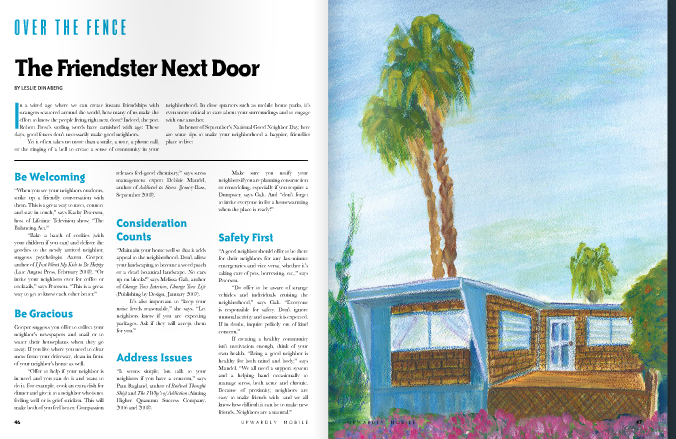
Won’t You Be a Good Neighbor (The Friendster Next Door)

This story as it originally appeared in Upwardly Mobile Magazine

This story as it originally appeared in Upwardly Mobile Magazine

It’s sad but true that in an age where we’re wired 24/7 and can–and do–create community anywhere, we often don’t know the people who live right next door. With all due respect to Robert Frost, good fences don’t really make good neighbors.

With as little effort as a smile, a note, a phone call or the ringing of a bell you can help create a sense of community in your neighborhood. Neighborliness is always nice, but when you live in close quarters such as mobile home parks, it’s even more critical to care about your surroundings and engage with one another.

In honor of National Good Neighbor Day on September 28, here are some tips to make your neighborhood a happier, friendlier place to live:

Be Welcoming
“When you see your neighbors outdoors, strike up a friendly conversation with them. This is a great way meet, connect and stay in touch,” says Kathy Peterson, host of Lifetime Television show, “The Balancing Act.”

“Bake a batch of cookies (with your children if you can) and have them deliver the goodies to the newly-arrived neighbor, suggests psychologist Aaron Cooper, author of “I Just Want My Kids To Be Happy.” “Or invite your neighbors over for coffee or cocktails,” says Peterson. “This is a great way to get to know each other better.”

Be Gracious
Cooper suggests you offer to collect your neighbors’ newspapers and mail or water their houseplants, when they go away. Or when clearing snow in your driveway, or sweeping, clean a path in front of your neighbor’s home as well.

“Offer to help if your neighbor is in need and you can do it and want to do it. For example, cooking an extra dish for dinner and giving it to a neighbor who is not feeling well or is grief-stricken, will make both of you feel better. Compassion releases feel-good chemistry,” says stress management expert Debbie Mandel, author of “Addicted to Stress.”

Consideration Counts
“Maintain your home well so that it adds appeal to the neighborhood. Don’t allow your landscaping to become a weed patch or dead botanical landscape, and no cars up on blocks,” says Melissa Galt, author of “Change Your Interiors, Change Your Life.”

“Keep your noise levels reasonable,” she says. “Let neighbors if you are expecting packages and ask them if they can accept them for you.”

Address Issues
“It seems simple, but talk to your neighbors if you have a concern,” says Pam Ragland, author of “The 7 Why’s of Addiction” and “Radical Thought Shift.”

Make sure you notify your neighbors if you are planning construction or remodeling, especially if you require a dumpster, says Galt, adding, “don’t forget to invite everyone in for a room or housewarming when the place is ready!”

Safety First
“A good neighbor should offer to be there for their neighbors for any last minute emergencies and vice versa whether it’s taking care of pets, borrowing, etc.,” says Peterson.

“Do offer to be aware of strange vehicles and individuals cruising the neighborhood; everyone is part of safety. Don’t ignore unusual activity and assume it is expected; if in doubt, inquire politely out of kind concern,” says Galt.

If creating a healthy community isn’t motivation enough, think of your own health. “Being a good neighbor is healthy for both mind and body,” says Mandel. “We all need a support system and a helping hand occasionally to manage stress both acute and chronic. Because of proximity, neighbors are easy to make friends with–and we all know how difficult it can be to make new friends. Neighbors are a natural!”

Originally published in Upwardly Mobile Magazine

HELPING THE HOMELESS

DR. LYNNE JAHNKE

If you mention Dr. Lynne Jahnke’s name to a homeless person, they might not know who you’re talking about. But if you mention her by her street nickname–“Dr. J”–their eyes light up and it’s a whole different story. “Yeah, I know Dr. J,” says Mitch, a Santa Barbaran who sleeps near the train tracks and spends his days at the downtown public library. “She’s cool. She’ll fix you right up with what you need.”

Jahnke–along with social worker Ken Williams and sometimes her assistant, Klea Kalionzes–hits the streets of Santa Barbara twice a week in search of homeless people in need of medical treatment. Often, her base of operations is a Volkswagen van filled with gear and space for “the guys to put their shopping carts if I need to take them to the hospital or the clinic,” she says. Sometimes, she’ll simply strap on a backpack full of medical supplies and cold water and go in search of homeless camps where she can help the sick and injured.

Street medicine is a long road from oncology, Jahnke’s first specialty. After practicing as a cancer specialist for almost ten years in San Francisco and Chicago, she came to town in 2000 to work at the Cancer Center of Santa Barbara. But two years ago, while in her mid-40s, Jahnke retired from oncology–“rewarding, meaningful work,” she says, “but I just decided I’d had enough oncology.” In a serendipitous turn of events, she met some people who were working with the homeless, and found her new calling. “It’s completely different but it feels great,” she says. “These people really have nothing–they’re so grateful if you give them a Tylenol or a Band-Aid. They can’t believe that a doctor is actually going out on the street and seeing them there.”

Although she loved being a cancer doctor, Jahnke says she continues to work with the homeless “because working in primary care with the homeless reminds me of the open heart and desire to help people that made me want to become a doctor 25 years ago. The patients are so kind and grateful for my care and the many other people who provide services to the homeless are wonderful to work with as well.”

Though she considers herself “retired,” and receives just a small stipend, when she’s not doing street rounds, Jahnke can be found three days a week at the lower eastside Casa Esperanza Homeless Shelter clinic, which offers 30 medical beds for patients released from the hospital who are still too ill to go back out on the streets. “I do a lot in coordinating the hospital discharges. I have working relationships with the doctors there,” says Jahnke.

Working with the homeless is a regular reminder to Jahnke of how fortunate she is. “This is why I went to medical school,” she says. “To take care of people who really need it.”

Originally published in Santa Barbara Magazine in Fall 2008.

Down the (New) Garden Path

This story as it appeared in Upwardly Mobile Magazine

This story as it appeared in Upwardly Mobile Magazine

Long, narrow side yards are often overlooked as valuable garden real estate, but they are especially useful as a way to make small spaces come alive and feel as is they’re part of the landscape. With planning, ingenuity, and a flair for the dramatic, landscape designer Mark Sargent transformed Judy and Rudy Escalera’s formerly confusing, underused space into a glorious side garden destination.

The Escaleras had lived in their Santa Barbara mobile home–in a senior living community next to a golf course–for about four years, when they decided it was time to redo the side yard. Judy was concerned that the gravel path might be dangerous, and she wanted to create a more cohesive, scenic look.

Sargent’s first impression was of “a garden that was semi-landscaped, but it had outgrown itself. There were attempts at little visual side paths but they didn’t really go anywhere and they weren’t inviting enough to make you want to get on them to see where they stopped.”

After consulting with the property manager about restrictions and an analysis of what should stay, what could be used but moved, and what should go in the garden, the two set a budget of $12,000, and got to work.

“We had a lot of resources, a lot of nice plantings to work with,” says Sargent. Though many of the plants were removed and placed in other areas, nothing stayed in its original place except a rose bush, hedges and some olive trees.

The first and most dramatic design change was extending the walkway out to the front property line. The Escaleras chose a “rather daring” Sedona Red flagstone tile that not only addressed the safety concerns and unified the look of the garden, it also had the unintended consequence of warming up the beige color of the house.

Initially Judy wanted to repaint the house when the side yard was done, but the reflection of the tile changed the color. “It was a clever accident,” explains Sargent. “It turns out the Sedona Red ties in so well that it made the house look like it was the right color.”

“Another thing that we did was change the steps at the side of the house,” says Judy. “We changed the design so that it had a little landing and the rail comes down like open arms, sort of saying ‘hi, here we are, welcome.’ You follow that beautiful red pathway and then on up into the different areas in the garden.”

Creating a pathway with a variety of interesting groupings of plantings–including Plumeria, Loropetalum, Aloe, Hydrangea, Jacob’s Ladder, Agave, Little Ollie, and Azalea–“helped give a sense of largeness to the garden so that the stairs didn’t just go marching straight down to the front door in a boring way,” says Sargent.

They also incorporated a birdbath, succulent rock garden, patio, an antique garden bench, and a water feature into the space. “It’s amazing that you can fit in so much and still end up not feeling overwhelmed by objects and feel that you actually have places to go,” says Sargent.

Other than trimming the olive trees and the hedges, the Escaleras are able to maintain the garden themselves, an important consideration for seniors and people on a budget. “I love to putter around,” says Judy. “It just gives me so much pleasure.”

Originally published in Upwardly Mobile Magazine

Pledging Beta

Recovering Alpha Mom shirt from cafepress.com

Recovering Alpha Mom shirt from cafepress.com

The book practically leapt off the library shelf and into my hands. How could I resist a title like, The Sweet Potato Queens’ Guide to Raising Children for Fun and Profit? Jill Conner Browne‘s sassy bon mots just cracked me up.

–(On men) “They’ve basically got two gears–horny and hungry.”

–(On women) “There is all kinds of stuff that you just shouldn’t ask any woman. Directly. If you want to know something personal about her, ask her nail technician or somebody who went to high school with her. You can find out just about anything you want to know about her this way–especially if she’s a bad tipper or was prone to stealing ninth grade boyfriends.”

–(On children) “Somewhere around 11 to 13, the eyeballs of children become extremely loose in their sockets, so that just about any disturbance in the air around them–say a word issuing forth from, say, your mouth–will cause immediate and severe rolling.” (My son must be precocious, because he started doing this at age 8)

–(On aging) “Who cares how old you are anyway? I’ve got waaay more interesting stuff to lie about in my life, thank you very much.”

I related to a lot of the book, but there was one section in particular that really hit a nerve. I had been struggling all summer with the question of how much I want to volunteer at my son’s school this year, and her observations about Alpha Moms really hit home for me. Last year I raised my hand to volunteer a few too many times and by the end of June I was burnt out, bitchy and resentful–leaving my husband only hungry.

Not wanting to go through that again–or needlessly torture my family–I thought long and hard and decided to give up some of the boards and committees and projects I had been involved with. My problem was, I still felt guilty.

Then I read the chapter titled, “Life is Hard Enough–Pledge Beta.” Conner Browne talks about how researchers have now come up with official categories for moms, including the “dearly demented and overtly overachievers,” otherwise known as Alpha Moms.

I’m sure you know the type. These women volunteer for everything so energetically that you could swear they’ve sucked all the energy out of the universe for themselves. Just looking at them makes me tired.

These are the women who laugh at the black and orange crepe paper you were so proud of yourself for remembering to bring for Halloween party, then furiously whirl around the room until it’s transformed into Disney’s Haunted House, complete with magic elevators and hitchhiking ghosts. Then they refuse to take compliments because they “just whipped everything up” the night before after their Pilates and Mandarin Chinese classes.

Those are Alpha Moms I realized. I always thought they were called Skinny Witches. Who knew?

A light bulb went on. I had been struggling to be an Alpha Mom, but I just don’t fit in. Why didn’t I see it before? I was trying to pledge the wrong sorority.

I can’t keep myself perfectly groomed and wear heels all the time. Who am I kidding? I consider myself well dressed if I go a day without spilling something on my shirt. Clearly I’m meant to be a Beta Mom.

Beta Moms, according to Conner Browne, “show up late, running down the halls, flip-flops flapping on the floor, breathing hard, sweating, wearing oversized T-shirts and frantic,” because they forgot about the stupid party until five minutes AFTER they were supposed to be there.

These are my people. I belong with the Betas, who the Alpha Moms only trust to bring paper towels and garbage bags to the party, but still bring extras in case we forget.

Boy do I feel better now.

I think I’ll take Conner Browne’s advice–“I can tell you this with absolute certainty: Nobody goes to the nursing home wishing they’d served on a few more committees or kept a cleaner house”–and just say no to a whole lot of things this school year.

And in keeping with my new Beta Mom m.o., “The Sweet Potato Queens’ Guide to Raising Children for Fun and Profit” is overdue to the library. But I just may have to keep it a teensy bit longer.

Send an email to email if you want to pledge Beta. There are no meetings, no dues, and no expectations. But we just may have a party someday.
Originally published in the Santa Barbara Daily Sound on August 29, 2008.

Kindergarten Redshirts

Photo chomnancoffee,  freedigitalphotos.net

Photo chomnancoffee, freedigitalphotos.net

School starts this week and a lot of families will be getting a late start–on purpose.

No, I’m not talking about those people who simply choose to extend their summers until after Labor Day, the way God intended. I’m talking about the people who decide to give their children an extra year filled with preschool or playtime before the academic rigors of kindergarten begin.

This graying of kindergarten is an interesting phenomenon. For many parents–especially the upper-middle class ones who can afford to stomach the extra year of preschool on the front end and extra year of supporting a child on the back end until s/he graduates from high school or college–the calculation goes something like this: you look at your four-year-old darling, especially if he’s a boy–because they tend to be squirrelier and less verbal when they’re little–and realize that his summer or fall birthday means that he’ll be younger than most of the other kids in his kindergarten class. So you decide to send him to school a year later. Then he’s at the older end of his class, with the presumption that his added maturity will give him an edge from grade to grade.

Private schools have a later birthday cutoff, but even in public school sometimes principals or teachers may suggest waiting another year to start is in your child’s best interest.

Not to mention their own.

One kindergarten teacher I know, Tammy, was nervous about commenting (which is why all of these names are pseudonyms), but did offer this, “All I can say is I’m really NOT into parents starting their kids at age four (turning five in the fall). That’s the worst.”

And as a parent, there is nothing worse than watching one kid who is not ready to be in school dominate all of the teacher’s attention for an entire year.

“I do believe that if a child is really immature, cannot hold a pencil, write their name, color a page and stay within the lines pretty well, cannot sit down long enough to listen to a story, cannot retell one fact from the story, and cannot follow a few simple instructions, then another year would be good for them to practice these steps in preschool,” says Chandra, another kindergarten teacher.

The other part of this equation is that “kindergarten is the new first grade,” according to many educators. Although most adults remember kindergarten as an idyllic year of naps, snacks and feeding the class hamster, it has become more and more academically demanding. With the advent of “No Child Left Behind” the pressure to teach things earlier and earlier gets even worse.

An estimated nine percent of children nationally are entering kindergarten a year later than they could, though there’s little evidence that children perform better in school if they start late.

But the decision to redshirt is such an individual one, and the research on the academic side–while mounting as a topic worthy of interest and study, especially since almost half the states have pushed back their birthday cutoffs since 1975–is still unclear.

At the same time, no one that I spoke to who redshirted their child regretted it.

“I absolutely did it,” says Wendy, whose son’s birthday is in late November. “Best thing I ever did. Especially with a boy. I have a girlfriend that did the opposite and her son is always the ‘baby’ of the class, and although she doesn’t see it, he suffers greatly for it. Pure immaturity. And they get meaner as they get older.”

To some professionals, redshirting children is necessary because kindergartens are more concerned with academics than with the emotional and physical development of youngsters. To others, the practice is not much better than coddling.

“I found that with some kids they acted young because their parents babied them, so it did not matter if they were one year older or not,” says Yvonne, another teacher friend.

Sometimes families decide to redshirt for reasons unique to their family dynamics. I have one friend, Darlene, who held back her second son because otherwise he and his older brother would have been one grade apart, and she didn’t want them competing so closely on the academic, social and athletic playing fields.

It’s no accident that the term “redshirt” comes from athletics, since the one place where redshirting is a proven advantage is on the sports field. Up until a few years ago the birthday cutoff date for Little League was July 31, which is a lot better explanation than astrology for the fact that 60 percent more Major League Baseball players are born in August than in July.

Aside from stacking the sports odds in favor of kids, experts also worry that redshirting puts low-income students at an extra disadvantage. The children who end up going to school young because their parents can’t afford to hold them back are also the ones with the least preparation and lowest rates of participation in preschool. Then those children arrive at school and have to compete with older, better prepared students whose parents may demand more challenging classrooms so their kids aren’t bored.

Still, parents are understandably more concerned with their own child than the bigger picture.

“Around the teenage years, it really starts to suck when your child is a full year younger than all his friends,” says Lola, whose son is entering high school having just turned14. “All the friends who are a year older start to like members of the opposite sex, start growing hair in lot of new places, think their parents are idiots, don’t want to play video games anymore, want to be downtown all the time and get their driver’s license long before your child who is the correct age for their grade. This leaves the correct age for their grade child feeling inadequate to say the least, not to mention lost and confused.”

Of course no one wants their child to have any disadvantages, which is why my friend Angie might have the best idea of all. “My recommendation to parents would be to have babies born between October-March.”

Originally published in the Santa Barbara Daily Sound on August 22, 2008.

Legacies: Storyteller

storytellerThe infectious chirping of children’s laughter greets visitors. Pigtails fly as a little girl rounds the playground on a tricycle, her smile as bright as the sun. This scene could take place at any of Santa Barbara’s high quality preschool programs, with one exceptional difference–this is Storyteller Children’s Center and these children are homeless.

Founded in 1988 by volunteers who pushed aside cots at Transition House to make space for a small group of children, Storyteller has a come a long way from those humble beginnings.

“We started out as a half-day program for about ten kids,” says Executive Director Terri Allison, who co-wrote the initial proposal to fund a childcare center for homeless children when she worked for the Community Action Commission. The children thrived and the program grew, incorporating in 1991 and moving to First Congregational Church, then to a dedicated center in 1999.

As the program matured, so did its goals. “In the beginning, the group was very focused on providing a safe space for kids,” says board president Jon Clark. “Now we’re looking in a more focused way at the children and their families and what they need. … In particular because of the living situations these children are in, it really is on Storyteller to provide educational experiences, nutrition and all those things that will help them grow.”

Most families are referred through word-of-mouth or from other agencies such as Transition House, Domestic Violence Solutions, St. Vincent’s, Department of Social Services and Child Protective Services.

“A teacher sits down with every family for at least an hour … to establish a level of trust with them and also to figure how we can help,” Allison says. In addition to early childcare and education services, offerings include on-site counseling, family services and case management; parent support groups and education workshops; mental health and disability services; health, vision and dental screenings and nutrition services.

“The teacher helps set goals with the parents and we monitor them on a monthly basis,” Allison says. “We know that the best way to affect change is through the whole family, so parents to have the skills that they need, as well as the children.”

“Parents who leave their children with us are expressing tremendous trust in the people that work at Storyteller,” says Clark. “Once that trusting relationship is developed, there is so much that we can do to help them deal with their family issues and parenting issues. That was a real eye-opener when we realized that the relationship between the organization and the families and the trust that developed was such a huge asset.”

Studies of graduates and their families show a marked improvement in their social and economic status and Storyteller is working with UCSB to research the longer-term impact of its programs. “What we’re trying to do is to make meaningful changes in the lives of children and their families that are going to play out over time,” says Clark.

“There is so much scientific evidence about the huge differences that quality preschool education can make in later years,” says Allison. Experts agree that investment in high quality education for young children has substantial economic payoffs–for every $1 invested, $3 to $16 is returned from decreased jail time and increased physical and mental health.

One of the biggest challenges for Storyteller is trying to focus on the depth of services to individual families and still offer a breadth of services to the community. The waiting list for children continues to grow. Allison cites research that there is only one licensed childcare space for every three eligible children in Santa Barbara County–regardless of a family’s ability to pay.

Still, Storyteller is doing its best to help more children. Celebrating its 20th anniversary this year, the organization opened a second facility, thanks in large part to the generosity of the Orfalea Foundation, who bought the building and is leasing it back to Storyteller rent-free for ten years, enabling Storyteller to mount a $3.2 million capital campaign for the expansion.

Last spring Storyteller was able to increase capacity from 29 to 50 children in the two preschools. By September of 2009 they expect to have 72 children enrolled.

“It’s really amazing to think of how far we’ve come,” says board member J.P. Sharp, a volunteer since 1994. “It was a real grassroots organization of helping children and helping parents and really teaching them how to parent. This is still a wonderful place to visit and volunteer.”

Originally published in Santa Barbara Seasons Magazine in Fall 2008.

Noozhawk Talks: Leslie Dinaberg Sits Down With Amy Kovarick

Amy Kovarick (courtesy photo)

Amy Kovarick (courtesy photo)

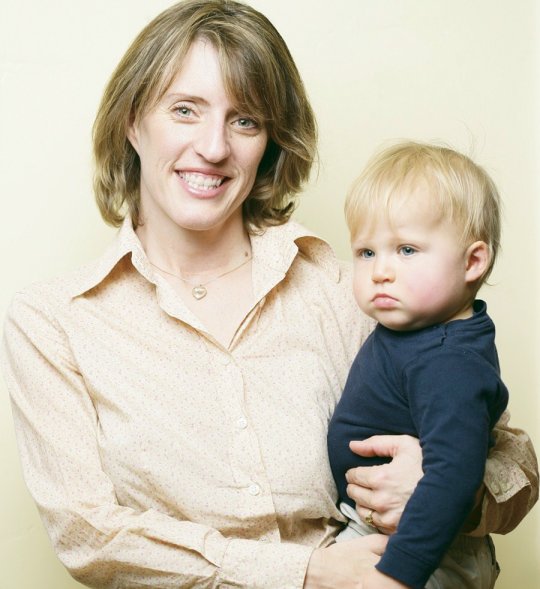
As a wife, mother and life coach, Amy Kovarick is a master of multitasking, and she’s helping others find balance in their lives, too.

By Leslie Dinaberg

Wife, mother, life coach, counseling psychologist, radio host and author of Baby on Board: Becoming a Mother Without Losing Yourself, Carpinteria-based Amy Kovarick knows a lot about multi-tasking.

Leslie Dinaberg: So you got started as a life coach after leaving the corporate world?

Amy Kovarick: Yes. I got married at 39 and Matt was born when I was 40, so it was a tremendous change. And finding where the ambitious kind of career Amy fit now with all of these other hats was part of my journey. One company I have, Empowered Motherhood, (Empoweredmotherhood.com) is very much about that. How do you keep close to yourself and true to who you are and yet bring your best to your kids?

… that’s kind of the heart of coaching, whether it’s Empowered Motherhood where it’s a mother community … or my private coaching practice (Amykcoaching.com) where I work with people across the country. The coaching part, no matter who I’m working with, is looking at that balance across your life.

… I’ve got folks who come for career issues, relationship issues, health issues, really right across the board. But it always comes down to balance, which one is falling off the load and have you even stopped to think about where you fit in and what you want, what’s interesting to you nowadays?

LD: It sounds like we could all use some of that.

AK: (Laughs) I think the best coaches are the ones that truly believe they don’t have answers for someone. They think you know deep down inside what’s best for your life and are good at just bringing out who you are. But the tricky part or the tough part about coaching is that there’s all that self-reflection and kind of the touchy feely part, coupled with a bunch of accountability and action items. That’s what drew me to coaching was the combination of the soft side with the no nonsense lets move side.

LD: What kinds of people typically come to you?

AK: A good example is the owner of this restaurant (Corktree Cellars in Carpinteria). She didn’t need to be fixed, she didn’t have a problem, she had a goal … I’ve worked with a lot of entrepreneurs, both men and women and a bunch of executives. I do corporate contracts where the corporation is paying me to coach some of their top leadership in reaching their peak performance if you will. But what I love about that is it is still the same, it’s one on one, there’s nobody there on the phone but them and I’m not working with their board of directors or their boss, it’s still weaves in issues from across their life.

I have a new woman that took on her first president role and so she’s been VP, she’s been this and that, but she’s a mom, she’s got two kids and she’s got all of the issues with that, plus she’s a new female president, in a new company that she doesn’t know these people, a bunch of men that are working for her and reporting to her and the coaching with her is full of all of the things you would imagine.

There are a lot of practical business things but there is the okay, how do you show up and be your full self and be as bold as you want to be and don’t be afraid of stepping on toes, but yet be effective. That’s what I love about my work.

One of my favorite long-term clients was a young girl going through college in New York and her father was footing the bill because he wanted her to be very successful. There’s a different kind of pace of just really working through her journey of becoming an adult and she’s graduated and is down in Australia at the Great Barrier Reef, she’s a conservation biologist.

… So the dreams differ, one wants to be the best leader, one wants to open a restaurant, one wants to be a marine biologist, so it sounds very different, different ages and walks of life, but it is all the same thing of who are you, what do you want to do, how are you going to get there–and that’s what fascinates me. That’s what keeps me in it is every person is different and no two coaching sessions look alike.

LD: In a way it sounds like what writing does, you sort of get to live other lives because you’re finding out so much about what other people are doing.

AK: Yes. And I get I thrive on one on one, real conversations, not a lot of superficial stuff. I’m terrible at networking or parties where you have to just chitchat. That’s my worst thing. So when I get to do my coaching, these people share a lot. And they come pretty unguarded, even my tough male executives.

LD: Do you get people that are motivated to change something?

AK: Yes. Change, grow. It’s people who even though they all look so different on the surface, the common thread is this desire to grow, to not just be successful because it’s not always about people wanting monetary success, it’s this almost fierce desire to not be static, to not stay the status quo. They want to keep pushing out their barriers, and some people for sure come with a problem, come with I’m really unhappy at work, I’m really unhappy in my relationship, I would like to meet someone, I would like to lose 50 pounds. Sometimes there is a very specific problem and they are all willing to look at themselves to take responsibility. By the nature of no one is going to hire me and pay my fees if they are a victim. … People who show up and want to work with me, they’re serious about their life.

… Often I get asked, well how is this different than therapy … the big difference is therapy often is about healing or fixing and it often goes into the past and the whys. How did I get here? Whereas coaching is about where are you now. Coaching is much more about present and future and very seldom do I go to the whys or what happened with your parents. That’s just not part of the conversation even though that’s really valuable but it’s not what I do.

LD: If you could be invisible anywhere in Santa Barbara, where would you go and what would you do?

AK: If I could get into my husband’s head. He’s a very private guy and as he said last night, “you know more about me than anyone in my entire life has every known.” But it’s like pulling teeth.

Vital Stats: Amy Kovarick

Born: Newport, Rhode Island, April 23

Family: Husband Mike Musson; Stepdaughters Layla, 20; Fina, 18 ; and Meli, 15; and son Matt, 2-1/2.

Professional Accomplishments: Author of “The Empowered Mother,” host of the radio show “Empowered Mother,” MA in Counseling Psychology, PCC (Professional Coach Credential), member of the International Coach Federation, has worked with hundreds of people in North America helping them reach their dreams.

Best Book You’ve Read Recently: Age of Turbulence, by Allen Greenspan

Little-Known Fact: I was in the Air Force and worked at the Pentagon.

Originally published in Noozhawk in July 2008. (Click here to read the story online.)

The happy-ish place on earth

DisneylandIs it possible that the happiest place on earth is now just a happy-ish place?

From my first visit to Disneyland as a 4-year-old, to the hundreds of journeys I’ve made there since, I’ve always thought Disneyland was an E-ticket ride.

The thing about going to Disneyland– sweaty bodies that aren’t your own, outrageous prices, long lines and theme park feet aside–is that it’s a chance to spread a little magic pixie dust and journey back to your childhood.

But this time, even though our recent trip was a blast, it was also a sad reminder that while I’m still a kid from the moment I spot Mickey from the freeway, my own kid is growing up way too fast. He didn’t even want to buy mouse ears because he’d “have to take them off on Thunder Mountain.”

Excuse me? Mouse ears are mandatory.

Back in the 70s, when I was rocking white Go-Go boots, pigtails and a Partridge Family lunchbox, my Grandpa Alex did the dry cleaning for Disneyland. This meant we got free tickets to Disneyland. We must have gone a dozen times every summer, but I still got mouse ears every time–and that was when your choices were with or without a bow. Now the ears (37 styles) snap on to 1,569 different hat options, and don’t even get me started on the patches. Yet Koss was not particularly interested.

Hmm … maybe it’s a boy thing? At least he still skipped with me.

New stuff comes and goes in the real world with alarming frequency, but everything in Fantasyland was just where I left it when I was 7. Watching Alice’s teacups spin brought back some of the happiest memories of my childhood–but if some kind of extreme thrill isn’t involved, then Koss wasn’t willing to wait in more than a five-minute line. My husband Zak got queasy just looking at those saucers spin.

I realize that not everyone digs Disneyland the way I do, but Zak was more excited by the free soda refills at one of the restaurants than the new Nemo ride. Admittedly, it wasn’t the best ride ever, but still, it’s a NEW RIDE at DISNEYLAND! To which he responded, it’s FREE REFILLS at DISNEYLAND! Point taken.

I think Zak’s happiest moment of our three-day adventure was when he saw that “It’s a Small World,” was closed for re-theming. I was crushed, but soon realized that even without the ride I could still hear the echoes of my dad singing, “It’s a Small World After All.”

Just so they wouldn’t feel left out, I sang it a few times for Zak and Koss. They were amused for the first ten minutes or so, then, I don’t know what happened. Some people don’t recognize fun, even when it’s screaming in their ear.

Like I said, it was a happy-ish place this time.

Still, I got them off the roller coasters and into the Tiki Room for a little while. The line for the pineapple froth was too long, and Koss thought it sounded icky, but inside I could almost see Grandpa Alex’s belly jiggling as he danced along with the birds in the “Tiki Tiki Tiki Tiki Tiki Room,”

Koss rolled his eyes when I shared the precious Disney memory of when he was a baby and I gracefully managed to spill an entire strawberry slushie on his tushie and then used the very last diaper in all of Disneyland to clean him off.

While I think that one of the greatest things about being a parent is getting to re-experience magic through the eyes of a child, I guess I also have to remember that as a child it’s not that much fun to hear your parents’ stories over and over again.

But seriously, this is a story that involves Disneyland, bodily fluids, and mom being embarrassed. You would think he’d be a little more amused. Where’s the pixie dust when you need it?

I was starting to worry that Koss might not have inherited my Disney gene, when we stumbled onto the parade. His skinny legs bounced along to “Under the Sea” and he grinned as he explained to the crowd that the starfish were doing some of the aerial moves he learned at Circus Camp. Then he waved to Peter Pan and Tinkerbell, forgetting for a moment that he’s almost 9 and too old to get too excited. This place has still got it.

When we finally got home, with throbbing feet and empty wallets, I was too tired to wash the theme park film of saturated fat, sunscreen, sweat and spilled sugar off my body. Koss is still smiling when we carry him to bed and still clutching a couple of magic rings we bought him instead of the mouse ears. Who needs pixie dust? Disneyland’s still got it.

Originally published in the Santa Barbara Daily Sound on July 18, 2008.

Bringing up Babies

Claire Bloomfield photo

Claire Bloomfield photo

I was interviewing this fascinating, accomplished, professional woman and it was going great. Our conversation had a nice rhythm, she had some anecdotes and zingers I knew would jump right off the page. Oh joy, oh boy, this profile was practically writing itself. Then, when the interview was just about over, I dropped the bomb. A conversational dud that fell with a big fat thud: Do you have any kids?

It sounds like a pretty innocent question, right? It’s not like I asked her about her favorite sexual position. But she didn’t have kids and that simple truth made me feel like I had crossed a line and was intruding into her personal life.

How is it that we can live in a society that teaches the four R’s–Reading, ‘Riting, ‘Rithmetic and Reproduction–and yet asking someone whether they have children can be considered rude? I wanted to explain to her that even though I’m now on the mom side of the fence, I’m not so far out of her neighborhood.

It wasn’t that long ago that I was childfree and working late nights at the office, cursing my colleagues who got to leave at 5 to pick up Timmy and Susie from daycare, while I had to work late to pick up their slack. I remember what it was like. As much as I love my son, I do sometimes long for the days when every dining out experience didn’t come with complimentary crayons.

There’s been so much written about “the mommy wars” between the stay-at-home moms and moms who work, but nobody really talks about the “my life choices are better than yours” tension between the women who have children and those who don’t. Like it or not: I could feel it in the air as I awkwardly ended the interview.

Now I’m not one of those women who believe it’s everyone’s fate to procreate. I can certainly understand why everyone doesn’t want a baby on board. Not everybody pines for progeny. I know plenty of cheerfully childless people, I thought. Look at Oprah, and Mother Teresa. What about Condoleezza Rice? What’s the big deal? I wanted to explain all that to this woman and couldn’t find the words. It just felt too personal, like I was asking her how much money she made or whether she believed in God.

But as I flipped through my address file later, I realized that the vast majority of people I hang out with have kids. It’s not that I don’t know a lot of childless people, but we don’t really run in the same circles. Apparently, they like their conversations uninterrupted by shouts of, “Stop stabbing your sister with a fork!”

The moment I walked down the aisle and got married it seemed like people started asking me about “the pitter-patter of tiny little feet.” It was amusing at first, but became progressively more painful and annoying as we struggled to have a baby, and the ticking of my biological clock joined in the pitter-patter chorus.

When I was struggling with infertility it seemed like the whole world was pregnant or potty training. I began to cringe inside every time someone asked about kids. Was this what it was like all the time for people without kids?

How do you keep your cool in a world filled with drool? My friend Cara, who gets asked all the time about kids, laughed, “I usually just tell them I’m raising kittens instead.”

Daisy, a college friend who tied her tubes in her 20s, said when people ask her “why don’t you have any children,” she simply retorts: “why don’t you have any class?”

Angie, who’s approaching 40 and is cheerfully childless, says she’s been asked, “Aren’t you getting to the age where you should be having babies?” Her favorite response: “Nah. But aren’t you getting to the age where you should have better manners?”

But my favorite response came from Camie, who said, “I’ll consider having a baby when maternity clothes and minivans are sexy.”

Hmm … I wonder what Angelina Jolie drives?

Is it rude to bring up babies? Share your thoughts–and horror stories–with email.

Originally published in the Santa Barbara Daily Sound on July 11, 2008.

Leslie Dinaberg Sits Down With Gay Browne

Gay Browne

Gay Browne

The Greenopia founder publishes city guides to help consumers find environmentally friendly businesses. A Santa Barbara book is due out … soon.”

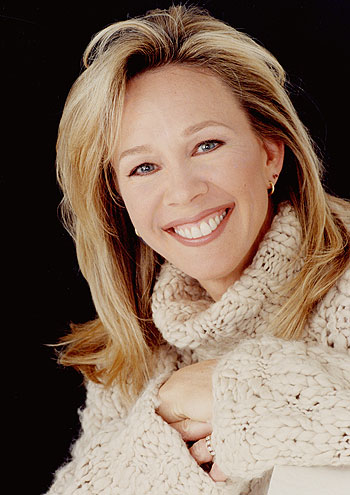
“Eat, shop, live green” is the mantra for Montecito mom Gay Browne. Her company, Greenopia, publishes Zagat-style city guides to help busy consumers find earth-friendly businesses. The Los Angeles book came out in 2006, San Francisco in 2007 and New York in 2008. She plans to expand to multiple cities across the country, including Santa Barbara, which “I promised the mayor I would do this year.”

Leslie Dinaberg: Tell me about the Greenopia books and website?

Gay Browne: It started because I have been a lifelong asthmatic and I’ve always been super conscientious about my health. … My oldest son was born with autism-related learning issues, and then I learned about him, and all of these illnesses led me to understanding that how you lead your daily life, can make a big difference in your health. … We built a house in 1994 that was the first environmental house in West Los Angeles, and in building the house I learned a whole lot inside out what goes into buildings and all of the environmental stuff and so I got fascinated about it.

…I thought I’ll create a guide, like a Michelin Guide and I’ll vet the businesses and services and I’ll give people a roadmap in clothes, in paints, in carpets in almost everything that they have an eco-friendly alternative solution.

LD: What has the response been to the books?

GB: It’s been phenomenal. … We have really done phenomenally well for being a new venture.

LD: So when you do a guide do you hire field researchers to go walk around?

GB: The way we do it is we go and we put an ad on Craig’s List or the local university, they all have environmental departments. …We’re trying to figure out a to work with universities to help cultivate their students, as well as help cultivate our criteria.

LD: That’s a great idea.

GB: The Bren School here at UCSB did a study of our research criteria of our 52 categories and they gave us some recommendations as well as a lot of good credits. And then recently we won an award from the EPA on our work for educating consumers for sustainability and climate change, which is good validation for us. But that’s how we go, we go into cities, we hire people and grid the cities, just like on a map. … And they have these 52 categories they use, they ask the questions, we put in all the data and then we come out with a leaf score of one to four leaves.

… The leaf score is not to penalize businesses for not being green, the leaf score rating is really for the consumers to know how much green is in that place, because if you were to look at a list of stores and it was McDonald’s, Shakey’s, Chinese food and a natural health store, the only reason you know that the natural health store has more health stuff is because of the name. Otherwise they could all have organic vegetables and fruits. So what we’re trying to do is give the four-leaf rating to those stores that offer more environmental friendly alternatives so the consumer who is more choosy will know.

LD: How would you think that Santa Barbara would rate?

GB: It’s small. I have to say I think we’re a little behind in the food department. There is not as much alternative for buying organic food as there is other places. Vons has a very small section of organic food. There’s the Farmer’s Market, which I personally never can get to because my kids always have sports on those days. … I think that Santa Barbara has a healthier lifestyle and the people are healthier but … I don’t see as many of the support services, like the pool guy, I want it to have no chemicals. They are not that experienced in doing that. Homebuilders, they are actually a little better, but certain categories are not as well versed. However the people that are here are more committed to living a healthy life. I don’t think that businesses have caught up with the desires that people have. … I promised the mayor I would do a guide by the end of the year, if not January 1st for sure by Earth Day.

LD: I can’t wait to see it.

GB: I started this because I became conscious about my life and I wanted other people to start being conscious about what their lives are … we have to start being really conscious of how we treat each other and how we use our resources and what our behaviors are to the planet. … My goal is treat the planet kindly, as well as each other, I think that somehow in businesses globalization that people forgot along the way that we can’t just swallow up everything.

LD: With these publications and this business that’s all over the place, how much do you need to travel?

GB: That’s a problem … there’s only one of me. … I do have to travel often. … I’m not unlike most moms with a passion. If you’ve got a passion and you’re a mom, you are dedicated to making it work. It’s hard on my kids when I’m gone. … But the good news is my husband is older and he’s semi-retired so he is around almost all the time. His office is in LA but because he’s semi-retired he goes in only every other week for two days, so it wouldn’t be possible without his financial support and his flexibility with his schedule.

LD: It sounds like you’re really, really busy, but when you’re not so busy, what do you like to do?

GB: Hang with my family. I love to play golf and tennis but I don’t play tennis or golf very much. I love to hike. I try to squeeze in a hike whenever I can, which is about once a month, and I do Yoga twice or three times a week. If I have free time I do something with the kids.

LD: If you could pick three adjectives to describe yourself, what would they be?

GB: I would say that I’m optimistic, energetic, and persistent or tenacious. If you ask my husband those are kind of an annoying three words. I tend not to get batted down until I really get batted down!

LD: I think to start any kind of a business yourself–especially something that no one has really done before–you would have to be tenacious.

GB: Right, or just naïve. You should probably be both. People say you never would have done this if you knew how hard it would be. I say not in a million years. It’s been way more work and way more money than I thought, but today when I heard that (green newsletter) Ideal Bite sold to Disney for $20 million and I have a meeting with Disney tomorrow, I’m thinking, well, maybe there’s hope.

LD: I would imagine that probably the money motivation is great, but it’s not just the money motivation.

GB: No, not at all. If I can get one mother to know that she should get her mercury tested before she has children to save her the headache and all the things I went through, or one mother who has a child with allergies to avoid allergy shots when she switches to an organic mattress because it has less molds and dust, it would make my life perfect. Money is a validation as a woman that I appreciate as an independent person, but I’m doing this because of my passion.

Vital Stats: Gay Browne

Born: Lexington, Ky., April 21, 1960, which is fitting since sometimes it falls on Earth Day.

Family: Husband, Tony; children Alex (Young) 19, Colin, 9, and Katie, 7

Civic Involvement: Works with local environmental groups such as theCommunity Environmental Council and the Environmental Defense Center. “I’m also trying to work more with the mayor’s office in supporting policies that have to do with the environment.”

Professional Accomplishments: Founder of Greenopia. Before that, spent five years working in public relations and 10 years in media advertising, including Star MagazineTravel and Leisure Magazine and the Los Angeles Times.

Best Book You’ve Read Recently: I loved Elizabeth Gilbert’s Eat, Pray, Love. I’m also reading The Comeback, which is case studies about women going back to work.

Little-Known Fact: “I just recently began telling people that I had an eating disorder at one point in my life. I didn’t used to actually admit that very often. … Given the chance of spending the day the way I choose, I will find a hammock or a couch and lie there almost all day and read. … People think because I’m energetic that I don’t need quiet time, but I really do need quiet time. They underestimate my need for quiet. That’s why I moved to Santa Barbara, because it was quiet.”

Did you know?

Healthful tips from Greenopia:

» If every American ate just one meal a week made of locally and organically raised meats and produce, it would reduce the country’s oil consumption by more than 1.1 million barrels of oil every week.

» Among conventionally raised produce, apples, bell peppers, celery, cherries, grapes (imported), lettuce, nectarines, peaches, pears, potatoes, spinach and strawberries are the highest in pesticides. The list of conventionally raised fruits and vegetables that are lowest in pesticides includes asparagus, avocados, bananas, broccoli, cabbage, eggplant, kiwi, mangoes, onions, pineapples, sweet corn (frozen) and sweet peas (frozen).

» Replace PVC shower curtains with a natural fiber or nylon alternative. That plastic smell comes from the toxic chemicals that make PVC (polyvinyl chloride).

» Pack leftovers in reusable glass containers instead of disposable plastic bags or containers, which are made from petroleum. Recycling helps a little, but only a fraction actually gets recycled. Additionally, items that are used once then discarded will sit in landfills or blow into waterways and cause harm.

» Buy local and reduce carbon emissions. The average piece of produce travels 1,500 miles to get a grocery store.

» Research has demonstrated that when compared with other household actions that limit carbon dioxide, taking public transportation can be more than 10 times greater in reducing the greenhouse gas. It takes one solo commuter of a household to switch his or her daily driving to using public transportation to reduce the household carbon footprint by 10 percent.

Originally published in Noozhawk on July 14, 2008.