The Race to Less Homework

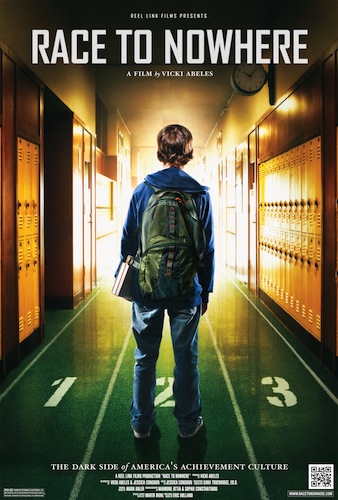
RaceToNowhere_27x40_0711Like many people I spoke to in the audience, I was both dreading and looking forward to seeing Race to Nowhere, a documentary about the impact of undue academic pressures, which was presented by the Orfalea Foundation and UCSB Arts & Lectures last weekend.

Mostly I was worried that watching the movie would become–ironically enough–a homework project for ME in that I feared that its depiction of the negative effects of too much homework and too much pressure to do well in school might motivate ME to want to take on the Sisyphean task of trying to change our educational system.

It’s not exactly a feel good movie, but it certainly is an effective one.

The movie did make me want to do something.

Directed by concerned mother Vicki Abeles, “Race to Nowhere” paints a scary story where cheating has become commonplace, students are disengaged from what they are supposed to be learning, stress-related illness and depression are rampant, and many young people arrive at college and the workplace unprepared and uninspired.

Plus, as one high school girl points out in the movie, “we live in a society today where you have to be smart, but also pretty, and also you have to do sports, and you have to be involved in art, and you have to find something unique about yourself. And you have to know yourself, because if you don’t know yourself then you’re going to lose yourself.”

Aurgh! Is it any wonder that, as Dr. Madeline Levine, a psychologist and expert on student stress who was in the movie and participated on the panel afterward, says, “20% of high school kids have major stress diagnosis or an anxiety disorder of some kind.”

They’ve spent their entire childhoods building their resumes.

It seems so overwhelming.

A lot of the challenges pointed out in the film–the federally mandated No Child Left Behind requirements; the emphasis on testing; too many students “qualified” for top universities and not enough spots available; global economic competition–are just too huge to even think about trying to overcome as a lone parent, but there is one issue that actually seems surmountable, even by little ol’ me.

Homework.

Despite the fact that, as friends with older kids taking AP classes remind me, our sixth grade son is “just getting started” on the homework treadmill, our entire household spends a ridiculous amount of time talking about homework, negotiating about homework, whining about homework and even crying about homework.

Yes, I am the one who usually cries about homework and does a little happy dance on the rare nights when he doesn’t have any. It’s painful and quite frankly we’d all be a lot happier if there were less of it.

Our son’s homework, with the exception of reading and studying for tests, is overwhelmingly full of busywork. Coloring endless pages of a “keepsake” book from a field trip is not a good use of the wee hours of the night, in my opinion. Coloring is supposed to be fun, right? Even the so-called “fun” projects like creating dioramas, board games or giant posters usually involve multiple trips to the crafts store searching for expensive supplies to create projects that require way too much parent participation and take way too much time.

Plus, when you look into the academic research about homework, there’s very little to support it, especially for younger children. According to the movie, there’s no correlation between homework and academic achievement in elementary school, and the correlation flatlines after two hours of high school homework.

“Kids are developing more school-related stomachaches, headaches, sleep problems, and depression than ever before,” writes William Crain, a professor of psychology and author of “Reclaiming Childhood: Letting Children Be Children in Our Achievement-Oriented Society.” “We’re seeing kids who are burned out by fourth grade. Soon, it will be by second grade.”

The other thing too much homework does is cut into kids’ time for physical activity (even though we’re worried about childhood obesity), as well as family time and even household chores. How can we teach our son to be a responsible member of our household (let alone society) when he doesn’t have time to do the friggin dishes?

Among the suggestions for parents at the end of the movie are to “reduce performance pressure” and “allow time for play, family, friends, downtime, reflection and sleep.” Those sound like do-able ideas to me. But can you help us out here, teachers? How about a little less homework.

When Leslie’s not clenching her teeth over her son’s homework, she’s usually home doing work of her own. She can be reached at Leslie@LeslieDinaberg.com. For more columns visit www.LeslieDinaberg.com. Originally published in the Santa Barbara Daily Sound on January 14, 2011.

Ode to the Wii

Boy Playing Videogame by imagerymajestic, freedigitalphotos.net

Boy Playing Videogame by imagerymajestic, freedigitalphotos.net

Thank you Nintendo. Wow–those are three words I never thought I’d say in a million years.

Until rather recently we were a family of Luddites when it came to gaming devices. No DS, no Playstations, no Game Boys, no Xbox 360’s at our house, as our son frequently reminded us. It got so bad that he would introduce himself to strangers by saying, “Hi, my name Koss. I don’t have any brothers and sisters, I don’t have any pets and I don’t have any electronic toys.”

Yes, for a long time our child was pitifully deprived of all that stuff.

When he dared to complain of boredom, we’d mock him mercilessly, then tell him to go read a book, play basketball, ride a bike, bounce on a pogo stick. Video games were a no-no at our house. We just didn’t go there.

I’ve got to admit, I felt a little teensy bit of parental superiority about it. Maybe not quite the same level of superiority that people who never give their kids fast food feel, and definitely not reaching the level of parental purity that those people with “Kill Your TV” bumper stickers feel, but still, I was kind of proud that we hadn’t given in on this particular issue.

My husband, a longtime fan of computer games, was also happy not to have a gaming machine in the house. Although, his thinking went more along the lines of, “Don’t give me a gun, I don’t want to have to kill again.”

Then came the summer of his tenth birthday when the boy had saved up enough money to buy a Wii.

Uh-oh.

He had prepared a 23-slide Power Point presentation on why he should be able to purchase the toy. (Yes, we let him use the computer. I said we were Gaming Device Luddites, not Amish!) He argued that it had lots of non-violent game options, that playing the Wii involved getting off the couch and actively moving, that he would strictly follow whatever time restrictions we gave him for the game, and that he had his own money saved up and this was what he “pretty please with sugar on top” wanted to buy with it.

So we caved. And it was a lot cheaper than getting him a baby sister or an iguana.

Koss was completely addicted to the Wii for about five minutes. Then he got into a new series of fantasy books and forgot all about it for couple of months.

Then one day, it rained. And rather than jump on the furniture or play “vaseball” with the last of my wedding crystal, we brought out the Wii. Whee! Now we have a Wii, the perfect toy for a rainy day.

And whee, let me tell you, every single time it rains I do a little happy dance for the Wii.

Since it’s mostly sunny, Santa Barbara just isn’t very well equipped for rainy days. When you coop 75 pounds of pre-teen energy into a very small house for too long eventually something’s got to give–usually it’s my sanity. Let’s face it; no matter how hard you work to civilize them, boys are wired for action. Thank goodness, now they’re also wired for Wii. While it rains outside, kids can still work up a sweat without catching pneumonia.

And I know this isn’t the case with every kid, but thankfully, as much as we have come to love the Wii, Koss would still rather play outside when he can. Whee, I love that Wii.

Share your thoughts on video gaming with Leslie@LeslieDinaberg.com. For more columns visit www.LeslieDinaberg.com. Originally published in the Santa Barbara Daily Sound on January 7, 2011.

From Yiddish to Yinglish

YiddishDictionaryOnline.com

YiddishDictionaryOnline.com

When it comes to traditional religion, I’ll readily admit that I’m more Jew-ish than Jewish. You won’t find me in temple unless there’s a Bar mitzvah or a book signing, and I’m certainly not one to pass up an offering of bacon-wrapped shrimp. They’re delish!

But there’s one part of Jewish cultural tradition–besides the latkes–that I have embraced with gusto: the language.

No, I’m not talking Hebrew, which is way too complicated and confusing for the short attention span theater of my brain these days. I get a case of Hanukkah guilt before the gelt every year when need a refresher course on the dreidel symbols.

No, I’m talking Yiddish. And whether you realize it or not, so are you.

You may not be one to just say nu to your kids. (A general word that calls for a reply. It can mean, “So?” “Huh?” “Well?” “What’s up?” or “Hello?” It’s like a verbal grunt, useful in a variety of situations.) And you may not kvetch about your boss. (Which literally means “to press or squeeze,” like a shoe that’s too small, but many people now also use it to mean, “complain, whine or fret.”)

You may not even schmear your bagel. (Which originally referred to a spread of cream cheese on a bagel but has extended to anything that can be spread, and in some cases refers to “an entire set or group of related things”, or the expression “the whole schmear.”) But from schmear to eternity, I’d bet my last bit of gelt (a Yiddish word for money, and for the chocolate coins eaten on Hanukkah by some and year-round by those of us that frequent See’s Candy) that words like glitch?(literally “slip,” “skate,” or “nosedive,” which many people now use to mean “a minor problem or error”) or zaftig (plump, but pleasantly so) have crossed your lips from time to time.

You’re speaking Yiddish and you don’t even know it.

Not to belabor my spiel?  (a long, involved sales pitch), or act like a maven ?(which comes from the Hebrew “mevin,” or “one who understands,” but has evolved to mean a know-it-all, and is often used sarcastically) of Yiddish vocabulary, but I’d bet you also use the words klutz?(which literally means “a block of wood,” but is often used for a dense, clumsy or awkward person) and nebbish (an insignificant, pitiful person; a nonentity) without giving them a second thought.

You’re a Yinglish speaker too.

I really don’t mean to be a noodge (to pester, nag, whine or be a pest or a whiner) about this, but chances are good that even somewhat vulgar Yiddish words like dreck (which means worthless material, especially merchandise) and tush (buttocks, bottom, rear end) have crossed your lips from time to time.

So here’s my Hanukkah gift to you: the next time someone asks you if you speak a second language you can tell them you are fluent in Yinglish and you do know more than bupkis (zero, or nothing) about Yiddish.

Share your Yiddish or Yinglish vocabulary words with Leslie@LeslieDinaberg.com. For more columns visit www.LeslieDinaberg.com. Originally published in the Santa Barbara Daily Sound on December 3, 2010.

Noozhawk Talks: Paul Freeman Gives Fresh Voice to Santa Barbara Children’s Chorus

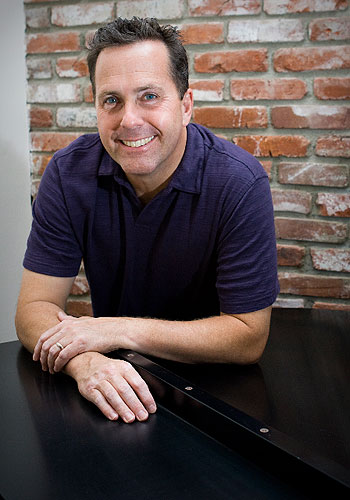
Paul Freeman, artistic director of the Santa Barbara Children’s Chorus, says there a number of reasons the community needs a children’s choir opportunity: “We had 60 or 70 kids audition and maybe 10 percent of them could sing well. Here are a bunch of kids who are clearly interested and they had all done musicals. They had all been doing all of the theater programs in town but none of them had been getting vocal training.” (Elite Henenson / Noozhawk photo)

Paul Freeman, artistic director of the Santa Barbara Children’s Chorus, says there a number of reasons the community needs a children’s choir opportunity: “We had 60 or 70 kids audition and maybe 10 percent of them could sing well. Here are a bunch of kids who are clearly interested and they had all done musicals. They had all been doing all of the theater programs in town but none of them had been getting vocal training.” (Elite Henenson / Noozhawk photo)

Revival of program is first step in plan to give kids more chances to sing

The Santa Barbara Children’s Chorus is getting a gleeful reprieve, thanks to local
businessman Paul Freeman. He didn’t even know of the dormant choir’s
existence when he decided, several years ago, that Santa Barbara needed a
better choral program for children and that he should be the one to give it to
them.

“It was a back-of-mind, pet project/goal of mine for years and I’m excited to be
able to finally do it, and do it in a way where I don’t have to worry so much about
making money doing it,” explains Freeman, a UCSB graduate. He was a child
singer and sang and toured with the Golden State Boys Choir, studied voice with
Peggy Norcross and performed with the Santa Barbara Camarata Choir, UCSB
Men’s Chorus and Mixed Choir and the Santa Barbara Symphony.

As president and owner of Professional Development Partners, a business
consulting firm for high tech companies, Freeman is now in a position to give
back to the community, filling what he sees as a void in student’s musical
training. When Freeman and his wife Tracy–who both grew up in town–returned
to Santa Barbara in 2008 with their two sons (Cole, now 13, and Parker, age 9)
he joined long-time theater friend, Clark Sayre, and has been co-directing the
Spring musical at Dos Pueblos High School for the past two seasons, an
experience which further underscored the need for better music education in
town.

“The weakest area for the kids was singing. We had 60 or 70 kids audition and
maybe 10 percent of them could sing well,” says Freeman. “Here are a bunch of
kids that are clearly interested and they had all done musicals. They had all been
doing all of the theater programs in town but none of them had been getting vocal
training.”

He found that while there were many instrument programs in the elementary
schools, there were virtually no singing programs.

“The original plan was to start up a for-profit choir and then turn it into a nonprofit
once we got it up and running,” explains Freeman, who began teaching in 1984
as Assistant Artistic Director of the Santa Barbara Children’s Theater, where he
wrote and directed musicals “for children, by children.” He continued working with
the Children’s Theater after moving to Los Angeles in 1989, where he
established the West Valley Children’s Chorus, which he ran for several
years.

When he began doing research for the Santa Barbara project, Freeman
discovered the Santa Barbara Children’s Chorus, which was no longer active.
The timing to take over the nonprofit was perfect because it was “out of money
and out of momentum,” while Freeman and his team-which consists of himself
as Artistic Director, and Stephanie Hein Muench as Musical Director-were
ready to pick up the ball and run with it.

Winter session auditions for the non-denominational choir will be held between
10 a.m. and 1 p.m. on Saturday, December 11 at the Unitarian Society of Santa
Barbara, 1535 Santa Barbara Street. If children have an audition song they will
be asked to perform it. However, Freeman emphasized that “it’s an inclusive
group, meaning if you sign up you can get in. We want to make music available
to anybody. The audition process is to help us understand what their skill level
is.”

He is looking to target children in grades 4-8, to give them proper vocal training
before they get to high school. “It’s no secret that money for a lot of that stuff has
been cut. The schools that do have choral programs are funded through
fundraising by PTA or some other outside group. There is very little public
funding.”

Freeman applies his management skills to his plans for the chorus. “Long-term
there are three things that we want to do,” he says. “The first is a fee-based
program with scholarships available. The idea is to try to get anybody who comes
in regardless of skill level or economic situation, and the curriculum is a
combination of group singing, solo singing and music theory.”

The students will be exposed to an eclectic array of music. Inspired in part by the
popular TV series “Glee,” Freeman plans to start a performance choir summer
camp to help attract more kids to the program.

Once the classes get up and running, the plan is to start an all schools choir.
“This would be an outreach program to all the schools that are interested in
participating,” he explains. “We would hold in-school auditions and take five or
ten kids per school, depending on how many kids there are, at no cost to them.
… We would have one rehearsal a month during the school year and then put on
a big, all-school concert at a venue like the Santa Barbara Bowl, the Lobero or
the Arlington.”

The third phase of the evolution will be to develop what Freeman describes as a
music franchise program. “This is being done in other big cities, like Chicago
Children’s Choir has this killer program where they put choral teachers in the city
schools and they bring the whole curriculum of the main program into the schools
as little modules.”

This is clearly a project driven by passion for Freeman, a former professional
chef at some of Los Angeles’ top restaurants, who now serves on the Goleta
Valley Junior High PTA Board and coaches and referees AYSO soccer in his
“spare” time. An admittedly very driven and busy guy, he says, “I always get
asked how do I manage to do all that stuff and I don’t always know the answer.”

Freeman says, “These programs are going to take some time to roll out but the
message I want to get across to people is that there’s some meat on this idea of
what to do with the choir. It’s not like we’re just trying to get some classes
running and that’s it. We’d really like to make this more institutional. I have a lot
of attention on getting it to the point where it’s self-sustaining, where it’s not
reliant on one or two people to make the thing happen, because that’s what
happens in these groups. You see it all the time.”

When asked to come up with three adjectives to describe himself, Freeman says
he’s “optimistic, goal-oriented and creative,” all qualities which will serve him well
in his new choir venture. “It’s sort of a puzzle to figure out and I have pretty high
aspirations for it,” he acknowledges. “If I wasn’t running a business that was
dealing in very huge deals it might seem more challenging. A lot of people would
see this as a big project and a lot of challenges, but for me, compared to some of
the other stuff at work I’ve got going on right now, it’s pretty straightforward. I
feel like it’s doable.”

Originally published in Noozhawk on November 22, 2010.

Sifting Through Silly Bandz and Squishys

Image http://www.sillybandz.com/photoweek.php

Image http://www.sillybandz.com/photoweek.php

Fart jokes, cooties and “one, two, three Jinx you owe me a Coke” are perennial rites of childhood that never fail to make me smile, but some of these new trends leave me feeling a little old and out of it.

First it was that array of extra-long shoelaces. Sure the colors were fun-who wouldn’t want to add tropical pink soccer balls and neon green tie dye to their wardrobe-but there was also so much more shoelace to figure out how to tie and then trip over. Seems like a lot more danger than they were worth – which is proof positive that I am old and cranky.

Then came the digital pets-Tamagotchi, Furby, Giga. Seriously? There are plenty of real animals waiting to be adopted. Or if you want something low maintenance, get a goldfish.

Then came the key chains. You couldn’t walk down an elementary school hallway without hearing the clang of Sponge Bob SquarePants, Strawberry Shortcake, Hannah Montana and Justin Beiber dangling dangerously from backpacks. Surely these were an accident waiting to happen.

Squishy mania was next on the scene. An infestation of blob-like sea monsters, jungle creatures and zoo animals began to appear in schoolyards, and fast food restaurants and liquor stores equipped with vending machine capsules were suddenly de rigueur. I was with my niece when she spotted a particularly rare glow-in-the-dark octopus Squishy and I thought I was going to have to call the paramedics to extract her hand from the vending machine.

Now silly bandz are the latest, out-of-control kid craze.

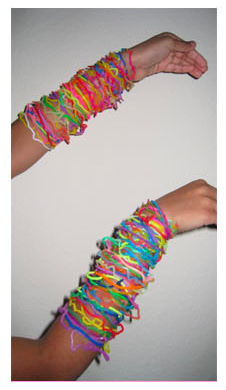
To a childless person these colorful bracelets stacked like Slinkys up the arms of kids might look like simple rubber bands. Yes, they are rubber bands, but simple, not so much.

These silly bands (or bandz depending on which brand you buy) are shaped like everything from Bugs to Barbies and musical instruments to Marilyn Monroe. Even skinny Elvis has his own silly band, which momentarily becomes fat Elvis if you put it around a grownup’s wrist.

But the beauty of these silicone-molded bracelets is that they return to their original shapes when you take them off your arm. It’s a magical shape-shifting rubber band.

Kids say half the fun of collecting the bracelets, which typically come in sets of 12 or 24, is trading them with friends. Parents like the price point (usually $3 for a pack of 12; $5 for 32). As one toy retailer said, “If you can do a shut-me-up product for $4.99, you won that day.”

Teachers, at least in some states, are less than thrilled. Complaints have come in that silly bands are distracting in class or even downright dangerous. The ban on bands has stretched from schools in Brazil and England to Boston, Wisconsin and Indiana. Can California be far behind?

Probably not.

Either way, nobody in our household will be too upset; since this is one trend my son has resisted the lure of. When I asked him why, he shrugged and said, “It’s just one more thing to remember in the morning. Besides, if you have rubber bands on your arm you’ll want to play with them and getting snapped by a rubber band hurts.”

That’s my boy.

When Leslie’s not pondering the latest kid crazes (Zhu Zhu hamsters, Lady Gaga, My Pillow Pets) she can be reached at Leslie@LeslieDinaberg.com. For more columns visit www.LeslieDinaberg.com. Originally appeared in the Santa Barbara Daily Sound on November 12, 2010.

Noozhawk Talks: Leslie Dinaberg Sits Down With Shannon Turner Brooks

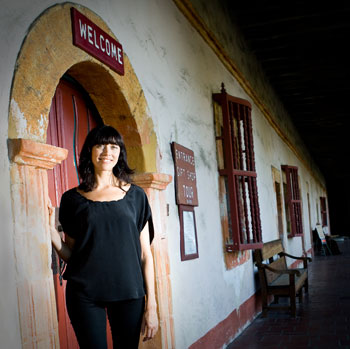
Shannon Turner Brooks of the Santa Barbara Conference & Visitors Bureau and Film Commission says the “really cool part of my job” is taking people out, “whether it’s for a travel TV show or just showing people around ... I don’t think I ever have gotten over how pretty Santa Barbara is, just what a beautiful place it is.” (Elite Henenson / Noozhawk photo)

Shannon Turner Brooks of the Santa Barbara Conference & Visitors Bureau and Film Commission says the “really cool part of my job” is taking people out, “whether it’s for a travel TV show or just showing people around … I don’t think I ever have gotten over how pretty Santa Barbara is, just what a beautiful place it is.” (Elite Henenson / Noozhawk photo)

As Director of Communications for the Santa Barbara Conference and Visitors
Bureau and Film Commission, it’s Shannon Turner Brooks‘ business to talk-a
lot-about Santa Barbara. Here Noozhawk gives her the chance to talk-a
little-about herself, as well what’s going on at the CVB.

Leslie Dinaberg: Can you explain how the Conference and Visitors Bureau and
Film Commission is different from the Chamber of Commerce and the Downtown
Organization?

Shannon Turner Brooks: Essentially our mission is to market Santa Barbara as a
destination for tourism and film production. The simplest idea to convey is that
we bring people here who spend money in our community and then leave,
whereas I think the chamber is more about business development and people
moving here. Then we work with the Downtown Organization a lot like on
Epicure.SB (a 31-day, community-wide culinary extravaganza coming up in
October) (http://www.santabarbaraca.com/epicuresb/), that’s a good example of
our partnership. We collaborate with them on a regular basis.

LD: And film production is different than the film festival?

STB: It is. We get a lot of commercials, catalog shoots; photo shoots and then
feature films. “It’s Complicated” was one that was filmed recently, “Sideways,”
too, but we’re used more often for one day of shooting or getting a few scenes
here. Any kind of production like that, that would bring people in to use the
locations and then also use local services.

… The film commissioner, Jeff Alexander, … his job is basically connecting
people, whether it’s location scouts or producers, with the locations they need
and the resources and showing them what we have. So if they say, “I need a
Wild West saloon,” we say, “Here’s Maverick’s, that’s where you should go.”

LD: People always hear about “Sideways” or “It’s Complicated,” but I know there
are a lot of smaller things going on too.

STB: The bread and butter would be the commercials like car commercials and
fashion photography for catalogs. … Definitely more of the production is in North
County.

LD: That makes sense just because of the open space and it’s sort of different
looking. So can you explain your job a little?

STB: As director of communications I manage all of our public relations, so I’m
the primary media liaison and a big part of my job is working with travel and
lifestyle media from around the world to generate editorial coverage about Santa
Barbara. So I set up press trips, come up with story ideas and pitch Santa
Barbara. We put on media events; relationship building is a big part of that. We
put on a dinner in LA recently. The California Travel and Tourism Commission
they host media receptions in New York and LA and San Francisco so I
represent Santa Barbara at those and essentially I’m always telling people what’s
new and what’s going on in Santa Barbara.

Then we have press trips, so essentially I’ll work with the local community to set
up hotels and restaurants and whatever experiences or interviews they want to
get when they are here, and a lot of just meeting with the media and talking with
them and being a resource and a fact checker. It’s a lot of coming up with the
story ideas and what’s new. You’re a journalist so of course you know,
sometimes people will say, I’m looking for something on a romance theme or
green wineries or something like that.

LD: So it’s a lot of knowing everything that’s going on.

STB: Yes, keeping tabs on everything that’s going on and being creative and
also coming up with new ways to sell the destination. Like one example, this year
my big push in the winter was celebrate a century of cinema on the American
Riviera. … 2010 was the 100 year anniversary of filmmaking in Santa Barbara
and also at the same time “It’s Complicated” was going to be released Christmas
Day and then the film festival had its 25th anniversary, so I could package that as
one story and get that out. That ended up generating a story that went out on the
Associated Press Wire, the AP travel editor put that out and then “USA Today”
put a huge front of the travel section feature on that. I think we got over 100
placements just from that kind of idea, sort of creating that and then we had our
micro site where we put the content for that-people could go for itineraries and
then we did “It’s complicated” hotel packages and it was kind of creating things
that they can interact with, whether it’s the location they can go to or hotel
packages inspired by “It’s Complicated.”

LD: So the people who wrote the story for the AP, did you bring them to Santa
Barbara and host them?

STB: No. They don’t always do that. They didn’t come here for that. I’m trying to
think of an example of something that we actually hosted. “Golf Digest” came
here and they did this huge feature in the December issue and it was about wine
and golf so we used the “Sideways” story with that. We host about 70 travel
media every year. For the most part it’s print, although a lot of it is online now,
like the international travel TV shows they come through. We recently had
“GMTV,” which is kind of the British equivalent of NBC’s “Today Show.” Two of
their hosts came through on a Thelma & Louise-style road trip, so we set them
up with paddle surfing with Blueline and they stayed at San Ysidro Ranch and we
went to Alma Rosa Winery to kind of do the “Sideways” thing. It varies.

LD: Do you ever get weird requests from people wanting to do things?

STB: Occasionally there is an obscure request or I think sometimes a journalist
will send out a note to all of their PR contacts saying I’m looking for x, y and z
and we don’t have anything. But mostly it’s the other way around, that they are
surprised by certain aspects of Santa Barbara because a lot of people think of it
as kind of high end, luxury, celebrities and we have all these interesting aspects
to our culture, like I just did a promotion of the green environmental aspect and
the food and wine has been really big lately. I think more often than not it is
pleasantly surprising when people look at all that Santa Barbara has to offer.

LD: How did you get into this kind of work?

STB: I went to UC San Diego and I studied communications there and my last six
months there I had gotten an internship through school at a magazine. (After
that) I moved to Santa Barbara because I grew up in Lompoc and I always loved
the area … I had originally looked for jobs with magazines, in publishing, and as
you know, it’s not a very big media market as I quickly discovered. I think it was
actually my mother who saw this ad for the visitor’s bureau. It was actually for an
administrative assistant, so I probably wouldn’t have looked at it, but the
description of it was interesting with the travel and the marketing and the film, so
I applied for it. … It ended up being a marketing coordinator. … That was ten
years ago in July that I’ve actually been with the visitor’s bureau fresh from
college.

LD: Obviously your responsibilities have changed; do you think anything has
changed significantly in terms of what’s going on in Santa Barbara in the last ten
years?

STB: It’s been interesting to see more of the changes of our product. We’re
always looking for what’s new and so seeing the evolution as new businesses
come up. Our wine industry has exploded. I think when I started we were at six
wineries and now it’s like 175. And I was really involved in the “Sideways”
marketing campaign and that was really interesting to see the effect, which we
are still seeing people from the press that are interested in that angle.

LD: What else do you do when you’re not working?

STB: I do love to travel. I love travel and I always have to have a trip in my mind
whether it is a weekend getaway to San Francisco or an international
adventure.

LD: What’s on your mind right now?

STB: Well I’m going to go to Treebones in Big Sur at the end of this month with
my childhood friends. We have an annual get together and there are five of us six
of us.

LD: Are you going to stay in the yurts?

STB: We are actually upgrading to the yurts because typically we’ve gone
camping and we’ve decided we’re grown up so yeah, we’re splurging on the
yurts. … I’m also going to North Carolina … and I’m going to Sardinia next May.

… Then I love to eat and drink, of course. (Laughs)

LD: You have a good job for that.

STB: I get to do a lot of that for my job. Everything I know about wine I’ve learned
from my job, from just taking journalists out to the wineries and meeting with
winemakers or working with them on our events. I really enjoy that part very
much. I’m very lucky to have the talented winemakers that we have. I just think
it’s so pretty to go up into the wine country.

LD: So are you professionally obligated to try out any restaurant that opens
up?

STB: I try to. (Laughs). We have a new blog actually, which has been fun. I’m
trying to do a weekly post. That’s been nice to give me something else that’s a
way to talk about what’s new aside from just my newsletter that I do.

LD: There’s such a high interest in that.

STB: Santa Barbara is a small town but it’s very food-oriented, so anytime there
is something new it is very exciting. So yes, I try to keep up on that. I am a
vegetarian so sometimes I write about things that I don’t actually eat but I
appreciate all of the local sensibilities. I’m not a moral vegetarian so I think
people should eat what their body tells them to eat. I like to do yoga, I love the
beach, all the fun Santa Barbara things: hiking, beaches, yoga, seeing family and
friends. There isn’t really time for much else. I do like to read and I read a
lot.

LD: If you could pick three adjectives to describe yourself, what would they
be?

STB: Tall (Laughs), calm, I’m very calm and easygoing.

LD: Do you have a favorite local spot?

STB: I feel like with my job that’s a dangerous question politically. I don’t think
anyone to hold that against me. … I do think that Casa Del Hererro is
spectacular and I would like to live there. I love the old Santa Barbara vibe. San
Ysidro Ranch is quite stunning as well. That’s another place I would like to live.
The courthouse, the view from the clock tower, which is where I send all of our
visitors and our media there and when I have friends come to town I usually take
them there for the proper tourist photo. It’s special.

LD: You probably get to do more of that kind of stuff than most people do.

STB: That’s true. It’s a really cool part of my job taking people out, whether it’s for
a travel TV show or just showing people around, it’s always nice to see things
through fresh eyes and how beautiful it is and how much they appreciate it. I
don’t think I ever have gotten over how pretty Santa Barbara is, just what a
beautiful place it is.

Vital Stats: Shannon Turner Brooks

Born: February 11, in San Francisco, CA. Grew up in Lompoc.

Family: “I’m not married, my mom’s always looking for a husband for me.”
Parents are retired teachers living in Lompoc (mom is county planning
commissioner Marell Brooks), plus a brother, sister-in-law and nephew in Santa
Barbara and another brother in Monterey.

Civic Involvement: Downtown Organization’s Cultural Committee, Board Member
of the Performing Arts League.

Professional Accomplishments: “I appreciate being able to help all these different
local businesses promote their success … that’s really the point of our
organization is to promote the community and bring in tourism tax dollars. It’s
very much a people-oriented job. We work with all of these local companies and
it’s great to be able to help them in any way that we can.”

Best Book You’ve Read Recently: “To Kill a Mockingbird” by Harper Lee, “The
Bone People” by Keri Hulme and “The Elegance of the Hedgehog” by Muriel
Barbery.

Little-Known Fact: “I’m addicted to music. I really love music and all day long I
listen to Pandora radio.”

Originally published in Noozhawk on August 29, 2010. Click here to read the story on that site.

My Kind of Playground

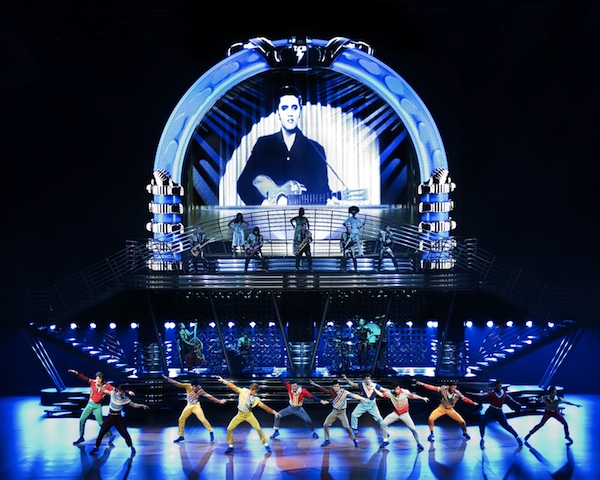
Viva ELVIS - Courtesy Julie Aucoin, Aria Resort

Viva ELVIS – Courtesy Julie Aucoin, Aria Resort

Once you have children, those moments when you feel completely relaxed are few and far between. I think I had one once in the early 90s and then another time in 2002 when I was zonked out on cold medicine, but until recently, that’s about it. And it occurs to me that I didn’t even have a kid in the 90s, so that must have just been anticipation. It’s not that being a mom isn’t absolutely wonderful, precious and fulfilling at least 77 percent of the time, but it’s almost never relaxing.

But once in a harvest moon the stars align just right and someone offers you and your husband a free trip to Las Vegas on the exact same weekend that someone else offers to take your son camping and, miracle of miracles, your kid’s soccer team has a bye that weekend.

Talk about timing.

I’ve heard rumors that younger, childless people stay out late and drink cocktails with fancy names on a regular basis, and I have a vague foggy memory of doing something like that myself once upon another lifetime. I’ve also heard alien mumblings about sleeping in, massages, long baths and spa treatments, but again, it had been a long, long while since I had indulged in anything that luscious.

I shooed away any guilty thoughts about lazy Saturdays as I lay soaking in a vanilla-scented spa tub at the ARIA Resort & Casino in Las Vegas, which is surely one of the least Vegas-like hotels on the strip. For some reason everything in this hotel smells like vanilla – although I’m guessing the reason is that they pump in the scent of vanilla. And, dare I say it; the opulent decor is tasteful by Vegas standards. From the curved 250-feet-long by 24-feet-high water wall that greets you along with the valet, to the stunning-but understated-for-Vegas-anyway, Maya Lin silver sculpture of the Colorado River that flows above the registration desk-this is hardly a typical hotel.

The Aria is the largest hotel in the world to earn a Leadership in Energy and Environmental Design (LEED) Gold Certification from the U.S. Green Building Council, but it also features the most technologically advanced guest rooms in the country, as my husband discovered when he put new grey hairs onto my head by accidentally pushing the “sleep” button, where one click closes the curtains, shuts down all of the electronics and turns off all the lights.

Luckily I was out of the tub at that point.

Even the casino has eco-friendly features like slot machine bases that serve as floor air-conditioning and specialized air curtains that help minimize the impact of tobacco smoke and perhaps pump the vanilla scent in. Of course neither of those things stopped us from losing what could have been a very nice pair of shoes at the Craps tables, but it was fun anyway.

We were wined and dined through a global variety of cuisines at the Town Square Center, with yummy nibbles and cocktails from Cana Latin Kitchen & Bar (South American), Texas de Brazil (Brazilian by way of Texas), Tommy Bahama’s Restaurant & Bar (Island-inspired), BRIO Tuscan Grille (Northern Italian) and Blue Martini (all-American alcohol). Then in a lovely coincidence, we were able to meet up with some of our best friends from Santa Barbara who happened to be spending their anniversary in Vegas.

Meeting for late night drinks (yes, more drinks) at the Aria’s View Bar, where my husband and our male friend were more drawn to the view of our sexy waitress’ accoutrements than the (also excellent) view of the strip, we couldn’t help but giggle at how much fun it was to be out late and not worrying about babysitters’ curfews.

The next morning it was spa time. Spa just happens to be one of my favorite words in the English language. My Vita Boost Facial was wonderfully relaxing and my skin looked great afterward, unlike some of the facials I’ve had where “bringing all of the impurities to the surface” actually makes your skin look worse. Not only that, the lovely Gina gave me paraffin treatments as well, leaving my hands and feet ever so soft and happy.

Then it was on to more gourmet cuisine (don’t miss the stuffed piquillo peppers, pintxo de chorizos and the churros with chili chocolate sauce at Julian Serrano), and my discovery of what a pleasant daytime beverage white sangria can be.

After a tour of Crystals, an impressive 500,000-square-foot retail/dining area at CityCenter featuring gorgeous galleries and stores like Prada, Christian Dior, Bulgari, Carolina Herrera, Hermes, Cartier, and Van Cleef & Arpels, it was time to tour the shopping areas of Town Square Center, where the more along the lines of my budget retailers like Old Navy, Victoria’s Secret, Borders, Lucky Brand Jeans and Bebe reside.

Spa treatments, gourmet food and shopping all in the same day! This is my kind of playtime. But it got even better. After returning to BRIO for yummy crab cakes and Mezza Chicken Limone, they treated us to Cirque Du Soleil’s newest offering, Viva ELVIS, an energetic fusion of dance, acrobatics and live music that had us bopping our heads and singing along with the King. Watching the show was actually one of the few times in this decidedly adult weekend that I wished my son had been with us, as it was definitely an entertaining event that kids of all ages would appreciate.

As for the rest, well, sometimes it’s good to get away from it all and play like a grownup.

When Leslie’s not fantasizing about her return to the Aria spa, she can be reached at Leslie@LeslieDinaberg.com. For more columns visit www.LeslieDinaberg.com. Originally published in the Santa Barbara Daily Sound on October 15, 2010.

Top Shelf — Works From Local Authors

Top Shelf — Works by Local Authors, originally published in Santa Barbara Seasons, Fall 2010.

Top Shelf — Works by Local Authors, originally published in Santa Barbara Seasons, Fall 2010.

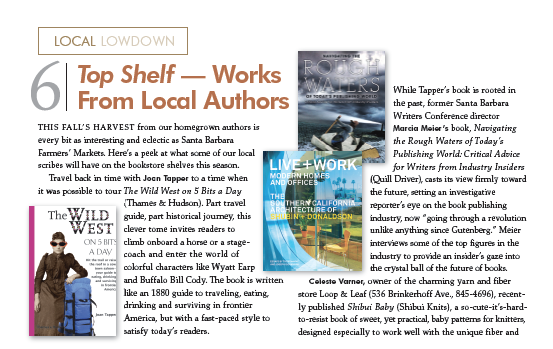
THIS FALL’S HARVEST from our homegrown authors is every bit as interesting and eclectic as Santa Barbara Farmers’ Markets. Here’s a peek at what some of our local scribes will have on the bookstore shelves this season.

Travel back in time with Joan Tapper to a time when it was possible to tour The Wild West on 5 Bits a Day (Thames & Hudson). Part travel guide, part historical journey, this clever tome invites readers to climb onboard a horse or a stagecoach and enter the world of colorful characters like Wyatt Earp and Buffalo Bill Cody. The book is written like an 1880 guide to traveling, eating,
drinking and surviving in frontier America, but with a fast-paced style to
satisfy today’s readers.

 While Tapper’s book is rooted in the past, former Santa Barbara Writers Conference director Marcia Meier’s  book, Navigating the Rough Waters of Today’s Publishing World: Critical Advice for Writers from Industry Insiders (Quill Driver), casts its view firmly toward the future, setting an investigative reporter’s eye on the book publishing industry, now “going through a revolution unlike anything since Gutenberg.” Meier interviews some of the top figures in the industry to provide an insider’s gaze into the crystal ball of the future of books.

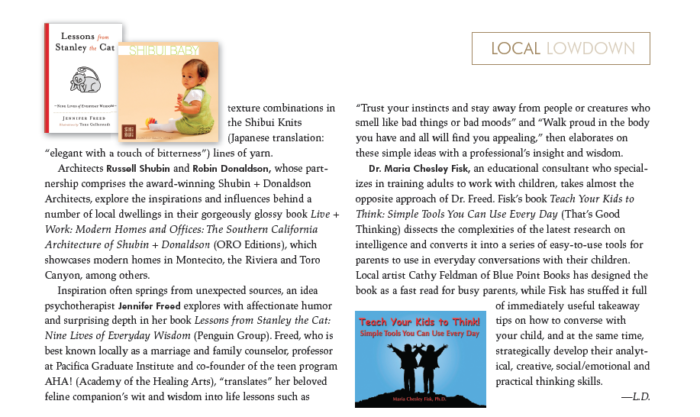
Celeste Varner, owner of the charming yarn and fiber store Loop & Leaf recently published Shibui Baby (Shibui Knits), a so-cute-it’s-hardto-resist book of sweet, yet practical, baby patterns for knitters, designed especially to work well with the unique fiber and texture combinations in the Shibui Knits (Japanese translation: “elegant with a touch of bitterness”) lines of yarn.

Top Shelf — Works by Local Authors, originally published in Santa Barbara Seasons, Fall 2010.

Top Shelf — Works by Local Authors, originally published in Santa Barbara Seasons, Fall 2010.

Architects Russell Shubin and Robin Donaldson, whose partnership comprises the award-winning Shubin + Donaldson Architects, explore the inspirations and influences behind a number of local dwellings in their gorgeously glossy book Live + Work: Modern Homes and Offices: The Southern California Architecture of Shubin + Donaldson  (ORO Editions), which showcases modern homes in Montecito, the Riviera and Toro Canyon, among others.

Inspiration often springs from unexpected sources, an idea psychotherapist Jennifer Freed explores with affectionate humor and surprising depth in her book Lessons from Stanley the Cat: Nine Lives of Everyday Wisdom  (Penguin Group). Freed, who is best known locally as a marriage and family counselor, professor at Pacifica Graduate Institute and co-founder of the teen program AHA! (Academy of the Healing Arts), “translates” her beloved feline companion’s wit and wisdom into life lessons such as “Trust your instincts and stay away from people or creatures who smell like bad things or bad moods” and “Walk proud in the body you have and all will find you appealing,” then elaborates on these simple ideas with a professional’s insight and wisdom.

Dr. Maria Chesley Fisk, an educational consultant who specializes in training adults to work with children, takes almost the opposite approach of Dr. Freed. Fisk’s book Teach Your Kids to Think: Simple Tools You Can Use Every Day (That’s Good Thinking) dissects the complexities of the latest research on intelligence and converts it into a series of easy-to-use tools for parents to use in everyday conversations with their children.

Local artist Cathy Feldman of Blue Point Books has designed the book as a fast read for busy parents, while Fisk has stuffed it full of immediately useful takeaway tips on how to converse with your child, and at the same time, strategically develop their analytical, creative, social/emotional and practical thinking skills.

Originally published in Santa Barbara Seasons Magazine, Fall 2010. Cover photo by Jim Bartsch.

Cover photo by Jim Bartsch.

Originally published in Santa Barbara Seasons Magazine, Fall 2010. Cover photo by Jim Bartsch.

Get Up Close and Personal with Architecture

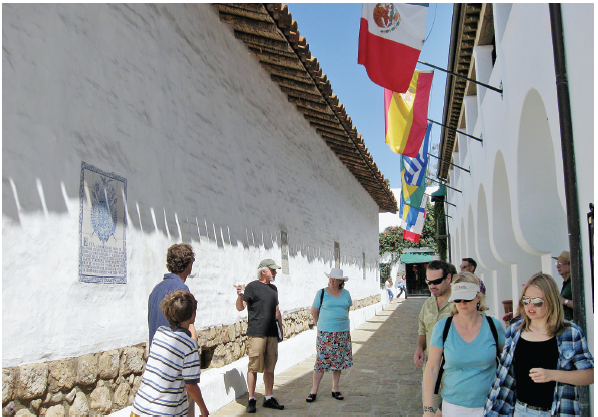
Brian Hofer points out details on the Architectural Foundation tour. Photo by Leslie Dinaberg.

Brian Hofer points out details on the
Architectural Foundation tour. Photo by Leslie Dinaberg.

To experience Santa Barbara architecture in all its glory, there’s nothing like strolling through town with an expert by your side to point out the rich history and international artistic influences that aren’t readily visible to the untrained eye.

Every weekend, trained docents from Architectural Foundation of Santa Barbara (www.afsb.org/tours_m.html, 805/965-6307) take both locals and tourists on walking journeys through the hidden courtyards, secret fountains and original adobes of downtown, focusing on architectural styles, significant and historic buildings, aesthetics and landscape history, as well as details like handmade tiles, wrought iron, stonework, balconies, doorways, archways and plantings.

The Sabado (Saturday) Tour starts in front of city hall and takes guests on a tour of De la Guerra Plaza, historic De la Guerra Adobe, El Paseo, Hill-Carrillo AdobeMeridian Studios, Lobero Theatre and more. The Domingo (Sunday) Tour, which starts at the Central Library, focuses on historic art and architecture of downtown Santa Barbara as it was reborn after the 1925 earthquake, including the library and its famous murals, La Arcada Court, the historic Arlington, The Granada and other architectural delights. You’ll also learn about Santa Barbara’s architectural history and how the Women’s League and Pearl Chase forced us to maintain architectural integrity, beautiful public park spaces and rich landscapes. Both tours start at 10 a.m. and last about 1-1 /2  hours. The foundation asks for a $10 donation per person, and proceeds go toward scholarships and other community programs.

Walking Wednesdays with Santa Barbara Walks is a clever new way to get some after-work exercise and experience the beauty of our local environment. The group, which is a project of COAST (Coalition for Sustainable Transportation, 805/875-3562), meets at 5:30 p.m. on the fourth Wednesday of every month and features a different theme and location each time. One walk included a tour through the upper eastside with architect Anthony Grumbine of Harrison Design Associates, beginning with a walkthrough of the historic Winsor Soule Hodges Residence (currently The Fielding Institute), a 1920s Spanish colonial revival estate, which was once the most expensive home built in Santa Barbara. The expedition also journeyed through a wonderful variety of architecture styles, including a Francis Underhill stripped classicism design, a Richard Neutra mid-century modern, French Norman and Dutch colonial, as well as the many architectural hybrids. Previous walks included an art walk with Ellen Durham, an architectural tour of El Andaluz with Jeff Shelton, trees of Santa Barbara with Bob Muller and a historical tour with Brian Hofer. Walking Wednesdays are free; visit www.coastsantabarbara.org/category/santa-barbarawalks/ for information on monthly locations and themes.

Originally published in Santa Barbara Seasons Magazine, Fall 2010. Cover photo by Jim Bartsch.

Cover photo by Jim Bartsch.

Originally published in Santa Barbara Seasons Magazine, Fall 2010. Cover photo by Jim Bartsch.

Limited Edition/Limitless Talent

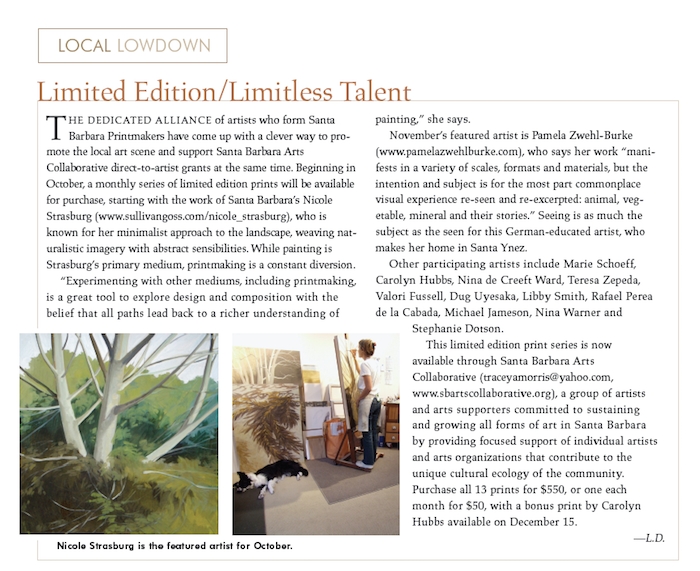
Limited Edition, Limitless Talent. Originally published in Santa Barbara Seasons Magazine Fall 2010.

Limited Edition, Limitless Talent. Originally published in Santa Barbara Seasons Magazine Fall 2010.

THE DEDICATED ALLIANCE of artists who form Santa Barbara Printmakers have come up with a clever way to promote the local art scene and support Santa Barbara Arts Collaborative direct-to-artist grants at the same time. Beginning in October, a monthly series of limited edition prints will be available
for purchase, starting with the work of Santa Barbara’s Nicole Strasburg (www.sullivangoss.com/nicole_strasburg), who is known for her minimalist approach to the landscape, weaving naturalistic imagery with abstract sensibilities.

While painting is Strasburg’s primary medium, printmaking is a constant diversion. “Experimenting with other mediums, including printmaking,
is a great tool to explore design and composition with the belief that all paths lead back to a richer understanding of painting,” she says.

November’s featured artist is Pamela Zwehl-Burke (www.pamelazwehlburke.com), who says her work “manifests in a variety of scales, formats and materials, but the intention and subject is for the most part commonplace visual experience re-seen and re-excerpted: animal, vegetable,
mineral and their stories.” Seeing is as much the subject as the seen for this German-educated artist, who makes her home in Santa Ynez.

Other participating artists include Marie Schoeff, Carolyn Hubbs, Nina de Creeft Ward, Teresa Zepeda, Valori Fussell, Dug Uyesaka, Libby Smith, Rafael Perea
de la Cabada, Michael Jameson, Nina Warner and Stephanie Dotson.

This limited edition print series is now available through Santa Barbara Arts
Collaborative (traceyamorris@yahoo.com, www.sbartscollaborative.org), a group of artists and arts supporters committed to sustaining and growing all forms of art in Santa Barbara by providing focused support of individual artists
and arts organizations that contribute to the unique cultural ecology of the community.

Purchase all 13 prints for $550, or one each month for $50, with a bonus print by Carolyn Hubbs available on December 15.

Originally published in Santa Barbara Seasons Magazine, Fall 2010. Cover photo by Jim Bartsch.

Cover photo by Jim Bartsch.

Originally published in Santa Barbara Seasons Magazine, Fall 2010. Cover photo by Jim Bartsch.