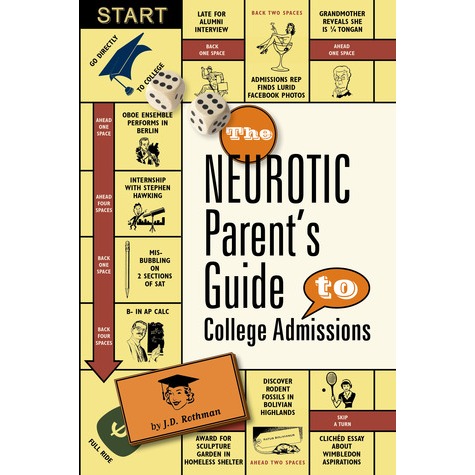
Some people say that getting your kid through the college application process is a lot like childbirth-you have to experience it yourself to really understand it. Unlike with childbirth, where the endorphins kick in and make you forget most of the pain once you hold that precious baby in your arms, the only chemicals associated with getting your child into college are stiff drinks (for the parents) and plenty of aspirin. Luckily, we can now add a healthy dose of laughter to the college admission cocktail, thanks to J.D. Rothman’s new book, The Neurotic Parent’s Guide to College Admissions. With a sassy, sarcastic style that reminded me of The Official Preppy Handbook, Rothman does a spectacular job of skewering the collective craziness that overtakes otherwise rational people during this phase of their lives. At the same time, it’s not just funny but also provides valuable insights and incisive anthropological observations into the process. “There’s a collective neurosis kind of thing that takes place for parents during this time of their lives,” explains Rothman, who is an Emmy-winning television writer and lyricist in her other work life. After an eye-opening college tour with her older son (now a junior at Duke), she started the anonymous Neurotic Parent Blog as a way to reflect on the nutty parents who had “started their kids in college preparatory programs in the fifth grade,” as well as the “thousands of shockingly bright, polite, alert students, all of whom were vying for her son’s (or your daughter’s) spot.” Up until that trip, she had “no idea there was this level of insanity about the college admission process.” The blog quickly caught on and went viral after a post about Cornell’s hotel’s ugly bedspreads. Rothman admits that she too got caught up in the craziness. Some of the other students had out of this world accomplishments, like “discovering galaxies,” so she wondered how her son would ever compete. Like many parent trips, the first one you feel during the college application process is guilt. Rothman writes, “Clearly it is all your fault. While you were letting your child engage in normal activities like summer camp, babysitting and bowling, other kids were interning for their senators, training seeing eye-dogs and starting hedge funds in Sri Lanka. As a result, for every impressive kid, there are 50 even more outstanding ones.” She observes that even parents who were “not neurotic about other things like eating and sleeping still became neurotic about the college admission process. … Thankfully it is usually not both members of a couple,” she laughs. “Thankfully” is right. Though I often want to give therapy bonds as baby shower gifts, this book will make a pretty good substitute. Laughter is clearly the best therapy for Rothman, who offers up an amusing “prayer for the SAT” (please protect me from mis-bubbling and using passive voice, bless my number two pencils and protect their points), two pages of “haikus for the neurotic parent” and an entire chapter about “barista readiness” (a college degree is fine, but at the end of the day, they’d better know how to prepare a venti, sugar-free, nonfat, vanilla soy, double-shot, decaf, no foam, extra hot, peppermint white chocolate mocha). Asked if her current book tour has made her more or less neurotic, Rothman, who will appear at Chaucer’s on Sunday at 2 p.m., says, “definitely more, but now I’m neurotic about selling books.” Of course it doesn’t hurt that her younger son was recently accepted into his “dream school.” Unlike the rest of us there will be no more college applications for her to deal with in the future-unless the kids don’t like being baristas and want to go to graduate school. The upside? That might mean there’s another book in her future, and ours. Since my son’s only in seventh grade-and hasn’t, to my knowledge, written any symphonies or cured any diseases-this is definitely one book I plan to keep on my shelf for future reading. As Rothman says in her “orientation to college angst,” “whether you have a kindergartener or a 12th grader, may your child’s search be full of multiple acceptances, generous merit scholarships and chill roommates.” If they’re not, may you at least retain the ability to laugh at it all! = Spend your tax day in a lively reading and conversation about the insanity of modern college admissions at Chaucer’s Books, 3321 State St. Sunday, April 15 at 2 p.m.
Category Archives: Articles
The Green Team
Environmental Education for the Next Generation
I can’t help but smile when I see Strawberry, Banana, Tree and Sun grinning from ear to ear, as they greet Thunder with the thunderous enthusiasm her name deserves. “Yay. Awesome. This is my favorite kind of day,” shout the others. No, this is not some strange morphing of the Nature Channel and H.R. Pufnstuf flashbacks from my childhood. It’s just a regular old Tuesday afternoon, and I’m watching Environmental Education for the Next Generation (EENG) at work in Judy Cosio’s second grade classroom at Monroe Elementary School. This entirely student-run nonprofit organization-connecting student volunteers from different universities with first and second graders to explore hands-on science experiments and promote sustainable action-is the brainchild of Ryland King, a UCSB undergrad. Inspired by his work as a surf camp counselor with a developmentally disabled child and a volunteer stint at Isla Vista School, King started the group in 2009. “I really kind of learned that when one teaches, many people are affected,” he says.
Indeed, many, many are affected by King’s vision. This year alone, EENG (which has
expanded from Santa Barbara to Santa Cruz, San Luis Obispo, and San Francisco)
will connect more than 2,300 elementary school students with college students,
providing the resources for them to traverse the wonders of the natural world
together. Besides Monroe, local participants include Santa Barbara Charter, Foothill,
Isla Vista, Howard, Adams and Hope.
“It’s so expensive to teach science,” says Jenna Ryan, a UCSB volunteer who also
answers to “Thunder,” her “Nature Team” name. “It’s such a bummer because I
think science is the most captivating discipline by far if you have the resources to let
kids get dirty and play with materials and things. The cool thing is that EENG is
totally free of charge to teachers and we volunteer … taking a little bit of the burden
off the school, while still allowing kids to really develop their imagination and jump
into things.”
“As you can see, the kids just love it when they come,” says Ms. Cosio. That’s an
understatement. The kids practically tackle their team leaders with excitement the
moment they walk in the door.
“You can just tell how enthusiastic they are and how empowered they are by the end
of it. … I’m blown away every time by how inspiring it is,” says Ryan.
The lesson I observed was the Environmental Extravaganza, where the kids recap
what they’ve learned over the last eight weeks. Topics include renewable energy
resources, soil science and water conservation. Based on the Jeopardy-style quiz
used to review the lessons with the kids, they definitely knew their stuff.
Forming teams with five or fewer children per volunteer creates an energetic
dynamic between the young students and the college-student volunteers. It looks
like a cross between school and a really great nature camp.
One of King’s goals is to provide positive role models “who have a passion for
education or a care and love for the environment and taking sustainable action …
when eight year olds can speak confidently about topics of sustainable action,
people will listen. … The program doesn’t just end with the kids. When they go home
and talk with their families about using a reusable bag or turning off the lights or
turning off the water after they take a shower or wash their teeth, parents and
family and friends really think twice.”
I can certainly attest to that. I became a lot better at turning off the lights when my
son started monitoring our electricity usage.
It’s not just the teachers, kids and their families that benefit. The college students
are also developing what King calls “professional skills with a soul.”
Ryan, an Environmental Studies major, agrees, noting, “I think that EENG is cool
because it really spans through all of the disciplines. I’m in a group with a
philosophy major and a chemical engineering major and people that aren’t
necessarily the crunchy greenies that maybe I spend most of my time with in my
classes. It’s a really cool thing that you can either connect to the environmental
aspect of it or you connect to the really cool personal aspect of it, the social
entrepreneurship aspect of it and investing in the next generation of young people.”
In addition to mentoring the elementary school students, college students also
mentor each other, training new volunteers as EENG grows.
“I think one thing is that everyone who works with us is so passionate about it that
it isn’t work. For us it’s a bunch of fun,” says King. “It’s hundreds of different college
students that have the same passion about the work that are making EENG what it is
and it’s really a team effort.”
==
For more information about Environmental Education for the Next Generation or to
donate visit www.eeng.org. A gala fundraiser is planned for May 13. Check the
website for further details, as well as additional information on how to bring EENG,
free of charge, to your elementary school.
Originally published in the Santa Barbara Daily Sound on April 6, 2012.
The Bratty Bunch
Do you ever have the urge to discipline someone else’s kids?
What about when their parents are sitting right there, yukking it up, chatting with friends or drinking cocktails, and otherwise ignoring the fact that their little brat is:
A.) Talking back to a teacher, lifeguard, parent, or other adult
B.) Tormenting a defenseless younger child
C.) Teasing an older child who could, by all rights, stop the little monster in his tracks, but is too nice (or well-mannered) to do so
D.) All of the above.
Doesn’t it drive you nuts?
I don’t know what I want to do more, put the kid in a time out or throttle the parents.
Now don’t get me wrong, I am hardly the strictest mom in the cul de sac, and my son is definitely not the best behaved on the block, but he knows that no means NO, and stop means STOP, and that there are serious consequences when he doesn’t behave in the way he’s supposed to.
That seems like a pretty basic rule for getting along in society, but you wouldn’t know it from watching some of these rude, self-absorbed, bratty little jerks in action.
I’m not the only one who’s annoyed.
In a recent Newsvine poll, 83 percent of the participants surveyed said that today’s kids are more self-centered than those of past generations.
There are lots of theories about why this has happened. Pediatrician Dr. Philippa Gordon told MSNBC, “I see parents ferociously advocating for their children, responding with hostility to anyone they perceive as getting in the child’s way- from a person whose dog snuffles inquiringly at a baby in a carriage, to a teacher or coach whom they perceive is slighting their child, to a poor, hapless doctor who cannot cure the common cold. There is a feeling that anything interfering with their kid’s homeostasis, as they see it, is an inappropriate behavior to be fended off sharply.”
I understand the impulse to do everything you can to make sure that your child is safe, healthy and happy. That protective instinct is as natural as breathing for most parents.
But somehow my parents, and most of my peers’ parents, managed to avoid coddling us the way so many parents do now. In fact, I remember my parents as being much more concerned about instilling proper behavior toward others (including themselves) than the other way around.
What happened?
Babble.com writer Madeline Holler postulates that, “We Gen Xers, who were so benignly neglected that we now over-compensate as parents by co-sleeping and baby-wearing and opting out. And that we’re so fixated on our children’s well-being that we wind up teaching them that other people’s feelings are less important than our own, that kids should first make sure they feel good, then (if ever) worry about others.”
It could be that.
Or it could be that in a culture that embraces snarky comments from “American Idol” judges, where Fisher Price has a toy called “Mr. Men Mr. Rude” and Mattel battles to control a line of dolls called “Bratz,” downright bratty behavior has become not only acceptable but cool.
But I suspect that the real reason most people give their kids such a free ride when it comes to bad behavior has nothing with over-protectiveness, cultural influence, or worrying about their children’s fragile self-esteem. I’m guessing they’re just exhausted, with too much to do and too little time to do it.
Not that I’m giving the parents a free pass on disciplining their children-and not that I’m going to step in and do it for them anytime soon, tempted as I may be.
But think about this the next time you see one of these sassy little brats at the pool, or the baseball field or the playground. And if he or she belongs to you, think about it extra hard.
Is Generation X raising Generation Rude? Email Leslie@LeslieDinaberg.com. For more columns visit www.LeslieDinaberg.com. Originally published in the Santa Barbara Daily Sound on March 23, 2012.
Bonding Over Books
Santa Barbara has a lot of great fundraisers, but one of my favorites is the annual CALM (Child Abuse Listening Mediation) Celebrity Authors’ Luncheon.
It’s easy to get excited about buying books, talking about books with other readers and listening to authors talk about books, not to mention a great lunch with a dessert of chocolate ganache and caramel tart with raspberry garnish chocolate ring coulis (they had me at chocolate ganache), and last but foremost on everyone’s mind, a really important and worthy cause.
As I hope most people already know, CALM has led the way in building awareness, providing education and inspiring hope to everyone involved in the effort to prevent child abuse and neglect in the Santa Barbara community for the past 40 years.
Last Saturday was the 26th event of its kind-and the first to be planned by event co- chairs Becky Cohn and Carolyn Gillio. They stepped into the stylin’ stilettos left by former co-chairs Sharon Bifano and Stephanie Ortale, who created and organized CALM’s first Annual Authors’ Luncheon in 1987 and only recently gave up the reins.
Thankfully, they left them in very good hands: the day went off without a hitch.
The theme of the decor was apples-Sunday was Johnny Appleseed Day, and I’m sure you all celebrated by spitting seeds around town: Artist Susan Day’s whimsical artwork, which graced the invitation and program and was raffled off for CALM, showed children reading atop and under an inviting apple tree. The centerpieces were full of apples and the first course was chilled strawberry and apple soup-but spilling the beans felt like the theme of the author interviews.
First up, was actor Joseph Mascalo, who has starred off and on as drug dealing murdering crime lord Stefano DiMera on the soap opera Days of Our Lives since 1982 (and was ostensibly there to talk about the coffee table book Days of Our Lives 45 Years: A Celebration in Photos). He spilled the beans on what it’s really like to work on a series where kidnaping, art theft, assassinations, fake deaths and real long lost evil twins are part of “just another day at the office.” The reality is a whole lot of hard work, as he explained in a charmingly booming voice that had the mostly female audience on the edge of their seats.
Next to spill the beans was Simon Tolkien, author of several British mystery thrillers (including his latest, The King of Diamonds) and a new resident of Santa Barbara. As the grandson of beloved author J.R.R. Tolkien (The Lord of the Rings, The Hobbit) Simon talked movingly about what it was like to grow up with such a famous surname and his bold decision, at the age of 40, to give up his career as a barrister and pursue a career writing novels.
Batting third and definitely leaving no holds barred was Meredith Baxter, an acclaimed actress, who most of us recognize from her years playing Michael J. Fox’s mother on the sitcom Family Ties. What many people didn’t realize, until she notably spilled the beans that she was a lesbian on The Today Show a few years ago, is that she’s also battled breast cancer, survived domestic abuse and has been a sober alcoholic for 19 years. If her book, Untied: A Memoir of Family, Fame, and Floundering, is anything like her frank discussion at the CALM lunch, she definitely has few secrets left to tell.
Last but most definitely funniest, Santa Barbara’s own Jenna McCarthy (who used to banter on KTYD with Matt McAllister in the morning). She elicited nods, laughter and a whole lot of guffaws when she shared insights from her recent book, If It Was Easy They’d Call the Whole Damn Thing a Honeymoon: Living with and Loving the TV- Addicted, Sex-Obsessed, Not-so-handy Man You Married. She spilled the beans on what married life is really like and why sticking with the man (did we really all just marry the same guy?) you’ve got might just be a very good idea after all.
Over the years some of the authors interviewed have included: Sue Grafton, Jane Russell, Barnaby Conrad, Michael Crichton, Julia Child, Ray Bradbury, Fanny Flagg, Maria Shriver and Jonathan Winters. While big names help fill seats and raise money for the child abuse, sexual abuse and incest services and programs at CALM, longtime luncheon goers agree that the “best known celebrity is not always the best interview.” I would have to agree. This year’s panel was among the best I’ve seen.
For more information about CALM visit www.calm4kids.org. For more columns visit www.LeslieDinaberg.com. Originally published in the Santa Barbara Daily Sound on March 16, 2012.
I’d like to thank the Academy
“I’d like to thank the Academy, and of course my wonderful husband and adorable son for inspiring me every day. And my fabulous family, friends and loved ones, for sticking by me in those lean years, when it looked like I might never be up on stage accepting this award. I couldn’t have done it without you.”
Since it looks like I won’t be hugging Billy Crystal on stage this Sunday, I thought it was about time that somebody heard my speech. After all, I’ve been practicing my Academy Award acceptance since I was a little girl, effusively thanking my best friend Tatum O’Neill, my husband David Cassidy, my best friend Julia Roberts, my boyfriend Jon Bon Jovi, and my husband John Cusack, depending on which year it was.
At various times I’ve fancied thanking the Academy for recognizing my directing, acting, writing, and-try not to laugh too hard-singing abilities. Despite the fact that the Oscar has yet to be awarded for best singing in the shower, I’m still practicing.
When you picture me giving this speech, envision me with Halle Berry’s body, in a red Valentino gown. My gown preferences have changed over the years-in third grade I was really into the “Little House on the Prairie” books and wanted to wear a red plaid petticoat. In seventh grade I thought strapless Quiana might be cute, and in college I wanted Geena Davis’ elegant long-sleeved gown. But no matter what the dress style, red always looks good for the camera.
Pink is another story. I still haven’t forgiven Gwyneth Paltrow for that ill-fitting pink, “Shakespeare in Love” Oscar night dress, or Penelope Cruz for her pink flamingo gown in 2007. If Penelope Cruz can’t carry off feathers, no one can. I bet you can’t hum a single tune by Bjork, but remember her swan Oscar dress in 2001? Of course you do. That was her career’s swan song, though that ridiculous image is forever embedded in our brains, along with Lady Gaga’s meat dress from another awards show.
Since I’ve been studying the Academy Awards so avidly for so many years-and I don’t seem to have any personal use for this knowledge-I’ll offer some of my sage advice to the nominees.
You’ve got just 45 seconds and more than a billion viewers for your moment of glory. Don’t blow it on a fashion “DON’T.”
DO expect to lose. Despite what your agent, your mother and your hairdresser have told you, prepare yourself for this possibility, then visualize it in your mind. There’s nothing more uncomfortable than watching a newly hatched Oscar loser try to hold back tears on camera. No one is that good of an actor.
DON’T talk too long. One the best Oscar speeches in history was Jane Wyman’s, “I accept this very gratefully for keeping my mouth shut for once.” She was accepting an Oscar in 1949 (I read about this one, I’m not that old!) for playing a mute character in “Johnny Belinda.” “I think I’ll do it again.” And she sat down.
DON’T picture the audience in their underwear, no matter how nervous you get. With most things in life, advice from “The Brady Bunch” is extremely reliable, however this is that rare exception. Try picturing Colin Firth and Brad Pitt (or Scarlett Johansson and Salma Hayek) in their underwear. Not exactly relaxing, is it?
DON’T get political. Your 45-second speech isn’t long enough to say anything meaningful about global warming or the presidential race. If you must be political, bring a visual aid to help communicate your point, such as a sad-looking puppy, or an extremely thin actress.
DO shed a few tears, but not too many. What’s to stop your mother from running up to the podium with a Kleenex?
Which reminds me of the most important advice I have to give to Oscar nominees (and for once, I hope my son is reading): DON’T forget to thank your mother.
Leslie’s all-time favorite line in an Oscar acceptance speech was from Dianne Wiest, who won Best Supporting Actress for “Hannah and Her Sisters” in 1987: “Gee, this isn’t like I imagined it would be in the bathtub.” Share your favorites with Leslie@LeslieDinaberg.com. For more columns visit www.LeslieDinaberg.com. Originally published in the Santa Barbara Daily Sound on February 24, 2012.
The Keeper of the Calendar
For as long as I can remember, my girlfriends have been an important part of my life. We’ve graduated from Kool-Aid and cookies to brie and Cabernet and have gone from dissecting Barbie’s hairstyles to debating whether “Blonded by the Light” or “Brazen Raisin” will better cover up our grays, but one thing remains true after all these years: without my girlfriends I’d probably never have made it this far.
My girlfriends are the ones that keep me (relatively) sane. They’re the only ones who really understand my drink order at Starbucks, or my irritation with the ten-items-or-less-line, or my love-hate relationship with Christmas.
This is why girls’ nights out are so important. They’re therapeutic, actually medicinal, and I’m not just talking about the vodka in our martinis. Men are great for a lot of things, and not just killing spiders (which my husband refuses to do) and reaching things on the highest shelves. But you can’t really talk to men about the importance of chocolate, the beauty of a new lipstick, or the ability of the perfect pair of black boots to update your whole wardrobe.
They just don’t get it.
My husband doesn’t really get it at all, but he doesn’t really complain about it either. I tell him I’m going out with my friends, and he looks up from the crossword puzzle, nods, grunts, and maybe, if I’m lucky, tells me to have a good time.
We’ve been together for 19 years and in all that time, he’s made social plans seven times, not including Mother’s Day and my birthday, where I have to remind him about what I want to do at least three times a day for a month beforehand, so I don’t think that really counts.
I’m the keeper of the social calendar and that’s okay, it’s worked for us all these years. At least until recently, when I told him I was leaving the house to meet my girlfriends. He looked up from the crossword puzzle, nodded, grunted, and said, “OK. I’m having boys’ night out on Thursday.”
Excuse me? Did I put that on the calendar? Since when are you scheduling your own “play dates,” honey?
I was sure I had misheard him. But no, come Thursday night he put on a jacket and actually left the house, all by himself. This has got to be a fluke, I thought.
Then it happened again the next week. Uh oh. Was my husband finally realizing how much fun it was to escape his family for a night on the town? This could be big trouble for me.
I thought I could nip the problem in the bud the night we both had plans. After all, a PTA meeting (followed by cocktails, but still, “It’s for the kids”) trumps an action movie, so he would just have to reschedule. I told him this, quite reasonably, I thought. But he just smiled, devilishly, and said, “It’s okay honey, your mom’s going to watch Koss so we can both go out.”
Oh dear. Couldn’t he at last have called his own mom?
The next thing I know he’ll be planning mancations and taking up fly fishing and snow boarding and how will I ever get away to the spa with MY friends if that happens?
I definitely need to stop this train wreck before it’s too late. He needs to tone his social life way down if I’m ever going to be able to keep up with mine.
“Honey,” I begin, in my sweetest most devious voice, “We need to talk.”
“Yeah, I’ve been forgetting to tell you something,” he says.
All right. I bet he’s going to tell me that he’s been spending too much time with his friends and realizes he would much rather be home spending time with his family, while I’m out with the girls.
I smile in anticipation.
“The guys and I are talking about a boy’s weekend. Let’s check the calendar.”
Uh oh, you mean my calendar?
Oh no. I’m doomed.
Share your tips for keeping your man at home with Leslie at email. For more columns visit www.LeslieDinaberg.com. Originally published in the Santa Barbara Daily Sound on January 27, 2012.
What’s cooking? As little as possible.
Culinary talent comes naturally for some people. They take a few ingredients, a plastic fork, a stove on its last legs and a flour sifter, then miraculously transform into MacGyver, tossing and throwing and shaping and forming ordinary things like milk, pepper and eggs into delicious concoctions.
My mom is kind of like that. I’ll look in her cupboards and find nothing worth eating, yet somehow, 10 minutes later, she’s created a feast out of thin air.
I didn’t exactly inherit that domestic goddess gene. It’s not that I don’t try. But my kitchen has seen more than a few fires in its day, and the most used “recipe card” from my wedding shower has the phone numbers of all the local takeout places.
But it’s not my fault. I think the cooking gene skips a generation.
My Grandma Sylvia was such a bad cook that she would often throw away an entire dinner she had made when my Grandpa came home from work and didn’t like the looks of it and suggested they go out to eat.
Consequently, my mom is a great cook. I’m sure she learned this as a defense against her own mother’s scorched casseroles and burnt briskets.
Try as I may, despite the scorch marks on my ceiling, I just can’t get all that fired up about cooking. What’s the point of spending hours chopping and grating something that will be gone in minutes? I suppose it would be nice, every once in a while, to take something to a potluck that wasn’t directly from Trader Joe’s, but frankly, I’ve got a lot more important things on my “to do” list.
Grandma Sylvia’s the one I take after. She would have loved Trader Joe’s. Back in her day there were no microwaves, and Ragu was the cutting edge in convenience foods. Grandma’s favorite cookbook (aside from the yellow pages, to make dinner reservations) was Peg Bracken’s “I Hate to Cook Book.”
I remember the dog-eared copy of the “I Hate to Cook Book” sitting on her counter between the flour and the sugar canisters, and the cookie jar filled with her favorite Pepperidge Farm Chessmen cookies. Who says you have to actually bake cookies to have your larder stocked?
“Some women, it is said, like to cook,” the book began. “This book is not for them.”
An advertising copywriter by day, Peg’s recipes always made good reading, even for someone like me, who had no intention of actually turning on the oven. Her recipes were for things like “Aggression Cookies,” which called for vigorous kneading, mashing, squeezing and beating, offering an opportunity for “channeling some energies away from throwing bricks.”
Another favorite was “Skid Road Stroganoff,” which called for you to add flour, paprika and mushrooms to the beef and noodles while you “light a cigarette and stare sullenly at the sink.” There was also “Stay Abed Stew,” where you mixed a bunch of stuff together and put it in the oven where it would “cook happily all by itself and be done in five hours” while you went back to bed.
Now that’s my kind of cooking.
Peg wrote for reluctant cooks like my Grandma and I, who knew that some activities-such as childbirth, paying taxes and cooking- “become no less painful through repetition.” Her book, she wrote, was “for those of us who want to fold our big dishwater hands around a dry martini instead of a wet flounder.”
Many of her instructions called for alcohol, often suggesting that it bypass the cooking process entirely and proceed straight down the cook’s throat.
That’s the point in the meal preparation process where I used to pull out my handy dandy recipe card and call for pizza delivery. I don’t do that anymore-I’ve got the number memorized. But, just like Grandma, I’m still game if my husband decides he wants to go out to dinner instead.
Her family would be eternally grateful if you can explain the joy of cooking to Leslie by emailing Leslie@LeslieDinaberg.com. For more columns visit www.LeslieDinaberg.com. Originally published in the Santa Barbara Daily Sound on January 20, 2012.
Dirty little secrets
I have a confession to make. I spent most of last week delving into other people’s secrets and now I’ve got a dirty little secret of my own: right now my son is playing computer games and eating Doritos so I can finish this column.
There, I said it-I admit that I am far from a perfect mother. It feels good to say it out loud.
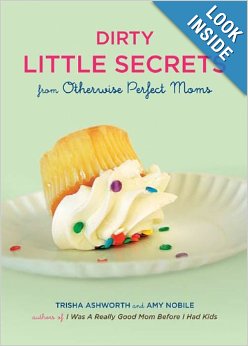
That’s just the cathartic effect that Trisha Ashworth and Amy Nobile were going for when they wrote-or should I say compiled the confessions for-their book, Dirty Little Secrets From Otherwise Perfect Moms. It took me all of a half an hour to read through such ditties as:
-“I lied and told my son’s preschool he was potty-trained so he could get in. I acted surprised when he had an ‘accident’ every day.”
-“I bit my daughter’s finger trying to steal a bite of her cookie.”
-“I let my two toddlers eat Milk Bones right out of the box. I figure, if they’re not barking, they’re fine.”
It took about three minutes for me to come to the conclusion that my friends’ dirty little secrets had to be a whole lot dirtier than these.
Boy was I right! Here are a few favorites, with names withheld to protect the not so innocent:
-“At least once a week I tell my husband we’re out of milk, then stop off for a martini on my way to the grocery store.”
-“Sometimes I tell everyone that I’m really angry and I give myself a timeout. Since at our house you get a minute for each year of age, this is my way to get some time to myself.”
-“On an exceptionally bad day with my three kids, I gave each of them a teaspoonful of leftover codeine cough syrup so I could have a couple of hours of peace and quiet to regroup, breath deep and possibly even take a shower by myself. I did this about three times. It was a sad day when that bottle ran out.”
– “When my daughter was little I told her that if she swallowed gum it would stick to the inside of her stomach and then all the food would stick and she would eventually explode. She accidentally swallowed her gum about a month ago and she thought she was going to die so I had to fess up that it wasn’t true.”
-“Our son walked in on us having sex and we told him we were wrestling. Of course it backfired when he tried to join in!”
-“When my kids were little they loved standing up in the shopping carts at the grocery store. I told them that if they fell out they might break a tile on the floor and then the store would take everything we owned to pay for it.”
-“My dirty little secret is pot. So long as you don’t get so wasted that you completely ignore your kids, pot is great. It’s a stress reliever and even makes those stupid Nickelodeon cartoons kind of fun.”
-“Most days my favorite member of my family is the cat.”
-“When my daughter was little and she had a tantrum and didn’t want to go to preschool, I told her the police were going to come and take her to jail if she didn’t shape up.”
-“I have wine every night at dinner and wake every day with coffee and will scratch your eyes out if you deny me either one.”
So there you have it. The cold, hard truth is that being a parent, more often than not, is just a daily game of Survivor and often we moms (especially but not exclusively) feel like we should be voted off the island. But doesn’t it feel better to come clean about those dirty little secrets?
=
Share your dirty little secrets with Leslie@LeslieDinaberg.com. For more columns visit www.LeslieDinaberg.com. Originally published in the Santa Barbara Daily Sound on January 13, 2012.
Tiptoeing into a minefield
Tipping may not be a city in China, but it sure feels like I’m in foreign territory when I get out my wallet. I understand restaurants, but everything else feels a little like…well, China.
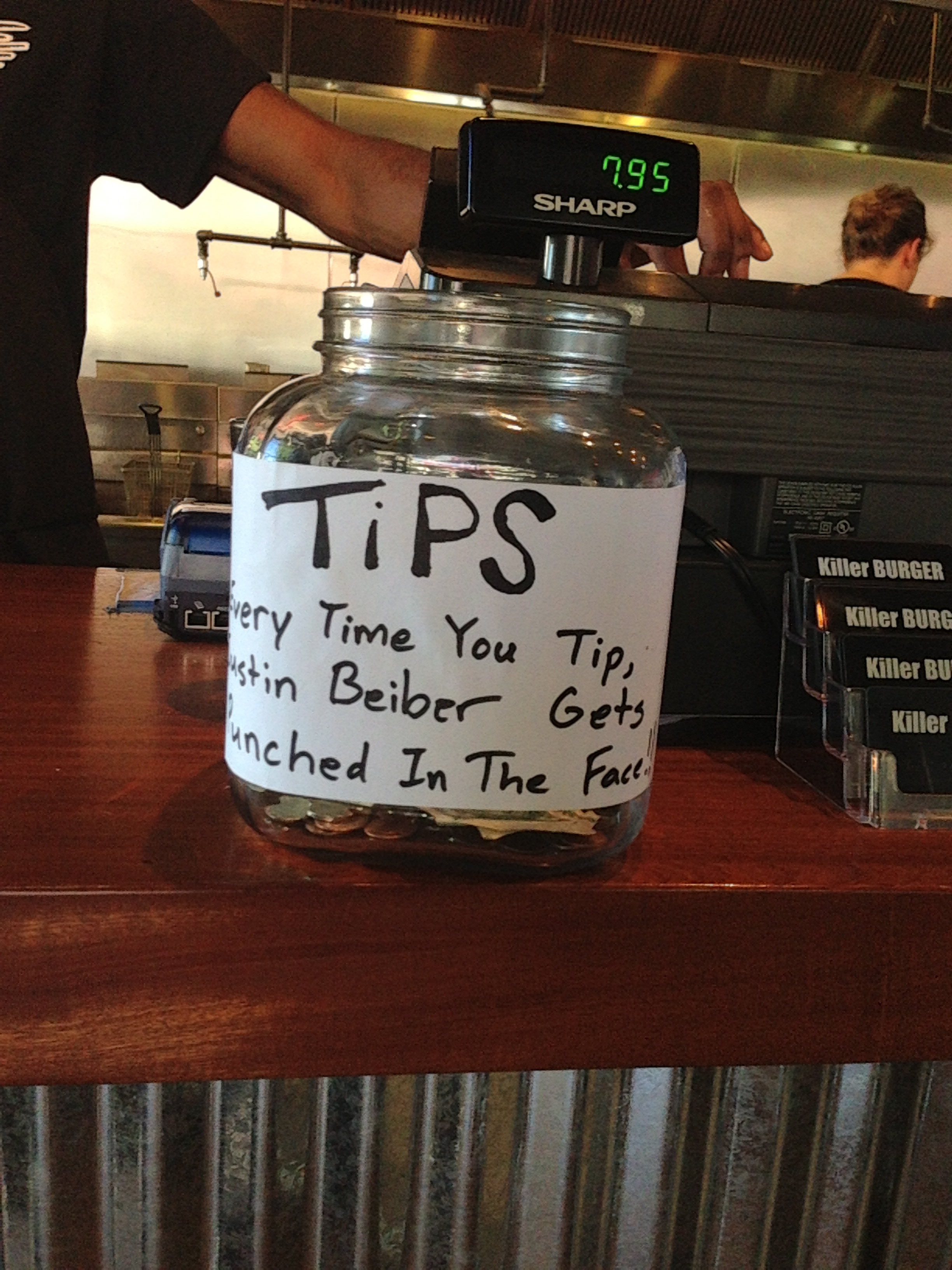
Hairdressers and hotel maids are confusing enough, but those ubiquitous countertop jars really get on my nerves. Especially the ones with passive- aggressive little sayings like “Support Counter Intelligence” or “Fear Change? Leave it Here.”
In some cases, like when I order my latte, I’m giving a tip with no guarantee of even getting my coffee, let alone having it served in an efficient and friendly manner. It’s a pre-tip.
I feel guilty not leaving anything, but I feel violated leaving a dollar pre-tip on an already overpriced $5 cup of coffee.
Especially if it’s cold.
If I do decide to leave a pre-tip, it’s more of a reflection on whether or not I’m having a good hair day, a happy bank account day or a right amount of caffeine day, than it is a reflection on the actually quality of service rendered.
But what am I going to do if the service is bad? Fish my dollar out of the jar? Heaven forbid the barista, or the people in line that I don’t know and will probably never see again, might think I was crazy, or worse yet – cheap!
My discomfort with tipping goes back to my Grandpa Jules, who, upon being seated at a restaurant, used to put an enormous pile of bills on the table and tell the server, “I will guarantee you this tip if the service is perfect, but every time you make a mistake I’m going to take some money away.”
Nothing like having a guarantee that your food will arrive to your table swimming in spit. Yum. It’s no wonder that my sister and I feigned illness before going out to dinner with him, and afterward actually became ill from the combination of embarrassment and server saliva.
Mind-boggling revenge fantasies are being played out in restaurant kitchens every day. If you don’t believe me, check out the war stories on www.stainedapron.com or www.bitterwaitress.com. There is even something I’ve long-feared, but never had proof of until now: the “Sh*tty Tipper Database.”
I knew it!
I remember being taught as a kid (by my other Grandpa, Alex) that tip stood for “to insure promptness,” and 15 percent was what you tipped for good service, while 20 percent was what you gave for excellence.
If the “18 percent gratuity added” line on the bill from a recent dinner with “a party of six or more” is any indication, my Grandfather’s relatively simple calculations have now gone the way of the 4.0 straight A grade-point- average.
In case you need to know what to tip the cabin steward on your next transatlantic cruise, or the Keno runner on your next tip to Vegas, there are tipping guides galore-including a bunch of apps–but is there anyone who isn’t confused about tips when you’re picking up takeout? Especially when you’re paying by credit card in a place that normally has table service?
The cashier is staring at you, and so is that empty tip line, just waiting to be totaled. You’d feel like a real jerk if you zero it out, but it seems ridiculous to give more than a dollar or two to someone who took a bag and walked it from the kitchen. Yet a dollar feels like an awfully small tip on a $27 meal. Yet if you figure out how many words you had to write just to earn that dollar, and then you think about the poor cashier, who probably gets paid minimum wage and is sending money home to her family in China … well, it’s enough to make you want to move to China.
I hear that real estate is cheap in the city of Tipping, which according to my Atlas is perched on the riverbank of Denial.
Share your tips-or additions to the Sh*tty Tipper Database-with email. For more columns visit www.LeslieDinaberg.com. Originally published in the Santa Barbara Daily Sound on January 6, 2012.
Do Kids Make You Fat?
Only if you add sugar.
I have no doubt that having kids makes your heart fuller and your wallet slimmer, but what about your waistline? According to a study by the University of Iowa College of Medicine and the University of Michigan, living with the little darlings also makes your belly bulge. And I’m not talking about pregnancy pudge here. Nor am I referring to all of that “drinking for two” that most fathers-to-be indulge in.
Nope, an examination of the nutritional cost of parenting found that simply living with children boosts your fat intake by almost five grams a day.
Could this mean that those last few bites of macaroni and cheese, pizza crusts and Girl Scout cookie crumbs actually count as calories? Even if you eat them standing up? What if you don’t want to carry the rest of the soccer snacks all the way back to the car? Or what if you bought the extra box of candy for a good cause? Those calories couldn’t possibly make you fat.
As caring and health-conscious parents, my husband and I do our best to intervene with the Halloween candy, Christmas cookies, gingerbread houses, Hanukah gelt, chocolate Easter bunnies and infinite supply of birthday goodie bags. Was it possible that this conscientious parenting was making us fat?
Before I got too stressed out about all this (and began foraging through the leftover birthday goodie bags for chocolate), I went to the most reliable and accurate source of health information available, Google. What do you know, not only does having kids make you fat, so do a lot of other things.
The International Journal of Obesity asked a group of scientists to weigh in on some of the causes of obesity. Number one was subscribing to The International Journal of Obesity.
Their remaining top ten list: 1. Inadequate sleep (there is definitely a connection to having children there). 2. Endocrine disruptors — substances in some foods that may alter fats in the body (I knew all that celery would end up biting me in the butt). 3. Pleasant temperatures — air conditioning and heating limit calories burned from sweating and shivering. 4. Fewer smokers — less appetite suppression. Also, dying makes you very skinny. 5. Medicines that cause weight gain. 6. Population changes — more middle-aged people in the population, who have higher obesity rates. 7. Older mothers — they tend to have heavier children (because they can’t hear Junior when he asks for that fourth cookie). 8. Genetic influences during pregnancy. 9. Darwinian natural selection — fat people living longer. 10. “Assortative” mating — overweight people procreating with others of the same body type, gradually skewing the population toward the heavy end (and providing a boon for the wedding registry business by providing the “supersize” option for china, bedding, towels and lingerie).
Architecture can make you fat too. That’s right, now they are saying that buildings and the way they are designed can make you fat.
“Take out all the elevators in buildings and people would be more fit,” urges a British architect. Even making stairways easier to find will help encourage fitness. And putting houses closer to shops, restaurants and workplaces will encourage people to walk or ride bikes. That’s right, that suburban ranch house that you bought once you had kids…it’s making you fat.
To counteract this phenomenon, I hear that an aerobics tycoon in Dallas is developing a 51-acre community that will be geared around a comprehensive wellness program.
Homeowners will pay a premium to build their own homes alongside a personal trainer, in 300 hour-long sessions. Only a limited number of cars will be allowed in the complex because guess what–you know what else makes you fat–cars. According to a study of Atlanta residents, there is a correlation between driving and weight gain. Each additional hour spent in a car per day is associated with a 6% increase in the likelihood of obesity. You know where moms spend most of their lives? Cars.
All of which leads me to the obvious conclusion that the witch in Hansel and Gretel must be thin because she built her own house, drives a broom, and eats kids instead of living with them. Hmmm…could this be the new Atkins Diet?