
About lesliedinaberg

When she's not busy working as an editor on a variety of magazine and book projects, Leslie Dinaberg writes feature articles, columns and grocery lists.

What I learned in kindergarten this year

Kindergarten, photo courtesy Lucelia Ribeiro, Flickr.

The tears started when I began to compose a thank you letter to my son’s teacher. Trying to put down on paper all of the amazing things he had learned in kindergarten — about the “bossy E,” who was simply silent when I went to school; about raising your hand to get attention, rather than shouting or pulling on shirtsleeves; about using sign language when you need to go to the bathroom; about taking turns and waiting patiently; that gray wolves mate for life and that little acorns grow into great big oaks — proved an impossible task. I just kept smearing the ink with my big, sloppy, sentimental mommy tears.

Kindergarten is such a big year in so many ways. Sure, we felt the influence of the outside world in preschool, like when Koss thought it was odd that his father and I didn’t have tattoos, like all of his 20-something teachers. Or when he picked up phrases like, “Let’s skedaddle,” or “Excuse me, sir,” that he would never have heard at home.

But kindergarten was different. Even I could remember kindergarten, which meant so would Koss, and any mistakes that we made here would go on his, gasp … permanent record! There were goals, standards, expectations, even report cards.

At Back to School Night, when Ms. Geritz told us that every one of the students would be reading by the end of the year, I just about fell out of my teeny, tiny, fake wood chair. They were just babies, many of them clinging to mom and dad for a few precious moments before running off onto the playground, with some stray glances back for reassurance.

Every milestone Koss encounters feels like a mixed blessing, as I give another bit of him away to the universe. As much as I want him to be independent, I dread it too.

Someone recently asked me when I most rejoiced, when he got out of diapers or when he could strap himself into a car seat, which he will soon strap himself out of permanently when he turns 6 next month. Koss can hardly wait. He’ll probably wake up at midnight to throw it out of the car.

As for me, well sure, ditching the diapers did inspire a little happy dance, but even the most celebratory milestones make me feel a little sad. Call me crazy, but I missed those 2 a.m. cuddles when he began sleeping through the night.

In kindergarten, each child greeted Ms. Geritz with a hug. That’s what I’ll probably miss the most. For the simple sweetness and also for the deeper symbolism. These children adore their teacher. For right now she is school to them. I wish I could bottle that love of learning, that openness to all of life’s possibilities and put it in a time capsule to bequeath to them when they’re 13 or 11 or 9 or whenever that seemingly unavoidable teenage ‘tude starts.

I’m a little bit comforted when I see Ms. Geritz’s past students — 1st and 2nd graders and even some 6th graders — stop by and give her hugs. She’s a part of them now and she always will be.

I’ll never forget the dejected look on Koss’s face when I explained to him that not only would he have a different teacher for first grade, but that there would be some different students too. He really liked his classmates. So did I. While neither one of us found a new best friend, we did meet a lot of nice people and I know that most of them will remain in our lives for a very long time.

But we’ll never be in kindergarten again and I can’t help but wish I had spent a little more time volunteering in the classroom. Maybe baked a cookie or two, instead of always buying them. Maybe re-learn how to bake, so that I could actually mean it when I say that. Although, I know that I would still feel guilty even if I had never missed a volunteer opportunity and had been a Martha Stewart lunatic about making perfect goodies for every event.

Koss would rather have Oreos anyway, I reminded myself, as I un-packaged the cookies after the end-of-the-year play.

Whether it was their first child to enter kindergarten or their last, all of the parents marveled that their babies had finally reached this stage, reading well enough to memorize lines and stand poised in front of the audience waiting their turn to perform.

For the finale, when the children signed and sang along to Louis Armstrong’s “What a Wonderful World,” there wasn’t a dry eye in house.

Then Ms. Geritz gave them each a memory book with a poem that said they would take a piece of them with her wherever they went.

Sorry if my big, sloppy, sentimental mommy tears smudged your paper. I’m sure I’ll get over it by the fall.


Originally published in South Coast Beacon on June 23, 2005.

When every day is Father’s Day

Photo courtesy Pexels.com.

Photo courtesy Pexels.com.

The job may sound grueling on paper, but not to the growing ranks of the more than 98,000 stay-at-home fathers in the United States — and not to Steve Boelter, Danny Echt, Robert Hilton and John Kerman, at least not most of the time.

While their individual family dynamics, professional circumstances and points-of-view vary greatly, these South Coast stay-at-home fathers agree on one thing: putting in the time at home to create a close bond with their children is pretty darn terrific.

Robert Hilton: THE TRIPLE THREAT

“I never thought I’d ever be a father and here I am and it is just wonderful,” said Robert Hilton. A touching statement from any 58-year-old, to be sure, but even more tender considering that Hilton is the stay-at-home father to 2-year-old triplets, Heather, Elizabeth and Spencer.

“He was a confirmed bachelor. He married late in life, and then I really wanted a family, one child or maybe two,” laughed his wife, Marie Hathaway Hilton, who works for Medtronics in Goleta. “We did it and it was really a shock. It’s been a real shift in how you perceive yourself and what it means to be a man … but I think what comes through is that the children are very much loved and they know they are loved. … For someone who is the last person on earth you could imagine being a dad, he has just done a great job and you can see that with the kids.”

Following the sage advice of other parents of multiples, Hilton has the toddlers on a pretty strict schedule, “otherwise it would just be chaos.”

Early on the retired marine mechanic had help from three generations of family friends, Sheri Morris, Nicole Dominguez and their Nana. “They saved my hide,” Hilton said. But after about seven months, he was on his own with three babies while Marie was at work.

“I remember one night when I was feeding one of them … I was terrified. I hadn’t really gotten used to it yet and I was a nervous wreck. It was 4 in the morning and whichever one it was I was feeding reached up and grabbed my finger and smiled. And that just did it for me. That just took everything away,” Hilton said.

“When you start hearing your children laugh and they call you dada, it’s just astounding. So it keeps me going that they’re so happy.”

Steve Boelter: THE HAREM LEADER

Known to other Kellogg School volunteers as “Steve and his harem,” Steve Boelter stays at home with Michael, 8, and Mason, 4.

“I’m pretty much it (as far as male volunteers in class),” Boelter said. “It’s me and the women.”

Once the owner of now-defunct Goleta restaurants Jasper’s and Boelter’s Grill, Boelter became a full-time father when Mason was a year old. He was unemployed and his wife Lisa’s business, Anna’s Bakery, was doing well.

“It just seemed to make sense that rather than pay for day care, I would stay home with the guys,” he said. As far as the adjustment to full-time fatherhood, Boelter said he may have had it easier than most. “I was pretty lucky with the whole deal as far as owning the restaurant. I knew how to cook, and I knew how to do the business thing and the shopping … It would be a lot harder if you were working behind a computer … it definitely takes a certain personality.”

As for his friends, “for the most part, everybody thinks it’s great,” Boelter said. Although his staying at home “really bugs” his own mother, his mother-in-law is “much more understanding.”

Boelter plans to get back into the paid workforce but for now he said, “it’s really fun just to be in every part of their lives. They’re not little for a whole lot of time.”

Having time to coach Little League and soccer and “take advantage of the time and get in the best shape of your life” is a real treat for the competitive bike racer.

He said he really values things like recently being able to attend both performances of Michael’s second-grade play.

“I notice a big difference … with my older kid, the relationship that we both had when I was working. It was not very close, whereas now it’s very close,” Boelter said.

While he never imagined that stay-at-home fatherhood would be the path his life would take, Boelter is happy with the way things worked out.

“My life is great right now.”

John Kerman: THE CONTRARIAN

“If I had it to do it all over again I’d do it,” said John Kerman, who stays at home with 10-year-old Jimmy and 8-year-old Catie, who both attend Washington School. While Kerman and his wife, Evalyn, business manager for the Montecito Water District, were committed to having one parent stay at home with the children, they didn’t decide it would be John until he was laid off from his banking job while Evalyn was pregnant with Jimmy.

“We said, let’s try this for a little while,” Kerman said. “I think it started out being more of a temporary thing, but then it started dawning on us that this was working pretty well and we decided to stay with it because, in part, we developed this sort of a contrarian lifestyle.”

Both spouses and their children seem to be quite happy with their roles. When asked if they ever envy each other, Kerman said, “yeah, there were some moments like that. But recently I think we’re far enough along with this … everyone is happy to be where they are.”

Evalyn said the people who most often express envy are working dads, who wish they could stay home with their kids.

“It’s fantastic that she has given me this opportunity to do this,” Kerman said. “I tell her just how thankful I am that she’s willing to work and support our family and give me this opportunity, and to tolerate me as the stay-at-home parent.

“I had no idea how hard the job is. I have so much respect for what women have done for all these years. It’s a tremendously challenging thing to do and … we fumble along and do the best we can, but, boy, I tell you, I’m thrilled to do it,” he said.

“There can be a competitive aspect to parenting for some moms whereas I just do it like any other home-improvement project: Slap it together and do the best you can and move on.”

Danny Echt: THE NETWORKER

“You can’t compare jobs and kids. I hope that all of this will mean that when my kids are teenagers and later adults in life that we’ll have a good and meaningful relationship. And work can satisfy that, too, from the money and the things that you can provide,” said Danny Echt, who stays at home with 7-year-old Gabby and 5-year-old Hannah while his wife, Dr. Margaret “Meg” Echt, runs a busy OB/GYN practice

“But the time and … the things that you just don’t know are going to come up when you’re available to accept those are great. I’ve learned that it takes a lot of time, so maybe the best part is just not having to put a schedule to it,” said Echt.

The Echts both felt strongly that one parent should stay home with the kids, and it just so happened that Meg had recently finished her residency when she got pregnant.

“It just made financial sense,” said Echt, a former coach and teacher who still gives a few tennis lessons a week when he’s not volunteering at Hope School or working at the Oaks cooperative preschool.

Unlike some stay-at-home fathers who may be uncomfortable with the stay-at-home mother culture, Echt has embraced what he calls the “network of at-home people,” joining playgroups when the girls were little and choosing a cooperative preschool, in part, to meet more parents.

“It is so critical because at the same time that you want no structure (in the summer) you also want to be able to ring somebody and say ‘hey, let’s go meet by the pool or the park,’ and if you know that people are doing the same thing it’s great.”

While he loves his role as stay-at-home dad, Echt said he would also like to give his wife the chance to be at home with the girls.

“The sacrifice that Meg has made — aside from the physical work, which is tough — is missing those moments where you just kind of feel really lucky to be with your kids. I would love to be able to give her that opportunity. … The logistics I haven’t figured out, but I’d love that.”

Originally published in South Coast Beacon on June 16, 2005.

Cherishing each phrase of my life

My father always knows how to say it best

“Don’t worry, honey. We’ll buy her pretty clothes and develop her personality.”

This was the first thing my Dad said to my mom when he saw me, his first-born.

Granted, this was 1963, I had a forceps-dented forehead, and the only labor fathers participated in those days was pacing the hospital halls and handing out cigars, so seeing this very un-Gerber-baby-like creature might have been a bit of a shock. Why he repeats the story every birthday is another matter.

Keep this in mind as I begin to tell you about a few of my father’s other favorite phrases. While most people’s Dads offer cliched fatherly wisdom about walking miles to school in the snow, earning just pennies an hour for backbreaking labor, or eating your vegetables because of starving children in faraway countries, my Dad is nothing if not an original.

Pain is Your Friend

Ask any of the 6th graders who helped to taunt, I mean, lead the kindergarteners through an obstacle course for a recent Vieja Valley School fundraiser, and they will tell you that this is my Dad’s favorite phrase. He coached them to use it to goad my 5-year-old son, who’s been the fortunate — or unfortunate — recipient of two generations worth of pent up Dinaberg testosterone. Koss was more impressed that all the 6th graders seemingly knew him.

Growing up with a football coach father, my mom, sister and I would often reflect on how lucky it was that we didn’t have any boys in our family. And surely it’s not coincidental that my sister and I both chose husbands who prefer golf and channel surfing to any sport where they might actually get hit. Luckily for Grandpa Bob, my son Koss, his only male grandchild, loves to wrestle, tackle and play rough, and Grandpa’s edict to “toughen up” doesn’t phase him any more than his bloody noses do.

Developmental Task

Pain was our friend and, according to Dad, if we couldn’t manage to play through it, we could always learn from it. Anything we didn’t want to do — from painting the sundeck to finishing our homework — or wanted to do but couldn’t — like going to that chaperone-less party because “everyone else was allowed to” — became a developmental task for my sister and I to learn from.

I repeated both of these adages to myself as I went through my own labor and delivery, where pain was most certainly NOT my friend, and my developmental task was to realize that I should have demanded an epidural at least two weeks before delivery. I really should stop saying you never taught me anything, Dad.

On Scholarship

My Dad never takes us out to dinner, golfing or to a movie. It must be the former athletic director in him, because we’re always “on scholarship,” and like the coach who is always fighting for more on behalf of his team, my generous-to-a-fault father, gives out many more scholarships than his finance director (mom) would like him to.

I’m Having Fun /Let’s Boogie

Delivered in an infectious singsong voice, I can’t help but smile every time I hear these Dad-isms. He is nothing if not fun to be with, and ready to pursue fun at any opportunity. Not many 41-year-olds still skip through parking lots with their fathers. I probably laugh more with him than anyone else … even, or maybe especially, at the most inopportune moments.

Call Me Sir

Having long given up on me, my sister and our girlfriends to show him the proper respect (Pa, we ain’t southerners!), my Dad has tried, to no avail, to get every male who’s ever come in spitting distance of us to call him Sir. Even his grandchildren stumble over the words. There’s just too much dissonance between the proper “Sir,” and the loveable, affable, completely improper guy that my Dad is.

I wouldn’t want him any other way.

Scoop Bob

Working for a small town newspaper in the same small town that my husband and I both grew up in, you’d think I’d have a pretty good ear to the ground when it comes to news. Certainly better than my father, who sometimes has to be told things a half dozen times before they sink in. But oddly enough, that’s not the case. While my mother often knows about things weeks before they hit the news, and is far too discreet to ever say anything, Scoop Bob works overtime to keep me in the loop about anything remotely newsworthy, including the cat that got stuck in Mrs. Haigh’s tree and the new Wow Cow flavors at McConnell’s.

As I slowly got out of the car on Sunday (“Hurry up mom,” Koss yelled.), I weighed the relative benefits of taking a nap versus checking my email. While my husband put in yet another load of laundry, it occurred to me — for the first time in my life — that I truly am my father’s daughter.

“It’s good to see me,” I said to myself, as I dialed my Dad’s number.

“Happy Father’s Day, Sir. Let’s celebrate by scholarship-ing me to some pretty new clothes at Nordstrom.”

Originally published in South Coast Beacon on June 16, 2005.

Parents plead to retain principal

Superintendent remains firm on transfer decision

Despite impassioned pleas from some parents to either delay or rescind her decision to shuffle the principals in the Hope School District, Superintendent Gerrie Fausett held firm to her plan to move Hope School principal Patrick Plamondon to Monte Vista School, Monte Vista’s Judy Stettler to Vieja Valley School, and Vieja Valley’s Barbara LaCorte to Hope in the fall.

At a board meeting on June 6, Fausett admitted, “the manner in which this decision has been disseminated to staff and parents was less than artful. It could have been communicated in a much better fashion,” a complaint which was at the heart of the comments from many of the approximately 300 parents and teachers gathered at the meeting.

Fausett outlined the scenario in which she told the principals of her decision, then visited teachers at each site, one by one, and urged them not to speak to each other until she had the chance to visit each school individually.

“Some parents knew about the change before others did. Please know, that was never my intent,” she said.

However, what many speakers took issue with was the fact that parents, teachers and the principals themselves had not been consulted prior to the decision, an area in which Fausett held firm.

“Staffing is one of my unique responsibilities and I have the perspective and the responsibility to make these kinds of decisions. It’s not a responsibility I should or will delegate,” she said. “The legacy of this district is to include parents whenever possible in the decisions affecting schools. Some of those decisions about personnel should not include parents.”

“We believe that you’ve made an honest mistake … I truly believe that it was not the correct process,” said Hope parent Ed Adams, who has been instrumental in organizing a petition “to object to the process by which this involuntary transfer of principals was done.”

Some Monte Vista parents also organized a petition, presented by parent Mary Vance, expressing their support of the principal rotation, thanking Stettler for her service and welcoming Plamondon to the school.

While the 60+ people who spoke at the meeting were about evenly split for and against the decision, the school board members all spoke out in favor of Superintendent Fausett’s judgment, citing her long track record in the local education community (she is a former Monte Vista School parent, as well as the former principal of Santa Barbara Junior High, principal of Washington School and Santa Barbara’s Assistant Superintendent of Elementary Education) as rationale for their support.

“She has a lot of experience in education, I don’t,” said board member Joe Liebman.

“There is always a better way,” said board member Elizabeth Owen. “I don’t believe she made a rash decision.”

Concluding the long evening, board president Steven Weintraub said, “I hope we’ll allow an incident like to become a stepping stone and not a stumbling block.”

Fausett hopes to be able to coordinate another meeting with the teachers before the end of the school year, “to try to send them off on a summer vacation with a sense of calm and security.”

LaCorte will get a head start at Hope School by serving onsite as summer school principal for all three schools. Fausett said, “Barbara likes doing it and I think looks at this summer especially as a chance to get to know the campus and some of the folks there, which is, of course, a great idea.”

Fausett said she also hopes to offer several summer opportunities for parents and students to meet their new principals before school begins.

Originally published in South Coast Beacon on June 9, 2005.

The tassle is worth the hassle

Graduation from College, image by Bluefield Photos.

Graduation from College, image by Bluefield Photos.

Graduation wisdom for the easily amused

Graduation and the accompanying commencement speech frenzy is upon us, and unless the phone rings like, right this second, I won’t be giving the keynote at a prestigious university, trade school, internet college, high school or junior high ceremony this year. I’m shocked, I’m appalled, and I could have used that honorarium for some new shoes, but I won’t let pettiness get in the way of sharing my accumulated wisdom. Lucky you!

Most graduation speeches are soaring invocations meant to raise your spirits and send you joyfully into the next phase of your life. Phooey! How’s that going to help you learn the best way to say, “Do you want fries with that?” Here’s some practical information from someone who’s been there.

For those of you who are proudly graduating from preschool, let me give you this advice: if it’s moving, don’t eat it, clean up your own mess, stand up straight and stop fidgeting, and no tickling unless the other person agrees. It’s time to grow up. Kindergarten’s a blast.

For those of you leaving elementary school, remember: be yourself. And if you can’t be yourself, then be one of the really cool kids that everyone else wants to be. If you’re not a cool kid in junior high, then think about what the 13-year-old Bill Gates must have been like. And please remember, no means no when it comes to tickling.

If you’re in high school and going onto college, this may be the single most important piece of information you’ll ever receive — don’t schedule 8 a.m. classes. Schedule classes that you’ll actually go to. You can always do the reading later on in your life, but you will never have the opportunity to hear these professors again. As George Bush has proved, even C students can go on to be president of the United States …you know what? Do the reading….

If you’re thinking about celebrating your graduation with alcoholic beverages, drink the best ones you can afford to avoid hangovers, and never mix your liquors. Eat something before you go to bed and remember, Jack in the Box is open 24 hours. If you ignore this advice, the whole “hair of the dog” theory only works for alcoholics. Take two Tylenol and remember how sick you feel the next time.

If you’re thinking about celebrating your graduation by having some kind of a symbol tattooed on your person, take a good look at your father’s belly and your mother’s behind before you make that decision.

And while you’re looking carefully at your parents, scan the aisles and memorize your classmates’ faces. If they are your friends and you remain friends, they will look fabulous at your 20th reunion. If you don’t see them again for 20 years, they will age with an unnatural speed that is quite terrifying.

If you’re moving out of your parent’s house and you’re taking a mattress with you, remember to tie it down on the truck. Trust me when I say that it’s embarrassing to have to fetch your mattress from an inside lane of Highway 101.

Here’s something for all you graduates, even the preschoolers — ignore all but one of the 327 credit card offers you will receive in the near future, and use that one only for emergencies. And by the way, a sale at Blue Bee does not constitute an emergency.

Separate your whites from your colors, and if someone offers to teach you how to cook more than Easy Mac and Top Ramen, jump on the opportunity. Your bank account, your significant other, and eventually your children will thank you.

Most new grads fall off the cliff of student life and land with a Wile E. Coyote-like ‘SPLAT!’ on the pavement of the real world. Before you get creamed by dump trucks full of utility bills and falling anvils of student loans, if you can possibly swing it, take that trip to Europe or go work for that nonprofit in Mexico.

And if you’re going to Europe on your parent’s dime, you’re also going to want to take me.

However, if you’re stepping from your cap and gown into the beckoning arms of the working world, remember that boss is not a four-letter word, and if your boss proves worthy of more colorful expletives, keep in mind that who you work for and who you work with is every bit as important as what you do.

On the other hand, there’s always graduate school.

Say yes to any opportunity that sounds interesting, challenging or gets you in the room with people you can learn from — even if you already have too much work to do. You will never have more energy than you have at this stage in your life, so you may as well take advantage of it.

And, seriously, you really have to stop tickling people.

To all my graduating friends, none of whom saw fit to give me even the teensiest honorarium or an honorary degree in applied mathematics, I leave you with this final piece of advice from Oscar Wilde: “The best thing to do with advice is to give it to someone else.”

Originally published in South Coast Beacon on June 9, 2005.

Hope principals transferred

Hope School parents were quite shaken last week when superintendent Gerrie Fausett announced her plans to reassign all of the district principals in the fall. But so far the other two district schools, Vieja Valley and Monte Vista, appear to not be too stirred.

“It’s created quite an uproar at Hope School,” said Fausett, who became superintendent in January. “I have several calls from other schools saying that they understand. That they like their principal but that they understand the need to have a district perspective and the sharing the wealth with regard to what each principal can bring to the site.”

About 100 Hope School parents gathered in protest at the district office Friday morning, as the result of a hastily organized phone campaign after Fausett visited teachers at each of the three school sites to make the announcement the day before. Letters also went out to parents explaining her decision to move Hope School principal Patrick Plamondon to Monte Vista School, Monte Vista School principal Judy Stettler to Vieja Valley School and Vieja Valley School principal Barbara LaCorte to Hope School.

Some of the Hope School parents carried signs that read “Don’t tear the heart out of our school,” to which Fausett responded, “For me, the heart of the school has to do with teachers and students, and that’s what I look at when I try to make these difficult decisions. I don’t believe that Patrick is the heart of a school, just like I was not the heart of Santa Barbara Junior High or Washington and that good things happen in the classroom where teachers and kids interact and that’s what it’s all about.”

Fausett stressed that the decision was not made lightly. “As a superintendent you’re hired to make some really tough decisions. This is a decision that has been really tough. I knew it would be tough, and yet, I’m not going about it light heartedly at all, I’ve given it a lot of thought.

School board members are backing the decision but Fausett said she did not get their consent. “The policy says the superintendent shall assess the needs of the district and assign management personnel to meet that need. It is something that the board knew that I was planning, but I didn’t necessarily ask them for their approval or anything,” she said.

Still, the regularly scheduled June 6 board meeting should be quite a lively one. Hope School parents held a meeting May 31 to plan strategy.

Vieja Valley parents were planning a forum on June 1 to provide an opportunity for people to voice their opinions in a “neutral environment.” A note to parents from the PTA Executive Board stated, “One of the strengths of our Vieja Valley community is that we are a thoughtful, intelligent group of individuals. We try not to act (and react) purely on emotion, which does not usually lead to good decisions. We like to get the facts and hear various viewpoints.”

Monte Vista parents did not have any kind of an organized effort as of press time.

This type of principal shakeup is not an anomaly on the South Coast. In 2001, Isla Vista School and Foothill School switched principals, and El Rancho School switched with Ellwood, according to Goleta Union School District assistant superintendent Daniel Cooperman. Goleta also made some other principal reassignments in the 1980s, he said.

Fausett — who previously served as principal of Santa Barbara Junior High, principal of Washington School and as Santa Barbara’s Assistant Superintendent of Elementary Education — characterized the management move as something that’s common in both the private and public sectors.

“I’ve had the experience of being moved from one place to the other and though it’s not necessarily something that you welcome and embrace all the time, but what happens is that once you get settled and started with the new school year and you realize that there are great parents and great kids all over this district and I think our principals need that benefit,” she said. “It benefits our students, but it’s going to benefit our principals as well.”

Asked if the decision to move the principals had anything to do with declining enrollment or closing one of the schools, Fausett said that was not a factor and that the moves are to strengthen the district. “As we’re in principal meetings and we’re working on curriculum or textbook adoption or whatever, Patrick will have the benefit of knowing two-thirds of the district instead of only one-third … it helps principals help superintendents make the right decisions.”

Originally published in South Coast Beacon on June 2, 2005.

Fausett explains principal rotation idea

Hope School parents were shaken last week when superintendent Gerrie Fausett announced plans to reassign all three of the district’s principals in the fall. So far, the other two schools, Monte Vista and Vieja Valley, appear to not be too stirred.

“It’s created quite an uproar at Hope School,” said Fausett, who became superintendent in January. “I have several calls from other schools saying that they understand. That they like their principal but that they understand the need to have a district perspective and the sharing the wealth with regard to what each principal can bring to the site.”

About 100 Hope parents protested at the district office May 27, the result of a hastily organized phone campaign after Fausett visited teachers at each school to make the announcement the day before. Letters also went out to parents explaining her decision to move Hope principal Patrick Plamondon to Monte Vista, Monte Vista principal Judy Stettler to Vieja Valley and Vieja Valley principal Barbara LaCorte to Hope.

Some Hope parents carried signs that read “Don’t tear the heart out of our school,” to which Fausett responded, “For me, the heart of the school has to do with teachers and students, and that’s what I look at when I try to make these difficult decisions.”

School board members are backing the decision but Fausett said she did not get their consent since the superintendent has the authority to assign management personnel.

Still, the scheduled June 6 board meeting should be a lively one. Hope parents held a meeting May 31 to plan strategy.

Vieja Valley parents were planning a June 1 forum on the decision. A note to parents from the PTA executive board stated, “One of the strengths of our Vieja Valley community is that we are a thoughtful, intelligent group of individuals. We try not to act (and react) purely on emotion, which does not usually lead to good decisions. We like to get the facts and hear various viewpoints.”

Monte Vista parents did not have any immediate organized effort.

Principal shakeups are not an anomaly on the South Coast. In 2001, Isla Vista and Foothill schools switched principals, as did El Rancho and Ellwood schools, according to Goleta Union School District assistant superintendent Daniel Cooperman. Goleta reassigned other principals in the 1980s, he said.

Fausett — who previously served as principal of Santa Barbara Junior High and Washington schools, as well as Santa Barbara’s assistant superintendent of elementary education — said the management moves would strengthen the district and had nothing to do with enrollment trends or closing a school.

“As … we’re working on curriculum or textbook adoption or whatever, Patrick will have the benefit of knowing two-thirds of the district instead of only one-third,” she said.

“It helps principals help superintendents make the right decisions.”

Originally published in South Coast Beacon on June 2, 2005.

Questions rise as enrollment falls

South Coast freeways are more crowded than ever, but there are fewer bikes in the cul-de-sacs and not as many strollers being pushed toward neighborhood parks.

What’s more, skyrocketing home prices are squeezing out middle-class families and bringing in seniors and upper-income families who tend to have fewer children.

In the 1998-99 school year, the Santa Barbara Elementary School District had 6,201 students. This year there are 5,876 students enrolled, with the numbers projected to fall to 5,770 this autumn. Declining enrollment is expected to hit the junior high schools this fall for the first time since 1996 and spiral into the high schools just two years later.

Why is this a problem? While research backs the common-sense notion that smaller learning environments help boost student achievement, fewer students mean fewer dollars for schools that are already strapped for cash. Fewer students also mean fewer parents who are available and willing to pony up the volunteer hours and fund-raising dollars to help fill in that gap.

In an effort to deal with some of these challenges and make optimal use of the facilities and resources available to the schools, the Santa Barbara School Districts has hired local consultant Pat Saley to assist with updating the Facilities Master Plan, which was last completed in 2003. As part of the initiative, the district will request input from the community about the “big-picture” issues that affect the schools.

In addition to changing demographics and enrollment trends, this includes the possibility of designating additional space for pre-school programs, as well as permanent facility needs for the K-8 Open Alternative School, currently housed at La Colina Junior High; the K-8 Santa Barbara Charter School, currently housed at Goleta Valley Junior High; and the K-6 Santa Barbara Community Academy, currently housed at the downtown district office and at Santa Barbara Junior High, and soon to have some students housed at La Cumbre Junior High.

Also under discussion are what to do with excess space in schools, plans for the two properties the districts own — in Hidden Valley and near San Marcos High — that were once designated for new schools, how new projects should be funded, whether the districts should continue to allow student transfers, and if, hypothetically, an elementary school were to be closed or relocated, how that should be handled.

“We’re asking for input on how to best use our facilities and properties,” Superintendent Brian Sarvis said last week. “None of these decisions have been made … this is the beginning of that process.”

“The idea is to figure out our priorities,” said Saley, who emphasized that the meetings weren’t focusing on individual schools needs yet.

Saley said about 50 people attended the first three community meetings and that she will present a summary of their input to the school board June 14 or June 28.

Santa Barbara School Districts consultant Pat Saley can be contacted at 969.4605 or psaley@silcom.com with any comments or questions.

Originally published in South Coast Beacon on June 2, 2005.

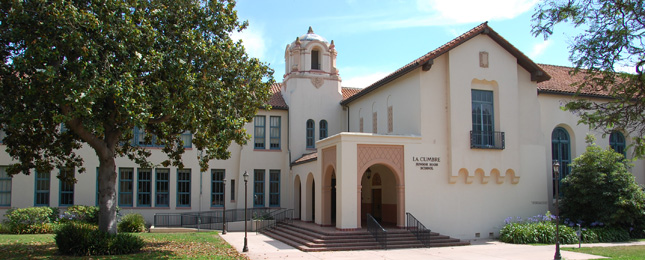
La Cumbre principal goes recruiting

La Cumbre Junior High, courtesy SBUnified.

Touting a closer-knit junior high community, one school aims to turn tide of enrollment

The vibe is different at La Cumbre Junior High these days. While the enrollment numbers are still down, new principal Jo Ann Caines’ dynamic energy seems to be resonating, at least with the people who know the native Santa Barbaran.

Students at Adams School (where she was principal until a few months ago), once a symbol for white flight, are now flocking to La Cumbre.

While only about 450 of the approximately 600 eligible students will attend La Cumbre in the fall, “the composition of our student body is going to be drastically different,” said Caines, “with more of the middle-income and middle- and high-achieving students that didn’t come here before.

“We’ve turned a huge corner thanks to Adams School,” she said, with all but 11 of the more than 100 sixth-graders planning to attend La Cumbre. “So while we’ll be very similar in size, we’ll be hugely different.”

This fall, Caines and assistant principal Jorge Fulco will concentrate on Monroe and Washington schools. Caines has even recruited an Adams fourth-grade parent, Katie Parker, to help her with the outreach.

“Jorge and I have been on the road since Feb. 1 doing outreach,” Caines said. “We gave more tours here … than they have in the prior five years combined.”

Of course, pitching the school is one thing, but telling a compelling story is another — and Caines certainly has one with her reorganization plan.

It might seem to be by design that, when Santa Barbara Community Academy upper-grade students move to La Cumbre’s campus in the fall, the junior high will begin to implement a core knowledge learning community that builds on the same concepts the academy has used successfully. But Caines said she did her research on the core knowledge curriculum (a sequenced, coherent program that uses a grade-by-grade core of common learning) prior to the school board’s decision to move the academy there.

Caines also has a Gifted and Talented Education (GATE)/pre-advanced placement learning community planned, a liberal arts/college preparatory group, and an intensive English development/newcomers community similar to the successful program she implemented at Adams.

Caines emphasized that the communities — which will be separated geographically to make it easier on students — are not tracks.

“Students can participate in any one that they choose or they qualify for,” she said.

Each student will also have a homeroom class where she hopes the smallness of the school will work to its advantage.

“Teachers will not only know their students but the students in that community,” she said.

The staff is coming on board after what Caines characterized as lots of “not easy” discussions.

“Change is hard,” she said. “They’ve been through four principals in two years, so it’s hard to say, ‘Is this really a change or is it going to be different next month kind of thing?’ So what I said to teachers is if it’s not a match for you then you should put in for a transfer because part of what I’m doing is building a new team, and more than anything I want people to be here because they want to be here.”

Three teachers have put in for transfers, but Caines said others are anxious to come to the school because of the new programs.

“Let’s be real. If you asked 100 adults about junior high, 97 of them will say they hated junior high,” she said. “It’s all about friends … Even though we’ll do outreach to the parents, … we’re going to put a lot of energy into the kids, because kids really do decide …They want to go where their friends are.”

Blurred boundaries

Transfers are one of the hot topics of discussion where school needs are concerned. When students transfer in from other districts, the district gets additional money, but intra-district transfers don’t change the funding and campuses like La Colina Junior High (which had only 591 students in 1993-94 and was up to 1,027 students in 2004-05) are getting overcrowded while campuses like La Cumbre Junior High (which had 1,030 students in 1993-94 and now has 433 students) have empty rooms..

Here’s a snapshot look at where secondary students are going (all figures are from the 2004-05 school year):

Junior High

Goleta Valley Junior High School

Incoming: +21 students from other districts; +48 students from within the district (total +69)

Outgoing: -1 student to other districts; -79 students to another school in the district (total -80)

La Colina Junior High School

Incoming: +29 students from other districts; +250 students from within the district (total +279)

Outgoing: -0 students to other districts; -50 students to another school in the district (total –50)

La Cumbre Junior High School

Incoming: +14 students from other districts; +41 students from within the district (total +55)

Outgoing: -2 students to other districts; -257 students to another school in the district (total –259)

Santa Barbara Junior High School

Incoming: +43 students from other districts; +154 students from within the district (total +197)

Outgoing: -2 students to other districts; -107 students to another school in the district (total –109)

High School

Dos Pueblos High School

Incoming: +74 students from other districts; +218 students from within the district (total +292)

Outgoing: -0 students to other districts; -101 students to another school in the district (total –101)

San Marcos High School

Incoming: +61 students from other districts; +325 students from within the district (total +386)

Outgoing: -7 students to other districts; -382 students to another school in the district (total –389)

Santa Barbara High School

Incoming: +151 students from other districts; +268 students from within the district (total +319)

Outgoing: -7 students to other districts; -328 students to another school in the district (total –335)

— Source: PAT SALEY

Originally published in South Coast Beacon on June 2, 2005.

Giving it his all—COMMUNITY BEACON: Larry Crandell

Santa Barbara’s favorite emcee has helped raised millions of dollars for local causes. But he can’t be outbid when it comes to community service.

His stationery (created by a 7-year-old admirer) reads, “From the desk of Mr. Santa Barbara, Mr. Montecito & the Godfather of Goleta, the one and only Larry Crandell.” But to most of us, he needs no introduction.

Even if you haven’t had the pleasure of his company one on one, you’ve no doubt seen him on stage, tirelessly raising money for causes ranging from the YMCA, the Boys & Girls Clubs, Hospice, the PARC Foundation, Transition House, the Santa Barbara Athletic Round Table and just about every other nonprofit organization in town.

Crandell estimates he is the master of ceremonies or auctioneer for about 100 charity events a year.

“I have a test. If I’m asked, I do it,” said the decorated World War II bombardier.

If people don’t know Crandell from his carrying of the philanthropic torch, they could certainly recognize him from when he carried the Olympic Torch in 2002, or be acquainted with him through his wife of 54 years, Marcy, or his five children — Larry Jr., Michael, Ashley (now deceased), Steven and Leslie — all of whom were raised in Santa Barbara.

Showing off pictures from his days playing basketball at Syracuse University, where the twinkle in his eye is immediately recognizable even 60 years later, Crandell proudly jokes that his five children, who went to Stanford University and UCSB, weren’t smart enough to follow in his academic footsteps.

Having already launched a successful software company with son Michael, Crandell is developing a new venture with Steven. There could be no better ambassador into the Santa Barbara business community than Larry Crandell, who has hobnobbed with just about everyone.

“When you’ve worked with a common cause there’s a camaraderie that you can’t do just by socializing, so I have access that I think I have the confidence to follow,” he said.

A degree of separation away from Crandell are the many celebrities with whom he’s done events, including Michael Douglas and Dennis Miller.

Humoring local philanthropists like Paul Ridley-Tree, who Crandell jokes is a special man, “he’s bid over $3 million, but he’s never bought anything,” is also a part of his repartee.

“My routine doesn’t change very much,” he admitted. “My secret is to keep changing audiences.

“I feel as though I’m on a victory tour, like a retiring athlete, only I don’t go anywhere and people treat me kindly.

“… At 82, life is sweet, I guess is the best way to put it.”

Originally published in South Coast Beacon on June 2, 2005