My Santa Barbara | ArchitecTours: Every Building Tells a Story

Julia Morgan—the architect who designed Hearst Castle—said: “Architecture is a visual art, and the buildings speak for themselves.” That may be true, but the intriguing personal stories behind the nine buildings highlighted in the 2015 Santa Barbara AIA Annual ArchitecTours also have some tantalizing tales to tell. This year’s tour, themed “buildings with a story,” takes place on Saturday, October 3 from 10 a.m.–4 p.m., culminating with a festive party. For more information and to purchase tickets, visit aiasb.com or call 805/966-4198.

—Leslie Dinaberg

Originally published in the Fall 2015 issue of Santa Barbara Seasons Magazine.

CL20: Modern suburban home addition prototype by Shubin + Donaldson Architects, courtesy AIASB.

CL20: Modern suburban home addition prototype by Shubin + Donaldson Architects, courtesy AIASB.

Contemporary art-filled residence by Bildsten Architecture and Planning, photo courtesy AIASB.

Contemporary art-filled residence by Bildsten Architecture and Planning, photo courtesy AIASB.

Craftsman bungalow by Blackbird Architects, photo courtesy SBAIA.

Craftsman bungalow by Blackbird Architects, photo courtesy SBAIA.

The Goodland Hotel by DMHA Architecture + Interior Design, photo courtesy SBAIA.

The Goodland Hotel by DMHA Architecture + Interior Design, photo courtesy SBAIA.

Gracious downtown living by Thompson Naylor Architects, photo courtesy AIASB.

Gracious downtown living by Thompson Naylor Architects, photo courtesy AIASB.

Luminous Santa Barbara County offices by DMHA Architecture + Interior Design, photo courtesy AIASB.

Luminous Santa Barbara County offices by DMHA Architecture + Interior Design, photo courtesy AIASB.

Mid-century modern library by PMSM Architects, photo courtesy AIASB.

Mid-century modern library by PMSM Architects, photo courtesy AIASB.

Modern cottage for multiple generations by AB Design Studio, photo courtesy AIASB.

Modern cottage for multiple generations by AB Design Studio, photo courtesy AIASB.

Tract house retread by Ensberg Jacobs Design, photo courtesy of AIASB.

Tract house retread by Ensberg Jacobs Design, photo courtesy of AIASB.

A Passion for Business Innovation

The Manzo-McKaig Melting Pot 

By Leslie Dinaberg
Courtesy Montecito Magazine

Courtesy Montecito Magazine

Like many immigrant families, the Manzo-McKaig patriarch came to the U.S. to pursue the American Dream.

Mission accomplished. From the Italian Store to the Pan-American Market chain, Enrico’s Deli and Casa Flores Tortillas, to their current successes in entrepreneurial ventures, hard work—and a love of food and family—run deep in the Manzo-McKaig gene pool.

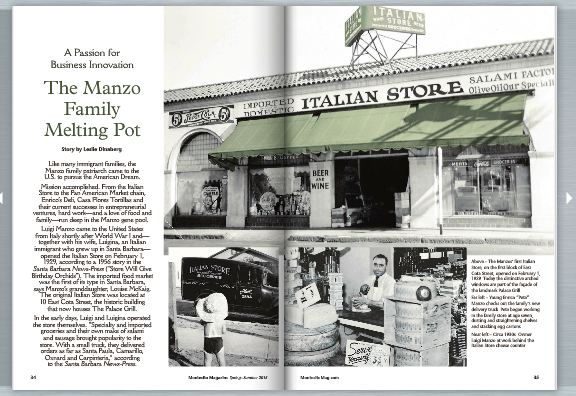
Luigi Manzo came to the United States from Italy shortly after World War I, and together with his wife Luigina, opened the Italian Store, on February 1, 1929, according to a 1956 story in the Santa Barbara News-Press (“Store Will Give Birthday Orchids”). The imported food market was the first of its type in Santa Barbara, says Manzo’s granddaughter, Louise McKaig, The original Italian Store was located at 10 E. Cota St., the historic building that now houses the Palace Restaurant.

In the early days, Luigi and Luigina operated the store themselves. “Specialty and imported groceries and their own make of salumi and sausage brought popularity to the store. With a small truck they delivered orders as far as Santa Paula, Camarillo, Oxnard and Carpinteria,” according to the Santa Barbara News-Press.

“My Grandma always told me she came through Ellis Island [also from Italy] when she was nine,” says Louise. “She said that her father and his brother went to work in the coal mines in Oklahoma.” According to the 1930 U.S. Census records, Luigina arrived in this country in 1915, and classified herself as an “unpaid worker, member of the family” at the “Family Grocery Store” in Santa Barbara.

The Manzo’s son Enrico “Pete” (Louise’s father) also began working at the store at the tender age of seven. “His first job was dusting, straightening shelves, and stacking the bulk eggs into cartons,” says Pete’s wife Dorothy “Dottie” Manzo. “Pete was still in high-school when his father, Luigi Manzo, got sick and handed Pete the keys to the store. ”
Courtesy Montecito Magazine

Courtesy Montecito Magazine

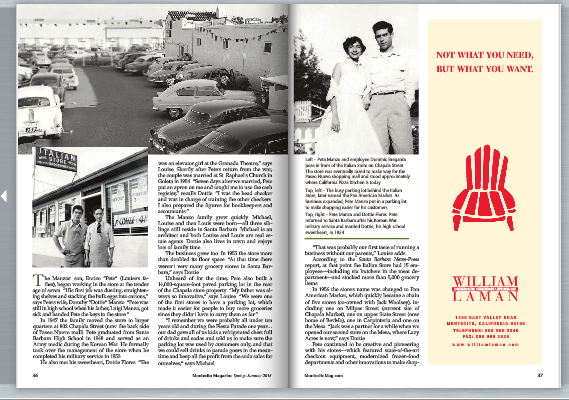
In 1947, the family moved the store to larger quarters at 802 Chapala St. (now the back side of Paseo Nuevo Mall). Enrico graduated from Santa Barbara High School in 1948, and served as an Army medic during the Korean War. He formally took over the management of the store when he completed his military service in 1953.

He also came back to home to his sweetheart, Dorothy “Dottie” Flores. “She was an elevator girl at the Granada Theatre,” says Louise. Shortly after Enrico’s return from the war, the couple was married at St. Raphael’s Church in Goleta in 1954. “Seven days after we married, Pete put an apron on me and taught me to use the cash register,” recalls Dottie. “I was the head checker and was in charge of training the other checkers. I also prepared the figures for bookkeepers and accountants.”

The Manzo family grew quickly. Michael, Louise and then Louis were born—all three siblings still reside in Santa Barbara. Michael is an architect and Louis and Louise are both real estate agents. Dottie also lives in town and enjoys lots of family time.

The business grew too. In 1955 the store more than doubled its floor space. “At that time there weren’t very many grocery stores in Santa Barbara,” says Dottie.

Unheard of for the time, Enrico also built a 14,000-square-foot paved parking lot in the rear of the Chapala store. “My father was always so innovative,” says Louise. “We were one of the first stores to have a parking lot, which made it easier for people to buy more groceries since they didn’t have to carry them as far.”
Courtesy Montecito Magazine

Courtesy Montecito Magazine

“I remember we were probably all under ten years old and during the Fiesta Parade one year … our dad gave all of us kids a refrigerated chest full of drinks and sodas and told us to make sure the parking lot was used by customers only, and that we could sell drinks to parade goers in the meantime and keep all the profit from the soda sales for ourselves, says Michael.

“That was probably our first taste of running a business without our parents,” says Louise.

According to the Santa Barbara News-Press report, at that point the Italian Store had 15 employees—including six butchers in the meat department—and stocked more than 5,000 grocery items.

In 1956, they changed the store’s name to Pan American Market, which quickly became a chain of five stores (co-owned with Jack Woolsey), including one on Milpas Street, where Chapala Market is now, one on upper State Street where Bev Mo is now, one in Carpinteria, and one on the Mesa. “Jack was a partner for a while when we opened our second store on the Mesa, where Lazy Acres is now,” says Dottie.

Enrico continued to be creative and pioneering with his stores—which featured state-of-the-art checkout equipment, modernized frozen-food departments and other innovations to make shopping easier. He was also always cutting edge with his marketing strategies.

One such promotion delighted local children. “We had a store in Carpinteria,” says Louise, “and my dad had this friend who was a helicopter pilot fly over the store dressed as Santa for Christmas.” Helicopter Santa also visited the Mesa store, according to Dottie.

This kind of attention-getting stunt wasn’t being done at that time; it was unheard of, Louise says.

“Pete was always coming up with new innovative business ideas, something inherited by our daughter Louise,” says Dottie. “We had special events, guests, or prizes for customers throughout the year especially for holidays and special occasions.”

“One year, my dad brought Engineer Bill, the famous kids TV show host, to our Pan American Market in Carpinteria and publicized it to bring new customers. Engineer Bill would be my kids’ generation’s version of Mr. Rogers,” explains Louise. “Sometimes Dad would hire a photographer to take family photos for customers wanting a keepsake. Creating an experience is an important approach to running a successful business. I’ve tried to follow in my father’s footsteps by implementing a lot of his teachings into my business like by selling a good product but also a good experience. On Mother’s Day he would have orchids given to all the mothers who were shopping at the store.”
Courtesy Montecito Magazine

Courtesy Montecito Magazine

“Growing up, my brothers, Mike and Louis and I spent a lot of time at the grocery stores. Most of the employees were like aunts and uncles to us,” recalls Louise.

“I remember bagging groceries for customers, stocking shelves, unloading cases of food off delivery trucks and miscellaneous repairs around the stores, ” says Louis.

“There were a lot of good characters and we had a lot of fun times,” says Michael.

“One time there was a butcher who wasn’t very nice to us. My dad suggested we give him ‘Happy Pills.’ So the next time he wasn’t being nice, my brothers and I made a little jar with M&Ms and wrote ‘Happy Pills’ on it,” says Louise.

“After that he was a lot nicer to us,” adds Michael.

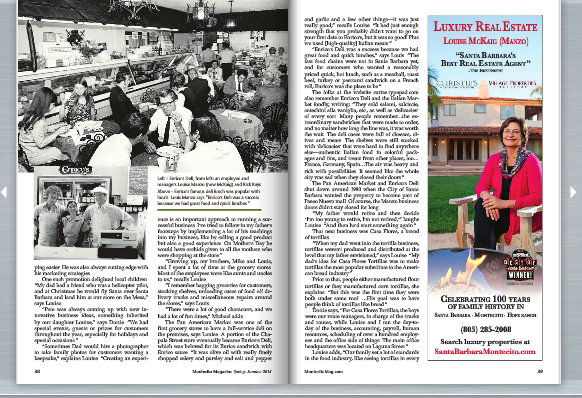
The family business ethos was backed up with innovative business strategies. For example, the Pan-American Market was also one of the first grocery stores to have a full service deli on the premises, says Louise. A portion of the Chapala Street store eventually became Enrico’s Deli, which was beloved for its Enrico sandwich with Enrico sauce. “It was olive oil with really finely chopped celery and parsley and salt and pepper and garlic and a few other things—it was just really good,” recalls Louise. “It had just enough strength that you probably didn’t want to go on your first date to Enrico’s, but it was so good! Plus, we used really good Italian meats.”

“Enrico’s Deli was a success because we had great food and quick lunches,” says Louis. “The fast food chains were not in Santa Barbara yet, and for customers that wanted a reasonably priced, quick, hot lunch, such as a meatball, roast beef, turkey or pastrami sandwich on a French roll, Enrico’s was the place to be.”

The folks at the website cartastypepad.com also remember Enrico’s Deli and the Italian Market fondly, writing: “They sold salami, salciccie, cotechini alla vaniglia, etc, as well as ‘delicacies’ of every sort. Many people remember… the extraordinary sandwiches that were made to order, and no matter how long the line was, it was worth the wait.  The deli cases were full of cheeses, olives, and meats.  The shelves were still stocked with “delicacies” that were hard to find anywhere else – authentic Italian food in colorful packages and tins, and treats from other places, too … France, Germany, Spain …The air was heavy and rich with possibilities. It seemed like the whole city was sad when they closed their doors.”

Of course, the Manzo business doors didn’t stay closed for long.

“My father would retire and then decide ‘I’m too young to retire, I’m not retired,'” laughs Louise. “And then he’d start something again.”

“We sold the stores because we wanted to go into our next businesses,” says Dottie.

That next business was Casa Flores, a brand of tortillas.

“When my dad went into the tortilla business, tortillas weren’t produced and distributed at the level that my father envisioned,” says Louise. “My dad’s idea for Casa Flores Tortillas was to make tortillas the most popular substitute to the American bread industry.”

Prior to that, people either manufactured flour tortillas or they manufactured corn tortillas, she explains. “But this was the first time they were both under same roof. … His goal was to have people think of tortillas like bread.”

“For Casa Flores Tortillas the boys were our route managers, in charge of the trucks and routes while Louise and I ran the day-to-day of the business, accounting, payroll, human resources, scheduling of over a hundred employees, and the office side of things. The main office headquarters were located on Laguna Street,” says Dottie.

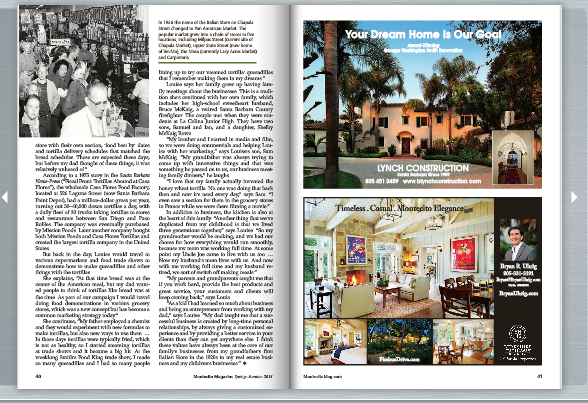
“Our family set a lot of standards in the food industry like seeing tortillas in every store with their own section, ‘food best by’ dates, and tortilla delivery schedules that matched the bread schedules, ” says Louise. “These are expected these days but before my dad thought of these things it was relatively unheard of.”

She continues, “He was very smart. He gave people things that no one else was getting. For example, Hidden Valley Ranch Dressing was new then, and he sold a lot of that. One of the first distributors was a family friend. When our family opened the first Enrico’s Deli, people could design their sandwich with a quarter pound of meat, their choice of bread, their choice of toppings, a salad choice plus a side green salad with Ranch dressing. As a child I remember lines out the door every day at lunchtime. The new deli and the new salad dressing were a very big hit in Santa Barbara.”

According to a 1975 story in the Santa Barbara News-Press (“Fiscal Front: Tortillas Abound at Casa Flores”), the wholesale Casa Flores Food Factory, located at 526 Laguna St. (now Santa Barbara Paint Depot), had a million dollar gross per year, turning out 30-40,000 dozen tortillas a day, with a daily fleet of 30 trucks taking tortillas to stores and restaurants between San Diego and Paso Robles. The company was eventually purchased by Mission Foods, which is now the number one tortilla company in the United States.

But back in the day, Louise would travel to various supermarkets and food trade shows to demonstrate how to make quesadillas and other things with the tortillas.

She explains, “At that time, bread was at the center of the American meal, but my dad wanted people to think of tortillas like bread was at the time. As part of our campaign I would travel doing food demonstrations in various grocery stores, which was a new concept but has become a common marketing strategy today.”

She continues, “My father employed a chemist and they would experiment with new formulas to make tortillas but also new ways to use them. … In those days, tortillas were typically fried, which is not as healthy, so I started steaming tortillas at trade shows and it became a big hit. I was running our tortilla booth at a big Smith’s Food King trade show in Salt Lake City and every day we had a long line of people wanting to taste our new healthier method of ‘steaming tortillas.’ This man kept coming up to me saying, ‘You’re more popular than Miss America!’ I finally asked ‘who is that guy?’ It turned out to be Dee Smith of Smith’s Food King, and Miss America was actually there hosting another booth that wasn’t as popular as ours. That impressed Dee Smith. I made so many quesadillas that week and I had so many people lining up to try our ‘steamed tortilla’ quesadillas that I remember making them in my dreams.”

“I love that my grandpa actually came up with the idea and was the first to do a honey wheat tortilla, no one was doing that back then,” says Louise’s son, Samuel McKaig. “It my mom’s idea to have a little bee on the front of the package.”

He continues, “I think something that added to the company was it wasn’t just my grandpa, [the kids] were always running it for him. The kids ran the operations and the corporate side of things and my grandma did the accounting and the payroll. So it was always a family thing.”

“We learned a lot doing that,” says Louise. “Even just the mind set of you either are building skills and what you don’t know how to do you learn to do because you just keep building on your knowledge, and surround yourself with knowledgeable people too.”

Louise—an agent with Village Properties—says her family grew up having family meetings about the businesses. This is a tradition she’s continued with her own family, which includes her high school sweetheart husband Bruce McKaig, a retired Santa Barbara County Firefighter. The couple actually met when they were students at La Colina Junior High. Louise says she still teases Bruce that he’s not really a native Santa Barbaran because he didn’t move to town till he was six months old. They have two sons, Samuel and Ian, and a daughter, Shelby McKaig Rowe.

“My brother and I started in media and film, so we were doing commercials and helping Louise with her marketing,” says Samuel. “My grandfather was always trying to come up with innovative things and that was something he passed on to us, our business meeting family dinners,” he laughs.

In addition to business, the kitchen is also at the heart of this family. “Another thing that we’ve duplicated from my childhood is that we lived three generations together,” says Louise. “So my grandmother would be cooking and we had our chores for how everything would run smoothly, because my mom was working full time. At some point my Uncle Joe came to live with us too. … Now my husband’s mom lives with us. And now with me working full time and my husband retired we sort of switch off making meals.”

“And we all cook different meals,” adds Samuel. “I married a French person, so we got some different cuisine in there. She cooks a lot.”

Along with the international cuisines of the various family businesses, Louise also had another business coordinating internal programs for travelers who came to Santa Barbara. “I learned all kinds of different skills doing that, ” she says. “You have to, especially when someone can’t communicate in your own language.”

The family legacy of creativity and always working to improve oneself continues to live on in Santa Barbara. “That was something he (Grandpa Enrico) was always teaching (my mother) and he was trying to teach me is being innovative and coming up with the next thing that no one has done before,” says Samuel. “He taught that to Louise and that’s what she uses in her real estate and that’s what she taught me… being creative and pushing the limits.”

“My parents and grandparents taught me that if you work hard, provide the best products and great service your customers and clients will keep coming back,” says Louis.

“Dad taught us to treat our employees and coworkers the way you want to be treated. He always made sure that everyone in the company was taken care of,” says Michael.

“As a kid I had learned so much about business and being an entrepreneur from working with my dad. My dad taught me that a successful business is created by long-time personal relationships, by always giving a customized experience, and by providing a better service to your clients than they can get anywhere else. I think these values have always been at the core of our family’s businesses from my grandfather’s first Italian Store in the 1920s to my real estate business and my children’s businesses. He taught by example that to make a business successful you need people to want to work for you. He helped our employees from top to bottom feel like they were an essential part of a team.”

Originally published in Montecito Magazine, Spring-Summer 2015.

Editor’s Pick: Casa del Herrero Celebrates 90 Years

Casa del Herrero, courtesy photo.

Casa del Herrero, courtesy photo.

George Fox Steedman and his wife Carrie moved into their new home on June 29, 1925. Now we have a chance to celebrate “father of Santa Barbara style” George Washington Smith’s architectural legacy with a special garden party. Casa del Herrero, 1387 E. Valley Rd., Montecito. June 28, 4–7 p.m. 805/565-5653, casadelherrero.com.

Originally published in Santa Barbara Seasons Magazine, Summer 2015.

—Leslie Dinaberg

The Art of Getting People Back to Nature | Yarnbomber Stephen Duneier

Stephen Duneier with one of a series of yarn-covered boulders he created at Lizard's Mouth. Photo by Scott London, ScottLondon.com.

Stephen Duneier with one of a series of yarn-covered boulders he created at Lizard’s Mouth. Photo by Scott London, ScottLondon.com.

By Leslie Dinaberg

Artists often use their work to provoke discussion or emotion, but Yarnbomber Stephen Duneier’s colorful creations are site-specific installations designed to get people out to the middle of nowhere.

In this case, “the middle of nowhere” is Santa Barbara County’s plethora of hiking trails. Duneier’s seven projects to date include creating an Alien Campsite on Davy Brown Trail; a series of covered boulders at Lizard’s Mouth; a reflective starfish above the pools at Seven Falls; a spider web at Sasquatch Cave in the playgrounds of Lizard’s Mouth; an enormous boulder on Saddlerock Trail; an ongoing Guinness Book of World Records attempt to create the world’s largest crocheted granny square; and creating his first project—cloaking a 40-ft. tall eucalyptus tree on the Cold Spring Trail’s east fork with a gigantic knitted sweater—which took place in 2012, just 82 days after he picked up knitting needles for the first time ever.

All of Duneier’s projects are done in a way that doesn’t permanently disturb nature, with permission from the U.S. Forest Service. “The forest service has actually been really supportive, now that I have a track record with them, and they know that I’m not just some guy who wants to use the land for my own purposes,” he says.

The other consistent element in a Yarnbomber project is that the installations stay up for just nine days. “The first weekend is all about people just stumbling onto it, then there are five days during the week, when nobody goes hiking very much. The second weekend is all about word–of–mouth. It sort of builds…but I don’t really want crowds; I just want it to be on people’s radar. And having it for nine days, you can’t procrastinate. You’re either going to go see it and make the effort today or you’re just not going to see it,” says Duneier.

The projects, many of which are done in collaboration with artists from around the world, have opened up a world of new experiences for Duneier, whose day job is writing about and managing investments, as well as teaching Decision Analysis at UCSB’s College of Engineering.

“I’ve always been speaking on macroeconomics; talking at big conferences…but now I’ve started talking about making dreams come true; this has been a little offshoot of the yarn bombs,” he says. The audiences vary, but the idea is “how do you have these grand visions and actually make them happen?”

His next “grand vision,” launching sometime this summer, incorporates metalwork and gemstones. As to where and when it pops up, the website yarnbomber.com is the best place to stay tuned.

Says Duneier, “I’m kind of a yes guy…I really don’t know where it all will lead.”

Originally published in the Summer 2015 issue of Santa Barbara Seasons Magazine.

Noozhawk Talks: Santa Barbara Writers Blend Talents, Wine Experiences

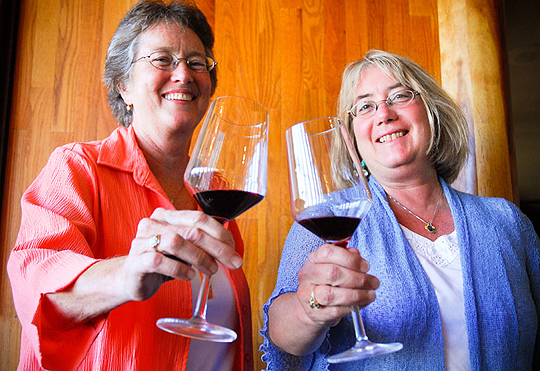
For Reka Badger, left, and Cheryl Crabtree, writing the California Directory of Fine Wineries was a labor of love — and red wine.  (Lara Cooper / Noozhawk photo)

For Reka Badger, left, and Cheryl Crabtree, writing the California Directory of Fine Wineries was a labor of love — and red wine. (Lara Cooper / Noozhawk photo)

Leslie Dinaberg: The California Directory of Fine Wineries book is quite lovely and takes you on a journey through 58 wineries in Santa Barbara County, San Luis Obispo and Paso Robles. How did you decide which wineries to include?Cheryl Crabtree: (Our editor) Tom Silberkleit picked them.LD: Do you know how he picked them?Reka Badger: He tasted all over the place.

CC: He researched heavily.

RB: He chose them for the wine and the quality of the destination.

CC: It had to have a double package … these were destination travel pieces more than wine experiences. He definitely did his homework.

LD: Both of you have written extensively about wine. Tell me about some favorites you discovered in the course of writing the book.

RB: I thought Whalebone’s wines were really good. There was something about knowing their stories that added such a dimension to tasting the wine, too. The guy who owns Whalebone, Bob Simpson, was an obstetrician, and he lost his fingers in a hunting accident and had to do something else. He got involved with vineyards by doing something that was similar to what he did as a doctor, using equipment. They were raising cattle, as well, so they were already kind of farmer types. Then he planted some vineyards and grapes. He’s so devoted to farming … and I liked their wines.

I thought Calcareous Vineyard was a wonderful story — those two sisters (Dana Brown and Erika Messer), and I thought the wines were really nice. Those Zinfandels really showed what you could do with zin. Their pinot … there really is pinot up there in the right spot. I could go on and on.

LD:: What about you, Cheryl? Did you have any discoveries?

CC: I did discover probably one of the best wineries here, Kenneth Volk Vineyards.

LD: Really?

CC: Kenneth Volk is a pioneer in the wine business. He started Wild Horse Winery up in Templeton. He was one of the first and he’s very academic.

RB: He loves to talk about it. He loves to tell you about it.

CC: He’s a scientist, but he loves experimentation. What happened with Wild Horse is, it got a little too big for him and he wanted to return to making just the wines he really wanted to make and experiment with. He’s got 16 or 20 different wines. Some are really unusual ones, from really unusual varietals. Those wines were really good. I loved seeing how much he loves to get his hands dirty and experiment. It’s like a kid with a chemistry kit.

LD: Is this book something people would use to map out their wine-tasting destinations?

RB: It gives a series of really good starting points. I think the purpose is to get people out there, give them an idea of what they might find, and then from there, they can do their own exploring. It’s not a comprehensive guide, but it can point you to some of your favorites and to some that you don’t know.

CC: And to make it seem accessible, because a lot of people who don’t come from California especially think, oh, it’s only for connoisseurs. But that’s not the case at all. The photos really show that. Just normal people learning about wine in a very informal, casual way.

LD: Let’s say, for example, Reka: Where would you take a friend from out of town if you were to go wine tasting?

RB: That’s a really tough one. I would want them to stay five days and we would go to five different regions.

LD:: Really?

RB: Yes. Because there’s a lot of driving involved in the western Paso Robles area, near Whalebone. Vina Robles emerged full-blown from the soil with all of this stacked stone and expensive state-of-the-art stuff, which I steer clear of usually. They usually look too fancy for me, but it was a fabulous experience.

Where we would go would depend on whether we were going to taste some wine or we were going to stop and have a picnic. L’Adventure is at the end of the road. It’s this crazy French guy (Stephen Asseo) who didn’t want to be restricted to the Bordeaux requirements for blending. He wanted to develop blends around cabernets, so he came over here and bought that property. It’s an adventure just getting there. If you want to take a ride and see some country, I would want to go out there. If it’s a short time, I would go someplace a little closer. If there’s no time at all, go down to downtown Paso Robles and just do the downtown.

CC: Same thing, downtown Solvang and downtown Santa Barbara, the Urban Wine Trail. If you have little time, I would focus on those because you can still taste some great wines and walk.

LD: Do you guys have a favorite wine? You mentioned you like reds, Reka.

RB: I do, but depending on the weather and what I’m doing and the time of day. Mornings I prefer champagne, definitely. Late afternoon hot, I love a real crisp rose; I really like the roses a lot, but I do like a red.

LD: What about you, Cheryl?

CC: Pinot Noir. There are several great Pinot Noirs from the Santa Rita Hills. Those are stellar. Kris Curran; anything she touches is wonderful. And she is married to Bruno D’Alfonso, who was (the winemaker) at Sanford for a long time. They now have their own label, D’Alfonso-Curran Wines, but she also is the winemaker for Foley. She works wonders; it doesn’t matter who she’s working for, just find Kris Curran. And she and Bruno have a tasting room in Solvang, too.

LD: I’ll have to remember that.

CC: She is incredible. And so is Bruno. They are, he’s a pioneer also. They helped pave the way. He was the one who crafted Sanford wines for years. But my favorite is Alma Rosa Chardonnay. That’s what we always buy.

RB: Is it pretty affordable?

CC: It’s $11.99 at Costco.

LD: Where’s your favorite place to enjoy a glass of wine?

RB: I have a zero gravity chair, and I sit out on the patio and I kick my feet up and that’s about it. How about you, Cheryl?

CC: Well, I haven’t gotten out much except to my patio, but if I could my favorite view is Ellwood Bluffs. But I’m not sure you can bring wine up there.

RB: Well, if you’re discreet. (Laughs)

CC: That’s where I would go if I had the time. Anywhere with a view around here is not hard to find. Have you ever been to Clautiere Vineyard in Paso Robles? The tasting room has wigs and you put the different wigs on and be whoever you are, wander around the grounds with these wigs and it’s like a French cabaret.

LD: What a hoot. I’ve never heard of that.

RB: You know winemakers are all eccentrics, really.

CC: They really are.

LD: The other part of this is I ask you two a few questions about yourselves. So, Reka, what else do you like to do when you’re not working?

RB: One of my favorite things is to dig holes and plant things. I love to get out there with a shovel and a hat and dig holes and plant. I’m an irrepressible gardener. I love to read, I love to swim, I like to travel but I don’t get to do enough of that now. When the wine runs out I like a nice cold Bombay Martini straight up.

CC: If I had time I would have a list of things that I used to do.

RB: What’s at the top of the list?

CC: Travel. I love to walk the dog and enjoy Santa Barbara. All of these wonderful open spaces that we have. We’re so lucky to be able to have that. Every day we can go to the Douglas Preserve or Hendry’s Beach or the Bluffs or the burned-out trails, but they’re kind of fun still; it’s unusual. It’s a different look but it’s interesting. Also, recently I’ve begun to really like watching water polo.

RB: Isn’t it weird to be interviewed? It’s very strange to be on the other side.

CC: Yeah, it’s peculiar.

LD: If you could pick three adjectives to describe yourself, what would they be?

RB: Gorgeous, confident, wealthy. Put that.

CC: You can think of those for us.

RB: Yeah, just look at us. Curious, driven; those are the only two I can think of.

CC: Stubborn, persistent.

RB: I think we’re going to go with two adjectives each since there are two of us.

Vital Stats: Cheryl Crabtree

Born: July 21, in ancient times, San Francisco

Family: Husband Chris; sons Cameron, 15, and Colin, 10; Lightning the Jack Russell terrier and cats Pepper and Lorraine

Civic Involvement: Hope School District Educational Foundation, volunteer for kids’ sports teams

Professional Accomplishments: BA Stanford University with Honors in humanities and comparative literature; graduate studies in comparative literature at New York University. Moved to Santa Barbara in 1983 to work for EF (Education First). “When the headquarters (and my writing job) moved to Boston in the late ‘80s, I decided to freelance until I found a ‘real’ job. Two decades later, I still don’t have a real job, but I’ve written tons of things.” This includes co-authoring the first edition of The Insider’s Guide to Santa Barbara; working for Fodor’s Travel Publications updating the Central Coast and Monterey Bay chapters in Fodor’s California guidebook since 2001; co-authoring Hometown Santa Barbara (with Noozhawk’s Leslie Dinaberg and Zak Klobucher, and Nancy Ransohoff and Starshine Roshell) and co-authoring California Directory of Fine Wineries. Story editor/writer Montecito Magazine, writer for Santa Barbara Seasons/Custom Media and writer for the Santa Barbara Conference & Visitors Bureau’s new Santa Barbara visitor’s magazine.

Best Book You’ve Read Recently: Deeply Rooted: Unconventional Farmers in the Age of Agribusiness by Lisa M. Hamilton; Out Stealing Horses by Per Petterson; The Little Book by Selden Edwards

Little-Known Fact “I spent a year in Norway as a high school exchange student and speak Norwegian. Heia Norge!”

Vital Stats: K. Reka Badger

Born: June 12, midcentury last, in Monterey Park

Family: Married 21 years to Jon Budac; two cats and a ball-crazy whippet

Civic Involvement: Creston Garden Club, Santa Barbara Botanic Garden, former board member Santa Barbara County Vintners’ Association

Professional Accomplishments: BA in cultural anthropology from UCSB. “I have worked a lot of different jobs, including driving a cab, making documentary films, building models for an animator, painting houses, writing celebrity bios and managing winery tasting rooms. Currently, I write weekly wine, food and garden-related columns (for the Santa Barbara News-Press and the Santa Maria Sun), and consider the publication of this book a landmark accomplishment.”

Best Book You’ve Read Recently: Pillars of the Earth, by Ken Follett; Mother of Pearl, by Melinda Haynes; The Good Earth, by Pearl S. Buck

Little-Known Fact: “I managed a little copy kiosk at the edge of the UCSB campus way back when and was among Kinko’s first handful of employees.”

Originally published on Noozhawk.com on August 2, 2009.

Inside the Flat File

Paintings on Guitar, by John Chervinsky, courtesy of wall space gallery

Paintings on Guitar, by John Chervinsky, courtesy of wall space gallery


There’s something magical about searching for art amidst the flat files. As wall space gallery owner Crista Dix says, “Looking through the flat files at the gallery is like heading to a buffet and coming back for thirds and fourths. Every drawer is filled with unique work, unlike the drawer before it, and the one after unlocks even more visual desserts.” 

Let’s take a peek inside the flat files.

Story by Leslie Dinaberg 

Aline Smithson

This series, entitled “Spring Fever,” is a take on childhood, womanhood and the future. Inspired by Michael Apted’s ongoing “7-Up” documentary series—chronicling the lives of British children every seven years through adulthood—based on the Jesuit maxim, “Give me the child until he is seven and I will give you the man.”

Aline Smithson says, “In this case, I give you the girl. ‘Spring Fever’ explores the idea of childhood and beyond, capturing seven-year-old girls wearing 1950’s spring hats. Juxtaposing hats traditionally worn by women half a century older with the visual of a child on the threshold of knowledge and sophistication allows us a glimpse into the future, and possibly a reflection of a face that wore a head full of flowers long ago.”

Smithson has had solo exhibitions throughout the United States, China and Europe and her work is in a number of museum collections. 

John Chervinsky

This work represents John Chervinsky’s photographic investigation into the nature of time, light, space and gravity. He creates these conceptual pieces by first composing and photographing a still life; cropping a subset of the image and sending it to a painting factory in China; waiting for an anonymous artist to complete an oil painting of the cropped section, and send it back in the mail; then reinserting the painting into the original setup and re-photographing the piece.

Chervinsky states, “ I’m interested in issues relating to perspective. I’m interested in the tensions expressed in the comparison between reality versus representation. I’m interested what happens when I collaborate with another artist that has no idea that they are involved in a collaboration, and I’m interested in seeing and expressing subtle changes over time that we might otherwise take for granted.”

Bill Finger

With a background in photography and more than 20 years working on movie sets, Bill Finger creates photographs of miniature scenes that seem life-sized. Handcrafting each element, he builds miniature dioramas of narrative scenes that serve as the subject of his large-scale photographs. 

“… I put the camera into the scenes as though it’s the viewer’s point of view, making the viewer a participant,” states Finger. “I also play with the idea of a filmic place that only exists to be photographed and then is destroyed after the photograph [is shot]. This happens in real life too. … I’m creating temporary places that are coming out of my imagination, but they exist in the real world as long as it takes me to photograph them.”

Space Oddity, featuring work by Bill Finger, John Chakeres, Charles Grogg and Ryan Zoghlin, will be on view from May 30 through June 28 at wall space gallery, 116 E. Yanonali St. C-1, 805/637-3898, wall-spacegallery.com.

Ryuijie

The subject matter in this series is botanicals frozen in blocks of ice. The ice is as important as the flowers it encases, providing an element of the unexpected and unpredictable. This element can be likened to the Japanese principle of wabi sabi—beauty in nature in all its imperfections.

“Taking spring flowers and stopping time, Ryuijie has managed to mix line, form and texture to brilliant effect,” says Crista Dix, owner of wall space gallery. Crafted by freezing the blooms, then illuminating them with light, these painterly images capture the eternal warmth of the season.

Ryuijie, who was born in Otaru, Japan, has steadfastly pursued his own photographic vision for more than 30 years. An exceptionally prolific artist, works by Ryuijie can be found in private and public collections worldwide.

“Photography is such a unique art form. Most think it’s about what image can be captured from a phone, like landscapes or selfies, but photography can be so much more,” says Dix. “It is fun for me to be involved in releasing someone’s creativity when they come in to look at work and see anything is possible.” 

All photographs pictured can be found in the flat files at wall space gallery.

Originally published in Santa Barbara Seasons Magazine, Spring 2015.

Pearl Chase Society Historic Homes Tour—Editor’s Pick for Spring

Pearl Chase Tour, photo by Steve Crozier

Culley House, photo by Steve Crozier

Several George Washington Smith-designed homes in Montecito take center stage in the annual Pearl Chase Society Historic Homes Tour. Between 1918 and his death in 1930, George Washington Smith designed more than 60 residential and non-residential structures, mostly in Santa Barbara, including a home originally designed for renowned violinist and composer Henry Eichheim, which is included on the tour and features rarely seen frescoes created by the famed Mexican muralist Alfredo Ramos Martinez.

Also on view is the Culley house (pictured), which is a bit of a departure from Smith’s earlier Andalusian-influenced designs, as it’s a rectangular structure with a cantilevered porch more akin to Monterey-style, which shows his influence becoming more Spanish Colonial than old-world Spanish. In addition, the bus-led tour stops at several other homes, where visitors can see Smith’s distinctive aesthetic first hand. Advance reservations are required. May 18, 11 a.m.–4 p.m. PearlChaseSociety.org, 805/961-3938.

—Leslie Dinaberg

Originally published in the Spring 2014 issue of Santa Barbara SEASONS Magazine.

Sandra Tsing Loh Dishes on Menopause, Marriage and “The Madwoman in the Volvo”

Sandra Tsing Loh will appear on Thursday, May 8 at UCSB Campbell Hall

Sandra Tsing Loh will appear on Thursday, May 8 at UCSB Campbell Hall (courtesy photo)

Humorist/memoirist will appear at UCSB Campbell on Thursday, May 8

By Leslie Dinaberg

Chatting with Sandra Tsing Loh—whose new book, The Madwoman in the Volvo, focuses on what she calls Generation Triple M  (Middle-Aged Moms in Menopause)—is a lot like reading one of her essays. Her level of frankness is engaging, enlightening and charming, kind of like catching up with long-lost friend. It’s also a little bit disarming, like looking in one of those magnifying mirrors and seeing your pores for the first time.

She calls it like she sees it, and her countless fans wouldn’t have it any other way. Count me among them. Here’s a brief snippet of our conversation last week.

Leslie Dinaberg: I’m excited about your new book, The Madwoman in the Volvo. Will your discussion at UCSB be a reading from the book or the one-woman show that’s themed around the book?

Sandra Tsing Loh: The show is still being developed, so it will be a bit of a combo. It will be a bit of a reading from it and then discussion, so reading, chat, conversation, that sort of thing. The one-woman show I’m still developing it, and I’m going to be workshopping it in New York later in May. That’s still in development, but there’s going to be some overlap.

Did writing about menopause and researching it and sort of immersing yourself in it make you feel better or worse about actually going through menopause?

Well, at first it made me feel worse and that’s partly why I wrote the book. … For me it was the huge depression spikes, just out of proportion to anything I’d ever felt. It kind of felt like my chemistry was changing and somebody said, “Have you been counting your periods? You could be in this.”

So, of course, it was a huge relief to go maybe I’m not just going nuts but something is happening to me that is biological and label-able. But then when I started getting into the menopause books, I found most of them were totally unhelpful! All of the advice was like, “just cut out alcohol, sugar and caffeine, drink eight glasses of water day, eat more kale, have walks, do yoga stretches before bed and you’ll be fine. Don’t take any Ambien or antidepressants.”

So all the advice is just to lead a more healthy life and eat many smaller meals—which a meal is like two unsalted almonds. (Laughs). So at a time when things are really crazy, the advice is like kale and water will solve it. It was just really unhelpful. I think that’s kind of like the health advice for women … calm down, listen to soothing music, clean out your sock drawer. I mean the advice is just really not helpful at all.

…As I was writing the book I sort of thought I knew where it started and ended, but during the process of writing it [menopause] was still continuing. So there was new material that came into the book—me just really hitting rock bottom.

Sandra Tsing Loh's latest book, "The Madwoman in the Volvo," takes on menopause.

Sandra Tsing Loh’s latest book, “The Madwoman in the Volvo,” takes on menopause.

It was one Sunday morning waking up and I’ve been trying to exercise and eat healthy and do all of these things that are keeping me balanced and I just couldn’t do it anymore. I was just at my wits end, really depressed with my girls at home. It’s also a moment described in the article where you go, “how can I raise these children, I can’t even like look at them anymore and their voices just are too high-pitched. I can’t even face going down and making breakfast for them. I just feel too old to be doing any of this and I just want to be alone and just stay in bed.”

You obviously came out of that. Your doctor helped.

I finally got to the gynecologist … she gave this great speech … where she says,  “there are the Chinet girls and paper plate girls. Chinet girls can put a lot on them and they won’t break, and paper plate girls, you just put one carrot on and they shatter.”

And she says, “I think you’re at heart a Chinet girl but right now you’re having a psychological reaction to physiological phenomenon, so take a break. If you want to take antidepressants you can, if you want to take some hormones you can, if you don’t want to take anything just be aware of when these huge waves of depression and emotion and hot flashes wash over you that it’s temporary, you can do that. And it’s up to you.”

It was great speech. It was actually very helpful. Because usually the advice is God forbid you tell your husband or a man about it, who will try to solve it immediately, rather than just saying either you’re going through a lot but you’re also pretty strong and you can have all of these options are fine. That was just really useful.

Do you feel like you’re still immersed in menopause because you’ve written the book and now you’re almost reliving it because you’re starting to talk about it again?

No I think I’m actually over the worst of it. Probably tomorrow something else will happen, but I think I am. And I have heard a lot of women have said, “You know what it will get better. I remember that time, but it will get better.”

I know that it will. Also, I remember my sister described turning 50 and then everything suddenly evening out, like you’d gone through all of this turbulence and then you’re in the smooth air and it’s oh so much better and I think I feel that way now at 52. I can get up and the sun is shining and the birds are singing and I’m having a normal response, which is to say, oh the sun feels good. This is a nice day. As opposed to a time where I everything seemed too hard to do and too terrifying. Like when you go oh my God, there’s the laundry basket, it’s unsorted, I have to go back to bed. (Laughs.) Where you can’t cope with stuff that’s on your plate.

… I ended up in that book actually going back to the gynecologist speech and she says, “now there are two things we are going to do. One is to take stuff off your plate and the second is to strengthen the plate.”

I think with women it’s a pretty good metaphor in terms of all the stuff we’re trying to juggle right now, especially at this age. This used to be an age where in tribes the women would go to a cave to be a crone and now we have these kids. We have like my father who is 93 and just keeps living on and on. We have tons of stuff on our plates right now, on top of working and writing and making money and paying bills and then also we are supposed to do Pilates and really be slim now too. It’s just a little bit beyond my abilities. (Laughs.) We have to do ten roles while doing this that are somewhat incompatible.

That’s a very honest and reassuring message. 

It’s a lot. I certainly like Sheryl Sandberg (Facebook COO and author of Lean In), I respect her and am totally happy with all these books coming out but it’s like oh my God! I must also look fantastic in a suit and be a best selling author and have really good work ethics!

I think there are some super human role models that are out there and that’s fine, but it’s hard to compare ourselves to that too. I mean I know I’m going off, but I love that Oprah can be really successful and still her weight goes up and down and she can wear these awesome pantsuits—that sounds good to me! Maybe I’m just on this today because I feel so bloated, but go ahead.

You may not be superwoman but you are certainly a busy lady. I had no idea about your science essays [Loh hosts the Loh Down on Science, a daily radio show] until I started doing some research. Let’s talk a little bit about the arts and sciences.  I would guess that not a lot of people who go to Caltech [she has a degree in physics] end up going into the arts. Have you ever felt like you needed to fight getting pigeonholed?

I’m the daughter of an Asian father, a Chinese father, so given my family background there was huge pressure to go into science because that was the only place where you could get a job was his real belief. And to a certain extent I still think about with my kids, like study computer engineering, don’t go into the arts. So I started that way, but since I went to Caltech, which is a very intense experience, the beauty of that was that it showed me that I was really not geared for a life in science in the long term. So I think of that as a blessing. But over the years it’s come back because I did finish my degree and it’s not that I’m uninterested in science. I think sort of a left brain and right brain combination is really useful to have.

I think, for instance, when you’re writing books sort of a left brain approach to art can really help you, because you structure things and sort of taking care of business and looking at things objectively. And the right brain is the free associative roaming thing.

Just this semester I started teaching two courses at UC Irvine: one was communicating science, which is kind of like the right brain side, and one was art and aesthetics to undergraduates, so that’s kind of left brain approach to art. It was a really fun combination. I’m really into combining the two wherever possible. Instead of STEM (science, technology, engineering and math) they have these STEAM programs (science, technology, engineering, art and math) or art and design in the middle, and I think that’s a really useful way. I’m happy to combine both hemispheres. … The science show is sort of a perfect combination of the two. We try to make science really understandable in 90 seconds and that itself is quite an art. I work with a really good staff to do it.

Given that much of what you write about comes from your own life and your own personal experiences, do you feel like that part of your mind that writes stories is always turned on?  Do you ever feel like you’re not working or this is not going to be something I write about?

I’m lucky, at the Atlantic I have an editor, Ben Schwartz, who really kept a firm hand on the tiller in that he would assign things and he would encourage one to go off on riffs for long periods of time. He was great on the phone you could call him up and … he would help you frame it … Even though my job is to kind of speak from my own life, it’s really kind of structured and molded a certain way so that it has a context.

I think with this particular book, because I rewrote it like five times … if anything she had me put more stuff in which was personal. The core of what happened in this section of my life was that I had an extra-marital affair and blew up my marriage and my boyfriend’s marriage and it was a really cataclysmic time. That’s sort of the core of the story that triggers all of this stuff, which I think is very much part of the journey I was going through in my forties.

The first time I wrote the book, I think I don’t even mention—and I’m living with my partner—I don’t even mention how I got there until like the last paragraph (Laughs). Because I wanted to write about it from the point of view of I’m just your average next-door neighbor, suburban mom, this is totally relatable. We all have menopausal symptoms, high five here are a few jokes. This is fun.  But then if you really start admitting some of the things that you did and your failings, your mistakes, you open yourself up to a lot of criticism.

But in the end, the book didn’t make sense unless I actually said what happened and my choices and the damage that it caused.

If you’re a humorist like I am, there’s very much an urge to just stay on the surface and just have it be funny. I had a lot of jokes that she cut. … But really my urge as a writer is to entertain and be funny and be likeable. That’s my urge as a writer. It is not to just spill everything, it really isn’t. But in this book I sort of had to because it didn’t make sense otherwise. And in my one-woman show that I’m developing at the Sundance Theater Lab, it’s even more personal.

How do your kids feel when you write about personal stuff?

My daughters are now 12 and 13 and … they’re pretty durable, but they’ve gone through a lot of changes ever since they were babies and that’s also a little bit described in the book. … They were being carried around in baby car seats through airports because both their dad who is a musician, would be on tour, and I would be doing theatre and often my sister was the glue that would watch them. … Then when they were about one and three my brother, his wife, collapsed of a cardiac arrest at 38, it was very traumatic. So the girls and I moved in with him for about two years when they were little.

They’re sort of used to a transient life and not just two families but a big tribe of people that are there, so they’ve adjusted. I would say they’ve adjusted pretty well … Of course the mother is the last to know, not until they write their own memoir, but it seems like it is a fairly stable situation at this point.

Not a lot of moms with daughters that age would say that, no matter what the external circumstances.

Yeah and I could go off on theories about that. That’s a whole other thing about when kids go back and forth; as long as there isn’t rancor between the parents there are sort of some pluses when they get two houses. Especially in this age going to one parent with a secret that the other doesn’t know—even though we all know.

What’s something most people would be surprised to learn about you? Since we feel like we know a lot. Is there anything that people would be surprised to hear?

I would say I make a really excellent quesadilla (Laughs). My cooking is pretty bad but I’m praised for that … I just got a Prius, used, my Volvo died. … I guess maybe the surprise would be that I write about my own life and pretty much it seems fairly hysterical most of the time, but I think I’m a good and sensible friend and I think I’m actually a very good listener. … People seek me out because I’m happy to listen for two or three hours.  And that’s probably where I get some of my material.

Now you’ve done the book tour circuit a few times, is it fun? Is it work or is it a little bit of both?

I think it’s both. It’s fantastic for writers who sort of live alone in their cave to go out, and it’s always amazing to see if anyone has ever read any of your stuff at all. And when they show up it’s amazing to meet anyone who has read your book or will read it! That’s really always a shock every time. … Typically when you have a book it’s a little bit fraught because you’re going out, your publisher is saying … how many people came to your reading or something like that. But overall I think it’s a happy time and I feel really privileged anytime I get to be out there and connect with people. It’s a pretty great thing to do and one is lucky to be in this position and the older I get the more I really appreciate it.

… As soon as you hear anybody else’s story it sort of validates why you wrote it in the beginning.  And usually that’s what happens. All the people start telling me what they’ve been going through and I love that part.

 I would imagine with what you write people, tell you all kinds of stuff.

Oh God, yes, totally. Yeah. I’ve had people on the plane … one time I was traveling and a lady was going to celebrate her 40th birthday and I said I was finishing a book. … I told her the core of it, and suddenly she turns to me and said, “I have never told anyone this before.”

And she had been telling me about her great husband and her perfect children and they were giving her a weekend off and how awesome and amazing her life was. And then as soon as I told her [about me] she said, “I’ve never told anyone this before, but I had an affair last month and I don’t know what to do. I’m thinking about this guy all the time.”

Suddenly the mask flew off. People do start to tell you, there are some messy lives that people lead and they have desires or thoughts and emotions that don’t really fit into what their life looks like from the outside. And that’s interesting.

Indeed it is.

Sandra Tsing Loh will be in Santa Barbara on Thursday, May 8 at 8 p.m. at Campbell Hall in a UCSB Arts & Lectures presentation. For more information and tickets click here.

Originally published in Santa Barbara SEASONS on May 6, 2014.


Growing Green Schools

Laguna Blanca Coastal Clean Up

Laguna Blanca Coastal Clean Up, courtesy photo

Inspiring students—and their families—to think globally and act locally, schools have become a vital incubator for environmental stewardship.

Students in Santa Barbara High’s Green Academy learn about green biology, environmental science and chemistry, but they also get their hands dirty by maintaining a large production garden, complete with row crops, native plant insectary, fruit trees, grapevines, chickens and bees. They also deliver regular orders of greens to the school cafeteria and take food home to enjoy with their families. Plus they provide native and edible plants to support thoughtful landscaping on campus.

Environmental awareness is woven into the curriculum at Laguna Blanca School. Captaining our local California Cleanup Day last fall, they helped clean up Miramar/Hammonds Beach and Hope Ranch Beach and collected a total of 65 pounds of trash and more than eight pounds of recycling. In addition to the daily discipline of an environmentally conscious curriculum, composting, recycling and using eco-friendly products, the school also celebrates Earth Day in a big way with their own festival, community service projects and even student-produced environmental short films.

As part of an architecture unit on developing the “perfect” school, students at The Knox School of Santa Barbara research “green” architecture and look into the future for energy sources beyond fossil fuels, ultimately constructing their own plans for green buildings.

At Midland School, boarding school students combine rigorous academics with a simple self-reliant lifestyle, close to nature, that emphasizes a connection to the environment and teaches students to be good stewards of the earth. For example, with the solar panel program, 10th graders have installed photovoltaic arrays every year since 2003—now more than 25% of the campus is powered by these arrays.

The outdoor education program at Santa Barbara Middle School offers a unique approach that takes students and staff on rigorous expeditions in the wilderness—with self-discovery in mind. These “trips” are learning adventures that take students by bike, boot or boat on journeys where they learn about pushing through personal boundaries while building communities.

Water Filling Stations are at schools throughout Santa Barbara

Water Filling Stations are at schools throughout Santa Barbara

At Cathedral Oaks Nursery School, an official Green Care Provider School, teaching children to live a green lifestyle is one of the main components of the school’s philosophy, with a garden program that provides snack-time treats fresh from their own fields, grown from seedlings sprouted in the school’s greenhouse.

Sprout Up!, a nonprofit youth-to-youth environmental education program that was founded at UCSB, sends college students into first- and second-grade classrooms at elementary schools to teach children vital concepts in environmental science and sustainability. Among the schools participating are Monroe, Adams and Isla Vista Elementary Schools.

Also a nonprofit, Lets’ Grow! (formerly the School Gardens Program funded by Orfalea Foundation), has installed or enhanced 35 school gardens in the county, including a recent one at McKinley Elementary School.

These are but a few of the exciting and positive developments on the local green school front. Stay tuned…

–Leslie Dinaberg

Originally published in the Spring 2014 issue of Santa Barbara SEASONS Magazine.

John Hodgman on Starring as John Hodgman

UCSB Student Appreciation Event Puts the Real John Hodgman Front and Center in Comedy Show I Stole Your Dad

By Leslie Dinaberg

Talking on the phone with John Hodgman while he’s on the set of The Daily Show is a bit surreal. The guy who usually trades witty bon mots with Jon Stewart is now bantering with ME! That same guy who plays the nerdy PC sidekick to Justin Long’s much cooler Mac, the whack-job Deranged Millionaire and the pompously Insane Academic Resident Expert turns out to be every bit as funny when he’s playing himself. He describes it as “doing my John Hodgman impersonation,” which is essentially what he’ll be doing in I Stole Your Dad, his new comedy show that is coming to UCSB Campbell Hall on April 1.

John Hodgman, courtesy photo

John Hodgman, courtesy photo

The show is a bit of a departure for Hodgman. “Ever since the world did not come to an end as I predicted it would in my last stand-up comedy special called Ragnarok (an apocalypse-themed stand-up comedy routine and NetFlix special revolving around his interpretation of Ragnarök, the Norse end of the world), I have been doing somewhat more personal kind of comedy, comedy where at least on the page I am not performing as an insane academic resident expert or a deranged millionaire but instead as John Hodgman, a person who has done those things, and other things, and is also just a normal human being with a normal family and two normal human children. So essentially I’m now doing my John Hodgman impersonation,” says Hodgman, who in addition to being a New York Times Magazine columnist, wrote the Complete World Knowledge trilogy: The Areas of My Expertise (2005), More Information Than You Require (2008) and That Is All (2011).

The 42-year-old writer/comedian says he decided to step away from the character concept and do his John Hodgman impersonation “mostly out of desperation.”

“To some degree I felt like I had told every hobo joke and fake history joke that I knew how to make, and to some degree I had made every deranged millionaire slash apocalyptic harbinger joke that I knew how to make. … At the same time I had started doing stand-up comedy, which you know I had been doing an imitation of for some years but usually reading portions of my book and/or performing little bits from it. But by the time I came out with my stand-up special for Netflix I really had given up using any scripts or nets—literal or figurative—and was really just doing comedy.  And I felt an interest in speaking a little bit more plainly and just being a little bit more vulnerable onstage,” he says.

“So part of it was, I had to make jokes about something and what else is there … oh yes, my real life,” he continues.

I Stole Your Dad includes Hodgmanesque observations on topics from how to dress like a young and relevant person to fax machines and other obsolete technology, to how to spend your time now that the world hasn’t ended, contrary to the Mayan prophecy. Also on the agenda: Downton Abbey, the state songs of Tennessee and the film criticism of Ayn Rand, done with an Eastern European accent, he promises.

When asked if it’s more or less difficult to be in front of an audience as yourself rather than being a character, Hodgman says, “The characters that I was playing were always exaggerated versions of myself, in the sense that I am someone who loves trivia and had picked up a lot of dumb knowledge along the way and then I loved pretending to be a deranged millionaire. It’s a little bit easier (to play John Hodgman) I suppose in that … characters have to be consistent whereas humans don’t have to be.”

He continues, “At no point when I am just talking on stage and telling stories am I ever forced to say ‘oh my character would never say that or say that in that way’ because it’s just me. And similar to the fact that you know those deranged characters are versions of myself, so it is also true that my real self is often somewhat deranged. Just because I will be telling more or less true stories from my life does not mean that I won’t get dressed up as Ayn Rand as she may or may not have appeared on Phil Donahue’s program in 1980 and rant in a vague Eastern European accent about Charlie’s Angels. That’s me too.”

A prolific writer as well as a performer, Hodgman claims that “my natural state is to avoid writing until the end of time,” but he tricks himself into writing “by booking small secret unannounced shows in a basement in Brooklyn that I call Secret Society, with a challenge to come up with something new to say at each one of these things. I would say that this has been a creative godsend, or if you don’t believe in god, me-send in so far as it allows me to pretend that I am not writing, just sort of sketching and drafting and coming up with things to say until the very last possible second—and the final writing happens on stage.”

Having appeared in guest roles as “the person wearing glasses” in a variety of films and TV shows, including Coraline, The Invention of Lying, Arthur, Baby Mama and Flight of the Conchords, as well as famously giving the Vulcan salute to President Obama at the Radio-Television Correspondents Association Dinner in 2009 (and receiving it back), Hodgman says, ” there’s not much left on the pop cultural bucket list.”

“I’ve pretty well wormed my way and insinuated myself into everything that I’ve ever wanted to be a part of from Battlestar Gallactica to Parks and Recreation and Community and all of my favorite things and projects, including The Daily Show for that matter. In many ways my career is just a series of times that I’ve insinuated myself into things that I love,” he says.

When pressed he does offer, “I was not consulted by J.J. Abrams on the new Star Wars movies, and I think rather than be offended, I think on balance I respect his restraint. If I were to push myself into the Star Wars movies in some way, it would be too much. The world is already struggling enough with the question of whether the new Star Wars movies are necessary. I don’t want to make J.J.’s fascinating task any harder.”

Hodgman has never been to Santa Barbara before and says he looks forward to finding a good gin martini (I gave him some tips) as well as seeing the UCSB campus. When warned about the busy bike lanes and skateboard lanes on campus, a light bulb goes off. He asks, “Is there any way that I could arrange for students to sort of build a skateboard rickshaw to take me on a tour of the campus? … I don’t skateboard myself but it seems like a great way to see the campus. Maybe someone could build a skateboard sidecar for me or a trailer.”

I promise to pass the request on to the folks at UCSB Arts & Lectures, who are presenting the show as a UCSB Student Appreciation Event. By hosting free and low-cost Student Appreciation Events, UCSB Arts & Lectures expresses its gratitude to UCSB students for their ongoing support; including the quarterly student lock-in fees students contribute to help sustain the program.  For more information or to purchase tickets to John Hodgman’s I Stole Your Dad on April 1 at 8 p.m., call 805/893-3535 or visit ArtsAndLectures.UCSB.edu.

Originally published in Santa Barbara SEASONS on March 18, 2014.