How much duck could a turkey chuck?

Turducken (via wikipedia)

Turducken (via wikipedia)

I giggle every time I hear the word “Turducken.” I’m not entirely sure why. Maybe it’s the first four letters, or the “duck” (literally) in the middle, but Turducken references abound this time of year and I can’t help but chuckle every time I hear or read the word.

I’ve never even tasted Turducken, though I have tried Tofurky, and Turducken has got to be better than that. It’s certainly funnier, and not at all self-righteous. Still, I couldn’t help but wonder about the origins of this Thanksgiving delicacy, so I decided to do some research.

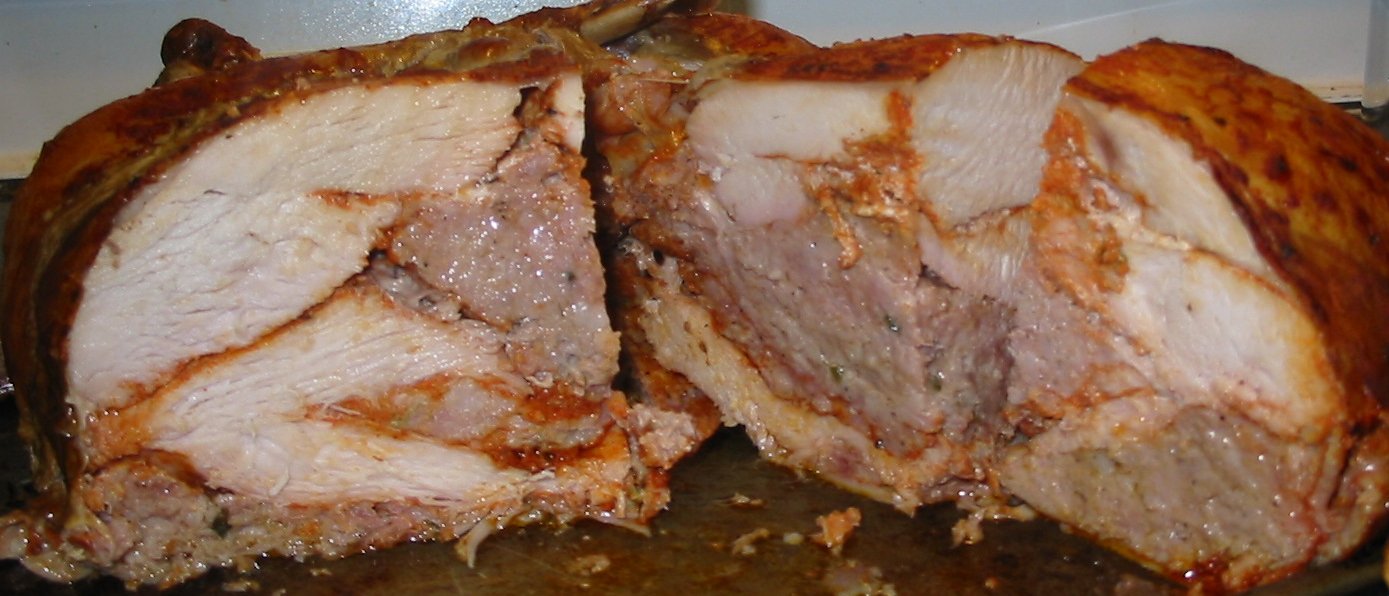
Turducken, for those of you that haven’t heard about this, is what you get when you take a chicken and stuff it inside of a duck, then you take that ducken and stuff it inside of a turkey.

In my head, I keep hearing Tevye from Fiddler on the Roof singing “Turducken, Turducken. Turducken!”

According to a 2002 New York Times story by Amanda Hesser, turkey found his inner duck (and chicken), “Once upon a time, possibly at a lodge in Wyoming, possibly at a butcher shop in Maurice, Louisiana, or maybe even at a plantation in South Carolina.” She wrote that “an enterprising cook decided to take a boned chicken, a boned duck and a boned turkey, stuff them one inside the other like Russian dolls, and roast them. He called his masterpiece Turducken.”

I guess chickdurkey and duchicky were already taken.

Of course these scenarios are certainly possible, as are the unsubstantiated claims that Cajun-Creole fusion chef Paul Prudhomme created the Turducken. But here’s the thing: all of these Turducken theories revolve around the idea that a man was the one who created the Turducken. I for one have never, in my 40-something year history of Thanksgiving celebrations, seen a man willingly move more than four feet away from any TV screening football games on Thanksgiving Day.

Therefore, it seems completely logical to me that a woman must have invented the Turducken.

Here’s my theory. You probably know the tune.

I Know An Old Lady Who Swallowed a Turducken (with apologies to anyone who can carry a tune or make a rhyme)

I know an old lady who swallowed a Turducken

I don’t know what kind of booze she was chuckin

She first bought a chicken

It seemed finger licken

But then in walked Chuck

He’d picked up a duck

The old lady sighed

With no room in the freezer

She’d have to cook both, to please the old geezer

She consulted Giada and Martha, her coven

They both told her simply to turn on the oven

She swallowed some wine, then swallowed some beer

What she did at this point isn’t perfectly clear

But then Rita showed up at the door with a turkey

The old lady took it; she didn’t want to be jerky

The oven then beeped it was ready to cook

How could the old lady get off the hook?

There was no way to fit three birds in her range

She had an idea, although it was strange

She’d seen a commercial a time long ago

Where peanut butter and chocolate did a Do-Se-Do

If Reese’s can do it then so can I

She gulped her martini and let out a sigh

Perhaps I’ll try.

And there you have the real explanation for how the Turducken came to be. Happy Thanksgiving!

If you’ve got a better explanation for this culinary oddity, email Leslie@LeslieDinaberg.com. For more columns visit www.LeslieDinaberg.com. Originally published in the Santa Barbara Daily Sound on November 20, 2009.

Childhood Pre Postmortem

© Paha_l | Dreamstime Stock Photos & Stock Free Images

© Paha_l | Dreamstime Stock Photos & Stock Free Images

“I guess I’m really a grown-up now” is a thought that has crossed my mind a lot lately.

I think my “kid emeritus” status has less to do with the rings on my trunk — and the wrinkles on my neck — than it has to do with the inescapable passage of time.

This week it was the anticipation of attending the memorial service for the father of a dear old friend that spurred my “I guess I’m really a grown-up” thoughts.

If middle-age has a rite of passage, attending your friends’ parents’ funerals must be it. In our twenties and thirties, our get-togethers were about engagements, weddings and babies. Now they are starting to be about funerals. It’s definitely not as much fun.

Losing a parent may be a common experience once you get to be in your 40s, but that doesn’t make it any less difficult. No matter how much you anticipate the loss – in this case my friend’s father battled cancer for ten years – it’s still a shock.

“My mom was on Hospice care and they told me she had only days to live, but I still didn’t quite believe it when it happened,” said my friend Ron. “It seemed like such a surprise.”

Many people think that once they reach the age of adulthood and get beyond the milestones of marriage and parenthood there are no more surprises. Surprise, surprise — it couldn’t be further from the truth.

“A myth supported by most theories of pre-adult development is that at the end of adolescence you get yourself together and, as a normal, mature adult, you enter into a relatively stable, integrated life pattern that can continue more or less indefinitely,” wrote psychologist Daniel Levinson. “This is a rather cruel illusion since it leads people in early adulthood to believe that they are, or should be, fully adult and settled, and that there are no major crises or developmental changes ahead.”

I’ll never forget how devastated and shocked I was the first time my mom got cancer. I was out of college and living on my own, but I could not have been more crushed by the news if I were a little girl and completely dependent on her.

That was my first dress rehearsal for the death of a parent. Thankfully, even though we’ve had a few more rehearsals over the years, we haven’t gotten to the curtain call yet.

“Our parents project an illusion of permanence,” writes Alexander Levy in “The Orphaned Adult: Understanding And Coping With Grief And Change After The Death Of Our Parents.” “Their death forces us to confront our own mortality.”

“Before we have experienced the death of a parent, we may expect that this will be a fairly minor milestone in our adult development. In fact, we may implicitly believe that once we reach adulthood, particularly if we have children of our own, that our development is more or less complete. We do not expect that there will be major changes in the way we experience the world or react to it. The research … demonstrates that the loss of a parent has profound and wide-ranging consequences for most of us,” wrote Debra Umberson in “Death of a Parent: Transition to a New Adult Identity.”

“It still surprises me that the stupidest little things can bring me to tears,” said my friend Carol, whose father passed away last year. “My dad used to love Nutter Butter cookies, and when I saw that flavor of yogurt last week I just lost it.”

I almost lost it myself when she shared this story. Frankly, every time one of my friends’ parents dies, I feel like it’s yet another dress rehearsal for the day my own parents pass away. I know it’s morbid, but I can’t help myself.

The idea that “we are next in line to die,” as Levy wrote, is the very thing that may actually force us to grow up. And yet – just like my son already knows that growing up is going to include more responsibilities than he wants to undertake – I really don’t want to have to grow up.

Share your thoughts with Leslie@LeslieDinaberg.com. For more columns visit www.LeslieDinaberg.com.Originally published in the Santa Barbara Daily Sound on October 9, 2009.

Rub Some Dirt in it

Courtesy Freeimages.net by Naypong

Courtesy Freeimages.net by Naypong

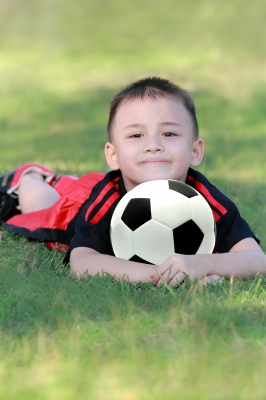
The email from the AYSO Region 122 – Infection Control Committee started out innocently enough (aside from the eerie Soviet era name): “In an effort to promote good hygiene and prevent the spread of disease” the board of directors of our local youth soccer group had formed an Infection Control Committee.

Okay, fine. We have a hard time getting enough parents to volunteer to referee and coach, but if they wanted form a committee to promote good hygiene I’m okay with that.

The first few paragraphs advocated what is basically common sense: stay home if you are sick; if you have a fever or other symptoms stay away from other kids until you’ve been well for 24 hours; don’t share water bottles, etc.

Even the suggestion to use “an alcohol-based hand sanitizer before handing out snacks and after a game” (as opposed to washing your hands) was probably a good one, though I wondered if perhaps we were going to be seeing “sponsored by Purell” embroidered on next year’s uniforms.

Our school district superintendent sent out a similar letter, cautioning parents to teach children not to share their personal items, wash their hands and, mostly importantly, keep their sick kids at home. Hallelujah, this is a huge pet peeve of mine.

But there was one key difference between the two letters. AYSO asked us to avoid “pre and post game handshakes and/or high fives.” Followed by the caveat, “we can still promote good sportsmanship with a post game cheer and by respecting our opponents, coaches and referees.”

Seriously, no high fives? No handshakes?

While I realize that cleanliness is next to flu-lessness and can appreciate the good intentions behind this, I wondered if the Infection Control Committee realizes there is a fine line between healthy hygiene and obsessive germophobia. I’m all for keeping our kids healthy, but seriously, no high fives? That last bit of physical contact is more than just tradition. It’s an important sign of good sportsmanship, a visible symbol that we all played our hardest and, win or lose, we can walk away from the field feeling good about the game.

Seriously, no handshakes?

Sure enough, the ban on hand-to-hand contact was enforced after our game on Saturday, when the kids had just spent the last hour rolling around the grass together, chest bumping, wrestling and helping each other up when they fall down.

The kids didn’t know what to do. Were fist bumps okay? One adult suggested shoulder taps, which I was sure, would result in a brawl.

My response was to giggle at the absurdity of it all. I wasn’t the only one. A referee commented on how odd it was that the kids were forbidden to shake each other’s hands, but that didn’t stop them from all coming to politely shake his hand and thank him for officiating their games. “Next time I’m going to hand out wipes,” he joked.

“I suppose latex gloves are always an option, and how about face masks,” said another soccer mom.

“Oh puleeeeeese,” said another friend. “Might as well have your kids just stay home FOREVER!!!”

Some saw the move as an indication of more than just a flu scare. “Ridiculous,” said a dad. “It seems part of the increasing attempt to teach every child to be afraid of everyone and everything… all for the sake of protecting other entities from liability. Invest in some hand sanitizer if the need arises but let the hugging and high fives commence/continue.”

Another said, “Must have been a big disappointment to have to cancel the planned mandatory AYSO feel good group hug. If I was still coaching I’d name the team the Snot Rockets and dominate.”

When asked about the handshake issue, assistant commissioner Eric Sanborn responded, “Please picture what the average six year old looks like after a soccer game. Sweaty and dirty, with a ring of Gatorade, snot and little bits of orange and watermelon all around his mouth. His shirt and hands were used all game to wipe his nose and they are now all covered with “snail trails” of snot. Would you want to slap ten hands like that and then eat a snack and lick your fingers? Especially during this cold season?”

I’ll admit, that’s not a pretty picture.

“We discussed what other sports leagues, including some professional soccer leagues, have done to reduce the spread of germs in a sports setting and we determined that the after game handshake/high fives followed by postgame snacks, was the likely time for kids to share germs with their teammates and opponents,” Sanborn continued. “We decided to take the focus away from handshakes and high fives for this season only and try to promote good sportsmanship in other ways. It was amazing to see how well parents responded last weekend. … The feedback from our families has been overwhelmingly positive, with a ratio close to 20 positive emails for each complaint.”

Okay, I get it. I wouldn’t want to be the one who gives all the kids in Santa Barbara the swine flu either. No hard feelings. High five!

When Leslie’s not trying to avoid an off-sides penalty, she can be reached at Leslie@LeslieDinaberg.com. For more columns visit www.LeslieDinaberg.com. Originally published in the Santa Barbara Daily Sound on September 25, 2009.

Every Day Should be Grandparents Day

Illustration by debspoons, freedigitalphotos.net

Illustration by debspoons, freedigitalphotos.net

Sometimes I can’t wait to be a Grandma.

Not that I don’t love this stage of my life-chaotic carpools, homework hassles and morning mayhem aside-because at ten our son is old enough to take almost anywhere and still young enough to want to be with his parents. But I know those days are dwindling fast. The specter of his teenage years casts a long shadow every time he gels his hair or rolls his eyes, which is happening more often every day.

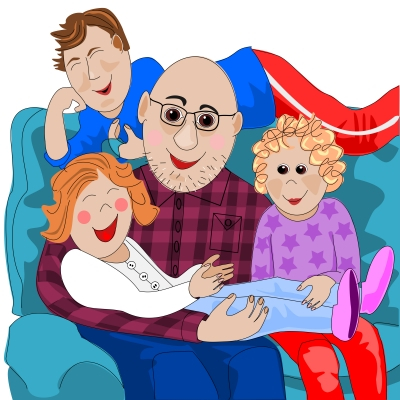
Being a Grandma seems so marvelously simple. As Robert Brault said, “To become a grandparent is to enjoy one of the few pleasures in life for which the consequences have already been paid.” What could be better? You spend time with the kids and you love them. There’s no way to do that wrong. There are no obligations to feel guilty about. No stretch marks, no late night phone calls to “pick me up” from sleepovers, no allowances, no dioramas, no lunches to pack and no laundry to do.

There are a lot fewer vegetables and a lot more dessert if you’re a grandparent.

A grandparent’s sole duty in life is to spoil their grandchildren-to hang on their every word, to bring them a new game or toy every time they see them, to tell them stories of all the rotten things mommy and daddy did when they were kids, to go on adventures, or take them swimming, to ball games or the movies.

Grandparents also make incredible audiences. When grandchildren learn to kick a ball, bust out some fancy dance moves, or jam on their first guitar piece, they can count on their grandparents to watch, listen and applaud-loudly and obnoxiously-every single time.

In turn, their grandchildren adore them. I still marvel at the way Koss’s eyes light up, he grins, mugs, chats up a storm and utterly turns on the charm whenever any of his grandparents are around.

Well, at least most of the time.

Lucky for all of us, his grandparents are around a lot. We’re lucky to all live in the same town. Really, really lucky. They’re great babysitters-which I probably, ahem, okay, absolutely definitely appreciate more than the kids-but they also make meals with him, which can get rather messy; come to watch him kick, run, jump and shoot, depending on which sports are in season; play video games with him; read books together, and take him to the library and the bookstore; and play lots and lots of card and board games. Heck, my dad even volunteered in his classroom and coached his flag football team.

I can relate to what Grandma (and great writer) Judith Viorst wrote in her contribution to the book “Eye of My Heart: 27 Writers Reveal the Hidden Pleasures and Perils of Being a Grandmother.” “Even if we are known to be basically modest, even if, as mothers, we refrained from shamelessly bragging about our kids, we grandmothers feel entitled to inform the world that our grandchildren are not merely extraordinary but…the most extraordinary. And if another grandmother is one-upping us in the extraordinary contest, we one-up right back.”

I know just how she feels. My son’s grandparents are the absolute best, not merely extraordinary but the most extraordinary grandparents around. My son’s grandparents rock! They’re the best grandparents in the world. So in honor of National Grandparent’s Day (which is Sunday, September 13th), thanks guys. You really are the best.

Care to try to one-up Leslie in the extraordinary grandparent contest? Email Leslie@LeslieDinaberg.com. For more columns visit www.LeslieDinaberg.com.  Originally published in the Santa Barbara Daily Sound on September 11, 2009.